Services on Demand
Journal

Article
 English (pdf)
 Article in xml format
 Article references
 Automatic translation
 Send this article by e-mail
Indicators
Related links
-
 Cited by Google
 -
 Similars in Google
Share

 Permalink
South African Journal of Agricultural Extension
On-line version ISSN 2413-3221Print version ISSN 0301-603X
S Afr. Jnl. Agric. Ext. vol.53 n.5 Pretoria 2025
https://doi.org/10.17159/2413-3221/2025/v53n5a21379
ARTICLES
What Fundamental Structures Does South Africa Need to Put in Place to Build an Inclusive and Thriving Hemp Industry?
Mailula L.P.I; Zantsi S.II; Mamabolo M.III; Mushunje A.IV; Zantsi S.V
IResearcher: Economic Analysis Unit, Agricultural Research Council, 1134 Park Street Hatfield, Pretoria, 0028. PhD student: Department of Agricultural Economics and Extension, University of Fort Hare, Alice. MailulaP@arc.agric.za, ORCID ID 0000-0002-7053-4089
IIAgricultural Economist: Economic Analysis Unit, Agricultural Research Council, 1134 Park Street, Hatfield, Pretoria, 0028. Department of Sustainable Agriculture and Development, University of the Free State, Bloemfontein and Department of Agricultural Science, Nelson Mandela University, Gqeberha. ZantsiS@arc.agric.za. ORCID ID 0000-0001-9787-3913
IIIAgricultural Economist: Economic Analysis Unit, Agricultural Research Council, 1134 Park Street, Hatfield, Pretoria, 0028. RanchM@arc.agric.za
IVProfessor: Department of Agricultural Economics and Extension, University of Fort Hare, Alice. AMushunie@ufh.ac.za, ORCID ID 0000-0002-2183-785X
VMSc Agric student: Department of Agricultural Economics, Stellenbosch University, Matieland, Stellenbosch. 19586787@sun.ac.za, ORCID ID 0000-0002-4296-6175
ABSTRACT
This discussion paper examines the potential and challenges of developing an inclusive hemp industry in South Africa, with a focus on the necessary regulatory, socioeconomic, market, and policy frameworks. The study reviews current legislative frameworks, relevant literature, and policy documents to discuss how meaningful participation of smallholder farmers in the cannabis value chain can be achieved. It emphasises the importance of a supportive policy environment, access to finance, and capacity-building initiatives to foster sustainable and equitable growth in the hemp sector. The discussion underscores the importance of coordinated efforts and learning from other industries to promote the participation of small-scale farmers and entrepreneurs, thereby driving economic development and job creation in rural communities. Numerous knowledge gaps have been identified that could aid in the implementation of the Cannabis Master Plan.
Keywords: Cannabis, Hemp, South Africa, Cannabis Master Plan, Smallholder Farmers.
1. INTRODUCTION
Hemp refers to specific varieties of the Cannabis sativa L. species cultivated for industrial, agricultural, medicinal, and consumable purposes. It produces a wide range of commercial and industrial products, including rope, textiles, clothing, shoes, ceiling boards, bricks, food, paper, biodegradable plastics, paint, insulation, and biofuels (Gedik & Avinc, 2020). Additionally, hemp is also used to extract cannabidiol (CBD), a non-psychoactive compound widely utilised in health and wellness products (Lowit, 2020). This distinguishes it from traditional landrace varieties such as marijuana, which are primarily cultivated for recreational use due to their high levels of tetrahydrocannabinol (THC). In South Africa, marijuana has historically been grown illegally, especially in the Pondoland region of the Eastern Cape.
Recently, South Africa has declared hemp an agricultural crop, allowing it to be planted in open fields in large quantities and traded for profit. Like many other governments, South Africa perceives cannabis legalisation as an economic opportunity that could generate jobs and tax revenues. According to the Cannabis Master Plan of South Africa (CMPSA), the hemp industry is estimated to create approximately 10,000 to 25,000 job opportunities across the entire value chain (Department of Agriculture, Land Reform and Rural Development, 2024). This translates to 10 to 24 jobs per hectare.
This corresponds to numerous social ills in the country, including rural poverty, a high unemployment rate, and the abandonment of field cultivation by rural households (Kwenda et al, 2023; Fransman & Yu, 2019; Shackleton et al., 2019). The abandonment of field cultivation is explained by numerous factors such as poor soils, inability to mobilise family labour for weeding, inadequate resources to fertilise the field, crop damage by wild animals, and erratic rainfall, among others (Shackleton et al., 2019). On the contrary, hemp, as a pioneer plant, can help mitigate the adverse effects of climate change due to its ability to colonise poor-quality soils, grow almost anywhere on marginal soils, prevent soil erosion, and grow year after year on the same land (Shekinah & Stute, 2018).
It is on these grounds that the expansion of the hemp industry could serve as a catalyst for job creation and revitalising rural economies through agriculture and agro-processing. However, it is unclear how the inclusion of smallholders, both from the production and processing side, would work, given the challenges with the institutional factors. Furthermore, many smallholders are impoverished and lack access to credit, which is necessary to tap into hemp production. Moreover, the voices of smallholder farmers are missing in this so-called 'silver bullet' master plan, yet they should be key players. Other concerns include the preparedness of the extension service for sound technical advisory services to new hemp farmers. Overall, for an industry to exist, let alone expand, common driving factors must be in place.
In this discussion paper, which relies on observations from farmer workshops conducted by the Agricultural Research Council1 across the country, relevant literature, policy documents, and data from Statistics South Africa, Trade Map, and the World Bank, we attempt to provide a provocative discussion on these issues to stimulate policy, planning, and research. In this section, we establish some foundational structures required by a typical sub-agricultural industry. In Section 3, we provide a profile of the typical South African smallholder who is poised to benefit from the hemp industry. The idea is to highlight the gaps in production expertise, resource endowment, and financial requirements. In Section 4, we provide a brief summary of the state of the cannabis industry in South Africa. The current plan of action and its shortcomings, as drawn from the CMPSA, are discussed in Section 5. We discuss these issues in general and highlight knowledge gaps in the final section.
2. WHAT ARE THE FUNDAMENTAL STRUCTURES THAT FORM THE BEDROCK OF AN INDUSTRY?
There are usually common driving factors for industries to develop and thrive, and this is true for agricultural industries as well (German, Bonanno, Foster & Cotula, 2020). Here, we will briefly identify and discuss some of the major driving forces.
2.1. Clear Business Opportunity and Market Certainty
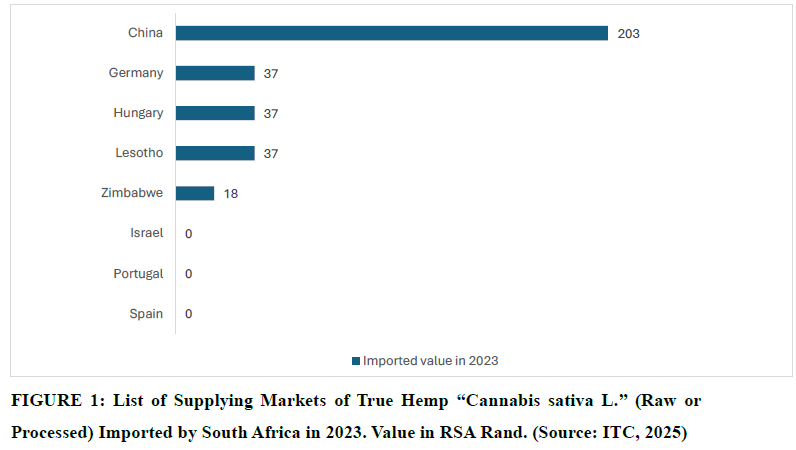
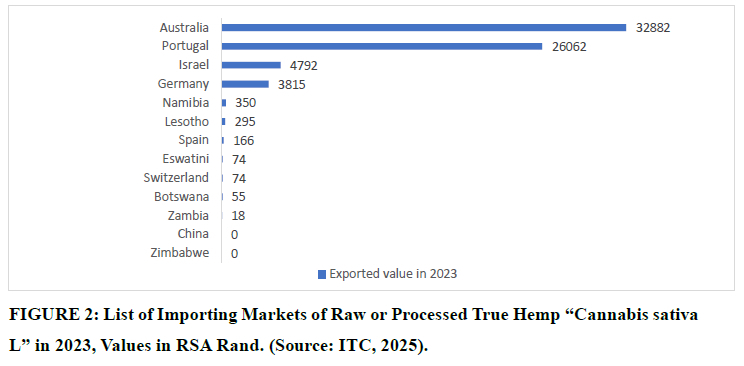
A clear and growing demand for hemp and its by-products, such as CBD oil, textiles, and bioplastics, ensures that businesses can confidently invest in cultivation and production. Additionally, an efficient supply chain is essential for consistently meeting this demand. In light of this, South Africa imports hemp products from other countries, which gives a clear indication that there is demand for hemp products domestically. Therefore, local production can potentially replace these imports at a lower cost (CMPSA). The following figures illustrate the exports and imports of hemp products by South Africa in 2023. Furthermore, the figure provides evidence of domestic and international market opportunities.
As shown in Figure 1, China emerged as the dominant exporter of true hemp (Cannabis sativa L., raw or processed) to South Africa in 2023, with an export value of R203. This was followed by Germany, Hungary, and Lesotho, each with reported export values of R37, while Zimbabwe contributed R18. In contrast, countries such as Israel, Portugal, and Spain reported zero export value, indicating no active trade in this product category with South Africa. True hemp's low aggregate import value underscores the limited domestic demand for raw and processed Cannabis sativa L. products. From a policy perspective, these figures suggest that while market interest exists, hemp remains a marginal commodity within the South African import landscape, potentially due to regulatory barriers, lack of processing capacity, or market readiness.
Figure 2 illustrates that Australia was South Africa's leading export market for raw or processed true hemp (Cannabis sativa L.) in 2023, with an import value of R32,882. This was followed by Portugal, which imported raw or processed true hemp valued at R26,062, and Israel, with imports worth R4,792. Countries with the lowest recorded import values included Zimbabwe and China, both at R0, and Zambia with an import value of R18. The top five export destinations for South African raw or processed true hemp in 2023 were Australia, Portugal, Israel, Germany, and Namibia. These trade values indicate the existence of international market engagement for South African true hemp (Cannabis sativa L.), though at varying levels across importing countries.
2.2. Clear and Supportive Policy Environment
A clear and supportive policy environment is essential for the growth of an agricultural industry, typically based on good governance, as Ortmann (2005) has argued. Good governance relates to government policies and institutions that promote competitive markets and efficiency by defining the rules of the game, which allow transaction costs to be reduced and thus increase the effective flow of goods and services (Beghin & Fafchamps, 1995).
Let us examine this in the context of current governance, specifically in the cannabis industry. In 2021, the country began to establish clearer regulations for the cultivation and processing of hemp, distinguishing it from other cannabis plants based on THC content (DALRRD 2021).
The regulations indicate that a farmer must acquire a hemp permit. To apply for a hemp permit, you must complete a form that can be downloaded from www.dalrrd.gov.za. Complete it with their details and personal information, then email it to 'Hemp.PIA@dalrrd.gov.za'. The application email should be accompanied by the following supporting documents: a copy of the producer/researcher's identity, company registration, title deed/lease agreement/PTO, a map of the farm/site, and proof of payment (R914).
2.3. Commodity Organisations
Commodity associations are organisations that bring together a wide spectrum of interest groups related to a particular commodity or sector in a particular country, whether for export, domestic market, or both (Shepherd & Cadilhon, 2008). Commodity organisations play a pivotal role in the development and growth of farmers and the industry itself. For example, commodity organisations can aid in regulation, setting or advising on grades and standards and their implementation, promotion of trademarks or quality signs within the industry, support for research, export, and domestic market promotion, provision of information and statistics, education and training, and support to the government in trade negotiations (Shepherd et al., 2008).
Organisations like the Cannabis Trade Association Africa (CTAA) and the African Cannabis Advisory Council (ACAC) advocate for the industry, provide resources and support, and engage in policy development (Jenkins et al., 2023). Additionally, collaborations between universities and research institutions may improve cultivation techniques, develop new products, and ensure the sustainability of hemp farming practices (Adesina, Bhowmik, Sharma, & Shahbazi, 2020). However, in the South African cannabis industry, there is no evidence of such an association at this stage, especially for hemp farmers. Existing associations or lobby groups are for dagga, but they are not very vocal. This could serve as a voice for farmers and a mediator between them and the government on pressing issues such as processing plants, export markets, and the pace of producer permit acquisition.
2.4. Access to Good Quality Extension Service
According to Álvarez-Mingote and McNamara (2018), agricultural extension services play a crucial role in empowering farmers with the knowledge, skills, and technology necessary to enhance their productivity and income. The services facilitate the dissemination of scientific and practical information, offering guidance on crop and livestock management, soil health, pest control, and resource conservation. Eliminating the gap between research institutions and the farming community would enable extension officers to help farmers adopt sustainable practices and innovations. Extension services also help farmers understand market demands and regulatory frameworks, enabling them to make informed decisions that enhance their competitiveness. A robust extension service is crucial for rural development, offering both technical support and a channel for policy feedback from farmers to the government.
However, the agricultural extension system in South Africa faces several challenges that limit its effectiveness. The system is under-resourced, with an insufficient number of extension officers available to serve the many farmers across the country, particularly in rural areas (Von Maltitz et al., 2023). Extension officers often lack adequate training, resources, and infrastructure to provide high-quality services. Moreover, constrained funding and administrative inefficiencies also affect the system's ability to deliver relevant, timely assistance, prolonging disparities in access to essential support and information (Lukhalo, 2017).
Growing cannabis involves understanding complex regulations and technical aspects, such as crop rotation, pest management, and quality control, to ensure compliance with local and international standards. Therefore, without strong extension services, farmers may struggle to adopt best practices, access the right inputs, or effectively market their produce. A lack of support can lead to low yields, increased costs, and potential regulatory non-compliance, thereby putting farmers' livelihoods at risk. As a result, the weakness of the South African agricultural extension system has significant implications for the successful adoption and profitability of new crops, especially in rural farming communities.
2.5. Access to a Good Quality Seed Supply
Hemp production requires access to reliable, high-quality seed. Quality seed is the foundation of a successful harvest, directly impacting farmers' yield, crop resilience, and profitability (Louwaars & Manicad, 2022). Hemp is relatively new to legal agricultural systems in many countries; therefore, establishing a dependable seed supply chain is crucial to avoid the variability in growth and cannabinoid content that can arise from inferior seeds. Furthermore, hemp's use as a fibre, grain, or cannabinoid-rich crop depends significantly on seed genetics, as different varieties are bred to optimise specific characteristics (Das, 2024). Reliable access to quality hemp seed enables farmers to better plan and manage their crops for intended uses, contributing to the crop's success.
For instance, adopting genetically modified (GMO) maize seeds in many regions has changed maize farming by providing farmers with seeds produced for higher yields, pest resistance, and climate resilience. This access to reliable, high-quality seeds has made maize production more productive, profitable and competitive (Mailula et al., 2024). Therefore, even for hemp, quality control and seed reliability remain important. Standardising seed quality and developing a strong supply chain for hemp seed would enable smallholder farmers in South Africa to achieve consistent results, support their livelihoods, and promote the crop's broader market adoption.
2.6. Access to Reliable Markets
Access to reliable markets is important for the success and sustainability of agricultural production, especially for smallholder farmers. Farmers cultivating crops like hemp and being in proximity to well-functioning markets can significantly impact their profitability and the feasibility of maintaining their operations. Consequently, markets must be within 100 kilometres of farming communities to minimise transportation costs, reduce product spoilage, and ensure timely sales (Savić et al., 2020). For example, when markets are nearby, farmers can easily reach buyers, secure fair prices, and reduce the risk associated with long, costly transportation that can eat into their profits.
3. ARE WE PREPARED TO SUPPORT SMALLHOLDERS TO TAP INTO THE HEMP INDUSTRY?
South African small-scale farming is characterised by unique and defining features shaped by the country's diverse landscapes, socioeconomic conditions, and cultural practices. Small-scale farms, which are often operated by families, are primarily located in rural areas where resources and access to infrastructure are limited. These farmers use traditional methods passed down through generations and rely on low-input systems, meaning they have minimal access to commercial inputs, such as fertilisers, pesticides, and advanced machinery. Despite these limitations, small-scale farms play a critical role in local food security and rural employment, contributing to the livelihoods of millions and supporting community resilience.
3.1. Demographics
According to Statistics South Africa's Community Survey, agricultural households are primarily composed of individuals (45-49), with females slightly higher than males. Furthermore, the Community Survey indicated that only 5,7% of the farmers participate in agriculture as a primary source of income, indicating commercially inclined smallholders (StatsSA, 2016). Moreover, Statistics South Africa's data shows that 73.7% of the adult population earns below R73,351 per annum (StatsSA, 2022); thus, many smallholders may find the initial investment in hemp production challenging without financial support or subsidies. Additionally, smallholder farmers are often characterised as being risk-averse. Thus, transitioning into hemp cultivation may be seen by an average smallholder as a riskier activity.
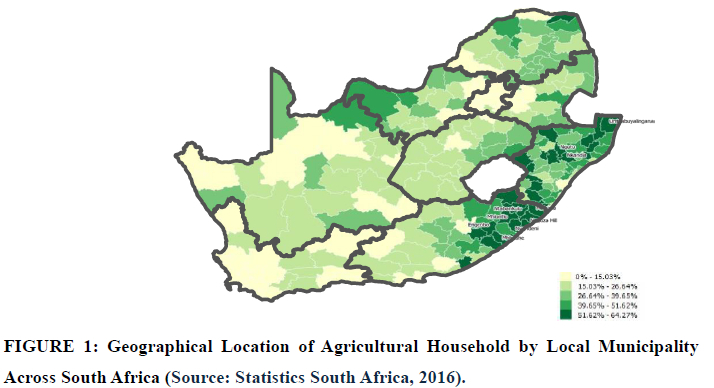
In terms of geographical location (illustrated in Figure 1), smallholder agricultural households are concentrated in three rural provinces. Eastern Cape (35.4%), Limpopo (33.0%) and KwaZulu-Natal (28.2%) (StatsSA, 2016).
3.2. Major Production Enterprises
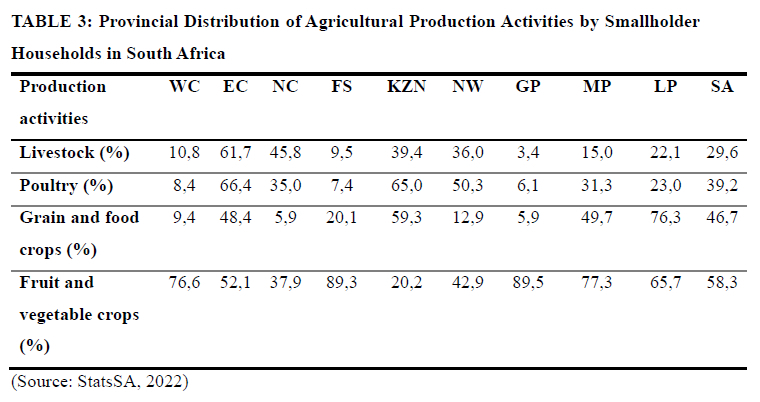
Table 3 below provides agricultural household production statistics. The key trends shown in the table are fruits and vegetables, followed by grains, which are the major agricultural activities among smallholders. This data further indicates that production is concentrated in provinces encompassing the former homelands, such as Limpopo, Mpumalanga, and the Eastern Cape (StatsSA, 2022).
Therefore, the likelihood of smallholders transitioning to hemp production in South Africa varies by region, depending on current agricultural practices, economic incentives, and other factors. Regions with a high focus on fruit and vegetable production, such as the Gauteng and Free State provinces, may find it easier to integrate hemp cultivation. In contrast, regions like the Eastern Cape focus on livestock and poultry, may require more significant incentives and support to make the transition2. The transition to hemp production will depend on economic viability, resource availability, market demand, and supportive government policies.
3.3. Poor Productivity Challenges
The productivity gap between smallholder and commercial agriculture in South Africa is substantial, particularly in widely produced crops such as maize and livestock production. Commercial farms achieve significantly higher yields per hectare than smallholders in virtually all agricultural activities. For instance, the results from the study of Zantsi, Cloete and Moring (2021) in maize production indicate that 95% of potential emerging farmers had maize yields equal to 40% of the 5.6 t/ha achieved on commercial farms. Only a small percentage (5%) achieved more than 40% of the commercial maize yield, with the highest yield being 80%.
This gap is largely due to differences in access to quality inputs, such as improved seed varieties, fertilisers, advanced farming technologies, irrigation systems, and better pest and disease management practices, which are not readily available to smallholder farmers. Additionally, technical production expertise and the adoption of new technology are significant causes of the wide productivity gap.
The key question then becomes, how much more difficult would it be to be competitive in a new crop if smallholders have not yet caught up in the other crops they know and have planted, in terms of productivity? Also consider the issue of risk aversion, which most smallholders tend to suffer from. Moreover, smallholders rely on public agricultural extension, which is heavily overloaded and perceived as weak (Maake & Antwi, 2022). Therefore, plans for tapping into the smallholder potential should consider these salient characteristics of smallholders.
Transitioning to hemp production requires overcoming several barriers contributing to the productivity gap. Smallholders will need access to high-quality hemp seeds, appropriate fertilisers, irrigation systems, and training on hemp farming techniques and pest management. Financial constraints and limited market access also complicate the transition.
Addressing these issues is important for smallholders to cultivate hemp successfully. Government interventions, such as subsidies, grants, and training programs, could play a vital role in levelling the gap. Moreover, farmers' cooperatives can help smallholders pool resources, share knowledge, and improve market access, thereby enhancing their chances of achieving viable hemp yields and competing with commercial operations.
3.4. Access to Markets and Credit
Smallholder farmers in South Africa face significant challenges in accessing markets and credit, which hinders their productivity and profitability (Gershon et al., 2020). Lack of infrastructure, such as inadequate road networks and limited transportation, restricts farmers' ability to reach formal markets, forcing many to rely on informal markets where prices are lower and more unstable.
In addition, smallholder farmers often lack timely and accurate market information, making it challenging for them to make informed decisions about crop choices and sale timings (Magesa et al., 2020; Moahid & Maharjan, 2020). Lack of market participation in value chains means farmers miss out on the benefits of processing, packaging, and branding their products, further limiting their income potential (Rob & Cattaneo, 2021).
Credit access also remains difficult for smallholder farmers, with many unable to meet the requirements and high interest rates imposed by formal financial institutions (Nordjo & Adjasi, 2020). The study of Mailula (2023) revealed that most smallholder farmers in South Africa lack access to credit, which consequently restricts their ability to engage in advanced agricultural practices such as adopting improved agricultural technologies.
Given these points, interventions are necessary to address these barriers, enabling smallholders to participate meaningfully in hemp cultivation. Access to affordable credit, facilitated by the establishment of reliable market channels, can encourage smallholders to invest in hemp production and provide a profitable outlet for their produce. According to Gedik and Avinc (2020), hemp is primarily cultivated as an industrial crop and is utilised in various sectors, including textiles, construction, biofuel production, and health products. To ensure profitability and minimise risk, farmers need to secure a market for hemp production before planting. This is often achieved through an off-take agreement with a buyer who commits to purchasing the crop at a predetermined price (Kabwe et al., 2018). The agreements help farmers manage financial risk by providing guaranteed income and aligning production with market demand, which is especially critical given the initial costs and regulatory requirements associated with hemp cultivation.
4. THE STATE OF THE CANNABIS INDUSTRY IN SOUTH AFRICA 4.1. Producer Numbers and Demographics
Since the declaration of the cannabis industry in 2021, a total of 1400 permits have been issued for hemp cultivation (Shabangu, 2024, personal communication). The number suggests a growing interest in the industry; however, it does not guarantee that all permit holders adhere to the regulations and produce hemp. Observations from recent training sessions have highlighted that Gauteng is leading in the number of hemp farmers (ARC, 2024). In contrast, provinces like North West are still in the early stages of understanding and adopting hemp farming.
Farmers in the North West Province are facing challenges in familiarising themselves with the complexities of hemp cultivation, including legal compliance, market access, and the specific requirements for producing hemp as an industrial crop. This disparity suggests that while the cannabis industry in South Africa is expanding, there is still a need for further education and support, especially in provinces that are still catching up.
4.2. Processors
The cannabis processing industry in South Africa is growing steadily but faces significant challenges. Following the decriminalisation of cannabis for private use in 2018, there has been increased interest and investment in developing a regulated cannabis sector (Obradovic, 2021). Major players, such as Labat Africa Group, are making substantial investments in cultivation, processing facilities, and international partnerships, highlighting the sector's potential.
However, these processing plants are scattered, and many are far away from smallholder farms due to the legacy of apartheid's separate development, where smallholders and commercial farms are often found in what used to be the Union of South Africa (Sihlobo, 2023). However, revitalisation of Agriparks3 could help in this regard. In countries with thriving cannabis production, processing plants are typically within a 100 km radius of the farms, which helps reduce transaction costs.
4.3. Markets
According to StatsSA (2024), the cannabis revenue in the South African market is estimated to reach $308.20 million by the end of 2024. The market is expected to expand at an annual growth rate of 1.19% from 2024 to 2029. Overall, the South African cannabis market exhibits promising growth prospects and presents lucrative opportunities for businesses operating within this industry. This will result in a market volume of $326.90 million by the end of 2029.
A farmer can benefit from the expected hemp yield of 12 tons per hectare of stalk and seed at the farm level. This is estimated to be worth R80,000 per hectare. If the farmer processes the CBD oil from the stalk, flower, and leaves, an estimated R150,000 per hectare can be achieved. At the maximum, the total value can be R230,000 per hectare, with an average profit of R45,000 per hectare.
The CMPSA highlighted the potential risk that large corporations with significant financial resources are likely to dominate the new cannabis industry in South Africa. This leads to a situation whereby smaller enterprises are being squeezed or even taken out of the cannabis industry. The total dominance or takeover by big corporations remains one of the serious challenges for the new cannabis industry in South Africa. The cannabis market is mostly export-oriented, and as such, these markets tend to have stringent product requirements; there are quota measures that may disadvantage smallholder producers. Therefore, to meaningfully include smallholders in this market, there is a need to form a cooperative marketing or commodity organisation group that will pull the smaller producers together.
5. THE CURRENT PLAN OF ACTION FOR EXPANDING THE SOUTH AFRICAN CANNABIS INDUSTRY
5.1. Cannabis Master Plan Recommendations
The National Cannabis Master Plan for South Africa outlines a comprehensive framework to establish a sustainable and globally competitive cannabis industry. It outlines opportunities and challenges at the national level. However, finer details for implementation on the ground are left to provincial departments.
Key recommendations include increasing the capacity of South African farmers to produce hemp and creating opportunities for small- and medium-sized enterprises across the cannabis value chain. The plan emphasises the need for substantial investment in research and technology to boost production, productivity, and competitiveness. It also aims to increase the variety and volume of cannabis products for both local and export markets, while enhancing the industry's manufacturing capabilities.
The plan proposes the development of education and capacity-building programs for stakeholders, along with implementing information and awareness campaigns related to cannabis. An executive oversight committee, program management office, and master plan task teams would be established to ensure coordinated implementation, monitoring, and evaluation. This integrated approach involves various government departments, industry stakeholders, and social partners working together to drive economic development, job creation, and poverty alleviation through the cannabis industry.
5.2. Implementation Strategy
The implementation strategy of the National Cannabis Master Plan for South Africa involves establishing joint governance, accountability, and monitoring mechanisms. It includes creating an Executive Oversight Committee to provide high-level leadership and coordination, supported by a Programme Management Office and Master Plan Task Teams. Provincial Cannabis Committees will be established to oversee the local implementation. The plan outlines targeted interventions across nine key pillars, including the development of regulatory systems, enhancement of sustainable seed systems, and promotion of research and product development. Additionally, it emphasises education, training, and public awareness campaigns to ensure informed participation by all stakeholders, from farmers to consumers.
6. DISCUSSION AND CONCLUDING REMARKS
To grow an inclusive hemp industry in South Africa, it is essential to establish a strong foundation that addresses a conducive and efficient regulatory framework, clear business opportunities that align with the socioeconomic realities of the stakeholders, and a conducive and clear policy environment.
Indeed, hemp production has the potential to benefit smallholders and address many of the country's social ills, such as poverty and unemployment, and revitalise field cultivation in the former homelands. The South African Cannabis Master Plan offers clear guidelines on how to tap into the lucrative potential of cannabis production nationally. However, at the grassroots level, the implementation is left to the provincial government departments. To this end, the implementation plan at the provincial level is not explicitly known. Our discussion in this paper scrutinised the plan of action and gaps in the knowledge that could assist in implementation on the ground. It is clear that for smallholders to benefit meaningfully from commercial cannabis production, beyond the traditional landraces, they will need to be funded.
As a country, we have had numerous smallholder initiatives funded by the government, but very few have been successful. One of the significant causes of failure is the absence of an exit strategy. Farmers pull out immediately as support is withdrawn. Additionally, the selection of willing and capable beneficiaries often presents a challenge. When support is available, everyone is willing to be part of the project to the extent that, in some instances, farmers group themselves only to get financial support.
Therefore, it is essential to learn from these mistakes and also draw inspiration from other successful initiatives, such as the National Wool Growers Association Scheme. Public-private sector collaborations tend to be more successful. From the public sector, the Agricultural Research Council and the then Department of Agriculture, Land Reform and Rural Development have conducted the commercial trial for cannabis, with some of the work still ongoing. The trials demonstrated that commercial hemp production in South Africa is possible and potentially feasible (CMPSA). This may enhance the participation of smallholder farmers in the cannabis industry.
The fundamental structures for smallholder cannabis farmers in South Africa have mixed support. The policy and legal framework around cannabis cultivation do not currently favour impoverished smallholder farmers, creating challenges for their participation. However, there is a clear business opportunity and market certainty for hemp, particularly when considering export trends.
A suggested plan of action has already been proposed. For example, according to the 2023 IAfrica report and CMPSA, these are the fundamental structures smallholders need to participate in the cannabis industry:
• Access to Finance and Investment: Smallholders need access to affordable financing options to cover the costs of setting up and maintaining cultivation and processing facilities. This includes grants, low-interest loans, and investments from both the public and private sectors. Financial institutions should be encouraged to develop cannabis-specific financial products. Land Bank's blended finance could be one possible avenue.
• Training and Education: Providing smallholders with the necessary skills and knowledge about cannabis cultivation, processing, and compliance with legal requirements is crucial. This can be achieved through training programs, workshops, and extension services that focus on best practices in agriculture, pest management, and post-harvest processing.
• Regulatory Support: Simplifying the licensing process and reducing the costs associated with compliance can help smallholders enter the market. Clear guidelines and support from government agencies can help smallholders understand and meet regulatory requirements, including quality standards.
• Infrastructure Development: Investment in infrastructure, such as irrigation systems, processing facilities, and transportation networks, is essential. This can help smallholders produce high-quality products and efficiently reach markets.
• Market Access and Linkages: Establishing cooperatives or associations can help smallholders share resources, access larger markets, and negotiate better prices. Partnerships with established companies can also provide smallholders with market access and support in terms of quality control and distribution.
• Research and Development: Supporting research into cannabis strains suitable for local conditions, as well as best practices for cultivation and processing, can help smallholders improve yields and product quality. Collaboration between the government and private sector in R&D can drive innovation and competitiveness in the industry.
However, to implement these ideas, the following knowledge gaps should be addressed. Firstly, we need to understand how the potential smallholder cannabis producers perceive hemp production. This bottom-up approach will help identify potential pitfalls. This entails conducting studies to determine the knowledge, attitudes, and practices of smallholder farmers regarding hemp production and seed access. Mapping the South African hemp value chain, identifying the various stages from cultivation to market, and the stakeholders involved.
Evaluating smallholder farmers' willingness to produce hemp through assessing their interest in hemp cultivation and the factors that influence their decision. Assessing the profitability of traditional cannabis (dagga) production versus hemp production will give a clear understanding of the economic benefits and risks associated with each option. Lastly, modelling smallholder farmers' production decisions on hemp production involves analysing various scenarios and factors that affect their decision-making processes.
7. WHAT LESSONS CAN SOUTH AFRICA DRAW FROM GLOBAL EXPERIENCES?
Several countries around the world have decriminalised the cultivation and trade of industrial hemp. These countries include, but are not limited to, Zimbabwe, Malawi, France, Canada, the United States of America, Italy, and China. In Malawi, Parliament approved the Cannabis Regulation Bill in 2020, which legalised the cultivation, processing, and marketing of industrial hemp, provided the THC content does not exceed 1% (Cannabis Regulation Act No. 6 of2020). This legislation came five years after the country issued its first license to explore industrial hemp as a potential cash crop. According to the Industrial Crop Association, trials conducted on 10 imported hemp varieties across Malawi confirmed the crop's viability. To support and grow the industry, the Malawian government announced a US$15 million investment package aimed at boosting production and preparing the country to enter the global market. Following the passage of the bill, the government also established the Cannabis Regulatory Authority to oversee the industry, setting licensing requirements and fees. These initiatives have positioned Malawi as a promising and increasingly established new entrant in the global industrial hemp market. Establishing a clear regulatory framework may help bring order to the sector and foster trust among investors and farmers. This indicates that South Africa requires a central, transparent institution to oversee hemp regulation and support, particularly in helping smallholder farmers understand and comply with the rules.
When examining a more established industrial hemp industry, Canada serves as a strong example. The country conducted industrial hemp research between 1994 and 1998, and in 1998, it decriminalised the cultivation of industrial hemp. That same year, the first commercial license to grow industrial hemp was issued in May (Government of Canada, 2025). In Canada, the THC limit for industrial hemp is set at 0.3%, and growers are required to use only varieties approved for commercial cultivation. In 2018, the country implemented the Industrial Hemp Regulations under the Cannabis Act, which provided a comprehensive framework for the production, processing, and sale of industrial hemp. More recently, in March 2025, Health Canada introduced amendments to the cannabis regulations, including those related to industrial hemp. These changes aim to streamline regulatory requirements and offer greater flexibility for industry stakeholders. Lastly, capacity building is a key structure that should not be overlooked. In Canada, farmers receive regular training on Good Agricultural Practices (GAPs), seed certification and THC testing requirements. These services are provided through a cooperative effort between Health Canada and agricultural extension programs (Government of Canada, 2025). In South Africa, agricultural extension officers can play a similar role in training smallholders on legal compliance and farming best practices. This support may help farmers avoid struggling to meet the quality and safety standards of hemp cultivation.
These examples demonstrate the importance of solid foundations in regulatory institutions, research and seed trials, clear laws, access to finance, strong markets, and farmer support.
Countries that have established these structures early have been more successful in developing competitive and inclusive hemp industries. South Africa can learn from their successes and shortcomings by applying the concept of policy diffusion. This entails carefully examining how these countries developed their hemp industries and adapting their strategies to suit our local context, with a particular focus on supporting disadvantaged communities (Sabatier & Weible, 2014).
Policy diffusion can occur through various mechanisms:
• Learning and imitation: Policymakers study the experiences of other jurisdictions and adopt similar policies based on observed outcomes.
• Coercion: External pressures, such as international agreements or economic incentives, encourage the adoption of specific policies.
• Competition: Jurisdictions compete to attract businesses, investment, or talent, which may lead them to adopt comparable policies to remain competitive.
By applying the principles of policy diffusion thoughtfully, South Africa can craft effective and context-specific strategies to advance its industrial hemp sector.
REFERENCES
ADESINA, I., BHOWMIK, A., SHARMA, H. & SHAHBAZI, A., 2020. A review on the current state of knowledge of growing conditions, agronomic soil health practices, and utilities of hemp in the United States. Agric., 10(4): 129. [ Links ]
AGRICULTURAL RESEARCH COUNCIL., 2024. Farmer and agricultural advisor training in nine provinces. Hatfield, Pretoria. [ Links ]
ÁLVAREZ-MINGOTE, C. & MCNAMARA, P., 2018. Evaluating agricultural extension and advisory services through a governance lens. J. Int. Agric. Ext. Educ., 25: 71-86. [ Links ]
BEGHIN, J.C. & FAFCHAMPS, M., 1995. Constitutions, institutions and the political economy of farm policies: What empirical content? In G.H. Peters & D.D. Hedley (eds.), Agricultural competitiveness: Market forces and policy choice. UK: Dartmouth Publishing Company, pp. 287-295. [ Links ]
DAS, R., 2024. Establishing Robust Tools for Cannabis propagation and variety improvement. Doctoral dissertation, Southern Cross University. [ Links ]
FRANSMAN, T. & YU, D., 2019. Multidimensional poverty in South Africa in 2001-16. Dev. South. Afr., 36(1): 50-79. [ Links ]
GEDIK, G. & AVINC, O., 2020. Hemp fiber as a sustainable raw material source for textile industry: can we use its potential for more eco-friendly production? In S.S. Muthu & M.A. Gardetti (eds.), Sustainability in the textile and apparel industries. Springer, pp. 87-109. [ Links ]
GERMAN, L.A., BONANNO, A.M., FOSTER, L.C. & COTULA, L., 2020. "Inclusive business" in agriculture: Evidence from the evolution of agricultural value chains. World Dev., 134: 105018. [ Links ]
GERSHON, O., MATTHEW, O., OSUAGWU, E., OSABOHIEN, R., EKHATOR-MOBAYODE, U.E. & OSABUOHIEN, E., 2020. Household access to agricultural credit and agricultural production in Nigeria: A propensity score matching model. S. Afr. J. Econ. Manag. Sci., 23(1):1-11. [ Links ]
GOVERNMENT OF CANADA., 2025. Hemp and hemp industry frequently asked questions. Available from https://www.canada.ca/en/health-canada/services/drugs-medication/cannabis/producing-selling-hemp/about-hemp-canada-hempindustry/frequently-asked-questions.html [ Links ]
IAFRICA., 2023. South Africa's Cannabis industry could emerge as a powerhouse, generating myriad jobs and income opportunities. Available from https://www.farmingportal.co.za/index.php/agri-index/68-crops/9001-south-africa-s-cannabis-industry-could-emerge-as-a-powerhouse-generating-myriad-jobs-and-income-opportunities [ Links ]
JENKINS, E., DEARDEN, T., FIGUERAS, A., MCGUINNESS, L., EWERT, A. & HAINES-SAAH, R., 2023. Cannabis education resources for parents: An environmental scan and critical content analysis in the context of legalization. Drugs Educ. Prev. Policy., 30(2): 124-140. [ Links ]
KABWE, S., MUTAMBARA, J., MUJEYI, K., BLACKMORE, E., VORLEY, B. & WENG, X., 2018. Contractfarming and informality: drivers and governance responses in Zambia and Zimbabwe. London, UK: International Institute for Environment and Development (IIED). [ Links ]
KWENDA, P., NTULI, M. & MUDIRIZA, G., 2023. Exploring unemployment differentials between former and non-former homeland areas in South Africa: A decomposition approach. Dev. South. Afr., 40(1): 166-190. [ Links ]
LOUWAARS, N.P. & MANICAD, G., 2022. Seed systems resilience-an overview. Seeds., 1(4): 340-356. [ Links ]
LOWIT, S., 2020. Industrial development projects: Industrial hemp. Available from https://www.tips.org.za/images/Industrial_hemp_post_covid_industrial_development_projects.pdf [ Links ]
LUKHALO, T., 2017. An expenditure review of agricultural extension system in South Africa. Master's thesis, University of Pretoria, Pretoria. [ Links ]
MAAKE, M.M.S. & ANTWI, M.A., 2022. Farmer's perceptions of effectiveness of public agricultural extension services in South Africa: An exploratory analysis of associated factors. Agric. Food Secur., 11(1): 34. [ Links ]
MAGESA, M.M., MICHAEL, K. & KO, J., 2020. Access and use of agricultural market information by smallholder farmers: Measuring informational capabilities. Electron. J. Inf.. Syst. Dev. Ctries., 86(6): 12134. [ Links ]
MAILULA, L.P., NHUNDU, K., MUSHUNJE, A., GEORGE, M., SEDI, M., OBUNYALI, C., OIKEH, S. & MADUBANYA, L.A., 2024. Welfare impact of genetically modified TELA® Bt maize varieties and their adoption among smallholder farmers in South Africa. J. Dev. Agric. Econ., 16(3): 111-121. [ Links ]
MOAHID, M. &. MAHARJAN, K.L., 2020. Factors affecting farmers' access to formal and informal credit: Evidence from rural Afghanistan. Sustain., 12(3): 1268. [ Links ]
NORDJO, R.E. & ADJASI, C.K., 2020. The impact of credit on productivity of smallholder farmers in Ghana. Agric. Finance Rev., 80(1): 91-109. [ Links ]
OBRADOVIC, I., 2021. From prohibition to regulation: A comparative analysis of the emergence and related outcomes of new legal cannabis policy models (Colorado, Washington State and Uruguay). Int. J. Drug Policy., 91: 102590. [ Links ]
ORTMANN, G.F., 2005. Promoting the competitiveness of South African agriculture in a dynamic economic and political environment. Agrekon., 44(3): 286-320. [ Links ]
PETTI, T.A. & CHATLOS, J.C., 2021. Implications of cannabis legalization: A national and international perspective. Adolesc Psychiatry.,11(2):. 80-94. [ Links ]
ROB, V.O.S. & CATTANEO, A., 2021. Poverty reduction through the development of inclusive food value chains. J. Integr. Agric., 20(4): 964-978. [ Links ]
SABATIER, P.A. & WEIBLE, C., 2014. Theories of the policy process. Westview Press. [ Links ]
SAVIC, B., PETROVIC, M. & VASILJEVIC, Z., 2020. The impact of transportation costs on economic performances in crop production. Ekon. Poljopr., 67(3): 683-697. [ Links ]
SHABANGU, A., 2024. National Department of Agriculture. Personal communications. [ Links ]
SHACKLETON, C.M., MOGRABI, P.J., DRIMIE, S., FAY, D., HEBINCK, P., HOFFMAN, M.T., MACIEJEWSKI, K. & TWINE, W., 2019. Deactivation of field cultivation in communal areas of South Africa: Patterns, drivers and socioeconomic and ecological consequences. Land Use Policy., 82: 686-699. [ Links ]
SHEKINAH, D.E. & STUTE, J.K., 2018. Sunn hemp: A legume cover crop with potential for the Midwest? Sustain. Agric. Res., 7(4): 63-69. [ Links ]
SHEPHERD, A.W. & CADILHON, J.J., 2008. Commodity associations and their potential role in supply chain development. BANWA., 8(2): 90-114. [ Links ]
SIHLOBO, W.A., 2023. Country of two agricultures: The disparities, the challenges, and the solutions. Johannesburg: Tracey McDonald Publishers. [ Links ]
STATISTICS SOUTH AFRICA., 2016. Community Survey 2016: Agricultural households. Available from https://www.statssa.gov.za/publications/03-01-05/Presentation_CS2016_Agricultural_Households.pdf [ Links ]
STATISTICS SOUTH AFRICA., 2022. General Household Survey, 2022. Available from https://www.statssa.gov.za/publications/P0318/P03182022. [ Links ]
VON MALTITZ, L., DAVIS, K., SUVEDI, M., CHANZA, C., AGWU, A.E., SASIDHAR, P.V.K., DIMELU, M.U., LIVERPOOL-TASIE, L.S.O., ANUGWA, I.Q. & TCHUWA, F., 2023. Strengthening agricultural extension training: Process skills and competency gaps in undergraduate agricultural extension curriculum in South Africa. Partnerships for Innovative Research in Africa (PIRA) Research Report. East Lansing, Michigan, USA: Alliance for African Partnership, Michigan State University. [ Links ]
ZANTSI, S., CLOETE, K. & MÖHRING, A., 2021. Productivity gap between commercial farmers and potential emerging farmers in South Africa: Implications for land redistribution policy. Appl. Anim. Husb. Rural Dev., 14(1): 22-30. [ Links ]
 Correspondence:
L.P. Mailula
Correspondence Email: MailulaP@arc.agric.za
1 The Agricultural Research Council has been tasked by the Department of Agriculture, Land Reform and Rural Development to conduct a workshop to train hemp permit holders and extension officers on important aspects of hemp production, ranging from production to marketing. The authors were part of the team that conducted the training.
2 This excludes farmers who are already producing marijuana.
3 Is a networked innovation system of agro- production, processing, logistics, marketing, training and extension services, located in a District Municipality. It was meant to enable a market-driven combination and integration of various agricultural activities and rural transformation services. However, the implementation was poor.