




Services on Demand
Journal

Article
 English (pdf)
 Article in xml format
 Article references
 Automatic translation
 Send this article by e-mail
Indicators
Related links
-
 Cited by Google
 -
 Similars in Google
Share

 Permalink
South African Journal of Agricultural Extension
On-line version ISSN 2413-3221Print version ISSN 0301-603X
S Afr. Jnl. Agric. Ext. vol.53 n.3 Pretoria 2025
https://doi.org/10.17159/2413-3221/2025/v53n3a17790
ARTICLES
Social-Ecological Attributes of Conservation Agriculture in Southern Malawi
Banda M.L.M.I; Mloza Banda H.R.II; Kibirige D.III; Cornelis W.IV
IPrincipal Secretary for Technical Services, Ministry of Agriculture, P. O. Box 30134, Lilongwe 3, Malawi. Email: medmloza@gmail.com. ORCID: 0000 0003 3640 2776
IIProfessor of Agronomy, University of Eswatini, Faculty of Agriculture, Department of Crop Production, P. O. Luyengo M205, Luyengo, Eswatini. Email: mlozab@gmail.com. ORCID: 0000 0003 3585 9707
IIISenior Lecturer, University of Eswatini, Faculty of Agriculture, Department of Agricultural Economics, P. O. Luyengo M205, Luyengo, Eswatini. Email: kibirigedouglas@gmail.com
IVProfessor of Agro-Environmental Soil Physics, University of Guelph, Faculty of Bioscience Engineering, Department of Environment, Coupure Links 653, Ghent B-9000, Belgium. Email: wim.cornelis@ugent.be. ORCID: 0000 0002 6605 6723
ABSTRACT
Sustainable agriculture strategies should actively involve communities to leverage their knowledge, address challenges with intangible outcomes, and avert reliance on external support systems for innovations. The study aimed to identify farmers' perceptions of conservation agriculture social and ecological attributes (CA) and how personal demographics influence the value placed on these qualities. Multiple linear regression following principal component analysis was used to aggregate attitudinal factors underpinning farmers' attitudes toward CA's social-ecological features. Multiple correspondence analysis was performed to assess missed opportunities for CA valourisation based on farmers' perceptions of the functioning of organisations promoting CA. Extension guidance, CA area, and years of village residence were significantly correlated with assessments of enhanced surface soil and water dynamics, moisture maintenance, and nutrient recycling regarding ecological features. Concerning social qualities, CA, extension advice, and livestock ownership produced significant correlations associated with views of enhanced social connections, knowledge strengthening, and well-being and health, respectively. Organisations supporting CA were perceived as insufficient in providing interactional platforms that support acceptance of and collective action for CA. These findings indicate the possibility of incorporating information on social-ecological values into CA design and management.
Keywords: Conservation Agriculture, Farmer Organisations, Farmers' Perceptions, Malawi, Principal Component Analysis, Social-Ecological System.
2.1. INTRODUCTION
In Malawi, conservation agriculture (CA) practices-that include no-till farming, crop rotations, intercropping with nitrogen-fixing legumes, and organic mulching-are highly relevant for addressing the region's persistent nutrient and water deficiencies. Conventional farming practices, such as burning or removing crop residue and intensive ridge tillage pervasive in Malawi, often worsen nutrient and water deprivation. CA systems enhance soil moisture dynamics, organic matter, and carbon sequestration while improving the efficiency of nutrient, water, and energy flows (FAO, 2022). Despite its potential, adoption remains limited, with CA practised primarily by small-scale farmers on 211,000 hectares, accounting for about 2% of cultivated land in the country (CIAT-World Bank, 2018). Smallholder farmers produce approximately 80% of Malawi's food, while estates dominate agricultural exports, contributing over 80%. Malawi ranks eighth in Sub-Saharan Africa (SSA) for CA adoption, with CA accounting for only 1.25% of the region's total cultivated area (Kassam et al., 2022).
Numerous studies have highlighted challenges hindering the adoption of CA by smallholder farmers in Malawi and SSA (Dougill et al., 2017; Bouwman et al., 2021; Araya et al., 2024). Kassam et al. (2022) synthesised these challenges, which include the absence of (i) champions and pioneer farmers, champion institutions and champion institutional leaders, (ii) farmers coming together to form powerful farmer organisations for proactive actions and greater self-reliance (iii) governance that creates policies and institutional support for CA paradigm change., (iii) education, research, and innovation systems supported by new communication technology that has aligned themselves to promoting the new paradigm, and (v) effective capacity for farmers and their associations to partner with the private sector in ways that benefit both as well as community and society at large, including nature. Addressing these obstacles is essential to improving CA uptake and enhancing the livelihoods of smallholder farmers in the region.
Extensive reviews on the state of CA in the region tend to show that indicators used in appraisals of practices or sustainability of CA often rely heavily on traditional biophysical metrics, such as agro-technical inputs or crop yields (Ngoma et al., 2021; FAO, 2022). While these metrics are important, they frequently overlook socio-ecological factors, including farmers' organisational structures, soil and water governance practices, and community development initiatives that align with the inter-relational innovation processes and learning discourse discussed by Kassam et al. (2022). Near-surface meteorological and soil ecological processes are complex, interconnected systems whose abstract nature can hinder understanding without targeted education or visualisation tools. These intangible attributes are critical indicators that can empower farmers and advisors to adaptively manage land, reverse degradation, and sustain long-term productivity (Dumanski et al., 2006; Llanillo et al., 2020). By adopting a social-ecological systems perspective, this study emphasises CA's potential to address key challenges in sustainable agriculture through the need to integrate intangible socio-ecological dimensions with tangible biophysical inputs and benefits in CA practice to foster a holistic approach to its sustainability.
The new agenda for sustainable agriculture stresses learning from farmers' experiences, emphasising local needs, and empowering communities to take care of the land (Kiome & Stocking, 1995). This approach ensures that those responsible for conserving natural resources are also the primary beneficiaries of improved future production. Yet, farmers' diverse views on agroecosystem goods and services are shaped by varying climatic and land management contexts, influencing their valuation of these resources (Tauro et al., 2018). Acknowledging these diverse perspectives fosters more inclusive decision-making and land management strategies (Biggs et al., 2022). Demographic characteristics and attitudinal profiles also significantly shape farmers' perspectives and actions (Munoz-Ulecia, 2022). To prioritise farmers as end-users of CA, this study examines the relationship between farmers' attitudinal profiles and their evaluation of CA's socio-ecological value. Unlike conventional agriculture, which has been institutionalised over centuries, CA involves significant organisational complexity and non-linear adaptation patterns across spatial and temporal scales (Erenstein et al., 2012). Thus, this study further investigates organisational outcomes against contemporary perceptions of factors influencing the performance of CA.
This paper aims to present an exploratory analysis of survey data to provide empirical insights into how farmers' demographics, socio-economic characteristics, farming experience, structural factors, and assets influence their perceptions, adoption, and long-term retention of CA practices. The specific objectives are to (i) identify and categorise the socio-ecological attributes of CA based on farmers' attitudinal statements, (ii) determine the drivers and determinants of farmers' perceptions regarding the socio-ecological attributes of CA, and (iii) assess farmers' perceptions of bottlenecks to scaling up CA, considering the roles of informal and formal community-level organisations. By examining the interplay of socially and ecologically relevant factors within CA land management, this study contributes to the adoption literature. It offers valuable recommendations for developing effective and efficient public policies and strategies supporting CA initiatives.
2.2. METHODS
2.1. Conceptual Framework
This study employed a place-based case study approach (Newman et al., 2020) to explore local farmers' lived experiences with social-ecological changes associated with the practice of CA. Social-ecological analyses are particularly suited for examining well-defined, localised case studies instead of broader, geographically dispersed initiatives (Perez-Soba & Dwyer, 2016). Unlike traditional adoption studies that isolate and measure specific controlling variables, this approach prioritised the perspectives of farmers practising CA. It allowed them to articulate the types and extent of social-ecological changes they experienced without imposing predetermined assumptions.
The study emphasised the value of incorporating local resource users' insights on system changes and understanding how these shifts are perceived based on personal and community impacts (Parlee et al., 2012). Normative influences at individual, community, and external levels were also considered. Data collection involved focus groups and household surveys, which facilitated productive discussions, uncovered differing viewpoints and highlighted the significance of farmers' perspectives in understanding CA's social-ecological transformation processes. Instead of isolating individual CA or ridge cultivation components, the research sought to capture farmers' perceptions at the systems level, focusing on the dynamics of the integrated production system.
2.2. Study Location
The study was conducted in four Extension Planning Areas (EPAs) between -14.79 to -15.17 latitude and 34.98 to 35.28 longitude in Balaka District, Southern Malawi. EPAs are well-defined agroecological zones where extension services are planned and implemented. Balaka lies on an extensive low-land plateau with isolated hills ranging from 350 to 800 m. a. s. l. on 2.5 % of the country's total land area of 94,080 km2 (Venema, 1991). The district exhibits one of the country's hottest and driest climate regimes, with temperatures typically varying from 16°C to 32°C over the year and a mean of 29°C during the growing season spanning from November to April. The area receives an average of 750 mm of unimodal annual rainfall and subtends precipitation to a potential evapotranspiration ratio of 1-1.3 and frequent dry spells. Farmers stated that CA was introduced in 2004 to prevent the accompanying risky climate regime for crop production. The most common types of soils observed are chromatic Luvisols and eutric Fluvisols (WRB, 1998). The majority of agricultural land in this area is dedicated to maize, which is often intercropped with pigeon peas (Cajanus cajan L.).
Farmers in the study area were using CA on an average area of 0.35 ha (0.86 ac) out of typical landholding sizes of 1.18 ha (2.9 ac) at the time of the household survey. Farmers practised CA by (a) minimising soil disturbance, (b) maintaining permanent ground cover, and (c) intercropping maize with pigeon peas. Direct planting using dibble sticks under no-till methods, without the traditional annual ridging, enabled the least amount of soil disturbance. To maintain soil moisture and control weeds, maize stover was spread on the previously intercropped fields during the dry season, extending the ground cover. Herbicides and gentle hoe weeding were also employed to manage weeds. Small livestock husbandry was integrated into CA as a safety net to address cash shortfalls, provide food, and improve soil fertility. Farmers are encouraged to incorporate agroforestry tree species into CA systems and practice crop rotations.
2.3. Data Collection
In-person questionnaires were conducted with 63 adult members randomly selected from 152 agricultural households practising CA across the four EPAs. Questionnaires were co-designed and pre-tested together with local extension personnel. A random sample of 16 respondents per EPA was deemed sufficient for the thematic analysis of this research. Guest et al. (2006) suggested that a minimum sample size of 12 should be used in qualitative investigations to achieve data saturation. This threshold is adequate for performing an in-depth assessment of local expert knowledge rather than requesting comments from a much larger region and engaging people with less local agronomic and cultural expertise. The household head or the person in charge of farming was interviewed. Therefore, the choice of male or female farmers for an interview was determined by their position in the family or leadership in agricultural operations.
The questionnaires were based on the World Overview of Conservation Approaches and Technologies (WOCAT) Questionnaire on Sustainable Land Management (SLM) Technologies, which is designed to assist in documenting, assessing, and disseminating SLM practices (WOCAT, 2016). A typical 5-point ordinal Likert scale allowed respondents to rate the degree to which they agreed or disagreed with predetermined statements on how well CA farming approaches compared to more traditional ridge tillage cultivation practices. Other questions addressed personal characteristics, farmer organisations, the agricultural environment, socio-economic factors, and technical aspects of CA. The household survey's strength was that each respondent rated the social and ecological aspects of CA independently based on their perceptions, understandings and experiences.
Each community had two focus groups with eight to ten people to promote dialogue among participants and to better understand how farmers perceived modifications CA made to key soil attributes. The divisions between men and women were addressed separately to give women greater opportunities to express their ideas. None of the volunteers selected for the focus group had participated in the household survey. The forums allowed participants the opportunity and time to familiarise themselves with the concept of social-ecological services before discussions. The focus group's strength is its capacity to yield the group's perspective rather than that of individuals, which helps to balance power dynamics in consensus-building (Evans et al., 2006).
2.4. Data Analysis
2.4.1. Identifying Representative Minimum Attitudinal Statements of Farmers ' Perceptions on Social-Ecological Attributes of Conservation Agriculture
Farmers' altitudinal responses from the survey and focus groups, based on the mean interval range of Likert scale values, were analysed using principal component analysis (PCA) in SPSS software (version 27, IBM, 2020). Previous research has employed the Likert scale and PCA for comparable perception data and findings (Greiner et al., 2009). PCA was aligned with the interview protocol to identify relevant CA social and ecological benefits, services, values, and relationships. This analytical technique effectively condensed respondents' attitudinal comments into smaller, more manageable composite statements, variables or principal components (PCs), while retaining most of the original information. During the analysis, the variables that met the requirement of coefficients score with eigenvalues greater than one were kept in the model. These variables also needed to meet the requirements of Bartlett's test of sphericity and the Kaiser-Meyer-Olkin (KMO) test (> 0.60) to confirm the suitability of the data for PCA. Internal consistency of Cronbach's alpha coefficients for attitudinal statements not less than 0.5 or ideally within a range approaching 0.7 -0.9 is considered "acceptable" in most cases according to SPSS standard. Similarly, an average of five-point Likert scores for PCs of more than 3.0 demonstrated strong reliability of the questionnaire instrument and internal consistency, implying that the constituent traits were highly and consistently recognised.
Kibirige (2013) presented the PCA of a given dataset of Y (PC) mathematically as:

Where, Yn = PC; n = a number > 1; bli = regression coefficient for the ith variable (eigenvector covariance matrix between variables); Xi = value of the ith variable. Equation 1 can be explicitly written as follows:

Where, Y1 = the 1st PC, the X1 and X2 are the 1st and 2nd independent variables of the 1st PC in the linear additive factor analysis model, and b11 and b12 are coefficients associated with the X1 and X2 variables. Equation 2 is repeated for a multiple PCA using a series of additive linear combinations of component loadings and variable values, and this can be presented as follows:

Where, n = 1....4; i- 1....14; bn1 ... bni = the component loading; and X1 ... Xj = the benefits related to CA.
2.4.2. Identifying Drivers/ Determinants of Farmers ' Perceptions of Social-Ecological Benefits Related to Conservation Agriculture
Multiple linear regression analysis was used to identify the drivers/ determinants of farmers' perceptions of benefits related to CA. The standard factor scores generated after PCA were used as dependent variables regressed on farmers' socio-economic characteristics as independent variables. The linear regression model is presented as follows;

Where YSij (dependent variable) = generated regression factor analysis scores; ß0 - ßn = coefficient parameters to be measured; e = error term; X1- Xn is explanatory variables. These variables were categorised into four groups: household attributes (gender, education and family size), farmers' experience (years of residence and years of CA practice), farmers' assets (number of fields cultivated, the area under CA, access to credit, and farm income) and learning platforms (extension advice received by farmers, number of farmers practising CA, and group membership). The Durbin-Watson statistical test was used to determine the number of autocorrelations inside the models, with a value larger than one indicating minimal autocorrelation among the independent variables.
2.4.3. Identifying Convergence Between Perceptions Influencing Social- Technical Constructs of Conservation Agriculture and Organisational Ecosystem
To support the identification of determinants for effective scaling up of CA, the study undertook to learn farmers' opinions on why some were not practising CA and their perceptions of the influence of community, village-level or formal organisations supporting CA. Multiple correspondence analyses were performed to examine convergence between perceptions influencing social-technical constructs of CA and organisational ecosystem associations using the CORRESP Procedure of SPSS (Ayele et al., 2014; IBM, 2020). The results of this analysis were to refer specifically to transactional processes, not to the individual components of either the person or environment in the CA social-ecological system.
2.5. Ethical Considerations
The Global Code of Conduct for Research in Resource-Poor Settings was used (Trust Project, 2018). It is based on the four TRUST values: fairness, respect, caring, and honesty. These four ideals served as the framework for the study, which was held in a project area for which permission was secured from village headmen who functioned as gatekeepers. They allowed and facilitated the identification of and access to houses in conjunction with a pre-existing project agreement. All data was gathered freely, with respondents expressing free, prior, and informed verbal consent to participate in the study.
3. RESULTS
3.1. Selected Personal Demographics and Asset Characteristics of Households
Of the 63 respondents interviewed, 40 were female, and 23 were female heads of households. Most respondents (72%) were literate, having completed at least four years of primary education. The primary crops grown included maize, tobacco, and cotton, while secondary crops consisted of pigeon peas, groundnuts, tomatoes, sweet potatoes, and cassava. Maize was cultivated in 50% to 84% of the total farmed area, whereas CA was practised in 14% to 82% of the area. Regarding livestock, farmers principally owned fowl (chickens, ducks, and doves). Amongst ruminant animals, 33 households owned goats, and only one owned a herd of 8 cattle.
3.2. Farmers' Perceptions and Determinants of Ecological Attributes of Conservation Agriculture
Four PCs accounted for 64.68% of the variance in the 14 attitudinal statements about farmers' perceptions of the ecological advantages that accrue to CA (Table 1).
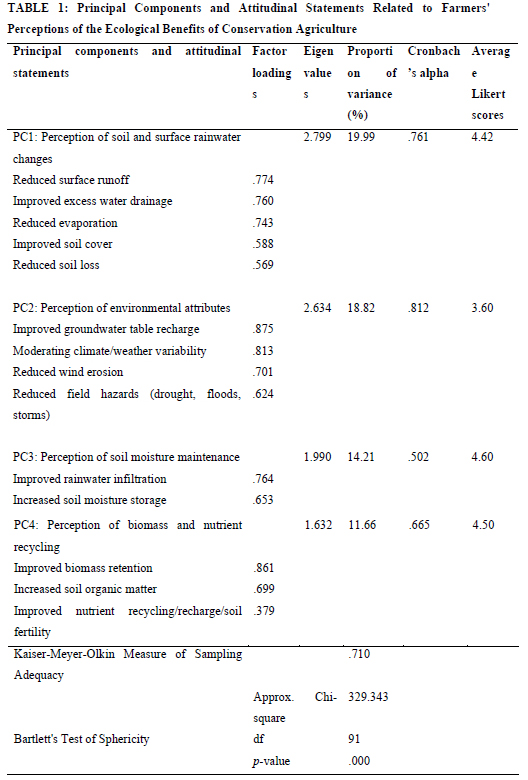
Farmers' perceptions of how CA affects soil and surface rainwater changes made up the first PC. Reduced surface runoff, better surplus water drainage, less evaporation, enhanced soil cover, and less soil loss were among the supporting attitudinal assertions. The second PC was mainly composed of farmers' perceptions of CA's contribution to environmental quality and accounted for 18.82% of the variation in the farmer's ranking of their perception. Supporting statements focused on enhanced groundwater table recharge, regulating climate/weather variability, and lowering the risk of adverse occurrences such as wind erosion, drought, floods, and storms. CA was attributed to improved soil moisture management through higher infiltration and greater soil moisture storage in the third PC, which accounted for 14.21% of the variance. The fourth PC explained 11.66% of the variance. It summarised the perception of biomass and nutrient recycling. It comprised three attitudinal statements, attributing CA to improved biomass retention, soil organic matter, and nutrient recycling or soil fertility. The internal consistency of Cronbach's alpha coefficients for the attitudinal statements in all PCs revealed adequate inter-item correlation, whereas average five-point Likert ratings above 3.0 indicated strong constituent qualities.
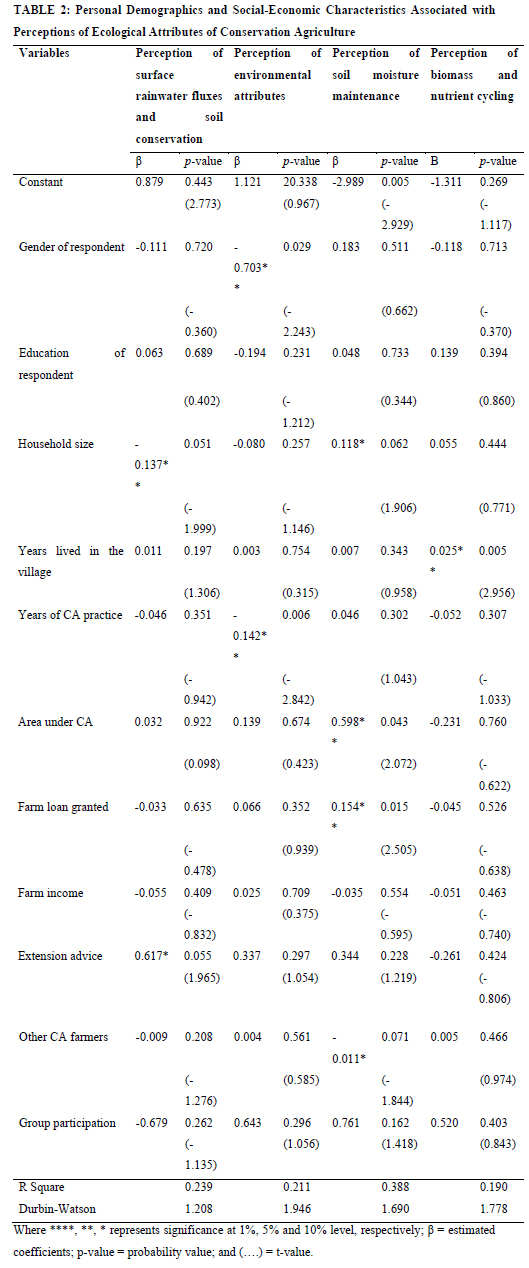
The results of a multiple regression model used to ascertain the relationship between farmer characteristics and the PCs mentioned in the previous section are shown in Table 2. Relationships between perceptions of surface rainwater fluxes and soil conservation were positively and negatively correlated with extension advice and household size, respectively. The extension advice's positive value favoured people's perceptions of the related component. The perception of CA's environmental attributes was significantly and negatively correlated with gender and the length of CA practice. This revealed unequal responses from male and female respondents and a lack of confidence in CA experience. Farm loan approval, household size, and CA area positively impacted farmers' attitudes toward maintaining CA's soil moisture, with the CA area having the greatest impact due to its largest coefficient. The influence of other farmers practising CA on the perception of CA's contribution to soil moisture was negative. The only significant factor that positively impacted farmers' experiences with biomass and nutrient recycling under CA was the time spent living in the village.
3.3. Farmers' Perceptions and Ethnosemantic Disclosure of Selected Soil Properties Contributed by Conservation Agriculture
Farmer perceptions of CA management-induced soil quality changes were elicited via a household survey. Two PCs were constructed from the survey's seven attitudinal statements concerning how respondents thought CA affected various soil attributes (data not shown). The two PCs accounted for 57.16% of the overall variability of the measured data. The first principal component (PC), which accounted for 38.18% of the variability in the measured statements, encompassed elements of soil compaction, water infiltration, and moisture retention, with the least loading on soil fertility. The attributes relating to soil structure, colour, and topsoil layer thickness were discovered in the second PC, which accounted for 18.98% of the variability of the measured statements. Although the second PC's Cronbach's alpha was low, the average five-point Likert scores showed strong appraisal instrument reliability and internal consistency. Regression analysis showed that respondents' gender in the first PC and extension advice received in PC2 significantly influenced the perception of soil quality characteristics.
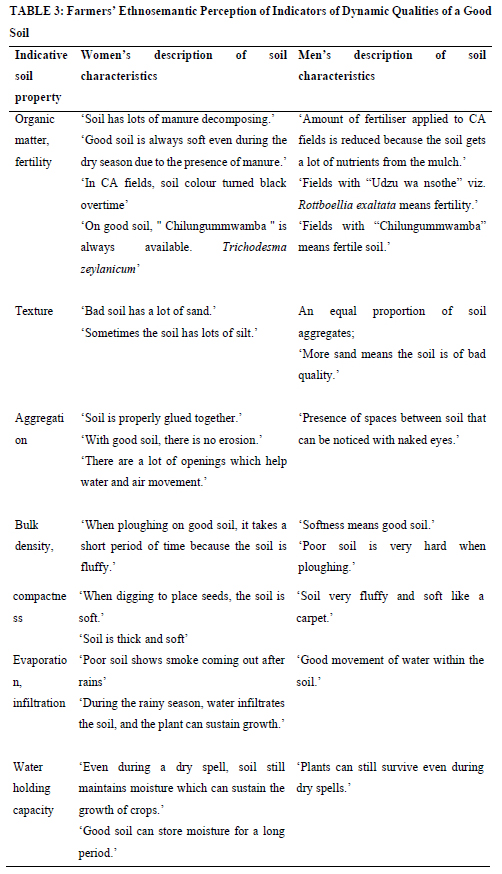
Table 3 reveals that in focus groups, women were more adept than men at identifying dynamic qualities of good soil with hitherto improved management through CA. Participants characterised soils in terms related to known scientific properties, namely, soil organic matter, texture, aggregation, compactness (bulk density), infiltration and water-holding capacity. Additionally, they identified two weed species, Trichodesma zeylanicum [(Burm. f.) R. Br.] and Rottboellia exaltata (L. f.) as bio-indicators of soil quality.
3.4. Farmers' Perceptions and Determinants of Social Attributes of Conservation Agriculture
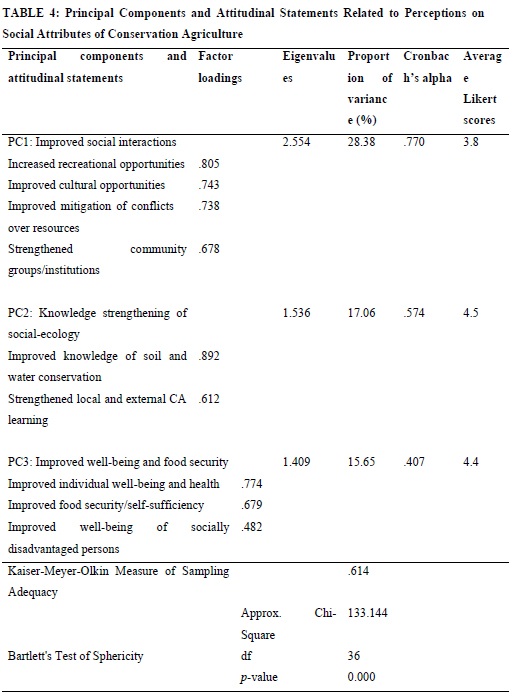
Three PCs, which accounted for 61.09% of the measured data's total variance, were reduced from nine attitudinal statements about farmers' perceptions of how using CA results in social advantages (Table 4). The first PC displayed a variation of 28.38% in the farmers' critique of CA's value in fostering social relationships and togetherness. Increased recreational opportunities (such as leisure, sport, and recreation), better cultural opportunities (such as worship, traditional functions, kinship visits, and funerals), improved resource conflict mitigation, and strengthened community networks highlight this component. Farmers' perceptions of social-ecological knowledge strengthening were reflected by a variation of 17.06% on PC2. Two attitudinal statements relating to better soil and water conservation knowledge and stronger social-ecological learning forums inside and outside the communities explained this component. Farmers' perceptions of enhanced well-being and food self-sufficiency accounted for 15.65% of the variability in the measured data in the third PC (Table 7). Three attitudinal items defined PC3: perceptions of improved individual wellness and health, food security/self-sufficiency, and the well-being of socially disadvantaged persons. However, the contribution of CA to improving the situation of the community's socially and economically disadvantaged persons based on gender, age, orphans, physical impairment, vulnerability, or other criteria had the lowest perception weighting. Unlike the average Likert scores, the constituent statements for the PC had the lowest Cronbach's alpha value when compared to the preceding PCs.
The number of fields farmers cultivated, and the area covered by CA were positively linked as predictors of farmers' perceptions that CA improved social interactions, with the primary variable having the greatest coefficient of influence on this component, as seen in Table 5. The overall area dedicated to crop cultivation and the attitudes of other farmers who practice CA had little impact on farmers' attitudes. Farmers' attitudes regarding strengthening their knowledge of the social ecology of CA were significantly influenced by the extension advice they received and their time spent living in the village, with the former variable being the primary factor due to its significant regression coefficient. The perception of well-being and food provisioning was only positively and significantly correlated with livestock ownership. Due to the household size, the duration of CA practice, and their negative coefficients.
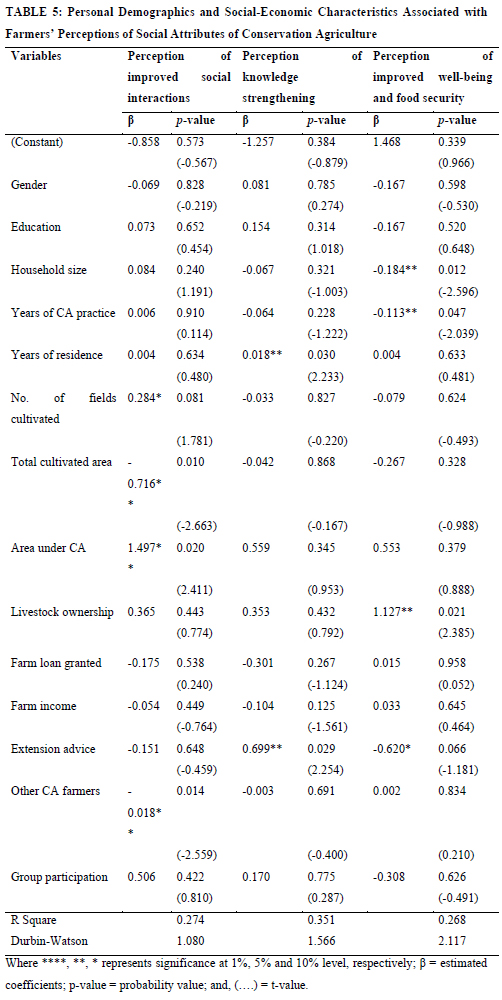
Determinants of farmers' perception of social attributes of CA being improved social interactions were positively identified with the number of fields farmers cultivated and areas under CA, the primary variable impacting this component based on its greatest coefficient (Table 5). Farmer's attitudes were significantly not influenced by the total area cultivated for crops nor by other farmers practising CA. Farmers' attitudes toward the social ecology of Conservation Agriculture (CA) were strongly influenced by extension guidance and their length of residency in the village. Extension guidance had the greatest impact among these factors, as indicated by its strong regression coefficient. Livestock ownership was the only determinant positively and significantly associated with the perception of well-being and food provisioning. Given their negative coefficients, household size, time spent practising CA, and receiving extension advice were unlikely factors that positively influenced perceptions that defined this PC.
3.5. Convergence Between Perceptions of CA Constructs Delimiting its Practice and Organisational Support
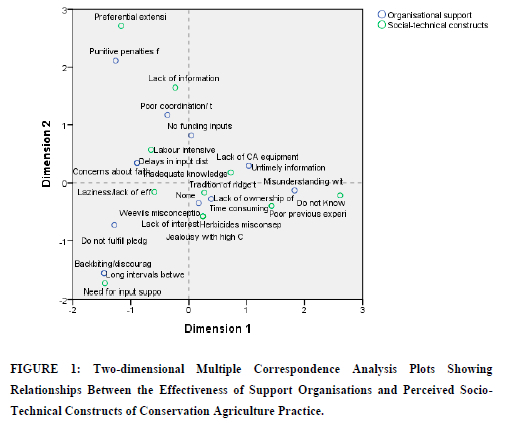
The study examined farmers' perceptions of socio-technical constructs and organisational support to identify factors that could facilitate the effective scaling up of CA. Multiple correspondence analyses between perceived factors influencing CA practice and the performance of organisations supporting CA yielded a two-dimensional plot in Figure 1. The biplot representation can be interpreted as follows: the further labels are from the origin, the more discriminating they are; the closer variables are to the origin, the less distinct they are likely to be. Time-consuming, lack of information, need for input support, preferential visits by extension agents and reluctance to join groups/networks because of prior negative experiences were read as probably discriminating social-technical factors delimiting CA. The study aimed to understand how farmers evaluated official, village-level, or community groups/networks in supporting the organisational drivers for successful conservation agriculture (CA) practices. The key organisational and group dynamics factors identified were poor coordination and transparency, harsh penalties for defaulters, group misunderstandings, demotivation from backbiting, unfulfilled pledges, and long intervals between meetings.
4. DISCUSSION
4.1. Personal Demographics and Social-Economic Characteristics
Determinants that identify personal demographics and socio-economic factors such as gender, age, education, extension training and household size may be considered to promote attitudes, beliefs, and behaviours that shape farmers' personalities and circumstances essential to addressing the issue at hand. From a social and ecological aspect, respondents' age and education were not influential factors in farmers' opinions of CA, as is evident in other studies (Ngwira et al., 2014; Chisenga, 2015). A negative perception of household size and its contribution to improved well-being, food provision and health support as a result of CA confirmed that large households compromise livelihood provisions. This finding also dissuades the assumption that all family members perceive benefit equally from a practice change. In keeping with the preceding, female respondents in focus groups demonstrated their ability to recognise tenets of soil quality. They were more skilled at describing soils using vernacular imagery, referencing attributes such as organic content, texture, aggregation, compaction, infiltration, and water-holding capacity-properties that correspond with established scientific parameters. This study argues that while research often highlights the share of assets, inputs, operations, or dividends allocated to women in agriculture, it is equally important to acknowledge the value of women's long-term experience with their land in shaping their knowledge of soil and other physical resources.
In individual and group discussions, soil fertility was not explained convincingly. Van Asten et al. (2009) noted that farmers may struggle to interpret certain observations due to a knowledge gap regarding unseen phenomena, such as the chemical properties of the soil. Their use of indicator weed plants associated with good soil fertility conditions, namely, Rottboellia exaltata and Trichodesma zeylanicum, is consistent with Mairura et al. (2007), who emphasised the integration of scientific and farmers' soil quality evaluation to bridge the knowledge divide. According to Rushemuka et al. (2014), enhancing farmers' soil descriptions can help bridge the gap between technical and farmers' soil knowledge systems, thereby fostering better communication. This improvement supports training initiatives and practical applications to boost soil productivity through modifications in production systems.
Based on a low PCA score, this work further showed that households and economic indicators may inadvertently overlook socially disadvantaged members, such as orphans, those with physical disabilities, or other vulnerable persons. Conservation agriculture, dubbed "red-ribbon farming", was hailed as a timely intervention for households impacted by the Human Immune Virus and the Acquired Immune Deficiency Syndrome (HIV/AIDS) pandemic over the past millennia (CTA, 1999). There is scant evidence that CA has been developed and promoted to address such social distress. This includes respite for those farming with physical disabilities or the plight of agrarian livelihoods plagued by labour challenges arising from deaths of frequently productive individuals, the loss of time as family members take time off from agricultural work to care for the sick and to mourn, the frequent loss and distress sale of livestock, or the loss of capital to illnesses that could otherwise be invested in agriculture. Future sociological contributions to agrarian change, including those anticipated from CA, must consider the livelihood challenges that marginalised members of families and communities continue to face.
A sense of knowledge strengthening was attributed to CA. This seems to have originated from farmers' extension training rather than their educational background. The progress made toward the goals of CA will depend upon the skill, effectiveness, and breadth of education and extension programmes (Kassam et al., 2011). The critical need for better and more widespread efforts in intergenerational agricultural education and training for conservation agriculture (CA) must be recognised if the practice is to achieve its full potential and if CA-led programs for agricultural improvement are to be effective. This can be achieved by providing a formal CA curriculum at school levels and in vocational and adult literacy education to engage farm people on a plane broad enough to meet the widening possibilities of CA (Mkomwa et al., 2022). The inordinate dependencies on extension training alone to change the trajectory of sustainable agriculture developments have long appeared lethargic, given that conventional agriculture curriculum, rather than sustainable, is still in use for formal and lifelong education.
4.2. Farming Experience
The second level of factors, closely aligned with personal history, pertains to farmers' experience, shaped by years of residence in the village and the duration of practising CA. Farmers gain experience in integrating a broad range of production-influencing parameters through shared information and intuitive adaptation. The length of CA practice appeared to engender a negative perception of CA's contribution to environmental attributes and sociologically to the perception of well-being. In contrast, years of residence were significantly associated with positive perceptions of soil fertility dynamics and knowledge enhancement. The resulting perceptions of CA throughout practice agree with the promise of CA delivering benefits in later years (Marogwe et al., 2011), which contrasts with the outcomes of the hasty socio-economic evaluation of CA critiqued by Mloza Banda and Nanthambwe (2011).
Farmers espoused the contribution of CA to improved social interactions and knowledge strengthening, which cannot be measured biophysically but are subject to temporal and spatial diverging perceptions of the demand, importance, and value among different stakeholders promoting the innovation and users of the innovation (Rudisser et al., 2020). Malinga et al. (2013) reported that socio-cultural elements were least common in ecosystem services literature, suggesting that indices selected for analysis of land-based innovations such as CA are often based on landscapes' current physical state (rather than people's state). As described in this study, the appraisal of broad-based latent social drivers of innovation development is necessary because of the complex mix of social and ecological services that landscapes supply and the rapid changes in landscapes brought about by agrotechnology such as CA.
Ignoring farmers' new knowledge elaborated during focus group discussions would be remiss. Their ethnosemantic elucidation of indicators of soil quality shows, on the contrary, that farmers could enumerate changes from CA practice using abroad purview of their experience rather than succinct scientific enumeration. This enables change agents to support great improvements in soil productivity by wider application of what farmers perceive and understand as presented through vernacular language, expressions and imagery. It is perhaps important to note that semi-structured expert knowledge questionnaires propose a set of principles, opinions, or values that are not openly deconstructed or challenged during farmer interviews, as are focus group forums that aid the discourse.
4.3. Structural Factors that Influenced Conservation Agriculture Learning
Farmers' access to extension services, awareness of other farmers using CA, and group participation all contributed to the third set of elements that might be deemed to affect social relationships and structural determinants of learning for the sustainability of the innovation. Awareness of other farmers using CA was significantly not connected with their view of CA's contribution, for example, to soil moisture maintenance or social interactions. When asked about the performance of organisations supporting CA or why other farmers were not practising it, farmers overwhelmingly cited poor coordination, lack of transparency, and weak group dynamics. Although the overall perception of extension guidance was positive, fellow CA farmers or their groups struggled to capitalise on the opportunities provided by CA.
Studies have long identified group involvement as a strong predictor of a household's likelihood of adopting conservation agriculture (CA) (Knowler & Bradshaw, 2007; Wellard et al., 2012). Ngwira et al. (2014) reported similar findings, attributing the relationship primarily to access to revolving fund initiatives, which facilitated the purchase of inputs such as herbicides and seeds. Additionally, these initiatives provided access to information and training that enhanced farmers' capacity and confidence to implement CA. Beyond simple membership, this study examined the nature of relationships, interactions, and the support and constraints affecting farmers' organisations within and outside farming communities. The findings did not align with those reported in previous studies. According to Newman et al. (2020), agrarian communities tend to possess a high level of resilience thanks to social networks that encourage group activity, reciprocity rules, and trusting relationships. However, this connectivity has eroded over time with resource shortages, implying that individuals sometimes adopt a more individualistic approach. To make matters worse, many organisations with hasty short-term conflicting interests and strategies often support CA (Mloza Banda & Nanthambwe, 2010). This may create suboptimal outcomes for social and ecological systems services meant to change people's livelihoods gradually and holistically.
Nonetheless, farmers need a common perception of collaboration for CA as a process that can trigger physical, psychological, and relational impacts. CA was developed as a systems-level social enterprise to address social, economic and environmental challenges (FAO, 2022). The mentioned organisational shortcomings and the lack of guided recognition of other farmers practising CA failed to detect and exploit community resources that provide different ways of enriching its entrepreneurial potential or coping with the innovation's obstacles. Part of the solution rests with long-term CA investment programmes embracing a range of medium-term projects across the social, economic and ecological dimensions for system-wide learning and transformative change (Biggs et al., 2022).
Extension training was significantly related to farmers' perception of soil and water conservation improvements or their knowledge of soil's physical properties. Inadequate agents, the routine scope of government extension agencies' work, and extension agents' failure to contact farmers on time have long been highlighted as important hurdles to agricultural technology dissemination (Wellard et al., 2012; Chisenga, 2015). External recommendations to governments for addressing capacity challenges have emphasised investing in popular learning platforms such as lead farmers, farmer groups, innovation platforms, and model villages. However, these initiatives have yet to be fully institutionalised or made sustainable. This work shows that extension agents remain pivotal and appear to have successfully contributed to a better understanding of the locally specific perception and provision of CA despite its complexity. Similar findings were echoed by Mazvimavi (2011), who argued that CA NGO promotions are not permanent and that institutionalisation of technology promotions through extension departments will significantly contribute to sustained CA adoption in Southern Africa.
4.4. Contribution of Conservation Agriculture to Farmers' Assets
The study examined assets provided by broader community or societal structures that help create an environment conducive to livelihood security through CA. These assets included agricultural loan access, income, livestock and landholding. Conservation agriculture did not significantly help secure farm loans or increase farmers' income. As a result, these factors were among the least important social drivers in shaping their perception of the practice. Failure to access or make necessary intensification of inputs or investments results in negative intervention outcomes (Jakovac et al., 2016). Nonetheless, Dawson et al. (2016) reported that farm income is a poor predictor of the well-being outcomes for the poor. Variability in physical resource endowment can result in unequal income patterns and agricultural households' earnings being highly seasonal due to climate seasons. The current study identified crop-livestock integration as a safety net or pathway out of income and food availability seasonality. Boss and Lutz (2017) showed that animal husbandry (especially of indigenous poultry, goats, rabbits and bees) complimented the introduction of CA.
The number of fields farmers cultivated and land area under CA improved farmers' perception of opportunities for social interactions availed by CA. From an ecological perspective, the area under CA was critical to farmers' perception of CA as a contributor to soil moisture maintenance under pervasive within-season rainfall variability in the region. Ngwira et al. (2014), working in the same area, reported a 30% increase in land area allocated to CA in six years, suggesting a step-wise adoption process. In the present study, CA land holdings were linked to the social and ecological facets of sustainability, referring to the ability to preserve the social presence of farmers in their communities and moisture provisioning of the soil to crops, respectively.
5. CONCLUSIONS
This paper advocates for adopting a social-ecological systems perspective to better understand the complex interactions influencing the adoption and sustained use of CA at the farmer level. Using the Balaka District in Southern Malawi as a case study, this research underscores the potential of leveraging local knowledge and community perceptions to gain deeper insights into and effectively characterise the social-ecological dynamics of conservation agriculture (CA). The social constructs of CA can open up opportunities for constructive engagement with farmers. Farmers described situations related to several aspects of social living, such as better social interactions, knowledge strengthening, well-being and health, and food sovereignty. From an ecological perspective, farmers gained a new appreciation for the soils that support them through CA, although understanding soil sensitivity to management is not simple. They used colourful ethnosemantic terminology to characterise soil properties linked to soil and water conservation and biomass and nutrient cycling. Omitting such ubiquitously observed attributes out of explicit consideration for CA valourisation risks decision-making and planning that is disconnected from what farmers feel to be of salient value to the new production system. Extension advice farmers received and demonstrated experiences of CA through practice on their parcels of land were major factors that provided a firm foundation for social-ecological learning.
The study reveals that some elements of CA innovation development, such as organisational support, have not moved into new and desirable system configurations and may lack the ability to support the innovation's sustenance. Poor coordination and transparency, misunderstanding within groups, and discouragement of members through gossip, for example, were highlighted as impediments to the performance of farmers and organisations supporting CA. These are critical nonmaterial or intangible features of technology that are as important as the associated material benefits. The sustainability of CA is dependent on maintaining cohesive farming communities and includes sharing positive transformation lessons with other farmers or through farmer organisations and networks. Policy interventions must address social factors that limit the effectiveness of CA in sustaining grassroots innovation. Without such support, CA risks following the pattern of other innovations that lose momentum once external oversight ends.
6. AUTHOR CONTRIBUTIONS
All authors have participated sufficiently in the work and take responsibility for the content, including participation in the manuscript's concept, design, analysis, writing, or revision. MLMB and HRMB were involved in the study conception and design; MLMB was responsible for data collection and curation; MLMB, HRMB and DK were responsible for analysis and interpretation; WC was responsible for supervision and manuscript intellectual content. All authors read and approved the final manuscript.
7. FUNDING
This research was not supported by any specific grant from funding agencies in the public, commercial, or not-for-profit sectors. This work was part of a doctoral studentship awarded to the first author, funded under grant number 2010-004 VLIR-UOS, Ghent University, Belgium.
8. DATA AVAILABILITY STATEMENT
This study did not generate or analyse new data. Data sharing does not apply to this article.
9. ACKNOWLEDGEMENTS
The authors thank the anonymous reviewers and editors for their valuable comments, greatly enhancing the manuscript. They also thank Mphatso Gama of the Machinga Agricultural Development Division for facilitating access to farmers, and we extend our heartfelt appreciation to the farmers for their participation and insightful responses during the study.
10. CONFLICTS OF INTEREST
The authors declare no conflict of interest.
REFERENCES
ARAYA, T., OCHSNER, T.E., MNKENI, P.N.S., HOUNKPATIN, K.O.L. & AMELUNG, W., 2024. Challenges and constraints of conservation agriculture adoption in smallholder farms in sub-Saharan Africa: A review. Int. Soil Water Conserv. Res., 12(4): 828-843. [ Links ]
AYELE, D., ZEWOTIR, T. & MWAMBI, H., 2014. Multiple correspondence analysis as a tool for analysis of large health surveys in African settings. Afr. Health Sci., 14(4): 1036-1045. [ Links ]
BIGGS, R. et al., 2022. Social-ecological change: Insights from the Southern African program on ecosystem change and society. Ecosyst. People., 18(1): 447-468. [ Links ]
BOSS, A. & LUTZ, S., 2017. The cheers and challenges of conservation agriculture programs. ECHO Dev. Notes (EDN)., 135: 1-6. Available from http://edn.link/cacheersnchallenges. [ Links ]
BOUWMAN T.I., ANDERSSON, J.A. & GILLER, K.E., 2021. Adapting yet not adopting? Conservation agriculture in Central Malawi. Agric. Ecosyst. Environ., 307: 1-14. [ Links ]
CHISENGA, C.M., 2015. Socio-economic factors associated with the adoption of conservation agriculture among women farmers in Balaka District, Malawi. Available from https://docs.lib.purdue.edu/open_access_theses/542. [ Links ]
CIAT WORLD BANK., 2018. Climate-Smart Agriculture in Malawi. CSA Country Profiles for Africa Series. Washington DC: International Center for Tropical Agriculture (CIAT). [ Links ]
TECHNICAL CENTRE FOR AGRICULTURAL AND RURAL COOPERATION (CTA)., 1999. AIDS and Agriculture: Red-ribbon Farming. Spore., 82: 1-2. [ Links ]
DAWSON, N., MARTIN, A. & SIKOR, T., 2016. Green revolution in sub-Saharan Africa: implications of imposed innovation for the well-being of rural smallholders. World Dev., 78: 204-218. [ Links ]
DOUGILL, A.J., WHITFIELD, S., STRINGER, L.C., VINCENT, K., WOOD, B.T., CHINSEU, E.L., STEWARD, P. & MKWAMBISI, D.D., 2017. Mainstreaming conservation agriculture in Malawi: Knowledge gaps and institutional barriers. J Environ Manage., 195(1): 25-34. [ Links ]
DUMANSKI, J., PIERETTI, R., BENITES, J.R., MCGARRY, D. & PIERI, C., 2006. The paradigm of conservation agriculture. Proc. World Assoc. Soil and Water Conserv., Paper No. P1-7: 58-64. [ Links ]
ERENSTEIN, O., SAYRE, K., WALL, P., HELLIN, J. & DIXON, J., 2012. Conservation agriculture in maize- and wheat-based systems in the (Sub)tropics: Lessons from adaptation initiatives in South Asia, Mexico, and Southern Africa. J. Sustain. Agric., 36(2): 180-206. [ Links ]
EVANS, K., VELARDE, S.J., PRIETO, R.P., RAO, S.N., SERTZEN, S., DAVILA, K., CRONKLETON, P. & DE JONG, W., 2006. Field Guide to the Future: Four Ways for Communities to Think Ahead. Nairobi, Kenya: CIFOR. [ Links ]
FOOD AND AGRICULTURE ORGANISATION (FAO)., 2022. What Is Conservation Agriculture? Available from http://www.fao.org/ag/ca/1a.html [ Links ]
IBM CORP., 2020. IBM SPSS Statistics for Windows, Version 27.0. Armonk, NY: IBM Corp. [ Links ]
GREINER, R., PATTERSON, L. & MILLER, O., 2009. Motivations, risk perceptions and adoption of conservation practices by farmers. Agric. Syst., 99: 86-104. [ Links ]
GUEST, G., BUNCE, A. & JOHNSON, L., 2006. How many interviews are enough? An experiment with data saturation and variability. Field Methods., 18(1): 59-82. [ Links ]
JAKOVAC, C.C., PEÑA-CLAROS, M., MESQUITA, R.C., BONGERS, F. & KUYPER, T.W., 2016. Swiddens under transition: consequences of agricultural intensification in the Amazon. Agric. Ecosyst. Environ., 218: 116-125. [ Links ]
KASSAM, A., FRIEDRICH, T. & DERPSCH, R., 2022. Successful experiences and lessons from conservation agriculture worldwide. Agronomy., 12: 769. [ Links ]
KASSAM, A., FRIEDRICH, T., SHAXSON, F. & PRETTY, J., 2011. The spread of conservation agriculture: Justification, sustainability and uptake. Int. J. Agric. Sustain., 7(4): 292-320. [ Links ]
KIBIRIGE, D., 2013. The impact of human dimensions on smallholder farming in the Eastern Cape province of South Africa. Doctoral thesis, University of Fort Hare, Alice, South Africa. [ Links ]
KIOME, R.M. & STOCKING, M., 1995. Rationality of farmer perception of soil erosion. Global Environ. Change., 5(4): 281-295. [ Links ]
KNOWLER, D. & BRADSHAW, B., 2007. Farmers' adoption of conservation agriculture: A review and synthesis of recent research. Food Policy., 32: 25-48. [ Links ]
LLANILLO, R.F., TELLES, T.S., JUNIOR, D.S., KAWEESA, S. & MAYER, A.B., 2020. Social benefits of conservation agriculture systems. In A. Kassam (ed.), Advances in Conservation Agriculture, Volume 2: Practice and Benefits. Cambridge, UK: Burleigh Dodds Science Publishing. [ Links ]
MAGDOFF, F. & VANES, H., 2021. Building Soils for Better Crops: Ecological Management for Healthy Soils. Sustainable Agriculture Research and Education (SARE) Program. National Institute of Food and Agriculture, U.S. Department of Agriculture. [ Links ]
MAIRURA, F.S., MUGENDI, D.N., MWANJE, J.I., RAMISCH, J.J., MBUGUA, P.K. & CHIANU, J.N., 2007. Integrating scientific and farmer's evaluation of soil quality indicators in central Kenya. Geoderma., 139: 134-143. [ Links ]
MALINGA, R., GORDON, L.T., LINDBORG, R. & JEWITT, G., 2013. Using participatory scenario planning to identify ecosystem services in changing landscapes. Ecol. Soc., 18(4): 10. [ Links ]
MARONGWE, L.S., KWAZIRA, K., JENRICH, M., THIERFELDER, C., KASSAM, A. & FRIEDRICH, T., 2011. An African success: The case of conservation agriculture in Zimbabwe. Int. J. Agric. Sustain., 9(1): 153-161. [ Links ]
MAZVIMAVI, K., 2011. Coordinating and advocating for conservation agriculture policies in Southern Africa. Regional CA Policy Report FANRPAN - Food, Agriculture and Natural Resources Policy Analysis Network. Pretoria, South Africa. Available from http://oar.icrisat.org. [ Links ]
MKOMWA, S., MLOZA-BANDA, H.R. & MUTAI, W., 2022. Formal education and training for conservation agriculture in Africa. In S. Mkomwa & A. Kassam (eds.), Conservation Agriculture in Africa: Climate Smart Agricultural Development. Cambridge UK: CAB International, pp. 305-330. [ Links ]
MLOZA-BANDA, H.R. & NANTHAMBWE, S., 2010. Conservation agriculture programmes and projects in Malawi: Impacts and lessons. National Conservation Agriculture Task Force Secretariat, Land Resources Conservation Department: Lilongwe, Malawi. Available from http://conservationagriculture.org/app/uploads/2019/02/CA-PROGRESS-IN-MALAWI-MLOZA-BANDA-NANTHAMBWE-2010.pdf. [ Links ]
MUÑOZ-ULECIA, E., BERNUES, A., ONDE, D., RAMANZIN, M., SOLIÑO, M., STURARO, E. & MARTIN-COLLADO, D., 2022. People's attitudes towards the agrifood system influence the value of ecosystem services of mountain agroecosystems. PLoS ONE., 17(5): e0267799. [ Links ]
NEWMAN, R., CAPITANI, C., COURTNEY-MUSTAPHI, C., THORN, J., KARIUKI, R., ENNS, C. & MARCHANT, R., 2020. Integrating insights from social-ecological interactions into sustainable land use change scenarios for small islands in the Western Indian Ocean. Sustainability., 12: 1340. [ Links ]
NGOMA, H., ANGELSEN, A., JAYNE, T.S. & CHAPOTO, A., 2021. Understanding adoption and impacts of conservation agriculture in Eastern and Southern Africa: A review. Front. Agron., 3: 671690. [ Links ]
NGWIRA, A., JOHNSEN, F.H., AUNE, J.B., MEKURIA, M. & THIERFELDER, C., 2014. Adoption and extent of conservation agriculture practices among smallholder farmers in Malawi. J Soil Water Conserv., 69: 107-119. [ Links ]
PARLEE, B.L., GEERTSEMA, K. & WILLIER, A., 2012. Social-ecological thresholds in a changing boreal landscape: Insights from Cree knowledge of Lesser Slave Lake region of Alberta, Canada. Ecol. Soc., 17(2): 20. [ Links ]
PEREZ-SOBA, M. & DWYER, J., 2016. The social-ecological system concept. DRG AGRI Workshop, 5-6 December 2016, Wageningen University, The Netherlands. [ Links ]
RUSHEMUKA, N.P., BIZOZA, R.A., MOWO, J.G. & BOCK, L., 2014. Farmers' soil knowledge for effective participatory integrated watershed management in Rwanda: Toward soil-specific fertility management and farmers' judgmental fertilizer use. Agr. Ecosyst. Environ., 183:145-159. [ Links ]
RÜDISSER, J., LEITINGER, G. & SCHIRPKE, U., 2020. Application of the ecosystem service concept in social-ecological systems - from theory to practice. Sustainability., 12: 2960. [ Links ]
TAURO, A., GOMEZ-BAGGETHUN, E., GARCIA-FRAPOLLI, E., CHAVERO, E.L. & BALVANERA, P., 2018. Unravelling heterogeneity in the importance of ecosystem services: Individual views of smallholders. Ecol. Soc., 23(4): 11. [ Links ]
TRUST PROJECT., 2018. Global Code of Conduct for Research in Resource-Poor Settings. Available from https://www.globalcodeofconduct.org/wp-content/uploads/2018/05/Global-Code-of-Conduct-Brochure.pdf. [ Links ]
VAN ASTEN, P.J.A., KAARIA, S., FERMONT, A.M. & DELVE, R.J., 2009. Challenges and lessons when using farmer knowledge in agricultural research and development projects in Africa. Exp. Agric., 45(1): 1 - 14. [ Links ]
VENEMA, J.H., 1991. Land resources appraisal of Liwonde agricultural development division. Land Resources Evaluation Project AG: DP/MLW/85/011. GOM/UNDP/FAO Field Document No. 23. [ Links ]
WELLARD, K., RAFANOMEZANA, J., NYIRENDA, M., OKOTEL, M. & SUBBEY, V., 2012. A review of community extension approaches to innovation for improved livelihoods in Ghana, Uganda and Malawi. J. Agric. Educ. Ext., 19(1): 21-35. [ Links ]
WORLD OVERVIEW OF CONSERVATION APPROACHES AND TECHNOLOGIES (WOCAT)., 2016. Questionnaire on Sustainable Land Management (SLM) Technologies. Bern, Switzerland. Available from https://www.wocat.net/documents/193/QT_Core_EN_jin8Fyy.pdf. [ Links ]
WORLD REFERENCE BASE (WRB)., 1998. World reference based on soils. Rome, Italy: Food and Agriculture Organization of the United Nations. [ Links ]
 Correspondence:
M.L. Banda
Correspondence Email: medmloza@gmail.com
