Services on Demand
Journal

Article
 English (pdf)
 Article in xml format
 Article references
 Automatic translation
 Send this article by e-mail
Indicators
Related links
-
 Cited by Google
 -
 Similars in Google
Share

 Permalink
South African Journal of Agricultural Extension
On-line version ISSN 2413-3221Print version ISSN 0301-603X
S Afr. Jnl. Agric. Ext. vol.53 n.1 Pretoria 2025
https://doi.org/10.17159/2413-3221/2025/v53n1a17584
ARTICLES
Creating Livelihoods Through Land Redistribution: Evidence from the One Household - One Hectare Programme in Kokstad
Zantsi S.I; Mgidi S.II
IAgricultural Economist, Economic Analysis Unit, Agricultural Research Council-Central Office, 1134 Park St, Hatfield, Pretoria, 0028, South Africa, Email: siphezantsi@yahoo.com; ORCiD ID: 0000-0001-9787-3913. Research Fellow, Department of Sustainable Food Systems and Development, University of the Free State, 205 Nelson Mandela Drive Park West, Bloemfontein
IIEconomist, South African Grain Farmers Association, The Grain Building, Agri-Hub Office, Park Block C, Ground floor, 477 Witherite Road, The Willows, Pretoria. Email: siyabongamgd@gmail.com;
ABSTRACT
The South African land redistribution programme has been criticised for solely focusing on redistributing land for commercial farming while ignoring land demand for small-scale farming and settlement. This study reports on implementing the One Household-One Hectare (1HH-1H ) programme in two Kokstad beneficiary villages. The study's first objective was to understand how the programme implementation works on the ground. The other objective was to assess the capacity of the programme to create livelihoods. Our analysis was based on household survey data from 20 beneficiary household heads and two agricultural advisors. The data was analysed using descriptive statistics. Findings show that the programme implementation was need-based and was a joint effort by various government departments. The implementation led to a village setup, where each beneficiary household has a residential area for buildings, kraals and a garden in their one-hectare plot. The remainder of the land was shared as grazing common and forest, while the other arable land was used for cooperative farming and individual arable field lands. In general, beneficiaries were content with the programme's implementation and reported a significant increase in their livestock herd and crop outputs. Additionally, beneficiaries now enjoy access to clean drinking water, irrigation water, and primary healthcare, among other benefits.
Keywords: Land Reform, Rural Development, Public Services, Aspirations.
1. INTRODUCTION
After the transition to democracy, the South African government committed to resolving the land question using three sub-programmes (see documentation in the Department of Land Affairs [DLA], 1997). The first programme was geared towards strengthening the tenure rights of farm workers and communal residents, the second one sought to restore land that was forcefully taken from original occupants during the colonial period, and the last subprogramme was intended to correct the skewed racial land ownership by redistributing it fairly and justly (the focus of this study).
While land redistribution remains one of the key tools for alleviating poverty in rural communities (Bonti-Ankomah, 2001), itis still one of the greatest challenges facing the postapartheid government. Specifically, the main problems include the slow pace at which land is being redistributed and the creation of livelihoods on the redistributed land. Key to the root cause of these problems is the inefficient implementation of whatever is written on paper as a policy.
Both scholarly literature and government reports on land redistribution programmes acknowledge that land redistribution must address the land needs of all beneficiaries (Aliber, 2019; DRDLR, 2013; Rusenga, 2020). The beneficiary list includes households or individuals who require land for commercial farming and those who require land for small-scale farming. The latter group represents the greatest demand, which remains unmet despite the strong will to subdivide the large commercial farms intended for land redistribution (Zantsi et al. 2021).
One of the land redistribution policies that has sought to address the needs of households who require land for residential and small-scale farming purposes is the 1Household-1Hectare (1HH-1H) programme, which was first introduced in 2015. In the 1HH-1H programme, farms acquired through the Pro-active Land Acquisition Strategy (PLAS) would be allocated to a group of households such that each household receives an equivalent of a hectare and obtains a certificate of use (Aliber et al., 2018). However, since the introduction of the 1HH-1H programme, no further information has been made available - neither via scientific publications nor publicly. Therefore, this article reports on a case study of households who benefited from this policy in two Kokstad villages.
The objectives of this paper are (1) to describe the implementation of the 1HH-1H programme and (2) to illustrate how livelihoods can be created through the small-scale farm model on redistributed land. By livelihood, the paper refers to the means of securing the necessities of life. This includes a place to build a house, keep livestock, and have a small garden. It is understood that through agricultural activities, one can generate income, produce one's food, and secure off-farm work closer to where one lives.
The remainder of the paper is structured as follows. The next section contextualises the study by reviewing the literature on any progress made regarding land redistribution to date and debates on its status. Data and methods are described in Section 3, Section 4 discusses the research findings, and Section 5 presents the findings and conclusion.
2. REVIEW OF LITERATURE ON LAND REDISTRIBUTION
This brief literature review aims to situate this study's central argument within the broader literature on land reform, rural development and poverty alleviation. The first part reviews land redistribution modalities and their progress thus far. These aspects are followed by a discussion of the reasons behind the progress, which boils down to land subdivision and the advocacy to meet the land demands of people requiring smaller land size. These aspects and land expropriation represent some major land reform debates.
South African land reform has three components: land tenure reform, land restitution, and land redistribution, which are the focus of this study (Department of Land Affairs 1997). Since its inception after 1994, the land redistribution programme has been implemented through various modalities. The latter include the Settlement Land Acquisition Grant (SLAG) of 1997-2000, the Land Reform for Agricultural Development (LRAD) of 2000-2010, the Proactive Land Acquisition Strategy (PLAS) of 2006-present, and the State Land Lease and Disposal Policy (SLLDP) of 2013. Among the sub-programs of PLAS, including equity share schemes, is the 1HH-1H programme. This brief literature overview looks at current land reform debates, the progress achieved regarding land redistribution, and the impact on beneficiary livelihoods.
2.1. Redistributed Land So Far and its Impact on Beneficiaries
The implementation and progression from one modality to the other have been largely informed by the efficacy of each modality to deliver the expected outcomes, among other things. The overall outcome of these modalities in redistributing land is estimated at around 10% of South Africa's commercial farmland (LRAAP, 2019). However, when private sales by black people are considered, it is estimated that the target of 30% in 2014 has been achieved (Vink & Kirsten, 2019). Nevertheless, stakeholders still feel that the land redistribution is too slow and that it has done little to improve the livelihoods of the beneficiaries, as most of the redistributed land is not being used productively (Aliber & Cousins, 2013; Kirsten et al., 2016; Mtero et al., 2019; LRAAP, 2019).
Bradstock's (2006) study on restitution and redistribution in the Nothern Cape found that beneficiary land has not contributed materially to the livelihoods of beneficiaries. This failure has been mainly because the redistributed and restituted land was geographically remote from the beneficiaries' residences and because of the lack of service or technical support to assist beneficiaries with start-up agricultural activities. Bradstock concludes that land reform is ineffective for poverty reduction in rural South Africa.
As for the other case in a different province, Aliber and Cousins (2013) argue that land reform has not had a noticeable impact on beneficiary livelihoods. In their analysis of land tenure security, land restitution, and land redistribution, case studies in Limpopo found minimal impact on livelihoods and blamed the large-scale commercial farm model for its capital-intensive nature and non-alignment with the realities and aspirations of beneficiaries. Kirsten et al. (2016) in the Northwest province also found little evidence of any improvement in beneficiary livelihood after they received farms under SLAG. Kirsten et al. (2016) blamed the lack of post-settlement support, large groups and group dynamics as the causes of project failure. Yet, Beinart et al. (2020) documented some evidence that some small-scale land reform beneficiaries have been able to expand their assets and assert their rights over land in Stutterhem in the Eastern Cape.
2.2. Reasons for Poor Progress
There are certainly several valid reasons behind the slow progress. Myriad explanations and rationalisations have been made for said reasons in the scientific literature. Zantsi (2021) identified the following reasons in development economics literature: insufficient post-transfer support, poor beneficiary selection, large farm size coupled with lacking or incompetent farming skills, and the reluctance of the state to give freehold titles to beneficiaries, along with the limited programme budget.
2.3. Current Land Reform Debates
Two important and recent debates that result from the poor progress and implementation of the programme, as mentioned in the preceding paragraphs, are land expropriation and subdivision of land reform farms. With regards to the second point, there is ample evidence of high demand for small land parcels from potential beneficiaries, ranging from less than a hectare up to 100ha, which is way below the average commercial farm of 2000ha (Aliber et al., 2006; Liebenberg, 2013; Zantsi & Greyling, 2021; Marcus et al., 1996). As such, there has been strong advocacy for the government to scrap the Land Subdivision Act of 1970 and allow for the subdivision of land (Aliber, 2019a; Aliber & Cousins, 2013; Binswanger-Mkhize, 2014; Rusenga, 2019). The land reform and agriculture advisory panel appointed by the president in 2019 has supported this advocacy (LRAAP, 2019). Evidence exists that small farms are relatively easy to manage, and beneficiaries can finance farm operations from their pockets (Rusenga 2020; Zantsi et al. 2021). The 1HH-1H program is one of the forms of small-scale farming that emerged from the land subdivision debate (we will come back to it in the following sub-section).
The other controversial debate is that of land expropriation without compensation. This represents the most radical action fueled by frustrations over the slow progress and was first proposed by the Economic Freedom Fighters (EFF) party and later adopted by the ruling party, the African National Congress (ANC) (Conradie, 2019; LRAAP, 2019; Xaba, 2020). Only the expropriation of less productive and unused land (Ramaphosa 2020) has been partially approved. However, such land types are challenging to find because of the vagueness of their definition. As such, there still is no evidence of implementation.
2.3.1. The One Household One Hectare Programme
The 1HH-1H policy was launched in 2015 by the then minister of Rural Development and Land Reform (now Department of Agriculture, Land Reform and Rural Development), Gugile Nkwinti, in Gorah farm, Kenton on Sea, at the Ndlambe local municipality. Each household is entitled to one hectare of land, which is acquired through one of the land redistribution modalities (DRDLR, 2016). According to Mr Nkwinti, "Land acquired by the state will be surveyed by the Surveyor General, land use plans will be formulated, and a notarial title deed will be issued to each household". He further stated that if there is a remainder of land after each household has been allocated one hectare, said land will be communally owned and designated for collective use, i.e., grazing land.
Moreover, it is said that households will be supported to produce for consumption purposes and to organise themselves into a primary cooperative linked to the Agri-Parks initiative (DRDLR, 2016). The programme is said to be funded through the Recapitalisation and Development Budget, and the government has set aside R100 million for the first year of the programme (Shopane, 2017). However, this policy has not received sufficient attention despite the support from gender equality movements. It has been criticised by the African Farmers Association of South Africa for limiting potential opportunities for its members (Kepe & Hall, 2016).
The 1HH-1H programme is more pro-poor, unlike the land reforms implemented in other countries such as Botswana, where the focus was on increasing agricultural productivity, conserving range resources, and improving social equity. However, evidence suggests that agricultural land reform policies such as the Tribal Land Grazing Policy and the National Policy on Agricultural Development harmed many poor households living in communal areas (Malope & Batisani, 2008). These authors reported that poor people were excluded due to high land development costs, ownership of only small herds or no cattle at all, and the lack of human capital.
3. METHODOLOGY
3.1. Description of the Study Area
The redistributed farms studied here, now villages, are situated at Aloekop under the Greater Kokstad Municipality in KwaZulu Natal. The Greater Kokstad Municipality is one of the five municipalities constituting the Harry Gwala District Municipality. The Greater Kokstad Municipality covers a land area of approximately 2 682 km2. According to the latest available census conducted in 2011, Aloekop has a population of 809 people living in 209 households (StatsSA, 2011). The same census further shows that, on average, a household has 4.3 persons. Females constitute the majority of the population ,51% and the population comprises black Africans. The dominant language is isiXhosa (81%), followed by Sotho (13%) and Zulu (5%). More than half (56%) of the population is of working age, between 15 and 64. Most households (39,9%) earn between R19,601 - R38,200 a year.
3.2. Data and Sampling
Two types of data were collected, namely qualitative and quantitative. The data was collected from three sets of participants: individual household heads, focus groups and two agricultural advisors. Data were collected from a sample of 20 beneficiary household heads, representing 20% of the total beneficiaries of the programme in the case study. Two extension advisors were interviewed. One of them was a general advisor and was present from the beginning of the project. The other was employed on a year contract as a farm manager for the cooperative farming part of the project.
The latter advisor, advising the beneficiary households on their farming aspects and coordinating the project development funds, acted as a form of participatory rural appraisal. According to Chambers (1994), participatory rural appraisal refers to 'a family of approaches and methods to enable rural people to share, enhance, and analyse their knowledge of life and conditions, to plan and to act.' Since the cooperative advisory farm manager was interacting with the beneficiaries daily and had been observing the project's progress, he was deemed a good source of information. His primary role was to assist beneficiaries in managing the cooperative farming aspect of the 1HH-1H programme as per the approved business plan, which is required for the post-settlement support intended for land reform benefactors.
3.3. Analytical Approach
The analysis of field survey data is guided and informed by the Sustainable livelihood framework (SLF) (Scones, 1998). The SLF provides a comprehensive and complex approach to understanding how poor and vulnerable people, amid policies (such as land reform), use their livelihood assets to form livelihood strategies to earn a living (Sharaunga & Mudhara, 2021). The study partly reports the findings using the five livelihood assets and by analysing the data descriptively. The analysis is also influenced by similar studies such as Puttergill et al.'s (2011) and Hart's (2012) investigations that also assessed the impact of a land reform programme. Therefore, as used in these studies, research methods included participatory rural appraisal, surveys and ethnographic fieldwork. The researcher's engagement with farmers is summarised in a narrative and descriptive manner.
4. RESEARCH FINDINGS
This section presents the research findings of the field survey and focus group discussion with the beneficiaries of the 1HH-1H programme. It first presents the respondents' background information before focusing on the land reform farm. It then describes the implementation process before using the SLF lens to assess the 1HH-1H programme's impact on beneficiary livelihood.
4.1. Background of the 1HH-1H Programme Beneficiaries
Before 2002, the beneficiaries of the 1HH-1H programme in Kokstad had initially lived in Pakkies, a rural village in Kokstad that belonged to the Pakkies family. Because this is a family-owned land and non-Pakkies families were considered outsiders, their tenure to the land was not secured. Any disagreements about village affairs were used against the outsiders, who were constantly reminded by the Pakkies that they were just visitors in their land and had no say in the governance of the land. For example, they had no say in community meetings on the development of the village and the allocation of plots to young people. Since land was becoming scarce and controlled by the Pakkies, outsiders found it riskier to have larger herds of livestock and had limited access to arable land. Even the development of their homesteads appeared riskier as conversations of eviction were starting to emerge. This only ended when their story came to the attention of the local municipality, which informed the local agriculture department.
4.2. The Implementation of 1HH-1H Programme in Kokstad
The Department of Agriculture, Land Reform and Rural Development (DALRRD) officials informed the outsiders from the Pakkies village about the 1HH-1H land redistribution programme and explained how it worked. They had to complete an application form accompanied by necessary documents and apply for a farm to the DALRRD.
Around 2002 and 2006, after the application for a farm was successful, the respondents, a group of 50 households, obtained a 12 818 hectare farm named Thuthuka Ngele at Aloekop. Another 50 households were awarded a 15 569 hectare farm at Ekuthuleni in the same area. The farms were bought for R1 169 136 and R1 360 000, respectively. These farms are next to each other and were initially used for commercial livestock farming. Since the farms and villages were similar in many respects, the researchers did not perform a comparative analysis. The farms were approximately five kilometres from Pakkies, where respondents originally came from before relocating and occupying the farms. The farms were bought under the Land Redistribution for Agricultural Development modality, a land redistribution pillar of the land reform policy.
However, they did not receive funding for relocation because it does not form part of the land reform program, at least for land redistribution, despite the dire need to start over building homesteads. During the focus group discussion, relocation and starting over appeared difficult for most of the beneficiaries, especially the poorest households. As such, only a few households relocated immediately after receiving the land; other households took a year or a couple of years to relocate (Focus group discussion, 2022). The government has poorly conceptualised the beneficiary relocation aspect of land reform (Bradstock, 2006; Zantsi et al., 2022).
It appeared that it is the beneficiaries themselves who decided to use the land in this form of village setup, where each household has a plot comprising of a section for buildings, kraals for panning livestock and a piece of arable land adjacent to the homestead, commonly known as a 'garden'. Hence, this was known as the bottom-up approach. In addition to these sections of the land, a household can have an arable field for planting field crops. The village then shares grazing land, which is divided into camps. Other arable fields are -fenced to be used by the villages as agricultural cooperatives. This is where the post-settlement support funding is used, for example, to purchase farm machinery, tilling implements, production inputs (seeds, fertilisers and pesticides) and money to employ a farm manager or qualified advisor to guide the cooperative.
Additionally, the advisor helps the beneficiaries compile a list of needed equipment and implements in the production process. The cooperative farming land is where the previous owner's farm buildings were situated. However, since the buildings and farm implements were in bad condition, the beneficiaries of 1HH-1H needed to purchase new implements and renovate the farm buildings.
According to the extension advisor, the implementation of the 1HH-1H was a joint project between government departments. In addition to DALRRD, the Departments of Water and Sanitation, Public Works, and Education also played a role. The researcher observed that several households had running water taps and pit toilets in the village. Additionally, most villages had a school, a clinic and a community hall.
4.3. Respondents' Demographic Information
Half (50%) of the respondents in this study had secondary education, while 30% had tertiary education. The remainder had informal training in farming as some had been farm workers, and others still worked on neighbouring farms. All the respondents in this study, including those with education qualifications, had 16 and 20 years of small-scale farming experience. In terms of abilities and good health, the respondents in the study were, on average, 51 years old, a somewhat physically active age.
Each household has a hectare of land. Some have fields, and all households share grazing land. Unlike in Pakkies, where they come from, in their new village, the respondents in the study have secure tenure in their land and access to a larger portion of land. Now, they can cultivate larger plots and keep larger herds of livestock. For example, the average herd size for cattle is 29, for sheep 51 and goats 28. The average herd growth since they relocated to the 1HH-1H farm was almost 300%, partly because of access to a larger grazing area. The livestock is used for family needs, such as rituals and sales of mainly non-breeding stock, the castrates. Several respondents with arable land mostly plant maize and vegetables for their own household consumption, and very few sell their produce, mostly vegetables, because of their perishability. Apart from municipal clean drinking water, a river passes through the farm for irrigation, and dams are used for drinking water for livestock. Moreover, there are patches of black wattle forests for harvesting firewood. Thatch grass is also harvested from the grazing lands.
The respondents in the study combine income from multiple sources, a common practice in many South African rural communities (Mamabolo et al., 2022). All the respondents in the study acknowledged gaining income from agricultural activities such as livestock and crop sales, in addition to income from one or more of the social grants, most of which come from child support grants. Other contributions to income sources (80%) were salaried employment, while 20% came from self-employment, such as being a street vendor. Half of the respondents (50%) stated that their monthly household income is between R10 001-R20 000, while 20% said that their income was between R5 000-R10 000 and R20 001-R30 000. Only a few respondents (10%) had low incomes, falling between R2 000-R5 000. Most of the respondents in the study could afford a household food basket, which in August 2022 was R4,775.59.
All our respondents had fenced gardens where they could cultivate food for household consumption. About 90% kept some form of livestock herd. Additionally, respondents demonstrated some form of household labour pull. The average household size in these villages was six persons. Of this average, more than half constitute the working age between 16 and 40 years.
The beneficiaries of the 1HH-1H in Kokstad relocated with their immediate families. Forty percent (40%) of them relocated with relatives like brothers and uncles, who also have their households (Survey data, 2022). Others relocated with friends. Therefore, the social kinships were not broken like in apartheid-forced removals such as the Betterment Planning that broke such kinships and ties (de Wet, 1995). For the beneficiaries of the 1HH-1H in Kokstad, this provides a backup system in difficult times because they can go and ask for help, borrow money or share groceries with relatives or neighbours.
Apart from individual farming on the arable land adjacent to their homesteads, beneficiaries farm together as a cooperative. This includes field crops, vegetable cultivation, and poultry (broiler) farming. However, group dynamics and dependency syndrome appear problematic in these cooperatives (Aliber, 2019b) in the Eastern Cape. For the beneficiaries of the 1HH-1H in Kokstad, these cooperatives were not fully functional.
4.4. Livelihood Outcomes
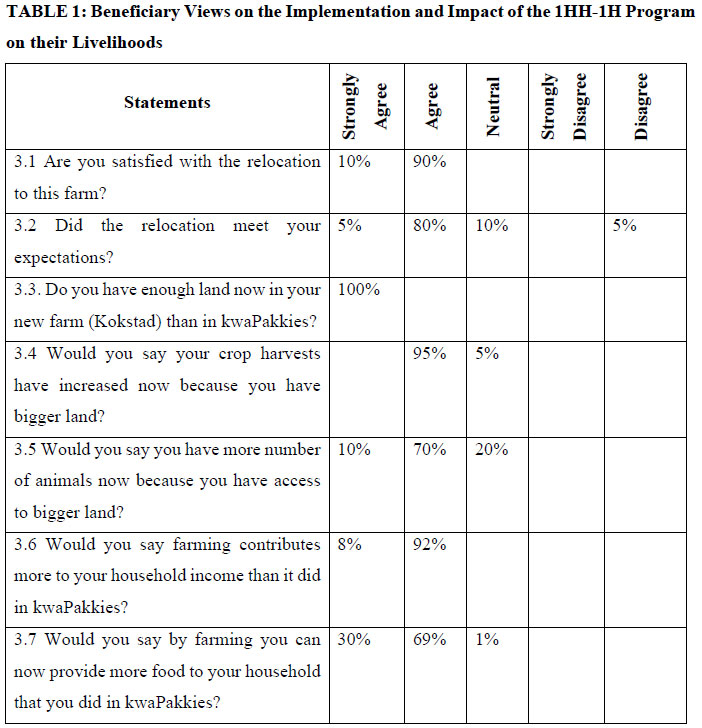
It can be argued that assessing developmental programs, particularly land reform projects, should be beneficiary-centric (Hart, 2012). Table 1 summarises beneficiary views regarding implementing the 1HH-1H, focusing on land need satisfaction and impact on their livelihoods. The beneficiaries' views are predominantly positive and reflect a general satisfaction.
The major findings from the respondents' responses include gaining secure access to a larger piece of land, where they could keep larger livestock herds and cultivate more extensive arable land, enabling them to gain more from farming as a livelihood strategy compared to when they had no land. In gauging their opinion, statements 3.4, 3.5 and 3.7 show that more than 70%, 80% and 99% of respondents stated that gaining access to more land improved their farming output (see Table 1).
This finding corroborates one of the common assumptions and objectives of land reform policy: land redistribution will lead to increased agricultural production because of increased access to land (NDP, 2012). However, it contradicts empirical estimations from Ryan (2017), who found that the receipt of land did not correlate significantly with per capita household expenditure and that land received through land redistribution programmes does not necessarily translate into increased agricultural activity.
As a confirmation of the intention of the 1HH-1H policy regarding the award of small pieces of land to households to pursue their diverse livelihood strategies (DRDLR, 2016), the respondents in this study rely solely on farming to earn a living. Still, farming contributes to the portfolio of their livelihood strategies. This is what has been observed elsewhere where land has been transferred, whereby most people in rural areas do not focus primarily on agricultural production but rather on finding employment, using social grants, and engaging in small-scale agriculture as the ideal livelihood (Hart, 2012; Puttergill et al., 2011).
Access to land where they have secure tenure contributes to respondent's well-being because now they no longer fear being evicted and can expand their homesteads. Respondents have homesteads and secure tenure where they can pursue other livelihood strategies besides farming, including working in retail stores in Kokstad. Others even work as teachers in the local schools. Beneficiaries also have access to basic services, clean water, sanitation, primary health care, and road infrastructure. This outcome of the 1HH-1H program in Kokstad is the envisaged outcome of some parts of the land redistribution policy, especially for redistributing land for small-scale farming and settlement purposes (Aliber, 2019a; LRAAP, 2019).
However, the cooperative aspect of the project, where beneficiaries farm together, mainly crops and poultry, seems unsustainable. In the view of the advisory farm manager, the project has the potential to meet and maintain long-term viable business requirements. For him, the successful procurement of the mechanisation package, the implementation of the infrastructure, and the purchase of production inputs are some of the project's strengths. One can also add the link between the farmers and the relevant market and create strong relationships with the relevant stakeholders.
However, the advisory farm manager pointed to conflict and the lack of vision and passion amongst most beneficiaries as the immediate challenge that the project encountered. Some of these problems lead to free rider problems. He also mentioned some opportunistic behaviour among beneficiaries whereby some of the beneficiaries wanted to be service providers for the coop, which amounts to a conflict of interest. He further stated that the beneficiaries would not want to follow the business plan as a guiding tool and believed that the 12-month contract was insufficient for the advisory manager to transfer farming skills and empower the beneficiaries. For him, these negative factors bring into question the project's sustainability.
5. DISCUSSION AND CONCLUSION
Implementing land reform has proven to be a complex task with minimal certainty of the outcome. Also, it has proven to be a learning-by-doing kind of task. For example, the South African government has tended to change the modalities of redistributing land constantly. Recent debates on land reform have taken the public back to the original policy, the 1997 White Paper on Land Reform Policy, which states that land redistribution has to prioritise people who require small pieces of land for subsistence farming and settlement purposes and for those who need larger pieces of land for commercial farming. This objective was overshadowed by the strong belief that government officials, influenced mainly by the agribusiness lobby group, that commercial farming is the only real agriculture and land reform should solely prioritise beneficiaries who would like to practice the latter (Aliber & Cousins, 2013; Rusenga, 2020).
Recent studies have shown that given the small land reform budget, poor structure and insufficient post-settlement and the lack of staff capacity within the government, as well as the quest by the government to reduce chronic poverty, giving people small pieces of land could be one of the plausible and effective ways of addressing land needs and achieve poverty alleviation (Aliber, 2019a; LRAAP, 2019). Building on these debates, the Presidential Advisory Panel on Agriculture and Land Reform report has made a strong recommendation to the government to expedite the subdivision of agricultural land, while Zantsi et al. (2021) empirically drafted a beneficiary-centric suggestion on how to subdivide agricultural land to meet the demand and objectives of people who require small pieces of land.
To contribute to this debate, this study has looked at implementing one of the land redistribution policies that sought to cater to the demand of people requiring small pieces of land for residential and small-scale farming purposes. This was done based on a case study involving the Thuthuka Ngele and Ekuthuleni beneficiaries of the 1HH-1H policy in Kokstad. In exploring the main argument, the paper's first objective was understanding the programme's implementation process. This is motivated by the fact that implementation seems to be the single challenge of land reform (Aliber, 2019a). Therefore, understanding it could help to avoid pitfalls in future projects.
The findings of this study show that implementing this programme in Kokstad used a problem-solving or meeting-the-demand approach. In effect, the municipality identified a problem faced by a group of their people. It referred to one of their departments, DALRRD, which spearheaded the process of addressing the problem of insecure land. This is solid evidence of how government departments can work together, which resonates with the intention of the 1997 White Paper on Land Reform Policy that land and agricultural services must be integrated to address the entire spectrum of social and physical needs of farm dwellers. The White Paper advocates for the 'convergence of health, education and social services [which] are important contributors to productivity in farming and rural sustainability" (DLA, 1997). This transpired in stark opposition to the reported incidents of poor coordination between various government departments (LRAAP, 2019).
Further, the land use plan largely s the needs and aspirations of the beneficiaries, which is rare to find in land reform implementation yet essential (Aliber et al., 2006; Zantsi et al., 2020). However, this project is not entirely beneficiary-centric because some beneficiaries in the study stated that they prefer to be supported as individuals and not as a cooperative because of group dynamics and free rider problems. In his view, the advisory farm manager also attested that conflict among beneficiaries was the major challenge in the cooperative aspect of the 1HH-1H project. Nevertheless, the problematic nature of group farming is not unique to this case study. Aliber (2019b) also reported it in his research based in the Eastern Cape. Cousins (2013) and Hall (2010) also raised concerns about the problematic process of collective farming by large groups on a single farm.
The other objective of this study was to assess the benefits of livelihood creation by the beneficiaries. This objective is also one of the main aims of land redistribution policies, particularly the 1HH-1H. This study contributes to the body of knowledge on the question by providing evidence of experiences and perspectives of stakeholders on how the receipt of land by beneficiaries has created or enhanced the creation of multiple livelihoods.
The researcher's analysis in this study was based on the Sustainable Livelihood Approach. In his analysis of household survey data, he found that the beneficiaries' relocation to the 1HH-1H farm allowed them to expand some of their livelihood assets, such as livestock, homesteads and crop cultivation. They also benefited from government agricultural support for cooperative farming, water, sanitation, and social infrastructure such as schools, community halls, roads, and primary healthcare. All support mechanisms contributed to their goal of creating a sustainable livelihood and their well-being. These non-agrarian contributions contrast with the sedentary thinking of many policies, which completely misses why people continue to base themselves in rural areas while pursuing livelihoods and lifestyles they deem appropriate, relevant and desirable (Hebinck et al., 2023). However, their financial assets do not seem to permit a sustainable livelihood because, for many respondents, social grants constitute a larger portion of their livelihood strategies portfolio. Overall, in terms of the beneficiary views, implementing the 1HH-1HH program in Thuthuka Ngele and Ekuthuleni was somewhat satisfactory and successful because it met most of their dire needs.
Firstly, what could be learnt from this project is that beneficiary-centric and needs-based approaches are the key factors in the success of developmental projects. Furthermore, for development to succeed, cooperation between stakeholders is essential. Thus, developmental projects such as land reform should be flexible enough to incorporate beneficiary aspirations, as beneficiary aspirations hardly match policy objectives; hence, flexibility is needed. Moreover, policies are neither fixed nor static. They need to evolve and shift and, above all, be reworked by their actual beneficiaries (Long, 2001). Poor households should be supported with relocation costs, which could be implemented using household income as a qualifying criterion.
Lastly, cooperative farming in its current form is not efficient and sustainable in developing rural communities. Yes, it remains cost-effective and is a pragmatic way of assisting rural households given the government's limited resources (money, extension advisors, and so on). However, many loopholes promote opportunistic behaviour (e.g., free rider) and dependency syndrome in cooperative farming. Efforts should be made to minimise these loopholes through commitment, for example. This could eliminate free riders and beneficiaries with questionable intentions.
REFERENCES
ALIBER, M., 2019a. How can we promote a range of livelihood opportunities through land redistribution? Working paper 58, Institute for Poverty, Land and Agrarian Studies (PLAAS). Cape Town: University of the Western Cape. [ Links ]
ALIBER, M., 2019b. Forms of agricultural support and the "culture of dependency and entitlement". Agrekon., 58(2): 141-153. [ Links ]
ALIBER, M., MABHERA, S. & CHIKWANHA, T., 2018. Agrarian reform and rural development. Alice: University of Fort Hare. [ Links ]
ALIBER, M. & COUSINS, B., 2013. Livelihoods after land reform in South Africa. J. Agrar. Change., 13(1): 140-165. [ Links ]
ALIBER, M., REITZES, M. & ROEFS, M., 2006. Assessing the alignment of South Africa's land reform policy to people's aspirations and expectations: a policy-oriented report based on a survey in three provinces. Research report. Pretoria: Human Sciences Research Council. [ Links ]
BEINART, W., MNWANA, S. & WOTSHELA, L., 2020. Land reform, rural inequality and agrarian change: the case of Isidenge, Stutterheim, Eastern Cape. Transformation: Critical Perspectives on Southern Africa, 102: 27-48. [ Links ]
BINSWANGER-MKHIZE, H.P., 2014. From failure to success in South African land reform. Afr. J. Agric. Resour. Econom., 9(4): 253-69. [ Links ]
BONTI-ANKOMAH, S., 2001. The social benefits of land redistribution in South Africa-case studies. Agrekon., 40(1): 76-86. [ Links ]
BRADSTOCK, A., 2006. Land reform and livelihoods in South Africa's Northern Cape province. Land Use Policy., 23: 247-259. [ Links ]
CHAMBERS, R., 1994. The Origins and Practice of Participatory Rural Appraisal. World Develop., 22(7): 953-969. [ Links ]
COUSINS, B., 2013. Land redistribution, populism, and elite capture: New land reform policy proposals under the microscope. Available from http://hsf.org.za/resourcecentre/focus/focus-70-on-focus/focus-70-oct-b-cousins.pdf/view [ Links ]
CONRADIE, B., 2019. Land use and redistribution in the arid west: The case of Laingsburg Magisterial District. Agrekon., 58(3): 281-291. [ Links ]
DE WET, C., 1995. Moving together. Drifting apart: Betterment planning and villagisation in a South African homeland. Johannesburg: Witwatersrand University Press. [ Links ]
HALL, R., 2010. Reconciling the Past, Present, Future: The Parameters and Practices of Land Restitution in South Africa. In C. Walker, A. Bohlin, R. Hall & T. Kepe (eds.), Land, Memory, Reconstruction and Justice: Perspectives on Land Claims in South Africa. Ohio University Press, pp. 17-40. [ Links ]
HART, T.G.B., 2012. How rural land reform policy translates into benefits. Develop. Southern Africa., 29(4): 563-573. [ Links ]
HEBINCK, P., SMITH, L. & ALIBER, M., 2023. Beyond technocracy: The role of the state in rural development in the Eastern Cape, South Africa. Land Use Policy., 126(2023): 106527. [ Links ]
KEPE, T. & HALL, R., 2016. Land redistribution in South Africa. Commissioned report for High-Level Panel on the assessment of key legislation and the acceleration of fundamental change, an initiative of the Parliament of South Africa. [ Links ]
KIRSTEN, J.F., MACHETHE, C.L., NDLOVU, T. & LUBAMBO, P., 2016. Performance of land reform projects in the North West Province of South Africa: Changes over time and possible causes. Develop. Southern Africa., 33(4): 442-58. [ Links ]
MALOPE, P. & BATISANI, N., 2008. Land reforms that exclude the poor: The case of Botswana. Develop. Southern Africa., 25(4): 383-397. [ Links ]
MAMABOLO. M., CHAMINUKA, P. & MACHETHE C., 2022. Temporal and spatial variation of income diversification strategies among rural households in South Africa. Develop. Southern Africa., 39(3): 372-387. [ Links ]
MARCUS, T., EALES, K. & WILDSCHUT, A., 1996. Down to earth: Land demand in the new South Africa. Durban: Indicator Press. [ Links ]
MTERO, F., GUMEDE, N. & RAMANTSIMA, K., 2019. Elite capture in land redistribution in South Africa. Research report No.55. Bellville, University of the Western Cape: Institute for Poverty, Land and Agrarian Studies. [ Links ]
NATIONAL PLANNING COMMISSION [NPC]., 2012. An integrated and inclusive rural economy. Chapter Six of the National Development Plan 2030. [ Links ]
LIEBENBERG, F., 2013. South African agricultural production, productivity and research performance in the 20th Century. Doctoral thesis, University of Pretoria, Pretoria. [ Links ]
LONG, N., 2001. Development Sociology: Actor Perspectives. London: Routledge. [ Links ]
LAND REFORM AND AGRICULTURE ADVISORY PANEL [LRAAP ]., 2019. Final report of the presidential advisory panel on land reform and agriculture. Pretoria: The Presidency. [ Links ]
PUTTERGILL, C., BOMELA, N., GROBBELAAR, J. & MOGUERANE, K., 2011. The limits of land restitution: Livelihoods in three rural communities in South Africa. Develop. Southern Africa., 28(5): 597-611. [ Links ]
RAMAPHOSA, C., 2018. Land reform in South Africa is crucial for inclusive growth. [ Links ]
RYAN, J., 2017. Examining land reform in South Africa: Evidence from survey data. Doctoral dissertation, University of Cape Town. [ Links ]
RUSENGA, C., 2019. The agribusiness model in South African land reform? Land Use implications for the land reform beneficiaries. Agrarian South: J. Political Econ., 8(3): 440-461. [ Links ]
RUSENGA, C., 2020. Setting them up to fail: Enforcement of the agribusiness model on land reform projects in South Africa. Rev. Afr. Political Econ., 47(165): 382-398. [ Links ]
STATISTICS SOUTH AFRICA [STATSSA]., 2011. Population census. Pretoria: South African government. [ Links ]
SHARAUNGA, S. & MUDHARA, M., 2021. Analysis of livelihood strategies for reducing poverty among rural women's households: a case study of KwaZulu-Natal, South Africa. J. Int. Dev., 33: 127-150. [ Links ]
SHOPANE, G., 2017. One Household, One Hectare programme on track. Available from https://www.vukuzenzele.gov.za/one-household-one-hectare-programme-track [ Links ]
VINK, N. & KIRSTEN, J., 2019. Principles and practice for successful farmland redistribution in South Africa. Working Paper No. 57. University of the Western Cape, Cape Town, South Africa: Programme for Land and Agrarian Studies. [ Links ]
XABA, B.M., 2020. South African land question and the dilemma of land expropriation without compensation: A critical examination. In A.O. Akinola, K. Kaseeram & N.N. Jili (eds.), The new political economy of land reform in South Africa. Cham: Palgrave Macmillan. [ Links ]
ZANTSI, S., MACK, G. & MANN, S., 2020. Cultural innovation, aspirations and success among smallholders in former homelands of the Eastern Cape Province of South Africa: Theory and evidence. Int. J. Soc. Econ., 47(3): 404-422. [ Links ]
ZANTSI, S. & GREYLING, J.C., 2021. Land redistribution in South Africa's land reform policy: A better way to select beneficiaries. Agrekon., 60(2): 108-127. [ Links ]
ZANTSI, S., MACK, G. & VINK, N., 2021. Towards a viable farm size - determining a viable farm household income for emerging farmers in South Africa's land redistribution programme: An income aspiration approach. Agrekon., 60(2): 91-107. [ Links ]
ZANTSI, S., MAZWANE, S. & GREYLING, J.C., 2022. Determinants of potential land reform beneficiaries' willingness to relocate from their former homeland homestead farms to commercial farms. S. Afr. Geogr. J., 104(2): 213-230. [ Links ]
 Correspondence:
Z. Zantsi
Correspondence Email: siphezantsi@yahoo.com