




Services on Demand
Journal

Article
 English (pdf)
 Article in xml format
 Article references
 Automatic translation
 Send this article by e-mail
Indicators
Related links
-
 Cited by Google
 -
 Similars in Google
Share

 Permalink
South African Journal of Agricultural Extension
On-line version ISSN 2413-3221Print version ISSN 0301-603X
S Afr. Jnl. Agric. Ext. vol.52 n.5 Pretoria 2024
https://doi.org/10.17159/2413-3221/2022/v52n5a14651
ARTICLES
Benefits of Herding on Communal Rangelands in Free State Province, South Africa
Conradie, B.I; Matthews, N.II; Bahta, Y.III
IProfessor of Economics, University of Cape Town, PBag X1, Rhodes Gift, 7703. Email: beatrice.conradie@uct.ac.za. ORCID Nr: https://orcid.org/0000-0002-4675-6300
IIProfessor of Agricultural Economics, University of the Free State, PO. Box 339, Bloemfontein, 9300. Email: matthewsn@ufs.ac.za. ORCID Nr: https://orcid.org/0000-0002-8975-9026
IIIProfessor of Agricultural Economics, University of the Free State, PO. Box 339, Bloemfontein, 9300. Email: bahtay@uct.ac.za. ORCID Nr: https://orcid.org/0000-0002-3782-5597
ABSTRACT
This study used survey data to measure the benefits of paid herding for small stockholders on the communal rangelands of the eastern Free State. Extensionists can recommend herding to their clients because it mitigated the worst of a recent drought by controlling intermediate consumption and facilitating better recruitment. However, the practice did not impact the size or composition of livestock losses. In drought, livestock holders prioritised off-take over accumulation and selectively shed male animals. Off-take was directed to sales rather than to home consumption. Herding affected the cost of production, with herders saving more than their wages on purchased feed and remedies but not enough to make their herds profitable.
Keywords: Benefits of Herding, Communal Rangeland, Herd Performance
1. INTRODUCTION
Many rural households in South Africa keep livestock on communal rangelands as part of their complex livelihood strategies, which are stretched thin over the rural-urban divide (Hornby & Cousins, 2019). Communal pastures tend to be overstocked (Hardin, 1968), although Ostrom (2009) reassured us that social-ecological systems can self-regulate. Social norms might be more challenging to enforce in South Africa, where 80% of the population was crowded onto 7% of the farmland in the early 20th century. Traditional rules still govern Namaqualand's communal pastures in the arid west of South Africa (Allsopp et al., 2007). Still, in the east, there are fewer rules and more conflict in recently formed common property associations in Kwazulu-Natal (Hornby & Cousins, 2019). Overcrowding is an issue on communal rangelands everywhere, and the question is, what is the best way to ensure that communal herds perform optimally? This paper investigates the benefits of hiring paid herders during drought for livestock holders.
With too many animals crowded into a communal pasture, the organising mind of a skilled herder can coax the best out of an overburdened resource. In arid Namaqualand, herders get better grazing for their flocks than free-range animals achieve on the same type of land (Müller et al., 2019) by varying pastures daily in response to eight plant, six livestock and two landscape indicators (Samuels et al., 2018; 2007). Herding decisions try to respect village and stock post boundaries and accommodate fellow herders' age and health (Salomon et al., 2013). Herding achieves significantly higher stocking rates than commercial farmers and has been offered as evidence of herding superior performance (Rhode & Hoffman, 2008; Samuels et al., 2021). On the communal rangelands of the Drakensberg in eastern South Africa, cattle herding is a seasonal activity primarily to protect croplands and deter predators and stock thieves (Chonco, 2009; Salomon et al., 2013; Schurch et al., 2021). These factors are more important for sheep and goats than for cattle. It is a common practice to keep small numbers of sheep or goats penned or roped at homesteads while larger flocks are driven to pasture daily and kraaled at night (Chonco, 2009).
The main question in this study is if herding contributes measurably to the reproductive efficiency and profitability of sheep flocks on communal land in the former homelands of Free State Province, South Africa. These herds are small, typically with fifteen sheep and six cattle. By presenting financial estimates, this study extends the literature on herding on communal pastures in South Africa, which could guide extension recommendations for smallholder livestock holders.
2. DATA AND METHODS
In April 2016, the University of the Free State conducted a -section survey of 217 livestock operations to examine whether total factor productivity varies by settlement type (Nyam, 2017). The study targeted smallholders along the N8 corridor to Lesotho. This area forms part of South Africa's grassland biome with an annual rainfall of 600-700mm per annum (and it was part of Bophuthatswana's homeland under Apartheid). The area's summer temperatures average around 20°C, while winter temperatures often drop to less than 10°C. The study area is part of South Africa's summer rainfall region, where natural pastures peak in autumn.
The survey covered about half of the 45 villages in Thaba Nchu, and the intention was to conduct seven randomly selected interviews at each village. Five or fewer interviews were conducted at seven sites, and between six and eight interviews were done at another ten settlements. In contrast, the remaining four sites were substantially oversampled, giving a sample size of n = 157 for Thaba Nchu. In peri-urban Botshabelo south of the N8 highway, two group farming schemes were surveyed, with 16 interviews conducted at one site and 44 interviews done at the second location. Nyam (2017) did not report response rates or explain how refusals were dealt with.
The dataset includes rich livestock and financial data, including labour arrangements, from which the classification variable for this study was developed. Although these sheep owners probably practice open-season mating, the survey date was the end of the 2015/16 production season because the survey was conducted just before the region's main commercial lambing season in autumn, which begins the next cycle. Sheep were classified as ewes, rams, wethers, gimmers and lambs, and we calculated potential fertility as the percentage of ewes in the flock and actual fertility according to the normal formula for reproductive efficiency, i.e., lambs born as a percentage of ewes in the flock. Surviving lambs and gimmers (older ewe lambs) were included as part of the recruitment, and this is a conservative estimate of reproductive performance since high losses occur during the perinatal period (Conradie & Nattrass, 2017). Losses were recorded by leading cause, and off-take includes sales and home consumption like food, gifts and ceremonies (lobola).
Simplified Meissner weights were used to construct a herd variable that combines sheep, goats, and cattle. Except for the share of herds, little is known about cattle and goats in this community, and this is a problem since cattle make up 70% of the large stock units (LSU) in each herd.
Due to the low literacy level in the study population and the minimal contribution of agricultural enterprises to household income, written farm records were rated, and most questions were answered by recall. To ease the recall burden, revenues were computed by valuing off-take at "average" farm gate prices with the median positive sales price substituting for missing observations.
Cost data were more ambiguous because the cost question was headed by the instruction to "Please provide information on the inputs used in the Sheep farm in the last 12 months" (emphasis added) while data was recorded in a column labelled "Total cost (Rand) per month". A closer look at the wage data reveals that respondents probably paid more attention to the column heading than the instruction above the table: In 2015/16, the statutory wage rate for agriculture was R13.33 per hour, which equates to roughly R120 per day, R600 per week and R2,650 per month. Herders in communal areas are expected to earn less than the statutory minimum in cash since they are partly paid in kind and often benefit from progeny share schemes. Tabulating "monthly" wages for the subset of households that employed non-family labour reveals that one-third of the 71 non-zero observations looked more like weekly than monthly figures, and no observations could even remotely be considered annual.
In these minimal production systems, intermediate consumption is expected to be low. Because zeros are inconvenient for statistical modelling, frequency distributions were used to investigate the possibility of undeclared patching 1of missing data. Since recall will cause a certain amount of unavoidable rounding, we focused on frequencies of more than 10%. The following unusual distributions of cost items were noted:
• Silage cost: No problems detected
• Fodder cost: No problems detected
• Lick blocks: The value of R200 occurred with a frequency of 10%
• Farm-produced feed: No problems detected
• Animal remedies: Values of R809 and R300 occurred with frequencies of 14% and 9%
• Veterinary services: R155 occurred with a frequency of 75%, and the remaining values duplicated the remedies observations.
• Transport: There were two problematic values. R166 had a frequency of 47%, and R400 had a frequency of 12%
• Fuel: No problems detected
• Mechanisation: No problems detected
• Electricity: R200 and R300 each had a frequency of 13%
• Hired machinery: No problems detected
• Other expenses: No problems detected
The borderline cases of R200 for lick blocks or R300 for animal remedies were not adjusted. The veterinary services variable was discarded entirely, and other dubious values were set to zero to undo patches in the original dataset.
Several new variables were formed. Feed and fodder expenses were combined in a variable called new feed. The adjusted animal remedies variable became newvet. Transport, fuel, mechanisation, electricity and hired machinery were combined to form newmech, other expenses were ignored because there was only one non-zero observation. These direct and overhead costs were spread across the mixed herd and converted from Rand per year per LSU to Rand per year per sheep. Comparing means to medians revealed that a small number of respondents may have reported costs annually. Still, since the 90th percentile was plausible for all variables except the newvet variable, we assumed that all costs were reported monthly, as was the case with wages.
A dummy variable was constructed to stratify the sample into free-range herds dherder = 0 and herds with a person in attendance dherder = 1 i. Categorical differences in reproductive rates, input use and off-take rates were established with t-tests of means and chi-square tests, depending on whether the variable being compared was categorical or continuous.
3. RESULTS
3.1. Socio-Economic Context
On the communal rangelands of the former homelands of South Africa, herding fits against a backdrop of lingering colonial and Apartheid land dispossession (Bernstein, 2012). Unemployment is high, and poverty is widespread in these areas. Government grants are an important source of income, and a third of households are female-headed. There were minor differences in the circumstances of female-headed households compared to male-headed households, which relates to the fact that female heads of household were somewhat less well-educated and more likely to be unmarried than male heads.
Just over 20% of male heads of household identified agriculture as their main occupation, and this figure was below 10% for female heads of household. Several respondents engaged in survivalist agriculture described themselves as having no occupation. It excludes people who would normally be classified as housewives or retired. Herds were mixed and small, on average consisting of 9.3 LSU with 70% cattle. More than 80% of households reported keeping sheep for sale and wool production. Ceremonial use and home consumption were mentioned almost as frequently. Fewer than half of households identified sheep as an important source of savings. The importance of wool for keeping sheep suggests that Merino breeds dominate, although the sheep breed was not formally recorded. There is no data on the type of cattle produced. Crop production is common and contributes significantly to food consumption in many households.
3.2. Herding Arrangements and Labour Productivity
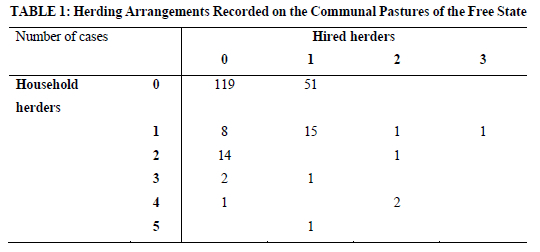
In this sample of 217 pastoralist households, 119 herds were free-range (55%). Varied labour arrangements for the other 98 cases are laid out in Table 1. Herding was most often the responsibility of a single hired herder working alone (24% of herds). Only two of these 51 hired herders were routinely off-duty during weekends, and they typically earned R800 per month for looking after a mixed herd with a size of 19.7 LSU. These wages were low by commercial standards, and there is no data on additional in-kind payments (e.g. food, airtime or tobacco) or progeny share benefits that might supplement the low cash wage. Another common arrangement was for a family herder to have a hired assistant (7% of cases). In this case, the herds were slightly larger (23.3 LSU), and the wages of hired workers were slightly higher than those of hired herders working alone (R900 per month). Not all family members working alongside hired herders were paid. There were 25 herds managed exclusively by family labour (12%), with a single person, perhaps the owner or the owner's child, taking on herding responsibilities in eight cases. Otherwise, duties were shared most often between two household members. The age and gender of household herders were not recorded. None of the household herders working on their own were paid, and in terms of stock numbers, they had the least demanding jobs of all. The remaining seven cases included three or more herders in different combinations of household and hired herders, and they cared for the biggest herds.
Labour input in man-days per year correlated strongly with sheep numbers and total herd size but not with cattle holdings. Excluding the free-range herds, whose supervision required minimal labour, a single variable Analysis of Variance test examined the labour productivity of family herders, hired herders working alone, pairs of hired and household herders and larger crews. Labour productivity differed significantly by herding arrangement (F = 3.94, p < 0.0108). Hired herders working alone were the most efficient, devoting 45 days per LSU per year to care for livestock. Household and hired herders working in pairs used 72 days per LSU in their system, while larger crews used 92 days per LSU per year. Crews consisting of family herders apparently spent 125 days per LSU per year on herding, but this figure might be inflated due to the low opportunity cost of young family members and the apparent measurement problems encountered when quantifying the use of family labour.
3.3. Effect of Herding on the Performance of Flocks
In Table 2, all cases of herding are pooled and compared to free-range flocks. Herders had control of significantly larger flocks with more ewes. Flocks managed by herders were more likely to include rams, and together, these factors ensured a higher level of potential fertility in herded flocks. Herders delivered on the reproductive potential of their flocks by ensuring that more lambs and gimmers survived than in free-range herds. When expressed as a percentage of ewes in the flock, herders achieved double the recruitment rate observed in free-range flocks. Two-thirds of free-range flocks reported zero recruitment compared to just over 40% of flocks with herders. This data is only for sheep. It is unknown if herding had a similar beneficial effect on the cattle fraction of these mixed herds. However, since sheep are more vulnerable to predators and stock thieves than cattle, these figures represent a best-case scenario of the beneficial effect of herding on communal pastures.
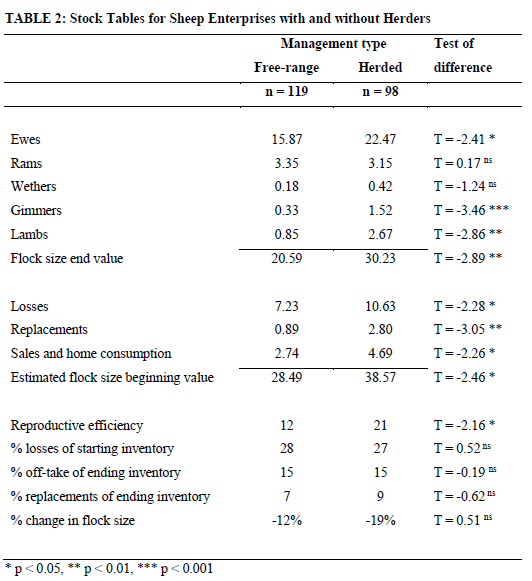
Herding could not significantly reduce losses in a bad year. The average figure of 27.5% losses across all flocks in the sample illustrates the dramatic effect on poor households' livestock assets when the rains fail. Amongst free-range flocks, the typical loss level was one in five sheep; only 15% of flocks experienced no losses, and in an extreme case, a household lost one and a half times as many sheep as it started the year with. Flocks with herders experienced similar losses. One in four sheep died or were stolen, and 90% of flocks recorded one or more losses. Two-thirds of the opening stock was lost during the year in three cases. The main sources of losses were tick-borne diseases (33%), theft/disputes (23%) and drought (19%). At 13% of losses, predation was a minor problem. Bad weather caused no losses.
With livestock numbers on the survey date interpreted as closing inventory, an opening balance was computed from flows recorded in the survey. Of all the flows, only recruitment was affected by herding. Both free-range and managed flocks contracted during the year, with managed flocks responding more to the drought than free-range flocks, but the test of significance indicates a high degree of variation within each group. Just 4% of free-range flocks experienced some accumulation, while 11% of flocks with herders increased in size during the 2015/16 drought.
3.4. Effect of Herding on Profitability
According to Table 3, there was a 50% difference in the production unit cost, of which some is attributable to herding. On the revenue side, Table 2 reported the same off-take rate for both flock types. Still, the prices at which culled animals were sold were significantly higher for flocks with herders than for free-range herds, and the difference was probably due to flocks with herders being in a better condition than free-range animals.
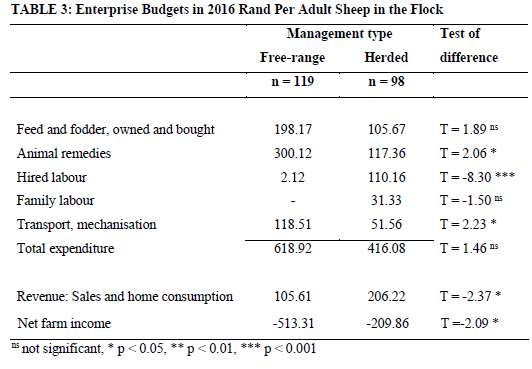
Herders saved 55% on supplementary feed and animal remedies, all for a modest additional cash outlay on wages of R141.49 per stock sheep per annum. The surplus of R33.77 per sheep on labour excludes a 56% saving on mechanisation and transport costs, which is more likely to have been caused by economies of scale than by herding directly. Free-range flocks, feed and fodder, accounted for a third of costs, animal remedies for half of it and mechanisation for the remaining 20%. In flocks with herders, feed and fodder accounted for 25% of expenditure, remedies for 28%, labour for 24% and mechanisation for 12% of the total. The presence of a herder doubled the off-take value, reducing the negative margin per stock sheep by almost 60%. While net farm income was negative on average for both flock types and the distribution of net farm income differed only marginally by treatment group, there were 5% more profitable flocks in the managed category than in the free-range category. Herders also prevented large losses; only three managed flocks incurred a loss of more than R1000 per stock sheep per annum, compared to 15% in the free-range category.
3.5. Herding in the Household Context
In the former homelands of South Africa, high levels of unemployment combined with limited access to farmland result in various livelihood strategies, of which livestock production is culturally important. The importance of herds as a source of food, cash income and savings depends on the availability of government grants and jobs in the local economy, and labour markets might discriminate against people with less education or against females. However, Table 4 reveals that none of these factors varied with herding. The only measurable difference was that households with herders also had vehicles, which raises the possibility that the adoption of paid herders could be constrained by affordability. While the probability of having a herder was positively correlated with herd size, there was no obvious minimum size at which herding became viable. At the two extremes, a herder's charges varied from a maximum of 140 cattle and 31 sheep to a minimum of eight sheep.
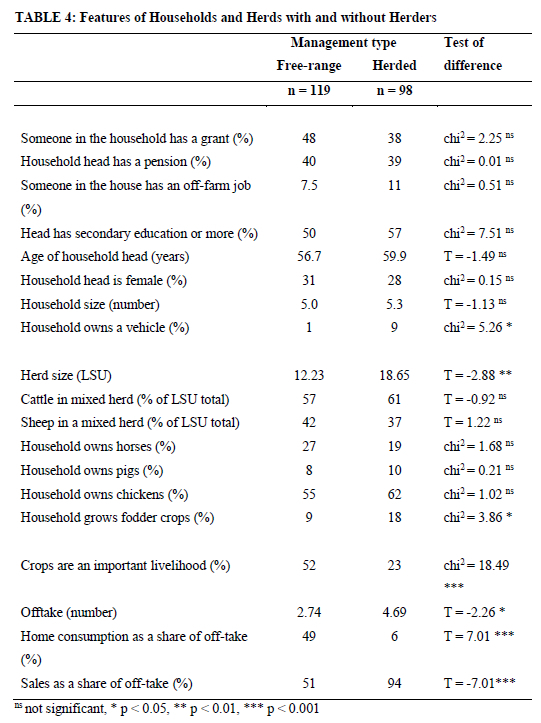
Herding was unaffected by the composition of herds or the likelihood of the household keeping pigs and chickens, but fodder production varied by herding. Both farm-produced and purchased fodder were insignificant. In 128 cases, all supplementary feed was purchased, usually just lick blocks to improve the palatability of dry grass in winter. In the 29 cases where some feed was home-produced, self-sufficiency varied from 2% to 100%, and the amount produced was limited to just 4.6 kg per LSU per year, which is barely enough for one day. At least twice as much fodder was purchased.
Households with free-range herds were twice as likely to identify crop production as a significant livelihood than in the case of free-range herds. We do not know which crops are grown at what scale, but most households were just supplementing maize meal with some home-grown spinach. Free-range herds were more important as a source of food and ceremonial goods than managed herds, although off-take rates did not vary by herding. In managed flocks, 94% of off-take was directed towards sales, with only 6% retained for home consumption.
4. DISCUSSION
There is a difference between livestock grazing on freehold and communal land. Farmers minimise the effect of rainfall variability on freehold land by stocking conservatively. On communal lands, farmers only control their actions, not those of their fellow land users. Under such conditions, the best strategy is to let flocks fluctuate with rainfall and grazing conditions. Herding can make this strategy more efficient. At Paulshoek in Namaqualand, communal grazing enables long-term stocking densities that are 75% higher than what is considered a safe level on neighbouring commercial farms, with numbers on the communal rangelands fluctuating by a factor of six between wet and dry years (Rohde & Hoffman, 2013). Although overstocking has permanently altered Paulshoek's vegetation matrix, botanists have deemed this degree of "overstocking" sustainable (Todd & Hoffman, 1999; Rhode & Hoffman, 2008). In contrast, a brief experiment with privatisation and paddocking went wrong in these communities (Samuels et al., 2021).
Stocking densities could not be calculated for Botshabelo and Thaba Nchu due to inadequate land and livestock data and no information on the social norms that govern the use of the communal rangeland. However, the stock numbers reported in Table 2 revealed that these flocks were caught on a downward trajectory during an unusually dry year when the commercial sector produced just 43% of the province's expected maize crop (DALRRD, 2020).
Drought causing such widespread reduction in flock sizes indicates a degree of overstocking, in accordance with the communal model.
Abeygunawardena and Dematewewa (2004) attributed communal herds' low productivity to late first births followed by widely-spaced calves, problems that communal cattle owners in Eastern Cape Province can relate to (Nqeno et al., 2011). During a drought, conception declines due to low fertility in underweight breeding stock, and these problems are compounded by high parasite loads (Nqeno et al., 2011; Tsotetsi & Mbati, 2003). While there is no data on parasite problems, 88% of respondents called parasites a "severe" or "very severe" problem. The impact of parasites can also be inferred from communal grazers' high expenditure on animal remedies compared to similar costs on freehold land (Strauss et al., 2021). Our data showed that employing a herder effectively reduces both these problems.
Higher reproductive efficiency fed directly to higher gross farm income in managed flocks. The saving of R275.26 per stock sheep per annum on feed and remedies associated with herding was more than the combined cost of these items in flocks with herders. Subtracting wages of R141.49 per stock sheep per year from the savings on feed and remedies gives a unit surplus of R133.77 for this sample's benefit-cost ratio of 2:1 for herding. This figure is over-optimistic because the cost of herding is subsidised by free family labour, and wage rates are 70% below the statutory minimum wage for agriculture. If family labour is costed at the same price as hired labour, the surplus associated with herding shrinks to R97.58 per stock sheep per annum, and the benefit-cost ratio falls to 1.55:1, which still favours herding. Enforcing minimum wages, on the other hand, increases the unit cost of labour to R471.63 per stock sheep per year and the cost of production to R746.22 per stock sheep per annum, and then herding becomes an inefficient choice.
While accurate for the available data, the financial analysis presented in this study must be treated as preliminary for several reasons. In addition to the issue of non-compliant wages, these figures exclude cattle and wool revenues. Cattle revenues should be higher than sheep revenues since there are more cattle than sheep in mixed herds, while wool could add as much as 50% to mutton revenues (Landman & Conradie, 2015). Another important result of this study was that some of the recall cost data collected was not plausible. Aliber and Mdoda (2015) reported a similar mismatch between cost and revenue attributed to unobservable home production. We tend to agree more with Hornby and Cousins (2019), who suspected that the problem might be on the cost side and related to low numeracy levels in surveyed communities. Since numeracy problems are compounded by long recall periods that conflate monthly with annual expenditures, panel studies with multiple waves yearly will produce the best results.
One must not think that smallholder livestock farmers are financially irrational because their data is sketchy. They are highly rational and understand the important trade-offs. Describing cattle as the glue that binds fractured communities together, Hornby and Cousins (2019) listed livestock as contributing to funds for consumption, reproducing the means of production, ceremonies and rents. Off-take decisions are understood as a trade-off between accumulation and consumption: "It is those households who are battling that want cattle and money today. We /leaders of the common property association try to persuade them to wait for a few years so that we can grow the business and sell more in the future, but they cry that there is no work" (Hornby & Cousins, 2019:210). Growing conditions and local labour markets shape the optimal balance of consumption and accumulation. Herds as assets grow in significance when wage work is scarce, and it is quite clear that livestock owners understand the implications of skimping on investment in their herds: "Sometimes I have to pinch money from my cattle and goats to educate and feed my children" (Hornby & Cousins, 2019:210). Even within these constraints, cattle are farmed for profit: "land reform beneficiaries laughed at the proposition /that cattle are just for social statusy but acknowledged that there may still be households who farmed cattle for the purposes of status rather than primarily for income" (Hornby & Cousins, 2019:214).
When the drought arrived, farmers could choose to sell animals, buy feed or sell some animals to buy feed for the rest. The data showed that farmers with larger herds were more inclined to sell some animals, while households with small herds tried their best to hang on to their animals, which underlines the cultural importance of herds.
5. CONCLUSION
The study investigated the benefit of herding on pastoral productivity during a very dry year on communal rangelands of the Free State Province. More than 80% of herds shrank during the study due to drought; under these conditions, herders had no impact on the magnitude or pattern of losses. Herders' main contribution was to deliver higher recruitment rates while saving on intermediate consumption. The two factors significantly buffered household income against the worst effects of the drought, but their efforts were insufficient to ensure profitability. Extension practitioners can confidently promote the herding of communal herds and might encourage small groups of neighbours or family relations to cooperate for this purpose. However, the extension message must include information about labour laws and the minimum wage for agriculture since current herding practices sometimes seem unlawful. It would help a lot if farmers could be convinced to keep written records, as these would make tracking the benefits of herding in their situations easier.
6. ACKNOWLEDGEMENTS
This research received no specific grant from funding agencies in the public, commercial, or not-for-profit sectors.
REFERENCES
ABEYGUNAWARDENA, H. & DEMATAWEWA, C.M.B., 2004. Pre-pubertal and postpartum anestrus in tropical Zebu cattle. Anim. Reprod. Sci., 82: 373-387. [ Links ]
ALIBER, M. & MDODA, L., 2015. The direct and indirect economic contribution of small-scale black agriculture in South Africa. Agrekon., 54(2): 8-37. [ Links ]
ALLSOPP, N., LAURENT, C., DEBEAUDOIN, L.M. & SAMUELS, M.I., 2007. Environmental perceptions and practices of livestock keepers on the Namaqualand Commons challenge conventional rangeland management. J. Arid Environ., 70(4): 740-754. [ Links ]
BERNSTEIN, H., 2013. Commercial Agriculture in South Africa since 1994: 'Natural, Simply Capitalism'. J. Agrar. Change., 13(1): 23-46. [ Links ]
CHONCO, J.M., 2009. Factors influencing choices of grazing lands made by livestock keepers in Enhlanokhombe in Ukhahlamba (Drakensberg). Unpublished doctoral thesis, University of KwaZulu-Natal, Pietermaritzburg, South Africa. [ Links ]
CONRADIE, B. & NATTRASS, N., 2017. The robustness of self-report data on predation: A comparison of two Karoo surveys. Afr. J. Agric. Resour. Econom., 12(3): 217-229. [ Links ]
CONRADIE, B. & LANDMAN, A., 2015. Wool versus mutton in extensive grazing areas. S Afr. Jnl. Agric. Ext., 43(1): 22-31. [ Links ]
DEPARTMENT OF AGRICULTURE LAND REFORM AND RURAL DEVELOPMENT (DALRRD)., 2021. Abstract of Agricultural Statistics. Pretoria: Directorate Statistics and Economic Analysis. [ Links ]
HARDIN, G., 1968. The tragedy of the commons: the population problem has no technical solution; it requires a fundamental extension in morality. Science., 162(3859): 1243-1248. [ Links ]
HORNBY, D. & COUSINS, B., 2019. "Reproducing the social": Contradictory interconnections between land, cattle production and household relations in the Besters Land Reform Project, South Africa. Anthropol. South. Afr., 42(3): 202-216. [ Links ]
MAPIYE, C., CHIMONYO, M. & DZAMA, K., 2009. Seasonal dynamics, production potential and efficiency of cattle in the sweet and sour communal rangelands in South Africa. J. Arid Environ., 73(4-5): 529-536. [ Links ]
MÜLLER, F.L., IGSHAAN SAMUELS, M., CUPIDO, C.F., SWARTS, M.B., AMARY, N.M., HATTAS, D., MORRIS, C., CYSTER, L.F. & STEPHEN BOATWRIGHT, J., 2019. The impacts of season and livestock management strategy on the quality of diets selected by goats and sheep in the semi-arid rangelands of Namaqualand, South Africa. Afr. J. Range Forage Sci., 36(2): 105-114. [ Links ]
NQENO, N., CHIMONYO, M. & MAPIYE, C., 2011. Farmers' perceptions of the causes of low reproductive performance in cows kept under low-input communal production systems in South Africa. Trop. Anim. Health Prod., 43(2): 315-321. [ Links ]
NYAM, Y.S., 2017. A metafrontier analysis of sheep production in the N8 development corridor. Unpublished doctoral thesis, Free State University, Bloemfontein, South Africa. [ Links ]
OSTROM, E., 2009. A general framework for analyzing sustainability of social-ecological systems. Science., 325(5939): 419-422. [ Links ]
ROHDE, R.F. & HOFFMAN, M.T., 2008. One hundred years of separation: The historical ecology of a South African 'coloured reserve'. Africa., 78(2): 189-222. [ Links ]
SALOMON, M., CUPIDO, C. & SAMUELS, I., 2013. The good shepherd: Remedying the fencing syndrome. Afr. J. Range Forage Sci., 30(1-2): 71-75. [ Links ]
SAMUELS, I.M., ALLSOPP, N. & HOFFMAN, M.T., 2021. Changes in pastoral mobility in a semi-arid montane region of South Africa: The role of policy and legislation. Afr. J. Range Forage Sci., 38(1): 1-13. [ Links ]
SAMUELS, M.I., SWARTS, M., SCHROEDER, A., NTOMBELA, K. & CUPIDO, C., 2018. Through the lens of a herder: Insights into landscape ethno-ecological knowledge on rangelands in Namaqualand. Anthropol. South. Afr., 41(2): 136-152. [ Links ]
SAMUELS, M.I., ALLSOPP, N. & KNIGHT, R.S., 2007. Patterns of resource use by livestock during and after drought on the commons of Namaqualand, South Africa. J. Arid Environ., 70(4): 728-739. [ Links ]
SCHURCH, M.P., MCMANUS, J., GOETS, S., PARDO, L.E., GAYNOR, D., SAMUELS, I., CUPIDO, C., COULDRIDGE, V. & SMUTS, B., 2021. Wildlife-friendly livestock management promotes mammalian biodiversity recovery on a semi-arid Karoo farm in South Africa. Front. Conserv. Sci., 2: 652415. [ Links ]
STRAUSS, A.J., AVENANT, N.L. & DE WAAL, H.O., 2021. The impact of predation on Merino and Dorper sheep flocks in the central Free State Province, South Africa. Indago., 37: 43-53. [ Links ]
TODD, S.W. & HOFFMAN, M.T., 1999. A fence-line contrast reveals effects of heavy grazing on plant diversity and community composition in Namaqualand, South Africa. Plant Ecol., 142(1): 169-178. [ Links ]
TSOTETSI, A.M. & MBATI, P.A., 2003. Parasitic helminths of veterinary importance in cattle, sheep and goats on communal farms in the northeastern Free State, South Africa. J S Afr Vet Assoc., 74(2): 45-48. [ Links ]
 Correspondence:
B. Conradie
Correspondence Email: beatrice.conradie@uct.ac.za
1 Patching is the practice of replacing missing observations with a sample average of median value, or with zeros depending on the dataset under consideration. Patching should always be formally declared and kept to a minimum. The alternative to patching is to delete incomplete observations. Both practices have disadvantages and it best to get the advice of experienced data analysts when confronted with a large number of zero observations.
