Services on Demand
Journal

Article
 English (pdf)
 Article in xml format
 Article references
 Automatic translation
 Send this article by e-mail
Indicators
Related links
-
 Cited by Google
 -
 Similars in Google
Share

 Permalink
South African Journal of Agricultural Extension
On-line version ISSN 2413-3221Print version ISSN 0301-603X
S Afr. Jnl. Agric. Ext. vol.52 n.4 Pretoria 2024
https://doi.org/10.17159/2413-3221/2022/v50n1a14407
ARTICLES
The Digital Readiness of Agricultural Advisory Professionals: A South African Case Study
Von Maltitz L.I; Van Niekerk J.A.II; Davis K.III
IDepartment of Agricultural Economics, University of the Free State, 205 Nelson Mandela Avenue, Bloemfontein, vonmaltitzL@ufs.ac.za, Orcid 0000-0002-7175-2344
IIAssociate Professor: Department of Sustainable Food Systems and Development, University of the Free State, 205 Nelson Mandela Avenue, Bloemfontein, vniekerkJA@ufs.ac.za, Orcid 0000-0001-9842-0641
IIISenior Research Fellow, International Food Policy Research Institute, Washington, USA. K.Davis@cgiar.org
ABSTRACT
Agricultural advisory services link producers, the government, the research community, and credit and input supply organisations. This vital role can be enhanced through the efficient use of digital platforms, especially in South Africa, where the advisor-to-producer ratio was last recorded to be 1:1019. According to the last census conducted in South Africa, 92.1% of households own a mobile phone, and only 21.1% do not have access to the internet, providing the platform for timeous interaction between advisors and their clients. The affordability of technology and data services, network coverage, and digital literacy are obstacles in the country that need to be addressed if access to ICTs is to be improved. This article focuses on the readiness of South African agricultural advisors to use digital platforms. Survey research was used to collect data from professionals, and the data was evaluated using a survey instrument that was developed based in part on similar work done in Rwanda. The results show that although most advisors are ready to use digital platforms, many obstacles must be addressed for efficient application.
Keywords: Agricultural Advisory Services, Digital Platforms, Digital Access, Digital Readiness, Digital Competency
1. INTRODUCTION
The importance of progressive socio-economic development in South Africa and, more specifically, rural South Africa is indisputable. Persistent poverty, excessive unemployment, sub-standard living conditions, and failing public infrastructure are just a few of the issues prevalent in the country (Wall, 2021; Habiyaremye et al., 2022). Amidst these circumstances, many households become involved in agriculture to enhance food security. The last census by Statistics South Africa (StatsSA) reported that 13.8% of all households in the country were classified as agricultural households involved in food production. The majority (89.2%) of these households were producing in their backyard to increase their food security and procure income for the household (StatsSA, 2023). Supporting these farmers in sustainably enhancing their production and progressing from subsistence to small commercial farmers is one of the critical roles that agricultural advisors fulfil. However, several factors impede advisory efficiency, of which a lack of funding is prominent. Lack of funding contributes to the current high extensionist-to-farmer ratio, last recorded to be 1:1019 by the Department of Agriculture, Land Reform & Rural Development (DALRRD, 2020). The deteriorating road conditions in the country are another factor increasingly hindering efficient service delivery in rural areas (Nyawo & Mashau, 2019). The culmination of these two issues highlights the need for an innovative approach to service delivery that includes using information and communication technologies (ICTs) and digital platforms (Antwi-Agyei & Stringer, 2021).
The call for participatory agricultural advisory processes, where farmers actively formulate solutions with and provide information to advisors, has been at the forefront of dialogues for decades (Chambers, 1997; Minh et al, 2010; Knook et al, 2018). This is opposed to the top-down linear approach, where the assumption is made that extension services know best, which has failed globally (Anderson & Feder, 2004). The participatory process contributed to the agricultural innovation systems approach where all stakeholders (farmers, researchers, government, NGOs, value chain institutions, etc.) collaborate to formulate solutions and enhance innovative developments (Hellin, 2012). The innovation system approach's efficiency significantly relies on successful networking amongst roleplayers (Davis et al., 2008). The increasing digitalisation of information and communication technologies (ICTs), including radio, television, computers, the internet, and mobile phones, has exponentially expanded the horizon for networking (Blum et al., 2020).
Access to digital platforms has drastically increased since the fourth industrial revolution was first coined in 2016 by the Founder and Executive Chairman of the World Economic Forum (WEF), Klaus Schwab (Lavopa & Delera, 2021; Ndung'u & Signé, 2020). It created new pathways entrepreneurs harnessed, resulting in increased income levels and improved quality of life (Xu et al., 2018). Productivity improvements stemmed from, amongst others, increased efficiencies related to decreasing communication costs, better supply chain interaction, and low-cost logistics (Schwab, 2017). The COVID-19 pandemic forced society to enhance the development and use of ICTs to communicate and educate in all sectors, including agricultural advisory services (Chivers et al., 2023).
According to the last census conducted in 2022 in South Africa, 92.1% of the population owns or has access to a mobile phone compared to 32.3% in 2001. A mobile phone was also the household item of preference, followed by a stove (86.9%), a refrigerator (83.2%), and a television (79%) (StatsSA, 2023). Only 21.1% of households did not have access to the internet either via mobile phones, Wi-Fi at home or the workplace, libraries, internet cafés, etc., and the majority (60.5%) of users accessed the internet through mobile phones or other mobile devices (StatsSA, 2023). Affordability of technology and data services, network coverage, and digital literacy are obstacles in the country that need addressing if access to ICTs is to be improved (Aruleba & Jere, 2022; Born et al., 2021).
Many scholars have expressed the advantages and possibilities digital platforms bring to agricultural advisory services (Tsan et al., 2019; Oyinbo et al., 2020; Fabregas et al., 2022; Klerkx et al., 2019). The complex communication flow in the entire food system can be facilitated by digital platforms, improving access to timeous information (Steinke et al., 2021). Farmers rely on up-to-date information concerning technological developments, market information, and weather forecasts on a near-daily basis to manage their production efficiently. Communicating relevant information to farmers is central to agricultural extension and advisory services, which digital technology can facilitate and expedite (Blum et al., 2020; Fabregas et al., 2022). Some studies have reported video content to be more helpful to farmers than written information, especially when farmers have time constraints or, in some cases, low literacy. Viewing practical demonstrations rather than reading a manual was reported to be beneficial and preferred by many farmers as it saves time and also counters illiteracy (Chivers et al., 2023). Many mobile phone applications that can assist farmers in managing crops, livestock, and weather data are available on the market. Cook and colleagues divide digital technologies in agriculture into four categories: 1. Data (collecting, measuring, storing, and reporting relevant statistics), 2. Control (assisting in managing specific tasks, such as GPS systems, electronic tracking, and livestock fencing), 3. Modelling (analysis and comparison of recorded data), and 4. Networking and communications (sharing information, diagnosing, problem-solving) (Cook et al., 2022). Another digital platform that has been shown to benefit farmers is digital financial inclusion (DFI). DFI allows farmers in remote areas better access to financial services, contributing to sustainable development and food security (Zhai et al., 2023).
The Department of Agriculture, Land Affairs, and Rural Development (DALRRD) in South Africa has reiterated the importance of using ICTs in agricultural advisory services. The last departmental review affirmed the importance of equipping advisors with appropriate tools and skills to use ICTs efficiently (DALRRD, 2020).
The abundance of available digital platforms can overwhelm both advisors and farmers. According to Saravanan and colleagues (2015), the essential factors to consider when using ICTs for advisory services are:
- Relevant content: A thorough needs assessment must ensure that content shared with farmers caters to their needs.
- Appropriate: A highly technical application that requires a lot of time and data from the consumer might not be applicable in areas lacking data availability and limited digital literacy.
- Integrated: ICTs must complement existing extension practices, not replace them.
- Institutionalising: For ICT development and use to be sustainable, continuous support is needed from the institutions endorsing it.
Digital platform usage in advisory services is not without challenges. Besides the technological aspects and challenges, it is essential to consider social science elements (Klerkx et al., 2019). For example, from a farmer's perspective, lack of digital literacy, data availability, internet coverage, and smartphone ownership create a digital divide, and generic content is not always relevant (Coggins et al., 2022; McCampbell et al., 2021). On the other hand, the ability and motivation of advisory professionals to efficiently utilise digital platforms are also vital to the success thereof (Olangunju et al., 2021). Spielman and colleagues (2021) provide a conceptual framework for using ICTs in agricultural advisory services. It displays the complexity of the multiple roleplayers and the many elements involved in using ICTs. These include the contextual political and policy framework, empowerment and equity issues, organisational capacity, and individual competencies (Spielman et al., 2021). Much of the research on digital technology usage has focused on farmers and their ability and willingness to use it. However, the mindset, attitude, and competency of agricultural advisors to utilise, formulate, and construct ICT platforms also play a vital role in the successful application thereof (Spielman et al., 2021).
This research study focused on the readiness of agricultural advisory agents in South Africa to use digital platforms to provide support services to producers. Readiness in this context describes how users are prepared to actively use digital technologies in executing their work. Factors that contribute to preparedness are the mindsets and attitudes of users, availability and access to said technologies, and institutional support related to them (Gfrerer et al., 2021).
2. METHODOLOGY
2.1. Data Collection and Analysis
As part of the research conducted and reported in the South African Extension Agent Competencies and Attitudes for the Future Research Report of the CGIAR Research Program on Policies Institutes and Markets (Davis et al., 2021), this study sought to understand South African advisory professionals competency levels, perceptions, and attitudes, especially toward digital advisory services. Questions focused on advisors' attitudes toward using different digital technologies and accessing and using various digital tools.
Survey research was used to collect data from extension professionals. Sector, experience, position in the workplace, and demographic information such as gender, age, and education levels were collected. A survey instrument was developed based partly on Spielman and colleagues' work in Rwanda (Spielman et al., forthcoming). The instrument was tested for face and content validity using a panel of experts from South Africa. The survey was in English.
The Alchemer survey platform was used for the online survey, which allows for secure communication between the surveyor, the respondent, and the survey database to ensure that data stay protected and are not accessible to other respondents or unauthorised entities. The service also allows for a restriction on the survey or sections that only enables respondents to proceed with the survey once they have completed certain sections or accepted specific terms and conditions.
Working with the DALRRD sub-programme National Extension Services, the quarterly Public Sector Forum meeting on 6 August 2021 was used for awareness creation with the Provincial Departments of Agriculture. Background was provided to the meeting members to get buy-in and support. When the survey was ready in September 2021, the provincial extension heads were approached to distribute it to their constituencies. For non-public staff from commodity organisations, agricultural unions, and private sector firms, lists were developed to obtain publicly available contact details. Information was shared widely through social media and follow-up emails to provincial and non-public organisations. All communication complied with the Protection of Personal Information Act (POPIA).
In addition, the annual South African Society for Agricultural Extension (SASAE) conference in Paarl, Western Cape, held 11-14 October 2021, was utilised to promote the survey. The event was compliant with all local COVID protocols. Study leads attended the conference and asked participants to fill out the survey. Paper copies were distributed. All face-to-face contact between the researcher and respondents aligned with South African COVID-19 protocols. Data collection took place between 30 September and 15 November 2021.
Data were analysed using descriptive statistics and tests of significance, using appropriate software (Excel and SPSS) for the data collected. The mean, variance, and correlates of three key indicator sets-technical skills, functional capacities, and digital readiness-among public and private sector extension agents were assessed using response data collected from an online survey. Indices derived from the data that capture the multidimensionality of these capabilities and econometric specifications appropriate to the nature of the data were used.
2.2. Study Population
The sampling frame for this survey was the entire population of agricultural advisors in South Africa. That includes all individuals who work as agricultural advisory professionals: crop advisors, livestock advisors, and other individuals working in agricultural advisory services in the public, private, and non-profit sectors in South Africa.
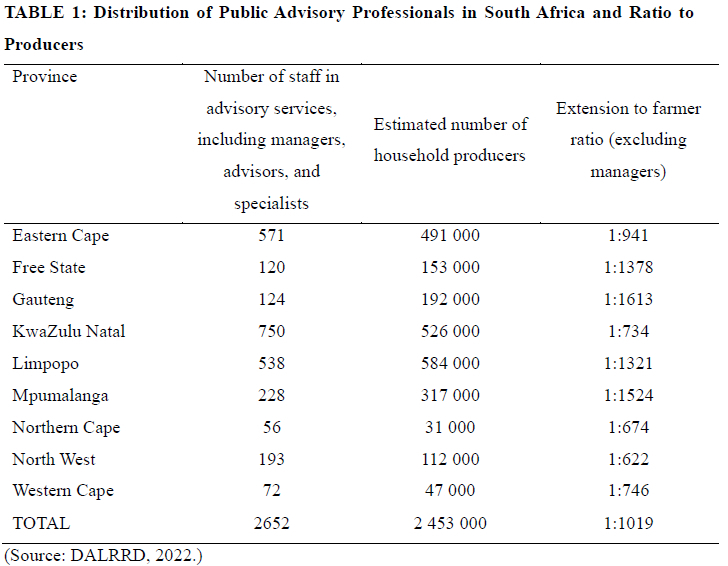
According to the latest figures, there are 2652 public sector agricultural extension professionals (Table 1) and roughly 1500 private sector officials.
3. RESULTS
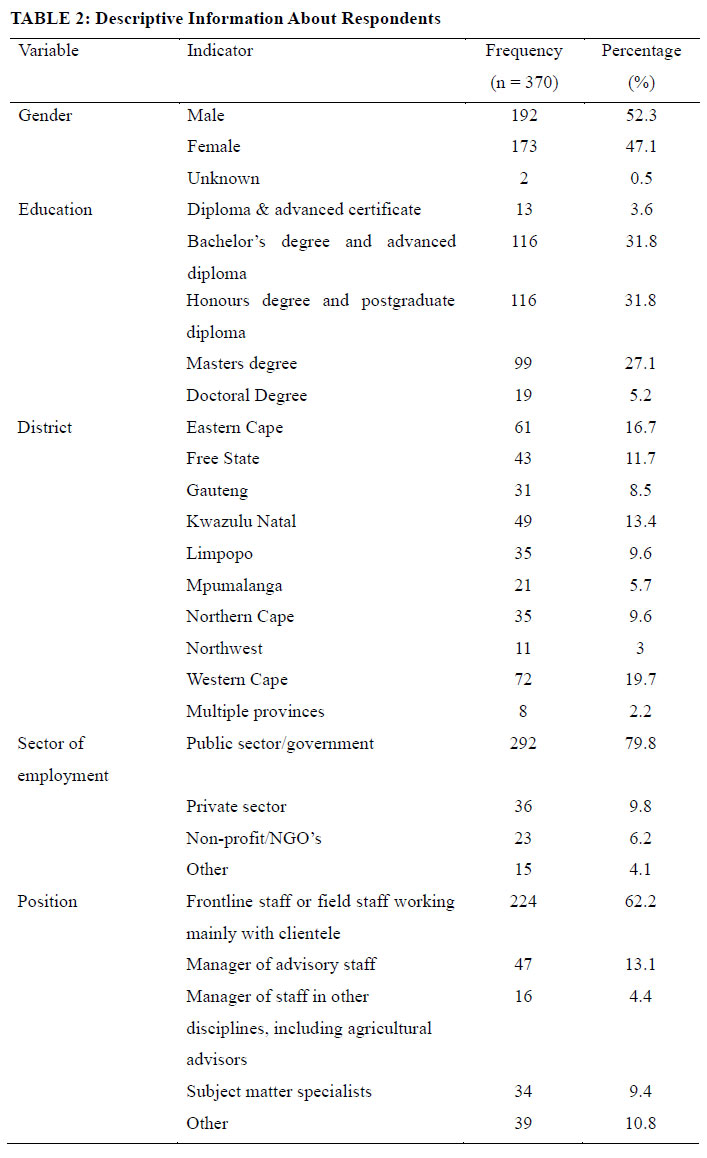
Three hundred and seventy respondents provided consent and completed the survey. An overview of the respondents is provided in Table 2 below:
The respondents answering "other" regarding their position in their job were all involved in agricultural advisory services but did not fit into the provided descriptives.
3.1. The Importance of Different Areas of Knowledge and Skills For Extension/Agricultural Advisory Services in the Future
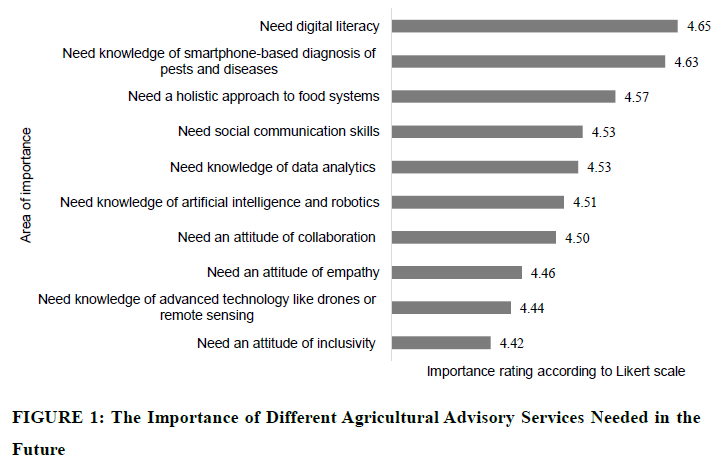
Respondents were asked to rate the importance of different topics according to the following Likert scale:
1 = I strongly disagree; 2 = I somewhat disagree; 3 = I neither disagree nor agree; 4 = I somewhat agree; 5 = I strongly agree The results are illustrated in Figure 1.
The results show that advisory professionals agreed with all the statements given to some extent, indicating that using and knowing different digital platforms is vital for the future. Digital literacy was ranked most important, followed by the smartphone-based diagnosis of pests and diseases. Other skills and competencies related to ICTs included knowledge of data analytics, artificial intelligence and robotics, and advanced technology like drones or remote sensing.
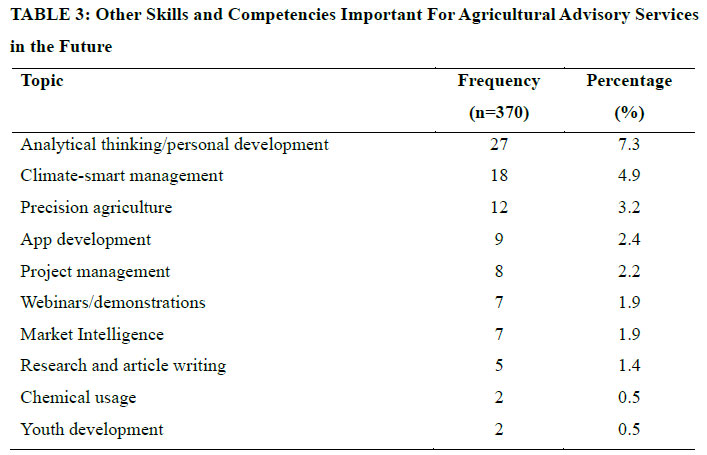
Respondents were asked to include additional topics not listed in the questionnaire, and the responses are summarised in Table 3.
3.2. Attitudes Towards Digital Agricultural Advisory Services
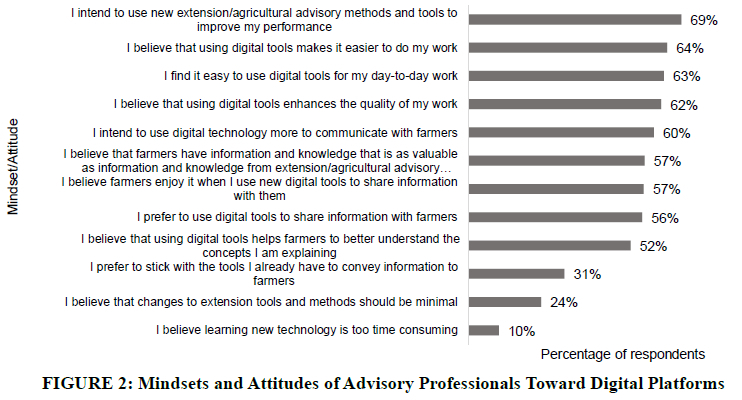
In this section, respondents were asked to indicate their attitudes and preferences toward using digital technologies in their work. Digital technologies were limited to smartphones, tablets, computers, and phone applications. Respondents could answer "yes" or "no" along each topic. The results are shown in Figure 2.
Although encouraging, the results above indicate that there is still some hesitance among agricultural advisory professionals to use digital technologies to perform their duties, which could be attributed to the country's lack of existing digital programs.
More than half (57%) of survey respondents agreed with or had a yes response to the question, "I believe that farmers have information and knowledge that is as valuable as information and knowledge from extension/agricultural advisory officers", reflecting an attitude of superiority that is still present in some cases, which is detrimental to participatory approaches in agricultural advisory services. This agrees with the findings of a study by Davis and colleagues in 2019 (Davis et al., 2019).
3.3. Access to Digital Tools and Usage
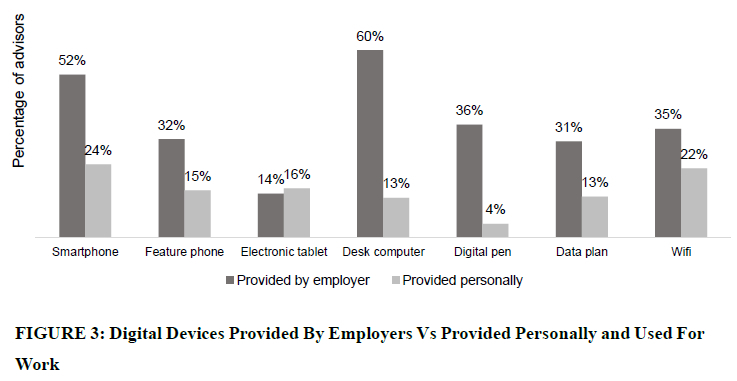
Respondents were asked to identify the digital tools they have access to and if they are provided to them by their employer or if they use their personal ones for work. They were also questioned on data sufficiency to perform their job and then asked which digital tool they used most regularly in performing their work. The results are illustrated in Figure 3.
When performing a sector comparison of digital devices provided by employers, there was a significant difference between the public and private sectors. Their employers better supported public sector employees regarding providing digital devices than private sector employees.
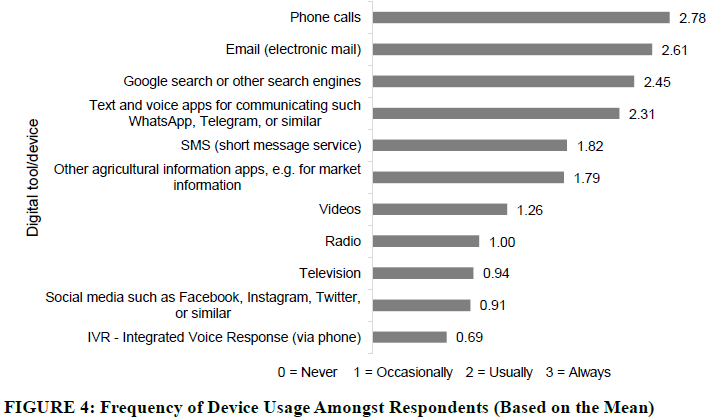
Regarding data sufficiency for work, 45.9% of respondents answered "no," and 54.1% answered "yes". There was a significant difference between public and private sector respondents, with 48.6% of public sector respondents and 81.1% of private sector respondents indicating that they usually have sufficient data to carry out their work on a smart device. Device usage is illustrated in Figure 4.
Phone calls, emails, search engines, and text and voice applications were the tools utilised most frequently by respondents. When comparing, there was a significant difference between male and female usage of search engines and emails, with females using these more frequently than males to conduct their work. Public sector agents also used phone calls, text messages, radio, and television more than private sector agents. Phones, desktop computers, digital pens, and Wi-Fi are more frequently used by agents older than 35 than agents below 35.
4. DISCUSSION
The study revealed that agricultural advisory professionals in South Africa realise the importance of using different digital tools and platforms in agricultural extension. This is consistent with a study conducted among advisory practitioners in the North West province in 2015, which indicated that digital advisory services play a vital role in accessing and sharing agricultural information and providing quality information on time (Oladele, 2015).
The mindset toward digital technologies indicated that most agricultural advisors were ready to use digital platforms, but some professionals still hesitated. Only 52.4% of respondents answered that using digital tools helps farmers better understand concepts, and 60% said they intend to use them more to communicate. This could be attributed to several factors, including the results in the section that indicated that only 52% of respondents were provided with a smartphone and only 35% with Wi-Fi by their employer. Only 54.1% of respondents indicated they usually have sufficient data to carry out their work. Successful execution of digital extension can only be performed if equipped with appropriate tools and adequate data. Lack of support will negatively impact advisors' mindsets toward digital technology (Gfrerer et al., 2021).
Regarding device usage, the results showed that extensionists hardly use social media and videos, focusing more on phone calls, email, and text messages. Using videos in support has been effective in many studies and should be considered (Gandhi et al., 2007; Ibeawuchi et al., 2021; Van Campenhout et al., 2016). Spielman and colleagues (2019) highlight social media's role in improving information sharing through social networking. Information can be customised to suit the needs of specific farmers, and data can be collected through the algorithms that social media employs (Spielman et al., 2019). Avenues other than phone calls, emails, and text messages must receive prioritised attention from policymakers and other stakeholders.
Public-sector agricultural advisors in South Africa are often criticised for being incompetent (Manoko, 2022). Taking advantage of the possibilities that ICTs offer, the South African public agricultural extension sector can access, design, and distribute innovative solutions to their clients and increase the quality of service provided. By providing and maintaining a conducive environment to ensure progress and development in digital agriculture, the public sector can ensure that agricultural development receives the necessary priority to safeguard food security (Cook et al., 2022).
5. CONCLUSION AND RECOMMENDATIONS
The need and scope for developing customised digital agricultural advisory tools in South Africa are substantial. The existing digital agricultural applications mainly focus on the commercial farming sector that pays for the service (Born et al., 2021). To support the smallholder and subsistence farming sector, the government should engage with private sector roleplayers to assist in developing appropriate platforms or use existing platforms for digital agricultural extension. Content has to be context-specific according to location and commodity.
Farmers must be consulted, and their needs must be catered to in formulating efficient digital platforms. Efficient implementation of digital agricultural advisory services can assist in overcoming funding issues in the public sector. Instead of endeavouring to appoint more advisors given the budget constraints, digital communication can be supported and facilitated instead of endeavouring to appoint more advisors, saving costs but still enhancing service delivery. Agricultural advisors must be equipped, trained, and supported to engage digital platforms so that farmers can benefit and food security is enhanced in the process.
The Global Forum for Rural Advisory Services (GFRAS) continuously researches digital advisory services in different countries. The latest report, "Digital advisory services: Global lessons in scaling up solutions", has just been published on their website (Larsen et al., 2023). The recommendations made should be incorporated into the formal training of advisory staff. Higher education institutions offering qualifications in agricultural advisory services must ensure that their modules are regularly updated to equip agricultural students with the digital tools they will use in their workplace. A recent study found that the available agricultural advisory undergraduate degree qualifications in South Africa had very little digital training content or none at all (Von Maltitz et al., 2023).
6. ACKNOWLEDGEMENTS
The research to support this article was conducted as part of the International Food Policy Research Institute (IFPRI) CGIAR Research Program on Policies, Institutions, and Markets.
REFERENCES
ANDERSON, J.R. & FEDER, G., 2004. Agricultural extension: Good intentions and hard realities. World Bank Res Obser., 19(1): 41-60. [ Links ]
ANTWI-AGYEI, P. & STRINGER, L.C., 2021. Improving the effectiveness of agricultural extension services in supporting farmers to adapt to climate change: Insights from northeastern Ghana. Clim. Risk Manag., 32: 1-13. [ Links ]
ARULEBA, K. & JERE, N., 2022. Exploring digital transforming challenges in rural areas of South Africa through a systematic review of empirical studies. Sci. Afr., 16: 2468-2276. [ Links ]
BLUM, M.L., COFINI, F. & SULAIMAN, R.V., 2020. Agricultural extension in transition worldwide: Policies and strategies for reform. Rome: FAO. [ Links ]
BORN, L., CHIRINDA, N., MABAYA, E., AFUN-OGIDA, O., GIRVETZ, E., JARVIS, A. & KROPFF, W., 2021. Digital Agriculture Profile: South Africa. Rome: FAO. [ Links ]
CHAMBERS, R., 1997. Whose reality counts? Putting the last first. London, UK: Intermediate Technology Publications. [ Links ]
CHIVERS, C., BLISS, K., DE BOON, A., LISHMAN, L., SCHILLINGS, J., SMITH, R. & ROSE, D.C., 2023. Videos and podcasts for delivering agricultural extension: achieving credibility, relevance, legitimacy and accessibility. J. Agric. Edu. Ext., 29(2): 173-197. [ Links ]
COGGINS, S., MCCAMMPBELL, M., SHARMA, A., SHARMA, R., HAEFELE, S.M., KARKI, E., HETHERINGTON, J., SMITH, J. & BROWN, B., 2022. How have smallholder farmers used digital extension tools? Developer and user voices from Sub-Saharan Africa, South Asia and Southeast Asia. Glob Food Secur., 32: 1-10. [ Links ]
COOK, S., JACKSON, E.L., FISHER, M., BAKER, D. & DIEPEVEEN, D., 2021. Embedding digital agriculture into sustainable Australian food systems: pathways and pitfalls to value creation. Int. J. Agric. Sustain., 20(3): 346-367. [ Links ]
DAVIS, K., EKBOIR, J. & SPIELMAN, D.J., 2008. Strengthening agricultural education and training in sub-Saharan Africa from an innovation systems perspective: A case study of Mozambique. J. Agric. Edu. Ext., 14(1): 35-51. [ Links ]
DAVIS, K., LANDINI, F., VAN NIEKERK, J.A., GREEN, K. & TERBLANCHE, S.E., 2019. Extension officers' perceptions of extension and innovation in South Africa. S Afr. Jnl. Agric. Ext., 47(4): 152-161. [ Links ]
DAVIS, K., VON MALTITZ, L., DE BRUYN, M., VAN NIEKERK, J.A. & NGOMANE, T., 2021. South African extension agent competencies and attitudes for the future: Results of a survey. Washington, D.C: CGIAR, International Food Policy and Research Institute. [ Links ]
DEPARTMENT OF AGRICULTURE, LAND REFORM AND RURAL DEVELOPMENT (DALLRD)., 2020. Draft review of the national framework for the minimum norms and standards for extension and advisory services in agriculture. Pretoria: Republic of South Africa. [ Links ]
FABREGAS, R., HARIGAYA, T., KREMER, M. & RAMRATTAN, R., 2022. Digital agricultural extension for development. In T. Madon, A.J. Gadgil, R. Anderson, L. Casaburi, K. Lee & A. Rezaee (eds.), Introduction to development engineering. Cham: Springer. [ Links ]
GFRERER, A., HUTTER, K., FÜLLER, J. & STRÖHLE, T., 2021. Ready or not: Managers' and employees' different perceptions of digital readiness. Calif. Manag. Rev., 63(2): 2348. [ Links ]
GANDHI, R., VEERARAGHAVAN, R., TOYAMA, K. & RAMPRASAD, V., 2007. Digital green: Participatory video for agricultural extension. In 2007 International Conference on Information and Communication Technologies and Development, Bangalore, India, pp. 1-10. [ Links ]
HABIYAREMYE, A., KING, N.A. & TREGENNA, F., 2022. Innovation and socio-economic development challenges in South Africa: An overview of indicators and trends. SARChI Industrial Development Working Paper Series WP 2022-03. The South African Research Chair in Industrial Development (SARChI), University of Johannesburg, South Africa. [ Links ]
HELLIN, J., 2012. Agricultural extension, collective action and innovation systems: Lessons on network brokering from Peru and Mexico. J. Agric. Edu. Ext., 18(2): 141-159. [ Links ]
IBEAWUCHI, B.O., ADISA, P.T., GBEDE, O.I., BILISUMA, K.W., DERARA, S.F. & AMINU, H.A., 2021. Review of the usage of video in agricultural extension to increase the adoption of agricultural innovation. J. Commun. Communication. Res., 6(2): 110-118. [ Links ]
KLERKX, L., JAKKU, E. & LABARTHE, P., 2019. A review of social science on digital agriculture, smart farming and agriculture 4.0: New contributions and a future research agenda. NJAS- Wageningen J. Life Sci., 90-91: 1-16. [ Links ]
KNOOK, J., EORY, V., BRANDER, M. & MORAN, D., 2018. Evaluation of farmer participatory extension programmes. J. Agric. Edu. Ext., 24(4): 309-325. [ Links ]
LARSEN, C.E.S., NIELSON, D., OLIVEIRA, S.K. & PAYNE, J., 2023. Digital advisory services: Global lessons in scaling up solutions. Lausanne, Switzerland: GFRAS. [ Links ]
LAVOPA, A. & DELERA, M., 2021. What is the fourth industrial revolution? Industrial Analytics Platform, UNIDO. Available from: https://iap.unido.org/articles/what-fourth-industrial-revolution. [ Links ]
MANOKO, T., 2022. "We want competent extension officers, please." Food for Mzansi. Available from: www.foodformzanzi.co.za. [ Links ]
MCCAMPBELL, M., ADEWOPO, J., KLERKX, L. & LEEUWIS, C., 2023. Are farmers ready to use phone-based digital tools for agronomic advice? Ex-ante user readiness assessment using the case of Rwandan banana farmers. J. Agric. Edu. Ext., 29(1): 29-51. [ Links ]
MINH, T.T., ERIK, C., LARSEN, S. & NEEF, A., 2010. Challenges to institutionalising participatory extension: The case of farmer livestock schools in Vietnam. J. Agric. Edu. Ext., 16(2): 179-194. [ Links ]
NJUGUNA, N. & SIGNÉ, L., 2020. The fourth industrial revolution and digitisation will transform Africa into a global powerhouse. Capturing the Fourth Industrial Revolution. A regional and national agenda. Washington D.C: The Brookings Institution. [ Links ]
NYAWO, J.C. & MASHAU, P., 2019. The development of the rural roads network for sustainable livelihoods in South African local municipalities. Gender and Behaviour., 17: 12553-12568. [ Links ]
OLADELE, O.I., 2015. Effect of Information Communication Technology (ICT) on agricultural information access among extension officers in North West Province South Africa. . S Afr. Jnl. Agric. Ext., 43(2): 30-41. [ Links ]
OLANGUNJU, O., HASSAN, S., SAMAD, M.Y.A. & KASIN, R., 2021. Enhancing work performance of extension agents among cocoa farmers in Malaysia: The influence of human resource development skills. Walailak J. Sci. & Tech., 18(5): 1-15. [ Links ]
OYINBO, O., CHAMBERLIN, J. & MAERTENS, M., 2020. Design of digital agricultural extension tools: Perspectives from extension agents in Nigeria. J. Agric. Econ., 71(3): 798-815. [ Links ]
SARAVANAN, R., SULAIMAN, R.V., DAVIS, K. & SUCHIRADIPTA, B., 2015. Navigating ICTs for Extension and Advisory Services. GFRAS Good Practice Notes for Extension and Advisory Services, Note 11. Lindau, Switzerland: GFRAS. [ Links ]
SCHWAB, K., 2017. The fourth industrial revolution. London, UK: Portfolio Penguin. [ Links ]
MINISTRY OF FINANCE., 2021. The national budget speech. Republic of South Africa. [ Links ]
SPIELMAN, D., ROSENBACH, G., MAKHIJA, S. & DAVIS, K., (Forthcoming). Assessing Agricultural Extension Agent Digital Readiness: Results of a Representative Survey in Rwanda. Rwanda Strategy Support Program Working Paper. [ Links ]
SPIELMAN, D., LECOUTERE, E., MAKHIJA, S. & VAN CAMPENHOUT, B., 2021. Information and communication technology (ICT) and agricultural extension in developing countries. Annu. Rev. Resour. Econ., 13: 177-201. [ Links ]
STATISTICS SOUTH AFRICA (STATS SA)., 2023. Census 2022. Statistical release: P03014. Pretoria: Republic of South Africa. [ Links ]
STEINKE, J., VAN ETTEN, J., MÜLLER, A., ORTIZ-CRESPO, B., VAN DE GEVEL, J., SILVESTRI, S. & PRIEBE, J., 2021. Tapping the full potential of the digital revolution for agricultural extension: an emerging innovation agenda. Int. J. Agric. Sustain., 19(5-6): 549-565. [ Links ]
TSAN, M., TOTAPALLY, S., HAILU, M. & ADDOM, B.K., 2019. The Digitalisation of African Agriculture Report 2018-2019. Wageningen, The Netherlands: CTA/Dalberg Advisers. [ Links ]
VAN CAMPENHOUT, B., VANDEVELDE, S., WALUKANO, W. & VAN ASTEN, P., 2016. Agricultural extension messages using video on portable devices: Increase knowledge about seed selection and seed storage and handling among smallholder potato farmers in southwestern Uganda. IFPRI Discussion Paper 1573. Washington, D.C: International Food Policy Research Institute (IFPRI). [ Links ]
VON MALTITZ, L., DAVIS, K., SUVEDI, M., CHANZA, C., AGWU, A.E., SASIDHAR, P.V.K., DIMELU, M.U., LIVERPOOL-TASIE, L.S.O., ANUGWA, I.Q. & TCHUWA, F., 2023. Strengthening agricultural extension training: process skills and competency gaps in undergraduate agricultural extension curriculum in South Africa. Partnerships for Innovative Research in Africa (PIRA) Research Report. East Lansing, Michigan, USA: Alliance for African Partnership, Michigan State University. https://aap.isp.msu.edu/index.php?cID=452 [ Links ]
WALL, K., 2021. The right to functioning urban infrastructure - A review. Town and Regional Planning., 79: 55-66. [ Links ]
XU, M., DAVID, J.M. & KIM, S.H., 2018. The fourth industrial revolution: Opportunities and challenges. Int. J. Financ. Res., 9(2): 90-95. [ Links ]
ZHAI, S., PENG, C. & SHENG, Y., 2023. Assessing the impact of digital financial inclusion on agricultural total factor productivity in China. Int. Food Agribus. Manag. Rev., 26(3): 519-533. [ Links ]
 Correspondence:
L. Von Maltitz
Correspondence Email: vonmaltitzL@ufs.ac.za