




Services on Demand
Journal

Article
 English (pdf)
 Article in xml format
 Article references
 Automatic translation
 Send this article by e-mail
Indicators
Related links
-
 Cited by Google
 -
 Similars in Google
Share

 Permalink
HTS Theological Studies
On-line version ISSN 2072-8050Print version ISSN 0259-9422
Herv. teol. stud. vol.81 n.2 Pretoria 2025
https://doi.org/10.4102/hts.v81i2.10728
ORIGINAL RESEARCH
From a public thief to benefactor: Using the fusion of horizons to read Luke 19:1-10 in Malawi
Louis NdekhaI, II
IDepartment of Theology and Religious Studies, School of Humanities and Social Science, University of Malawi, Zomba, Malawi
IIDepartment of Ancient and Biblical Studies, School of Humanities, University of South Africa, Pretoria, South Africa
ABSTRACT
This article examines the narrative of Zacchaeus in Luke 19:1-10 through two perspectives: the text and its Malawian readers. It utilises Gadamer's concept of the two horizons, highlighting how the different dimensions shape understanding. The analysis reveals that both contexts deal with exploitation, but their respective responses vary. Zacchaeus face acceptance from Jesus and ostracism from his community, whereas in Malawi, public offenders often gain celebrity status without accountability. The contrasting reactions provide a heuristic context for addressing exploitation, ultimately enhancing Malawian Christians' awareness and commitment to justice regarding national resource exploitation. Through this analysis, the article demonstrates the continuing relevance of Gadamer's fusion of the horizons in Africa and how the paradigm can enhance the use of biblical text in dealing with social issues.
CONTRIBUTION: The study celebrates and continues the work of Prof. Mazamisa, who devoted his life to applying the paradigm of the reader, text and the two horizons as a framework for reading biblical texts
Keywords: fusion of horizons; Gadamer; Jesus; Zacchaeus; Malawi; economic justice.
Introduction
This study examined the narrative of Zacchaeus in Luke 19:1-10 through the paradigm of the two horizons, that of the reader and the text. Gadamer and Thiselton present a horizon as a framework that shapes one's worldview, which can be expanded and revised through interaction with other perspectives (Gadamer 2007; Thiselton 1992). In this fusion of horizons, a genuine understanding emerges between minds. The objective of interpretation is to create a meaningful engagement between the reader and the text, ensuring accurate comprehension while enriching the interpreter's own understanding. Using the paradigm of the two horizons, the study examined the horizon within the narrative of Luke 19:1-10 vis-à-vis the experiences of Malawian readers. In both contexts, communities bear the brunt of exploitation by national elites who collude with foreign entities to take advantage of the populace. However, each horizon exhibits different reactions to such exploitation. Within the world of Luke 19:1-10, a wealthy man embodying exploitation elicits two contradictory social responses: a warm and generous welcome from Jesus (Lk 19:5) and social ostracism from his community (Lk 19:7). In contrast, within the Malawian context, known embezzlers of public resources often achieve celebrity status and are seldom held accountable for their transgressions. This study argues that the contrasting responses of Jesus and the Jerichoan community offer the Malawian reader valuable and complementary strategies for engaging with individuals like Zacchaeus, who exploit public resources for personal enrichment. Ultimately, the fusion of the textual horizon and that of the Malawian reader serves as a heuristic framework for investigating how the narrative in Luke 19:1-10 can expand, revise, and enhance Malawian Christians' awareness of and commitment to justice amid the rampant plunder of national resources. The study adopts an interdisciplinary methodology, integrating the two horizons paradigm, historical-critical analysis and social-historical analysis. The fusion of these horizons serves as the overarching theoretical framework, which is critically informed by a historical-critical examination of Luke 19:1-10 alongside a social-historical analysis relevant to the Malawian context. This interdisciplinary approach facilitates a clear delineation of both the reader's horizon and that of the text prior to engaging them in a dialogical interaction.
The study has three sections. The first section discusses the paradigm of the reader, text and the two horizons and their relevance for analysing Luke 19:1-10 in a Malawian context. The second section examines the horizon in Luke 19:1-10, specifically Jesus' reception of Zacchaeus vis-à-vis that of the Jerichoan community and its implications for the community's quest for economic justice. The third section brings into dialogue the horizon in Luke 19:1-10 and that of the Malawian reader and its implications for the Malawian reader's quest for justice amid the rampant plundering of national resources. Through this analysis, the article demonstrates the continuing relevance of Gadamer's fusion of the horizons in Africa in how the paradigm can enhance the use of biblical text in dealing with social issues. Beyond this, the study celebrates and continues the work of Prof. Mazamisa, who devoted his life to the application of the paradigm of the reader, text and the two horizons as a framework for reading biblical texts.
The reader, the text and the two horizons: Theoretical perspectives
The relationship between the text and the reader has historically been at the centre of the hermeneutical task (Gadamer 2007:157). The relationship assumes an intricate association between the reader and the text, such that the text has no meaning without the reader, just as there is no reader without a text. The two-dimensional nature of the interpretative task suggests that both the reader and the text exert their influence, both influencing and being influenced by the other (cf. eds. Suleiman & Crosman 2014:vii). This dynamic arises from the fact that the reader and the text belong to two different worlds, and both worlds exert a considerable influence on the interpretative task. Thus, not only does reading shape a reader's view, but also that a reading exercise has the potential for generating multiple interpretations (Golden 1986:91). The interaction between the horizon of the text and that of the reader is what is referred to as the 'fusion'. In contemporary hermeneutics, this relationship is often understood in terms of horizons. Key to the analysis of the two horizons as an interpretative paradigm has been by the pioneering works of Hans-Georg Gadamer and Antony Thiselton. Gadamer defines a horizon as a framework that shapes one's worldview, a range of vision that includes everything that can be seen from a particular vantage point (Knotts 2014:236). Therefore, for Gadamer, in a hermeneutical context, understanding involves the fusion of horizons, which in essence entails the process of bridging the gaps between then and now (Knotts 2014:239). Gadamer also points to the fact that the interpreter's pre-understanding, which informs their approach to the text, is a critical element in extracting meaning (Knotts 2014; cf. Jauss 2001). He argues that the reader's encounter with the text is never totally abstract; one brings to the text a set of prejudices, presuppositions and preconceived notions which are challenged and engaged in the process of reading (Knotts 2014:235). Gadamer posits that a horizon of understanding is dynamic rather than static (Knotts 2014:137). A horizon can be broadened and refined through engagement with diverse perspectives. In the process of interpretation, the text serves as a contrasting horizon that intersects with the reader's own world. The text embodies the voices of the ancients, who, according to Gadamer, possess valuable insights that are relevant to contemporary discourse. This premise suggests that the ancients offer cognitive content and truths worthy of reflection by moderns (Knotts 2014:234). The representative nature of texts as horizons emanates from the fact that even in their original settings, texts were products of horizons. Jauss (2001) argues:
[T]hat the past event cannot be understood without taking into account its consequences, that the work of art cannot be separated from its effects. The very history of effects and the interpretation of an event or work of the past enables us to understand it as a plurality of meanings that was not yet perceivable to its contemporaries. (p. 7)
Here, Jauss presents the text as a product of complex and uncompleted interpretative processes of its time. Thus, in keeping with Gadamer, the text's cognitive content and implied truths, which, even at the time of its writing, were developing and responding to contextual factors, represented a way of looking at reality that resonated with that world. Yet even though the text represented that ancient world, it also has significance for the modern reader.
Jauss and Gadamer's position finds support in Joel Green's perspective on the role of gospel text for their primary and subsequent audiences (Ndekha 2020b:219). For example, using Luke's Gospel as an example, Green argues that in addition to contemporary issues, the gospel also presents a world in which God intervenes through miraculous conceptions and many other idealised phenomena. This, according to Green, suggests that Luke's narrative, and that of the other gospel writers, were both a response to contemporary issues and an invitation to embrace an alternative worldview and to live as if the reign of God had already revolutionised that age (Green 1997:11; Ndekha 2020b:219). This understanding demonstrates that even as ancient texts interacted with their primary audiences, they also, in the process, presented to later generations truths, perspectives and realities which they could not ignore. This is because, as Gadamer posits, texts are invested with some significant level of cognitive content, intentional properties or serious material which will challenge a reader's beliefs (Knotts 2014:237). The new truths and perspectives in the text become 'prejudice-busters' (Knotts 2014:237). Beyond their original contexts, the text becomes more than a description or report of historical events. They can also facilitate the critique of a reader's perspective and become agents of change in the reader's conception of reality. Thus, as Knotts (2014:239) posits, understanding therefore consists in the fusion of horizons, in hermeneutically bridging the gaps between then and now by, among other things, allowing each horizon full consideration and respect. It entails the reader both respecting the rights of the text and allowing it to speak. However, this fusion, according to Gadamer, need not be understood in terms of the reader entering the other horizon and becoming one with the mindset of the other time and place. Rather, as Knotts (2014:239) argues, it implies a common understanding at the level of a 'higher universality'. The bridging or 'fusing' of horizons involves creating a meaningful engagement between the reader and the text, ensuring accurate comprehension while enriching the interpreter's own understanding (Knotts 2014:239).
Gadamer's hermeneutical paradigm has been hailed for its distinctiveness in accepting the possibility of dialogue with texts, its recognition of the role of language in dialogue, and the importance of fusion of horizons as a product of successful dialogue between the text and the reader (Vessey 2009:251). However, Antony Thiselton took the discussion of the paradigm of the two horizons to another level. Unlike Gadamer, who places the hermeneutical task within the general context of the interaction between a reader and ancient text, Thiselton places the challenge within biblical hermeneutics, particularly on the relationship between language and hermeneutics. In his book titled New horizons in hermeneutics: The theory and practice of transforming biblical reading, Thiselton (1992) examined how language conveys meaning, particularly how a person today interprets Scripture or any other ancient document written in a culture far different from their own. In keeping with Gadamer's two horizons, Thiselton (1992:8) notes the propensity of the biblical text to engage readers in ways which can transform attitudes and criteria of relevance both at a communal and interpersonal level. According to him, the very fact that the act of reading can result in the re-ranking of expectations, assumptions and goals which readers initially bring to texts has implications on the relationship between a reader and a text. It suggests that a key aspect of the hermeneutical task is to blend two perspectives: that of the original writer, who expressed his thoughts within a specific historical and intellectual context, and that of the contemporary reader. Thiselton, therefore, describes a horizon as an interconnected web of expectations and assumptions that readers bring to a text, shaped by shared behaviours and beliefs that guide interpretation (Thiselton 1992:46). He emphasises that the ultimate aim of any interpretative act is to move towards a fusion of horizons, where the insights of the interpreter harmonise with those of the text or tradition (cf. Bartholomew 1996:126). In general, Thiselton (1992) posits that the dialogue between the reader and the text enriches the reader's understanding, allowing them to transcend simple subjective views or strict traditionalism. By embracing this fusion, the reader can uncover deeper meanings and cultivate a more profound appreciation for the text at hand.
The significance of using the paradigm of the two horizons in contemporary hermeneutics cannot be over-emphasised. At the core of its significance is the way the paradigm facilitates new awareness and change in perspective, especially in the context of societal pursuit of truth. The concept of the two horizons assumes meaning as a product of experiential reality. Thus, since a horizon is subject to expansion and revision, in the process of fusing horizons, understanding occurs between minds, and the reader grows in their awareness and pursuit of truth (Knotts 2014:239). Similarly, as Yilmaz (2022:232) has demonstrated, the paradigm has the potential to promote ethical dialogue in a community context. This understanding assumes culture or tradition as both a self-enclosed structure that is given by one's horizon and one that continuously points past this horizon in genuine dialogue (cf. Pertierra 2020:46). One of the natural consequences of cultural dialogue is the creation of cultural hybrids, which in some contexts can be termed as alternative cultures (Timalsina 2020). In this case, as Oman (2000:16) argues, while the paradigm of the two horizons does not offer a blueprint for achieving intercultural understanding, it provides the foundation for efforts to work towards the resolution of intercultural disagreements. It suggests that where texts are critically studied concerning both their affinity and conflicting horizons with the social-cultural trends of the reader's world, it has the potential, as Oman (2000:16) suggests, to address the distortive effect of power inequalities in society. All this signifies that the paradigm of the two horizons has heuristic significance for reading biblical texts in certain social conditions.
Sasaki (2011:45 ff) lays out six conditions for the possible process of the fusion of the horizons:
-
Condition 1: Interpretation is bound by the cultural tradition to which it belongs.
-
Condition 2: The basic cluster of texts as the basis of interpretation, namely textual interpretation practices influence interpretation.
-
Condition 3: The temporal distance between the horizons of the text and that of the interpreter.
-
Condition 4: The claim to truth that brings the fusion of horizons.
-
Condition 5: The transformation of the interpreter's worldview.
-
Condition 6: The spatial distance which the fusion cannot overcome.
While all six conditions for the fusion of horizons are significant, conditions 4 and 5 are particularly pertinent for this study. Firstly, the claim to truth that the text's horizon brings to the interpretative task is important in the present study. It helps in bridging the gap between the world of the Jerichoan community and that of the Malawian reader confronted with similar challenges as their 1st-century counterpart. Gadamer says (cited in Sasaki 2011):
When we read a text, we assume its completeness. Not only does the reader assume an immanent unity in meaning, but his understanding is likewise guided by the constant transcendent expectation of meaning that proceeds from the relation to the truth of what is being said. (p. 47)
In consonance with Gadamer's observation, in examining Luke 19:1-10, the Malawian reader engages with the text's inherent truth claims, which resonate profoundly within the Malawian socio-cultural context. Secondly, the analysis in this study is interested in the possible transformation of the Malawian worldview arising from the interaction with the narrative of Luke 19:1-10. Such transformation should align with the Malawian reader's aspirations for economic justice, especially regarding the accountability of those who misappropriate national resources.
The two-pronged horizon in Luke 19:1-10
The story of Zacchaeus is one of the well-known narratives found in Luke's Gospel. The narrative has its context in Luke 18:18-30, wherein Jesus discusses the possibility of the rich to enter the kingdom of God (Lk 18:18-30). Within this context, the account in Luke 19:1-10 continues the discussion on the possibility of salvation for the wealthy and how this would influence their perspective on material possessions. Numerous scholarly works centre on the narrative's role within the early Christian movement, with Luke 19:1-19 frequently seen as pivotal to Luke's examination of the interplay between socio-economic classes, particularly the rich and the poor, and the transformative dimensions of salvation on these dynamics (Balch 2003; Ndekha 2020a; Tannehill 1996). Ndekha (2020b:199) offers a critical analysis of the Zacchaeus narrative within academic discourse, highlighting how various scholars have nuanced its interpretive functions in relation to the early church. Key themes identified include the narrative's portrayal of Zacchaeus as a positive exemplar for wealthy individuals who distribute their resources to the underprivileged (cf. Balch 2003:1145; Tannehill 1996:277), its emphasis on inclusivity regarding the potential marginalisation of tax collectors and other societal outcasts in the nascent Christian community (Tannehill 1996:277), and its apologetic role in validating the presence and influence of Christian patrons within early Christian circles (Balch 2003:1145). Furthermore, Motuku (2023) analyses Luke 19:1-10 from the perspective of economic justice, highlighting Luke's critique of native collaborators like Zacchaeus who profit from Roman oppression of impoverished farmers. He argues that Greco-Roman elites accumulate wealth through heavy taxation and land seizure, benefiting the wealthy at the expense of the poor. Motuku (2023:21) suggests that Luke's message reflects God's economy, which opposes the unjust Greco-Roman system. Zacchaeus is depicted as embodying the radical response necessary to embrace Luke's compelling call. Evidently, Motuku, Balch, and Tannehill portray Zacchaeus as a model disciple or repentant thief whose encounter with Jesus exemplifies the essence of being a follower of Christ within the context of the Greco-Roman world. Finally, in a recent analysis, Isachsen (2024) places Zacchaeus' story and related stories in the question of discipleship within the early Christian movement. However, according to him, this discipleship is to be understood within the context of the demand for radical redistribution of wealth between the rich and the poor, proclaimed to householders and people of material wealth (Isachsen 2024:35). According to him, this approach represents Luke's economy of salvation in the Third Gospel.
The above readings present insightful perspectives on Luke 10:1-19. It is also evident that the emphasis in the above studies is placed on Jesus' encounter with Zachaeus and its implications for the latter's economic outlook, including its function within the early Christian movement. However, there is a dimension of the story which is rarely noticed, but which represents a unique horizon to the text of Luke 19:1-10. It is possible to see Luke 19:1-10 from the perspective of a community seeking economic justice and their response towards those accused of exploiting the masses. Considering the Hellenistic milieu of the Third Gospel, this viewpoint aligns with the prevailing negative perceptions that Greek culture held regarding wealth and the affluent class (Desmond 2006:4-5). This sentiment is similarly mirrored in the attitudes of the Jerichoan community towards Zacchaeus, highlighting a broader socio-cultural disdain for the wealthy in the context of the text. The study's argument is that a close reading of Luke 19:1-10 reveals that at the heart of the text is how to deal with social pariahs, such as tax collectors, in a community context. Thus, within the world of the text, a wealthy man embodying exploitation elicits two contradictory social responses: a warm and generous welcome from Jesus (Lk 19:5) and social ostracism from his community (Lk 19:7). The appreciation of these approaches to dishonest wealth for a reader who faces similar truth claims would have implications for their understanding of the reality of their time.
Luke 19:1 presents Zacchaeus as a wealthy tax collector who wanted to see Jesus but was not only unable to do so on account of his short stature but also one who is not socially approved by his community (Lk 19:7). The reference to him as ἀρχιτελώνης and πλούσιος places Zacchaeus high within the Greco-Roman social structure. Ndekha (2020b:199) demonstrates that in the Friesen Poverty Scale, chief tax collectors are grouped under municipal elites on level 3 (PS3) with an average annual income of 25 000-150 000 denarii a year. Such individuals belonged to the upper 2% of the Greco-Roman structure. Table 1 shows the Friesen Poverty Scale adopted by Ndekha in analysing the social status of Zacchaeus.1
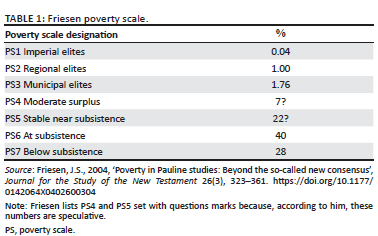
Ndekha (2020b:199) demonstrates that from the poverty scale, municipal elites constituted decurial families, wealthy men and women who did not hold office, some freed persons, some retainers, some veterans, and some merchants (cf. Friesen 2004:341). Municipal authorities were the retainer class and comprised those who supported the governing elite by serving them in various functions, including collecting taxes (Lenski 1984; cf. Autero 2011:37). Security forces also fell under the retainer class. In the Greco-Roman world, this class of municipal authorities, including all the rich, commanded significant authority and respect. Ndekha (2020b:206) demonstrates how the power and influence of the rich in society enabled them to be called οἱ γνώριμοι (Ari. Ath. Con., 1), the notables, the οἱ διωνομασμενοι, the distinguished by name (Iso. Aga. Loc. 20:19), and οί δυνάμενοι (Dem. Frag. 255), the powerful. This power and influence were buttressed by the fact that they could afford the gift of friendship or entertainment to visitors. Through this, they created networks of friendships and maintained those networks through offering expensive gifts (Eur. Tro. Wom. 1249) (Ndekha 2020a). In public places and streets or marketplaces, the rich were given reverence or space by the masses, including special seats or best view. In Matthew 5:23, these spaces are referred to as 'chief seats' which enabled those who occupied them 'to be seen of men' (Mt 23:5).
This analysis indicates that, under typical circumstances, Zacchaeus would have been considered an honourable man in Jericho. It suggests that he would not have had difficulty seeing Jesus. Generally, wealthy individuals like Zacchaeus would have been afforded the right of way and given the best vantage point to view Jesus, or Jesus would have been approached directly and encouraged to engage with Zacchaeus. For example, in Luke 7:1-9, the centurion who wanted Jesus' assistance but could not approach him was assisted by leaders of the synagogue to have Jesus come and heal his servant. In Luke 7:4-5, when the leaders of the synagogue came to Jesus, they pleaded earnestly with him, saying, 'This man deserves to have you do this, because he loves our nation and has built our synagogue'. Here, the status of centurion, including his benevolence to the Jews, became the social capital that enabled him to obtain local assistance to access Jesus. Inversely, there was no one willing to assist Zacchaeus to see Jesus. It took Zacchaeus himself to make an effort to see Jesus. Contrary to the social expectation of the rich in Luke 19:4, Zacchaeus ran ahead and climbed a sycamore-fig tree to see Jesus. This action was fraught with cultural implications. Climbing a tree in 1st-century Judea and the Greco-Roman world in general would have been perceived as an undignified act, akin to the frivolity associated with childhood play, termed παιδιά [childhood], παίζειν [to play a sport] or παιγνία [playful]. Such behaviours evoked notions of immaturity and social embarrassment (cf. Theo. 1211 and Ari. Fro. 375) (cf. Ndekha 2020b:149-150). In all this, the narrative illustrates Zacchaeus' plight as a socially isolated, affluent individual, marginalised by the community. The profound alienation experienced by Zacchaeus within the Jerichoan community is notably highlighted by the collective dissent expressed by the crowd concerning Jesus' choice to enter Zacchaeus' home (Lk 19:7). This murmuring served as a manifestation of the community's overarching sentiment and illustrates Zacchaeus' exclusion from their social structure. The verbal rejection effectively situated him as a discernible outsider within the societal context.
The Jerichoan community's rejection of Zacchaeus was rooted in his identity as a tax collector, which, by extension, labelled him a public thief. The designation of ἀρχιτελώνης or chief tax collector, indicates that he was responsible for overseeing the collection of various tolls in the region (Danker 1988:305). As such, he profited financially from collaborating with Roman oppressors to extract resources from impoverished agrarian farmers. This practice, in turn, supported the wealth accumulation of Greco-Roman elites who imposed heavy taxes and seized land through oppressive systems designed to benefit the affluent (Motuku 2023:137). Hutson (2014) summarises the role of chief collectors and their propensity to public ridicule:
Under the Roman Republic (which preceded the Empire), private businessmen called 'publicans' bid on public contracts for various government jobs, including tax collection. To handle the vast sums, publicans formed associations, something like modern corporations, each headed by a lead bidder and a few officers backed by many investors. Having bid to deliver to Rome a specified amount from a province, they worked with local officials, who collected within their districts. Taxes on agriculture and import customs were subject to unpredictable fluctuations, so getting the numbers right was a tricky business. Publicans were also moneylenders, speculators, and contractors supplying materials for the army. Such enterprises provided opportunities for cooking the books, commodities speculation, side deals, graft, and extortion to defraud Rome, local officials, fellow investors, and average citizens. (p. 165)
From the above excerpt, it is evident that being referred to as the chief tax collector implies that Zacchaeus was an outcast in his local community. He was grouped with sinners, the lame, the blind, the prostitutes, and the other so-called expendable members of society, even though his riches and position should have gained him respect in his community and culture (cf. Motuku 2023; Neyrey 1988). Consequently, although he was evidently rich and therefore, technically a leader, the crowd could not make way for him (Lk 19:3). In addition, the bystanders' discontentment with Jesus' proposition to be hosted by Zacchaeus points to his low social status in Jericho (Lk 19:7) (Ndekha 2020a; cf. Nolland 1989:905). From the description of the work of the chief tax collectors, the Jerichoan community's attitude to Zacchaeus epitomised Jewish opposition to self-enrichment at the expense of the poor. By implication, the attitude characterised Jewish nationalism and its inherent abhorrence of any Jewish subjects who collaborated with foreign sources to exploit their own people. This Jewish attitude, exemplified in the Jerichoan community, resonates with the Greek conception of riches, which regarded riches not so much as a material fact but far more as an ethical and political phenomenon with individual greed as the controlling factor (Desmond 2006:4-5; Ndekha 2020a). Thus, in the Jewish context, while rich benefactors such as the centurion (Lk 7) were respected, those natives who became rich at the expense of the poor, like tax collectors, were given the social ostracism they deserved. It is not possible to establish the extent to which this Jewish attitude would have served as a deterrent to economic traitors like tax collectors. However, the negative attitude to Zacchaeus demonstrated the entrenched nationalist values the community placed on its members and the consequences for breaching the same. This demonstrates a Jewish commitment to have no respect for those known to acquire their wealth through dishonesty at the expense of the poor.
Inversely, within the same text of Luke 19:1-10 Jesus presents an alternative response to self-enrichment and exploitatin of the rich. In total defiance of social norms, Jesus chose to meet and be welcomed by an individual whom society had marginalised (Lk 19:5). His attitude represented a gentle, warm and ultimately disarming acceptance of a public exploiter who faced social ostracism. This interaction had profound implications not only for Zacchaeus himself but also for the impoverished masses of Jericho and its surroundings. Jesus' generous acceptance of Zacchaeus offered the latter a chance to repent from his economically fraudulent practices and to reconcile with his estranged community by making economic restitution through divesting his wealth to those affected by his unjust actions (Motuku 2023:71). Through his encounter with Jesus, Zacchaeus was willing to rearrange his finances by giving half of his ὑπάρχοντα, possessions, to the poor, and to repaying fourfold to anyone he had defrauded. Levine and Witherington (2018:512) argue that the present form of Zacchaeus' declaration in Luke 19:8 has been a source of considerable hermeneutical controversy. Some think the present indicative active δίδωμι [I give] and ἀποδίδωμι [I restore] suggest regular practice; that it is Zacchaeus' response to the crowd's negative reaction; that he is a benevolent individual, although no one appreciated it in his community. However, most scholars think that Luke 19:8 is Zacchaeus' statement of intent, a change in his social orientation. This latter view is supported by Zacchaeus's reference to 'Lord'. The vocative Κύριε [Lord] suggests that he is responding to Jesus' magnanimous welcome of him (Culpepper 1995:358; Evans 1990:280; Franklin 2001:951; Green 1997:671; Levine & Witherington 2018:512; Ndekha 2020a). The declaration demonstrates the transforming nature of Jesus' warm and non-judgemental approach and its ability to turn a public thief into a benefactor to the people of Jericho and the surrounding areas. It is noteworthy that, although he does not state that he is no longer a tax collector, by rearranging his finances and giving half of his ὑπάρχοντα, possessions, to the poor, and to repaying fourfold to anyone he has defrauded, Zacchaeus was technically quitting the profession. As Hutson (2014:165) notes, agricultural taxes and import customs often fluctuated unpredictably in the Greco-Roman world. This unpredictability created considerable challenges in accurately assessing revenue for the tax collector and probably fuelled their involvement in underhanded deals. This challenge and its consequences would have made the job of tax collector for the now-righteous Zacchaeus tricky.
The effectiveness of Jesus' approach in turning a public thief into a benefactor demonstrates the method's efficacy and raises the question of the best approach to deal with public looting of national resources: shunning the rich who exploit the poor, as in the case of the Jerichoan community, or, as Jesus did, a firm and loving approach. However, any answer to the question of which approach - Jesus' or the Jerichoan community's - was the most effective in transforming Zacchaeus, needs to be placed within the context of the totality of his experiences. It is noteworthy that what became of Zacchaeus at the end of the narrative was a product of his experiences. He was a lonely man shunned by his community. His decision to meet Jesus and eventually become a benefactor reflected his overall experience, which, among others, included his desire to win back his place in the community that ostracised him. Therefore, it is plausible to postulate that his ostracism by the community and the warm and non-judgemental attention from Jesus coalesced to create a new benefactor of the community out of a former public thief. The significance of this dual approach in addressing a community's pursuit of economic justice cannot be overstated. A reader who engages with this perspective will inevitably appreciate the profound insights and compelling truths the text conveys.
Fusing the horizons: Luke 19:1-10 in the Malawian context
As Sasaki (2011:45 ff) argues, two of the six conditions for which the fusion of horizons is possible are: (1) the claim to truth that brings the fusion of horizons, and (2) the transformation of the interpreter's worldview. The two conditions provide a content in which in interacting with the text, Malawian readers can experience immanent unity with the text. Such unity also cognitively persuade them to put into practice the new-found knowledge gained from their encounter with the text's truth claims (cf. Sasaki 2011:47). However, in making the horizon of the text relevant to the horizon of the Malawian reader, it is important to establish the similarities and differences between the situation of the community in Jericho in the 1st-century Palestine and the Malawian context.
Malawi is a landlocked country bordering Moçambique to the South, East, and West, Tanzania to the Northeast, and Zambia to the Northwest. The country is one of the poorest in the world, with a Gross Domestic Product (GDP) per capita of $556.74 (IMF 2023). However, Ndekha (2020a:5) notes that even within such economic constraints, the country's resource structure reveals extreme inequalities. He demonstrates how the wealthiest 10% of Malawians spend 34 times more than the poorest (cf. Masanjala & Mussa 2015). According to Ndekha, this statistic suggests that out of the total population of 20 million, 2 million people have the largest share of the national wealth. This glaring inequality not only resonates with the socio-economic structure of the Greco-Roman world in which Jesus and Zacchaeus subsisted within the upper 2% of the social structure (cf. Friesen 2004), but it also demonstrates the human propensity for accumulation at the expense of the majority.
Ndekha (2020a:5) also asserts that the inequality prevalent in the country is fundamentally attributed to inadequacies within the public finance management system and corruption affecting public service delivery (cf. Mussa & Masanjala 2015:8). According to Ndekha (2020a:5), this issue, exacerbated by nepotism and tribalism, allows only those with connections to the political framework or individuals who can financially influence the system to access public resources. Alarmingly, this situation reflects a stark contradiction in a nation where over 80% of the population identifies as Christian (cf. Ndekha 2020a; National Statistics Office 2018), with the Bible serving as a significant framework for public meaning-making. A distinct feature of Malawi society, that makes it significantly different from its Jerochian counterpart, is its lassez-faire attitude to those who plunder national resources.
Unlike the Jerichoans who ostracised Zacchaeus on account of dishonest wealth, in Malawi, known public plunderers and embezzlers of national resources often achieve celebrity status and are seldom held accountable for their transgressions. Some studies have examined the dynamics of patronage within Malawian culture, analysing its repercussions for the veneration of political elites and affluent individuals within the community (Gilman 2001; Shawa 2012; see also Takiyah 2013). Central to the Malawian socio-political landscape is the bwana (big man) syndrome, a phenomenon through which elites leverage their control over national resources to exploit the masses, thereby positioning themselves as benefactors deserving of praise from the impoverished populace (Gilman 2001:46). A pertinent illustration of this dynamic can be observed in the way in political or other social gathering, Malawian women are made to sing praise songs for political leaders or the rich. This tendency reveals the social control exterted by the wealth over the less fortunate which, by implication, fosters a passive acceptance of their authority. This control manifests in various forms, similar to the Greco-Roman context where affluent individuals monopolise government supply contracts (see Hutson 2014). In Malawi, for those elites responsible for public finances, it involves cooking books, defrauding the government and diverting resources meant for the average citizen for personal gains (cf. Chingaipe 2022; Majanga 2015). A notable aspect of this social passivity is the tendency to idolise politicians despite clear instances of their self-serving behaviour. Shawa (2012:47) exemplifies this through a song woven into the Malawian social narrative that portrays political leaders as paragons of virtue, even in the face of their evident self-enrichment at the expense of the public treasury. One song nearly worships Malawi's first president (Shawa 2012:47):
Kunoku Malawi kuno
Ngakhale mu Africa
Kulibe wina puresidenti woposa Kamuzu
Mbumbazikunyadira
Ife tikunyadira, kulibe wina purezidenti woposa Kamuzu.
[Here in Malawi
Even in the whole of Africa
There is no president as powerful as Kamuzu
Women are happy, there is no president like Kamuzu].
The song extols Kamuzu Banda, the first president of the country, as the greatest president in Malawi and across Africa. This perception of his leadership granted Kamuzu a blank cheque to manage the country as he saw fit. Consequently, by the time of his death, he had accumulated sufficient wealth to be considered the richest Malawian. However, no one questioned this accumulation; instead, he was lauded for being a wealthy president, despite arriving in Malawi from Britain in 1958 with comparatively nothing. The same trend was observable in the public perception of Bingu Mutharika, another president of Malawi, during his time in office. As a result of the social and economic changes he implemented, the Malawian populace began associating him with biblical metaphors, referring to him as Mose wa lero [contemporary Moses] (Kondowe, Ngwira & Chibambo 2020). Notably, this leader, who assumed office with a net worth of $150 000.00, passed away with a net worth of $152 million, a significant increase achieved over 12 years (Nation News Paper 2013). The prevailing attitude towards leaders and the wealthy at the national level reflects a broader societal culture that respects affluence at all strata. This perspective is further entrenched by proverbs that legitimise leaders' and the elites' appropriation of public resources. For instance, a well-known proverb in Malawi states, 'a goat eats where it is tethered'. This saying implies that those responsible for overseeing public assets are entitled to benefit from them, not only in terms of legitimate compensation but also in ways that extend to the misuse of their authority.
Gadamer posits that an individual's engagement with a text is never completely abstract; rather, it is informed by a range of prejudices, presuppositions and preconceived notions that, ideally, are examined and interrogated during the reading process (Knotts 2014:235). Similarly, a Malawian reader of Luke 19:1-10 approaches the text with experiences of exploitation that have become integral to the social fabric, encompassing presuppositions and preconceived notions regarding leadership and their perceived entitlement to access public resources. However, in keeping with Gadamer (Knotts 2014), one brings one's horizon of understanding into dialogue with a text, and, in this process, one's horizon is challenged, expanded and changed. Similarly, a Malawian reader brings their horizon and all its various dimensions into dialogue with the horizon in Luke 19:1-10. A unique dimension of the horizon in Luke 19:1-10 is the Jerichoan community's public ostracism of those who become rich at the expense of the poor. Despite his riches, the community not only disdains Zacchaeus but also openly abhors any attempt to accommodate him. Thus, although rich and powerful, no one gave him the right of way to see Jesus, but also disapproved of Jesus' plan to be hosted by Zacchaeus. Inversely, Jesus gave Zacchaeus a uniquely positive attitude with life-altering consequences. Thus, Jesus and the Jerichoan attitudes towards those who enrich themselves at the expense of the poor confront the Malawian reader with a truth claim which they must consider (cf. Knotts 2014:234). The Jerichoan community's stance on self-enrichment challenges the Malawian people's propensity to worship those who plunder national resources for personal gain. It also challenges the Malawian religious community that stoops down to solicit funds from the rich and ends up being the benefactors of dishonest wealth. There are examples of church buildings in Malawi built with dishonest money from politicians who loot public resources. Therefore, the community in Jericho not only presents an indictment on the Malawian community's passivity to exploitation but also a model of a community quest for justice. By actively rejecting and socially ostracising dishonest business practices, the community in Jericho established a framework for distinguishing between honourable and dishonourable behaviour, even in the absence of legal enforcement. For thoughtful Malawian readers, the Jerichoan community's attitude to self-enrichment has the potential to be paradigmatic of their contextual perception of the same social vice. Furthermore, Jesus' method of restoring a public sinner, such as Zacchaeus, offers Malawian readers valuable perspectives on addressing the misappropriation of national resources. This raises the question of whether a synthesis of these approaches could serve as a more effective strategy for engaging with individuals involved in ethical transgressions akin to those of Zacchaeus in Malawi.
However, the likelihood of a Malawian reader engaging with the horizon of Luke 19:1-10 depends on how well they can relate to the economic circumstances of the Jericho community, their response to public looters and the implications of those actions. Admittedly, the context of economic exploitation is common in both the Jerichoan and Malawian contexts. As horizons are never static but are open to expansion and revision through interaction with other perspectives, the Malawian reader of Luke 19:1-10 is presented with an opportunity to review their perception and attitude towards those who loot national resources and exploit the poor. In keeping with Gadamer's position, this fusion does not need to be understood in terms of the Malawian reader exactly doing what is happening in the text; publicly shaming the dishonest rich or magnanimously warming to them with the hope of their transformation. It involves appreciating what the horizon of Luke 19:1-10 presents before them and then deciding how, in their context, the universal aspects of the message of the text can enhance Malawian communities' quest for economic justice.
Conclusion
The article has analysed Luke 19:1-10 from the perspective of the fusion of horizons. It has demonstrated how the concept of 'The Reader, the Text, and the Two Horizons', as pioneered by Gadamer, expanded by Thiselton, and profoundly contextualised by the likes of Prof. Mazamisa, can provide a heuristic tool for a community's quest for economic justice in Malawi, where economic exploitation by a few is dominant. At most, engaging with the narrative of Luke 19:1-10 allows the Malawian reader to critically explore the feasibility of cultivating a just society. This engagement initiates a dialectical process in which their preconceived notions about leadership and wealth are brought into dialogue with the text. As these views are both contested and contextualised within the scriptural narrative, the reader is prompted to reassess their perspectives. Ultimately, this reflective process can inform their strategy for addressing the quest for justice in the face of rampant misuse of public resources by a small cohort of avaricious individuals within the Malawian community.
Acknowledgements
This study partially draws on insights from the author's thesis entitled 'Luke's gospel and Greco-Roman panegyrics: The sermon on the plain (Lk 6:20-49) in its social context' towards the degree of Doctor of Philosophy at the School of Education and Humanities, University of Gloucestershire, England, with supervisors Prof. Philip Esler and Dr Adrian Long, received February 2020, available here: https://doi.org/10.46289/RP76BS28.
Competing interests
The author, L.N., has reported that they received funding from the University of South Africa that may be affected by the research reported in the enclosed publication. They have disclosed those interests fully and have in place an approved plan for managing any potential conflicts arising from that involvement.
Author's contribution
L.N. declares that they are the sole author of this research article.
Ethical considerations
This article followed all ethical standards for research without direct contact with human or animal subjects.
Funding information
The author disclosed receipt of the following financial support for the publication of this article. This work was supported by the University of South Africa.
Data availability
The author declares that all data that support this research article and findings are available in the article and its references.
Disclaimer
The views and opinions expressed in this article are those of the author and are the product of professional research. It does not necessarily reflect the official policy or position of any affiliated institution, funder, agency or that of the publisher. The author is responsible for this article's results, findings and content.
References
Autero, E., 2011, 'Social status in Luke's infancy narrative: Zechariah the priest', Biblical Theology Bulletin 41(1), 36-45. https://doi.org/10.1177/0146107910393146 [ Links ]
Balch, D.L., 2003, 'Luke', in J.D.G. Dunn & J.W. Rogerson (eds.), Eerdmans commentary on the Bible, pp. 1104-1160, Eerdmans, Grand Rapids, MI. [ Links ]
Bartholomew, C.G., 1996, 'Three horizons: Hermeneutics from the other end: An evaluation of Anthony Thiselton's hermeneutic proposals', European Journal of Theology 5, 121-136. [ Links ]
Chingaipe, H., 2022, 'A decade of governance as "roving banditry": The political economy of public finance mismanagement in Malawi, 2010-2020', in K. Ross, A.L. Chiweza & W.O. Mulwafu (eds.), Beyond impunity: New directions for governance in Malawi, pp. 47-76, University of Cape Town, Cape Town. [ Links ]
Culpepper, A., 1995, 'Luke', in L. Keck (ed.), The new interpreter's Bible, vol. IX, pp. 1-490, Abingdon Press, Nashville, TN. [ Links ]
Danker, F., 1988, Jesus and the new age, Fortress Press, Philadelphia, PA. [ Links ]
Desmond, W., 2006, The Greek praise of poverty, University of Notre Dame, Notre Dame, IN. [ Links ]
Evans, C., 1990, Luke, Baker Books, Grand Rapids, MI. [ Links ]
Franklin, E., 2001, 'Luke', in J. Barton & J. Muddiman (eds.), Oxford Bible commentary, pp. 922-959, Oxford University Press, Oxford. [ Links ]
Friesen, J.S., 2004, 'Poverty in Pauline studies: Beyond the so-called new consensus', Journal for the Study of the New Testament 26(3), 323-361. https://doi.org/10.1177/0142064X0402600304 [ Links ]
Gadamer, H.G., 2007, The Gadamer reader: A bouquet of the later writings, Northwestern University Press, Chicago. [ Links ]
Gilman, L., 2001, 'Purchasing praise: Women, dancing and patronage in Malawi party politics', Africa Today 48(4), 43-64. https://doi.org/10.1353/at.2001.0069 [ Links ]
Golden, J.M., 1986, 'Reader-text interaction', Theory into Practice 25(2), 91-96. https://doi.org/10.1080/00405848609543206 [ Links ]
Green, J.B., 1997, The Gospel of Luke, Eerdmans, Grand Rapids, MI. [ Links ]
Hutson, C.R., 2014, 'Luke 19:1-10: Exegetical perspective', in C.A. Jarvis & E. Johnson (eds.), Feasting on the Gospels, pp. 165-169, WJKP, Louisville, KY. [ Links ]
IMF, 2023, Country report, viewed 11 December 2024, from https://www.imf.org/en/Publications/CR/Issues/2023/11/22/Malawi-Second-Review-Under-the-Staff-Monitored-Program-with-Executive-Board-Involvement-and-541708#. [ Links ]
Isachsen, B., 2024, 'The money-loving, the rich, the tax-collector, and the gentile: Unexpected calls to discipleship in Luke and Acts', Currents in Theology and Mission 51(4), 33-38. [ Links ]
Jauss, H.R., 2001, 'The Identity of the poet in the changing horizon of understanding', in J.L. Machor & P. Goldstein (eds.), Reception Study: From literary theory to cultural studies, pp. 7-28, Routledge, New York, NY. [ Links ]
Knotts, M.W., 2014, 'Readers, texts, and the fusion of horizons: Theology and Gadamer's hermeneutics', Acta Universitatis Carolinae Theologica 4(2), 233-246. https://doi.org/10.14712/23363398.2015.6 [ Links ]
Kondowe, W., Ngwira, F.F. & Chibambo, M., 2020, 'A study of metaphors used for Bingu Mutharika and Peter Mutharika as presidents of Malawi and the impact on their political legacy', International Journal of Applied Linguistics and English Literature 9, 61-68. https://doi.org/10.7575/aiac.ijalel.v.9n.2p.61 [ Links ]
Lenski, G.E., 1984, Power and privilege: A theory of social stratification, UNC Press Books, Chapel Hill. [ Links ]
Levine, A. & Witherington, B., 2018, The Gospel of Luke, Cambridge University Press, Cambridge. [ Links ]
Majanga, B., 2015, 'Sealing leakages of public funds abuse: The Malawi cashgate case', Applied Finance and Accounting 1(2), 2374-2410. https://doi.org/10.11114/afa.v1i2.726 [ Links ]
Motuku, K.P., 2023, 'Economic justice in Luke 19: 1-10: A post-apartheid imperial critical reading with reference to the land question in South Africa', PhD thesis, University of Pretoria. [ Links ]
Nation News Paper, 2013, Bingu was worth more than K61bn, viewed 23 May 2025, from https://mwnation.com/bingu-was-worth-more-than-k61bn/. [ Links ]
National Statistics Office, 2018, Malawi national census report, National Statistics Office, viewed 20 May 2019, from http://www.nsomalawi.mw/images/stories/data_on_line/demography/census_2008/Main%20Report/Census%20Main%20Report.pdf. [ Links ]
Ndekha, L., 2020a, 'Praising the poor and blaming the rich: A panegyric reading of Luke 6:20-49 in Malawian context', HTS Teologiese Studies/Theological Studies 76(4), a6065. https://doi.org/10.4102/hts.v76i4.6065 [ Links ]
Ndekha, L.W., 2020b, 'Luke's Gospel and Greco-Roman panegyrics: The Sermon on the plain (LK 6: 20-49) in its social context', PhD thesis, University of Gloucestershire. [ Links ]
Neyrey, J.H., 1998, Honour and shame in Matthew, Westminster John Knox Press, Louisville, KY. [ Links ]
Nolland, J.H., 1989, Luke 1-9:20, Word Biblical Commentary, Thomas Nelson Publishers, Nashville, TN. [ Links ]
Oman, N.B., 2000, 'Sharing horizons: A paradigm for political accommodation in intercultural settings', PhD thesis, McGill University. [ Links ]
Pertierra, I.X.L., 2020, 'On Gadamerian hermeneutics: Fusions of horizons, dialogue, and evolution (s) within culture as dynamic system of meaning', Eidos: A Journal for Philosophy of Culture 4(4), 45-62. https://doi.org/10.14394/eidos.jpc.2020.0040 [ Links ]
Sasaki, K., 2011, 'A process of the fusion of horizons in the text interpretation', a paper presented at De l'herméneutique philosophique à l'herméneutique du texte, Nagoya University, Nagoya December 9, 2011. [ Links ]
Shawa, L.B., 2012, 'The Big-Man syndrome as a security threat in Malawi: A critical theory perspective' Southern Africa Peace and Security Studies 1(2), 44-56. [ Links ]
Suleiman, S.R. & Crosman, I. (eds.), 2014, The reader in the text: Essays on audience and interpretation, Princeton University Press, Princeton, NJ. [ Links ]
Takiyah, N.A., 2013, 'Book review: The dance of politics: Gender, performance, and democratization in Malawi by Lisa Gilman. 2009. Philadelphia: Temple University Press. xi +268 pp', Dance Research Journal 45(1), 119-122. https://doi.org/10.1017/S0149767712000368 [ Links ]
Tannehill, R., 1996, Luke, Abingdon Press, Nashville, TN. [ Links ]
Thiselton, A.C., 1992, New horizons in hermeneutics: The theory and practice of transforming biblical reading, Zondervan Publishing House, Grand Rapids, MI. [ Links ]
Timalsina, S., 2020, Dialogue and culture: Reflections on the parameters of cultural dialogue, viewed 02 April 2025, from https://www.academia.edu/81418259/Dialogue_and_Culture_Reflections_on_the_Parameters_of_Cultural_Dialogue. [ Links ]
Vessey, D., 2009, 'Gadamer and the fusion of horizons', International Journal of Philosophical Studies 17(4), 531-542. https://doi.org/10.1080/09672550903164459 [ Links ]
Yılmaz, E., 2022, 'The fusion of horizons: The possibility of a genuine ethical dialogue', South African Journal of Philosophy 41(3), 229-239. https://doi.org/10.1080/02580136.2022.2086741 [ Links ]
 Correspondence:
Louis Ndekha
lndekha@unima.ac.mw
Received: 09 Apr. 2025
Accepted: 27 May 2025
Published: 01 Dec. 2025
1. It can be argued that Ndekha's adoption of the Friesen Poverty Scale is based on its ability to provide a basic skeleton to the social structure of the Greco-Roman cities. He, however, notes how the scale has been criticised based on its lack of precision in its use of moderate or near subsistence levels of economic statuses and for plucking percentages out from the air using generalised conclusions drawn from pre-industrial societies (Ndekha 2020b:127). However, although superseded by other more comprehensive scales, Friesen's scale continues to provide a comprehensive approximation of the different levels of wealth and poverty in the Greco-Roman world beyond the traditional 'poor-rich' binary approach (Ndekha 2020b:127).
