Services on Demand
Journal

Article
 English (pdf)
 Article in xml format
 Article references
 Automatic translation
 Send this article by e-mail
Indicators
Related links
-
 Cited by Google
 -
 Similars in Google
Share

 Permalink
SAMJ: South African Medical Journal
On-line version ISSN 2078-5135Print version ISSN 0256-9574
SAMJ, S. Afr. med. j. vol.115 n.8 Pretoria Sep. 2025
https://doi.org/10.7196/SAMJ.2025.v115i7.3054
IN PRACTICE
CASE REPORT
Rising trends in sodium nitrite suicides: A case series from Cape Town, South Africa
V R BachanI, II; M B K M HielaIII, IV
IMB ChB, FC For Path (SA), MMed (For Path), Dip For Med (SA) Path; Division of Forensic Medicine and Toxicology, Department of Pathology, Faculty of Health Sciences, University of Cape Town, South Africa
IIMB ChB, FC For Path (SA), MMed (For Path), Dip For Med (SA) Path; Observatory Forensic Pathology Institute, Forensic Pathology Service, Western Cape Department of Health and Wellness, Cape Town, South Africa
IIIBSc, BSc (Med) Hons, MPhil, MPH; Division of Forensic Medicine and Toxicology, Department of Pathology, Faculty of Health Sciences, University of Cape Town, South Africa
IVBSc, BSc (Med) Hons, MPhil, MPH; Forensic Toxicology Unit, Forensic Pathology Service, Western Cape Department of Health and Wellness, Cape Town, South Africa
ABSTRACT
Sodium nitrite (NaNO2) ingestion results in methaemoglobinaemia, which can cause hypoxia, metabolic acidosis and death. Sodium nitrite is an inorganic salt, easily accessible and widely used as a colourant, food preservative and corrosion inhibitor. Although previously rarely seen in medicolegal practice, sodium nitrite poisoning cases are increasing globally. This case series examines three fatalities investigated at the Observatory Forensic Pathology Institute (formerly Salt River Mortuary) in Cape Town, Western Cape Province, South Africa, between 2020 and 2023. The three cases involve sodium nitrite, with labelled containers found at the death scene. Postmortem findings included chocolate-brown discolouration of the blood, blue-grey discolouration of the nail beds and distinctive skin lividity. Toxicological analyses included ethanol, common drugs of abuse, methaemoglobin and sodium nitrite determined in various matrices. This report highlights the importance of thorough death scene investigations and challenges in ancillary testing, and contributes to the literature on sodium nitrite-related suicides. The accessibility and rapid lethality of the chemical underscore the need for greater awareness among medical professionals and policy-makers regarding its misuse.
Keywords: sodium nitrite, poisoning, forensic pathology, postmortem toxicology, Cape Town, South Africa
Sodium nitrite (NaNO2) is a yellowish-white, crystalline, odourless, water-soluble and hygroscopic powder commonly used as a food preservative, colourant and antimicrobial agent in meat, fish and dairy products, and as a corrosion inhibitor.[1-4] It is also used in medicine as an antidote to cyanide poisoning, the therapeutic dose being 300 mg (10 mL) intravenously infused.[1,2] The lethal dose of sodium nitrite in humans is estimated to be between 1.0 g and 2.6 g in a typical adult.[1] Aside from its practical uses, sodium nitrite ingestion has gained attention as a method of suicide due to its accessibility, affordability and rapid lethality. Ingestion of toxic levels of sodium nitrite results in elevation of blood methaemoglobin (MetHb), leading to systemic hypoxia, metabolic acidosis, cyanosis and potential death. [2] While cases of sodium nitrite poisoning have been documented globally,[1,4,5] they are underreported in South Africa (SA), where its use is regulated by the Foodstuff, Cosmetics, and Disinfectants Act No. 54 of 1972, as amended.[6-8] This report highlights three suspected cases of suicide that occurred between 2020 and 2023 involving sodium nitrite ingestion in Cape Town, SA. We aim to expand the understanding of the medicolegal implications and toxicological challenges of such postmortem cases.
Ethical approval for the study was granted by the University of Cape Town Human Research Ethics Committee (ref. no. HREC 044/2025).
Case presentation and management
Case 1
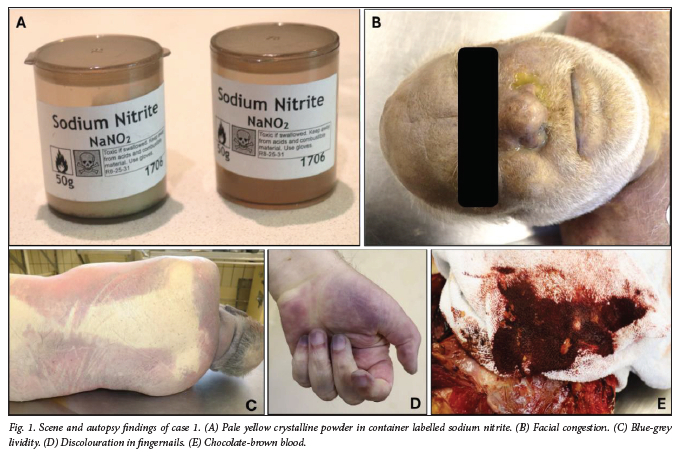
A 63-year-old man was found unresponsive on the floor of a hotel bathroom. He had checked into the hotel 2 days before and was scheduled to check out that day, when he was found by members of the cleaning service. A month before, he had concluded funeral arrangements for himself in the event of his death. At the scene of death, the deceased was found supine, with no apparent signs of injury. No suicide note was found at the scene. A funeral policy card was displayed on the bathroom counter. Two brown plastic containers labelled 'Sodium Nitrite, NaNO2' were found on the counter in the room, both of which contained a fine, pale-yellow powder, one of which was almost empty (Fig. 1A). The body was refrigerated for ~2 days after his death, until the postmortem examination. Autopsy revealed an obese adult male with a body mass index (BMI) of 37.3. No external injuries to the body were noted. Conjunctival and facial congestion were present (Fig. 1B). Lividity was noted posteriorly and assumed a distinct blue-grey colour (Fig. 1C). Similarly, the fingernails also displayed blue-grey discolouration at the tips (Fig. 1D). Internal examination revealed a chocolate-brown discolouration of the blood and viscera (Fig. 1E). The organs were congested. Myocardial and prostate hypertrophy and moderate atherosclerotic disease were present. Histological examination of the heart revealed moderate coronary artery atherosclerosis and myocardial fibrosis. Grade 4 hepatic steatosis (>66%), hypertensive renal disease and moderate pulmonary oedema were observed. Postmortem blood and urine samples were submitted for routine toxicological analysis, including blood alcohol and drug testing (panel of 29 common substances). An additional request for MetHb analysis (blood and powder exhibit) was made. No ethanol (0.00 g/100 mL) or drugs were found to be present. The MetHb level in the blood was 18.1% using an unvalidated carbon monoxide (CO)-oximetry method. An ultraviolet-visible spectrophotometric preliminary screen revealed the presence of sodium nitrite in the powder exhibit.
Case 2
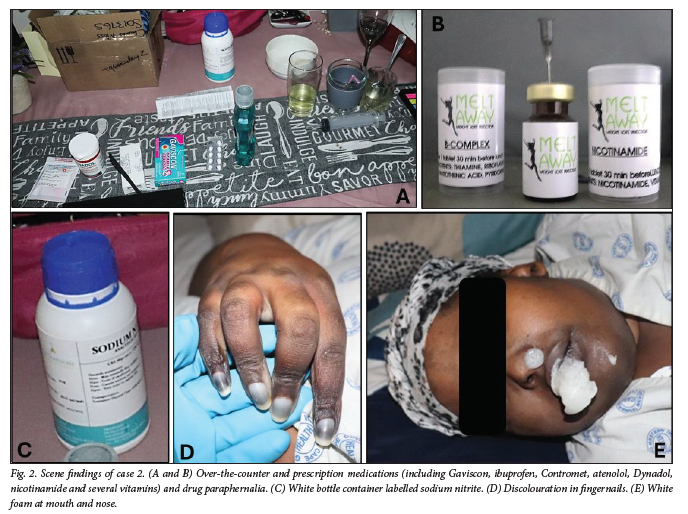
A 25-year-old female student was found unresponsive, lying on her left side in her bed at her student residence. White foam-like froth was visible at the nose and mouth, and intense blue discolouration of the fingernails was apparent, indicating cyanosis. The deceased showed no evident signs of injury. At the scene of death, numerous containers of over-the-counter medications (Fig. 2A and B) were found on the desk, including one container labelled sodium nitrite (Fig. 2C). A letter of instructions was found on the refrigerator, which indicated where her suicide letter and belongings could be found. The deceased had a previous medical history of depression and anxiety. The body was refrigerated for 2 days until the postmortem examination. Autopsy revealed an obese young female adult with a BMI of 37.3, with no significant external markings or injuries. There was notable intense blue discolouration of the fingernails (Fig. 2D), with dark brown discolouration of blood and viscera. Early signs of body decomposition were observed, including skin slippage. No significant wounds or injuries were noted. The organs were generally congested, with oedematous lungs and small bilateral pleural effusions. The liver was particularly noted to be chocolate-brown in colour. There was no significant natural disease present and no sign of pregnancy. Postmortem biological samples, i.e. blood, bile and stomach content, were submitted for routine toxicological analysis, including blood alcohol and drug testing (panel of 29 common substances). Neither ethanol (0.00 g/100 mL) nor drugs were found to be present.
Case 3
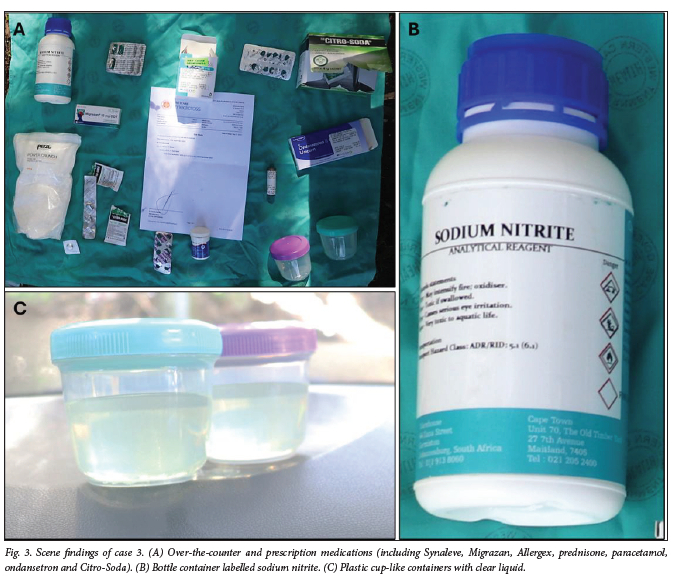
Law enforcement officers on patrol found a 24-year-old male student unresponsive in a motor vehicle. The vehicle was parked in a secluded parking area along the ocean. He had last been seen alive the previous day and had sent a concerning message to his girlfriend. He had a medical history of depression. There were numerous packages of medication in the vehicle, including anti-nausea and pain medication and a bottle labelled sodium nitrite (Fig. 3A and B). In addition, two small transparent plastic containers of clear liquid were present on the dashboard (Fig. 3C). A sick note from a local medical centre and a delivery note were found in the vehicle, indicating the purchase of sodium nitrite and its delivery the day before his body was discovered. The sick note and labels on the other medication containers had the same date. The body was refrigerated until the postmortem examination 5 days after his death. An autopsy revealed a tall, muscular young male with a BMI of 30.9. Hypostasis was noted to be dark blue, purple and brown in colour, with the distribution consistent with the position of the body in the driver's seat of the motor vehicle. There were no features of decomposition. No body markings or significant injuries to the body were noted. The organs and viscera revealed brown discolouration. The stomach contained dark-coloured fluid with a very strong chemical odour, and no undissolved tablets were observed. No significant natural disease was present. Postmortem specimens, i.e. blood, bile, vitreous humor and gastric content, were submitted for routine toxicological analysis, including blood alcohol and drug testing (panel of 29 common substances). No ethanol (0.00 g/100 mL) was found, and the drug testing was positive for acetaminophen (13 mg/L) and codeine (0.033 mg/L).
Discussion
Recent studies reveal an alarming rise in sodium nitrite-related suicides worldwide, particularly among young adults, driven by the easy accessibility of the substance and the dissemination of detailed instructions online.[9-13] E-commerce platforms play a significant role in enabling access to sodium nitrite, often marketed as part of 'suicide kits'.[5,14,15] These kits are frequently accompanied by advice on ingesting sodium nitrite in combination with alcohol or other drugs such as sedatives, anti-emetics and antacids to minimise discomfort and enhance absorption, underscoring the need for regulatory intervention and public education.[16-18]
Postmortem findings in sodium nitrite poisoning cases are strikingly consistent. Key indicators include blue-grey lividity, chocolate-brown discolouration of the blood, intense cyanosis and pulmonary oedema.[4,15] In this report, sodium nitrite-labelled powder and/or containers were found at all three death scenes, corroborating patterns reported in the literature.[4,5,15] Furthermore, circumstantial evidence such as internet searches, suicide notes and the victims' medical histories, including prior suicide attempts, are invaluable for medicolegal investigations.[4,5,15] Two of our reported cases had a history of depression and the third had made plans for his death the previous month.
The identification of sodium nitrite as the toxic agent (poison) in poisoning cases can be challenging owing to its nonspecific presentation and the absence of obvious physical findings. MetHb levels serve as a critical diagnostic marker, with elevated concentrations typically confirming poisoning.[16] However, MetHb levels in fatal cases vary widely, complicating interpretations, especially after medical treatment (e.g. administration of the antidote methylene blue).[16] While MetHb levels >60% are generally considered 'lethal', lower concentrations have been reported, particularly in individuals with pre-existing comorbidities.[16,19] Moreover, extended postmortem intervals, inadequate storage conditions and poor sample quality (e.g. putrefied specimens) can significantly impact MetHb stability for CO-oximetric or spectrophotometric measurements, necessitating alternative testing strategies and leading to MetHb misestimations.[16,20]
A reliable measurement of sodium nitrite levels in blood is challenging owing to nitrites rapidly converting into nitrates, resulting in false low concentrations.[9] Nitrite and nitrate determination in biological samples is indispensable for confirming sodium nitrite poisoning; however, the instability of nitrite in blood, coupled with the scarcity of validated analytical methods for postmortem matrices, poses significant hurdles.[9] Advanced techniques such as spectrophotometry and chromatography require meticulous sample preparation (e.g. derivatisation), can be costly and time consuming, and are prone to interference from endogenous substances.[16] Testing alternative matrices such as vitreous humor, pericardial fluid and gastric contents has been shown to yield more reliable results.[16,21]
Circumstantial evidence from death scenes, including the presence of sodium nitrite powder, drinking containers and suicide notes, plays a pivotal role in corroborating toxicological findings. Toxicological investigations should routinely include alcohol, common drugs of abuse and medications, as substances such as metoclopramide frequently co-occur in sodium nitrite poisoning cases.[4,15,21,22] Metoclopramide and similar drugs (e.g. ranitidine, ondansetron, olanzapine, famotidine, cimetidine), often part of 'suicide kits', are detected in multiple reports and can provide critical insights into the intent and circumstances of death.[5,15,22] In our case 3, ondansetron, an anti-emetic, was present on the scene.
The cases in this study underscore the importance of integrating scene evidence, toxicological data and circumstantial findings. Without the scene and autopsy findings to guide the investigator in these cases, no conclusive cause of death could have been ascertained were the toxicological analyses solely relied upon. This limitation could prove crucial in cases where the scene may have been altered, or ifthevictimhadbeen moved or taken to hospital. Comprehensive death investigations, encompassing the simultaneous determination of MetHb, nitrite and nitrate levels in biological specimens, are critical. Non-biological evidence, such as sodium nitrite containers or related drugs and paraphernalia, also strengthens case conclusions. Despite the challenges, an interdisciplinary approach remains crucial in addressing these complex cases. Sodium nitrite toxicity should be classified as a notifiable medical condition. Once reported, the source of sodium nitrite can be investigated and measures put in place to shut down the route of access.
Clinicians should consider nitrite toxicity in the differential diagnosis of cases with cyanosis and no apparent cardiovascular cause.[23] Successful resuscitation after ingestion of 15 g of sodium nitrite has been reported, the patient initially presenting with loss of consciousness and cyanosis. Treatment included supportive measures, as well as gastric lavage, activated charcoal and intravenous methylene blue.[24]
The increase in sodium nitrite-related suicides necessitates action. Two of our reported cases were young students with a history of depression. The ease of accessibility of this chemical to vulnerable individuals is deeply concerning. Policymakers must enforce stricter regulations on the sale and distribution of sodium nitrite, particularly through online platforms. Education campaigns targeting healthcare providers, emergency responders and the public are essential to raise awareness regarding the substance's lethality. Enhanced toxicological research and the development of validated analytical methods for detecting nitrite in postmortem samples are equally critical to improving diagnostic accuracy.
In all three cases presented, based on autopsy findings, toxicological results and circumstantial evidence, the cause of death was determined to be unnatural, consistent with sodium nitrite poisoning.
Conclusion
Sodium nitrite-related suicides represent a growing public health concern globally and in SA. The three cases presented highlight the chemical's rapid lethality and the forensic challenges in its detection. Comprehensive investigations, combining autopsy findings, toxicological analysis and circumstantial evidence, are essential for confirming sodium nitrite poisoning. Urgent action is required to address this emerging issue. Policymakers should enforce stricter regulations on the sale and distribution of sodium nitrite, particularly online. Awareness campaigns targeting healthcare professionals, emergency responders and the public are crucial for early recognition and intervention. Furthermore, investment in toxicological research and the development of validated methods for detecting nitrite in biological samples are needed to improve diagnostic accuracy and support preventive measures.
Teaching points
Sodium nitrite induces methaemoglobinaemia, causing systemic hypoxia, metabolic acidosis and cyanosis, which can lead to death if untreated.
Characteristic forensic indicators include chocolate-brown discolouration of blood, blue-grey nail discolouration and distinct lividity patterns.
Detecting nitrite and nitrate in biological matrices is complicated by instability and limited validated methods.
MetHb levels in fatal poisoning cases are typically high (exceeding >30 - 40%); however, lower concentrations might be obtained in individuals with pre-existing conditions. Values should be interpreted with caution owing to inter-individual and postmortem variability.
Stricter regulation, public education and enhanced toxicological capabilities are critical to curbing the rising misuse of sodium nitrite in suicides.
Data availability. Not applicable.
Declaration. None.
Acknowledgements. The authors would like to thank the forensic pathology officers at the Observatory Forensic Pathology Institute (OFPI) for their assistance in the medicolegal investigation of the presented cases, as well as the laboratory personnel involved in ancillary investigations, including those at the Histopathology Laboratory, Forensic Toxicology Unit (FTU) and Forensic Chemistry Laboratory (FCL).
Author contributions. Both authors conceived and designed the research study. VRB wrote the first draft of the manuscript. MBKMH revised the manuscript critically. Both authors approved the final version for publication.
Funding. None.
Conflicts of interest. None.
References
1. Tomsia M, Glaz M, Nowicka J, Szczepanski M. Sodium nitrite detection in costal cartilage and vitreous humor - case report of fatal poisoning with sodium nitrite. J Forensic Leg Med 2021;81:102186. https://doi.org/10.1016/j.jflm.2021.102186 [ Links ]
2. Padovano M, Aromatario M, D'Errico S, et al. Sodium nitrite intoxication and death: Summarizing evidence to facilitate diagnosis. Int J Environ Res Public Health 2022;19(21):13996. https://doi.org/10.3390/ijerph192113996 [ Links ]
3. Nishiguchi M, Nushida H, Okudaira N, Nishio H. An autopsy case of fatal methemoglobinemia due to ingestion of sodium nitrite. J Forensic Res 2015;6:1-3. https://doi.org/10.4172/21577145.1000262 [ Links ]
4. Bugelli V, Tarozzi I, Manetti AC, Stefanelli F, di Paolo M, Chericoni S. Four cases of sodium nitrite suicidal ingestion: A new trend and a relevant forensic pathology and toxicology challenge. Leg Med 2022;59:102146. https://doi.org/10.1016/jiegalmed.2022.102146 [ Links ]
5. Durão C, Pedrosa F, Dinis-Oliveira RJ. A fatal case by a suicide kit containing sodium nitrite ordered on the internet. J Forensic Leg Med 2020;73:101989. https://doi.org/10.1016/j.jflm.2020.101989 [ Links ]
6. National Department of Health, South Africa. Foodstuffs, Cosmetics, and Disinfectants Act, 1972 (Act No. 54 of 1972) as amended. Regulations relating to the labelling and advertising of foodstuffs. Government Gazette No. 3530. 1972. [ Links ]
7. Freedman ML. Seven cases of poisoning by sodium nitrite. Public Health 1962;62:20-24. [ Links ]
8. Kaplan A, Smith C, Promnitz DA, Joffe BI, Settel HC. Methaemoglobinaemia due to accidental sodium nitrite poisoning. Report of 10 cases. S Afr Med J 1990;77(6):300-301. [ Links ]
9. Zerbo S, Spanò M, Albano GD, Buscemi R, Malta G, Argo A. A fatal suicidal sodium nitrite ingestion determined six days after death. J Forensic Leg Med 2023;98:102576. https://doi.org/10.1016/j.jflm.2023.102576 [ Links ]
10. McCann SD, Tweet MS, Wahl MS. Rising incidence and high mortality in intentional sodium nitrite exposures reported to US poison centers. Clin Toxicol 2021;59(12):1264-1269. https://doi.org/10.1080/15563650.2021.1905162 [ Links ]
11. Smith EM. Sodium nitrite suicide and social media influence. Nursing 2023;53(12):44-47. https://doi.org/10.1097/01.NURSE.0000991568.99431.13 [ Links ]
12. Khan H, Barber C, Azrae D. Suicide by sodium nitrite poisoning: Findings from the National Violent Death Reporting System, 2018 - 2020. Suicide Life-Threat Behav 2024;54:310-316. https://doi.org/10.1111/sltb.13043 [ Links ]
13. Durão C, Pedrosa F, Dinis-Oliveira RJ. Another suicide by sodium nitrite and multiple drugs: An alarming trend for 'exit'? Forensic Sci Med Pathol 2021;17:362-366. https://doi.org/10.1007/s12024-020-00340-2 [ Links ]
14. Yoon JC, Kim SE. Suicide attempt using sodium nitrite ordered on the internet: Two case reports. Medicine 2022;101(28):e29355. https://doi.org/10.1097/md.0000000000029355 [ Links ]
15. Matheux A, Loiseau M, Sabini S, et al. Suicide of a young woman using a kit containing sodium nitrite ordered on the internet. Toxicol Anal Clin 2022;34(3):S139-S140. https://doi.org/10.1016/j.toxac.2022.06.232 [ Links ]
16. Tusiewicz K, Kuropka P, Workiewicz E, Wachelko O, Szpot P, Zawadzki M. Nitrites: An old poison or a current hazard? Epidemiology of intoxications covering the last 100 years and evaluation of analytical methods. Toxics 2023;11(10):832. https://doi.org/10.3390/toxics11100832 [ Links ]
17. Hickey TBM, MacNeil JA, Hansmeyer C, Pickup MJ. Fatal methemoglobinemia: A case series highlighting a new trend in intentional sodium nitrite or sodium nitrate ingestion as a method of suicide. Forensic Sci Int 2021;326:110907. https://doi.org/10.1016/j.forsciint.2021.110907 [ Links ]
18. Saleh D, Lucyk S, McGillis E. Methemoglobinemia caused by sodium nitrite overdose. Can Med Ass J 2022;194(30):E1066-E1067. https://doi.org/10.1503/cmaj.220434 [ Links ]
19. Cvetković D, Zivković V, Lukić V, Nikolić S. Sodium nitrite food poisoning in one family. Forensic Sci Med Pathol 2019;15(1):102-105. https://doi.org/10.1007/s12024-018-0036-1 [ Links ]
20. Mañibo MV, del Rosario-Fortun R. Suicide by sodium nitrite ingestion: An autopsy case report. Phillipine J Path 2024;9(2):61-64. https://doi.org/10.21141/PJP.2024.10 [ Links ]
21. Caballero CG, Rollan VGdC, Gonzalez MAM. Suicidal poisoning by sodium nitrite: A dangerous mode from internet. In regard of a case. Spanish J Legal Med 2023;49:37-40. https://doi.org/10.1016/j.remle.2023.03.007 [ Links ]
22. Loiseau M, Matheux A, Sabini S, et al. Suicide of an adolescent girl with sodium nitrite ordered on the internet. J Forensic Sci 2023;68(6):2200-2204. https://doi.org/10.1111/1556-4029.15350 [ Links ]
23. Price D. Methemoglobin inducers. Goldfrank's Toxicologic Emergencies. 8th ed. New York, NY: McGraw-Hill, 2006:1698-1706. [ Links ]
24. Katabami K, Hayakawa M, Gando S. Severe methemoglobinemia due to sodium nitrite poisoning. Case Rep Emerg Med 2016;9013816:1-3. https://doi.org/10.1155/2016/9013816 [ Links ]
 Correspondence:
VR Bachan
varushka.bachan@uct.ac.za
Received 24 January 2025
Accepted 15 May 2025