Services on Demand
Journal

Article
 English (pdf)
 Article in xml format
 Article references
 Automatic translation
 Send this article by e-mail
Indicators
Related links
-
 Cited by Google
 -
 Similars in Google
Share

 Permalink
SAMJ: South African Medical Journal
On-line version ISSN 2078-5135Print version ISSN 0256-9574
SAMJ, S. Afr. med. j. vol.115 n.3 Pretoria Apr. 2025
https://doi.org/10.7196/SAMJ.2025.v115i3.3042
CORRESPONDENCE
Non-tuberculous mycobacteria in children: A 7-year multicentre retrospective laboratory analysis
To the Editor: Data on the prevalence of non-tuberculous mycobacteria (NTM) remain fragmented, with information primarily available from only a few countries.[1] In cases of paediatric community-acquired infections, NTM is often considered a less likely diagnosis unless there are targeted efforts to raise awareness. Within the hospital setting, an NTM aetiology is frequently overlooked until the patient fails to respond to broad-spectrum antibiotics or tuberculosis treatment.[1] Additionally, unlike Mycobacterium tuberculosis, NTM is not classified as a notifiable disease, and the paucibacillary nature of infections in paediatric populations may contribute to the under-reporting of the NTM burden in this age group.[2] The current study analysed culture data from children aged <12 years, sourced from two tertiary academic hospital laboratories and one regional tuberculosis laboratory, to assess the frequency and types of NTM in the paediatric population of the Western Cape Province of South Africa (SA).
NTM data were collected between 1 January 2016 and 31 December 2022 from the National Health Laboratory Service (NHLS) laboratory information system (TrakCare, Australia). NTM were identified from mycobacterial growth indicator tube cultures using the GenoType Mycobacterium common mycobacteria (CM) and additional species (AS) line probe assays (LPAs) (Bruker, USA).
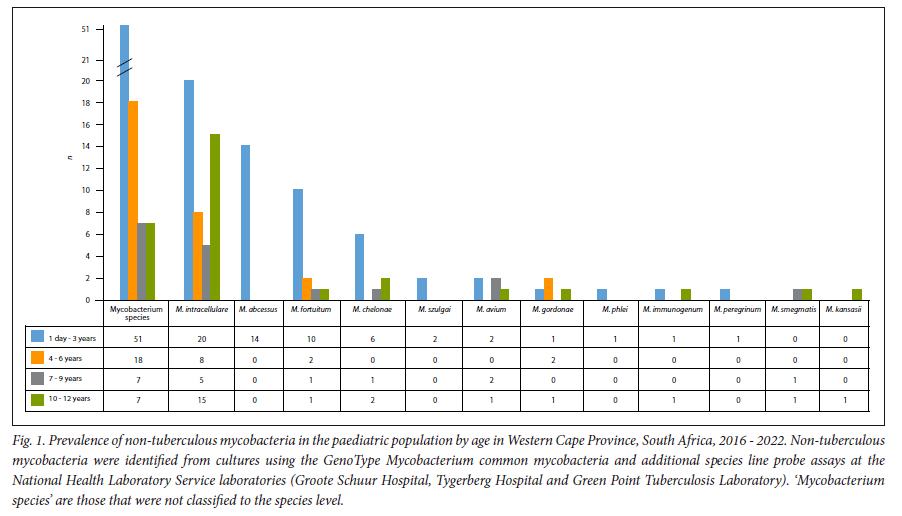
A total of 3 758 LPAs were screened to identify 186 paediatric NTM cultures (162 patients), representing 4.9% of all cases. The sample types included sputum (n=96), gastric aspirates (n=53) and bronchial alveolar lavages (n=10), which accounted for 85% of the total samples. In comparison, 15% were extrapulmonary samples (n=6 fluid aspirates, n=6 superficial swabs, n=5 cerebrospinal fluids, n=5 tissues, n=3 fine needle aspirates, n=1 blood culture, n=1 urine). From the cohort of 133 patients with sputum and gastric aspirate samples, only 3 (2.2%) children had NTM confirmed with a second sample, collected at least 1 week apart. Males made up 50.8% of the cases. The predominant NTM identified were mycobacterium species unidentified to the species level (76/186, 40.8%), followed by Mycobacterium intracellulare (48/186, 25.8%), and M. abscessus (14/186, 7.5%) (Fig. 1). Toddlers aged 1 day to 3 years showed a higher prevalence of M. abscessus (14 cases compared with 0 in other age groups). In addition, M. intracellulare was less common in the toddler group (n=20/109), with an odds ratio of 0.23 (95% confidence interval 0.14 - 0.37), compared with early adolescents aged 10 - 12 years (n=15/30). NTM among paediatric patients in SA remain rare. The current NTM prevalence of 4.9% aligns with the SA literature, which reports a 6% yield of NTM among children investigated for pulmonary tuberculosis as part of a tuberculosis vaccine surveillance programme. [3] Owing to the ubiquitous nature of NTM, their microbiological presence should be confirmed with a second independent sputum sample.[4] The limited number of repeat samples (2.2%) for confirmation in the current study may reflect clinical judgement regarding potential contamination, a lack of awareness of the diagnostic criteria, or challenges in obtaining a second sample due to patient loss to follow-up or difficulties in collecting sputum from children.[5] The study data suggest a higher likelihood of infection with the M. avium complex in older children, as observed in published adult data,[6] while there was a trend toward M. abscessus infection in younger children. We detected 15% of the samples to be from an extrapulmonary site. The presentation of disseminated NTM disease in previously healthy children is uncommon, and should raise suspicion and further investigation for an underlying immunological defect, such as Mendelian susceptibility to mycobacterial disease.[7] Finally, we acknowledge that this study did not include data on NTM treatment, outcomes, or clinical factors. Diagnosing NTM respiratory disease requires a thorough radiological, clinical and microbiological assessment.[4] Therefore, laboratory reports alone are insufficient to differentiate between a true NTM infection and a harmless bystander during colonisation.
C Opperman
National Health Laboratory Service, Green Point TB-Laboratory, Cape Town, South Africa; SAMRC Centre for Tuberculosis Research, Division of Molecular Biology and Human Genetics, Stellenbosch University, Cape Town, South Africa; Division of Medical Microbiology, Department of Pathology, University of Cape Town, South Africa christoffel.opperman@nhls.ac.za
S Singh, Y Ghebrekristos
National Health Laboratory Service, Green Point TB-Laboratory, Cape Town, South Africa; SAMRC Centre for Tuberculosis Research, Division of Molecular Biology and Human Genetics, Stellenbosch University, Cape Town, South Africa
R Warren
SAMRC Centre for Tuberculosis Research, Division of Molecular Biology and Human Genetics, Stellenbosch University, Cape Town, South Africa
W Goosen
SAMRC Centre for Tuberculosis Research, Division of Molecular Biology and Human Genetics, Stellenbosch University, Cape Town, South Africa; Department of Microbiology and Biochemistry, University of the Free State, Bloemfontein, South Africa
Keywords: non-tuberculous mycobacteria, children, paediatric
Data availability. Data analysed in support of this study can be obtained from the corresponding author (CO) upon reasonable request. Institutional approval from the NHLS for access is required.
Ethical approval. This study received ethical approval with a waiver of informed consent from the Human Research Ethics Committee of Stellenbosch University (ref. no. S22/10/191). Institutional approval was granted by the NHLS (ref. no. PR 2232714).
Disclaimer. The views and opinions expressed in this article are those of the authors, and do not necessarily reflect the official policy or position of any affiliated agency of the authors.
References
1. Ahmed I, Tiberi S, Farooqi J, et al. Non-tuberculous mycobacterial infections - a neglected and emerging problem. Int J Infect Dis 2020;92S:S46-S50. https://doi.org/10.1016/j.ijid.2020.02.022
2. Thomas TA. Tuberculosis in children. Pediatr Clin North Am 2017;64(4):893-909. https://doi.org/10.1016/j.pcl.2017.03.010
3. Hatherill M, Hawkridge T, Whitelaw A, et al. Isolation of non-tuberculous mycobacteria in children investigated for pulmonary tuberculosis. PLoS ONE 2006;1(1):e21. https://doi.org/10.1371/journalpone.0000021
4. Daley CL, Iaccarino JM, Lange C, et al. Treatment of nontuberculous mycobacterial pulmonary disease: An official ATS/ERS/ESCMID/IDSA clinical practice guideline. Eur Respir J 2020;56:2000535. https://doi.org/10.1183/13993003.00535-2020
5. Grant LR, Hammitt LL, Murdoch DR, O'Brien KL, Scott JA. Procedures for collection of induced sputum specimens from children. Clin Infect Dis 2012;54(Suppl 2):S140-S145. https://doi.org/10.1093/cid/cir1069
6. Dawood H, Richards L, Lutchminarain K, et al. Southern African HIV Clinicians Society guideline on the management of nontuberculous mycobacteria in people with HIV. South Afr J HIV Med 2024;25(1):1657. https://doi.org/10.4102/sajhivmed.v25i1.1657
7. Ford TJ, Silcock RA, Holland SM. Overview of nontuberculous mycobacterial disease in children. J Paediatr Child Health 2021;57(1):15-18. https://doi.org/10.1111/jpc.15257