



Services on Demand
Journal

Article
 English (pdf)
 Article in xml format
 Article references

 Automatic translation
 Send this article by e-mail
Indicators
Related links
-
 Cited by Google
-
 Similars in Google
Share

 Permalink

South African Journal of Education
On-line version ISSN 2076-3433Print version ISSN 0256-0100
S. Afr. j. educ. vol.46 n.3 Pretoria Aug. 2026
https://doi.org/10.15700/saje.v46n3a2347
ARTICLES
Building a culture of democracy: learner elections, leadership training and electoral integrity in schools
Marius H. SmitI; Annemarie BritzII
IFaculty of Education, North-West University, Potchefstroom, South Africa marius.smit@nwu.ac.za
IIDanie Theron Gedenkskool, Carletonville, South Africa
ABSTRACT
The election of learners to representative bodies or leadership positions in schools often fail to uphold democratic principles. With this study we critically examined the democratic nature of learner elections in South African primary and secondary schools. A survey, using convenience sampling, was conducted among learners and educators. We incorporated Habermas's discourse ethics to evaluate the role of schools in fostering democratic engagement. The findings reveal that election officers and educators often lack democratic literacy, learners face undue influence, and elections frequently mirror popularity contests rather than substantive democratic processes. Since learners are not inherently familiar with democracy, public schools serve as crucial spaces for cultivating democratic values and procedures. Conducting representative councils for learners (RCL) and leader elections democratically could foster educational transformation while promoting learners' personal growth and leadership development. We recommend reforming learner election procedures and creating structures that ensure meaningful learner participation and leadership training.
Keywords: democracy; education law; election process; leader elections; leadership development; representative council for learners; school governance; school policy
Introduction
The principles of democracy extend beyond the realm of national governance, influencing a wide range of social institutions - including schools. More than a century ago, John Dewey (2016), in his seminal work, Democracy in Education, highlighted the reciprocal relationship between democracy and education: democracy shapes education and education, in turn, shapes democracy. Dewey believed that democracy was an ethical ideal (a way of life), rather than a political arrangement, and that participation rather than representation is the essence of democracy. Central to his educational philosophy is the pragmatic principle of experiential learning - the idea that learners construct knowledge most effectively through direct, meaningful experiences (Dewey, 1938). In Dewey's view, schools should function as miniature democratic societies where learners actively participate, inquire and reflect, thereby cultivating the habits and dispositions necessary for democratic life.
Accordingly, schools are critical spaces where democratic values must be applied and cultivated (Smit & Oosthuizen, 2011). One practical expression of this is the election of learners to leadership positions at schools, a democratic practice that could foster civic engagement and a deeper understanding of participatory governance. However, undemocratic election practices occur from time to time which undermine the advancement of democracy and responsible citizenship (Smit & Oosthuizen, 2011). Unfair aspects of society are often mirrored in the education system, and when such practices persist in schools, they ultimately become embedded and misshape the broader national culture and ethos (Smit & Oosthuizen, 2011:59). Smit and Oosthuizen (2011) explain that a lack of clear guidelines and standardised measuring instruments for regulating the election of leaders or representative councils for learners (RCLs) result in irregularities or undemocratic practices.
Existing research focuses on the functionality of RCLs (Carr & Williams, 2009; Hunt, 2014; Mabovula, 2009; Phaswana, 2010) rather than the democratic integrity of electoral processes. Mabovula (2009:230) found little evidence of democratic participation in school governance by RCL members at some schools in the Eastern Cape province of South Africa. In a survey conducted by the Gauteng Department of Education ([GDE], 2013) in 256 schools it was found that 18.6% of the respondents (709 learners who had served on RCLs) were dissatisfied with the election process, while 27.4% stated that RCL elections were not open to all learners. According to De Bruin (2006), certain aspects of RCL elections in schools are not truly democratic, with some procedures failing to promote transparency, participation, and accountability. Similarly, Salzwedel (2010) found that RCL elections often resembled popularity contests, resulting in the exclusion of candidates with the strongest leadership qualities. However, despite its relevance, the existing body of literature on school elections of learners to leadership positions reflects a temporal gap and remains limited, indicating a significant lacuna in scholarly enquiry. While academic literature and theoretical discussions (Isaacs, 2021; Phaswana, 2010; Waghid, 2022; Woolman & Fleisch, 2008) offer valuable insight into democracy in education, there remains a notable deficiency of empirical research focussed on democratic election practices for learners in leadership positions in schools. In response to this gap, we present the findings of an empirical study on the election of learners to leadership positions in public schools. We engage with relevant legal and theoretical frameworks and propose reforms to enhance democratic participation in schools.
Theoretical Framework
In this study we drew on Dewey's civic education theory (Dewey, 1916/1966), emphasising that democratic experiences in schools contribute to the development of democracy. We also focussed on Habermas's (1996) theories of discourse ethics which highlight the role of fostering deliberative (discursive) democracy in fostering open participation.
Habermas's discourse ethics and deliberative democracy
Habermas (1996) contends that legitimate democratic decision-making arises from rational discourse among stakeholders. Schools, as microcosms of democracy, should foster deliberative engagement (reasonable discourse) among learners through structured election processes that encourage open discussion, equal participation, and transparent decision-making. Prior to this research it seemed that RCL elections at secondary schools and the election of leaders in primary schools often failed to uphold these principles, resulting in an environment where discourse is limited, democratic principles are not adhered to, and learner agency is constrained.
Conceptualising democracy Democracy is a multifaceted concept which has evolved over the centuries, from direct democracy in ancient Athens to modern models such as representative, participative, deliberative and cultural democracy (Asenbaum, 2026; Blaug & Schwarzmantel, 2000; Cunningham, 2002; Economou, Kyriazis & Platias, 2022; Habermas, 1996; Hendriks, 2023; Wahlström, 2022). The main democratic theories include direct democracy, liberal democracy, republicanism, Schumpeterian elitist democracy, social democracy, participative democracy, deliberative (discursive) democracy, agonistic democracy and transformative democracy (Asenbaum, 2026; Blaug & Schwarzmantel, 2000; Hendriks, 2023). These theories are not discussed in detail, as much scholarly research has been devoted to this topic (Asenbaum, 2026; Blaug & Schwarzmantel, 2000; Chapman & Dunstan, 1990;
Cunningham, 2002; Dewey, 1916/1966; Fishkin & Laslett, 2003; Habermas, 1996; Held, 2006; Kotzé, 2004; Kymlicka & Wayland, 1996; Schumpeter, 1943; Smit, 2009; Steyn, Du Plessis & De Klerk, 1999; Tarrant, 1989; Wiklund, 2005). Given that the concept of democracy is inherently dynamic and continuously evolving (Asenbaum, 2026), it is not possible to provide a single, all-encompassing definition. Nevertheless, the closest workable approximation to a definition of democracy, which reflects the consensus of most scholars is: a political, cultural and societal system in which power or authority is exercised through institutions and practices that are grounded in the principles of freedom and equality, enabling autonomous choice or elections, inclusive participation, public deliberation, and accountable representation (Hendriks, 2023). Asenbaum (2026), however, argues that the normative approach -rather the nominal and practice approaches - is the most suitable for understanding democracy as it emphasises freedom and equality as foundational values that define genuinely democratic systems. As a normative framework for political or societal decision-making, deliberative democracy emphasises ideals such as open discourse, rational legislation, participatory politics and civic self-governance (Cunningham, 2002). However, despite the plurality of perspectives and innovative approaches to democratic theory, substantive political and organisational democracy, in whatever form it is defined, has yet to be fully realised anywhere in the world and is certainly lacking within many institutions or organisations (Asenbaum, 2026).
Literature Review: Democracy, Education, Election of School Leaders, Representative Councils of Learners ("RCLs") and the Law
An inextricable relationship exists between education, democracy and the law, as is clear from the Constitution of the Republic of South Africa, 1996 (hereafter, the Constitution), education-specific legislation and international law (Dewey, 1916/1966; Smit & Oosthuizen, 2011). The founding provision, section 1, of the Constitution (Republic of South Africa [RSA], 1996a) affirms that South Africa is a constitutional democracy rooted in the rule of law. The Children's Act (RSA, 2005) affirms the right of children to participate in decisions that affect their lives. Correspondingly, the preamble of the National Education Policy Act (RSA, 1996b) emphasises that democratic transformation of education should serve the interests of all South Africans and uphold their fundamental rights. Section 4(b) of this Act stipulates that policies must be developed to promote the advancement of democracy within the education system.
A fundamental challenge for any democratic society is to educate successive generations in democratic values, legal principles, and responsible citizenship (Ruitenberg, 2015; Smit & Oosthuizen, 2011). Can schools truly function democratically, or is their traditional structure inherently authoritarian? Some school principals, educators and parents are concerned that introducing democratic practices could undermine authority and lead to unmanageable classrooms, as the majority of learners could allow their preferences to dominate the schools (Smit, 2013).
The process of democratising schools necessitates the inculcation of knowledge, values, and attitudes that translate into substantive democratic engagement by means of education (Aspin, 1995; Kiess, 2021; Ruitenberg, 2015). During the 1990s, the decentralisation of education, aligned with participatory democratic theory, became a key component of global educational restructuring (Aspin, 1995; Karlsson, 2002; Sayed, 1999). The notions of participation and deliberation emerged as fundamental tenets in the promotion of democratic school governance (Grant Lewis & Naidoo, 2004; Mncube, Davies & Naidoo, 2015). However, Smit and Oosthuizen (2011) found that the weaknesses of various democratic traditions are evident in the South African education system. Since learners are not inherently equipped with an understanding of democracy, public schools serve as crucial incubators or nurseries for democratic learning (Dayton, 1994; Haraldstad, Tveit & Kovac, 2022; Kiess, 2021; Ruitenberg, 2015). In a sociological study, Kiess (2021) presents compelling empirical evidence that students at schools and universities who participate in democratic activities such as student councils and class speakers develop stronger political trust and are more likely to vote and engage in political participation. This study was done in nine European countries and showed that democracy practiced early becomes active democratic citizenship at later stages in the students' lives (Kiess, 2021).
Democracy in schools, election regulations and guidelines
To effectively implement democracy in public schools, it is essential to understand the relevant legal provisions, administrative guidelines, and core principles of democratic practice. In this regard, section 11(1) of the South African Schools Act (RSA, 1996c) provides for a representative council of learners (RCL) to be established at every secondary or combined public school that enrols learners from Grade 8 or higher (Department of Education [DoE], 2003). However, in practice many primary schools also hold annual elections for learner leaders, usually learners in Grade 7, who may be referred to by various titles such as leaders, prefects or learner council members. In this article the term "leaders" is used to refer to elected primary school learners that serve on a leadership body or council.
The RCL is a body of elected learner leaders in secondary schools established to serve and represent the interests of the student body. The RCL may also select two of its members to serve on the school's governing body (SGB). South Africa is unique in this respect as RCL learners that serve on SGBs have full voting rights in all non-contractual matters of school governance that affect their daily school experience. The provincial member of the executive council for education (MEC) is responsible for determining the functions and procedures for the election of RCLs (RSA, 1996c). In terms of the Personnel Administration Measures (DoE, RSA, 2001), deputy-principals manage RCL elections.
The regulations and guidelines regarding RCL elections vary to some extent across the nine provinces in South Africa (DoE, 2003; Northern Cape Department of Education [NCDE], 2016; Northern Province [NP], 2000; Western Cape Department of Education [WCDE], 2008). The respective provincial guidelines contain similar provisions that stipulate the following: two representatives (one male and one female) should be elected for each grade or class, where practicable, to serve on the RCL; the head of department appoints an election officer (usually the deputy-principal) who is assisted by class educators (electoral assistants); only learners in the Grade 8 and above may serve on the RCL. In RCL elections, each candidate must be nominated and seconded in writing by their peers. The electoral assistant compiles a list of all candidates, which is then displayed on the class notice board. Voters should be checked against the appropriate school register which serves as a voters' roll. Elections are conducted by secret ballot, with each learner entitled to one vote per vacant position on the RCL. RCL elections typically take place annually in the first or the last quarter and should ideally align with democratic principles. The guidelines further specify that RCL leaders should be elected to an executive committee, which consists of a president, deputy-presidents, secretary, and treasurer. In addition, RCL members may serve in portfolios such as media, sport, culture, education, or any other sub-committee deemed necessary (DoE, 2003; NCDE, 2016; NP, 2000; WCDE, 2008).
While guidelines do not mandate the election of leaders or learner councils in primary schools, they do not prohibit it either. Primary schools' internal policies may, therefore, regulate the election of learner representatives and leaders in primary schools.
Democratic principles
The practice of democracy in schools should align with the education that citizens receive; otherwise, the influence of the surrounding environment will undermine the lessons learned in early schooling (Parry & Moran, 1994:48). Wahlström (2022) revisited Dewey's idea of civic literacy and found that when learning occurs through responsible, reflective classroom discourse (i.e. dialogue rooted in democratic values) schools become more than knowledge factories, they become places where democratic sensibilities take shape. In empirical studies, Fishkin (2011) concluded that deliberative (discursive) democracy tended to produce outcomes which are superior to those in other forms of democracy.
The four principles of deliberative democracy, namely, generality, autonomy, power neutrality and ideal role-taking, serve as benchmarks for assessing substantive democracy (Eriksen & Weigard, 2003; Habermas, 1996; Lafont, 2020). Applying the principles of discourse ethics (which undergird deliberative and participative democracy) means, in practice, that voters should be educated before an election about the purpose and procedure of the democratic process, as well as the features of effective leadership and the functions of the leaders or RCL (ideal role-taking). All affected parties should have the right to participate, ensuring that every eligible voter can cast a ballot, with each vote carrying equal weight (generality) (Eriksen & Weigard, 2003; Habermas, 1996). Candidates must have a fair and equal opportunity to participate (power neutrality) and should be given adequate time or opportunity to introduce themselves, garner support and communicate their abilities and character to voters (openness and transparency) (Eriksen & Weigard, 2003; Habermas, 1996). The voters should receive sufficient notice of the election to gather information and make informed, independent decisions (autonomy) (Eriksen & Weigard, 2003; Habermas, 1996). The election process must be fair, legitimate and conducted with integrity, including secret ballot voting to prevent undue influence or victimisation. Furthermore, partisan or self-serving interference, whether economic, political, cultural or administrative, must be avoided and prohibited. All participants, including voters, candidates and election officials, should be educated to base their decisions not on personal gain or purely selfish considerations, but on the best interest of the school community and its shared educational purpose (Eriksen & Weigard, 2003; Habermas, 1996).
Research Design and Methodology
In the research upon which this study is based we employed a non-experimental survey design. The target population in the education district, which comprised 47 secondary schools, 104 primary schools, and four combined schools (n = 155), was approximately 390 potential participants. The potential participant population in the target districts was made up of deputy principals, mentor educators and learner leaders. The number of deputy principals who were responsible for learner elections and leadership was 155 (one per school) and the educators that served as leader guardians ("mentors") in the target population were 205. Some of the larger schools had two educators that served in this capacity. Following a positivist paradigm, we used electronic questionnaires in this quantitative study to collect data on factors influencing leader and RCL elections. Questionnaires were distributed via electronic mail (email) or Google Forms to selected respondents (n = 94) using convenience sampling.
At secondary schools, the following persons were invited to participate: one learner (who had attained age of majority (18 years old), i.e. adult status) serving on the RCL and the governing body, educators acting as RCL guardians and deputy-principals that were responsible for overseeing the RCL elections, as stipulated by the Personnel Administration Measures (DoE, RSA, 2001). At primary schools the leaders' educator guardians and deputy-principals were invited to participate. Learners in primary schools were not eligible for participation in the survey for ethical reasons, since they were underage, and parental consent could not be obtained for the participation of minor learners.
We used convenience sampling, a standard non-probability approach in quantitative education research when access to resources constrain probability sampling (see e.g. Ergene & Karabogaz, 2024:297-298). Participants were selected based on practical accessibility, experience and relevance (Creswell & Creswell, 2017). The Sage Encyclopedia of Educational Research, Measurement, and Evaluation (Frey, 2018) defines convenience sampling as a standard non-probability technique used in education research, noting use-cases and validity caveats. We acknowledge the limits on generalisability and the requirement to apply appropriate robustness checks with demographic comparisons. Independent schools as defined by section 1 and regulated in terms of Chapter 5 of the South African Schools Act (i.e. private schools), were excluded from the study. The research adhered to the ethical requirements approved by the university's ethics committee.
The Measuring Instrument: Development and Validation of the Questionnaire Since no standardised instrument existed to assess the application of legal principles and democratic theory, a questionnaire was developed. The questionnaire comprised four sections:
• Section A - Biographical and demographical information of the respondent.
• Section B - Knowledge of legal determinants and understanding of democratic principles.
• Section C - The election process of leaders or RCL members.
• Section D - The scope and frequency of democratic practices during elections of leaders or RCL members.
The validation process included the following: (a) face validation by three subject specialists and the statistical consultant to identify common errors, (b) content validation through a pilot study, (c) construct validation using statistical analysis to assess the suitability of data for factor analysis, and (d) internal consistency testing using Cronbach's alpha coefficient to evaluate inter-correlation of items and the consistency in the measurement. Cronbach' s alpha values were as follows: Section B - 0.86 and 0.90; Section C - 0.65; and Section D - 0.76. These values were deemed reliable (Field, 2009). Additionally, the Kaiser-Meyer-Olkin (KMO) test yielded values of 0.88 for Section B, 0.58 for Section C and 0.76 for Section D, confirming the adequacy of the data for factor analysis. The final step in the validation process involved rectifying errors and formatting the final questionnaire in Google Forms.
Data Collection
Respondents received a link to Google Forms, which, when clicked, opened the questionnaire on their smartphone or personal computer. This allowed for seamless electronic completion and submission. Anonymity and confidentiality of all respondents were strictly maintained during this process. Upon data collection, the Google database automatically compiled responses into a spreadsheet for analysis.
Data Analysis
The Statistical Consulting Services of the North-West University (NWU) assisted with the data processing. Statistical analyses were conducted using the Statistical Package for the Social Sciences (IBM Corp., 2017) and the Statistical Analysis System (SAS, 2016) software suite. During data capturing, numerical values were assigned to each category and variable. The data analysis included descriptive statistics to show trends in the data, a comparative analysis, including t-tests and ANOVA, to examine differences between groups and relationships between variables, as well as effect size calculations (Cohen's d) to assess the magnitude of ordinal and nominal data across demographic sub-groups. The p-values obtained from t-tests for sub-groups were reported for completeness, acknowledging that no random sampling was employed. Due to space constraints and the need to maintain a focused and concise discussion, we do not elaborate here on all data presented in the tables.
Biographical and Demographical Statistics
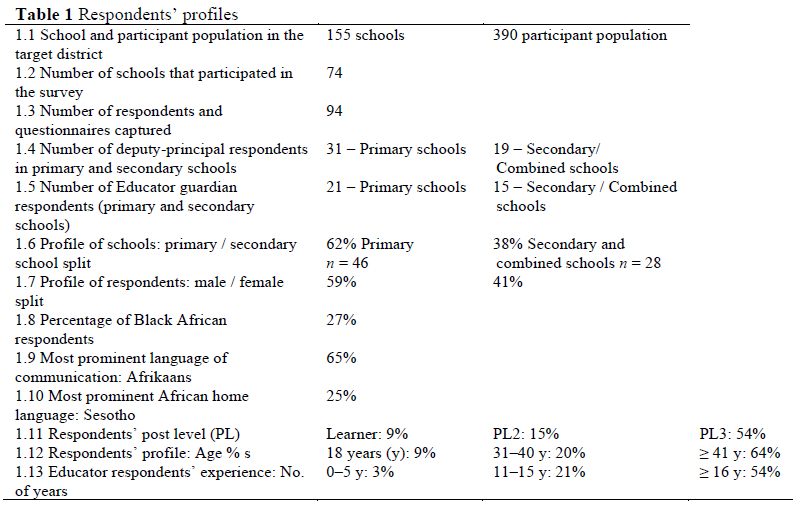
The results in Table 1 (Item 1.5) indicate that more males than females participated in the survey, with males more frequently serving as educator guardians or deputy principals. Not all the biographical or demographical data from the study are contained in Table 1 as attention is directed primarily to the results of greatest interpretative value. The response rate and number of participating schools was somewhat disappointing (Item 1.2), likely due to the respondents' reluctance to complete electronic questionnaires. Although selected schools were visited and potential respondents were instructed on completing the questionnaire via their smartphones or computers, many still declined to participate. Common reasons included a lack of electronic devices or insufficient internet data. Data collection occurred during the last month of the school year, with most responses from primary school educators.
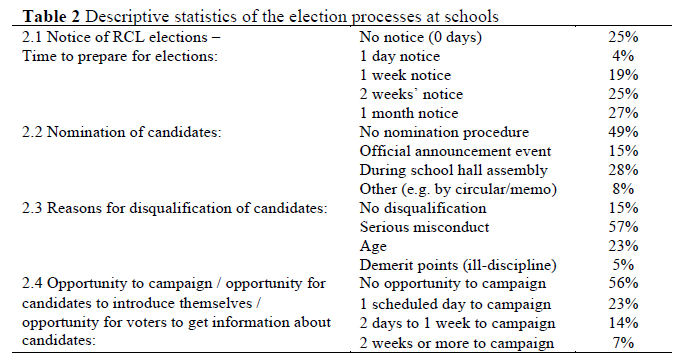
Providing voters with sufficient information to make informed decisions is an essential component of a democratic process. However, according to Table 2 (Item 2.4), 56% of the respondents reported that candidates were not afforded the opportunity to introduce themselves to the voters (learners) during the nomination process.
Only 28% of respondents (Item 2.2) indicated that candidates were allowed to present themselves during a school assembly. This suggests that learners had limited opportunities to campaign and gather support, ultimately depriving voters of their democratic right to make informed and autonomous decisions. Item 2.1 reveals that in 25% of cases learners and candidates received no prior notice, effectively making the election of leaders or RCL members a surprise. In 23% of cases (Item 2.1), learners had less than a week's notice to consider potential candidates.
Results: Knowledge of Democratic Principles and the Law regarding RCL Elections
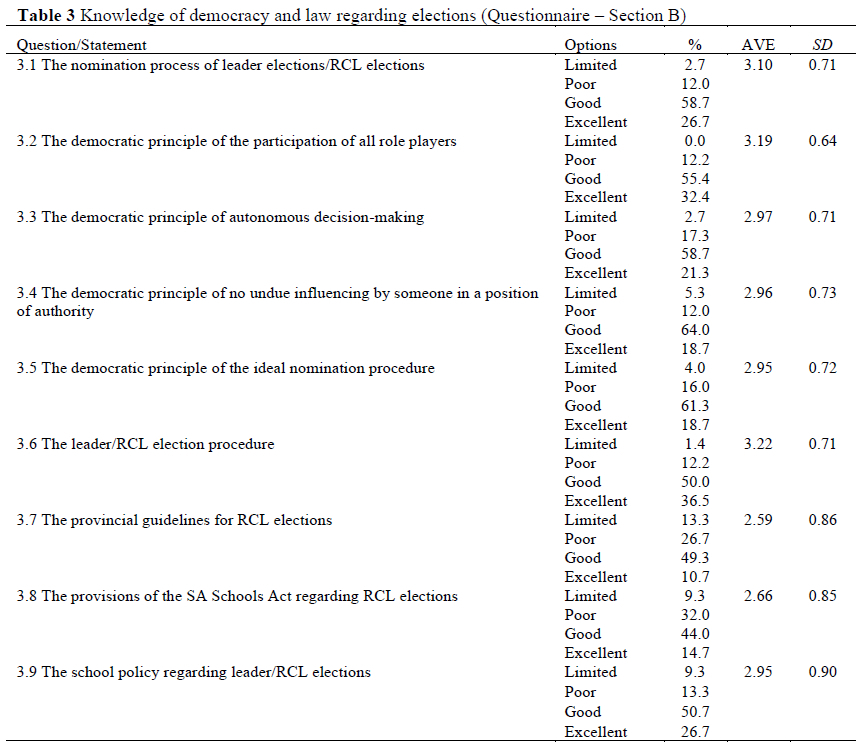
Table 3 presents data on nine key questions assessing respondents' self-evaluative perception of their knowledge of democracy and the legal framework governing the elections of leaders and RCL members. The average score was used as a benchmark to gauge respondents' perceived level of knowledge for each question. However, self-evaluation carries the inherent risk or pitfall of the so-called "halo effect", where individuals tend to overestimate their own abilities or knowledge. Evidence from the statistical analysis of data suggests that this bias was present in this study. While Table 3 presents the full set of data, the analysis is confined to findings of particular importance or relevance.
The highest average (3.22) was recorded for Item 3.6 in Table 3, where 86.5% of the respondents rated their knowledge of the election procedure as good or excellent. The second highest score (3.19) was on Item 3.2, reflecting respondents' broad knowledge of understanding the democratic principle of role-player participation. Yet, despite these high self-assessments, contradictions emerge. For instance, in Item 3.7 (Table 3), 40% of the respondents rated their knowledge of provincial guidelines as poor or limited. Similarly, Item 3.8 shows that 41% admitted to having poor or limited knowledge of the South African Schools Act, while 23% acknowledged the same regarding school policies. The highest standard deviation (0.90) was observed in Item 3.9, indicating significant variation among respondents regarding their knowledge of school policies on leader or RCL elections.
Further inconsistencies arise when comparing Item 3.1 of Table 3 (knowledge about the nomination process of leader or RCL elections) with Table 2 (Items 2.2 and 2.4). While respondents claimed to have knowledge of the nomination process for elections, 56% indicated that candidates were not given an opportunity to introduce themselves during nominations. Additionally, Items 3.7 and 3.8 in Table 3 report the lowest self-assessed knowledge scores - 2.59 for knowledge of provincial guidelines for RCL elections and 2.66 for Schools Act provisions.
These admissions, deviations and inconsistencies undermine the high self-rating in Item 3.6 (Table 3) revealing a tendency of respondents to overestimate their knowledge, while simultaneously acknowledging gaps in their understanding.
Opinions about the Democratic Features of the Election Process
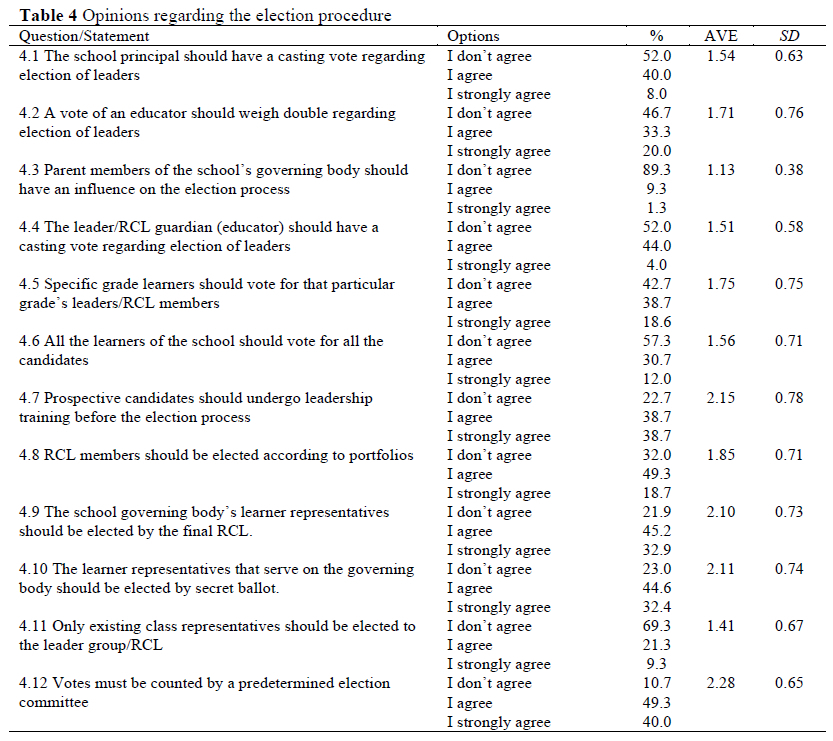
The mean (average) serves as a benchmark for assessing the extent of respondents' agreement or disagreement. The questions in Table 4 were designed to evaluate the respondents' opinions regarding the principles of substantive democracy (as previously discussed), namely, ideal role-taking, power neutrality, openness and transparency, generality, independent autonomous decision-making (voting) and a fair legitimate process.
Most respondents held that neither school principals (Item 4.1), not parents that serve on the school governing body, nor the RCL guardians (Item 4.4) should have casting votes. This affirms the principle of power neutrality as members of school management and governance should not have determinative voting power. Yet, the findings are somewhat disconcerting as approximately 48% (large minority) of the respondents favoured the idea that a principal or RCL guardian should have a casting vote and thus only 52% supported the idea of one person one vote. However, in one instance, most respondents held that an educator's votes should carry double weight (Item 4.2, 53.3%), which is counter to the principle of power neutrality (all voters should have equal say). It may be that this outcome was influenced by the large proportion of primary school educators that participated in this survey.
Table 4 (Item 4.7) indicates that almost 78% of respondents believed that prospective candidates should undergo leadership training before the election process. This strongly affirms the principle of ideal role-taking (voters should be educated). Most of the respondents, i.e. 57.3% (Items 4.5 and 4.6) were not in favour of all learners voting for all the candidates for RCL membership. Conversely, this means that the majority believed that learners of a particular grade should elect RCL leaders from their own grade. This is understandable as, in most cases, leaners in junior grades do not know the candidates in higher grades and voters should in principle vote only for candidates that they know. In a sense, these findings agree with the democratic principle of ideal-role taking as voters (learners of different grades) should know what and who they are voting for.
A strong majority of respondents (77%) (Item 4.7) asserted that all prospective candidates should undergo leadership training before the election process. Importantly, this affirms the principle of ideal role-taking and implicitly acknowledges that learners need training as they do not naturally know or automatically understand what leadership entails. A significant outcome is that 68% of the respondents (Item 4.8) were in favour of the requirement that RCL members should be elected to specific portfolios. This agrees with the democratic principle of openness and transparency. However, this outcome differs from the usual practice at most schools where candidates are ordinarily simply elected from a list of names without being linked to a particular portfolio or function. This finding thus has important implications for the election process as it would require candidates to link their candidacy to a particular portfolio or portfolios. These announcements should be conducted in a fair and transparent manner, which implies that schools should have an election policy on campaigning by candidates that provides equitable opportunities for each candidate to be introduced during the preparatory phase of an RCL election.
A substantial majority of respondents (78%) believed that only elected RCL members should vote for leaders that would represent them on the school governing body (Item 4.9) and that this election should be by secret ballot (Item 4.10). This affirms the democratic principles of autonomy (independent decision-making) and generality (those that are affected should vote). Item 4.11 affirms that 69.3% of the respondents believed that RCL leaders should be elected from the entire body of learners and not merely from an existing (pre-selected) group of class representatives. This affirms the principle of generality. The final question in Table 4 (Item 4.12) is uncontroversial as 89.3% of the respondents held that votes should be counted by a pre-determined election committee. This may stem from prior experiences of undue interference in the counting process, thus reinforcing the democratic need for election integrity, and a fair transparent process that is not subject to undue influence or ad hoc and arbitrary manipulation. To summarise, most of the findings affirm that most respondents agreed with or adhered to the principles of substantive democracy.
The Democratic Nature and Fairness of RCL Elections
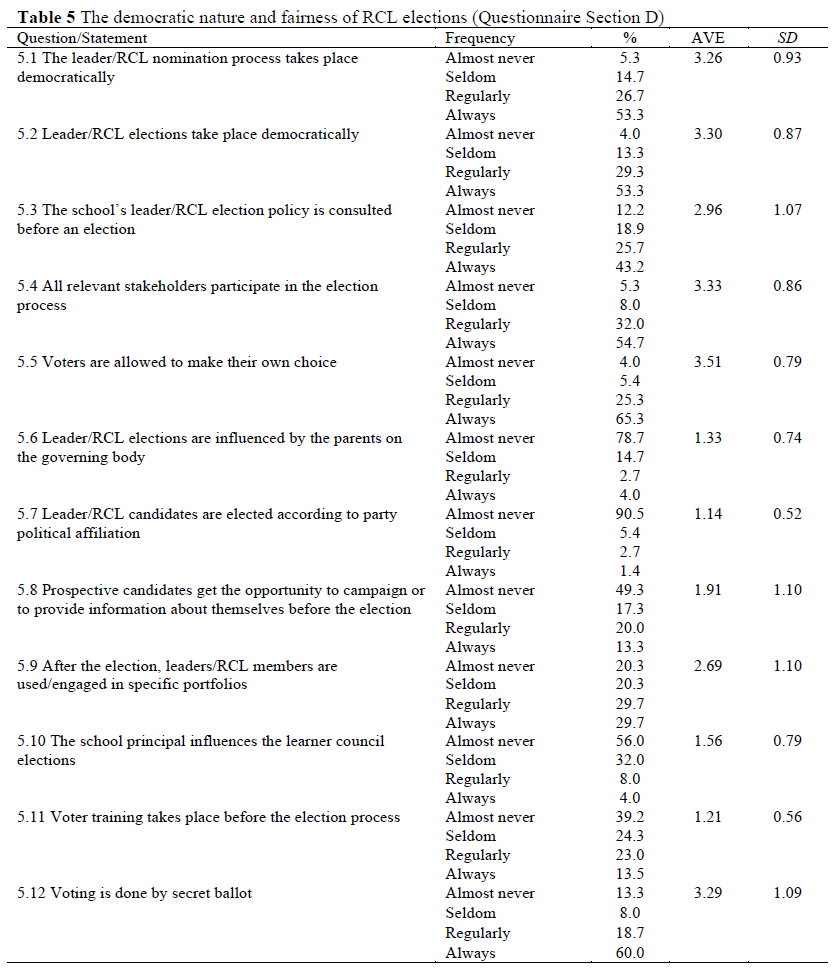
In Table 5 the average serves as a guideline to indicate the frequency of occurrences. The discussion does not extend to every item of data presented in Table 5 but highlights the findings that are most significant for the objectives of the study. According to Item 5.5, most respondents believed that voters were free to make their own choices during RCL elections (Ave. 3.51). A positive finding (Table 5, Item 5.7) is that political affiliation rarely influenced leader or RCL elections, confirming compliance with section 33A of the Schools Act, which prohibits party-political activity in schools.
Disturbing trends emerge when the percentages of undemocratic practices are considered. According to respondents, 20% of nomination processes (Item 5.1) and 17.3% of elections (Item 5.2) rarely or never occurred democratically. These findings suggest that almost one-fifth of these processes failed to uphold democratic principles.
According to Table 5, a substantial majority of respondents indicated that the nomination process (Item 5.1, 80%), elections (Item 5.2, 82.6%), voter participation (Item 5.4, 86.7%) and voting by secret ballot (voter autonomy) (Item 5.12, 78.7%) regularly or always occurred democratically at the schools. However, 31.1% of the respondents (Item 5.3) admitted that school policies were rarely or seldom consulted. Furthermore, 63.5% of respondents (Item 5.11) indicated that voter training rarely or almost never took place before the election process. Two thirds of the respondents (66.6%) indicated that candidates seldomly or almost never had the opportunity to campaign and inform voters (Item 5.8). These findings are contrary to the democratic principle of ideal role-taking as voters enter the RCL elections unprepared for key aspects of a democratic election, including the nomination process and voting procedures. Without proper voter training and information, elections risk becoming undemocratic. This is particularly important for primary school voters who generally lack awareness of leadership qualities and are uninformed about the electoral process. Ensuring voter autonomy requires that individuals make informed choices based on adequate preparation, proper guidance and fair processes (cf. Table 2; Item 2.4). The survey findings indicate that the principle of power neutrality is adhered to by and large as election outcomes are not influenced by parent members of the school governing body (Item 5.8), political party affiliation (Item 5.7) or school principals (Item 5.10). Most of the respondents (Item 5.9, 59.4%) indicated that RCL leaders were engaged in specific portfolios after being elected. The practice of involving RCL leaders in specific portfolios at schools is particularly important as it reinforces the value and usefulness of democratic elections and enables purposeful democratisation of the school environment.
Key Statistics: Results of the t-tests with Effect Sizes
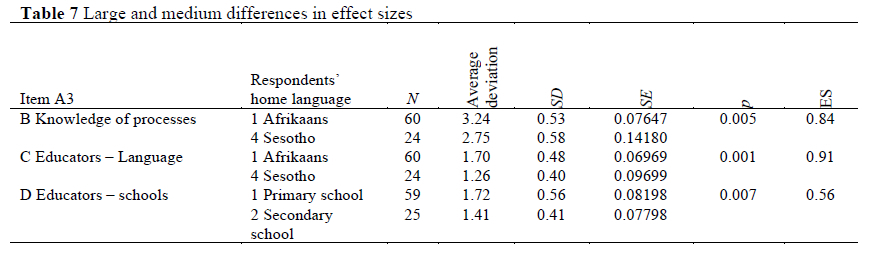
To determine differences between independent demographic groups, e.g. male/female, and Afrikaans- or Sesotho-speaking educators, Cohen's effect sizes were used. While p-values from t-tests for independent groups were reported for completeness, interpretations were based on Cohen' s effect sizes (d) due to the absence of random sampling. Using t-tests we examined differences based on gender, home language, school type and whether elected learner councillors should serve on the school governing body. Not all the data from the study are discussed in Tables 6, 7 and 8 - attention is primarily directed to the results of greatest significance and interpretative value.
The results in Table 6 indicate that female respondents were more likely than male respondents to believe that educators' voices should carry more weight during the voting process. A possible explanation for this is that female educator respondents were mostly responsible for teaching rather than management, particularly in primary schools.
Table 7 (Item B - Knowledge of processes) reveals a significant effect size difference (0.84) between Afrikaans-speaking and Sesotho-speaking respondents regarding their perceived knowledge of electoral processes. Afrikaans-speaking respondents were more confident in their understanding of the procedures of leader or RCL elections than their Sesotho-speaking counterparts. Additionally, a large effect size difference (0.91) was observed between these groups (Table 7, Item C) concerning the weight that educators' vote should carry in learner council elections. Afrikaans-speaking respondents favoured greater influence for educators in voting, whereas Sesotho-speaking respondents adopted a more laissez faire approach, allowing learners more autonomy in the election process.
Table 7 (Item D - Educators schools) shows a medium effect size difference (0.56) between primary and secondary school educators. Primary school educators were more likely to believe that their votes should carry greater weight in the election process than their secondary school counterparts. A possible explanation for this finding may stem from the perception of primary school educators that younger learners are not yet capable of making informed decisions, thus requiring greater intervention by educators. While this perspective may have merit, the practice of unequal voting rights contradicts the democratic principle of generality and is inherently undemocratic. A more effective approach would be to strengthen voter education on leadership qualities and the role of leaders or the RCL, thereby increasing confidence in the accuracy of voter's choices and ensuring that each vote carries equal weight in a truly democratic process.
Analysis of Variance (ANOVA) Effect Sizes and Differences in Perceptions
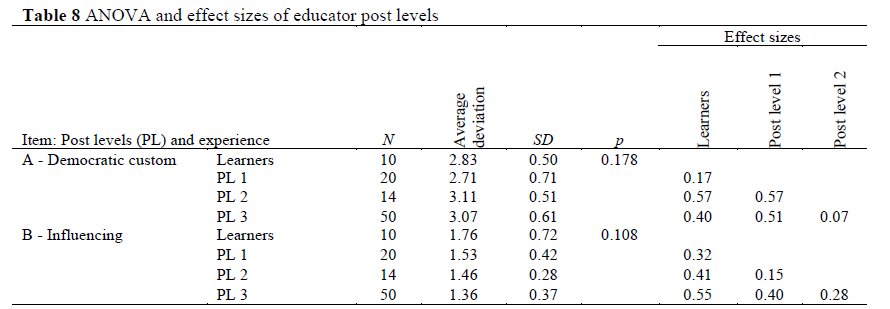
The ANOVA effect sizes highlight differences in opinions between educators (categorised by PLs and years of experience) and learners. This discussion focusses on medium to large differences between these groups. The most significant disparities between educators and learners pertain to the application of democratic practices and the extent of voter influence.
Democratic Practices - Educators Vis-à-vis Learners - the Halo-effect
Table 8 (Item A - Democratic customs) reveals a significant difference (p-value = 0.178) between learners, who perceived the application of democratic practices in RCL elections as low, and PL 3 educators, who held a more favourable perception of these practices. A possible explanation for this result is that deputy-principals (PL 3 educators) who oversee the election process may be unaware of or perhaps indifferent to the undemocratic elements in leader or RCL elections. This reflects the halo effect in which individuals responsible for managing the process overestimate its fairness, while learners - who are directly affected by the leader or RCL elections - perceive them as less democratic.
Influencing During RCL Elections Table 8 (Item B - Influencing) confirms a substantial difference (p-value = 0.108) between learners and educators regarding perceptions of voter influence. Learners strongly believed that undue influence occurred during leader or RCL elections, whereas educators generally denied this. This discrepancy may stem from the fact that deputy principals assumed that leader or RCL elections were conducted in line with policies and legislation, while learners' responses reflected their lived experiences, suggesting otherwise.
Synopsis: The Key Findings of this Study The following findings summarise the most significant results of this study. We determined that only selected learner groups participated in leader or RCL election processes and enjoyed voting rights. Most of the respondents indicated that voters did not receive adequate notice prior to elections. In most cases, candidates were not afforded an opportunity to introduce themselves during a nomination process or to campaign for support. Two thirds of the respondents reported that no voter training occurred before the election process. Half of the respondents stated that elected RCL members were rarely assigned to specific portfolios following the elections. Nearly half of the respondents believed that the school principal, the leaders or RCL guardians, and educators should have either a deciding or a majority vote in the election process. Most respondents demonstrated limited or no knowledge of the provincial election guidelines, the Schools Act or school policy provisions regarding elections. Secondary school learners were particularly convinced that undue influence occurred during the RCL election process.
Recommendations for Improving School Leader Elections and Leadership Development Currently, provincial guidelines and school policies do not adequately provide for fair notice periods, pre-election voter education, leadership training, or a clear articulation of democratic principles underpinning voting rights and election procedures. We recommend that learners and educators undergo comprehensive training on democratic principles and leadership characteristics before the election process. This training should include instruction on defining leadership, identifying leaders, types of leaders, the roles and responsibilities of leaders, as well as key democratic and election procedures, such as the nomination process, campaigning, ballot paper management, and voting protocols.
Therefore, we recommend that the national and provincial departments of basic education should collaborate to develop improved guidelines for RCL elections for secondary schools as well as guidelines for elections of primary school leaders.
Campaigning Procedures and Voter Awareness The revised election guidelines should incorporate structured campaigning procedures, as these help candidates plan, focus and clearly articulate their intentions. Campaigning also provides voters with essential information about candidates, enabling them to make informed decisions. Suggested guidelines and school policies should specify the duration of the campaigning period, time of the year, campaigning rules, the disclosure of each candidate' s basic biography, endorsements, leadership qualities, general vision, and specific portfolio aspirations, allowing for regulated, structured campaigning according to acceptable rules of conduct to comply with the democratic principle of openness and transparency.
Implementation of a Portfolio System for RCL Members
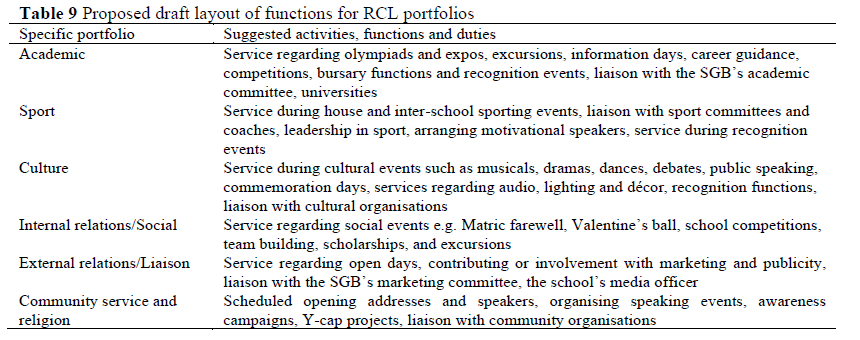
Beyond their general duties, we recommend that leaders or RCL members should be assigned responsibilities through designated portfolios or sub-committees. A portfolio system offers several advantages, including that it structures leader or RCL activities into clearly defined, planned functions; all leaders or RCL members gain experience in multiple facets of leadership, planning, organisation and execution of tasks; senior leaders can mentor novice leaders or RCL members, fostering leadership development; responsibilities can be distributed and shared more equitably, and promoting teamwork and cooperation. Table 9 outlines suggested portfolios and their respective functions within RCL sub-committees.
The application of the portfolio system could serve as a mechanism for leadership training and development in keeping with Dewey's (1938) educational method of experiential learning.
Learner Participation in Elections - Age-appropriate Inclusion
It is important to acknowledge that learners in the Foundation Phase (Grades 1-3) lack the developmental readiness to take an active role in school leadership elections. At this young age children are still developing the foundational cognitive, emotional, and social skills. Their ability to understand the implications of their choices and critical evaluation of leadership traits is limited. Furthermore, young learners are highly impressionable and vulnerable to outside influences, making it difficult to ensure a free and equitable decision-making process. For these reasons, we suggest that it is not developmentally appropriate to include young learners in leadership elections.
On the other hand, learners in Grades 4 and higher, have a higher degree of emotional maturity, reasoning ability, and awareness of their school environment. They are more able to understand the roles and responsibilities of elected leaders, and therefore, they should be given the right to vote in leader or representative elections.
Conclusion
By investing in such holistic leadership development and strengthening the frameworks that support it, schools may ensure that both the election process and the roles that follow become more credible, participatory and enriching. Future democratic leaders are likely to emerge from learners who are elected to serve as leaders or RCL members in schools. This approach will empower school leaders and encourage learners to take active roles in school life, ultimately nurturing a culture of democratic citizenship.
Notes
i . Published under a Creative Commons Attribution Licence.
Acknowledgement
This work is based on research supported in part by the National Research Foundation of South Africa (Grant Number: 150846). The grant holder acknowledges that opinions, findings and conclusions or recommendations expressed in any publication generated by the NRF-supported research are those of the authors, and that the NRF accepts no liability whatsoever in this regard.
Authors' Contributions
MHS wrote the manuscript, AMB conducted the research, provided and analysed the data. The Statistical Consultancy Services (S Ellis) of the NWU conducted all statistical analyses.
References
Asenbaum H 2026. A multiperspectival approach to democratic theory: Five lessons for democratic innovations. Politics, 46(1):114-133. https://doi.org/10.1177/02633957251320041 [ Links ]
Aspin DN 1995. The conception of democracy: A philosophy for democratic education. In JD Chapman, ID Froumin & DN Aspin (eds). Creating and managing the democratic school. Washington, DC: The Falmer Press. Available at https://files.eric.ed.gov/fulltext/ED384138.pdf#page=40. Accessed 13 August 2026. [ Links ]
Blaug R & Schwarzmantel J (eds.) 2000. Democracy: A reader. Edinburgh, Scotland: Edinburgh University Press. [ Links ]
Carr I & Williams C 2009. The mediation of Representative Council of Learners policy in Western Cape schools - 1997 to 2003. South African Journal of Education, 29(1):69-82. https://doi.org/10.15700/saje.v29n1a144 [ Links ]
Chapman JD & Dunstan JF (eds.) 1990. Democracy and bureaucracy: Tensions in public schooling. London, England: The Falmer Press. [ Links ]
Creswell JW & Creswell JD 2017. Research design: Qualitative, quantitative, and mixed methods approaches (5th ed). Thousand Oaks, CA: Sage. [ Links ]
Cunningham F 2002. Theories of democracy: A critical introduction. London, England: Routledge. [ Links ]
Dayton J 1994. Democratic value inculcation in public schools: The role of the Constitution and the courts. Paper presented at the Annual Meeting of the American Educational Research Association, New Orleans, Louisiana, 4-7 April. Available at https://files.eric.ed.gov/fulltext/ED374569.pdf. Accessed 31 August 2026. [ Links ]
De Bruin P 2006. Kookpot woed by spogskool oor leerlingraadsverkiesing. Beeld, 13 Februarie. [ Links ]
Department of Education, Republic of South Africa 2001. Personnel Administrative Measures. Government Gazette, 434(22594), August 24. [ Links ]
Department of Education (now Department of Basic Education) 2003. Regulations and Guidelines for Establishment, Election and Functions ofRepresentative Learner Councils. Government Gazette. General Notice No. 140 of 2000 (as amended by GN No. 70 of 2003). [ Links ]
Dewey J 1916/1966. Democracy and education: An introduction to the philosophy of education. New York, NY: Free Press. [ Links ]
Dewey J 1938. Experience and education. New York, NY: Macmillan. [ Links ]
Economou EML, Kyriazis NC & Platias A (eds.) 2022. Democracy in times of crises: Challenges, problems and policy proposals. Cham, Switzerland: Springer. https://doi.org/10.1007/978-3-030-97295-0 [ Links ]
Ergene O & Karabogaz Y 2024. The effects of the flipped classroom model on student's proportional reasoning. Journal of Pedagogical Research, 8(1):294-311. https://doi.org/10.33902/JPR.202425424 [ Links ]
Eriksen EO & Weigard J 2003. Understanding Habermas: Communicating action and deliberative= democracy. London, England: Continuum. [ Links ]
Field A 2009. Discovering statistics using SPSS (3rd ed). London, England: Sage. [ Links ]
Fishkin JS 2011. When the people speak: Deliberative democracy and public consultation. Oxford, England: Oxford University Press. [ Links ]
Fishkin JS & Laslett P (eds.) 2003. Debating deliberative democracy. Malden, MA: Blackwell Publishing. [ Links ]
Frey B (ed.) 2018. The SAGE encylopedia of educational research, measurement, and evaluation. Los Angeles, CA: Sage. [ Links ]
Gauteng Department of Education 2013. Representative council of learners (RCLs) survey: Training needs assessment at GDE secondary schools. Draft Report V 1.0. Available at https://www.education.gov.za/Portals/0/Documents/Reports/Research%20Repository/PDOU%20Pla nning/RCLs%20Survey.pdf?ver=2019-09-09-101802-980. Accessed 16 August 2026. [ Links ]
Grant Lewis S & Naidoo J 2004. Whose theory of participation? School governance policy and practice in South Africa. Current Issues in Comparative Education, 6(2):100-112. Available at https://files.eric.ed.gov/fulltext/EJ853842.pdf. Accessed 11 August 2026. [ Links ]
Habermas J 1996. Contributions to a discourse theory of law and democracy. Translated by W Rehg. Cambridge, England: Polity Press. [ Links ]
Haraldstad Å, Tveit AD & Kovač VB 2022. Democracy in schools: Qualitative analysis of pupils' experiences of democracy in the context of the Norwegian school. Cambridge Journal of Education, 52(1):73-89. https://doi.org/10.1080/0305764X.2021.1935738 [ Links ]
Held D 2006. Models of democracy (3rd ed). Cambridge, England: Polity Press. [ Links ]
Hendriks F 2023. Rethinking democratic innovation: Cultural clashes and the reform of democracy. Oxford, England: Oxford University Press.https://doi.org/10.1093/oso/9780192848291.001.0001 [ Links ]
Hunt F 2014. Learner councils in South African schools: Adult involvement and learners' rights. Education, Citizenship and Social Justice, 9(3):268-285.https://doi.org/10.1177/1746197914545928 [ Links ]
IBM Corp. 2017. IBM SPSS Statistics for Windows (Version 25.0) [Computer software]. Armonk, NY: Author. [ Links ]
Isaacs A 2021. Analysing educational leadership in relation to deliberative democracy: Towards a defensible form of school leadership. PhD dissertation. Stellenbosch, South Africa: Stellenbosch University. Available at https://scholar.sun.ac.za/server/api/core/bitstreams/3da8cb52-db00-4afe-8382-ea817317425/content. Accessed 13 August 2026. [ Links ]
Karlsson J 2002. The role of democratic governing bodies in South African schools. Comparative Education, 38(3):327-336. https://doi.org/10.1080/0305006022000014188 [ Links ]
Kiess J 2021. Learning by doing: The impact of experiencing democracy in education on political trust and participation. Politics, 42(1):75-94. https://doi.org/10.1177/0263395721990287 [ Links ]
Kotzé D 2004. The nature of democracy in South Africa. Politeia, 23(3):22-38. [ Links ]
Kymlicka W & Wayland SV 1996. Multicultural citizenship: A liberal theory of minority rights. Oxford, England: Clarendon Press. [ Links ]
Lafont C 2020. Democracy without shortcuts: A participatory conception of deliberative democracy. Oxford, England: Oxford University Press. [ Links ]
Mabovula N 2009. Giving voice to the voiceless through deliberate democratic school governance. South African Journal of Education, 29(2):219-233. https://doi.org/10.15700/saje.v29n2a162 [ Links ]
Mncube V, Davies L & Naidoo R 2015. Democratic school governance, leadership and management: A case study of two schools in South Africa. International Perspectives on Education and Society, 26:189-213. [ Links ]
Northern Cape Department of Education 2016. Notice for the establishment, election and functioning of Representative Councils of Learners in public schools in the Northern Cape. Northern Cape Provincial Gazette Notice no. 110 of 2016. [ Links ]
Northern Province (now Limpopo Province) 2000. Notice of determination ofguidelines for establishment, election and functions of Representative Council of Learners. Regulations in terms of the South African Schools Act No. 84 of 1996. General Notice no. 140 of 2000. [ Links ]
Parry G & Moran M 1994. Democracy and democratization. London, England: Routledge. [ Links ]
Phaswana E 2010. Learner councillors' perspectives on learner participation. South African Journal of Education, 30(1):105-122. Available at https://www.sajournalofeducation.co.za/index.php/saje/article/view/251/176. Accessed 6 August 2026. [ Links ]
Republic of South Africa 1996a. Constitution of the Republic of South Africa, Act No. 108 of 1996. Pretoria: Government Printer. [ Links ]
Republic of South Africa 1996b. National Education Policy Act, No. 27 of 1996. Government Gazette, 370(17118), April 24. [ Links ]
Republic of South Africa 1996c. South African Schools Act, No. 84 of 1996. Government Gazette, 377(17579):1-50, November 15. [ Links ]
Republic of South Africa 2005. Children's Act, No. 38 of 2005. Pretoria, South Africa: Government Printer. [ Links ]
Ruitenberg CW 2015. The practice of equality: A critical understanding of democratic citizenship education. Democracy & Education, 23(1):1-9. https://doi.org/10.65214/2164-7992.1129 [ Links ]
Salzwedel I 2010. Die jeug het die ATKV nog altyd na aan die hart gelê. Die ATKV-Jeuginstituut doen baie vir die jeug en hul onderwysers, boonop alles in Afrikaans. Taalgenoot, 1 July:10. [ Links ]
SAS Institute Inc. 2016. The SAS System for Windows 10 TS Level 1M0. Cary, NC: Author. [ Links ]
Sayed Y 1999. Discourses of the policy of Educational Decentralisation in South Africa since 1994: An examination of the South African Schools Act[1][2]. Compare: A Journal of Comparative and International Education, 29(2):141-152. https://doi.org/10.1080/0305792990290204 [ Links ]
Schumpeter J 1943. Capitalism, socialism and democracy. London, England: George Allen & Unwin. [ Links ]
Smit M 2013. Compatibility of democracy and learner discipline in South African schools. De Iure, 46(1):345-365. Available at https://www.scielo.org.za/pdf/dejure/v46n1/18.pdf. Accessed 6 August 2026. [ Links ]
Smit MH 2009. A model for the improvement of democratic school governance in South Africa - an education law perspective. PhD thesis. Potchefstroom, South Africa: North-West University. Available at https://repository.nwu.ac.za/server/api/core/bitstreams/e635702d-4f86-4bd8-99d1-a7b6027a884e/content. Accessed 13 August 2026. [ Links ]
Smit MH & Oosthuizen IJ 2011. Improving school governance through participative democracy and the law. South African Journal of Education, 31(1):55-73. https://doi.org/10.15700/saje.v31n1a415 [ Links ]
Steyn JC, Du Plessis WS & De Klerk J 1999. Education for democracy. Durbanville, South Africa: Wachwa. [ Links ]
Tarrant JM 1989. Democracy and education. Aldershot, England: Avebury. [ Links ]
Waghid Y 2022. Re-imagining Muslim education and the cultivation of democratic citizens in South Africa. Journal of Education in Muslim Societies, 4(1):5-19. [ Links ]
Wahlström N 2022. School and democratic hope: The school as a space for civic literacy. European Educational Research Journal, 21(6):994-1008. https://doi.org/10.1177/14749041221086721 [ Links ]
Western Cape Department of Education 2008. Provincial notice no. 164: Measures relating to governing bodies and a representative council of learners for public schools (excluding public schools for learners with special education needs). Provincial Gazette Extraordinary, 6519:1-20, May 20. Available at https://www.fedsas.org.za/Documents/Category/Provincial. Accessed 17 August 2026. [ Links ]
Wiklund H 2005. Democratic deliberation - In search of arenas for democratic deliberation: A Habermasian review of environmental assessment. Impact Assessment and Project Appraisal, 23(4):281-292. https://doi.org/10.3152/147154605781765391 [ Links ]
Woolman S & Fleisch B 2008. Democracy, social capital and school governing bodies in South Africa. Education and the Law, 20(1):47-80. https://doi.org/10.1080/09539960802138269 [ Links ]
Received: 18 July 2022
Revised: 24 April 2026
Accepted: 21 May 2026
Published: 31 August 2026