



Services on Demand
Journal

Article
 English (pdf)
 Article in xml format
 Article references
 Automatic translation
 Send this article by e-mail
Indicators
Related links
-
 Cited by Google
 -
 Similars in Google
Share

 Permalink
South African Journal of Education
On-line version ISSN 2076-3433Print version ISSN 0256-0100
S. Afr. j. educ. vol.46 n.2 Pretoria May. 2026
https://doi.org/10.15700/saje.v46n2a2372
ARTICLES
Mental health literacy among secondary school teachers in the City of Ekurhuleni Metropolitan Municipality, Gauteng, South Africa
R. Mutangi; S. V. Moodley; S. M. Patrick
School of Health Systems and Public Health, Faculty of Health Sciences, University of Pretoria, Pretoria, South Africa. rabmao@yahoo.com
ABSTRACT
School mental health care in South Africa forms part of the primary health care package in the form of an integrated programme for the promotion of school health. However, there appears to be a limitation in teacher mental health literacy, which may not meet the needs of South African secondary school youth in terms of coverage and uptake. The aim with the study reported on here was to explore secondary school teachers' mental health literacy in the City of Ekurhuleni, using a cross-sectional descriptive design. In total, 132 secondary school teachers participated in this study. A mental health literacy assessment was conducted using 4 vignettes, each scoring 1 for a total of 4, with a mean score of 1.23 (SD = 0.96) obtained. For the assessment of depression literacy, a 22-item questionnaire scored out of 22 was used, with a mean score of 10.65 (SD = 3.21) observed. Overall, the study results reveal a low mental health literacy level and a poor ability to identify the clinical features of depression among secondary school teachers in the City of Ekurhuleni. It is imperative that teachers become more aware of the mental health of their learners. We propose that the pre-service and in-service training curriculum of teachers include training on the identification of mental health systems.
Keywords: depression; depression literacy; mental health knowledge; mental health literacy; mental health promotion; mental health services; secondary school teachers
Introduction
Mental illness (World Health Organization [WHO], 2023) and substance use (United Nations Office on Drugs and Crime [UNODC], 2023) are common global disorders that pose a major threat to global health. An estimated 13% of the world's population was living with mental disorders in 2019 (WHO, 2022b). The loss in global productivity due to mental health conditions and the treatment costs of mental health-related medical conditions create an annual global financial toll of an estimated $1 trillion (WHO, 2024). A broad definition of mental health disorders encompasses many forms, such as eating disorders, depression, bipolarity, anxiety, and schizophrenia (Jorm, Korten, Jacomb, Christensen, Rodgers & Pollitt, 1997; Whitley, Smith & Vaillancourt, 2013). Depression and related disorders rank fourth as leading causes of disease globally (Arias, Saxena & Verguet, 2022). Depression is now the leading cause of disability worldwide, with a 20% increase in cases in almost a decade (WHO, 2023). Currently, the prevalence of common mental health illness is reportedly to be 16.5% in South Africa, with one in every six people suffering from depression, anxiety, or some problems related to substance use (Craig, Rochat, Naicker, Mapanga, Mtintsilana, Dlamini, Ware, Du Toit, Draper, Richter & Norris, 2022).
Mental health problems remain marginalised with minimal legislative support and a massive lack of political will (Aggarwal, Berk, Taljard & Wilson, 2016). Mental health conditions in Africa remain at the periphery of national budgets, with minimal resources being channelled towards the overall health system (WHO, 2022a). Stigmatisation remains a crucial social determinant of mental health and mental health coverage and uptake of mental health services remain very poor from the community level upwards (WHO, 2022a). In a few studies conducted in South Africa, stigma has been identified as a barrier to seeking help for mental health (Andersson, Schierenbeck, Strumpher, Krantz, Topper, Backman, Ricks & Van Rooyen, 2013). Cultural beliefs, such as mental illness being the result of witchcraft, may impact seeking help in some communities in South Africa (Bila & Carbonatto, 2022).
Literature Review
Epidemiology of mental illness in children and adolescent
Depression affects at least one in every 33 children (Bonnar, 2017; Tay, Tay & Klainin-Yobas, 2018). It is one of the most common emotional disorders in children, and interferes with a child's life, development, and emotional stability (Bruland, Pinheiro, Bittlingmayer & Bauer, 2016). Depression leads to a high rate of attempted and successful suicides in young persons (Bruland et al., 2016). Research highlights that substance use and mental health problems frequently begin in youth, and half or more of all mental health issues have shown to begin in childhood (Kutcher, Wei, Gilberds, Ubuguyu, Njau, Brown, Sabuni, Magimba & Perkins, 2016). In developing countries, one in seven persons between 10 and 19 years old have reported mental health disorders, contributing to 13% of the global disease burden for this age. This is alarming as anxiety and depressive disorders can lead to suicide, which is the fourth leading cause of mortality among persons 15 to 29 years old (WHO, 2025). Since this age group is most affected by mental health, teacher mental health literacy is vital to aid in identifying disorders and assisting individuals to seek health care.
The benefits of mental health literacy
Evidence shows that a good mental health knowledge base helps to raise the levels of awareness (Brooks, Irmansyah, Lovell, Savitri, Utomo, Prawira, Isjandar, Renwick, Pedley, Kusumatayi & Bee, 2019; Huang, Yang & Pescosolido, 2019; Miller, Musci, D'Agati, Alfes, Beaudry, Swartz & Wilcox, 2019). Consequently, this may help decrease the stigma and may increase the number of those who seek professional assistance, and access to life-saving treatments through the use of health services (Aluh, Okonta & Odili, 2019; Brooks et al., 2019).
Jorm (2012) suggests that MHL comprises an understanding of how mental disorders can be prevented, the ability to recognise when a mental illness is developing, an understanding of help-seeking options, treatment available, self-help strategies, and mental health first aid skills to help others (Jorm, 2012, 2015; Jorm et al., 1997). MHL is a fundamental requirement for mental health promotion, prevention, stigma reduction, and care programmes (Attygalle, Perera & Jayamanne, 2017; Kutcher, Wei & Coniglo, 2016; Svensson & Hansson, 2016).
High MHL levels may improve the community and institution's ability to respond to mental disorders (Nguyen Thai & Nguyen, 2018; Tay et al., 2018). The role of MHL in relation to mental health care has been analysed in multiple empirical studies (Nguyen Thai & Nguyen, 2018; Tay et al., 2018). They provide supportive evidence for the real need to further MHL research and intervention.
The role of teachers in learners' mental health
Adolescents spend more of their time in learning institutions than in any other formal institutional structure (Fazel, Hoagwood, Stephan & Ford, 2014). Teachers are most likely to influence their learners and bring about positive changes for their learners and the community at large (Fazel et al., 2014). Teachers are uniquely placed in a societal space that allows them to execute more functionally fulfilling roles as far as mental health is concerned (Bruland, Schulze, Harsch, Pinheiro & Bauer, 2017; Townsend, Musci, Stuart, Ruble, Beaudry, Schweizer, Owen, Goode, Johnson, Bradshaw, Wilcox & Swartz, 2017). The availability of mental health information pertaining to MHL in learning institutions in sub-Saharan Africa, South Africa, included, is limited (Atilola, 2016). By virtue of their place in the society, teachers may be the first people approached by adolescents when seeking help for issues related to emotional stress (Kutcher, Bagnell & Wei, 2015) and are best placed to proactively identify potential signs of emotional instability (Kutcher, Bagnell, et al., 2015). However, it is impossible for teachers to identify the warning signs of mental illness correctly if they are not fully equipped with the right knowledge (Kutcher, Gilberds, Morgan, Greene, Hamwaka & Perkins, 2015).
In most developing countries teachers are not adequately trained to deal with mental health care needs of their learners who present with warning signs or milder forms of depression (Ganasen, Parker, Hugo, Stein, Emsley & Seedat, 2008; Jorm, 2012). School teachers who are prepared well are in a good position to provide initial supportive assistance to learners with mental health problems (Ojio, Yonehara, Taneichi, Yamasaki, Ando, Togo, Nishida & Sasaki, 2015). The effects of several MHL programmes aimed at teachers have been reported but not yet reviewed in a systematic manner (Kutcher, Gilberds, et al., 2015; Swannell & McDermott, 2015).
Integrating mental health programmes
In order to successfully attain the core goals of universal health coverage (UHC) in South Africa and globally, it is crucial to integrate health education and promotion activities into the education system (WHO, 2023). The effectiveness of integrated school mental health programmes is dependent on the ability of educators to recognise and support learners who could be struggling with mental health issues (Bonnar, 2017; Bruland et al., 2017; Kutcher, Wei & Coniglo, 2016; Svensson & Hansson, 2016). Teachers are best placed to deal with early warning signs and referral for further management (Miller et al., 2019; Spiker & Hammer, 2019). Teachers and other key staff members have a vital partnership role in the identification and prevention of problems related to mental health in adolescents. Some research has been undertaken on the teacher's role in mental health provision, but little is known about the actual levels of individual teacher's MHL. Thus, the aim with this study was to assess MHL among South African secondary school teachers in the City of Ekurhuleni Metropolitan Municipality, Gauteng province.
Research Problem
Teachers are best placed to deal with early warning signs of mental health issues and referral for further management. Teachers and other key staff members have a vital partnership role in the identification and prevention of problems of mental health in adolescents. As such, it is crucial that educators and allied partners are fully empowered to actively play a vital role in the management of mental health issues in South Africa. Some research has been carried out on the teachers' role in mental health provision, but little is known about the actual levels of individual teacher's MHL. School-generated information regarding MHL in South Africa is very limited. The aim with this study was to analyse and describe the MHL levels of secondary school teachers in the City of Ekurhuleni.
Methodology
A descriptive cross-sectional study was undertaken among secondary school teachers in the City of Ekurhuleni from 28 February to 30 September 2021.
Study Setting and Participants The study was conducted in the large suburban region of Ekurhuleni, east of Johannesburg. According to 2017 statistics by Statistics South Africa (n.d.), the City of Ekurhuleni is a multi-racial, multi-cultural and multi-religious community. It is one of the five districts of the Gauteng province and one of the eight metropolitan municipalities of South Africa. Ekurhuleni North and Ekurhuleni South are the two school districts in the municipality.
The study population was teachers employed at government and private secondary schools in the City of Ekurhuleni. The inclusion and exclusion criteria were as follows:
a) Inclusion criteria
Permanent teachers employed at public and private secondary schools in the City of Ekurhuleni.
b) Exclusion criteria
School principals, student teachers and temporary teachers.
All secondary schools in Ekurhuleni for which contact details were available, were invited to participate in the study.
Measurements
Numerous methods have been used to measure MHL as no gold-standard assessment exists to capture this information (Jorm et al., 1997; O'Connor, Casey & Clough, 2014). The tools focused on assessing the constructs of MHL with vignettes and a depression literacy survey (Jorm et al., 1997). The participants' ability to identify and recognise mental health symptoms was assessed using vignettes. Vignettes were originally used in a study in the United States of America (USA), and permission was obtained from the author to use them (Azuero, 2016) in our study. The vignettes did not provide answer options, but rather required respondents to generate their own answers.
Four different vignettes, applicable to a local setting (Azuero, 2016), were used and intended to assess the individual teacher's ability to accurately identify symptoms of mental illness. The data collection tool presented teachers with vignettes of four mental health cases to elicit the teachers' knowledge levels about the features of mental illness and depression. One vignette was on obsessive compulsive disorder (OCD) and one on attention deficit hyperactivity disorder (ADHD), in random sequence. For each vignette, the participants had to imagine that the story was about them and had to respond to two questions: "Would this be a problem for you?" Yes/No, and "What name would you give this problem?" For the depression vignettes, all answers that included the words "depression", "depressed" and "depressive" were coded as correct. For the OCD vignette, all answers that included the words "obsession", "obsessed", "obsessive" and "compulsive disorder" were marked as correct. For the ADHD vignette, all answers that included the words "hyperactive disorder", "hyperactive" and "attention deficit" were marked as correct. If a participant provided more than one label, their response was coded as correct if it included any of the labels mentioned above. A total score of 3 or 4 out of 4 was regarded as high MHL, and a score of 2 or less as low MHL.
A 22-item depression literacy questionnaire consisting of multiple-choice items, developed by Griffiths, Christensen, Jorm, Evans and Groves (2004) (permission obtained for its use), formed part of the data collection tool. The depression literacy questionnaire elicited information about the knowledge of the features of depression and depression treatment options. Each correct item was scored 1 point with a maximum score of 22 points. These depression items were summed (0-22) to provide the participant' s depression literacy score (DLS). The final part of the data collection tool elicited information about the individual teacher's referral choices for learners with mental health problems.
Data Collection
The researchers collected primary data electronically using Qualtrics XM software. We obtained a list of the schools in the City of Ekurhuleni and telephoned the school principals to explain the aim with the research and to follow up on a formal request to participate distributed via electronic mail (email). In the email a list of email addresses of all the teachers at each school who were willing to participate was requested. The online survey required a limited time frame for completion, with responses having to be saved and submitted before moving on to the next question. The participants could not move back to the previous questions once they had submitted a response. Four reminders were sent to non-responders to encourage completion of the survey.
Data Management and Analysis
The data were recorded automatically on Qualtrics and then imported to Stata statistical software for analysis. Descriptive statistics (percentages and frequencies) summarised the categorical data. Scores were calculated using the correct responses for the four vignettes and a mean was calculated. Similarly, a total score out of 22 was determined for the depression literacy questions and a mean score obtained.
Ethical Considerations
The Research Ethics Committee of the Faculty of Health Sciences at the University of Pretoria granted permission for the study to be conducted (reference number 349/2020).
Results
Response Rates
Forty-one schools provided access to teachers' email addresses. The relevant schools provided the email addresses for 160 teachers, who were invited to participate, of which 132 (82.5%) teachers completed and submitted the online survey.
Demographic Characteristics of Participants
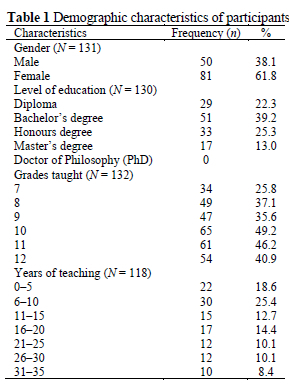
The demographic characteristics of the survey participants are summarised in Table 1. Most of the participants were female (61.8%) between 26 and 66 years with a mean age of 42.9 years. Fifty-one (39.2%) teachers held bachelor's degrees and 30 (25.4%) had between 6 and 10 years of teaching experience. Many teachers taught multiple grades, with almost half of participants (49.2%) teaching Grade 10.
Ability to Identify Mental Health Illness Using Vignettes
For all the vignettes, more than 80% of participants correctly identified that the vignettes depicted a problem (see Table 2), with the lowest percentage (84.3%) obtained for the ADHD vignette. For the first depression vignette, 115 (89.1%) respondents identified it as a problem, and for the second depression vignette 110 (87.2%) respondents acknowledged that it was a problem. However, only 53 participants (41.1%) correctly identified the first depression vignette as depicting depression and even fewer (n = 10, 9.1%) identified the second depression vignette as depicting depression.
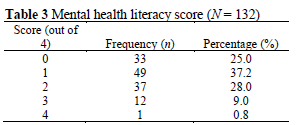
The ability of the individual teachers to identify symptoms of mental illness accurately in the probing questions section (in their own words), was assessed and scored out of four for every participant (see Table 3). Participants who did not attempt to respond to a vignette scored zero for that vignette. The mean score obtained was 1.23 (SD = 0.96). Thirteen (9.8%) participants scored 3 to 4 indicating a high level of MHL level, while 119 (90.2%) scored 2 or less indicating low levels of MHL.
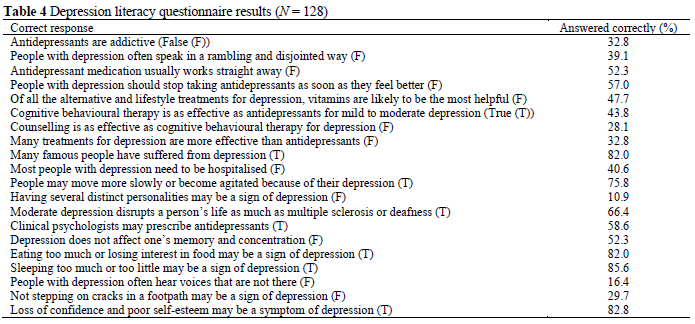
Depression Literacy Questionnaire Results
More than 80% of participants knew that sleep and appetite issues were features of depression (see Table 4). However, a large group confused the features more commonly associated with other mental disorders (e.g. multiple personalities, hallucinations) as depression. It appeared that many of the participants lacked knowledge about depression treatment.
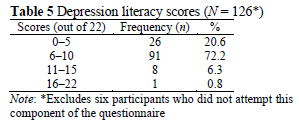
The summing of the depression items (0-22) was done to allocate DLS scores to participants (see Table 5). A mean score of 10.65 (SD = 3.21) was observed. One hundred and seventeen (92.9%) participants obtained a DLS of 0 to 10, and only nine (7.1%) obtained a score of 11 and above.
Referral Choices
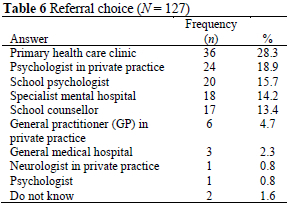
Table 6 summarises the individual teacher's referral choices for learners with mental health problems. Teachers preferred to refer learners with mental health challenges to primary health care clinics (28.3%), followed by psychologists in private practice (18.9%), school psychologists (15.7%), and school counsellors (13.4%).
Discussion
In this study, teachers' ability to identify mental health problems using vignettes indicates that many teachers could identify potential mental health problems among learners but few teachers were able to correctly identify the nature of the problem. The scores reveal that MHL was poor among secondary school teachers. The DLS mean score of 10.65, and the fact that 117 (92.8%) participants scored less than 10 out of 22, indicates a low knowledge level of depression among secondary school teachers in the City of Ekurhuleni. The finding of low levels of MHL in this study are consistent with other studies that have found low levels of MHL in Africa and globally. A study on Malawian teachers showed low mental health knowledge (Kutcher, Gilberds, et al., 2015). A study by Bruland et al. (2016) conducted in Europe also showed low levels of MHL among teachers and social workers.
Adolescents spend more of their time in learning institutions than in any other formal institutional structure (Fazel et al., 2014). Teachers have the potential to influence learners and bring about positive changes in the learners and the community at large (Fazel et al., 2014). Teachers are uniquely placed in a societal space that allows them to execute more functionally fulfilling roles regarding mental health (Bruland et al., 2017; Townsend et al., 2017). The finding of a lack of MHL among teachers needs to be addressed.
The low levels of MHL are possibly attributable to a lack of formal training. Research shows that teachers have minimal formal training in the identification of mental health illness (Bruland et al., 2016). Society unrealistically expects of teachers to work as teachers and to act as mental health assessors and providers, yet there has been little or minimal formal training on mental health offered to them to successfully perform this role (Kutcher, Gilberds, et al., 2015). A study on MHL conducted in Canada showed that informed teachers were able to achieve the desired change to meet the long-term outcome of an increase in MHL (Whitley et al., 2013). According to Miller et al. (2019), teacher MHL was associated with student literacy in the adolescent depression awareness programme.
A lack of funding for mental health activities may explain the lack of training and low levels of MHL. A study in sub-Saharan Africa found that most African states had no budget or monitoring system for activities related to mental health (Atilola, 2016). According to Fazel et al. (2014), mental health interventions in high-income countries are generally better and more countries are shifting their budgets to cater for mental health care needs. A study by Ganasen et al. (2008) revealed that most developing countries had minimal to no budgets for mental health issues. The study also showed that developing countries were moving slowly to acknowledge the daunting effects and impact of mental illness.
It would benefit the teachers and the school-based health teams at secondary schools in the City of Ekurhuleni to have resource contacts and information about mental health resources, and the process of accessing these. Helplines and community resources are available for assistance with mental health issues in South Africa but many of these facilities may have limited experience in dealing with adolescent mental health issues.
Appropriate resources would need to be identified by the provincial Departments of Education and Health. For a comprehensive school-based mental health strategy that starts in the classroom, teachers' literacy levels need to be improved. Proper training and education of hundreds of teachers will have an impact on thousands of children, their families, and the country (Whitley et al., 2013). The national Department of Basic Education and the provincial Department of Education should review the teacher training curriculum to address MHL among teachers. The findings in this study point to an urgent need to distribute literature on mental health in the form of pamphlets among secondary school teachers in the City of Ekurhuleni. While this might have budget implications in a resource-constrained environment like South Africa, it can be easily justified by the high rates of mental illness in the country (Craig et al., 2022). This may help to increase teachers' general knowledge levels in dealing with learners' mental health and their own stressors. Information on how to access community services and guidance on legal issues should be readily available to teachers. Without adequate guidance, standardised training, firm monitoring and evaluation systems and procedures, the identification of mental health is a chance event based on the knowledge, motivation, and capacity of individuals within the school environment.
The study had a few limitations. The unavailability of an updated contact list of schools in the City of Ekurhuleni, coupled by the lack of interest from potential participants, limited the number of participants. Some schools could not provide functional telephone numbers and email addresses, while others did not provide access to teachers' email addresses, citing privacy and confidentiality. Some schools indicated that their teachers were under physical, psychological, and emotional strain due to the coronavirus disease (COVID-19), and they would not allow them to participate. It is, therefore, unclear how representative the participants in this study were of all secondary school teachers in the City of Ekurhuleni. The findings of this study may not be generalisable to all secondary school teachers in the City of Ekurhuleni but give an indication that MHL may be an issue in the district. Lastly, we could not determine whether the schools' protocols or regulations guided the teachers' referral choices. The available literature highlights the vital role of MHL in the formulation and implementation phases of mental health care (Atilola, 2015; Ojio et al., 2015). A sound level of literacy and knowledge about mental health could reduce the levels of stigma around mental health, promoting positive attitudes towards seeking help, encouraging communities to help persons with mental health concerns, and cultivating a spirit of ownership and seeking help (Atilola, 2015; Jorm, 2015; Wei, Hayden, Kutcher, Zygmunt & McGrath, 2013).
Conclusion
With this study we confirmed that teachers lacked knowledge about identifying and dealing with learners with mental health issues. Teachers were not, on average, aware of the mental health symptoms and could not accurately identify them. Furthermore, we confirmed that teachers were not generally knowledgeable about the clinical features and treatment options of depression. Given the growing burden of mental illness among children and adolescents, these deficiencies need addressing so that schools may act as reliable and effective mental health resources. The introduction of mental health services to the Primary Health Care (PHC) model will help improve the quality of care given to those in need of mental health services, and the school may act as reliable and effective hubs for such services.
Acknowledgement
I would like to express my sincere gratitude to everyone who supported me throughout this Master of Public Health research journey. My heartfelt appreciation goes to my supervisors for their guidance and encouragement, and to my colleagues, friends, and family for their unwavering support and inspiration. This work would not have been possible without your contributions, and I am truly grateful.
Authors' Contributions
RM did the research proposal, distributed the data collection tools and conducted the research. He further analysed the data using the appropriate and approved statistical methods. SVM was the supervisor of this research, analysed the data using the appropriate and approved statistical methods, proofreading and professional editing. SMP conducted the professional language editing and statistical analysis using the appropriate and approved statistical methods. He was also responsible for quality control measures. All authors reviewed and approved the final manuscript.
Notes
i. Published under a Creative Commons Attribution Licence.
References
Aggarwal S, Berk M, Taljard L & Wilson Z 2016. South African adolescents' beliefs about depression. International Journal of Social Psychiatry, 62(2):198-200. https://doi.org/10.1177/0020764015618226 [ Links ]
Aluh DO, Okonta MJ & Odili VU 2019. Cross-sectional survey of mental health literacy among undergraduate students of the University of Nigeria. BMJ Open, 9(9):e028913. https://doi.org/10.1136/bmjopen-2019-028913 [ Links ]
Andersson LMC, Schierenbeck I, Strumpher J, Krantz G, Topper K, Backman G, Ricks E & Van Rooyen D 2013. Help-seeking behaviour, barriers to care and experiences of care among persons with depression in Eastern Cape, South Africa. Journal of Affective Disorders, 151(2):439-448. https://doi.org/10.1016/j.jad.2013.06.022 [ Links ]
Arias D, Saxena S & Verguet S 2022. Quantifying the global burden of mental disorders and their economic value. eClinicalMedicine, 54:101675. https://doi.org/10.1016/j.eclinm.2022.101675 [ Links ]
Atilola O 2015. Level of community mental health literacy in sub-Saharan Africa: Current studies are limited in number, scope, spread, and cognizance of cultural nuances. Nordic Journal of Psychiatry, 69(2):93-101. https://doi.org/10.3109/08039488.2014.947319 [ Links ]
Atilola O 2016. Mental health service utilization in sub-Saharan Africa: Is public mental health literacy the problem? Setting the perspectives right. Global Health Promotion, 23(2):30-37. https://doi.org/10.1177/1757975914567179 [ Links ]
Attygalle UR, Perera H & Jayamanne BDW 2017. Mental health literacy in adolescents: Ability to recognise problems, helpful interventions and outcomes. Child and Adolescent Psychiatry and Mental Health, 11:38. https://doi.org/10.1186/s13034-017-0176-1 [ Links ]
Azuero CB 2016. Brief depression literacy intervention with palliative cancer outpatients. PhD dissertation. Tuscaloosa, AL: The University of Alabama. Available at https://ir-api.ua.edu/api/core/bitstreams/f1b3e3a1-6e32-4414-a63c-986e2d94d8c1/content. Accessed 10 April 2026. [ Links ]
Bila NJ & Carbonatto CL 2022. Culture and help-seeking behaviour in the rural communities of Limpopo, South Africa: Unearthing beliefs of mental health care users and caregivers. Mental Health, Religion & Culture, 25(6):543-562. https://doi.org/10.1080/13674676.2022.2097210 [ Links ]
Bonnar F 2017. Raising mental health literacy. British Journal of Nursing, 26(22):1218. https://doi.org/10.12968/bjon.2017.26.22.1218 [ Links ]
Brooks H, Irmansyah I, Lovell K, Savitri I, Utomo B, Prawira B, Iskandar L, Renwick L, Pedley R, Kusumayati A & Bee P 2019. Improving mental health literacy among young people aged 11 -15 years in Java, Indonesia: Co-development and feasibility testing of a culturally appropriate, user-centred resource (IMPeTUs) - a study protocol. BMC Health Services Research, 19:484. https://doi.org/10.1186/s12913-019-4328-2 [ Links ]
Bruland D, Pinheiro P, Bittlingmayer UH & Bauer U 2016. "Teachers' mental health literacy." Prävention und Gesundheitsförderung, 11:73-79. https://doi.org/10.1007/s11553-016-0536-3 [ Links ]
Bruland D, Schulze K, Harsch S, Pinheiro P & Bauer U 2017. Mental health literacy of teachers and social workers: Qualitative interviews and in-depths findings: Dirk Bruland. European Journal of Public Health, 27(Suppl. 3):ckx187.548. https://doi.org/10.1093/eurpub/ckx187.548 [ Links ]
Craig A, Rochat T, Naicker SN, Mapanga W, Mtintsilana A, Dlamini SN, Ware LJ, Du Toit J, Draper CE, Richter L & Norris SA 2022. The prevalence of probable depression and probable anxiety, and associations with adverse childhood experiences and socio-demographics: A national survey in South Africa. Frontiers in Public Health, 10:986531. https://doi.org/10.3389/fpubh.2022.986531 [ Links ]
Fazel M, Hoagwood K, Stephan S & Ford T 2014. Mental health interventions in schools in high-income countries. The Lancet Psychiatry, 1(5):377-387. https://doi.org/10.1016/S2215-0366(14)70312-8 [ Links ]
Ganasen KA, Parker S, Hugo CJ, Stein DJ, Emsley RA & Seedat S 2008. Mental health literacy: Focus on developing countries. African Journal of Psychiatry, 11(1):23-28. https://doi.org/10.4314/ajpsy.v11i1.30251 [ Links ]
Griffiths KM, Christensen H, Jorm AF, Evans K & Groves C 2004. Effect of web-based depression literacy and cognitive-behavioural therapy interventions on stigmatising attitudes to depression: Randomised controlled trial. The British Journal of Psychiatry, 185(4):342-349. https://doi.org/10.1192/bjp.185A342 [ Links ]
Huang D, Yang LH & Pescosolido BA 2019. Understanding the public's profile of mental health literacy in China: A nationwide study. BMC Psychiatry, 19(1):20. https://doi.org/10.1186/s12888-018-1980-8 [ Links ]
Jorm AF 2012. Mental health literacy: Empowering the community to take action for better mental health. American Psychologist, 67(3):231-243. https://doi.org/10.1037/a0025957 [ Links ]
Jorm AF 2015. Why we need the concept of "mental health literacy". Health Communication, 30(12):1166-1668. https://doi.org/10.1080/10410236.2015.1037423 [ Links ]
Jorm AF, Korten AE, Jacomb PA, Christensen H, Rodgers B & Pollitt P 1997. "Mental health literacy": A survey of the public's ability to recognise mental disorders and their beliefs about the effectiveness of treatment. The Medical Journal of Australia, 166(4):182-186. https://doi.org/10.5694/j.1326-5377.1997.tb140071.x [ Links ]
Kutcher S, Bagnell A & Wei Y 2015. Mental health literacy in secondary schools: A Canadian approach. Child and Adolescent Psychiatric Clinics of North America, 24(2):233-244. https://doi.org/10.1016/j.chc.2014.11.007 [ Links ]
Kutcher S, Gilberds H, Morgan C, Greene R, Hamwaka K & Perkins K 2015. Improving Malawian teachers' mental health knowledge and attitudes: An integrated school mental health literacy approach. Global Mental Health, 2:e1. https://doi.org/10.1017/gmh.2014.8 [ Links ]
Kutcher S, Wei Y & Coniglio C 2016. Mental health literacy: Past, present, and future. The Canadian Journal of Psychiatry, 61(3):154-158. https://doi.org/10.1177/0706743715616609 [ Links ]
Kutcher S, Wei Y, Gilberds H, Ubuguyu O, Njau T, Brown A, Sabuni N, Magimba A & Perkins K 2016. A school mental health literacy curriculum resource training approach: Effects on Tanzanian teachers' mental health knowledge, stigma and help-seeking efficacy. International Journal of Mental Health Systems, 10:50. https://doi.org/10.1186/S13033-016-0082-6 [ Links ]
Miller L, Musci R, D'Agati D, Alfes C, Beaudry MB, Swartz K & Wilcox H 2019. Teacher mental health literacy is associated with student literacy in the Adolescent Depression Awareness Program. School Mental Health, 11(2):357-363. https://doi.org/10.1007/s12310-018-9281-4 [ Links ]
Nguyen Thai QC & Nguyen TH 2018. Mental health literacy: Knowledge of depression among undergraduate students in Hanoi, Vietnam. International Journal of Mental Health Systems, 12:19. https://doi.org/10.1186/s13033-018-0195-1 [ Links ]
O' Connor M, Casey L & Clough B 2014. Measuring mental health literacy - a review of scale-based measures. Journal of Mental Health, 23(4): 197-204. https://doi.org/10.3109/09638237.2014.910646 [ Links ]
Ojio Y, Yonehara H, Taneichi S, Yamasaki S, Ando S, Togo F, Nishida A & Sasaki T 2015. Effects of school-based mental health literacy education for secondary school students to be delivered by school teachers: A preliminary study [Special issue]. Psychiatry and Clinical Neurosciences, 69(9):572-579. https://doi.org/10.1111/pcn.12320 [ Links ]
Spiker DA & Hammer JH 2019. Mental health literacy as theory: Current challenges and future directions. Journal of Mental Health, 28(3):238-242. https://doi.org/10.1080/09638237.2018.1437613 [ Links ]
Statistics South Africa n.d. Ekurhuleni. Available at https://www.statssa.gov.za/?page_id=1021 & id=ekurhuleni-municipality. Accessed 29 May 2026. [ Links ]
Svensson B & Hansson L 2016. How mental health literacy and experience of mental illness relate to stigmatizing attitudes and social distance towards people with depression or psychosis: A cross-sectional study. Nordic Journal of Psychiatry, 70(4):309-313. https://doi.org/10.3109/08039488.2015.1109140 [ Links ]
Swannell EJ & McDermott MR 2015. Measuring and predicting mental health literacy for depression. International Journal of Mental Health Promotion, 17(5):293-311. https://doi.org/10.1080/14623730.2015.1089010 [ Links ]
Tay JL, Tay YF & Klainin-Yobas P 2018. Mental health literacy levels. Archives of Psychiatric Nursing, 32(5):757-763. https://doi.org/10.1016/j.apnu.2018.04.007 [ Links ]
Townsend L, Musci R, Stuart E, Ruble A, Beaudry MB, Schweizer B, Owen M, Goode C, Johnson SL, Bradshaw C, Wilcox H & Swartz K 2017. The association of school climate, depression literacy, and mental health stigma among high school students. Journal of School Health, 87(8):567-574. https://doi.org/10.1111/josh.12527 [ Links ]
United Nations Office on Drugs and Crime 2023. World drug report. New York, NY: United Nations. Available at https://www.unodc.org/res/WDR-2023/WDR23_Exsum_fin_DP.pdf. Accessed 10 April 2026. [ Links ]
Wei Y, Hayden JA, Kutcher S, Zygmunt A & McGrath P 2013. The effectiveness of school mental health literacy programs to address knowledge, attitudes and help seeking among youth. Early Intervention in Psychiatry, 7(2):109-121. https://doi.org/10.1111/eip.12010 [ Links ]
Whitley J, Smith JD & Vaillancourt T 2013. Promoting mental health literacy among educators: Critical in school-based prevention and intervention. Canadian Journal of School Psychology, 28(1):56-70. https://doi.org/10.1177/0829573512468852 [ Links ]
World Health Organization 2022a. Barriers to mental health care in Africa. Available at https://www.afro.who.int/news/barriers-mental-health-care-africa. Accessed 31 March 2026. [ Links ]
World Health Organization 2022b. World mental health report: Transforming mental health for all. Geneva, Switzerland: Author. Available at https://iris.who.int/bitstream/handle/10665/356119/9789240049338-eng.pdf?sequence=1. Accessed 31 March 2026. [ Links ]
World Health Organization 2023. Towards global mental health for all: A journey through consecutive Global Mental Health Summits. Available at https://www.who.int/publications/m/item/towards-global-mental-health-for-all. Accessed 10 April 2026. [ Links ]
World Health Organization 2024. Mental health at work. Available at https://www.who.int/news-room/fact-sheets/detail/mental-health-at-work. Accessed 31 March 2026. [ Links ]
World Health Organization 2025. Mental health of adolescents. Available at https://www.who.int/news-room/fact-sheets/detail/adolescent-mental-health. Accessed 31 March 2026. [ Links ]
Received: 1 May 2022
Revised: 7 November 2023
Accepted: 6 February 2026
Published: 31 May 2026