



Services on Demand
Journal

Article
 English (pdf)
 Article in xml format
 Article references

 Automatic translation
 Send this article by e-mail
Indicators
Related links
-
 Cited by Google
-
 Similars in Google
Share

 Permalink

South African Journal of Education
On-line version ISSN 2076-3433Print version ISSN 0256-0100
S. Afr. j. educ. vol.46 n.1 Pretoria Feb. 2026
https://doi.org/10.15700/saje.v46n1a2635
ARTICLES
Geographical regions and primary school learners' achievement differences in Ghana: Implications for an inclusive curriculum
Winston Kwame AbroampaI; Maxwell Kwesi NyatsikorII; Eric Daniel AnangaIII
IDepartment of Teacher Education, Faculty of Educational Studies, Kwame Nkrumah University for Science and Technology, Kumasi, Ghana. wkabroampa@knust.edu.gh, wynxtin@yahoo.com
IIDepartment of Humanities and Social Sciences Education, Faculty of Education, University for Development Studies, Tamale, Ghana
IIIDepartment of Social Studies, Faculty of Social Sciences Education, University of Education, Winneba, Ghana
ABSTRACT
In the study reported on here we investigated the effects of geographical regions on primary school learners' achievement in Ghana's National Standardised Test, aiming to understand how regional differences in learning opportunities challenge Ghana's dual purpose of effectively implementing the basic school curriculum and inclusive education. Data from 318,254 Grade 4 learners in 9,619 public schools analysed with multilevel modelling showed that the region negatively affected mathematics (β = -.586) and English (β = -.807) achievement. Compared to the Western North region, 10 regions positively impacted mathematics achievement significantly, 3 had negative effects, and 2 had insignificant effects. All regions significantly enhanced English achievement compared to the Western North region. On average, learners in the Ahafo region earned an extra 6 marks (β = 6.365) in mathematics and 15 marks (β = 14.715) in English, while in the Eastern, Western, and Volta regions, learners were disadvantaged by 1, 4, and 5 marks, respectively, in mathematics. The findings reveal significant inequalities in educational opportunities across the regions, and achievement significantly depended on where learners attended school. It is thus essential to consider regional-based inequalities when assessing learners, while intentional efforts are made to address these inequalities to ensure inclusive education and curriculum implementation.
Keywords: achievement; curriculum; English language; geographical region; inclusive education; location; mathematics; schools
Introduction
Goal 4 of the United Nations Sustainable goals signals the promotion of inclusive and equitable education and lifelong learning opportunities for all (United Nations, 2015). This goal seeks to address the significant disparities in global educational opportunities among learners at different levels of education. Given this goal, many countries have brought about educational reform to achieve this global mandate (Adeniyi, Al Hamad, Adewusi, Unachukwu, Osawaru, Onyebuchi, Omolawal, Aliu & David, 2024; Ministry of Education [MoE], 2015). Despite these country-specific reforms and policies (Adeniyi et al., 2024; Humes & Priestley, 2021) to address these disparities, significant educational opportunities and academic achievement differences existed among learners from different countries across the globe (Chudgar & Sankar, 2019; Mullis, Martin, Foy, Kelly & Fishbein, 2020). For instance, analyses of different waves of international assessments, such as the Programme for International Student Assessment (PISA), Progress in International Reading Literacy Study (PIRLS), Trends in International Mathematics and Science Study (TIMSS), and the Southern and Eastern African Consortium Monitoring of Educational Quality (SEACMEQ), have partly attributed the differences in learners' achievement to the different country-level characteristics (Agasisti, Avvisati, Borgonovi & Longobardi, 2021; Hungi, Ngware, Mahuro & Muhia, 2017; Sumida & Kawata, 2021). These macro-level influences on the learning outcomes of learners from different countries include socio-economic factors (Anlimachie & Avoada, 2020), educational systems (Van Hek, Buchmann & Kraaykamp, 2019), and the geographical locations of participating countries (Matheny, Thompson, Townley-Flores & Reardon, 2022). Within countries, there is evidence of significant differences in the achievement of learners from various parts of a country. For instance, achievement data from Australia show significant differences among learners across different geographical regions (Australian Curriculum, Assessment and Reporting Authority [ACARA], 2021; Halsey, 2018; Thomson, Wernert, Buckley, Rodrigues, O'Grady & Schmid, 2021). Similarly, in the United States of America (USA), abundant research evidence validates the impact of schools' geographical location on learners' achievement (Irwin, De La Rosa, Wang, Hein, Zhang, Burr, Roberts, Barmer, Bullock Mann, Dilig & Parker, 2022; Reardon, Kalogrides & Shores, 2019). Likewise, significant achievement differences have been linked to the geographical backgrounds of learners from different European countries (Agasisti et al., 2021; Sumida & Kawata, 2021). According to extant literature, these geographical differences in learners' achievement reflect various factors, including socio-economic disparities, educational resources, cultural influences, and policy contexts (Chesters & Cuervo, 2022; Mullis et al., 2020). In the African context, evidence from SEACMEQ data (Sumida & Kawata, 2021) and Nigeria (United Nations Children's Fund [UNICEF], 2025) suggests that learners from specific parts of the country persistently outperform those from other parts.
In Ghana and other parts of the world, the causes of educational inequalities and subsequent achievement by primary school learners are countless. Whereas studies have linked these differences to learners' characteristics (Breit, Schneider & Preckel, 2025; Nyatsikor, 2024), others have attributed this to the unequal socio-economic amenities and educational facilities across Ghana's 16 regions (Nyatsikor, Abroampa & Esia-Donkoh, 2020). Other studies highlight the unequal quality of teachers in classrooms across the regions (Nyatsikor, Sosu, Mtika & Robson, 2020). Although studies and reports on geographical disparities and trends in learners' achievement in Ghana are available (Ghana Statistical Service [GSS] 2021; MoE, 2016; National Council for Curriculum and Assessment [NaCCA], 2021), studies on how each of the 16 regions contributes uniquely to learners' achievement are absent. Consequently, with this study we offer a fresh dimension of evidence from the Ghanaian and African contexts by examining the magnitude of the geographical regions' impact on primary school learners' achievements in mathematics and English. This is crucial to understanding how macro-level influences facilitate or hinder the full implementation of Ghana's inclusive education policy and Sustainable Development Goal (SDG) 4. In the following sections we present the literature review, the methodology and methods adopted, and a discussion of results generated from the data concerning the research questions guiding the study. We also present the conclusions, implications, and recommendations from this study and we acknowledge the limitations of the study.
Literature Review
Theoretical review - theory of educational productivity
We used Walberg's (1981) theory of educational productivity to explain how different school regions influence learners' achievement. Walberg (1981, 1986) identified nine factors necessary for enhancing affective, behavioural, and cognitive learning. These are (i) learners' ability or prior achievement, measured by standardised tests; (ii) age and development; (iii) motivation or self-concept; (iv) amount of instruction or time spent learning; (v) quality of instruction; (vi) home environment; (vii) classroom environment; (viii) peer group environment; and (ix) the impact of mass media, especially the minimum time spent watching television. These nine factors are condensed into three main factors: learner aptitude, the amount and quality of instruction, and the psychological environment. The dataset that we used did not include all variables specified in the theory. Nonetheless, we argue that different geographical regions in Ghana offer distinct psychological environments and teaching and learning opportunities for learners within each region. This stems from the diverse social, economic, and educational opportunities and challenges characterising each region regarding the optimisation of learner aptitude, the amount and quality of instruction, and the psychological environment. Therefore, we hypothesised that schools and districts within specific regions would perform similarly due to region-specific and within-group similarities. However, they will differ from other regions, which provide different psychological environments that influence the districts, schools, and learners within (Walberg, 1981, 1986). Therefore, the different geographical regions where learners attended school influenced their achievement in mathematics and English language in many ways, as the regions offered distinct teaching and learning opportunities and psychological environments.
Empirical review
The influence of geographical regions or locations on learners' academic achievement has been explored in different contexts globally (Banda, Liu, Banda & Zhou, 2023; Halsey, 2018; Sumida & Kawata, 2021). These studies consistently indicate that schools and learners from socio-economically advantaged locations of a region or country outperform those from disadvantaged parts. These achievement disparities have been attributed to differences in funding, educational infrastructure, technology, and instructional materials between socio-economically advantaged, urban and socio-economically disadvantaged, rural locations (Roscigno & Crowle, 2001; Zhang, 2006). Rural and economically disadvantaged regions face challenges such as poverty, limited parental education, and inadequate resources, which contribute to lower academic performance (Byun, Meece & Irvin, 2012; Hardré & Sullivan, 2008). These unfavourable rural-associated characteristics are favourably moderated by the relatively better urban characteristics and conditions, leading to improved learning outcomes. In other contexts, differences in learners' achievement have been attributed to differences in language proficiency (Planas, McKinley, Smith, Ingram, Essien & Moore, 2025) as well as cultural practices and community attitudes toward education in specific regions (Adomako Gyasi, Zhou & Amarteifio, 2023). In the USA, the diverse cultural and linguistic landscape influences educational practices and outcomes across different states (Irwin et al., 2022; Matheny et al., 2022). Although significant achievement variances exist among learners from different locations within states, the disparities tend to be greater between states. Lubienski and Lubienski (2013) attribute this to differences in state policies and unequal educational opportunities and outcomes among learners in the USA.
In Ghana, regional disparities significantly influence learners' academic achievement across various educational indicators. For instance, significant relationships between the quantity and quality of resources and infrastructure in geographical regions and learners' achievement levels have been reported in studies (MoE, 2016; Nyatsikor, Abroampa, et al., 2020). Generally, compared to rural schools, urban centres receive more human and non-human resources for education, leading to improved learning environments (Arthur, Mishra & Zenengeya, 2020). Predominantly, rural and socio-economically disadvantaged schools lack essential resources, including textbooks, digital tools, and internet connectivity, to facilitate effective teaching and learning (GSS, 2021; MoE, 2018). The seeming differences in the quantity and quality of teachers across the regions of Ghana have also been found to be a significant variable influencing the regional differences in learners' achievement (NaCCA, 2021; Nyatsikor, Abroampa, et al., 2020). In contrast to rural localities, urban areas in a region attract more qualified teachers due to better living conditions, professional development opportunities, and more promising career prospects (Darvas & Balwanz, 2014; MoE, 2016). According to GSS (2021), any settlement with 5,000 or more persons qualifies as urban. With this criterion, the national urban population was 56.7% compared to the national rural population of 43.3%. In order of magnitude, the most to least urbanised regions in Ghana are Greater Accra (91.7%), Ashanti (61.6%), Bono (58.6%), Central (57.9%), Bono East (52.6%), Western (51.6%), Eastern (51.5%), Ahafo (48.7%), Northern (47.4%), Volta (42.1%), Oti (32.6%), North East (32.6%), Western North (29.8%), Savanna (29.6%), Upper West (26.4), and Upper East (25.4%). From these statistics, we were interested to know whether the most urbanised regions favoured and contributed to learners' learning outcomes the most, while the most rural regions disfavoured learning outcomes the most, as contended by numerous studies. Drawing from this reasoning and prior evidence from different contexts, we explored the unique contributions of Ghanaian geographical regions to primary school learners' mathematics and English language achievement in a national achievement test. Our exploration was guided by three research questions.
Research Question
1) How much variance in learners' mathematics and English language achievement is explained by the country's geographical regions?
2) To what extent does each geographical region account for learners' mathematics achievement variance?
3) To what extent does each geographical region account for learners' English language achievement variance?
Context of the Study
The National Standardised Test (NST)
The data for the 2021 NST for all public primary Grade 4 learners in Ghana was used for the study. The NST seeks to gauge learners' proficiency in the content standards for mathematics and English. It also assesses knowledge, skills, values, and attitudes germane to the pre-tertiary education curriculum (NaCCA, 2021). The key focus of the NST is to examine the quality of educational inputs in relation to learning outcomes, thereby addressing Sustainable Development Goals 4.1.1 and 4.1.2, as well as the global proficiency framework (GPF). The framework emphasises conducting a national learning assessment at the primary stage, at the end of primary, and at the end of lower secondary education. Each subject comprised 35 questions. Learners who correctly answered up to 17 questions (i.e., 49% and below) were judged to have achieved below basic proficiency; scores between 18 and 22 (i.e., 50%-65%) were considered to have attained basic proficiency, while learners with scores between 23 and 27 (66%-79%) signalled proficiency in a subject. Learners who correctly answered at least 28 of the total of 35 items were deemed to have advanced knowledge (highly proficient) in the subject.
Materials and Methods
Independent, Dependent, and Covariates
The independent variable in this study was the geographical regions where the schools were situated. The regions were coded as follows: Ahafo = 1, Ashanti = 2, Bono = 3, Bono East = 4, Central = 5, Eastern = 6, Greater Accra = 7, North East = 8, Northern = 9, Oti = 10, Savannah = 11, Upper East = 12, Upper West = 13, Volta = 14, Western = 15, and Western North = 16. The dependent variables were learners' mathematics and English language achievement scores. Three variables comprising learners' gender, schools and class size were controlled.
Study Population, Sample, and Sampling
The study population comprised all learners in the fourth grade in public primary schools in Ghana. According to the NaCCA report, 14,883 primary schools with 431,206 fourth-grade learners were registered to participate in the NST. Of this total, 398,698 learners participated in the English language test, and 399,486 took the mathematics test. Data were collected cross-sectionally nationwide on 17 December 2021, through a census of all fourth-grade learners in public schools. Ethical considerations implemented included obtaining informed consent from learners, school and educational authorities and parents.
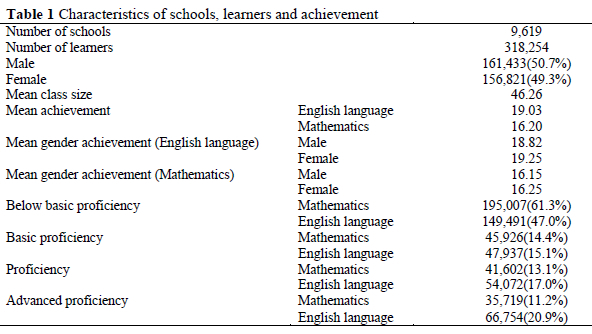
However, for our study, data from 318,254 learners in 9,619 schools were used. We applied two inclusion criteria to arrive at the final sample size. Firstly, we included learners who participated in the English language and the mathematics tests. Secondly, only schools with minimum class sizes of 10 learners were included to ensure the appropriate application of the multilevel modelling technique (Heck & Thomas, 2020; Hox, Moerbeek & Van de Schoot, 2017). Table 1 details the number of schools, learners, and achievement levels.
Data Analysis Strategy
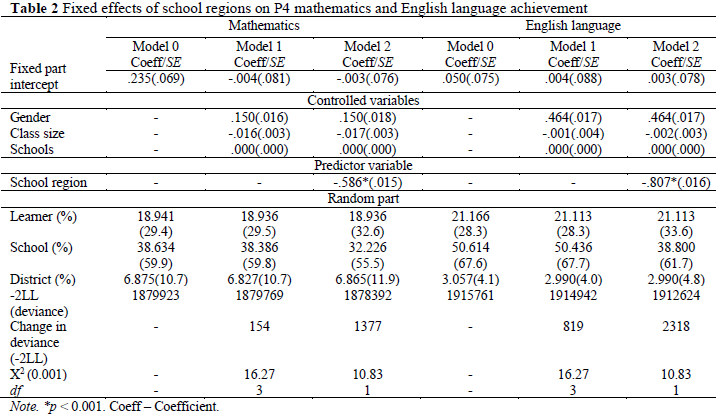
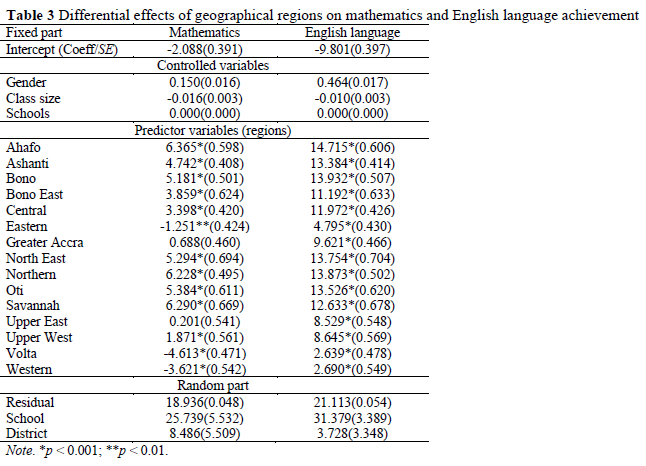
The data were analysed using a three-level modelling technique recognising the nested nature of the data where learners were nested in schools and schools in districts. The independent, dependent and covariates were grand mean-centred, ensuring that the variances of the intercept and the slopes in the regression had a clear interpretation when all explanatory variables were equal to zero (Heck & Thomas, 2020; Hox et al., 2017). The analyses were done in four stages. Firstly, an unconditional model with no predictors was specified to compute the intraclass correlation coefficient (ICC) to determine the proportion of variance accounted for by clustering in the data. The ICC signals whether the multilevel modelling technique is required to analyse the data (Heck & Thomas, 2020). In addition, the unconditional model helps to establish the extent to which the deviances of subsequent models improve over the initial deviance (-2 log likelihood [-2LL]) (Heck & Thomas, 2020). At stage two, three covariates (schools, learners' gender and class sizes) were controlled to account for their confounding effects on achievement in both subjects. The third stage of the analysis introduced schools' geographical regions as the independent variable to estimate the regions' fixed effects on achievement. In the fourth stage we explored the differential effects of schools' geographical regions on achievement in both subjects. The coefficients derived for the variables and their respective standard errors (in brackets) are presented in Tables 2 and 3.
Results
Discussion of Results
The unconditional models revealed strong evidence of grouping effects on achievement in both subjects. For mathematics, school and district-level differences accounted for 59.9% and 10.7% of the achievement variance, with the remaining 29.4% as a residual, unexplained variance. Regarding English language, schools and districts accounted for 67.6% and 4.1% of the achievement variance, while 28.3% remained unexplained at learner level. Controlling for the three covariates (i.e., schools, learners' gender, and class sizes) resulted in significant drops in the -2LL of the mathematics and English language models, as shown in Table 2. The diverse contributions and impact of schools (Nyatsikor, Abroampa & Esia-Donkoh, 2021), learners' gender (Rosén, Steinmann & Wernersson, 2022; Van Hek, Kraaykamp & Pelzer, 2018) and class sizes (Blatchford & Russel, 2021; Hattie, 2009) to the learning outcomes have extensively been explored and documented in prior studies. Introducing the predictor variable (the geographical region of schools) to the model as a fixed effect resulted in substantial decreases in the -2LL for mathematics and English language models, signalling its statistically significant contribution to achievement differences. The independent variable explained 15.9% of the between-school and -0.6% of the between-district achievement differences in mathematics. There was a marginal increase in the district-level coefficients (Level 3) for mathematics when the predictor variable was added to the model, resulting in negative variances. This phenomenon occurs when predictor variables that have more group level variance than a random sampling process are added to the model (Hox et al., 2017). Consequently, the apparent within-groups variance can increase, resulting in a negative estimate for the explained variance as observed. For English language, the independent variable explained 23.0% of the between-school and 0.0% of the between-district achievement differences. For both subjects, the geographical location of schools explained none of the between-learner differences in achievement. This may be due to different reasons, including the moderation and mediation effects of other variables. Intriguingly, geographic regions accounted for a greater proportion of the school achievement variance than the district-level variance. This suggested the presence of significant and systematic disparities in the composition and characteristics of schools and their achievement patterns within and across the regions of the country.
Research question 1: How much of learners' mathematics and English language achievement variances are collectively explained by the geographical regions in Ghana
Collectively, the 16 geographical regions accounted for β = -0.586 in mathematics and β = -0.807 in English language achievement variance, which were significant at p < 0.001. The negative coefficient estimates for both subjects suggest that the cumulative conditions of the geographical regions constituting the nation negatively impacted learners' achievement by approximately a mark in both subjects. This result challenges Ghana's efforts to create a conducive macro-level environment that enhances teaching and learning. Given this, Research Questions 2 and 3 disaggregate the unique impact of each of the 16 regions to highlight which regions positively and negatively impacted learners' achievement in both subjects.
Research question 2: To what extent does each geographical region account for learners' mathematics achievement variance?
The impact of geographical regions on learners' mathematics achievement was mixed. With the Western North region as redundant, all the other regions significantly impacted achievement except the Greater Accra and Upper East regions. Three regions (Eastern, Volta, and Western) had a negative impact on learners' achievement in mathematics. The Ahafo, Savanna, Northern, Oti, North East, and Bono regions showed the greatest favour for primary school learners' mathematics achievement.
Research question 3: To what extent does each geographical region account for learners' English language achievement variance?
With the Western North region as reference, all other regions made a statistically significant, positive impact on English language achievement. The Ahafo, Bono, Northern, North East, Oti and Ashanti regions favoured achievement the most.
The significant impacts of geographical regions on learners' achievement in school subjects validate prior studies and reports across different contexts (Chesters & Cuervo, 2022; Kadio, 2023). However, the dissimilar effects of the geographic regions on the two subjects suggest a complex relationship between each subject and the characteristics of the geographical regions. Prior studies indicate that school geographical regions differ in terms of infrastructure (Ansong, Okumu, Bowen, Walker & Eisensmith, 2017) and socio-economic status (Chowa, Masa, Wretman & Ansong, 2013). Specifically, rural and urban areas within regions have been found to have a significant impact on achievement. Predominantly, learners from urban, socio-economically advantaged localities consistently outperform their peers from rural and socio-economically disadvantaged localities (Nyatsikor, Sosu, et al., 2020). These achievement differences do not arise from merely labelling a locality as either rural or urban, but rather from the cumulative effects of the economic, social, and educational resource advantages and disadvantages characterising the urban and rural localities that constitute the regions of Ghana.
Nonetheless, the insignificant difference in impact between the redundant region and Greater Accra, particularly in mathematics achievement, is quite curious. According to the GSS (2021), the urban population in Accra is 91.7% compared with Western North's 29.8% and Upper East's 25.4%. Given prior studies suggesting statistically significant differences in the impact of rural and urban localities, this result counters and highlights the importance of other contextual variables that mediate and moderate their effects on one another. Nonetheless, we offer two hypotheses to explain these insignificant differences. Firstly, categorising urban and rural areas in the regions of Ghana is not premised on the quality of educational resources but rather on a minimum population of 5,000 in a locality (GSS, 2021). Hence, it may be the case that the quality of educational resources for schools in the regions concerned was not significantly different from one another, regardless of their percentage urban or rural status. A second hypothesis may be that factors other than the regions' characteristics are more important determinants of achievement for these regions, given the evidence that many factors and educational inputs at the learner, teacher, school, and community levels mediate and moderate achievement levels (Johansson, Gustafsson, Hansson & Alatalo, 2024; Kyriakides, Creemers & Charalambous, 2018). The results demonstrated a non-linear relationship between a region's status in terms of its urban and rural composition and achievement levels in both subjects.
Conclusion
The results from this study suggested that significant disparities existed among the regions in the country regarding their contributions to primary school learners' mathematics and English language achievement. Approximately six marks (β = 6.365) of the Ahafo primary school learners' mathematics achievement was uniquely attributed to the cumulative advantages associated with the region, while the disadvantages associated with the Volta Region resulted in learners achieving approximately five marks (β = -4.613) lower than their peers from the Western North. This demonstrates a significant difference of approximately 11 marks (i.e., β = 10.978) attributed to the geographical differences between learners from the Volta and Ahafo regions. In English language achievement, Ahafo primary school learners scored approximately 15 marks (β = 14.715) more than those from the Western North region due to differences in school geographical regions. Understanding these factors is essential for developing evidence-based policies and interventions that promote educational equity and improve learning outcomes for all learners across all regions.
Implications for Policy and Practice
The study revealed significant differences in mathematics and English language achievement across Ghana's geographical regions, highlighting the need for a curriculum that acknowledges and addresses these regional inequalities. An inclusive curriculum should incorporate strategies to support learners from disadvantaged regions, ensuring that they have equal opportunities to succeed academically. Given the differences in English language achievement across regions, an inclusive curriculum should consider the linguistic diversity of Ghana. This may involve incorporating multilingual approaches or providing additional language support in regions where English proficiency is lower. Furthermore, the regional differences in achievement suggest that an inclusive curriculum should be culturally responsive, incorporating diverse perspectives and examples from various Ghanaian contexts. This can help make the curriculum more relatable and engaging for learners across all regions.
The study findings on regional achievement disparities imply that a one-size-fits-all assessment approach may not be equitable. An inclusive curriculum should incorporate diverse assessment methods that accurately measure learner progress while accounting for regional differences in resources and learning contexts. Additionally, an inclusive curriculum should emphasise building strong foundational skills in these subjects across all regions. This may involve allocating more time and resources to these core subjects in areas where achievement is lower.
To address the regional disparities, an inclusive curriculum should incorporate strategies for engaging local communities and leveraging local knowledge and resources. This can help make the curriculum more relevant and sustainable across diverse contexts. While acknowledging the digital divide among the regions, an inclusive curriculum should thoughtfully integrate technology where possible. This could involve developing offline digital resources or leveraging mobile technologies that are more widely available across regions.
The foregoing shows that the research highlights the dynamic nature of regional educational disparities. An inclusive curriculum should, therefore, include mechanisms for ongoing monitoring and adaptation to ensure that it remains responsive to changing regional needs and contexts. By considering these implications in curriculum development, policymakers and educators can work towards creating a more equitable and inclusive education system that addresses the diverse needs of learners across all regions of Ghana, in line with SDG 4 and the country's policy on inclusive education.
Recommendations
We recommend implementing targeted policies that foster equitable access to educational resources and interventions to ensure equal educational opportunities for all learners, regardless of their location. There is a need for qualitative studies to be carried out to explore reasons for the specific region's contributions to learners' achievement. In particular, stakeholders need to establish what "regional-based" factors, conditions, and advantages promote the Ahafo region's contribution to learning outcomes, so that they can use the findings to mitigate the negative impact of other regions on learners' achievement.
Authors' Contributions
WKA conceptualised the article, provided data, developed the background and problem statement, and contributed to the methodology and discussion sections. MKN contributed to the methodology, analysed data using software, did interpretation and contributed to the discussions. EDA contributed to the interpretation of the data and crafted implications of the study. All authors reviewed the final version of the article.
Notes
i. Published under a Creative Commons Attribution Licence.
References
Adeniyi IS, Al Hamad NM, Adewusi OE, Unachukwu CC, Osawaru B, Onyebuchi CN, Omolawal SA, Aliu AO & David IO 2024. Educational reforms and their impact on student performance: A review in African countries. World Journal of Advanced Research and Reviews, 21(2):750-762. https://doi.org/10.30574/wjarr.2024.21.2.0490 [ Links ]
Adomako Gyasi P, Zhou L & Amarteifio ENA 2023. Socio-cultural and economic determinants of girl child education in Ashaiman municipality of the Greater Accra region of Ghana. Cogent Social Sciences, 9(2):2275431. https://doi.org/10.1080/23311886.2023.2275431 [ Links ]
Agasisti T, Avvisati F, Borgonovi F & Longobardi S 2021. What school factors are associated with the success of socio-economically disadvantaged students? An empirical investigation using PISA data. Social Indicators Research, 157(2):749-781. https://doi.org/10.1007/s11205-021-02668-w [ Links ]
Anlimachie MA & Avoada C 2020. Socio-economic impact of closing the rural-urban gap in pre-tertiary education in Ghana: Context and strategies. International Journal of Educational Development, 77:102236. https://doi.org/10.1016/j.ijedudev.2020.102236 [ Links ]
Ansong D, Okumu M, Bowen GL, Walker AM & Eisensmith SR 2017. The role of parent, classmate, and teacher support in student engagement: Evidence from Ghana. International Journal of Educational Development, 54:51-58. https://doi.org/10.1016/j.ijedudev.2017.03.010 [ Links ]
Arthur A, Mishra S & Zenengeya M 2020. Ghana education fact sheets: Analyses for learning and equity using MICS data. Accra, Ghana: UNICEF. Available at https://data.unicef.org/wp-content/uploads/2019/07/Ghana_Fact_Sheets_Digital.pdf. Accessed 19 September 2024. [ Links ]
Australian Curriculum, Assessment and Reporting Authority 2021. National Assessment Program-Literacy and Numeracy achievement in reading, writing, language conventions and numeracy: National report for 2021. Sydney, Australia: Author. Available at https://www.nap.edu.au/docs/default-source/default-document-library/2021-naplan-national-report.pdf. Accessed 5 May 2024. [ Links ]
Banda LOL, Liu J, Banda JT & Zhou W 2023. Impact of ethnic identity and geographical home location on student academic performance. Heliyon, 9(6):e16767. https://doi.org/10.1016/j.heliyon.2023.e16767 [ Links ]
Blatchford P & Russell A 2020. Rethinking class size: The complex story of impact on teaching and learning. London, England: UCL Press. https://doi.org/10.14324/111.9781787358799 [ Links ]
Breit M, Schneider M & Preckel F 2025. Mathematics achievement and learner characteristics: A systematic review of meta-analyses. Learning and Individual Differences, 118:102621. https://doi.org/10.1016/j.lindif.2024.102621 [ Links ]
Byun SY, Meece JL & Irvin MJ 2012. Rural-nonrural disparities in postsecondary educational attainment revisited. American Educational Research Journal, 49(3):412-437. https://doi.org/10.3102/0002831211416344 [ Links ]
Chesters J & Cuervo H 2022. (In)equality of opportunity: Educational attainments of young people from rural, regional and urban Australia. The Australian Educational Researcher, 49(1):43-61. https://doi.org/10.1007/s13384-021-00432-0 [ Links ]
Chowa GAN, Masa RD, Wretman CJ & Ansong D 2013. The impact of household possessions on youth's academic achievement in the Ghana Youthsave experiment: A propensity score analysis. Economics of Education Review, 33:69-81. https://doi.org/10.1016/j.econedurev.2012.08.005 [ Links ]
Chudgar A & Sankar D 2019. Global education disparities. In Oxford research encyclopedia of education. New York, NY: Oxford University Press. [ Links ]
Darvas P & Balwanz D 2014. Basic education beyond the Millennium Development Goals in Ghana: How equity in service delivery affects educational and learning outcomes. Washington, DC: The World Bank. https://doi.org/10.1596/978-1-4648-0098-6 [ Links ]
Ghana Statistical Service 2021. Ghana 2021 population and housing census (General Report Vol. 3D). Accra, Ghana: Author. Available at https://census2021.statsghana.gov.gh/subreport.php?readreport=MTMxOTU3MTAxLjg4MjU%3D. Accessed 28 February 2026. [ Links ]
Halsey J 2018. Independent review into regional, rural and remote education (Final Report). Available at https://www.education.gov.au/recurrent-funding-schools/resources/independent-review-regional-rural-and-remote-education-final-report. Accessed 31 July 2024. [ Links ]
Hardré PL & Sullivan DW 2008. Teacher perceptions and individual differences: How they influence rural teachers' motivating strategies. Teaching and Teacher Education, 24(8):2059-2075. https://doi.org/10.1016/j.tate.2008.04.007 [ Links ]
Hattie J 2009. Visible learning: A synthesis of over 800 meta-analyses relating to achievement. New York, NY: Routledge. Available at https://inspirasifoundation.org/wp-content/uploads/2020/05/John-Hattie-Visible-Learning_-A-synthesis-of-over-800-meta-analyses-relating-to-achievement-2008.pdf. Accessed 28 February 2026. [ Links ]
Heck RH & Thomas SL 2020. An introduction to multilevel modelling techniques: MLM and SEM approaches (4th ed). London, England: Routledge. [ Links ]
Hox JJ, Moerbeek M & Van de Schoot R 2017. Multilevel analysis: Techniques and applications (3rd ed). New York, NY: Routledge. [ Links ]
Humes W & Priestley M 2021. Curriculum reform in Scottish education: Discourse, narrative and enactment. In M Priestley, D Alvunger, S Philippou & T Soini (eds). Curriculum making in Europe: Policy and practice within and across diverse contexts. Bingley, England: Emerald Publishing. https://doi.org/10.1108/978-1-83867-735-020211009 [ Links ]
Hungi N, Ngware M, Mahuro G & Muhia N 2017. Learning barriers among Grade 6 pupils attending rural schools in Uganda: Implications to policy and practice. Educational Research for Policy and Practice, 16:129-155. https://doi.org/10.1007/s10671-016-9199-2 [ Links ]
Irwin V, De La Rosa J, Wang K, Hein S, Zhang J, Burr R, Roberts A, Barmer A, Bullock Mann F, Dilig R & Parker S 2022. Report on the Condition of Education 2022 (NCES 2022-144). Washington, DC: National Center for Education Statistics. Available at https://nces.ed.gov/pubs2022/2022144.pdf. Accessed 28 February 2024. [ Links ]
Johansson S, Gustafsson JE, Hansson Å & Alatalo T 2024. Estimating effects of teacher characteristics on student achievement in reading and mathematics: Evidence from Swedish census data. Scandinavian Journal of Educational Research, 68(4):717-734. https://doi.org/10.1080/00313831.2023.2175252 [ Links ]
Kadio KE 2023. Academic achievements in Sub-Saharan Africa: Contexts, peers and inequalities. Education Economics, 31(2):166-188. https://doi.org/10.1080/09645292.2022.2052807 [ Links ]
Kyriakides L, Creemers B & Charalambous E 2018. Equity and quality dimensions in educational effectiveness (Vol. 8). Cham, Switzerland: Springer. https://doi.org/10.1007/978-3-319-72066-1 [ Links ]
Lubienski CA & Lubienski ST 2013. The public school advantage: Why public schools outperform private schools. Chicago, IL: The University of Chicago Press. [ Links ]
Matheny KT, Thompson ME, Townley-Flores C & Reardon SF 2022. Uneven progress: Recent trends in academic performance among U.S. School Districts (CEPA Working Paper No. 22-02). Stanford, CA; Stanford Center for Education Policy Analysis. Available at https://cepa.stanford.edu/content/uneven-progress-recent-trends-academic-performance-among-us-school-districts. Accessed 17 May 2024. [ Links ]
Ministry of Education 2015. Government of Ghana inclusive education policy. Accra, Ghana: Author. Available at https://www.unicef.org/ghana/reports/inclusive-education-policy. Accessed 19 September 2024. [ Links ]
Ministry of Education 2016. Republic of Ghana medium term expenditure framework (MTEF) for 2016-2018: Programme based budget estimates for 2016. Accra, Ghana: Author. Available at https://mofep.gov.gh/sites/default/files/pbb-estimates/2016/2016-PBB-10-MoE.pdf. Accessed 28 February 2026. [ Links ]
Ministry of Education 2018. Ghana education sector analysis. Accra, Ghana: Author. Available at https://sapghana.com/data/documents/Ghana-Education-Sector-Analysis-2018.pdf. Accessed 12 December 2024. [ Links ]
Mullis IVS, Martin MO, Foy P, Kelly DL & Fishbein B 2020. TIMSS 2019 international results in mathematics and science. Chestnut Hill, MA: Boston College, TIMSS & PIRLS International Study Center. Available at https://www.skolporten.se/app/uploads/2020/12/timss-2019-highlights-1.pdf. Accessed 5 August 2024. [ Links ]
National Council for Curriculum and Assessment 2021. Ghana 2021 national standardize test: Report findings. Accra, Ghana: Author. Available at https://nacca.gov.gh/wp-content/uploads/2024/04/2021-NST-REPORT-UPDATED.pdf. Accessed 7 August 2022. [ Links ]
Nyatsikor MK 2024. Primary school learners' age and academic achievement in Ghana. The moderating effects of school types. Educational Research: Theory & Practice, 35(1):53-71. Available at https://files.eric.ed.gov/fulltext/EJ1417705.pdf. Accessed 28 February 2026. [ Links ]
Nyatsikor MK, Abroampa WK & Esia-Donkoh K 2020. The impact of school locale on pupils' competencies in selected subjects: Does it matter more for specific regions in Ghana? Global Journal of Transformative Education, 2(1):72-85. https://doi.org/10.14434/gjte.v2i1.31174 [ Links ]
Nyatsikor MK, Abroampa WK & Esia-Donkoh K 2021. The influence of school type on pupils' proficiency in selected school subjects: Implications for curriculum implementation in Ghana. Global Journal of Educational Research, 20(1):1-16. https://doi.org/10.4314/gjedr.v20i1.1 [ Links ]
Nyatsikor MK, Sosu EM, Mtika P & Robson D 2020. Teacher characteristics and children's educational attainment in Ghana: Do some teacher characteristics matter more for children attending disadvantaged schools? Frontiers in Education, 5:162. https://doi.org/10.3389/feduc.2020.00162 [ Links ]
Planas N, McKinley J, Smith K, Ingram J, Essien AA & Moore E 2025. Students' linguistic challenges when learning mathematics: Voices of teachers from seven countries. African Journal of Research in Mathematics, Science and Technology Education, 29(2):239-251. https://doi.org/10.1080/18117295.2025.2494292 [ Links ]
Reardon SF, Kalogrides D & Shores K 2019. The geography of racial/ethnic test score gaps. American Journal of Sociology, 124(4):1164-1221. https://doi.org/10.1086/700678 [ Links ]
Roscigno VJ & Crowle ML 2001. Rurality, institutional disadvantage, and achievement/attainment. Rural Sociology, 66(2):268-292. https://doi.org/10.1111/j.1549-0831.2001.tb00067.x [ Links ]
Rosén M, Steinmann I & Wernersson I 2022. Gender differences in school achievement. In T Nilsen, A Stancel-Piątak & JE Gustafsson (eds). International handbook of comparative large-scale studies in education. Cham, Switzerland: Springer. https://doi.org/10.1007/978-3-030-38298-8_46-1 [ Links ]
Sumida S & Kawata K 2021. An analysis of the learning performance gap between urban and rural areas in sub-Saharan Africa. South African Journal of Education, 41(2):Art. #1779, 17 pages. https://doi.org/10.15700/saje.v41n2a1779 [ Links ]
Thomson S, Wernert N, Buckley S, Rodrigues S, O'Grady E & Schmid M 2021. TIMSS 2019 Australia (Vol. II). Camberwell, Australia: Australian Council for Educational Research. https://doi.org/10.37517/978-1-74286-615-4 [ Links ]
United Nations 2015. Transforming our world: The 2030 Agenda for sustainable development. New York, NY: Author. Available at https://sdgs.un.org/2030agenda. Accessed 20 June 2024. [ Links ]
United Nations Children's Fund 2025. Annual report 2024 UNICEF Nigeria. Abuja, Nigeria: Author. Available at https://www.unicef.org/nigeria/reports/annual-report-2024. Accessed 28 February 2026. [ Links ]
Van Hek M, Buchmann C & Kraaykamp G 2019. Educational systems and gender differences in reading: A comparative multilevel analysis. European Sociological Review, 35(2):169-186. https://doi.org/10.1093/esr/jcy054 [ Links ]
Van Hek M, Kraaykamp G & Pelzer B 2018. Do schools affect girls' and boys' reading performance differently? A multilevel study on the gendered effects of school resources and school practices. School Effectiveness and School Improvement, 29(1):1-21. https://doi.org/10.1080/09243453.2017.1382540 [ Links ]
Walberg HJ 1981. A psychological theory of educational productivity. In FH Farley & NJ Gordon (eds). Psychology and education. Chicago, IL: National Society for the Study of Education. [ Links ]
Walberg HJ 1986. Synthesis of research on teaching. In MC Wittrock (ed). Handbook of research on teaching (3rd ed). New York, NY: Macmillan. [ Links ]
Zhang Y 2006. Urban‐rural literacy gaps in sub-Saharan Africa: The roles of socioeconomic status and school quality. Comparative Education Review, 50(4):581-602. https://doi.org/10.1086/507056 [ Links ]
Received: 4 August 2024
Revised: 9 August 2025
Accepted: 27 October 2025
Published: 28 February 2026