Services on Demand
Journal

Article
 English (pdf)
 Article in xml format
 Article references
 Automatic translation
 Send this article by e-mail
Indicators
Related links
-
 Cited by Google
 -
 Similars in Google
Share

 Permalink
South African Journal of Education
On-line version ISSN 2076-3433Print version ISSN 0256-0100
S. Afr. j. educ. vol.45 n.4 Pretoria Nov. 2025
https://doi.org/10.15700/saje.v45n4a2697
ARTICLES
From traditional to digital: Transforming education through communication media in the 21st century
Ndamulelo Innocentia Mabidi
College of Human Sciences, School of Arts, Department of Communication Science, University of South Africa, Pretoria, South Africa. mabidni@unisa.ac.za
ABSTRACT
With this systematic review, I explore the transformative role of communication media in the shift from traditional to digital education methods in the 21st century. Over the past decade, technological advancements have significantly reshaped educational landscapes, making learning more interactive, flexible, and accessible. The use of communication media, both for teaching and learning and within institutional structures, has become a crucial component in ensuring the successful integration of digital tools. In this review, I examine the importance of communication media in fostering student engagement, enhancing collaboration, and promoting knowledge sharing within digital learning environments. Despite the many opportunities presented by digital technology, challenges such as the digital divide, digital literacy gaps, and resistance to change continue to impact effective implementation. By focusing on how communication media facilitate the adoption of digital education, this article highlights the growing need for educators and higher education institutions to embrace ongoing professional development in digital media practices. The findings underscore the importance of addressing communication media barriers to harness the full potential of digital education and ensure equitable access to learning opportunities. The article offers practical recommendations for policymakers, educators, and researchers to guide future developments in educational communication media.
Keywords: 21st century learning; collaboration; communication media; digital education; digital literacy; educational transformation; engagement; knowledge sharing
Introduction
The 21st century has seen a radical transformation in higher education institutions (HEIs), with a shift from traditional classroom-based teaching to technology-driven learning environments (Adeyele, 2024). The introduction of technological tools and platforms, online classrooms, and social media has drastically transformed how knowledge is disseminated and consumed. Due to digital learning technology, education is no longer restricted to physical lecture halls or inflexible schedules (Dubey & Sharma, 2023). However, this transformation has presented new challenges, particularly in communication media. As digital learning tools become more popular, effective communication among lecturers, students, and HEIs has become critical to ensure their successful implementation.
Communication is defined as "the exchange of information, ideas, emotions, and attitudes between two or more individuals via verbal or non-verbal means" (Ahmad, 2020:para. 3). Additionally, "communication media such as email, instant messaging, text messaging, and video chat might address limitations of a lecture-based format by providing increased individualized instruction, personal interaction, interest, enthusiasm, and participation" (Kay & Lauricella, 2015:2). Based on these definitions, it can be said that communication within the HEI context is the process of sharing information between lecturers and students through various traditional and digital mediums. Thus, communication plays a pivotal role in education, serving as the foundation for both teaching and learning processes.
However, the role of communication media in the digital age has evolved notably. Traditional teaching forms, including face-to-face instruction and written materials, have been replaced by technology-based tools for teaching and learning (Ghavifekr & Rosdy, 2015; Singh, Steele & Singh, 2021), including online discussion forums, recorded and live broadcast lectures, and interactive platforms. This evolution of communication media and strategies has been a significant issue in the transformation of education. Accessible, easy-to-use digital technologies are mandatory for enhancing engagement, ensuring inclusivity, and overcoming barriers presented by the adoption of technological tools.
According to Islam, Sarker and Islam (2022), the increased adoption of digital technologies has transformed the HEI landscape, enabling new methods of teaching and learning as well as paradigms that prioritise student-centredness and flexibility. Examples of technology that have facilitated this shift include learning management systems, online assessments, and interactive platforms (Bradley, 2021; Kraleva, Sabani & Kralev, 2019). These digital technologies and tools provide learning resources and opportunities for students from diverse backgrounds and geographical locations (Gorski & Clark, 2002). However, successfully implementing these tools requires effective communication between HEIs, lecturers, and students.
While technology has changed the education landscape, it has also presented new challenges. Jamil and Muschert (2024) state that the digital divide is one of the many issues, with students struggling to access the tools, gadgets, and internet connectivity required for successful online learning. Furthermore, the swift adoption of digital technology has ignited issues pertaining to digital literacy (Neumeyer, Santos & Morris, 2021). Lecturers and students alike may struggle to navigate new platforms, which may hinder the overall teaching and learning experience. Additionally, Nickerson (2020) posits that resistance to change from HEIs and lecturers may delay the adoption of digital practices. To address these challenges, HEIs require sustained efforts to promote effective communication and foster digital literacy, thereby supporting the adoption of digital technologies and tools in education. For lecturers, this entails being empowered to use digital tools in the digital classroom. For students, it involves learning how to collaborate with fellow students online and engage with online platforms. Therefore, promoting a culture of effective communication is necessary to harness the ability of digital education, and both lecturers and students must adapt to this volatile digital era.
Motivated by the continued increase in technology adoption in HEIs, I aim to provide a comprehensive understanding of how communication media has been a driving force in the transformation of education, highlighting both the benefits and challenges of digital learning environments. As a result, I aim to address the following questions in this review:
• What role has communication media played in the transformation of education from traditional methods to digital practices over the past decade?
• What challenges exist for digital technology in HEIs in the 21st century?
• What opportunities exist for digital technology in HEIs in the 21st century?
Theoretical Perspectives: Media Richness Theory and Constructivist Learning Theory In this study, the transformative role of communication media in the shift from traditional to digital education methods in the 21st century is informed by the media richness theory and the constructivist learning theory. These two theoretical perspectives provide insight into how communication media facilitate the adoption of digital education.
The media richness theory posits that the effectiveness of communication media is determined by the "richness" of the medium used. Media richness refers to the ability of a communication medium to convey specific information (Daft & Lengel, 1986). For example, Bergin (n.d.:para. 4) found that "written or text-based media that are low in media richness were preferred in situations where unambiguous data information needs to be exchanged. A face-to-face environment that is high in media richness was preferred for messages containing information that may be unclear and open to multiple interpretations or being high in equivocality."
For example, a message intended to update students on the new due date for an assignment could be communicated through written text or electronic mail (email), but a more detailed message such as personalised feedback or a clarity-seeking question could benefit from a face-to-face engagement because it allows both the lecturer and student to rely on verbal cues such as tone of voice, body language, and other physical gestures. In the context of HEIs, digital technologies and tools have introduced a range of new media, each offering varying levels of richness for teaching and learning. Additionally, understanding and using the appropriate communication medium can help to enhance engagement, promote inclusivity, and bridge the digital divide among lecturers and students from different backgrounds.
However, when adopting digital tools, lecturers must be cognisant of the available media types. By aligning the medium with the communication required for the task, such as using video-based instruction for complex concepts, they may improve learning outcomes and ensure more effective communication in the educational process. The media richness theory also underscores the importance of empowering lecturers and students to navigate diverse digital tools through digital literacy.
The basic premise of the constructivist learning theory is that students construct their own understanding and knowledge through experiences and reflection (Vygotsky, 1978). This theory suggests that learning occurs when a student actively reflects on what they are taught and, in turn, engages with new information to support what was previously taught or learnt. The support, dialogue, and guidance others provide in this process (known as the social aspect) are central to learning (Piaget, 1973; tygotsky, 1978). The principles of the constructivist theory are relevant to this study, as they highlight the active role of students in creating knowledge through interaction with learning materials, other students, and society at large. Effective communication could support this process by facilitating collaboration with others, including lecturers.
However, in the context of digital education, HEIs should adopt communication practices that encourage open dialogue and student collaboration and participation. By creating platforms for less formal interaction (such as socialising) via online discussion forums and group discussions, lecturers can foster an environment that aligns with the principles of the constructivist theory. Additionally, open communication between students and lecturers can help to enhance students' understanding of new knowledge, ensuring that it builds upon their prior knowledge. This practice also helps to address issues such as digital literacy, as the communication approach encourages students to engage with digital technology and tools.
Methods
The systematic literature review (SLR) methodology was used to collect data in this study. Moher, Shamseer, Clarke, Ghersi, Liberati, Petticrew, Shekelle, Stewart and the PRISMA-P Group (2015) state that the SLR is used to collate relevant evidence according to pre-specified eligibility criteria to answer specific research questions. The SLR was conducted according to the Preferred Reporting Items for Systematic reviews and Meta-Analyses (PRISMA), an evidence-based minimum set of items for reporting systematic reviews and meta-analyses (Moher et al., 2015). As a result, the following phases were followed to collate relevant evidence for the study.
Search Strategy
A systematic search of academic databases (including Google Scholar, ScienceDirect, SAGE Journals, Emerald, EBSCOhost, Elsevier, Taylor & Francis, and SpringerLink) was conducted to gather relevant scholarly documents published between 2014 and 2024. The search was focused on studies discussing the convergence of digital technology and communication in education, as well as the role of communication in supporting the adoption and effectiveness of digital learning tools.
Document selection
This phase involved identifying appropriate and relevant scholarly documents for use in the study. The steps in this phase included identifying (initial database search), followed by selecting (determining the inclusion and exclusion criteria), and including (choosing the relevant scholarly documents).
Initial database search
The search phrases and keywords that were used to retrieve scholarly documents from the databases mentioned above included: "transforming education through digital technology in the 21st century"; "transforming education through communication media in the 21st century"; "the role of communication media in education"; "the role of communication media in education in the 21st century"; "the role of communication media in the 21st century education environment"; "from traditional to digital education"; "from traditional to digital education in the 21st century"; "digital education in the 21st century"; "traditional education in the 21st century"; and "adopting technology in the 21st century classroom."
Eligibility Criteria
I reviewed every publication used in the study to determine whether it met the inclusion and exclusion criteria. This exercise was aimed at identifying the scholarly documents used in the research. The selected scholarly documents adhered to the following inclusion and exclusion criteria.
Inclusion criteria
• Studies conducted between 2014 and 2024
• Studies published globally
• Studies published in the English language
• Studies focusing on the transformation from traditional to digital education
• Studies relating to digital education in HEIs
Exclusion criteria
• Studies conducted prior to 2014
• Studies limited to a specific region
• Studies not published in the English language
• Studies not focusing on the transformation from traditional to digital education
• Studies not relating to digital education in HEIs
Data Extraction and Analysis
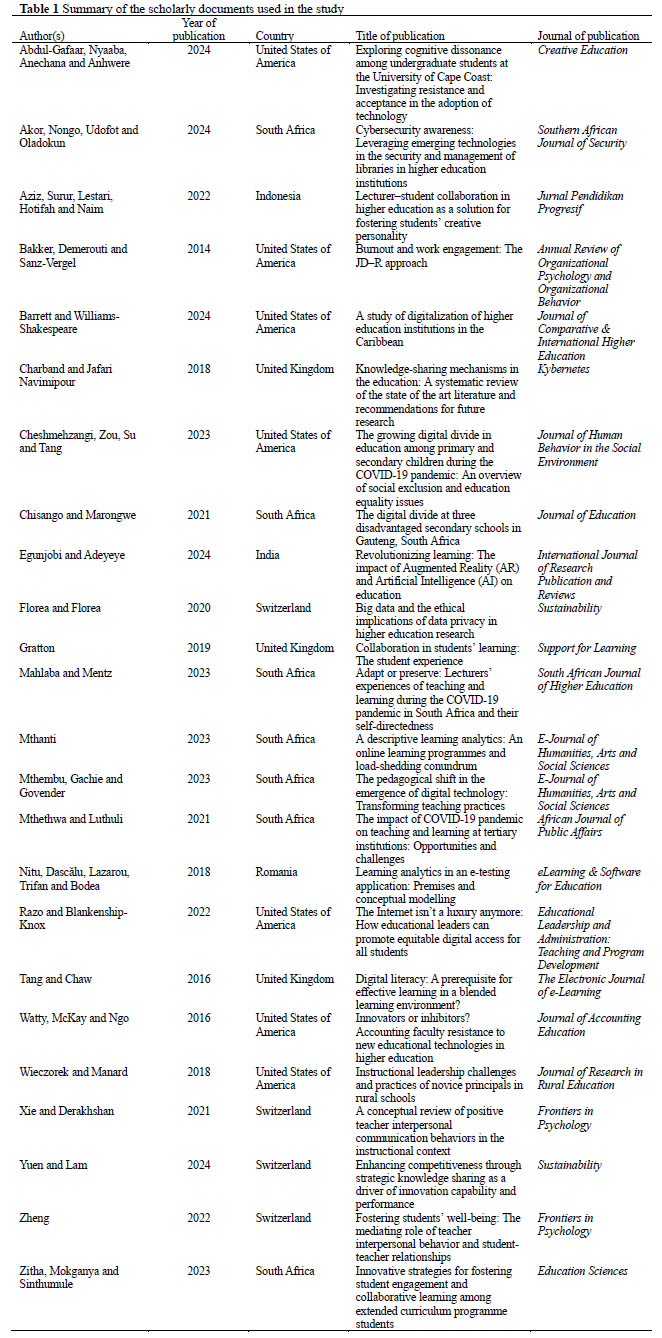
I conducted a title and abstract screening on the sourced publications or records using the aforementioned inclusion and exclusion criteria. Subsequent to this process, I extracted data using a form designed specifically for this purpose. Pertinent information, such as the author(s), year of publication, country, title of publication, and journal of publication, was extracted from each eligible record. In Phase 1, the aforementioned electronic databases were searched to identify relevant publications for the research. In Phase 2, duplicate publications were removed, and the remaining studies were reviewed based on their titles, abstracts, and keywords to ensure alignment with the study's defined inclusion and exclusion criteria. In Phase 3, publications that were aligned with the inclusion criteria were included for review in the study.
A total of 124 articles were retrieved from the academic databases mentioned above. In total, the search returned 248 scholarly documents. After removing duplicates, 88 records were eligible for title and abstract screening. The remaining records were further screened, and additional records were excluded due to information deemed irrelevant and not meeting the inclusion criteria. In total, 24 articles met the criteria for full-text review. Table 1 lists the scholarly documents used in the study.
Data Synthesis
A qualitative approach was adopted to analyse the results, while a synthesis method was applied. Transforming education through communication media in the 21st century was conceptualised, categorised, and later evaluated for theoretical applicability. Additional relevant publications were examined to settle variations in the formulation and integration. As a result, 12 common themes emerged.
The role of communication media in the transformation of education from traditional methods to digital practices over the past decade
• Student engagement
• Collaboration
• Relationship building
• Knowledge sharing
Challenges for digital technology in HEIs in the 21st century
• The digital divide
• Digital literacy and communication skills
• Resistance to change
• Privacy and security concerns
Opportunities for digital technology in HEIs in the 21st century
• Innovation in pedagogical practices
• Enhancing flexibility and accessibility
• Enhanced collaboration
• Personalised learning and student-centred approaches
Literature Review
The final 24 studies (see Table 1) conducted worldwide and published across various academic databases were included in the systematic review, providing a detailed view of the transformative role of communication in the shift from traditional to digital education methods in the 21st century.
The role of communication media in the transformation of education from traditional methods to digital practices over the past decade
Student engagement
A study by Zitha et al. (2023) states that communication media are one of the key functions that promote engagement in the learning process. They found that when educators used innovative teaching and learning strategies, this captured students' attention, in turn promoting active participation and engagement. Bakker et al. (2014:389) define engagement as "a positive motivational state of vigour, dedication, and absorption." The behavioural outcomes of engaged students may include high levels of physical energy, the ability to deal with the challenges presented by learning, and a willingness to invest time and effort to excel in school tasks. Moreover, Zitha et al. (2023) argue that engagement promotes collaboration among students, thereby enhancing student performance. As a result, they encourage lecturers to provide students with peer-to-peer collaboration opportunities to foster engagement and support peer learning.
Collaboration
The role of communication media in peer-to-peer and student-lecturer collaboration cannot be overemphasised. In collaborative learning environments, lecturers are encouraged to group students together to solve problems and share ideas as a team (Zitha et al., 2023). In this context, communication media are crucial, as they facilitate content generation and knowledge exchange between students, enriching their learning. By encouraging group projects and collaboration, educators can provide students with opportunities to learn from one another (Gratton, 2019). This type of collaboration helps students to develop creativity, confidence, improved communication skills, and emotional intelligence, which are invaluable in an online academic environment.
Relationship building
According to Wieczorek and Manard (2018), excellence in HEIs results from quality relationships built through communication. For educators and students, transparent communication is critical for fostering their relationship, which is critical to building a supportive and engaging learning experience (Xie & Derakhshan, 2021). For example, students may feel more comfortable opening up to their lecturer if they have a relationship with them. Conversely, lecturers may go the extra mile in assisting students if they believe they have a positive working relationship, therefore, a positive influence on the student's performance. This relationship creates a positive teaching and learning environment for both lecturers and students.
Furthermore, Zheng (2022) found that communication between lecturers and students fosters positive psychological support for students. When students know that they can approach their lecturers, they are more likely to engage with the curriculum and feel motivated and productive. Educators nurture such relationships with students through communication and contribute to students' overall performance. A strong lecturer-student relationship, built on transparency and communication, has benefits that extend beyond academic performance, supporting students' personal and professional development.
Knowledge sharing
Charband and Jafari Navimipour (2018) found that knowledge sharing among lecturers and students can foster a collaborative teaching and learning environment, innovation, and improved performance, which is achieved through communication. According to Yuen and Lam (2024:3), "the exchange of knowledge facilitates the cross-pollination of ideas, blending diverse expertise and insights that can spark innovative solutions and drive the development of new products, services, or processes." In the traditional lecture hall, lecturers and students share knowledge through formal teaching, debates, discussions, and seminars. In contrast, in the online classroom, knowledge-sharing opportunities include informal online discussion forums, live broadcast or recorded classes, virtual consultations, and webinars. This suggests that learning in the digital era is flexible, allowing students to engage with content in their own time.
Challenges for digital technology in HEIs in the 21st century
The digital divide
Although digital technology and tools offer numerous benefits to HEIs, they also entail notable costs for the learning environment. One of the prevalent challenges to digital education is the ever-increasing digital divide, which creates barriers to teaching and learning (Cheshmehzangi et al., 2023). Notably, not all students have access to personal gadgets or devices, the Internet, digital literacy skills, or the technology required for online learning (Razo & Blankenship-Knox, 2022). In South Africa, the advent of load-shedding was another issue that exacerbated the digital divide considerably (Mthanti, 2023). Numerous other factors determine students' access to digital tools for learning, which can create disparities in educational prospects. This digital divide may exclude learners from low-income backgrounds, thereby delaying their progress, creating communication gaps, limiting their participation in online collaboration and individual tasks, and preventing them from having timely access to materials and feedback from lecturers.
Digital literacy and communication skills Tang and Chaw (2016) posit that one needs a certain level of digital literacy to use technology effectively for learning. In other words, both lecturers and students require proficiency in digital tools to use them effectively in teaching and learning. Research conducted by Chisango and Marongwe (2021) and Þen Ersoy (2023) emphasises that students from disadvantaged backgrounds struggled with digital technology and tools in HEIs, particularly because they were exposed to them for the first time at tertiary institutions. For example, such students may feel overwhelmed, struggle to complete tasks on time, lack an understanding of instructions, avoid asking for help due to peer pressure or concerns, and lack peer-to-peer collaboration due to their unfamiliarity with online learning tools. Mahlaba and Mentz (2023) found that lecturers faced challenges such as a lack of reliable internet connectivity and insufficient training on digital platforms. This lack of digital literacy can affect the overall teaching and learning experience.
Resistance to change
Another significant challenge is resistance to adopting digital media tools. Abdul-Gafaar et al. (2024) note that students experience a sense of lost social interaction, as digital media often feels impersonal. Additionally, discomfort with reduced in-person interaction and pressure to stay abreast of digital platforms made many students less inclined to switch to digital platforms, instead preferring traditional interaction. Despite the growing importance of adopting new technologies in teaching and learning, Watty et al. (2016) found that many lecturers were reluctant to adopt new technological tools, citing time constraints, lack of support, lack of interest, workload, limited resources, and a preference for traditional teaching methods. Both studies suggest that the issue is not a lack of access to digital technology, but rather lecturers' preference for traditional tools or their feeling undertrained to use such platforms effectively in their teaching.
Privacy and security concerns Despite the notable impact of digital technologies and tools in HEIs, privacy and security concerns have emerged as the adoption of these tools has increased (Florea & Florea, 2020). Collecting, storing, and disseminating student data have raised issues regarding informed consent, data privacy, anonymity, and confidentiality. Akor et al. (2024) investigated cybersecurity awareness in HEIs. Their study revealed a wide range of cybersecurity threats, from malware infections to data breaches, highlighting the need for robust security measures for both students and HEIs to protect learning content and data. Therefore, it is suggested that HEIs should leverage modern technology to bolster information security.
Opportunities for digital technology in HEIs in the 21st century
Innovation in pedagogical practices
Mthembu et al. (2023) are of the view that the advancement of digital technology has led to a fundamental transformation in pedagogy practices. Technologies like artificial intelligence, augmented reality, virtual reality, and virtual laboratories provide learning experiences that did not previously exist in traditional physical classrooms (Egunjobi & Adeyeye, 2024). For example, this technology is transforming digital learning by enhancing learning, making it more personalised, interactive, and simulation-based.
Enhancing flexibility and accessibility There is growing research evidence that digital technology enhances teaching and learning in HEIs, "making the learning experience more easily accessible, engaging, interactive, collaborative, and participatory" (Barrett & Williams-Shakespeare, 2024:118). These approaches are valuable in the 21st century classroom, as they prepare students for the future world of work. Accessibility and flexibility allow students to engage with content anytime, anywhere, and at their own pace (Charband & Jafari Navimipour, 2018; Yuen & Lam, 2024). Mthethwa and Luthuli (2021) support this notion, stating that online learning allows students to study from anywhere in the world, provided they have stable internet connectivity. This also helps students to become more responsible, as they learn to manage their time and prioritise tasks. Moreover, flexible learning options cater for diverse students in various geographical locations.
Enhanced collaboration
Collaboration in HEIs is not limited to students; it also includes lecturer-student collaboration. In their study, Aziz et al. (2022) found that lecturer-student collaboration activities were essential in developing student creativity. The results of the analysis show that lecturer-student collaboration activities have implications for the level of student creativity. Lecturers can collaborate with students through research projects, co-publishing, material development, mentorship opportunities, workshops and seminars, and conference presentations.
Personalised learning and student-centred approaches
Digital technologies also offer the opportunity to implement personalised learning strategies in the online learning environment. Research conducted by Nitu et al. (2018) suggests that in a personalised learning environment, educators can use tools such as customisable metrics to measure and track how long it takes students to complete an online assessment, which online pages have the highest viewership, how many students download online material, the correlation between the content students like and final grades, etc. This allows lecturers to monitor content, page views, and assignment completion rates in real time, enabling them to make timely page or content revision interventions, such as a change in wording, assessments, or scenario examples.
Findings and Discussion
The literature analysed in this study reveals that although there are challenges and opportunities for digital technology in HEIs in the 21st century, communication media have played a significant role in transforming education from traditional methods to digital practices over the past decade. The findings on the role of communication media in transforming education indicate various benefits. According to Zitha et al. (2023), communication media is one of the most critical aspects impacting student engagement. In this regard, the findings indicate that a student's engagement with the learning content, performance, and teaching aids can be linked to their overall engagement in the classroom. This supports the core principles of the media richness theory, which suggest that rich media, such as in-person classrooms or online video-enabled lectures, are more effective for conveying complex content or instruction because they enable immediate feedback and incorporate both verbal and physical cues. Zitha et al. (2023) add that a disengaged student may shy away from working in teams, highlighting the importance of appropriate communication media in enhancing learning. Additionally, lecturers who encourage group work or collaboration among students promote learner-led collaboration (Gratton, 2019), which is essential for both online and face-to-face instruction. This perspective is supported by Vygotsky's (1978) constructivist learning theory, which emphasises the importance of students constructing their own learning.
The results of the study further suggest that student engagement and collaboration are essential for relationship building in HEIs, which is achieved through effective communication (Wieczorek & Manard, 2018). Such collaborative environments empower learners to build knowledge through dialogue, reflection, and practical application of knowledge, aligning with the constructivist learning theory. Thus, communication is important for establishing relationships between students and lecturers, thereby improving the learning experience. This is also linked to positive behavioural elements such as student motivation and productivity (Xie & Derakhshan, 2021). Charband and Jafari Navimipour (2018) identified knowledge sharing as another benefit of communication in HEIs, particularly for student performance. Although students exchange ideas in various ways in online and face-to-face learning environments, this exchange stirs new ideas in them. It encourages them to develop new thinking methods and ideas to solve everyday challenges (Yuen & Lam, 2024). Collaboration can also occur between lecturers and students (Aziz et al., 2022). At this level, collaboration is critical for nurturing creative thinking among students. Examples of student-lecturer collaboration cited in the literature analysed include co-authoring research outputs, content development, departmental presentations, and attendance at workshops and seminars (Aziz et al., 2022). This suggests that communication fosters mutual understanding and respect when working in teams, builds trust, and creates a safe space for individuals to thrive. As a result, communication enhances the quality of collaboration between students and lecturers.
Barrett and Williams-Shakespeare (2024) found that communication technology enhanced the flexibility and accessibility of teaching and learning. Charband and Jafari Navimipour (2018) and Yuen and Lam (2024) endorse the use of communication technology in the 21st-century classroom, as it ensures that students are ready for the professional work environment where they may be required to use various technological tools to conduct their day-to-day activities. In agreement, Mthethwa and Luthuli (2021) argue that it enables students to enrol in online education from any location and in their own time. It also benefits students by helping them balance their studies with personal commitments.
From a teaching and learning perspective, digital advancements have improved pedagogy practices (Mthembu et al., 2023). Various learning technologies that previously did not exist in physical classrooms have been introduced, improving teaching practices as we know them today (Egunjobi & Adeyeye, 2024). These technologies provide collaborative, personalised, and interactive student learning experiences (Nitu et al., 2018). These teaching practices and tools can be customised to provide metrics on which content students enjoy most, what they struggle with, and which examples or scenarios to include in assessments. This suggests that communication technology gives lecturers insight into how to customise content with the above in mind, and highlights areas for improvement.
However, extant literature notes several disadvantages of embracing digital technology for teaching and learning in HEIs. Cheshmehzangi et al. (2023) identify the digital divide as a disadvantage, as some students (particularly those from marginalised groups) cannot afford technological devices. Mthanti (2023) shares findings from a study conducted in South Africa that identified power cuts as a critical issue contributing to the widening digital divide. This limits students' online communication with lecturers and participation in the online teaching and learning environment. Another factor determining students' access to digital tools for online learning is digital illiteracy and communication skills (Chisango & Marongwe, 2021; Þen Ersoy, 2023; Tang & Chaw, 2016). Students require digital literacy skills to successfully engage and learn in the 21st-century online classroom. Lecturers also experience challenges in teaching and learning on an online platform (Mahlaba & Mentz, 2023), some of which are digital illiteracy, insufficient training, and connectivity issues. These disadvantages may affect teaching and learning.
Despite the importance of HEIs adopting communication strategies to not only provide teaching and learning but also to support students, the literature analysed reveals that students and lecturers alike showed reluctance to adapt to change (Abdul-Gafaar et al., 2024; Watty et al., 2016). The preference for face-to-face interaction influenced students' desire to migrate to online teaching and learning. For the lecturers, factors that affected their interest in adopting technological tools included work pressure and commitments, a lack of resource allocation, training interventions from their HEI, and preference for what they believed worked - teaching in a traditional face-to-face classroom.
Privacy and security concerns were identified as another factor linked to digital technology in HEIs (Florea & Florea, 2020). These privacy concerns impact cybersecurity, the processing of student data, and access to institutional data and content. This finding is crucial, as it not only affects lecturer and student engagement with online teaching platforms but also the ease of communication and lesson delivery on these platforms. In light of these disadvantages, the role of communication in transforming education must be emphasised.
Limitations of the Study
A key limitation of this study is the scope of the reviewed literature, as I specifically focused on studies published between 2014 and 2024, omitting historical insights into digital technology in HEIs from prior centuries or periods. As technology constantly evolves, earlier research could offer insights into how digital transformation has impacted education over the years. Additionally, this study was not limited to a specific geographic location; considering studies from only one area could allow the researcher to conduct a detailed review of one area. Furthermore, the reliance on the SLR approach may exclude relevant perspectives from qualitative and quantitative methodologies, leading to a biased understanding of the topic under study due to the limited search period, language, timeline, region, and study topic.
Conclusion and Recommendations
Using digital tools and technology to transform education in the 21st century has significantly changed traditional teaching and learning approaches, offering both opportunities and challenges. Digital tools such as social media, online learning platforms, and virtual classrooms have altered how knowledge is taught and consumed, fostering more interactive and non-discriminatory educational practices. However, this shift requires effective communication strategies among institutions, lecturers, and students to ensure that these technologies are implemented and adopted successfully. While resistance to change, the digital divide, digital literacy, and communication gaps remain notable disadvantages, digital education opportunities are indisputable. Effective communication media can facilitate the relationship between technology and education in the 21st century, enabling both lecturers and students to benefit from digital tools.
In conclusion, while transforming education from a traditional to a digital approach presents challenges, it also offers opportunities to cultivate more convenient, adaptable, attainable, and student-centred learning institutions. Therefore, the following recommendations are put forward.
1) Enhanced lecturer training and support: HEIs should invest in regular, ongoing professional development for lecturers to ensure the effective use of digital technology. Training on digital tools and technology available in institutions could enable lecturers to effectively integrate technology into teaching and learning.
2) Promoting digital inclusion: With the intervention of educational policymakers, HEIs should prioritise efforts to bridge the digital divide by providing underprivileged students with access to the relevant tools, learning portals, devices, and internet connectivity they need to ensure they are not left behind or excluded.
3) Developing digital literacy: Lecturers and students must be empowered with relevant skills to effectively use digital tools and platforms. Additionally, digital literacy programmes should be part of curricula, ensuring that students can engage with modern learning technology.
4) Promote effective communication: HEIs should establish relevant communication channels and strategies that would benefit the institution in promoting and adopting a digital learning environment. Institutions should create platforms for two-way communication, collaboration, feedback, and timely communication, fostering a sense of engagement, belonging, and unity within the HEI.
5) Ongoing research and innovation: As digital tools and technologies evolve, researchers must explore new methodologies, platforms, and approaches to improve digital education. HEIs should conduct ongoing research on the effectiveness of current digital technologies, tools, and communication media in achieving effective and inclusive educational outcomes.
As shown in this article, communication media have played a critical role in transforming education by enhancing student engagement; collaboration among students, lecturers, and peers; relationship building; and knowledge sharing. The literature reviewed also highlights opportunities for digital technology in HEIs in the 21st century, including innovation in pedagogical practices, enhancing flexibility and accessibility, improved collaboration, and personalised learning and student-centred approaches. Furthermore, the media richness theory and the constructivist learning theory guide lecturers and HEIs in effectively using digital tools to create a supportive and engaging learning environment. Thus, through the recommendations proposed above, HEIs may navigate the challenges of digital transformation and use effective communication media to enhance teaching and learning in the 21st century.
Notes
i. Published under a Creative Commons Attribution Licence.
References
Abdul-Gafaar S, Nyaaba RA, Anechana R & Anhwere DK 2024. Exploring cognitive dissonance among undergraduate students at the University of Cape Coast: Investigating resistance and acceptance in the adoption of technology. Creative Education, 15:2499-2520. https://doi.org/10.4236/ce.2024.1512152 [ Links ]
Adeyele TK 2024. Revolutionizing health education: The dynamic shift of e-learning platforms. In X Liu (ed). Innovation and evolution in higher education (Vol. 22). London, England: IntechOpen. https://doi.org/10.5772/intechopen.1004562 [ Links ]
Ahmad H 2020. Definitions of communication. Lahore, Pakistan: Minhaj University Lahore. Available at https://www.researchgate.net/publication/346031905_Definitions_of_Communication. Accessed 17 December 2024. [ Links ]
Akor SO, Nongo CJ, Udofot CO & Oladokun BO 2024. Cybersecurity awareness: Leveraging emerging technologies in the security and management of libraries in higher education institutions. Southern African Journal of Security, 2:1-14. https://doi.org/10.25159/3005-4222/16671 [ Links ]
Aziz R, Surur M, Lestari S, Hotifah Y & Naim N 2022. Lecturer-student collaboration in higher education as a solution for fostering student's creative personality. Jurnal Pendidikan Progresif, 12(1):241-253. https://doi.org/10.23960/jpp.v12.i1.202219 [ Links ]
Bakker AB, Demerouti E & Sanz-Vergel AI 2014. Burnout and work engagement: The JD-R approach. Annual Review of Organizational Psychology and Organizational Behavior, 1:389-411. https://doi.org/10.1146/annurev-orgpsych-031413-091235 [ Links ]
Barrett SAM & Williams-Shakespeare ES 2024. A study of digitalization of higher education institutions in the Caribbean. Journal of Comparative & International Higher Education, 16(2):117-126. Available at https://files.eric.ed.gov/fulltext/EJ1427073.pdf. Accessed 11 November 2025. [ Links ]
Bergin R n.d. Media richness theory. Monterey, CA: Center for Homeland Defense and Security, Department of National Security Affairs, Naval Postgraduate School. Available at https://www.chds.us/coursefiles/IS4010/lectures/tech_media_richness_long/story_content/external_files/Media%20Richness%20Theory%20Script.pdf. Accessed 12 November 2025. [ Links ]
Bradley VM 2021. Learning Management System (LMS) use with online instruction. International Journal of Technology in Education, 4(1):68-92. https://doi.org/10.46328/ijte.36 [ Links ]
Charband Y & Jafari Navimipour N 2018. Knowledge sharing mechanisms in the education: A systematic review of the state of the art literature and recommendations for future research. Kybernetes, 47(7):1456-1490. https://doi.org/10.1108/K-06-2017-0227 [ Links ]
Cheshmehzangi A, Zou T, Su Z & Tang T 2023. The growing digital divide in education among primary and secondary children during the COVID-19 pandemic: An overview of social exclusion and education equality issues. Journal of Human Behavior in the Social Environment, 33(3):434- 449. https://doi.org/10.1080/10911359.2022.2062515 [ Links ]
Chisango G & Marongwe N 2021. The digital divide at three disadvantaged secondary schools in Gauteng, South Africa. Journal of Education, 82:149-165. https://doi.org/10.17159/2520-9868/i82a09 [ Links ]
Daft RL & Lengel RH 1986. Organizational information requirements, media richness and structural design. Management Science, 32(5):554-571. https://doi.org/10.1287/mnsc.32.5.554 [ Links ]
Dubey DK & Sharma K 2023. Perception based comparative analysis of online learning and traditional classroom-based education experiences in Mumbai [Special issue]. International E-Research Journal, 330(B):79-164. [ Links ]
Egunjobi D & Adeyeye OJ 2024. Revolutionizing learning: The impact of Augmented Reality (AR) and Artificial Intelligence (AI) on education. International Journal of Research Publication and Reviews, 5(10):1157-1170. https://doi.org/10.55248/gengpi.5.1024.2734 [ Links ]
Florea D & Florea S 2020. Big data and the ethical implications of data privacy in higher education research [Special issue]. Sustainability, 12(20):8744. https://doi.org/10.3390/su12208744 [ Links ]
Ghavifekr S & Rosdy WAW 2015. Teaching and learning with technology: Effectiveness of ICT integration in schools. International Journal of Research in Education and Science, 1(2):175-191. Available at https://files.eric.ed.gov/fulltext/EJ1105224.pdf. Accessed 23 October 2025. [ Links ]
Gorski P & Clark C 2002. Multicultural education and the digital divide: Focus on disability. Multicultural Perspectives, 4(4):28-36. https://doi.org/10.1207/S15327892MCP0404_6 [ Links ]
Gratton R 2019. Collaboration in students' learning: The student experience [Special issue]. Support for Learning, 34(3):254-276. https://doi.org/10.1111/1467-9604.12261 [ Links ]
Islam MK, Sarker MFH & Islam MS 2022. Promoting student-centred blended learning in higher education: A model. E-Learning and Digital Media, 19(1):36-54. https://doi.org/10.1177/20427530211027721 [ Links ]
Jamil S & Muschert G 2024. The COVID-19 pandemic and e-learning: The digital divide and educational crises in Pakistan's universities. American Behavioral Scientist, 68(9):1161-1179. https://doi.org/10.1177/00027642231156779 [ Links ]
Kay RH & Lauricella S 2015. Investigating and comparing communication media used in higher education. Journal of Communication Technology and Human Behaviors, 2(1):1 -20. https://doi.org/10.7726/jcthb.2015.1001 [ Links ]
Kraleva R, Sabani M & Kralev V 2019. An analysis of some learning management systems. International Journal on Advanced Science Engineering Information Technology, 9(4):1190-1198. [ Links ]
Mahlaba SC & Mentz E 2023. Adapt or preserve: Lecturers' experiences of teaching and learning during the COVID-19 pandemic in South Africa and their self-directedness. South African Journal of Higher Education, 37(4):181-204. https://doi.org/10.20853/37-4-4858 [ Links ]
Moher D, Shamseer L, Clarke M, Ghersi D, Liberati A, Petticrew M, Shekelle P, Stewart LA & PRISMA-P Group 2015. Preferred reporting items for systematic review and meta-analysis protocols (PRISMA-P) 2015 statement. Systematic Reviews, 4:1. https://doi.org/10.1186/2046-4053-4-1 [ Links ]
Mthanti BJ 2023. A descriptive learning analytics: An online learning programmes and load-shedding conundrum [Special issue]. E-Journal of Humanities, Arts and Social Sciences, 4(12):161-174. https://doi.org/10.38159/ehass.202341214 [ Links ]
Mthembu NG, Gachie W & Govender DW 2023. The pedagogical shift in the emergence of digital technology: Transforming teaching practices [Special issue]. E-Journal of Humanities, Arts and Social Sciences, 4(11):1330-1344. https://doi.org/10.38159/ehass.20234112 [ Links ]
Mthethwa RM & Luthuli C 2021. The impact of COVID-19 pandemic on teaching and learning at tertiary institutions: Opportunities and challenges. African Journal of Public Affairs, 12(3):91-103. Available at https://journals.co.za/doi/pdf/10.10520/ejc-ajpa_v12_n3_a6. Accessed 18 October 2025. [ Links ]
Neumeyer X, Santos SC & Morris MH 2021. Overcoming barriers to technology adoption when fostering entrepreneurship among the poor: The role of technology and digital literacy. IEEE Transactions on Engineering Management, 68(6):1605-1618. https://doi.org/10.1109/TEM.2020.2989740 [ Links ]
Nickerson ME 2020. Factors affecting resistance and adaptation behavior to innovative digital pedagogy. PhD dissertation. Malibu, CA: Pepperdine University. Available at https://www.proquest.com/docview/24352079237fromopenview=true&pq-origsite=gscholar&sourcetype=Dissertations%20&%20Theses. Accessed 18 October 2025. [ Links ]
Nitu M, Dascãlu MI, Lazarou E, Trifan L & Bodea CN 2018. Learning analytics in an e-testing application: Premises and conceptual modelling. eLearning & Software for Education, 2:239-246. https://doi.org/10.12753/2066-026X-18-103 [ Links ]
Piaget J 1973. To understand is to invent. New York, NY: Grossman. [ Links ]
Razo R & Blankenship-Knox AE 2022. The Internet isn't a luxury anymore: How educational leaders can promote equitable digital access for all students. Educational Leadership and Administration: Teaching and Program Development, 34:55-68. Available at https://files.eric.ed.gov/fulltext/EJ1366252.pdf. Accessed 14 November 2024. [ Links ]
Þen Ersoy N 2023. Empowering inclusion: Addressing barriers in distance learning for disadvantaged groups. TOJET: The Turkish Online Journal of Educational Technology, 22(4):52-60. Available at https://files.eric.ed.gov/fulltext/EJ1409813.pdf. Accessed 24 October 2025. [ Links ]
Singh J, Steele K & Singh L 2021. Combining the best of online and face-to-face learning: Hybrid and blended learning approach for COVID-19, post vaccine, & post-pandemic world. Journal of Educational Technology Systems, 50(2):140-171. https://doi.org/10.1177/00472395211047865 [ Links ]
Tang CM & Chaw LY 2016. Digital literacy: A prerequisite for effective learning in a blended learning environment? The Electronic Journal of e-Learning, 14(1):54-65. Available at https://files.eric.ed.gov/fulltext/EJ1099109.pdf. Accessed 17 October 2025. [ Links ]
Vygotsky LS 1978. Mind in society: The development of higher psychological processes. Cambridge, MA: Harvard University Press. [ Links ]
Watty K, McKay J & Ngo L 2016. Innovators or inhibitors? Accounting faculty resistance to new educational technologies in higher education. Journal of Accounting Education, 36:1-15. https://doi.org/10.1016/jjaccedu.2016.03.003 [ Links ]
Wieczorek D & Manard C 2018. Instructional leadership challenges and practices of novice principals in rural schools. Journal of Research in Rural Education, 34(2):1-21. Available at https://jrre.psu.edu/sites/default/files/2019-06/34-2_0.pdf. Accessed 17 October 2025. [ Links ]
Xie F & Derakhshan A 2021. A conceptual review of positive teacher interpersonal communication behaviors in the instructional context. Frontiers in Psychology, 12:708490. https://doi.org/10.3389/fpsyg.2021.708490 [ Links ]
Yuen SSM & Lam HY 2024. Enhancing competitiveness through strategic knowledge sharing as a driver of innovation capability and performance. Sustainability, 16(6):2460. https://doi.org/10.3390/su16062460 [ Links ]
Zheng F 2022. Fostering students' well-being: The mediating role of teacher interpersonal behavior and student-teacher relationships. Frontiers in Psychology, 12:796728. https://doi.org/10.3389/fpsyg.2021.796728 [ Links ]
Zitha I, Mokganya G & Sinthumule O 2023. Innovative strategies for fostering student engagement and collaborative learning among extended curriculum programme students. Education Sciences, 13(12):1196. https://doi.org/10.3390/educsci13121196 [ Links ]
Received: 4 February 2025
Revised: 7 August 2025
Accepted: 30 September 2025
Published: 30 November 2025