




Services on Demand
Journal

Article
 English (pdf)
 Article in xml format
 Article references
 Automatic translation
 Send this article by e-mail
Indicators
Related links
-
 Cited by Google
 -
 Similars in Google
Share

 Permalink
South African Journal of Education
On-line version ISSN 2076-3433Print version ISSN 0256-0100
S. Afr. j. educ. vol.45 n.1 Pretoria Feb. 2025
https://doi.org/10.15700/saje.v45n1a2489
ARTICLES
Exploring socio-demographic factors associated with poor school attendance among secondary school learners in South Africa
Viome Amakuro Showers; Robynne Danielle Abrams; Philomene Nsengiyumva
Department of Statistics and Population Studies, University of the Western Cape, Cape Town, South Africa. 4109410@myuwc.ac.za
ABSTRACT
The Department of Basic Education in South Africa acknowledges that 99% of primary school-aged children attend school, but attendance at secondary school level is not yet universal. Low levels of secondary school attendance contribute to poverty and unemployment. We investigated the socio-demographic elements associated with school attendance among secondary school-aged learners in South Africa. We adopted a quantitative research approach and a cross-sectional design. The positivist research paradigm was applied, and the 2019 General Household Survey data (nationally representative survey) were used. The family socialisation theory and household production framework were embraced as the theoretical framework in this study. Descriptive analysis and cross-tabulations were conducted, and a Chi-square test was performed to measure the association between school attendance and learners' characteristics. Furthermore, logistic regression was conducted to explore the factors associated with school attendance. Study findings agree with the assertions of the family socialisation theory and household production framework. We found that the overall school attendance level was 93.5% and older learners had significantly lower levels of school attendance. High levels of educational qualification of household heads inspired higher school attendance as the odds of school attendance for learners quadrupled when household heads attained secondary education relative to those with unschooled heads (OR = 4.1; p < 0.001). Being a Coloured learner, being part of a large household, being an orphan, and living in a low-income household were associated with reduced levels of school attendance. We recommend targeting and supporting learners who are over-aged for their grades, Coloured, and with poor or educationally low family backgrounds via conditional cash transfers to improve school attendance in the South African population.
Keywords: barriers to schooling; learners; school attendance; school dropout; secondary education; South Africa
Introduction
School attendance has become a more desirable activity for children and adolescents all over the world (United Nations Educational, Scientific and Cultural Organization [UNESCO], 2020). The global initiative to promote school participation can be traced to the Universal Declaration of Human Rights (Act 26 of 1948), which endorses education as a fundamental right. It emphasises that education "at elementary and fundamental stages" should be made "free and compulsory" (United Nations, 1948:7). On this premise, Sustainable Development Goal 4 has been expanded to pursue an "inclusive and equitable education and to promote lifelong learning opportunities for all" (UNESCO, 2016a: 116). Being educated gives one a competitive edge in life, yet getting an education requires going to school.
The South African population is composed of four racial groups - Black, Coloured, Indian/Asian, and White (Statistics South Africa, 2019b). Before 1994, the South African education system was racially segregated. Non-white schools experienced systematic deprivation in terms of essential teaching and learning resources (Sibanda, 2001). At the advent of the democratic regime in 1994, schools and departments of education became deracialised and unified (Spaull, 2015). Over these years, school attendance at the primary school level has become almost universal (99%). However, school attendance at the secondary school level is not yet universal. In addition, for those aged 16 to 18 years, which is the official age group for upper secondary education, the attendance rate has not exceeded 86% (Department of Basic Education [DBE], Republic of South Africa [RSA], 2018). Research has shown that adolescents who are not in school are at higher risk of engaging in unprotected sex, unplanned pregnancies, and being infected with the human immunodeficiency virus (HIV) (Kattan & Székely, 2015; National Department of Health, Statistics South Africa, South African Medical Research Council & ICF, 2019; Stoner, Pettifora, Edwards, Aiello, Halpern, Julien, Selin, Twine, Hughes, Wang, Agyei, Gomez-Olive, Wagner, MacPhail & Kahn, 2017). Therefore, higher levels of secondary school attendance will help to check the high prevalence of HIV in the country when schools are used as an effective platform for disseminating reproductive health education. To combat poverty and generate a substantial human capital boost for the economy, one must look beyond primary education. Attending and finishing secondary education will create the leverage for people to acquire the knowledge and skills to escape poverty (Lutz, Crespo Cuaresma & Sanderson, 2008; World Bank, 2018). It will also enable adolescents to pursue higher education, access better economic opportunities, and reach their full potential. Hence, understanding the factors associated with secondary school attendance in South Africa will inform the development of strategies that will improve school participation, combat poverty, and advance the economy. Historically, students' refusal to attend school can be predominantly attributed to lack of funds for their tuition (DBE, RSA, 2018). With this article, we extend knowledge by investigating the association between learners and their household characteristics with school attendance. We provide a general review of some socio-demographic variables affecting school attendance among secondary school-age learners in South Africa. We explain how much their sociodemographic characteristics affect schooling. Furthermore, we reveal the level of secondary school participation based on learners' racial groups, which is a topical issue within the South African context.
Literature Review
A global overview of secondary school attendance
Secondary school attendance levels vary between developed and developing countries. In developed regions like North America and Europe, nearly all students transition from primary to secondary school, highlighting high attendance rates at secondary school levels (Petrosino, Morgan, Fronius, Tanner-Smith & Boruch, 2012). In the United States of America (USA), about 92% of the population who are 16 to 17 years old are still enrolled in school (De Brey, Snyder, Zhang & Dillow, 2021). In the United Kingdom enrolment rate for those aged 15 to 19 years was 83% in 2019 (Organisation for Economic Co-operation and Development [OECD], 2021). Compulsory school attendance for secondary-aged adolescents and youths as well as strict child labour laws introduced in the 1930s have been instrumental in enhancing secondary school participation in these countries. Also, the significant investment in education and the provision of various educational pathways including a well-organised vocational education relevant to the diverse needs of the student population has contributed immensely to the high secondary enrolment rates (Goldin & Katz, 2003; Tymenko, 2019). However, in developing nations, particularly in Sub-Saharan Africa (SSA), enrolment rates are lower with only 63% of young people enrolled in lower secondary school and a further drop to 42% at the upper secondary level (UNESCO, 2020). As a result, SSA hosts the highest number of out-of-school children in the world. The education system in SSA is challenged by a plethora of problems including underfunding, inadequate and neglected infrastructure, non-inclusive education, unqualified teachers, and poor learner achievement accompanied by high dropout rates (Chikoko & Mthembu, 2020; Ezumah, 2020; Lewin, 2006; Majgaard & Mingat, 2012; United Nations Economic Commission for Africa, African Union, African Development Bank & United Nations Development Programme, 2014). In Tanzania, early marriage and pregnancy for girls, lack of parental support, and economic pressure make many adolescents drop out of school, which results in poor secondary school attendance (Joyce-Gibbons, Galloway, Mollel, Mgoma, Pima & Deogratias, 2018; Msafiri & Lianyu, 2022). In Ghana, data from a household survey indicated that lower secondary and upper secondary attendance was estimated at 93% and 81% respectively in 2018 (UNESCO Institute for Statistics [UIS], n.d.). This makes Ghana stand out over other West African countries in secondary school participation mainly because of the free senior high school policy which became operational in 2017 (Abdul-Rahaman, Rongting, Wan, Iddrisu, Abdul Rahaman & Amadu, 2020; Kwegyiriba, 2021). In Zimbabwe, the net enrolment rates for lower and upper secondary education are as low as 58% and 11% respectively (Zimbabwe National Statistical Agency, 2021). Financial hardship, long distances to schools, lack of qualified teachers, and dilapidated school infrastructure have hindered optimal secondary school attendance in the country (Phiri, Ndlovu, Dube, Nyathi, Ncube & Tshuma, 2020).
Furthermore, child marriage is unacceptably high in Zimbabwe with 33% of female children getting married before 18 years, which also impedes secondary school participation (Bengesai, Amusa & Makonye, 2021; Zimbabwe National Statistics Agency & United Nations Children's Fund [UNICEF], 2019).
Secondary education in South Africa
Secondary education in South Africa spans from Grades 8 to 12 with an official age of 14 to 18 years. Lower secondary education includes Grades 8 to 9 and attendance is mandatory. The upper secondary or Further Education and Training (FET) phase continues from Grades 10 to 12, which is not compulsory. The provision of upper secondary education could be academic via high schools or technical via technical and vocational educational and training colleges (DBE, RSA, 2018; Du Plooy & Du Preez, 2022). South Africa's public expenditure on education including secondary education exceeds that of most SSA countries when considering the percentage of total government spending. The nation's government expenditure on education as a percentage of the gross domestic product (GDP) was 5.9% in 2019 and has continued to increase (World Bank, n.d.). This represents one of the highest among the Organization for Economic Cooperation and Development (OECD) member and partner countries relative to their GDP (Khuluvhe & Netshifhefhe, 2021; Mlachila & Moeletsi, 2019; OECD, 2022). South African public expenditure on education accounted for about 20% of the total government expenditure in the 2019/2020 fiscal year. As part of the 20% education allocation, 5%, representing 89,000,000,000 rands, was directed to secondary education (Statistics South Africa, 2021). With these, the country is within UNESCO's (2016b) recommended 4-6% of GDP and at least 15-20% total public expenditure on education. Government funding of schools is based on a pro-poor framework informed by the 2006 amended National Norms and Standards for School Funding (NNSSF). Annually the Minister of Basic Education is required to rank public schools into quintiles where the poorest are grouped into quintile 1 and the least poor in quintile 5. This grouping is based on the condition of schools' infrastructure and the wealth of the people living in the surrounding area. The government expenditure on schools also follows a ranking pattern where quintile 1 schools receive more funding while the least funding goes to quintile 5 schools. Quintiles 1 to 3 schools are designated as no-fee schools as payment of school fees is not required. School governing bodies (SGB) in quintiles 4 to 5 schools determine the school fees charged and the majority of parents of learners in these schools are to endorse such charges to make it operational. For parents who are unable to pay fees because of low income or other reasons, there is provision to apply for full or partial exemption of payment of school fees. Unfortunately, many families eligible for school fee exemptions do not apply because they are unaware, cannot go through the time-consuming application process, or want to preserve their dignity. Orphans, children from foster homes, or beneficiaries of child support grants are exempted from paying fees (Chikoko & Methembu, 2020; Department of Education, RSA, 2006; Mestry, 2014; Pampallis, 2008). Therefore, about 60% of public schools do not require their learners to pay fees (Van Dyk & White, 2019). This funding system was put in place to redress the past apartheid education system in which African/Black children and schools were poorly educated and grossly underfunded (McConnachie, Skelton & McConnachie, 2022). Private schools (independent schools) are eligible to receive government subsidies if they do not charge school fees above a certain threshold and meet preset performance requirements. Generally, the fees of private schools are higher than public schools. Some schools, predominantly in the Western Cape province, operate in private-public partnerships (collaboration schools) that can be likened to the charter schools in the USA (Veriava & Skelton, 2022). These schools depend on government and non-profit organisations or private entities for funding. They seek to provide high-quality education to all learners regardless of socioeconomic background. Furthermore, about 87% of schools accommodating 79% of learners were designated as no-fee schools in 2019 (DBE, RSA, 2020a). Also, 95.6% of the learners who attended ordinary secondary schools were in public schools, and the remaining 4.4% (197,870 learners) were in independent schools in the same year (DBE, RSA, 2020b). The above underscores the government' s efforts to make education accessible to all learners, especially at the secondary school level.
Despite all these effort, some challenges still exist. Learners from public schools in poor rural areas have poorer educational outcomes than those from public schools in rich neighbourhoods (Statistics South Africa, 2024; Veriava & Skelton, 2022). This phenomenon is due to inadequate and deteriorating facilities in South African rural schools (Du Plessis & Mestry, 2019). Grade repetition in South Africa is very high, especially in Grades 10 and 11. More than 15% of learners repeat these grades resulting in South Africa having the highest level of repetition among the OECD member or partner countries (DBE, RSA, 2019; OECD, 2018). As a result, many learners drop out of school at this level. Most secondary school-aged learners complain that their classrooms are overcrowded, they are unable to afford school fees, or are already satisfied with their educational level and do not seek to continue, which negatively impacts school attendance (DBE, RSA, 2019). Moreover, the demand for technical and vocational education and training is low because it is perceived as an alternative for those who do not get good grades for university admission, and employment opportunities with a technical education are limited. This demotivates students and causes a significant number to drop out without completing their training. Technical and vocational education and training (TVET) colleges face resource constraints with inadequate workshops, equipment, and teaching materials (Buthelezi, 2018; World Bank, 2018). These are some of the issues affecting secondary school-age learners in South Africa.
Sociodemographic factors affecting school attendance
The factors that affect school attendance are broad and cross-cutting. Nevertheless, with regard to sociodemographic factors, school attendance is affected by individual-level characteristics like age, gender, race, orphanhood status, or place of residence. Household-level characteristics that affect schooling include household size, household income, and the education and gender of the head of the household.
Age
In many countries, school participation usually peaks at ages 10 to 13 years because of late entry into school - especially in developing countries (Huisman & Smits, 2015; Kazeem, Jensen & Stokes, 2010; Kuépié, Shapiro & Tenikue, 2015; Westberg, 2010). Children who start schooling late or repeat grades and become over-aged for their current grades are more likely to quit school before completing secondary education (UNESCO, 2016a). Learners' commitment to attending school is thus expected to reduce as they grow older.
Gender
In low and middle-income countries, females are often behind compared to males in terms of schooling because of early marriage or pregnancy, but in recent times, this gap has been closing (Evans, Akmal & Jakiela, 2019; Kattan & Székely, 2015; UNESCO, 2015). The patriarchal system and male child preference encourage males to attend school and attain higher educational qualifications than females (Roby, Erikson & Nagaishi, 2016). Hence, school attendance for boys and girls may differ based on the opportunities provided for them.
Race
In the past, Black South Africans had the greatest odds of quitting school, whereas Whites have been at the forefront educationally (Heaton, Amoateng & Dufur, 2014). The educational disadvantage of Blacks in South Africa can be traced back to the apartheid regime where they were discriminated against and could not access the same quality of education as Whites could (Spaull, 2015). This highlights how a population' s racial group can affect school attendance.
Orphanhood
Orphans do not enjoy the same level of support for their education as non-orphans (Case & Ardington, 2006). Case, Paxson and Ableidinger (2004), describe this as the exertion of Hamilton's rule. They are of the opinion that investment in children's educational training in a household is more prominent for those with closer biological ties than distant relations or non-related members. As a result, orphans have a higher likelihood of not attending school than non-orphans.
Place of residence
Parents in rural areas may not prioritise formal education for their children since it is usually not required to access local employment opportunities (Smits & Huisman, 2013). Parents' perceptions of potential future benefits of each child' s education influences their decision to invest in it. Another argument is that educational facilities are more concentrated and accessible in urban areas than in rural areas (Huisman & Smits, 2015). This favours those learners living in urban environments to attend school more than those residing in rural places.
Educational level of household heads
Parents with higher educational attainment inspire and encourage their children to achieve higher levels of education. Meanwhile, poorly educated parents do not place the same value on their children' s education but have low expectations for them and will not motivate them as much to attend and succeed in school (Shehu, 2018). The above may inform disparities in school attendance based on parental household educational level.
Gender of heads of households Several studies have shown that adolescents from female-headed households attend school more than their counterparts from male-headed households (Arends-Kuenning & Duryea, 2006; DeRose, Garcia, Salazar & Tarud, 2014; Westberg, 2010), thereby, asserting that women are more committed to investing in their children's education than men.
Household size
The financial burden of taking care of a large household can overwhelm parents to the point that they become unable to meet all school-aged members' educational needs (Kazeem et al., 2010). In this scenario, education investments are prioritised for the members that they can provide for. The likelihood of learners from large households attending school would thus be lower.
Household income
The availability of resources in the home is a key factor in determining school attendance. Even if tuition is free, poor families are unable to afford books, uniforms, or other things needed to support their children's schooling (Farah & Upadhyay, 2017; UNESCO, 2020; United Nations, 2013).
Poverty encourages child labour which competes with school attendance because poor families cannot forfeit the immediate inflow of family revenue from child labour for the sake of educating their children (Arends-Kuenning & Duryea, 2006). Therefore, learners from rich households attend school more than those from poor households.
Theoretical Framework
The family socialisation theory and household production framework form the theoretical foundation of this article. The family socialisation theory posits that, as children interact (socialise) with family members, their values, attitudes, behaviour, and life aspirations are formed (Battin-Pearson, Newcomb, Abbott, Hill, Catalano & Hawkins, 2000). As children look up to parents as role models, family practices and expectations shape their attitudes towards schooling and other life aspirations (Rumberger & Lim, 2008). Hence, parents who are not educated or have little education, and have low educational expectations for their children will not socialise with their children to desire advanced education. Meanwhile, parents with advanced education can better plan their children' s education and provide quality educational resources that will inspire their children to an advanced level of education. The household production framework holds the view that parents are primarily responsible for allocating resources to family members. Hence, the funding for education will be based on their judgment of the optimal use of available resources (Kazeem et al., 2010). The decision to invest in children's education is informed by their perceived future returns from the educational training of each child. Hence, the resources in the form of household income will be used to support children's education as deemed fit by the parents. The cost of schooling can overwhelm parents with limited household income resulting in them not being able to send their children to school. It is expected that children from households with higher levels of income will be more likely to attend school than those from poorer homes. Although government-initiated intervention programmes to support the poor exist, school attendance from a sociodemographic perspective is mainly motivated by the above theoretical underpinnings.
Methodology
A quantitative research approach and cross-sectional design were adopted in this study. The positivist research paradigm was applied in exploring the socio-demographic factors associated with school attendance (Kumatongo & Muzata, 2021). We used nationally representative data from the 2019 General Household Survey (GHS) and extracted attributes related to learners and their household characteristics.
Study Population
South Africa is in the extreme south of the African continent. It is divided into nine provinces, namely the Eastern Cape, Free State, Gauteng, KwaZulu-Natal, Limpopo, Mpumalanga, Northern Cape, North West, and Western Cape. Gauteng is the most populated, while the Northern Cape is the least populated (Statistics South Africa, 2019b). The population is estimated to be about 59 million and is composed of Black, Coloured, Indian/Asian, and White racial groups. Over 80% of the population are Black Africans, while Coloureds, Whites, and Indians/Asians constitute 8.8%, 7.9%, and 2.6% respectively. In 2019 the number of children between 10 and 14 years was estimated to be 5,427,902 and those between 15 and 19 years of age were 4,660,002. These two age groups make up 17.2% of the entire population (Statistics South Africa, 2019b).
Data Collection
In this study, we used the 2019 GHS secondary data hosted on the DataFirst microdata portal of the University of Cape Town. The survey dataset was downloaded after registering and requesting from the DataFirst portal (Statistics South Africa, 2019a).
Ethical Considerations
We did not require ethical approval to retrieve the data because secondary data were used. No individual-level data were collected during retrieval. The data were initially collected by Statistics South Africa survey officials who obtained informed consent from respondents during the survey (Statistics South Africa, 2020).
Study Sample
A two-stage sampling procedure was used to select participants from the General Household Survey 2019. The first stage involved a proportionate stratified sampling of primary sampling units (PSUs). Systematic sampling was applied in the second stage for the sampling of dwelling units from the sampled PSUs across all nine provinces in the country. Those residing in student accommodation houses, nursing homes, healthcare facilities, detention facilities, and military barracks were excluded from the survey (Statistics South Africa, 2020). For this study, only participants between 14 and 18 years old, which is the official school age for secondary education, were included (DBE, RSA, 2018). Those whose school attendance status was undetermined or who had already completed Grade 12 (secondary education) or any equivalent national qualification framework level (National Qualifications Framework Level 4) were excluded.
Data Analysis
For this study, which was to identify the factors associated with school attendance among secondary school-aged learners, the dependent variable was school attendance. The independent variables included learners' individual-level characteristics like gender, age, racial group, orphanhood status, and place of residence. Additionally, the learner' s household variables were the gender of the head of the household, household size, monthly household income, and the highest level of education of the head of the household. Using sample weights, descriptive analysis was carried out to show the distribution of the learner's characteristics. Cross-tabulation was used to indicate the variation between school attendance and learners' individual and household characteristics. A Chi-square test was used to measure the association between school attendance and the learners' characteristics and household characteristics. A multiple logistic regression analysis was carried out to determine the impact of variables influencing school attendance. Results were interpreted using 5% as the level of significance (p < 0.05). The data were analysed using the IBM Statistical Package for the Social Sciences (SPSS) Version 28 software.
Results
Descriptive Analysis
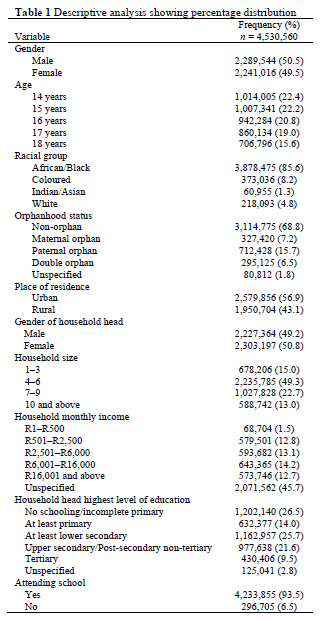
Table 1 shows the percentage distribution of the learners and household characteristics. The total weighted sample was 4,530,560, of which 50.5% (n = 2,289,544) were male and 49.5% (n = 2,241,016) female. The majority of the learners were between 14 and 16 years old. The data show that Black learners accounted for 85.6% (n = 3,878,475), while Coloured, White, and Indian/Asian learners accounted for 8.2% (n = 373,036), 4.8% (n = 218,093), and 1.3% (n = 60,955) respectively. More learners lost their fathers (n = 712,428) than those who lost their mothers (n = 327,420). Those living in urban areas were 2,579,856, and accounted for 56.9% of all the learners. The data indicate further that 2,303,197 of the learner's households were headed by women (50.8%). Most of the secondary school learners' households consisted of four to six household members (49.3%; n = 2,235,785). The monthly household income of 1.5% (n = 68,704) of secondary school learners was below R501. Over a million heads of learners' households (26.5%; n = 1,202,140) did not hold at least a primary education. The overall level of school attendance for secondary school learners was 93.5% (n = 4,233,855).
School Attendance by Learners' Characteristics
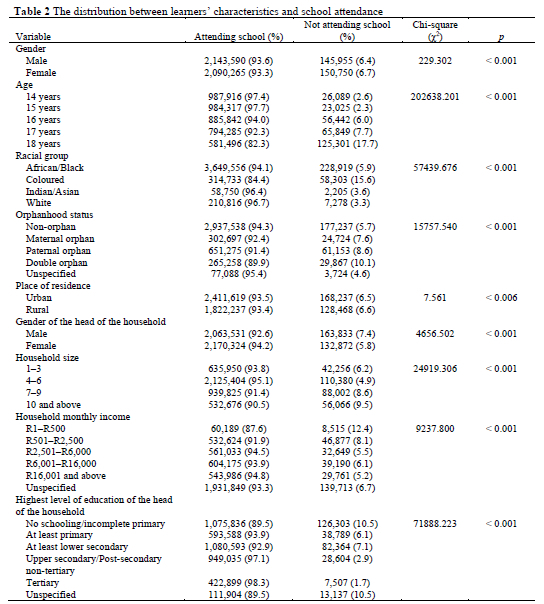
Table 2 displays the distribution between school attendance and learners' characteristics and household characteristics. The study results indicate that there was a very narrow gap in the level of school attendance for boys and girls (93.6%, n = 2,143,590; and 93.3%, n = 2,090,265) respectively. The Chi-square test indicates that school attendance is associated with gender. This means that school attendance differed significantly between boys and girls (χ2 = 229.302; p < 0.001). For the age of learners, secondary school attendance was fairly the same for learners aged 14 and 15 years (97.4%, n = 987,916; and 97.7% n = 984,317 respectively), yet school attendance declined among learners aged 18 years with 82% (n = 581,496) attending. The Chi-square results reveal an association between the age of learners and school attendance (χ2 = 202638.201; p < 0.001). This means that school attendance decreases significantly as learners advance in age. Considering the racial group, the findings reveal that Coloured learners had the lowest level of school attendance (84.4%; n = 314,733), while White learners had the highest level of school attendance (96.7%; n = 210,816). The Chi-square test indicates that there was a significant relationship between the racial group and school attendance for the learners (χ2 = 57439.676; p < 0.001). This implies that the racial group of learners affects school attendance. There was a significant association between orphanhood status and school attendance (χ2 = 15757.540; p < 0.001). Learners who had lost one or both parents had lower levels of school attendance. Further results indicated that the level of school attendance for learners residing in urban areas was not much different from that of their counterparts in rural areas (93.5%, n = 2,411,619; and 93.4%, n = 1,822,237 respectively). There was an association between learners' place of residence and school attendance (χ2 = 7.561; p < 0.006), which implies that learners' school attendance depends on whether they live in rural or urban areas. Furthermore, learners in households headed by females had a significantly higher level of school attendance than those in households headed by males (94.2%, n = 2,170,324; and 92.6%, n = 2,063,531 respectively). In this regard, the Chi-square test indicates that there was a significant relationship between the gender of learners' household heads and school attendance (χ2 = 4656.502; p < 0.001). Hence it shows that learners from female-headed households attended school more than those from male-headed households. Further findings indicate that school attendance among learners decreased significantly as household size increased, as shown by the Chi-square test (χ2 = 24919.306; p < 0.001). This means that learners are more likely to attend school when the household is smaller. This implies that the educational needs of learners are better provided for when the household consists of fewer members. This study also shows that learners from households with a monthly income of R500 and less had the lowest level of school attendance (87.6%; n = 60,189), while learners from households with a higher income of R16,001 and above (94.8%; n = 543,986) had the highest level of school attendance. When households do not have a decent income, they will not be able to provide financial support to their household members, which in turn affects the school attendance of the household members. Hence, the Chi-square test indicates a significant relationship between households' income and school attendance (χ2 = 9237.800; p < 0.001) of learners from those households. Furthermore, the study reveals that when learners' household heads had attained tertiary education, school attendance peaked at 98.3% (n = 422,899), while for those with little or no schooling it was at 89.5%, (n = 1,075,836). The Chi-square test indicates a significant relationship between school attendance and the level of education for the heads of the learners' households (χ2 = 71888.223; p < 0.001). This means that learners from a well-educated background attend school more than those from a less-educated background.
Factors Associated with School Attendance of Secondary School Learners
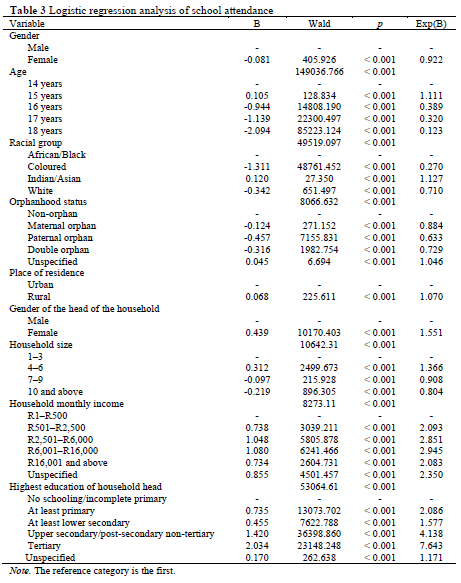
Table 3 indicates that the gender of the learners did not have a great effect on the level of attendance because the odds were approximately 1 (OR = 0.922; p < 0.001) after adjusting for other study variables. Hence, being a female learner did not lead to much reduction in school attendance. The odds of attending school reduced by 88% for all learners aged 18 years, compared with those aged 14 (OR = 0.123; p < 0.001). This means that the learners were less interested in schooling as they became older. Thus, age is an important factor regarding school attendance among secondary school-aged learners. Coloured learners were 73% less likely to attend school when compared with Black learners. When compared with Black learners, White learners were 29% less likely to attend school, while Indian/Asian learners were 1.1 times more likely to attend school. Even though double orphans and maternal orphans were less likely to attend school, paternal orphans had the lowest odds of attending school (OR = 0.633; p < 0.001) when compared to non-orphans. This implies that losing a father is more detrimental to learners' schooling status. Although significant, rural residence did not have much influence on learners' school attendance (OR = 1.070; p < 0.001). Compared with learners from male-headed households, learners in female-headed households had a 1.6 times increased chance of attending school (OR = 1.551; p < 0.001). Compared to male-headed households, more learners from female-headed households favoured school attendance. Households of more than nine members resulted in a 20% reduction in the odds of schooling when compared with households with fewer than four members (OR = 0.804; p < 0.001), which means that a large household is detrimental to school attendance for learners. Learners from households with an income above R16,000 were more than twice likely to attend school in comparison with their counterparts from households with a monthly income of not more than R500. Hence, low household income is a factor discouraging school attendance among learners in secondary school. Generally, the odds of attending school were 4.1 times higher for learners of which the heads of the households had completed upper secondary/post-secondary education compared to those with little or no schooling. When the heads of the households held tertiary qualifications, the chance of learners from those household was 7.6 times higher compared with learners from household where the head of the household had no primary education. This means that the attainment of higher educational qualifications by heads of households resulted in a higher level of school attendance by learners from those households.
Discussion
The key objective of this study was to assess the individual and household factors associated with school attendance of learners from 14 to 18 years old in South Africa. A quantitative approach was employed in this study. The 2019 GHS secondary data were used and the SPSS Version 28 software was used to analyse the data. Cross-tabulation and a Chi-square test were used to measure the relationship between school attendance and gender, age, racial group, orphanhood status, place of residence, gender of the head of the household, household size, monthly income of the household, and level of education of the head of the household. Furthermore, logistic regression was used to measure the factors affecting school attendance among secondary school learners.
This study reveals that age is key in determining whether people attend school in South Africa. At the age of 16, school attendance begins to decline appreciably, which is not surprising because compulsory schooling ends at 15 years (DBE, RSA, 2018). Increasing the age for compulsory schooling to 18 years may help to improve secondary school attendance levels in South Africa. Grade repetition in South Africa is remarkably higher in upper secondary school grades which encourages dropping-out tendencies and jeopardises school attendance. The National Policy Pertaining to the Progression and Promotion (NPPPR) was implemented to promote learners automatically when they have previously repeated - even if they did not meet the minimum learning requirement for promotion (Mogale & Modipane, 2021). With this in place, the expected outcome is to have sustained high school attendance at all grades but most of these promoted learners felt inadequate and frustrated, which made them more inclined to drop out (Khobe & Mukuna, 2023). Hence, ensuring that learners enter school at the appropriate age and transit progressively through each grade level after achieving the required learning competence is critical. Those who may not do well in general education can explore technical and vocational education. More investment should be made to make technical and vocational education more attractive for adolescents and youths. Going through technical and vocational education should equip people with in-demand skills suitable for the current labour market. Additionally, the quality of teaching and learning should be improved at the upper-secondary level.
Unlike in other African countries like Nigeria, Uganda, Zimbabwe, and Niger where many more boys than girls attend school, being female does not deter girls from attending school in South Africa (Evans et al., 2019; Kazeem et al., 2010; Roby et al., 2016; Zimbabwe National Statistical Agency, 2021). In the African countries mentioned above, child marriage and highly entrenched patriarchal cultural practices that perceive female education as less important than male education are responsible for such discrepancies. The prevalence of child marriage is as low as 4% in South Africa (UNICEF, 2022). This challenge does not seem to have a consequential effect on school attendance based on gender. An equal level of school participation for boys and girls secures a future of gender equality for South Africa.
A study on school enrolment in South Africa has shown racial gaps in school attendance where Black and Coloured children had poorer educational outcomes compared to other racial groups (Heaton et al., 2014). The racial divide in school attendance and the disadvantage of Coloured learners were also established in this study. This points to the fact that the inequalities that existed during the apartheid regime still apply. The chances for social mobility and alteration of this structure are very narrow. The assertions of the family socialisation theory are confirmed in this paper as previously disadvantaged families (Coloureds) transfer educational disadvantage to their children. Further research directions can explore the circumstances surrounding Coloured households to gain more understanding of why they have lower participation levels in secondary education. Government agencies or non-governmental organisations should prioritise intervention for the Coloured racial group.
This study shows that orphanhood adversely affects the level of schooling as was observed in other studies (Case & Ardington, 2006; Evans & Miguel, 2007; Kazeem & Jensen, 2017). It can thus be said that family relatives or non-relatives who assume parental responsibilities over orphans are not able to make the same commitment toward the education of orphans as their biological parents would. Despite the introduction of the NNSSF and the Regulations Relating to the Exemption of Parents for Payment of School Fees in Public Schools, which gives orphans and other children with financial constraints exemption from paying fees, orphans in the country are still behind in school attendance. This should inform the need to provide adequate support for orphans in their educational pursuits. Support can be given to cater for uniforms, books, and other educational materials.
Unlike in other African countries (Nigeria, Morroco, Tanzania), living in a rural environment does not have a great effect on the level of school attendance in South Africa. School attendance in rural places is negatively affected by poor infrastructure and cultural practices that restrict female education (Joyce-Gibbons et al., 2018; Kazeem et al., 2010; Smits & Huisman, 2013). However, in South Africa, rural residence does not have a big negative impact on schooling among secondary-school-aged learners. This may be one of the benefits of the NNSSF which allows for poor rural schools to be funded equitably so that an equality of school participation is maintained with that of urban schools. This is remarkable progress towards the pursuit of equality in South African society.
This study shows that learners from large households were more unlikely to attend school compared with their counterparts in small households. This shows that for large households the resources to support the education of school-aged members are overstretched. Providing support for learners from poor and large households will be an important approach to tackling this challenge. According to the report from the General Household Survey, most respondents claimed that a lack of money for fees was the reason why learners were no longer attending school (DBE, RSA, 2018). Even with the provision for a fee exemption for parents with financial constraints, the results still affirm that household income that informs the affordability of fees is associated with school attendance. The difference in the level of school attendance between learners based on their household income shows that poverty hinders schooling. However, when the burden of tuition fees is removed for poor households, it does not eliminate non-attendance. The postulation of the household production framework comes to bear as the desire to satisfy other needs takes precedence over education. Therefore, reducing the level of poverty will improve school attendance. Conditional cash transfers directed towards economically disadvantaged households, dependent on consistent school attendance, have been demonstrated to improve schooling (Petrosino et al., 2012). This can also be implemented in South Africa. While ensuring that all learners from poor households benefit from the no-fee policy, addressing learners with poor academic performance is also crucial. This study demonstrates that educating a generation confers an educational benefit to the next generation. The family socialisation theory agrees with this phenomenon as learners from households with poorly educated heads were not attending school as much as those with well-educated household heads. About 27% of the heads of households did not have a primary education, which is worrisome. When heads of households are educated, the chances that children will attend school are increased. There is a need to strengthen the Adult Basic Education and Training System to reach uneducated adults.
Conclusion and Recommendation
The aim with this study was to investigate the individual and household factors associated with school attendance among secondary school-aged learners in South Africa. The study revealed that about a quarter of all the learners' heads of households had not completed primary education. Age as an individual-level characteristic and educational attainment of learners' heads of households as household-level characteristic were the most important factors associated with school attendance in this study. In the South African population, gender and urban/rural place of residence do not have a great effect on school attendance. Learners belonging to the Coloured racial group were the most disadvantaged with regard to school attendance. School attendance levels decrease as adolescents grow older (UNESCO, 2020). The educational background of a learner is also an inspiring factor for school attendance. Taking measures to ensure that learners start attending school on time and transit progressively through higher grades is recommended. Learners from poor backgrounds, large households, orphans, and Coloureds should be provided with additional educational support. Mobilising resources to ensure that the current population of learners attend and complete school will bring about future rewards.
Acknowledgement
We thank the University of Cape Town for making the dataset easily retrievable via the DataFirst portal.
Authors' Contributions
VAS: Development of the research idea, downloaded data, performed statistical analysis, wrote the results and discussion. RDA: Wrote the literature review. PN: Wrote the methodology and edited the final draft.
Notes
i. Published under a Creative Commons Attribution Licence.
References
Abdul-Rahaman N, Rongting Z, Wan M, Iddrisu I, Abdul Rahaman AB & Amadu L 2020. The impact of government funding on senior high enrolment in Ghana [Special issue]. South African Journal of Education, 40(4):Art. #1648, 10 pages. https://doi.org/10.15700/saje.v40n4a1648 [ Links ]
Arends-Kuenning M & Duryea S 2006. The effect of parental presence, parents' education, and household headship on adolescents' schooling and work in Latin America. Journal of Family and Economic Issues, 27(2):263-286. https://doi.org/10.1007/s10834-006-9011-1 [ Links ]
Battin-Pearson S, Newcomb MD, Abbott RD, Hill KG, Catalano RF & Hawkins JD 2000. Predictors of early high school dropout: A test of five theories. Journal of Educational Psychology, 92(3):568-582. https://doi.org/10.1037/0022-0663.92.3.568 [ Links ]
Bengesai AV, Amusa LB & Makonye F 2021. The impact of girl child marriage on the completion of the first cycle of secondary education in Zimbabwe: A propensity score analysis. PLoS ONE, 16(6):e0252413. https://doi.org/10.1371/journal.pone.0252413 [ Links ]
Buthelezi Z 2018. Lecturer experiences of TVET College challenges in the post-apartheid era: A case of unintended consequences of educational reform in South Africa. Journal of Vocational Education & Training, 70(3):364-383. https://doi.org/10.1080/13636820.2018.1437062 [ Links ]
Case A & Ardington C 2006. The impact of parental death on school outcomes: Longitudinal evidence from South Africa. Demography, 43(3):401-420. https://doi.org/10.1353/dem.2006.0022 [ Links ]
Case A, Paxson C & Ableindinger J 2004. Orphans in Africa: Parental death, poverty, and school enrollment. Demography, 41(3):483-508. https://doi.org/10.1353/dem.2004.0019 [ Links ]
Chikoko V & Mthembu P 2020. Financing primary and secondary education in sub-Saharan Africa: A systematic review of literature [Special issue]. South African Journal of Education, 40(4):Art. #2046, 9 pages. https://doi.org/10.15700/saje.v40n4a2046 [ Links ]
De Brey C, Snyder TD, Zhang A & Dillow SA 2021. Digest of education statistics 2019 (NCES 2021-009). Washington, DC: National Center for Education Statistics, Institute of Education Sciences, U.S. Department of Education. Available at https://files.eric.ed.gov/fulltext/ED611019.pdf. Accessed 28 February 2025. [ Links ]
Department of Basic Education, Republic of South Africa 2018. General Household Survey (GHS): Focus on schooling 2016. Pretoria: Author. Available at https://www.education.gov.za/Portals/0/Documents/Reports/General%20Household%20Survey%202016%20Focus%20on%20Schooling.pdf. Accessed 13 July 2022. [ Links ]
Department of Basic Education, Republic of South Africa 2019. General Household Survey (GHS): Focus on schooling 2018. Pretoria; Author. Available at https://www.education.gov.za/portals/0/documents/reports/20191104_GHS_final.pdf. Accessed 13 July 2022. [ Links ]
Department of Basic Education, Republic of South Africa 2020a. Annual report 2019/20. Pretoria: Author. Available at https://www.gov.za/documents/annual-reports/department-basic-education-annual-report-20192020-05-nov-2020. Accessed 18 July 2024. [ Links ]
Department of Basic Education, Republic of South Africa 2020b. School realities 2019. Available at https://www.studocu.com/en-za/document/stadio-higher-education/pgce-senior-phase-and-fet/school-realities-2019-final/118535263. Accessed 28 February 2025. [ Links ]
Department of Education, Republic of South Africa 2006. South African Schools Act (84/1996): Amended national norms and standards for school funding. Government Gazette, 494(29179), August 31. [ Links ]
DeRose L, Garcia PC, Salazar A & Tarud C 2014. Household structure and school attendance in 67 countries: Why children with absent fathers do better in some places. In Proceedings of the annual meeting of the Population Association of America. Available at https://paa2014.populationassociation.org/abstracts/142305. Accessed 28 February 2025. [ Links ]
Du Plessis P & Mestry R 2019. Teachers for rural schools - a challenge for South Africa [Special issue]. South African Journal of Education, 39(Suppl. 1):Art. #1774, 9 pages. https://doi.org/10.15700/saje.v39ns1a1774 [ Links ]
Du Plooy B & Du Preez K 2022. Perceptions of staff and students about the NC(V) model of workplace engineering artisan training offered by South African TVET colleges. South African Journal of Higher Education, 36(1):96-114. https://doi.org/10.20853/36-1-4505 [ Links ]
Evans DK, Akmal M & Jakiela P 2019. Gender gaps in education: The long view (CGD Working Paper 523). Washington, DC: Center for Global Development. Available at https://www.cgdev.org/publication/gender-gaps-education-long-view Accessed 4 April 2022. [ Links ]
Evans DK & Miguel E 2007. Orphans and schooling in Africa: A longitudinal analysis. Demography, 44(1):35-57. https://doi.org/10.1353/dem.2007.0002 [ Links ]
Ezumah BA 2020. Critical perspectives of educational technology in Africa: Digital education and learning. Cham, Switzerland: Palgrave Macmillan. https://doi.org/10.1007/978-3-030-53728-9 [ Links ]
Farah N & Upadhyay MP 2017. How are school dropouts related to household characteristics? Analysis of survey data from Bangladesh. Cogent Economics & Finance, 5(1):1268746. https://doi.org/10.1080/23322039.2016.1268746 [ Links ]
Goldin C & Katz L 2003. Mass secondary schooling and the state: The role of state compulsion in the high school movement (Working Paper 10075). Cambridge: National Bureau of Economic Research. https://doi.org/10.3386/w10075 [ Links ]
Heaton BT, Amoateng AY & Dufur M 2014. Race differences in educational attainment of youth aged 7-18 in post-apartheid South Africa: The role of family structure, resources and school quality. South African Review of Sociology, 45(1):101-121. https://doi.org/10.1080/21528586.2014.887917 [ Links ]
Huisman J & Smits J 2015. Keeping children in school: Effects of household and context characteristics on school dropout in 363 districts of 30 developing countries. Sage Open, 5(4):1 -16. https://doi.org/10.1177/2158244015609666 [ Links ]
Joyce-Gibbons A, Galloway D, Mollel A, Mgoma S, Pima M & Deogratias E 2018. Successful transition to secondary school in Tanzania: What are the barriers? Journal of International Development, 30(7):1142-1165. https://doi.org/10.1002/jid.3304 [ Links ]
Kattan RB & Székely M 2015. Patterns, consequences, and possible causes of dropout in upper secondary education in Mexico. Education Research International, 2015:1-12. https://doi.org/10.1155/2015/676472 [ Links ]
Kazeem A & Jensen L 2017. Orphan status, school attendance, and their relationship to household head in Nigeria. Demographic Research, 36:659-690. https://doi.org/10.4054/DemRes.2017.36.22 [ Links ]
Kazeem A, Jensen L & Stokes CS 2010. School attendance in Nigeria: Understanding the impact and intersection of gender, urban-rural residence, and socioeconomic status. Comparative Education Review, 54(2):295-319. https://doi.org/10.1086/652139 [ Links ]
Khobe MA & Mukuna KR 2023. The effects of school progression policy on the progressed Grade 12 learners' well-being at schools - A case study of the Motheo Education District, South Africa. E-Journal of Humanities, Arts and Social Sciences, 4(10):1243-1252. https://doi.org/10.38159/ehass.20234107 [ Links ]
Khuluvhe M & Netshifhefhe E 2021. Funding and expenditure trends in post-school education and training. Pretoria, South Africa: Department of Higher Education and Training. Available at https://www.dhet.gov.za/Planning%20Monitoring%20and%20Evaluation%20Coordination/Funding%20and%20Expenditure%20Trends%20in%20Post-School%20Education%20and%20Training%20-%20March%202021.pdf. Accessed 28 February 2025. [ Links ]
Kuépié M, Shapiro D & Tenikue M 2015. Access to schooling and staying in school in selected sub-Saharan African countries. African Development Review, 27(4):403-414. https://doi.org/10.1111/1467-8268.12156 [ Links ]
Kumatongo B & Muzata KK 2021. Research paradigms and designs with their application in education. Journal of Lexicography and Terminology, 5(1):16-32. Available at https://www.researchgate.net/publication/352816503_RESEARCH_PARADIGMS_AND_DESIGNS_WITH_THEIR_APPLICATION_IN_EDUCATION. Accessed 28 February 2025. [ Links ]
Kwegyiriba A 2021. Free senior high school policy: Implications to education access equity in Ghana. British Journal of Education, 9(8):68-81. https://doi.org/10.37745/bje.2013 [ Links ]
Lewin KM 2006. Seeking secondary schooling in Sub-Saharan Africa: Strategies for sustainable financing. Washington, DC: World Bank.Available at https://documents1.worldbank.org/curated/en/903881468008772327/pdf/588920NWP0no0110Box353823B01PUBLIC1.pdf. Accessed 28 February 2025. [ Links ]
Lutz W, Crespo Cuaresma J & Sanderson W 2008. The demography of educational attainment and economic growth. Science, 319(5866):1047-1048. https://doi.org/10.1126/science.115175 [ Links ]
Majgaard K & Mingat A 2012. Education in Sub-Saharan Africa: A comparative analysis. Washington, DC: World Bank. https://doi.org/10.1596/978-0-8213-8889-1 [ Links ]
McConnachie C, Skelton A & McConnachie C 2022. The Constitution and the right to a basic education. In F Veriava & T Kathrada (eds). Basic education rights handbook (2nd ed). Braamfontein, South Africa: SECTION27. [ Links ]
Mestry R 2014. A critical analysis of the National Norms and Standards for School Funding policy: Implications for social justice and equity in South Africa. Educational Management Administration & Leadership, 42(6):851-867. https://doi.org/10.1177/1741143214537227 [ Links ]
Mlachila M & Moeletsi T 2019. Struggling to make the grade: A review of the causes and consequences of the weak outcomes of South Africa's education system (IMF Working Paper No. 19/47). Washington, DC: International Monetary Fund. Available at https://www.imf.org/en/Publications/WP/Issues/2019/03/01/Struggling-to-Make-the-Grade-A-Review-of-the-Causes-and-Consequences-of-the-Weak-Outcomes-of-46644. Accessed 28 February 2025. [ Links ]
Mogale ML & Modipane MC 2021. The implementation of the progression policy in secondary schools of the Limpopo province in South Africa. South African Journal of Education, 41(1):Art. #1853, 10 pages. https://doi.org/10.15700/saje.v41n1a1853 [ Links ]
Msafiri M & Lianyu C 2022. Analysis of sociocultural factors for schools drop out among girls in Tanzania: A case study of junior secondary school. Asian Journal of Education and Social Studies, 33(4):15-29. https://doi.org/10.9734/AJESS/2022/v33i4711 [ Links ]
National Department of Health, Statistics South Africa, South African Medical Research Council & ICF 2019. South Africa Demographic and Health Survey 2016. Pretoria, South Africa: National Department of Health. Available at https://www.dhsprogram.com/pubs/pdf/FR337/FR337.pdf. Accessed 28 February 2025. [ Links ]
Organisation for Economic Co-operation and Development 2018. Education at a glance 2018: OECD indicators. Paris, France: OECD Publishing. https://doi.org/10.1787/eag-2018-en [ Links ]
Organisation for Economic Co-operation and Development 2021. Education at a glance 2021: OECD indicators. Paris, France: OECD Publishing. https://doi.org/10.1787/b35a14e5-en [ Links ]
Organisation for Economic Co-operation and Development 2022. Education at a glance 2022: OECD indicators. Paris, France: OECD Publishing. https://doi.org/10.1787/8e9ec00d-en [ Links ]
Pampallis J 2008. School fees: Issues in education policy number 3. Johannesburg, South Africa: Centre for Education Policy Development. Available at https://www.saide.org.za/resources/Library/Pampallis,%20J%20-%20School%20Fees.pdf. Accessed 28 February 2025. [ Links ]
Petrosino A, Morgan C, Fronius TA, Tanner-Smith EE & Boruch RF 2012. Interventions in developing nations for improving primary and secondary school enrollment of children: A systematic review. Campbell Systematic Reviews, 8(1):i-192. https://doi.org/10.4073/csr.2012.19 [ Links ]
Phiri K, Ndlovu S, Dube T, Nyathi D, Ncube C & Tshuma N 2020. Access to formal education for the San community in Tsholotsho, Zimbabwe: Challenges and prospects. Heliyon, 6(7):e04470. https://doi.org/10.1016/j.heliyon.2020.e04470 [ Links ]
Roby JL, Erickson L & Nagaishi C 2016. Education for children in sub-Saharan Africa: Predictors impacting school attendance. Children and Youth Services Review, 64:110-116. https://doi.org/10.1016/j.childyouth.2016.03.002 [ Links ]
Rumberger RW & Lim SA 2008. Why students drop out of school: A review of 25 years of research. Santa Barbara, CA: University of California. Available at https://www.issuelab.org/resources/11658/11658.pdf. Accessed 4 April 2022. [ Links ]
Shehu HK 2018. Factors influencing primary school non-attendance among children in North West Nigeria. Literacy Information and Computer Education Journal, 9(2):2916-2922. Available at https://infonomics-society.org/wp-content/uploads/licej/published-papers/volume-9-2018/Factors-Influencing-Primary-School-Non-attendance.pdf. Accessed 28 February 2025. [ Links ]
Sibanda A 2001. Racial differences in educational attainment in South Africa. Paper presented at the 24th General Population Conference, International Union for the Scientific Study of Population (IUSSP), Salvador, Brazil, 18-24 August. https://doi.org/10.13140/2.1.3295.2321 [ Links ]
Smits J & Huisman J 2013. Determinants of educational participation and gender differences in education in six Arab countries. Acta Sociologica, 56(4):325-346. https://doi.org/10.1177/0001699313496259 [ Links ]
Spaull N 2015. Schooling in South Africa: How low-quality education becomes a poverty trap. In A de Lannoy, S Swartz, L Lake & C Smith (eds). South African Child Gauge 2015. Cape Town, South Africa: Children's Institute, University of Cape Town. Available at https://ci.uct.ac.za/sites/default/files/content_migration/health_uct_ac_za/533/files/ChildGauge2015-lowres.pdf. Accessed 4 April 2022. [ Links ]
Statistics South Africa 2019a. General Household Survey 2019 [dataset]. Version 1. Pretoria: Statistics SA [producer], 2019. Cape Town: DataFirst [distributor], 2019. https://doi.org/10.25828/vtvj-pv21 [ Links ]
Statistics South Africa 2019b. Mid-year population estimates 2019. Pretoria: Author. Available at https://www.statssa.gov.za/publications/P0302/P03022019.pdf. Accessed 19 November 2021. [ Links ]
Statistics South Africa 2020. General Household Survey 2019. Statistical release: P0318. Pretoria: Author. Available at https://www.statssa.gov.za/publications/P0318/P03182019.pdf. Accessed 14 May 2021. [ Links ]
Statistics South Africa 2021. Financial statistics of consolidated general government 2021/2022. Available at https://www.statssa.gov.za/publications/P91194/P911942022.pdf. Accessed 16 July 2024. [ Links ]
Statistics South Africa 2024. Census 2022: A profile of education enrolment, attainment and progression in South Africa (Report no. 03-01-81). Pretoria: Author. [ Links ]
Stoner MCD, Pettifora A, Edwards JK, Aiello AE, Halpern CT, Julien A, Selin A, Twine R, Hughes JP, Wang J, Agyei Y, Gomez-Olive FX, Wagner RG, MacPhail C & Kahn K 2017. The effect of school attendance and school dropout on incident HIV and HSV-2 among young women in rural South Africa enrolled in HPTN 068. AIDS, 31(15):2127-2134. https://doi.org/10.1097/QAD.0000000000001584 [ Links ]
Tymenko M 2019. Trends of secondary education development in the USA, Great Britain and Ukraine through reforms and innovations. Education: Modern Discourses, 2:51-58. https://doi.org/10.32405/2617-3107-2019-1-7 [ Links ]
United Nations 1948. Universal declaration of human rights. Available at https://www.un.org/en/about-us/universal-declaration-of-human-rights. Accessed 19 November 2021. [ Links ]
United Nations 2013. The millennium development goals report 2013. New York, NY: Author. Available at http://www.un.org/millenniumgoals/pdf/report-2013/mdg-report-2013-english.pdf Accessed 5 May 2022. [ Links ]
United Nations Children's Fund 2022. Child marriage country profile: South Africa. Available at https://data.unicef.org/resources/child-marriage-country-profiles. Accessed 16 July 2024. [ Links ]
United Nations Economic Commission for Africa, African Union, African Development Bank & United Nations Development Programme 2014. MDG Report 2014: Assessing progress in Africa toward the Millennium Development Goals. Addis Ababa, Ethiopia: Authors. Available at https://www.afdb.org/fileadmin/uploads/afdb/Documents/Publications/MDG_Report_2014_11_2014.pdf. Accessed 18 July 2024. [ Links ]
United Nations Educational, Scientific and Cultural Organization 2015. Education for all 2000-2015: Achievements and challenges (EFA Global Monitoring Report 2015). Paris, France: Author. https://doi.org/10.54676/LBSF6974 [ Links ]
United Nations Educational, Scientific and Cultural Organization 2016a. Education for people and planet: Creating sustainable futures for all (Global Education Monitoring Report, 2016). Paris, France: Author. https://doi.org/10.54676/AXEQ8566 [ Links ]
United Nations Educational, Scientific and Cultural Organization 2016b. Education 2030: Incheon declaration and framework for action for the implementation of sustainable development goal 4: Ensure inclusive and equitable quality education and promote lifelong learning opportunities for all. Paris, France: Author. Available at https://uis.unesco.org/sites/default/files/documents/education-2030-incheon-framework-for-action-implementation-of-sdg4-2016-en_2.pdf. Accessed 11 May 2022. [ Links ]
United Nations Educational, Scientific and Cultural Organization 2020. Inclusion and education: All means all (Global Education Monitoring Report 2020). Paris, France: Author. https://doi.org/10.54676/JJNK6989 [ Links ]
UNESCO Institute for Statistics n.d. Education SDG4 monitoring. Available at https://databrowser.uis.unesco.org/browser/EDUCATION/UIS-SDG4Monitoring/t4.1. Accessed 28 February 2025. [ Links ]
Van Dyk H & White CJ 2019. Theory and practice of the quintile ranking of schools in South Africa: A financial management perspective [Special issue]. South African Journal of Education, 39(Suppl. 1):Art. #1820, 9 pages. https://doi.org/10.15700/saje.v39ns1a1820 [ Links ]
Veriava F & Skelton A 2022. Education rights in independent schools. In F Veriava & T Kathrada (eds). Basic education rights handbook (2nd ed). Braamfontein, South Africa: SECTION27. [ Links ]
Westberg NB 2010. Girls versus boys? Factors associated with children's schooling in rural Malawi. Master's thesis. Ás, Norway: Norwegian University of Life Sciences. Available at http://hdl.handle.net/11250/187408. Accessed 18 October 2021. [ Links ]
World Bank n.d. Government expenditure on education, total (% of GDP) - South Africa. Available at https://data.worldbank.org/indicator/SE.XPD.TOTL.GD.ZS?locations=ZA. Accessed 16 October 2024. [ Links ]
World Bank 2018. An incomplete transition: Overcoming the legacy of exclusion in South Africa. Systematic country diagnostic. Washington, DC: Author. Available at https://openknowledge.worldbank.org/entities/publication/627f0a09-980b-5f5f-a746-87be426ed6e7. Accessed 28 February 2025. [ Links ]
Zimbabwe National Statistical Agency 2021. Education statistics report 2018-2020. Harare: Author. Available at https://www.zimstat.co.zw/wp-content/uploads/publications/Social/Education/Education_Report_2020.pdf. Accessed 16 July 2024. [ Links ]
Zimbabwe National Statistics Agency & UNICEF 2019. Zimbabwe Multiple Indicator Cluster Survey 2019 (Survey Findings Report). Harare, Zimbabwe: ZIMSTAT. Available at https://www.unicef.org/zimbabwe/media/2536/file/Zimbabwe%202019%20MICS%20Survey%20Findings%20Report-31012020_English.pdf. Accessed 28 February 2025. [ Links ]
Received: 8 March 2023
Revised: 3 October 2024
Accepted: 10 February 2025
Published: 28 February 2025
