Services on Demand
Journal

Article
 English (pdf)
 Article in xml format
 Article references
 Automatic translation
 Send this article by e-mail
Indicators
Related links
-
 Cited by Google
 -
 Similars in Google
Share

 Permalink
South African Journal of Education
On-line version ISSN 2076-3433Print version ISSN 0256-0100
S. Afr. j. educ. vol.41 n.4 Pretoria Nov. 2021
https://doi.org/10.15700/saje.v41n4a1933
ARTICLES
Primary school pre-service teachers' solutions to pattern problem-solving tasks based on three components of creativity
Ifunanya J.A. UbahI; Ugorji I. OgbonnayaII
IDepartment of Science, Technology and Mathematics Education, Faculty of Education, University of Johannesburg, Auckland Park, South Africa
IIDepartment of Science, Mathematics and Technology Education, Faculty of Education, University of Pretoria, Pretoria, South Africa ugorji.ogbonnaya@up.ac.za
ABSTRACT
Education stakeholders and researchers in South Africa have emphasised the need to enhance teachers' creativity through problem-solving tasks. Teachers' creativity entails using new ideas of creative devices to solve problems, implement solutions, and make learning more effective. In the research reported on here, Guilford's theory was used to explore primary school pre-service teachers' solutions to pattern problem-solving tasks based on 3 components of creativity. The data for this research were produced from primary school pre-service teachers' written responses to the pattern problem-solving tasks, and an extract from participants' semi-structured interviews. The research involved a qualitative design using convenient purposive sampling to sample 62 pre-service teachers enrolled for a primary mathematics module at a selected higher education institution. Participants' responses to the written tasks were analysed using content analysis, while the semi-structured interviews were analysed thematically. The result shows that 35 participants were able to draw patterns and express patterns in nth form, while 27 failed to do so. The most common method used to draw a new pattern was counting in 2s and 4s. Furthermore, the result shows that half of the pre-service teachers who participated in the study were not capable of producing varied solutions to pattern tasks. An indication that they did not have the creative potential to prepare learners even after they had been exposed to advanced mathematics content as part of their training process. We recommend that pre-service teacher education programmes should include academic activities that could help pre-service teachers enhance creativity through tasks with divergent thinking.
Keywords: creativity; flexibility; fluency; originality; patterns; pre-service teachers; primary school; problem-solving tasks
Introduction
In a quest for increased teacher enrolment in schools, due to ever-growing demand, developing economies such as South Africa recruit under-qualified teachers that do not possess adequate knowledge of mathematical content and pedagogy to teach mathematics (Deacon, 2016; Ubah & Bansilal, 2018). These under-qualified teachers do not possess the ability to develop learners' creative thinking (Jojo, 2020). As observed by Deacon (2016:25), this leads to a "cycle of mediocrity, where school leavers who were themselves poorly taught are returned to the schools as teachers." This study was conducted in the context of pre-service primary school teachers who found the mathematics content that they were expected to teach after graduation, difficult. Primary school mathematics forms the foundation for mathematical concepts and the main objective of primary mathematics is to help learners understand, make sense of mathematical concepts, and improve on their creativity (Gallant, 2013; Gouws & Dicker, 2011). Education stakeholders and many researchers in South Africa highlight the need for enhanced teacher creativity through problem-solving tasks (South African Institute for Distance Education, 2017).
Vale and Barbosa (2015:103) observe that "creativity begins with curiosity and engages learners in exploration and experimentation-based tasks where they can translate their imagination and originality." Researchers (like Wilkie & Clarke, 2016) have found that understanding and being able to identify patterns allow learners to make educated guesses, assumptions, hypotheses as well as the enhancement of creativity. Research results (Ayllón, Gómez & Ballesta-Claver, 2016:209) have shown that "mathematical problem solving and problem posing are closely related to creativity." Hence, problem-based tasks should be used in mathematics classroom instruction to enhance learners' creativity.
Problem-based tasks usually require creative thinking and recent research (Childcare, 2019; Mendez, 2016) about teaching and learning of mathematics reveal that the development of learners' creativity and mathematical ability could be attributed to the use of patterns in instruction. Moreover, research reveals that learners with a better understanding of patterns tend to perform better in mathematics courses, while learners who are not doing so well in mathematics can substantially increase their scores by training with patterns (Ankowski & Ankowski, 2015). According to Guilford (1975), once learners begin to spot patterns they see them everywhere, not only in the environment but also in daily routines and all kinds of regular behaviour. Mathematics educators must provide prospective teachers with creative ideas for solving mathematical tasks and encourage them to think independently and critically. In this way, primary school pre-service teachers will enhance their creative abilities as well as successfully undertake the same type of tasks, to which they will expose their learners when they start their teaching careers.
Literature Review
The use of patterns is a strategy of 21st-century problem-solving skills. According to Vale, Pimentel, Cabrita, Barbosa and Fonseca (2012:173), the study of patterns "makes it possible to get mathematical ideas as generalization and algebraic thinking where visualization plays an important role." Similarly, Safitri, Wijayanti and Masriyah (2018) observe that pattern-based tasks have the creative potential to prepare learners for further learning and to enhance their problemsolving skills. Creative ability is a skill that teachers must possess to stimulate the creativity of their learners. Yazgan-Sag and Emre-Akdogan (2016) have explored the views and differences that creativity engenders in prospective South African teachers. Their results reveal that prospective mathematics teachers' creativity was related to the type of instruction presented by the teacher, tasks presented to the learners, and teachers' approaches to solving problems.
Problem solving is the basis of mathematics because it entails solving tasks not based on procedures (National Council of Teachers of Mathematics [NCTM], 2015). Dunlosky, Rawson, Marsh, Nathan and Willingham (2013) observe that what learners learn is greatly influenced by the tasks given to them by their teachers. Therefore, mathematical tasks must be intellectually challenging for learners, develop different approaches, create ideas, and provide multiple solutions that introduce fundamental mathematical ideas, and enhancement of creativity (NCTM, 2015).
According to Aguilar and Telese (2018:26), "teachers have difficulty in implementing nonroutine activities that are open-ended and require reasoning and problem-solving strategies." Phonapichat, Wongwanich and Sujiva (2014) argue that this difficulty may be because teachers fail to connect real-life situations with mathematical content. They teach learners to memorise procedures in solving problems but do not deeply explain the concepts behind textbook problems (Phonapichat et al., 2014). Therefore, pre-service teachers should possess the mathematical content knowledge for solving non-routine problems as well as the pedagogical knowledge essential for having a positive effect on their learners' learning (Worrell, Brabeck, Dwyer, Geisinger, Marx, Noell & Pianta, 2014).
According to Liljedahl, Santos-Trigo, Malaspina and Bruder (2016), problem-solving is a prominent research area in mathematics education, aimed at connecting problem-solving processes to students' enhancement of problem-solving competencies and mathematical ability. Vale et al. (2012) reveal that pre-service teachers' mathematical creativity and ability were enhanced through pattern problem-solving tasks.
Schrauth's (2014) qualitative case study on mathematical creativity in middle-grade classes revealed that reasoning, explanation, and use of relevant terminology improved students' mathematical creativity. Leikin, Leikin and Waisman' s (2017) study on the development of students' mathematical creativity revealed that the enhancement of creativity in mathematics teachers requires the creation of a "pattern" learning environment.
Patterns can be seen everywhere in our environment and do not always have to be stated in numerical form (NCTM, 2000). Mathematics is a subject that is peculiar with patterns, it involves spatial, numeric, and logical relationships with predictable regularities (Mulligan & Mitchelmore, 2009). The patterns that learners learn at primary school level include recurring patterns (e.g., XYZXYZXYZ), spatial structural patterns (e.g. various geometrical shapes), and increasing patterns (e.g. 5, 10, 15, 20...). Pattern tasks provide learners with the opportunity to observe, verbalise, generalise, and formally translate them.
Obara' s (2019) research on how prospective teachers arrived at generalisations based on patterns revealed that the prospective teachers experienced some difficulties in input-output relationships in a generalisation process. McCrory, Floden, Ferrini-Mundy, Reckase and Senk's (2012) study revealed that if primary school teachers were not equipped with the knowledge to help learners make the leap from numbers and arithmetic to learning about relationships (patterns), then the learning of mathematical skills could be a challenge.
The literature reviewed for this research reveal a sparsity of research studies on pre-service primary school teachers' knowledge of how to create, share, and solve mathematical problems through pattern-based activities. The studies also indicate that teachers had difficulty in implementing non-routine classroom activities that involved reasoning and problem solving. Moreover, it has been a challenging task for teachers to develop learners' creativity in pattern problem-solving tasks. However, most of the empirical studies analysed were on developed economies, with a paucity of research on developing economies like South Africa, hence the need for this research. In this research we used the Guilford framework to explore pre-service primary school teachers' solutions to two pattern problemsolving tasks based on three components of creativity (fluency, flexibility, and originality).
Theoretical Framework
This research is anchored in Guilford' s Theory of Creativity as a problem-solving technique that improves divergent thinking (Guilford, 1967). In mathematics, creativity is conveyed through the design of non-complicated challenges and the identification of novel methods of solving mathematical tasks. Presentation of learners with non-routine questions that involve creative thinking, diverse ideas, and multiple answers leads to the enhancement of mathematical thinking (McCrory et al., 2012). If teachers were mathematically competent to analyse their learners' solutions to creatively structured tasks, then the solution could be achieved. For example, instead of the teacher asking, "How do we divide 15 oranges equally among 5 bowls?" with the procedure being unambiguous, the teacher will ask, "How do we divide 15 oranges among several bowls?"; this question has a diverse solution/answer, and the learner will have to consider a variety of alternatives before choosing the right answer (Yee, 2005).
Mann (2006) observes that there is no generally acknowledged description of mathematical creativity because creativity could be expressed in different ways. However, Vale et al. (2012) observe that the accepted definition of creativity involves divergent and convergent thinking. This is in line with Guilford' s theory of creativity.
The divergent and convergent thinking aspects of creativity are key characteristics of 21st-century problem-solving skill. Convergent thinking involves obtaining a single response to a problem while divergent thinking involves many possible solutions to a problem. Solving problems by analysing all the likely solutions and identifying the best solution to the problem is referred to as divergent thinking. Divergent thinkers keep their minds open to any possible solutions presented to them and the more prospects they can come up with, the more efficient they become in divergent thinking.
Guilford' s main components of creativity are fluency, flexibility, and originality. Fluency involves the ability to quickly come up with many diverse ideas, measured by the total number of ideas generated. Flexibility involves students changing ideas amid solutions. Originality is the proficiency in creating different ideas, which is measured as the number of novel ideas generated. In a regular mathematics classroom, originality is shown when a student explores diverse solutions/answers to a task and then creates a new, different solution/answer. However, Kaufman and Sternberg (2019:59) state that a major limitation on the assessment of students' creativity is the lack of scaled instruments that could be used for a large sample. In problem-solving tasks, fluency, flexibility, and originality could be easily measured in a few samples but scoring is time-consuming, hence not most ideal for classroom use.
Research findings in mathematics education reveal that problem solving is closely related to creativity, and that the creative process develops during problem solving (Ayllón et al., 2016; Palmér & Van Bommel, 2018). Tasks that promote creativity must be open-ended and teachers should provide their learners with open-ended tasks with diverse alternative solutions rather than closed tasks with a single solution (Siswono, 2008). The study of patterns should involve open-ended problem-solving tasks that could promote diverse mathematical ideas where visualisation plays an important role. Obara (2019) observes that open-ended pattern-based tasks have great creative potential.
It is important to note that for effective learning, teachers should propose mathematical tasks involving learners in a creative way, and teachers should be competent in analysing their learners' diverse solutions to tasks (Palmér & Van Bommel, 2018). Research shows that what learners learn is greatly influenced by the tasks they are given by their teachers (Dunlosky et al., 2013). Therefore, mathematical tasks must be intellectually challenging for learners, must involve different approaches, creative ideas, and provide multiple solutions that introduce fundamental mathematical ideas (NCTM, 2015).
To enhance their mathematical knowledge and ability, teachers must inspire learners to generate diverse solutions to mathematical tasks in a rich learning environment. Problem-solving is at the core of mathematics because it includes solving tasks not based on procedures (NCTM, 2015). Since learners develop creativity if suitable learning prospects are offered by the teachers, then primary school pre-service teachers' training should involve encouraging students to solve mathematical problems that enhance creativity.
Guilford' s theory postulates that the enhancement of creativity depends on the ability of the students/learners to visualise varied solutions to a task. This postulation is referred to as divergent thinking. Hence, the relevance of Guilford' s theory in this research is based on the interaction of the three components of creativity (fluency, flexibility, and originality) in analysing participants' solutions in two pattern problem-solving tasks.
Research Question
The research question in this research was: What are primary school pre-service teachers' solutions to pattern problem-solving tasks based on fluency, flexibility, and originality?
Methodology
Research Design
In this research we employed a qualitative research method (in general) and a case study approach (in particular) to explore primary school pre-service teachers' solutions to pattern problem-solving tasks based on fluency, flexibility, and originality. Qualitative research method was chosen because it permits a detailed analysis of a small number of elements over time (Hsieh & Shannon, 2005).
Sampling
The participants in this study were 62 Bachelors in Education (BEd) pre-service primary school teachers at a South African university. They were purposively selected for the study. They were enrolled in a foundational method course in mathematics as part of the requirement for their qualification. The participants for the interviews were purposively and conveniently sampled to select information-rich cases to answer the research question (Etikan, Musa & Alkassim, 2016).
Ethical Considerations
The University granted us permission to conduct the study. Informed consent was obtained from all the participants to have their scripts analysed, be interviewed, and for the interviews to be audio recorded.
Data Collection
The data for this research were collected from the participants' written solutions to two pattern problem-solving tasks and through semi-structured interviews. The two tasks were part of a formal assessment of the foundation method course. The tasks were intended to probe the students' creative solutions on pattern problem-solving tasks. Two experts in mathematics education validated the written tasks. Four participants (one high achiever, two average achievers, and one lower achiever) were interviewed. The interviews were audio recorded. The first author conducted and transcribed the interviews word for word while the second author checked the transcriptions. Furthermore, the interviewees were asked to crosscheck the transcriptions of the interviews to ensure the credibility of the data (Korstjens & Moser, 2018).
Data Analysis
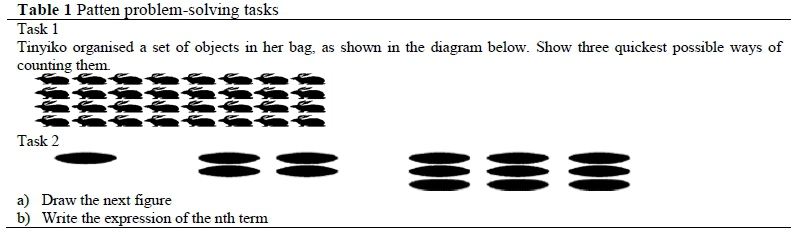
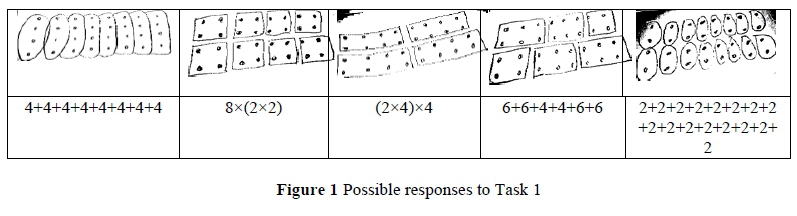
An analysis of data entails breaking down the information gathered into elements to obtain responses to the research question (Sauro, 2015). In this research, the data from written tasks were analysed using content analysis (Kondracki, Wellman & Amundson, 2002). The interview data were organised and analysed to get an overview of what was revealed, and the responses were discussed. The analysis was based on Guilford's theory that identified three components of divergent thinking. Firstly, fluency was measured by the number of correct responses obtained by all the participants to the same task; this is a process that Silver (1997) describes as multiple solution tasks. Secondly, flexibility was measured with the number of different solutions that the participants produced. Thirdly, originality was measured by analysing the number of novel responses in the categories identified. In this research, we presented two pattern tasks that required producing various and different responses. Responses derived from each task would determine how creative the participants were. The details of the tasks and the possible responses to the tasks are presented in Table 1 and Figures 1 and 2 respectively.
Research Results and Discussion
Summary of the Results of the Written Responses Table 2 presents a summary of the number of ways of counting and the number of participants in each response group.
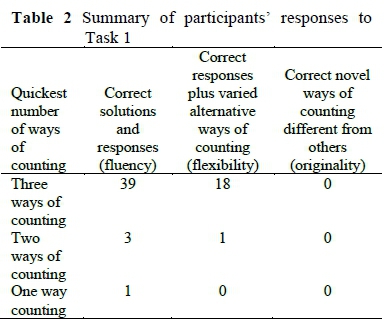
Table 3 is a summary of the frequency of participants' correct responses to tasks on the identification of patterns and the general rule that leads to generalisation based on fluency, flexibility, and originality of responses.
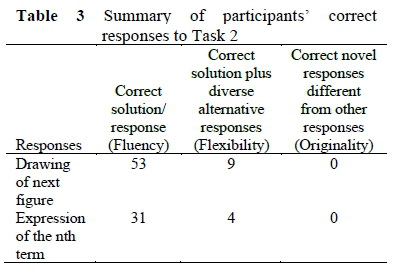
Table 2 reveals that 39 of the 62 participants provided correct solutions/responses in counting the objects, 18 participants showed correct answers plus a variety of three alternative ways of counting while none of the participants showed original ways of counting. Three participants were able to show only two correct ways of counting, while one participant was flexible in his response, and none used a novel way of counting. Finally, a participant showed only one correct way of counting based on fluency. This is an indication that most of the participants produced the correct solution/answers to the task while few of the participants used different solutions in counting the objects. It is important to note that most students preferred counting in patterns of 2s and 4s. This result reveals that participants were at the fluency and flexibility levels of creativity. These findings are in agreement with Vale et al. (2012) who revealed that fluency and flexibility were statistically significant. However, some of the participants were able to use previous knowledge of counting to enhance their visualisation skills through recognition and reorganisation in the growing pattern problem-solving task. This finding is similar to that of Vale et al. (2012) that pattern tasks promote creativity. However, the finding also supports Vale and Pimental' s (2011) assertion that earlier work on counting tasks in a symbolic setting can enhance creativity.
The same analytic approach to the first task was used for analysing participants' responses to Task 2. All the participants drew the correct pattern of the figure required in task 2; 53 participants were quick in drawing the required pattern, nine participants used a different approach to respond while no participants produced a novel response. However, for the correct expression of the nth term, 31 participants showed a quick response, four participants come up with correct different responses. This is an indication that none of the participants applied deconstructive reasoning (Rivera, 2009). The analysis of Table 3 indicates that half of the participants that were at the creativity level of fluency and flexibility on the drawing of patterns could not express the general rule of the pattern derived.
This finding supports the view of Ubah and Bansilal (2018:860) that "being able to produce the correct answers to questions based on school-level content is just one small part of a mathematics teacher' s task. Beyond that, a teacher should be able to link new content to big ideas in mathematics, to provide unambiguous explanations [of mathematical concepts]."
We suggest that teachers should be trained on how to improve on their originality of ideas that differ from those of other teachers. This observation is in line with Conway (1999) who believes that students should seek varied ideas and original responses to mathematical problems to enhance creativity. The learner who can apply diverse approaches to finding a solution to a task is the most successful problem solver (Conway, 1999). Based on these observations, we recommend that teacher education programmes need to offer content courses that offer pre-service teachers with prospects of becoming creative thinkers. Future teachers must be trained in a manner that they should implement non-routine mathematical activities that involve reasoning to enhance their learners' creative potential. They need to recognise tasks that promote fluency as well as flexibility and originality which involves a higher-level thinking process.
Results of the Semi-Structured Interviews The purpose of this was to allow the data from the semi-structured interviews to speak for themselves (Wellington, 2000). The excerpts from the interviews with four participants; Lucky, Shaba, Sam, and James (pseudonyms) are presented here. Excerpts 1 to 3 are from dialogues between the first author (A) and Lucky while excerpts 4 to 6 are from dialogues between the same author and Shaba.
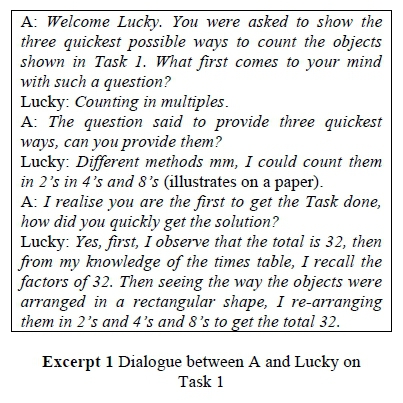
Lucky' s response to Task 1 reveals that he visualised the arrangement in different ways connecting previous knowledge about number relationships and their connections with basic geometric shapes. Lucky's ability to re-arrange the objects through numerical expressions that translate to his thinking and visualisation was his success. The interview continued, where Lucky was asked about his response to Task 2.
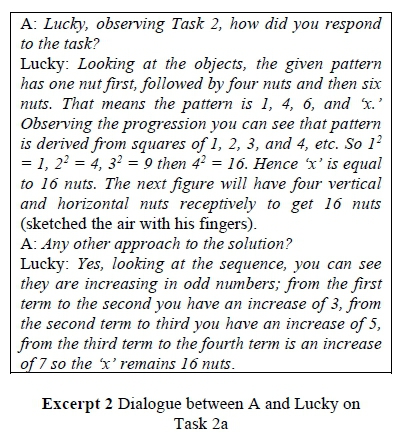
Excerpt 2 reveals that Lucky identified the pattern in a figurative sequence, described it, and produced an argument to support his claims using different representations. A questioned Lucky further about his creative ability to express the nth term rule.
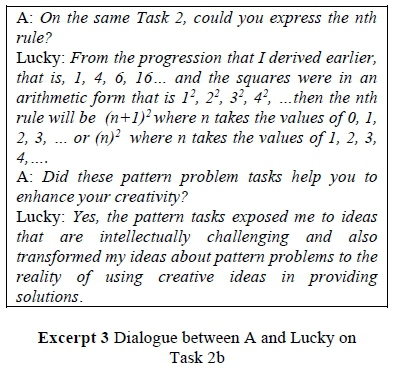
Lucky was able to write the numerical expressions translating the way of seeing, to make possible the generalisation to distinct terms.
When the participant (Shaba) who showed only one way of counting the objects was probed during the interview about his performance in the written task, he replied that he "was blank" and preferred using one method to teach such a task. This assertion was revealed in the interview extract below.
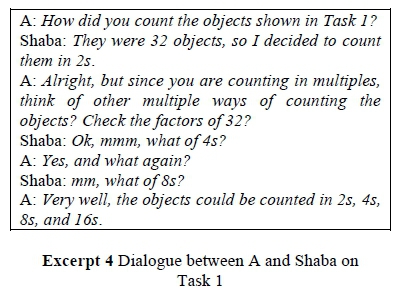
The author spent ample time leading Shaba to identify other ways of counting the objects apart from counting in 2s. With the author's guidance, Shaba was able to identify two more ways of counting the objects. Shaba's response to Task 1 revealed that he was unable to generate a great number of ideas. The author went further to probe his response to Task 2.
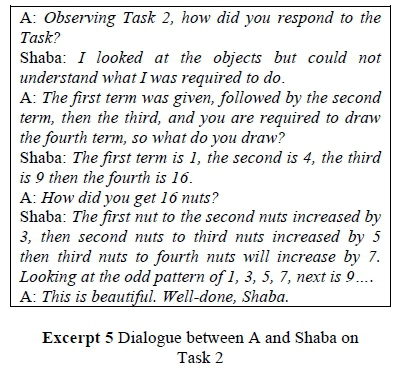
Shaba's interview extract in Excerpt 5 reveals that through the guidance of the first author, he identified a pattern in an odd sequence, described it, and produced an argument to support his solution to the task. The author probed further on his creative ability to express the nth term of the pattern.
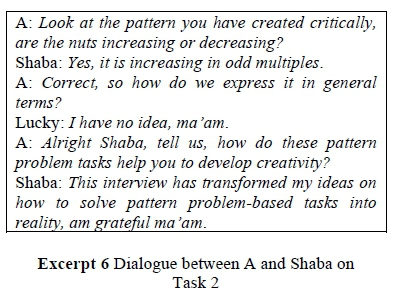
With guidance from A, Shaba identified the growing sequence of the pattern but could not express the general term of the sequence.
In the dialogue between A and another participant, Sam, the latter stated that he was able to count the objects in Task 1 and drew the next figure as requested in Task 2, but he was unable to state the correct expression of the nth term. With guidance from A, Sam made several fruitless attempts to get the correct expression of the nth term. Another interview with James was a replica of Shaba's, thus it can be said that the data had attained saturation point (O'Reilly & Parker, 2013). Hence, we were able to conclude from the interviews that most pre-service teachers could not express the general form of the patterns drawn. This submission concurs with Guest, Bunce and Johnson (2006) who note that data saturation can be achieved with a low sample contingent on the proposed sample. Generally, we identified that pattern tasks are intellectually challenging, allow different approaches in solving the tasks, and hence enhance creativity - an indication that pre-service primary mathematics teachers should be exposed to challenging pattern problem-solving tasks which can improve their level of creativity for their future teaching career.
Conclusion and Recommendation
This exploratory research concentrated on the written responses of 62 pre-service teachers to tasks based on the drawing and nth term of patterns. The results show that although 35 participants were able to draw patterns and express patterns in nth form, 27 failed to do so. Furthermore, the results show that out of the three known components of creativity, two of them, fluency and flexibility, were mostly identified in the drawing of patterns than in the expression of a general rule. The major limitation that we encountered was how to measure creativity.
However, we opted to follow the methods of other researchers (Conway, 1999; Silver, 1997) that did not assign a percentage score to each participant, but rather created a group analysis. This suggestion necessitated the need to measure the creativity of the participants through the three components mentioned above.
It was found that most of the participants could not correctly state the general rule of the identified patterns. The findings of this study raise a concern about the need for teacher education programmes to improve pre-service primary school teachers' knowledge of the mathematical concepts that the prospective teachers would teach after their pre-service programmes. This concern seems to be justified in light of the observation by Ubah and Bansilal (2018:861) that "most university programmes focus on developing knowledge of advanced mathematics, ... [having] the assumption that pre-service teachers have developed an understanding of the school mathematics content they need."
However, we could not justify this assumption in this research, hence there is an urgent need for the improvement of prospective teachers' creativity and mathematical knowledge for teaching primary mathematics. The major contribution of this research is that it provided empirical evidence that teachers should implement non-routine tasks that involve reasoning and seek out new and novel ideas to stimulate their learners' creativity. They should provide an enabling problem-solving environment that stimulates creativity and improves the mathematical competence of their learners. From this research we recommended that pre-service primary school teachers should be exposed to diverse academic activities for the development of their qualities and abilities that constitute creativity as part of their training programmes.
Authors' Contribution
The first author conceptualised the study, collected and analysed the data. Both authors wrote the manuscript and reviewed the final manuscript.
Notes
i . Published under a Creative Commons Attribution Licence.
References
Aguilar J & Telese JA 2018. Mathematics understanding of elementary pre-service teachers: The analysis of their procedural-fluency, conceptual-understanding, and problem-solving strategies. Mathematics Teaching Research Journal, 10(3):24-37. Available at https://scholarworks.utrgv.edu/tl_fac/27/. Accessed 15 November 2021. [ Links ]
Ankowski A & Ankowski A 2015. Using patterns to boost your child's math skills. Available at https://www.pbs.org/parents/expert-tips-advice/2015/09/patterns-boosts-childs-math-skills. Accessed 3 November 2021. [ Links ]
Ayllón M, Gómez IA & Ballesta-Claver J 2016.Pensamiento matemático y creatividad a través de la invención y resolución de problemas matemáticos [Mathematical thinking and creativity through mathematical problem posing and solving]. Propósitos y Representaciones, 4(1): 169-218. https://doi.org/10.20511/pyr2016.v4n1.89 [ Links ]
Childcare 2019. Basic math skills in child care: Creating patterns and arranging objects in order. Available at https://childcare.extension.org/basic-math-skills-in-child-care-creating-patterns-and-arranging-objects-in-order/. Accessed 2 November 2021. [ Links ]
Conway KD 1999. Assessing open-ended problems. Mathematics Teaching in the Middle School, 4(8):510-514. https://doi.org/10.5951/MTMSA8.0510 [ Links ]
Deacon R 2016. The initial teacher education research project: Final report. Johannesburg, South Africa: JET Education Services. Available at https://www.jet.org.za/resources/deacon-iterp-final-composite-report.pdf. Accessed 3 November 2021. [ Links ]
Dunlosky J, Rawson KA, Marsh EJ, Nathan MJ & Willingham DT 2013. Improving students' learning with effective learning techniques: Promising directions from cognitive and educational psychology. Psychological Science in the Public Interest, 14(1):4-58. https://doi.org/10.1177/1529100612453266 [ Links ]
Etikan I, Musa SA & Alkassim RS 2016. Comparison convenience sampling and purposive sampling. American Journal of Theoretical and Applied Statistics, 5(1 ):1-4. https://doi.org/10.11648/j.ajtas.20160501.11 [ Links ]
Gallant A 2013. Self-conscious emotion: How two teachers explore the emotional work of teaching In M Newberry, A Gallant & P Riley (eds). Emotion and school: Understanding how the hidden curriculum influences relationships, leadership, teaching, and learning (Vol. 18). Bingley, England: Emerald Group Publishing Limited. [ Links ]
Gouws E & Dicker AM 2011. Teaching mathematics that addresses learners' multiple intelligences. Africa Education Review, 8(3):568-587. https://doi.org/10.1080/18146627.2011.618721 [ Links ]
Guest G, Bunce A & Johnson L 2006. How many interviews are enough? An experiment with data saturation and variability. Field Methods, 18(1):59-82. https://doi.org/10.1177/1525822X05279903 [ Links ]
Guilford JP 1967. Creativity: Yesterday, today and tomorrow. Journal of Creative Behavior, 1(1):3-14. https://doi.org/10.1002/j.2162-6057.1967.tb00002.x [ Links ]
Guilford JP 1975. Creativity: A quarter century of progress. In IA Taylor & JW Getzels (eds). Perspectives in creativity. Chicago, IL: Aldine. [ Links ]
Hsieh HF & Shannon SE 2005. Three approaches to qualitative content analysis. Qualitative Health Research, 15(9):1277-1288. https://doi.org/10.1177/1049732305276687 [ Links ]
Jojo Z 2020. Mathematics education system in South Africa. In G Porto Jr. (ed). Education systems around the world. London, England: IntechOpen. https://doi.org/10.5772/intechopen.77636 [ Links ]
Kaufman JC & Sternberg RJ 2019. The Cambridge handbook of creativity (2nd ed). Cambridge, England: Cambridge University Press. [ Links ]
Kondracki NL, Wellman NS & Amundson DR 2002. Content analysis: Review of methods and their applications in nutrition education. Journal of Nutrition Education and Behavior, 34(4):224-230. https://doi.org/10.1016/S1499-4046(06)60097-3 [ Links ]
Korstjens I & Moser A 2018. Series: Practical guidance to qualitative research. Part 4: Trustworthiness and publishing. European Journal of General Practice, 24(1):120-124. https://doi.org/10.1080/13814788.2017.1375092 [ Links ]
Leikin R, Leikin M & Waisman I 2017. What is special about the brain activity of mathematically gifted adolescents? In R Leikin & B Sriraman (eds). Creativity and giftedness: Interdisciplinary perspectives from mathematics and beyond. Switzerland: Springer International Publishing. https://doi.org/10.1007/978-3-319-38840-3 [ Links ]
Liljedahl P, Santos-Trigo M, Malaspina U & Bruder R 2016. Problem-solving in mathematics education. Switzerland: Springer International Publishing. https://doi.org/10.1007/978-3-319-40730-2 [ Links ]
Mann EL 2006. Creativity: The essence of mathematics. Journal for the Education of the Gifted, 30(2):236-260. https://doi.org/10.4219/jeg-2006-264 [ Links ]
McCrory R, Floden R, Ferrini-Mundy J, Reckase MD & Senk SL 2012. Knowledge of algebra for teaching: A framework of knowledge and practices. Journal for Research in Mathematics Education, 43(5):584-615. https://doi.org/10.5951/jresematheduc.43.5.0584 [ Links ]
Mendez D 2016. How patterns help children learn about life. Available at https://www.wehavekids.com/parenting/How-Patterns-Help-Children-Learn-About-Life. Accessed 10 September 2019. [ Links ]
Mulligan J & Mitchelmore M 2009. Awareness of pattern and structure in early mathematical development. Mathematics Education Research Journal, 21(2):33-49. https://doi.org/10.1007/BF03217544 [ Links ]
National Council of Teachers of Mathematics 2000. Principles and standards for school mathematics. Reston, VA: Author. [ Links ]
National Council of Teachers of Mathematics 2015. Standards for mathematics teacher preparation. Available at http://www.nctm.org/Standards-and-Positions/CAEP-Standards/. Accessed 12 September 2019. [ Links ]
Obara S 2019. Pre-service teachers exploring the role of pattern-based reasoning in the context of algebraic thinking. EURASIA Journal of Mathematics, Science and Technology Education, 15(11):em1763. https://doi.org/10.29333/ejmste/109262 [ Links ]
O'Reilly M & Parker N 2013. "Unsatisfactory saturation": A critical exploration of the notion of saturated sample sizes in qualitative research. Qualitative Research, 13(2):190-197. https://doi.org/10.1177/1468794112446106 [ Links ]
Palmér H & Van Bommel J 2018. Problem solving in early mathematics teaching-a way to promote creativity? Creative Education, 9(12):1775-1793. https://doi.org/10.4236/ce.2018.912129 [ Links ]
Phonapichat P, Wongwanich S & Sujiva S 2014. An analysis of elementary school students' difficulties in mathematical problem solving. Procedia - Social and Behavioral Sciences, 116:3169-3174. https://doi.org/10.1016/j.sbspro.2014.01.728 [ Links ]
Rivera FD 2009. Visuoalphanumeric mechanisms that support pattern generalization. In I Vale & A Barbosa (eds). Patterns: Multiple perspectives and contexts in mathematics education. Viana do Castelo, Portugal: Escola Superior de Educacao do Instituto Politecnico de Viana do Castelo. [ Links ]
Safitri I, Wijayanti P & Masriyah 2018. The creativity of prospective teachers in mathematical patterns problem solving based on emotional intelligence. Journal of Physics: Conference Series, 1108:012116. https://doi.org/10.1088/1742-6596/1108/1/012116 [ Links ]
Sauro J 2015. SUPR-Q: A comprehensive measure of the quality of the website user experience. Journal of Usability Studies, 10(2):68-86. Available at https://uxpajournal.org/wp-content/uploads/sites/7/pdf/JUS_Sauro_Feb2015.pdf. Accessed 13 November 2021. [ Links ]
Schrauth MA 2014. Fostering mathematical creativity in the middle grades: Pedagogical and mathematical practices. PhD dissertation. San Marcos, TX: Texas State University. Available at https://digital.library.txstate.edu/bitstream/handle/10877/5260/SCHRAUTH-DISSERTATION-2014.pdf?sequence=1&isAllowed=y. Accessed 30 October 2021. [ Links ]
Silver EA 1997. Fostering creativity through instruction rich in mathematical problem solving and problem posing. ZDM, 29:75-80. https://doi.org/10.1007/s11858-997-0003-x [ Links ]
Siswono TYE 2008. Promoting creativity in learning mathematics using open-ended problems. Paper presented at the Third International Conference on Mathematics and Statistics (ICoMS-3), Bogor, Indonesia, 5-6 August. Available at https://www.researchgate.net/profile/Tatag-Siswono/publication/282946369_PROMOTING_CREAVITY_IN_LEARNING_MATHEMATICS_USING_OPEN-ENDED_PROBLEMS/links/5623bf6308aed8dd1948bfc5/PROMOTING-CREAVITY-IN-LEARNING-MATHEMATICS-USING-OPEN-ENDED-PROBLEMS.pdf. Accessed 4 November 2021. [ Links ]
South African Institute for Distance Education 2017. Unit 3: Teaching through problem-solving. Braamfontein, South Africa: Author. [ Links ]
Ubah IJA & Bansilal S 2018. Pre-service mathematics teachers' knowledge of mathematics for teaching: Quadratic functions. Problems of Education in the 21st Century, 76(6):847-863. https://doi.org/10.33225/pec/18.76.847 [ Links ]
Vale I & Barbosa A 2015. Mathematics creativity in elementary teacher training. Journal of the European Teacher Education Network, 10:101 -109. Available at https://drive.google.com/file/d/147QKSH6XllduTyY8hPVFvYSIJKf84BXT/view. Accessed 30 October 2021. [ Links ]
Vale I & Pimentel T 2011. Mathematical challenging tasks in elementary grades. In M Pytlak, T Rowland & E Swoboda (eds). Proceedings of the Seventh Congress of the European Society for Research in Mathematics Education. Rzeszow, Poland: ERME. Available at https://www.academia.edu/6334249/MATHEMATICAL_CHALLENGING_TASKS_IN_ELEMENT ARY_GRADES. Accessed 5 November 2021. [ Links ]
Vale I, Pimentel T, Cabrita I, Barbosa A & Fonseca L 2012. Pattern problem-solving tasks as a means to foster creativity in mathematics. In TY Tso (ed). Proceedings of the 36th Conference of the International Group for the Psychology of Mathematics Education (Vol. 4). Taipei, Taiwan: PME. Available at https://www.researchgate.net/publication/306078059_Pattern_problem_solving_tasks_as_a_mean_to_f oster_creativity_in_mathematics. Accessed 5 November 2021. [ Links ]
Wellington J 2000. Educational research: Contemporary issues and practical approaches. London, England: Continuum. [ Links ]
Wilkie KJ & Clarke DM 2016. Developing students' functional thinking in algebra through different visualisations of a growing pattern' s structure. Mathematics Education Research Journal, 28:223-243. https://doi.org/10.1007/s13394-015-0146-y [ Links ]
Worrell F, Brabeck M, Dwyer C, Geisinger K, Marx R, Noell G & Pianta R 2014. Assessing and evaluating teacher preparation programs. Washington, DC: American Psychological Association. Available at https://www.apa.org/ed/schools/teaching-learning/teacher-preparation-programs.pdf. Accessed 3 November 2021. [ Links ]
Yazgan-Sag G & Emre-Akdogan E 2016. Creativity from two perspectives: Prospective mathematics teachers and mathematician. Australian Journal of Teacher Education, 41(12):25-40. https://doi.org/10.14221/ajte.2016v41n12.3 [ Links ]
Yee FP 2005. Developing creativity in the Singapore primary mathematics classroom: Factors that support and inhibit. Thinking Classroom, 6(4):14-19. [ Links ]
Received: 5 September 2019
Revised: 19 August 2020
Accepted: 1 October 2020
Published: 30 November 2021