




Services on Demand
Journal

Article
 English (pdf)
 Article in xml format
 Article references

 Automatic translation
 Send this article by e-mail
Indicators
Related links
-
 Cited by Google
-
 Similars in Google
Share

 Permalink

South African Journal of Science
On-line version ISSN 1996-7489Print version ISSN 0038-2353
S. Afr. j. sci. vol.122 n.5-6 Pretoria May./Jun. 2026
https://doi.org/10.17159/sajs.2026/24503
PERSPECTIVE
Reviewing the use of pejorative ethnophobisms in the common and scientific names of South African fishes
Phumza M. NdaleniI; Alex C. WinklerII, III; Qurban RouhaniIII; Matthew W. FarthingIII; Mandla L. MagoroII, III; Natanah GushaII, III; Melissa PollardII; Lubabalo MofuII, III; Dinah MukhariII, III; Warren M. PottsII, III
IFoundational Research and Services, South African National Biodiversity Institute, Pretoria, South Africa
IISouth African Institute for Aquatic Biodiversity, Makhanda, South Africa
IIIDepartment of Ichthyology and Fisheries Science, Rhodes University, Makhanda, South Africa
ABSTRACT
SIGNIFICANCE:
The naming of species is central to biological research, communication and conservation practice. However, some scientific and common names reflect historical and cultural biases rooted in colonial and apartheid-era contexts. By evaluating fish species and common names, we highlight that certain terms, such as 'Hottentot' and 'caffer', are no longer appropriate in a democratic society committed to dignity, equality and respect. This review ensures that scientific language evolves in a way that respects and reflects the diversity of the global community.
Keywords: inclusive scientific language, offensive, political history, species renaming, taxonomic revision
Introduction
The practice of naming living things is fundamental to our understanding of the natural world. It allows scientists and the public to communicate unambiguously about organisms and their relationships, promotes consistency in research, and facilitates our understanding of biodiversity, conservation and sustainable use. Organisms are named through scientific and common naming systems. Binomial nomenclature, formalised by Carl Linnaeus in the mid-18th century1, provides a universal naming standard. The International Code of Zoological Nomenclature (ICZN 1999) governs this system.2 Researchers naming new species may reference biological traits or geographic origin, or honour individuals, although there is room for creativity, including jokes or puns.1 For instance, in the name Electrolux addisoni (Compagno & Heemstra, 2007), the genus (Electrolux) references the ray's feeding mechanism and the species (addisoni) honours the collector Mark Addison.3 As scientific and common names are human constructs influenced by historical and social factors, some may become inappropriate or offensive to later generations.4
Historical influences on existing ethnophobic names
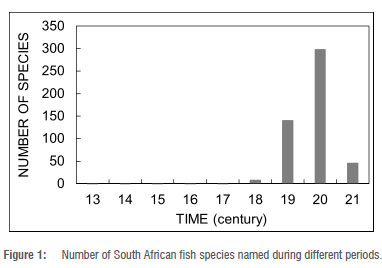
South Africa's complex political history - from its precolonial era through colonisation, apartheid and democracy - illustrates how cultural and historical contexts shape naming practices. European colonisation displaced Indigenous peoples and apartheid (1948-1994) entrenched racial segregation. The 1996 Constitution sought to redress these injustices. Section 16 protects freedoms of expression, including the press, artistic creativity, academic work and scientific research, such as naming species. However, these freedoms have limits; incitement to violence, war propaganda and advocacy of hatred based on race, ethnicity, gender or religion are unlawful. Hate speech is intentional communication that incites harm or promotes hatred.5 Consequently, the use of terms such as kaffir or caffer are in tension with the unethical principles of a democratic South Africa as seen in the reasoning of legal judgments where such terms have been used, e.g. the case of Ryan vs Petrus (2009). However, some scientific names, such as Rattus caffra, were coined before global awareness of their offensiveness. Considering fish taxonomy, the first South African fish species was named during the colonial era in 1772 (Smooth horsefish Congiopodus torvus, Gronow, 1772). Since then, 8 species were named in the 18th century, 140 species in the 19th century, 298 in the 20th century and 46 in the 21st century (see Figure 1).6-8 Because some of these species were named by naturalists with European and American ancestry, with most of the naming taking place during the colonisation and apartheid period, it stands to reason that there may be a number of these names that may be offensive or culturally insensitive to social groups that were living in South Africa at the time and now. In essence, language that was once considered neutral or descriptive can become deeply offensive as our understanding of its historical impact and contemporary harm evolves. While the original naming may not have intended to be offensive, continued use in South African publications and the education system is unethical (if deemed "harmful communication" and impairs human dignity, e.g. case of S v Puluza). Responses from the general public indicate that the use of words such as 'Hottentot' or 'caffer' undermines human dignity. The term 'caffer' has therefore acquired such painful associations with apartheid-era dehumanisation that its continued use in scientific names can cause emotional harm today. This therefore creates a genuine tension in taxonomy between nomenclatural stability and social responsibility. The scientific community increasingly recognises that maintaining offensive names can exclude people from science and perpetuate historical injustices.4
Universal trends towards renaming species
It is argued that scientific name changes should be avoided, as they disrupt nomenclatural stability and scientific communication.9 However, continued use of words that promote advocacy of racial, national or religious hatred that leads to discrimination is unethical, as it undermines human dignity, and should be eliminated.10,11 This convention also mandates that all public authorities and institutions uphold these obligations.
Revision of species names
While there has been a process to review the common names of South African birds, which included the renaming of several species4, as well as botanical scientific names12, no such endeavour has been undertaken on South Africa's fishes. Importantly, no endeavour to adjust zoological scientific nomenclature has been proposed by southern African zoologists, despite efforts by botanists.12 To this end, the zoological community is criticised for its lack of progress in addressing insensitive names.12 Considering South Africa's history, the era in which most fish were named, and the clear directives provided by our progressive constitution, it is necessary to review the common and scientific names of fishes.
In this context of name changing, although the ICZN Code does not explicitly address offensive names, Article 23.3.5 states: "A name that may cause offense cannot be rejected on that basis alone."2 However, there is growing recognition that names causing social harm may warrant consideration.2 The Commission has also begun acknowledging that nomenclature follows "an internationally agreed, quasi-legal procedure", but must also consider broader impacts. In other words, a name like 'caffer' cannot be removed just because it is now seen as a slur - the name is valid as long as it was correctly published and is not a junior synonym, homonym or otherwise invalid. However, although the process is deliberately conservative because changing names disrupts scientific literature and databases, cases involving genuinely offensive epithets (like those containing racial slurs) would likely be considered under the Commission's plenary power if properly submitted and justified. Here we aim to review the common and scientific names of South African fishes to identify any names that may be offensive.
Methods
The authorship team consists of a diverse group of scientists, postdoctoral fellows and postgraduate students from the National Research Foundation-South African Institute for Aquatic Biodiversity (NRF-SAIAB), South African National Biodiversity Institute (SANBI) and the Department of Ichthyology and Fisheries Science (DIFS) at Rhodes University (Makhanda, South Africa). This research involved a review of South African scientific and common marine and freshwater fish names, with the objective of identifying names that have become offensive.
Reference materials used in compiling the list of fish names (genus, species and common names) were Diversity, Distribution, and Extinction Risk of Native Freshwater Fishes of South Africa7, A Complete Guide to the Freshwater Fishes of Southern Africa6 and Coastal Fishes of the Western Indian Ocean (Volumes 1-5).8 The compiled list was reviewed independently by each team member. Members were asked to flag potentially offensive or culturally insensitive common or species names. Each species identified as potentially offensive was evaluated within a South African context by the authorship group.
Within the South African context, one of the measures of what is classified as offensive is what falls within hate speech and crimen injuria. This includes any communication that is harmful, incites harm, or promotes hatred based on race, gender, sex, ethnicity, religion, disability and sexual orientation.5 This prohibits the use of hate speech.5 In addition, crimen injuria is a common law crime in South Africa that refers to the unlawful, intentional and serious violation of the dignity or privacy of another person.13 This includes (i) racial slurs or insults, (ii) sexual harassment, invasive threats, (iii) public shaming or humiliation and (iv) any deliberate act meant to degrade a person's human worth. The use of such words directly undermines the constitutional right to human dignity, which affirms that everyone has the right to have their dignity respected and protected.14 However, to convict someone of crimen injuria, the court must prove that (i) the act is not justified or excused by law (e.g. self-defence or public interest), (ii) the accused meant to impair dignity or acted knowing the consequences and (iii) there is actual harm to the victim's sense of self-worth, integrity or humanity. In this study, the criterion for determining offensive names was founded on point (iii), namely that there is actual harm to the victim's sense of self-worth, integrity or humanity. This included considerations of race, culture and ethnicity, as well as fish named after individuals associated with the slave trade. The final list of 'offensive' names was compiled by consensus.
Results and discussion
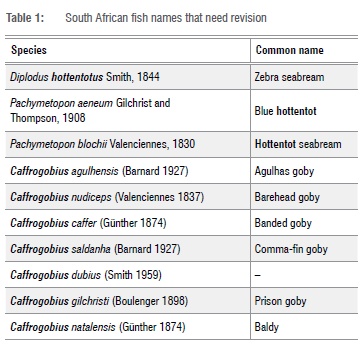
In total, the group reviewed 489 common names and 492 genus and species names for South African fishes. Of these names, five were flagged by one or more individuals as possibly constituting an 'offensive' name. In terms of common names, the hottentot seabream (Pachymetopon blochii Valenciennes, 1830) and blue hottentot (Pachymetopon aeneum Gilchrist and Thompson, 1908) were identified to be deserving of revision (Table 1). In terms of scientific names, the names of all species belonging to the genus Caffrogobius and those with the species-group names caffer (Caffrogobius caffer Günther, 1874) and hottentotus (Diplodus hottentotus Smith, 1844) were deemed to be 'offensive'. (Table 1)
From an ethnological perspective, the term 'Hottentot' was derived from 'Hautitou' and was historically used by Europeans to refer to the first nations people they encountered on arriving in South Africa - the Khoikhoi people of the Cape of Good Hope.15 Koopman was more specific and suggested that the word 'Hottentot' was derived from the Dutch who used the term "Hottentotten" as an onomatopoeia to mock the "strange-sounding" language of the Khoikhoi, which was said to resemble that of farm animals.16 Over time, the term 'Hottentot' became a European term that was used to describe a person with lower intelligence.16 More recently, a derivative of this term - "Hotnot" - has been declared by the courts as constituting "hate speech"17 and therefore it is clear that the word 'Hottentot' has no place in modern vernacular, let alone in the common or scientific names of fishes.
The word 'caffra' is derived from the Arabic 'kaffir', meaning infidel18, while in Islam, a Kāfir refers to someone who "covers" or "rejects" the truth of Islam - i.e. a disbeliever or infidel19. The term was adopted by Arab traders on the East African coast (Swahili coast) to describe non-Muslim Bantu-speaking peoples in inland Africa.19 From there, Portuguese and later Dutch colonists adopted the term - spelling it 'cafre', 'caffer' and eventually 'kaffir' in English and Afrikaans.19 The shift into a racial slur came about during European colonialism in southern Africa, especially under Dutch and British rule; the word evolved into a derogatory racial term used to refer to black Africans.19 In modern South Africa, the term 'kaffir' is considered hate speech and a criminal offence under crimen injuria and anti-discrimination laws, and remains a symbol of colonial racism to black South Africans.4
These names were assigned before South Africa became a democratic nation, and the rationale behind these names is unclear as it is not provided in the original species description. Nevertheless, because the use of the word 'caffer' is prohibited in South Africa and several studies have proposed eliminating words derived from "caf[e]r" and "caff[e]r" in fungi, plants, birds and algae4,18, it is suggested that all names that include this term be changed. Similarly, botanists recently changed the names of all botanical scientific names referring to "caffra" to "afra", in a similar endeavour to ours.12 In Thiele and Smith's (2025) publication, citing unanimous support to dissolve the use of "caffra" in botanical circles, they criticise the zoological community for not following suit, with reference to the currently valid name of the Cape buffalo (Syncerus caffer).12 Herein we also suggest that all names for all fish species that include this term be considered for change.
Proposing to change these names is a step towards making scientific practice more inclusive and respectful of all cultures. Science does not exist in a vacuum, but rather it exists within human society, and human society evolves. Likewise, as human society evolves, its outlook to science, including how scientific names are formulated, will also evolve. By removing offensive names, we can ensure that scientific language evolves in a way that respects and reflects the diversity of the global community. It is crucial to establish guidelines and codes that support the rejection of culturally inappropriate terms in favour of more suitable alternatives. Through these efforts, we can promote a more inclusive and respectful scientific environment.
While changes to the scientific names of fish will have to go through a formal process through the ICZN, amendments of the common names of organisms is less formal. As the common names of fish often vary between geographical regions, such a change may be complex. For certain taxa such as birds, there are formal bodies that review common names and synonymise them in order to standardise the names in identification guides.
In fisheries, there are few formal bodies that review fish common names globally or in South Africa.6 One of the most appropriate ways to change the common name of a fish is to publicise the proposed change in the media and taxonomic guides and to inform retailers of the suggested changes. For example, the common name of P. blochii (Hottentot seabream), a commercially exploited species, has already been changed through voluntary adoption by retailers and seafood distributors to the Cape bream to encourage consumer interest.20 Regarding common names, it is recommended that the names of both the hottentot seabream (P. blochii) and blue hottentot (P. aeneum) be changed in identification guides, retailer branding and recreational fishing guide books to the Cape seabream and blue seabream (based on its blue head and flanks), respectively.
In conclusion, the revision of fish common and scientific names that carry offensive connotations is an important step toward fostering respect, inclusivity and cultural sensitivity in scientific practice. Names such as hottentot seabream, blue hottentot, Diplodus hottentotus, the genus Caffrogobius and Caffrogobius caffer no longer align with present-day values. By proposing a call to re-evaluate these common and scientific names, we aim to contribute to a more equitable and respectful scientific community. These changes not only acknowledge the cultural and historical context of the regions in which these species occur but also align with broader global efforts to help build a more inclusive scientific community. In some instances, this has occurred naturally due to public perceptions, such as the case of the name change to Cape bream. However, in many instances, these names persist, particularly when it comes to scientific names that need a formal procedure and scientific review.
Acknowledgements
We acknowledge Mr Ian R. Bills for his valuable contributions to the development of the methodology, offensive name flagging, and the writing of the paper. However, during the final stages of writing, he indicated that due to his tight schedule, he would not be able to continue and encouraged us to proceed with the submission without his involvement.
Declarations
We have no competing interests to declare. We have no AI or LLM use to declare. All authors read and approved the final manuscript.
References
1. Heard SB, Mlynarek JJ. Naming the menagerie: Creativity, culture and consequences in the formation of scientific names. Proc Biol Sci. 2023;290(2010), Art. #20231970. https://doi.org/10.1098/rspb.2023.1970 [ Links ]
2. Ride WDL, Cogger HG, Dupuis C, Kraus O, Minelli A, Thompson FC, et al. International Commission on Zoological Nomenclature [document on the Internet]. c1999 [cited 2025 Jul 08]. Available from: http://www.bio-nica.info/biblioteca/ICZNCode.pdf [ Links ]
3. Compagno LJ, Heemstra PC. Electrolux addisoni, a new genus and species of electric ray from the east coast of South Africa (Rajiformes: Torpedinoidei: Narkidae), with a review of torpedinoid taxonomy. Smithiana Bull. 2007;7:15-49. http://hdl.handle.net/1807/41309 [ Links ]
4. Driver RJ, Bond AL. Towards redressing inaccurate, offensive and inappropriate common bird names. Ibis. 2021;163:1492-1499. https://doi.org/10.1111/ibi.12984 [ Links ]
5. Promotion of Equality and Prevention of Unfair Discrimination, Act 4 of 2000, Republic of South Africa. [ Links ]
6. Skelton PH. A complete guide to the freshwater fishes of southern Africa. Cape Town: Struik Publishers; 2024. [ Links ]
7. Chakona A, Jordaan MS, Raimondo DC, Bills IR, Skelton PH, van der Colff D. Diversity, distribution and extinction risk of native freshwater fishes of South Africa. J Fish Biol. 2022;100(4):1044-1061. https://doi.org/10.1111/jfb.15011 [ Links ]
8. Heemstra PC, Heemstra E, Ebert DA, Holleman W, Rendall JE. Coastal fishes of the western Indian Ocean. Makhanda: South African Institute for Aquatic Biodiversity; 2022. [ Links ]
9. Ceríaco LM, Aescht E, Ahyong ST, Ballerio A, Bouchard P, Bourgoin T, et al. Renaming taxa on ethical grounds threatens nomenclatural stability and scientific communication: Communication from the International Commission on Zoological Nomenclature. Zool J Linn Soc. 2023;197(2):283-286. https://doi.org/10.1093/zoolinnean/zlac107 [ Links ]
10. United Nations. International covenant on civil and political rights [document on the Internet]. c1967 [cited 2025 Jul 08]. Available from: https://treaties.un.org/doc/treaties/1976/03/19760323%2006-17%20am/ch_iv_04.pdf [ Links ]
11. United Nations General Assembly. 2106 (XX) International Convention on the Elimination of all Forms of Racial Discrimination [webpage on the Internet]. c1965 [cited 2025 Jul 08]. Available from: https://docs.un.org/en/a/res/2106(XX) [ Links ]
12. Thiele KR, Smith GF. Slow progress in mending the laws of botanical nomenclature. Nat Ecol Evol. 2025;9(2):183-184. https://doi.org/10.1038/s41559-024-02569-4 [ Links ]
13. Burchell J. Protecting dignity under common law and the constitution: The significance of crimen injuria in South African criminal law. S Afr J Crim Justice. 2014;27(3):250-271. https://hdl.handle.net/10520/EJC167889 [ Links ]
14. Constitution of South Africa, Act 108 of 1996, Republic of South Africa. [ Links ]
15. Jeffreys MD. The origin of the name Hottentot. Afr Aff. 1947;46(184):163-165. https://doi.org/10.1093/oxfordjournals.afraf.a093573 [ Links ]
16. Koopman A. The use of the ethnonym 'Hottentot' in the bird names 'Hottentot Teal' and 'Hottentot Buttonquail'. Ostrich. 2021;92(2):151-155. https://doi.org/10.2989/00306525.2021.1880194 [ Links ]
17. Bronstein V. What you can and can't say in South Africa [document on the Internet]. c2006 [cited 2025 Jul 08]. Available from: https://www.researchgate.net/profile/Victoria-Bronstein/publication/272676482_WHAT_YOU_CAN_AND_CAN'T_SAY_IN_SOUTH_AFRICA_Freedom_of_Expression/links/54eb12170cf27a6de11646ef/WHAT-YOU-CAN-AND-CANT-SAY-IN-SOUTH-AFRICA-Freedom-of-Expression.pdf [ Links ]
18. Smith GF, Figueiredo E. (126) Proposal to add a new Article 61.6 to permanently and retroactively eliminate epithets with the root caf [e] r-or caff [e] r-from the nomenclature of algae, fungi and plants. Taxon. 2021;70(6):1395-1396. https://doi.org/10.1002/tax.12622 [ Links ]
19. Arndt JS. What's in a word? Historicising the term 'Caffre' in European discourses about southern Africa between 1500 and 1800. J South Afr Stud. 2018;44(1):59-75. https://doi.org/10.1080/03057070.2018.1403212 [ Links ]
20. World Wildlife Fund. Cape bream [webpage on the Internet]. c2013 [cited 2025 Jul 18]. Available from: https://wwfsassi.co.za/sassi-list/fish/?id=50 [ Links ]
 Correspondence:
Phumza Ndaleni
Email: ndalenimp@gmail.com
Published: 28 May 2026
