




Services on Demand
Journal

Article
 English (pdf)
 Article in xml format
 Article references
 Automatic translation
 Send this article by e-mail
Indicators
Related links
-
 Cited by Google
 -
 Similars in Google
Share

 Permalink
South African Journal of Science
On-line version ISSN 1996-7489Print version ISSN 0038-2353
S. Afr. j. sci. vol.122 n.1-2 Pretoria Jan./Feb. 2026
https://doi.org/10.17159/sajs.2026/23979
BOOK REVIEW
Putting a "problem representation" lens on mental health policy. What do we learn?
Melvyn Freeman
Department of Psychology, Stellenbosch University, Stellenbosch, South Africa Email: Melvynfreeman57@gmail.com
Book Title: Mental Health Policy In South Africa. Exploring Problem Representation
Authors: Claire Morrison, Pieter Fourie and Urbanesia Adams
ISBN: 9781032992914 (hardback, 110 pp, GBP42) 9781003603351 (eBook, 110 pp, GBP18)
Publisher: Routledge, Oxon, UK
Published: 2025
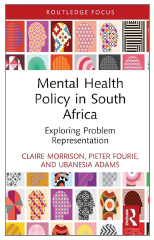
I approached this book review with some hesitation as I anticipated that my perspective might be overly defensive or even conflicted. Although policy is ultimately made by politicians and legislation by parliamentarians, I was employed at South Africa's National Department of Health and was responsible for coordinating and drafting many of the policy documents and the legislation under analysis in this book. But I was persuaded that the reason I was being asked to do this review was precisely the reason I thought I should decline. This then is as much my subjective response to a book that analyses policies I was responsible for drafting, as an objective review of it.
This book utilises an analytical approach developed by Carol Bacchi, a political scientist from Australia, in which, irrespective of the subject matter, the key question that is asked is 'What is the problem represented to be (WPR)?' The idea is that if one fully interrogates how the 'problem' is represented in policy, as well as the underlying assumptions of how these representations came about, it becomes feasible to not only better understand why the policy is what it is, but also to change it in accordance with the findings of this novel approach. In this case the analytical focus is on how mental health in South Africa is conceptualised and constructed in public policy.
This is an intriguing method for examining policy and legislation, and I read the book with great interest and with the hope of both gaining new insights into the policies already written and that potential new ones would be improved as a result of this approach. [This was despite the prospect of being 'exposed' and potential anomalies being revealed. Were we as the drafters unduly biased in any particular direction - consciously or unconsciously? Were we prejudiced? Did we simply get things 'incorrect' due to ignorance or ideology?] Unfortunately, and I concede that this may be my defensiveness, the problem areas that were identified by the authors as being the dominant representations were indeed the problems that we as drafters and policymakers felt needed attention and focus and hence the added insights were limited. There were also few surprises with respect to the assumptions that were identified as being behind the policy and legislation. For example, we were certainly aware as drafters of pitfalls such as falling into the medical model, but we also knew that these were policies of the Department of Health and that we were already stretching certain limits by, for instance, making the social determinants a central theme. Moreover, without having a diagnosis, the Department of Health would battle with practicalities such as ordering medication or calculating prevalence and hence writing the medical model out of policy would not have been possible or desirable. In addition, there was little by way of clear suggestions or proposals arising from the analysis of what a more progressive or enlightened mental health policy focus should be for South Africa. As such I found the book a little disappointing.
One important issue that was identified was the lack of, or poor, implementation of the policies. This issue is well known by most people in the public mental health and policy space in South Africa. But it reflects not just a problem of the disjuncture between policy and implementation in mental health, but in health more generally and indeed across government departments. Although the analysis does propose that there should be more accountability bult in and more assistance provided to provinces, and these are good suggestions, the problem of implementation is a deeper one that needs broad governmental and structural intervention.
The analysis identified five dominant problem representations in the policies: (1) the separation of mental health from general health services; (2) lack of intersectoral collaboration in mental healthcare services; (3) a disconnect between communities and mental healthcare services; (4) the link between poverty and mental health problems; and (5) the infringements of human rights of people with mental health problems. While I would probably have added a few other themes to this list, I felt somewhat vindicated as what had been prioritised as problems through this analysis are indeed problem areas that need concerted attention in policy and legislation.
The WPR method looks for both the explicit and implicit representations. This is done with respect to each "problem representation". I am unsure whether this is a problem with the method itself or its application in this book, but by siloing each problem representation, the book sometimes loses sight of the holistic nature of the policies. For example, the critique of integration into general health care suggests that this focus assumes accessibility alone will solve the challenges of mental health care, overlooking service quality, training, social conditions and stigma. Yet these dimensions are addressed elsewhere in the policy framework. Similarly, when poverty is critiqued as being overemphasised, the conclusion arises only if that theme is examined in isolation. This tendency risks misrepresenting the intent and scope of the original policies.
Other shortcomings reduce the book's authority and I wondered whether the authors should have perhaps included an additional author who is more steeped in the mental health policy and legislative environment. For example, discussion of the law is particularly limited. A large section in Chapter 2 addresses criminal law (forensic psychiatry) while giving inadequate attention to the Mental Health Care Act of 2002 - a central piece of legislation that is in fact one of the documents chosen by the authors for specific analysis. When the Act is discussed, important protections - such as safeguards against unwarranted admission and treatment - are underexplored. Later the role of Mental Health Review Boards is inaccurately described. The book quotes the Act as saying that the Boards must "advocate for service users' needs and protect their rights", yet the Act specifies far narrower functions. This inaccuracy appears to stem from a misreading of later policy frameworks.
Chapters 2 and 3 provide useful overviews of how mental health is conceptualised and politically managed in South Africa, but they rely heavily on older references. Of 82 references in Chapter 2 and 52 in Chapter 3, only 3 in each were published after 2020. Mental health research is a rapidly evolving field, and engagement with more recent scholarship would have enhanced the book's relevance and possibly altered some critiques.
Despite these limitations, the book has significant value. Its main contribution lies in showing how analytical frameworks from outside the health sector - such as political science and governance - can yield new insights into policy. By examining both explicit and implicit assumptions, the WPR method highlights dimensions that may be overlooked by policymakers in mental health themselves. Interdisciplinary engagement of this sort should be encouraged.
The book is concise and accessible, although the small font in the hard copy makes it less reader-friendly. I would recommend that people involved in mental health policy, researchers and others in mental health both in South Africa and globally read it. Policy drafters should also seriously consider utilising the WPR methods when developing and reviewing policy and legislation, and include people from different disciplines in this process.
Published: 29 January 2026
