Services on Demand
Journal

Article
 English (pdf)
 Article in xml format
 Article references
 Automatic translation
 Send this article by e-mail
Indicators
Related links
-
 Cited by Google
 -
 Similars in Google
Share

 Permalink
South African Journal of Science
On-line version ISSN 1996-7489Print version ISSN 0038-2353
S. Afr. j. sci. vol.121 n.11-12 Pretoria Nov./Dec. 2025
https://doi.org/10.17159/sajs.2025/20627
RESEARCH ARTICLE
The distribution and status of rooibos (Aspalathus linearis) and its ecotypes in the wild
Tineke KraaijI; Vernon VisserII, III; Gerhard C.P. PretoriusIV
INatural Resource Science and Management Cluster, Faculty of Science, Nelson Mandela University, George, South Africa
IICentre for Statistics in Ecology, Environment and Conservation, Department of Statistical Sciences, University of Cape Town, Cape Town, South Africa
IIINational Institute for Theoretical and Computational Sciences, University of Cape Town, Cape Town, South Africa
IVNaturaLibra Environmental Services cc, Malmesbury, South Africa
ABSTRACT
Aspalathus linearis ('rooibos') is a polymorphic perennial shrub native to the Fynbos Biome (South Africa), which is commercially cultivated and harvested from the wild to produce rooibos tea, a herbal health drink. Ongoing utilisation of the species necessitates knowledge of the status of the species in the wild to facilitate sustainable management of the resource. We assessed the current occurrence, potential distribution, estimated population size and threats to persistence of wild rooibos and its ecotypes. We confirmed previous accounts of the distribution range of wild rooibos, although it was absent from historically recorded locations south of Malmesbury in the Western Cape Province of South Africa. The predicted distribution range of the species is almost 600 000 ha, with relatively little overlap in the predicted ranges of the respective ecotypes (120 000-250 000 ha each). Based on the predicted distribution ranges in conjunction with field-observed population densities, the total population of wild rooibos is estimated, based on crude extrapolation, to be at least 15 million plants and each ecotype at least 3 million. More than a quarter of the species' predicted range (20-40% of each ecotype's range) occurs in proclaimed protected areas. Our evaluation of threats suggests that wild rooibos is not significantly threatened by harvesting, invasive alien plants, overgrazing or inappropriate fire regimes. Potential genetic contamination with cultivated varieties, and further large-scale agricultural transformation are unlikely, while climate change arguably constitutes the largest threat. These findings are promising for securing this wild resource in the future, and valuable for informing conservation status and sustainability assessments, resource management and monitoring.
SIGNIFICANCE:
• The study presents a national assessment of the status of a biotrade resource, rooibos (Aspalathus linearis), in the wild.
• The species' estimated population is at least 15 million plants and its predicted distribution 600 000 ha, of which >25% occurs in proclaimed protected areas.
• Climate change arguably constitutes the largest threat to wild rooibos, more than harvesting, inappropriate fire regimes, genetic contamination and further habitat transformation.
• These findings are promising for securing this wild resource in the future and valuable for informing conservation status (e.g. lUCN Red List) and sustainability (e.g. CITES Non-Detriment Finding) assessments and monitoring.
Keywords: biotrade resource, conservation status, population size, species distribution modelling, wild rooibos ecotypes
Introduction
Aspalathus linearis (Burm.f.) Dahlg., or 'rooibos', is a highly polymorphic perennial shrub endemic to drier areas of the truly winter-rainfall, northwestern part of the Fynbos Biome1,2 within the hyperdiverse Cape Floristic Region3 of South Africa. Rooibos is commercially cultivated on a large scale to produce rooibos tea, a traditional herbal health drink, marketed internationally.4 Rooibos tea is a well-established and organised industry with a relatively stable production mass annually. Currently, only a very small portion of the produce (0.001% of approximately 20 000 metric tons annually) comes from wild harvested populations (Gerhard Pretorius, unpublished data), but prior to the 20th century, rooibos tea was exclusively collected in the wild.5 With the ongoing utilisation of wild populations of the species, knowledge of its distribution, abundance, ecology, and potential threats to its persistence is vital for the sustainable management of this resource. Such foundational knowledge is also required to inform conservation status assessments (e.g. using the International Union for Conservation of Nature [lUCN] Red List criteria)6 and potential trade regulation (e.g. following the Non-Detriment Finding process used by CITES [Convention on International Trade in Endangered Species of Wild Fauna and Flora)7.
Accordingly, a resource status assessment8, commissioned by the South African government, was recently undertaken for rooibos in the wild, with the aim of informing potential trade regulation, and assessment and future monitoring of the conservation status of the species. Aspects of this resource assessment related to the species' population ecology and effects of harvesting are presented by Kraaij and Pretorius9, while the current paper addresses aspects focused on the distribution and abundance of, and threats to, the species and its respective ecotypes.
A substantial component of the literature on rooibos pertains to its cultivation, such as establishing optimal growth conditions for cultivated plants10,11, and its utilisation, such as characterising phenolic and phytopharmaceutical properties12-14. Studies of wild rooibos have considered the species' taxonomy, morphology1,2,5,15, genetic variation16-18 (a brief account occurs in the study species description), and distribution, but information on the latter is outdated or patchy, and often contained in studies focused on other aspects of the species' biology or ecology1,2,5,15-18. Malgas et al.5 mapped the potential distribution of wild rooibos based on bioclimatic suitability for the species but have not rated the importance of the bioclimatic parameters influencing the species' occurrence. They recommended consideration of soil factors in attempts at modelling the potential distribution of the species, in addition to investigation of bioclimatic correlates of the ecotypes separately. Lötter and Le Maitre19 also performed bioclimatic modelling to estimate the realised niche of wild rooibos and the range suitable for cultivation under the contemporary climate and future climate change. They found seasonal precipitation and low minimum winter temperatures to be important factors affecting the species' distribution, and predicted substantial range contraction for wild and cultivated rooibos under future climate change scenarios. Importantly, the current distributions of the species and ecotypes have not been field-verified comprehensively, and no other study has modelled the distributions of the ecotypes separately. Aiming to fill these gaps, we assessed, for wild rooibos and its ecotypes: (1) their current occurrence, (2) their potential distribution, (3) their population size, and (4) threats to their persistence. With this information, and by drawing on a related study9, we provide a coherent assessment of the species' status in the wild and set a baseline against which future monitoring can be conducted.
Study species
Rooibos occurs in the winter rainfall area of South Africa from Vanrhynsdorp in the north to the Cape Peninsula and the Betty's Bay area in the south, while unconfirmed records exist as far east as Riviersonderend and Bredasdorp.1,15 Rooibos' range is characterised by cold wet winters and hot dry summers with 300-900 mm of rain per annum with no known occurrence records in the bimodal or summer rainfall regions of South Africa.1,15 The species occurs at elevations of 450-900 metres above sea level and is adapted to deep, well-drained, oligotrophic and acidic sands.12,20 The ecology and harvesting of rooibos are detailed in a related study by Kraaij and Pretorius9. Rooibos is an extremely variable species complex displaying distinct ecotypes or geographical forms.1,2,16 Additionally, some other closely related species, like A. pendula Dahlg. and A. lebeckioides Dahlg., may be difficult to distinguish from wild rooibos.12 These taxonomic and identification issues complicate attempts to verify historical location records and to map the distribution of A. linearis. Moreover, differentiation among the ecotypes of wild rooibos, with the view to delineate and compare their distributions, is equally challenging, with several categorisations in existence that show overlap and differences.5,12,15,17
The ecotypes differ in habit, fire-survival strategy, vegetative and reproductive morphology, biochemistry, and genetics.12,16,17 Local land users identified four main growth forms, namely an 'Erect' or 'Upright' form, a 'Prostrate form', a 'Bush' or 'Shrub' form, and a 'Tree' form, although Malgas et al.5 included the Tree form with the Erect form (Supplementary figure 1). Both the Bush and Prostrate forms are wider than they are tall and possess more stems closer to the ground than the Erect form.5 Hawkins et al.15 later additionally identified the 'Salignus' type, a tall (2-3 m), lanky, willow-like form with a sparse canopy (Supplementary figure 1). Prostrate and Shrub forms resprout after fire, while the Erect, Tree, and Salignus forms regenerate from seed only. The cultivated 'Nortier' form of the species originates from the upright and densely branched Erect form12, resembling in habit the Bush and Erect types15. The Erect and cultivated forms possess the highest harvestable biomass.5
Distribution and habitat preferences are evident between the ecotypes: the Bush, Prostrate and Tree types occur towards the northern part of the species' range, and the Prostrate, Erect and Salignus types toward the south.15 Prostrate and Erect ecotypes occur at higher elevations (>400-600 masl), the Bush type at lower rainfall sites (<200 mm p.a.) and the Salignus type at higher rainfall sites (>500 mm p.a.) at lower elevation. Ecotypes co-occur at the regional scale, e.g. Erect and Prostrate, or Bush and Prostrate occur in the same region, whereas co-occurrence at the local scale (e.g. Prostrate and Erect occurring interspersed) is possible but uncommon.15 For the purposes of this resource assessment, we differentiated four ecotypes: (1) Bush (including Bush and Shrub forms), (2) Prostrate, (3) Erect (including Erect, Upright and Tree forms), and (4) Salignus (after Kraaij and Pretorius9) (exemplary images in Supplementary figure 1).
Methods
Current occurrence
All obtainable geo-referenced data on historically recorded wild rooibos were collated in a geographic information system (GIS) shapefile. These data were sourced from GBIF (https://www.gbif.org') and CapeNature databases, published research5,12,15,16,19, and author (G.C.P.P.) and expert knowledge of wild populations. Historically recorded locations were revisited in the field (during September 2023 to February 2024) as far as possible to establish the species' presence or absence at these locations. En route to these locations and to sites where population surveys were undertaken (details below), additional observations on the species' presence or absence were made along the roadside. Georeferenced pictures were taken of rooibos plants present at these locations and the specific ecotype determined from the pictures. All verified and new occurrence locations of wild rooibos and its respective ecotypes were collated in a GIS database.
Species distribution modelling
We used maximum entropy (MaxEnt) modelling in R21 using the package dismo to predict the distribution of wild rooibos (detailed methods are in the supplementary material). The field-verified location records (n = 146) of the species and ecotypes were used as input data for the species distribution models (Supplementary figure 2). After removal of duplicate occurrences within individual pixels of ~1 km resolution of the environmental predictor rasters, 100 occurrences were used for modelling potential distributions. These 100 occurrences included 12 records for the Bush type, 42 for Prostrate, 33 for Erect and 13 for Salignus. Predictor variables used were precipitation of warmest quarter; precipitation of coldest quarter; maximum temperature of warmest month; minimum temperature of coldest month; topographical slope; soil electrical conductivity; soil K, Na, P, C, N and pH; and percentage sand. Models were evaluated using the area under the receiver operating characteristic curve (AUC). We used the cloglog output of MaxEnt to predict the distribution of rooibos, both as an entire species and for individual ecotypes. This output serves as an indicator of relative environmental suitability.22 To capture model uncertainty, we generated weighted mean suitability maps for the species and ecotypes based on an ensemble of 100 model runs with varied model choices and parameter settings.23 For easier interpretation, we converted these weighted mean suitability maps into binary presence/absence maps by applying a threshold value equivalent to the maximum sum of sensitivity and specificity. To assess environmental factors that potentially affect the distribution of rooibos and its ecotypes, we produced response curves illustrating the relationship between each environmental predictor and the predicted relative suitability.
Population size and extent of protection
To obtain an estimate of the range of densities at which rooibos and its ecotypes occur in the wild, population surveys were undertaken during September 2023 to February 2024 across a large part of the geographical range of rooibos (Supplementary figure 3) and across various land holder types, harvesting regimes and post-fire vegetation ages (see Kraaij and Pretorius9 for more detail). In total, 45 populations were surveyed: 15 populations of the Bush ecotype, 11 Prostrate, 14 Erect, and 5 of the Salignus ecotype. At each survey site, belt transects of 2 m in width and of variable length were positioned a minimum of 5 m apart across a population of wild rooibos, until approximately 50 individual plants were recorded, taken as representative of that population. The total length of the transects surveyed was recorded to enable calculation of the density of plants in each surveyed population. At each of these sites, threats pertaining to these populations were noted with consideration of harvesting, fire frequency (the latter two metrics were assessed quantitatively by Kraaij and Pretorius9), invasive alien plants, overgrazing, land transformation, or other obvious threats.
Crude estimates of the total population sizes of A. linearis and its ecotypes were subsequently calculated by multiplying the range of plant densities at which the species occurred (obtained from population surveys) by the sizes of the predicted distribution ranges obtained from our species distribution modelling. The areas predicted to be occupied by the species and the ecotypes were based on the binary presence/absence predictions from the distribution modelling. The mean, minimum and maximum density of plants for the species and for each ecotype were then multiplied by the area of the predicted distribution range to provide three estimates of the population size for the species and ecotypes (i.e. population size estimates based on mean, minimum and maximum density). These estimates were interpreted using knowledge of the spatial distribution of populations in the landscape.9 To determine the proportion of the species' and ecotypes' ranges that occurs inside proclaimed protected areas, we overlaid the predicted distribution ranges of the species and ecotypes with a spatial layer of proclaimed protected areas (https://portal.environment.gov.za/PortalDownloads/PACA_Gazettes/PA) in GIS.
Threats
Information on potential threats to wild rooibos was obtained from (1) the literature, (2) discussions with land managers and harvesters, and (3) observations and data collected during our population surveys. Furthermore, we used GIS to assess the occurrence of fields of cultivated rooibos within the predicted distribution range of wild rooibos and calculate the distances from cultivated rooibos to our field-verified locations of wild rooibos and to the population survey sites.
Results and discussion
Current occurrence
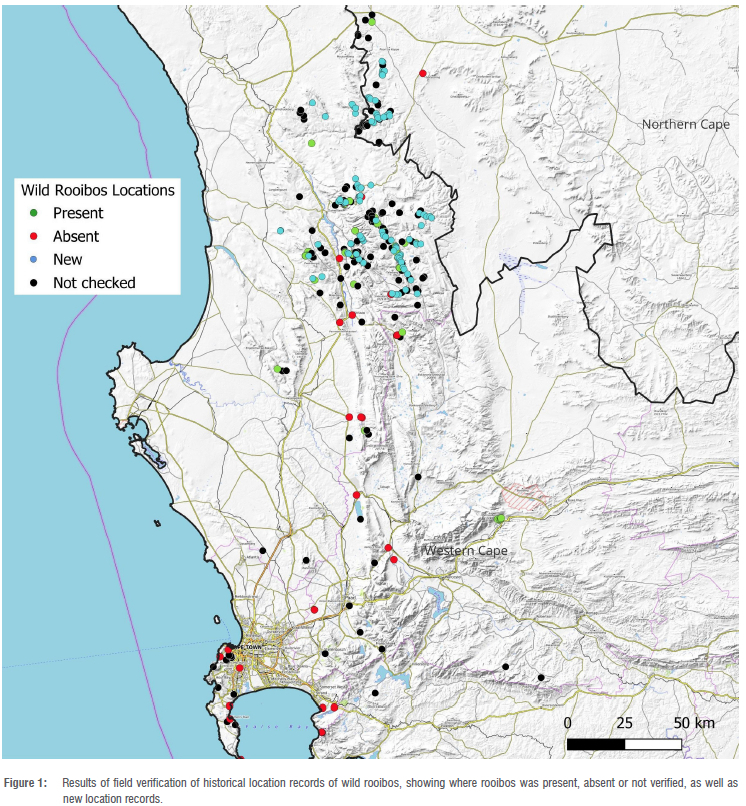
A total of 235 historical location records were assimilated and informed field verification of the species' current occurrence. The species was absent at 30 and present at 47 of these locations, and was recorded at 99 new locations (Figure 1). The easternmost confirmed population was at De Doorns, while rooibos was not found at an outlier north of Nieuwoudtville and one east of Vanrhynsdorp, and some locations around Citrusdal. Notably, wild rooibos was not found at any of the historical locations that were field-verified south of Malmesbury, at Franschoek, on the Cape Peninsula, or the Gordon's Bay and Betty's Bay areas.12 Some of these historical location records may have been inaccurate spatially, or comprised misidentifications, where comprehensive verification of data associated with herbarium specimens would be required to resolve this. In some cases where rooibos was absent from historically recorded locations, the habitat at these locations was clearly unsuitable for rooibos, that is, the habitats had very steep slopes, clay soils, or wetlands, and lacked the plant assemblages commonly associated with wild rooibos populations. However, the species (and mostly the Prostrate type) does occur in some of these outlying areas to the south, as gleaned from iNaturalist records (http://www.inaturalist.org/) verified by trusted sources. Nevertheless, it seems clear from our field verification that the species mainly occurs in the area between Nieuwoudtville in the north, Groot Winterhoek in the south, Wupperthal and the Tra-Tra mountains in the east, and just southeast of Graafwater in the west.
Predicted distributions
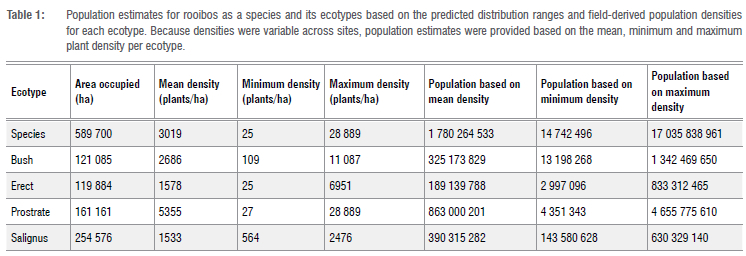
MaxEnt models for rooibos and its ecotypes all exhibited high accuracy (AUG values of 0.95-0.98) which lends confidence to the predicted distributions. For the species as a whole, the predicted distribution stretches from Nieuwoudtville in the north to just southeast of Geres, with the bulk of its distribution around Glanwilliam and Gitrusdal (Figure 2; Supplementary figure 4). This largely matches descriptive accounts of the species' distribution1, although our predicted distribution extends beyond Vanrhynsdorp to Nieuwoudtville, but not southward beyond Geres to the Gape Peninsula and Betty's Bay. The latter is owing to our input data not including confirmed occurrences of the species in the south (Figure 1; Supplementary figure 2). Gompared with the suitability map predicted by Lötter and Le Maitre19 under contemporary climate, our predicted distribution range has a similar boundary, but with a larger area of suitability predicted within. The area predicted by the species distribution model to be occupied by wild A. linearis is almost 600 000 ha in extent, while the areas predicted to be occupied by the respective ecotypes ranged between approximately 120 000 ha and 250 000 ha (Table 1). The Salignus ecotype had the largest predicted area occupied, followed by the Prostrate type, Bush type and, lastly, the Erect type.
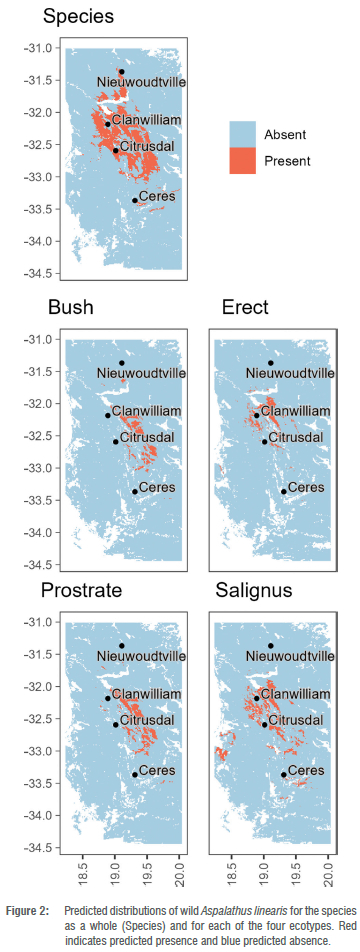
The ecotypes exhibited distinct but somewhat overlapping predicted distributions (Figure 2). Only at the core of the entire species distribution was there substantial overlap of the ecotypes (Supplementary figure 5). Note that the predicted distribution for the entire species does not equal the sum of the predicted distributions of the respective ecotypes (minus duplication due to overlaps). This is because the predicted distribution for each entity (species or ecotype) is based on its own model determining suitability for that entity, and, compared to the entire species, the ecotypes seem to have higher suitability at the extremes of their ranges (Supplementary figures 4 and 5) and higher thresholds for defining presence or absence. The Bush and Prostrate (both resprouter) ecotypes had fairly similar predicted distributions, largely to the east and south of Glanwilliam and Gitrusdal (Figure 2). The Erect and Salignus (both reseeder) ecotypes also had similar distributions but differed from the other two ecotypes in that their distributions extended to the west and north of Glanwilliam and Gitrusdal. The Salignus ecotype was the only ecotype predicted to have a distribution extending further south to around Geres and west beyond Piketberg, with predicted occurrences in these areas larger in extent than a few insubstantial dots. These predictions of ecotype distributions only partially match the descriptions of ecotype distribution by Hawkins et al.15 gleaned from field observations. These authors stated that the Bush and Tree types occur towards the northern part of the species' range, the Erect and Salignus types towards the south, and the Prostrate type across the range from north to south. Our predictions show more of a distinction in distribution of the resprouter forms (Bush and Prostrate) versus reseeder forms (Erect and Salignus) between northeast and southwest, with the Salignus type's distribution being the most encompassing.
Environmental correlates of distribution
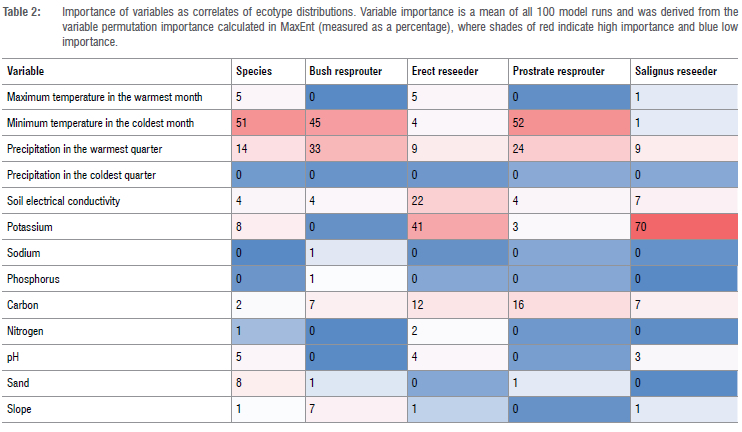
Ecotypes exhibited unique patterns in terms of the importance of variables as correlates of distribution, with little overlap of variable importance ranking (Table 2). The minimum temperature of the coldest month came out as the most important correlate of distributions for rooibos and for the Bush and Prostrate resprouter ecotypes (importance values from 45% to 52%), and rooibos and the Bush and Prostrate ecotypes exhibited highest suitability at or below freezing temperatures (Supplementary figure 6A-G). Precipitation in the warmest quarter was the second most important variable for the species and the same two ecotypes (14% to 33%), and the species and these ecotypes exhibited highest suitability for low precipitation in summer (Supplementary figure 6A-G). Potassium was the most important correlate for the Erect and Salignus reseeder ecotypes (41% and 70%, respectively), with suitability being highest at very low values of potassium (Supplementary figure 6D,E). Soil electrical conductivity was also important for the Erect type, with high suitability at very low conductivity (Supplementary figure 6D). Garbon was moderately important for the Erect and Prostrate types, with high suitability at low levels of carbon (Supplementary figure 6G,D). When comparing our results with those of Lötter and Le Maitre19, both studies found low minimum winter temperatures and low summer precipitation as important variables, but they found winter precipitation to be the most important variable and slopes of 3-10° to be moderately important, whereas precipitation in the coldest quarter and slope showed zero or near zero importance in our study. It is possible that low winter temperatures may promote rooibos germination as cold stratification of seeds or fluctuating diurnal temperatures facilitate germination in some hard-coated fynbos species.24,25 It is furthermore likely that higher temperatures in winter (and generally), particularly along with high moisture availability (~higher summer precipitation), would facilitate pathogenic oomycetes such as Pythium spp. (predominantly P. irregulare) and Phytophthora cinnamomi that are known to cause mortality of rooibos in nurseries and natural settings.26 Wild rooibos' preference for soils with low levels of potassium and carbon and low electrical conductivity generally aligns with the soil nutrient conditions that have been established as optimal for cultivated rooibos.11,27
Population size
Note that, because the population size estimates are based on the predicted distributions derived from distinct models, the population size estimate for the species as a whole does not equal the sum of those of the respective ecotypes (Table 1). The total population size estimated for A. linearis, based on the area of the predicted distribution range in conjunction with population densities recorded during our field surveys, ranges between approximately 15 million and 17 billion plants (Table 1). The population sizes estimated for the respective ecotypes range between approximately 3 million and 5 billion plants. The Prostrate ecotype was estimated to be most numerous, followed by the Bush type or the Salignus type, depending on the field density measurement considered (mean, minimum or maximum). The Erect ecotype thus had the smallest predicted range and the smallest estimated population size.
These estimates, however, need to be interpreted with circumspection, as the characteristics of the species' distribution and abundance in the landscape significantly challenged attempts at estimating total population size. Some ecotypes, such as the Salignus type, was discernible amongst other vegetation due to its upright and tall growth form, making visual assessment of the distribution and abundance of plants reasonably achievable. With the Prostrate type, this was much more difficult. Throughout its range, wild rooibos exhibits a highly irregular, clumped distribution of populations scattered across the landscape, with populations typically occupying only a small part of seemingly suitable, homogeneous swathes of habitat (Gerhard Pretorius, personal observation). Moreover, there was very large variation in the size of populations (a few to tens of thousands of plants) and the density of individuals within populations (25 to almost 30 000 plants per hectare).9 Extrapolating such a vast range in densities across large areas is a crude exercise which may lead to substantial compilation of error. Furthermore, the population density surveys were typically done in areas where plants were dense enough for the population to be recognised from a moving vehicle, and sufficiently dense to enable recording of 50 individuals with reasonable survey effort. These constraints meant that surveys were focused on the higher end of the population density spectrum, which would have led to overestimation of population densities and, subsequently, of population sizes. In addition, population densities vary in space as well as in time, such as with fire frequency and post-fire vegetation age.9 The derived population size estimates thus apply to a particular point in time, and it should be assumed that the total population size of rooibos will vary in time in relation to the extent of different post-fire vegetation ages in its distribution range.
Considering the abovementioned complexities and extensive extrapolation inherent to the estimation of the population sizes of A. linearis and its ecotypes, realistically, population sizes are likely closer to the bottom end of the estimated ranges. Owing to the inherent characteristics of the species' occurrence, more rigorous population size estimates would require systematic surveys of the species presence/absence in grid cells to determine variation in the density of populations across the landscape, in addition to widely replicated assessments of plant density within grid cells (within populations).
Extent of protection
More than a quarter (27%) of the predicted distribution range of A. linearis occurs within proclaimed protected areas on state or private land (Supplementary table 1). When considering the ecotypes separately, 28% of the Bush type's predicted range occurs within proclaimed protected areas, 38% of the Prostrate type's range, 20% of the Erect type's range, and 33% of the Salignus type's range. A third to more than a half (entire species 37%, Bush type 45%, Prostrate type 36%, Erect type 57%, Salignus type 39%) of these areas are represented by protected areas on state land. The species as a whole, and all the ecotypes, are thus well conserved.
Threats
At 40% of the population survey sites, no obvious threats to the study species were noted. Overharvesting or illegal harvesting was deemed a threat at 13% of the sites, but, generally, overharvesting and illegal harvesting were not found to be major threats to the wild resource.9 Land transformation was considered a threat at 28% of sites, but the terrain in many of these areas was unsuitable for rooibos cultivation, while legal regulations applicable to vegetation clearing may also deter further large-scale transformation. Overgrazing was deemed a threat at 4% of sites, but no direct evidence was found that overgrazing has led to severe degradation of habitat where wild rooibos occurs, or that it has caused mortality of wild rooibos plants. Invasive alien plants were considered a threat at 15% of the sites, virtually exclusively due to the presence of Cuscuta campestris ('Dodder'), a parasitic climber. Although Acacia saligna and Acacia cyclops both commonly invade cultivated rooibos fields, the latter occurred at a single site, while no other woody invasive species were noted, suggesting that invasive alien plants do not pose a substantial threat to wild rooibos populations. Changing fire regimes and, in particular, too frequent and too severe fires, threaten the persistence of biodiversity in the Fynbos Biome generally28, but Kraaij and Pretorius9 argue that inappropriate or changing fire regimes are unlikely to threaten wild rooibos, on account of long fire return periods recorded in its range and the species' ecological resilience to fire.
Climate change is predicted to severely affect the truly winter-rainfall, northwestern part of the Fynbos Biome29,30, which coincides with the distribution range of wild rooibos. Given that minimum winter temperatures proved to be the most important environmental correlate of A. linearis' present distribution (Table 2), climate warming may be expected to have severe impacts on rooibos. During the population surveys, at least two wild rooibos populations appeared to have been negatively affected (widespread mortality) by unusually high rainfall during the preceding summer, which is consistent with the result that the species exhibits preference for low precipitation in summer (Table 2). It is known that rooibos, also in cultivation, requires well-drained soil and is susceptible to mortality if subjected to water-logged soils. If climate change results in more frequent episodes of extreme rainfall, as is expected, this phenomenon may threaten the well-being of the species. Lötter and Le Maitre19 modelled a potential range shift of wild A. linearis (without consideration of the respective ecotypes) under a scenario of climate change. They accordingly predicted a southeastward and upslope shift for the species, and, more encouragingly, showed that most of the areas where range expansion was indicated occur in existing conservation areas or include conservation-worthy vegetation. We did not repeat this type of assessment as these findings seem sufficiently current and informative to guide conservation efforts aimed at buffering potential effects of climate change on the species. However, distinctive modelling of potential climate change effects on each of the ecotypes would be instructive.
Hybridisation seems unlikely in wild rooibos as morphological differences between ecotypes are evidently maintained even where such types occur in close proximity.12 Isolation by distance, and geographical barriers such as mountains and deep river valleys, may play a role in gene flow in rooibos, limiting both pollination between sub-populations and seed dispersal by ants.18 Wild rooibos displays low to moderate genetic diversity, with populations becoming less diverse south of the Suid Bokkeveld toward the Cederberg, possibly indicative of clinal variation.18 Reseeding and resprouting populations evidently differ genetically.16,17 The distinctness of ecotypes suggests that seed dispersal is slow and that sub-populations are worthy of conservation.5,15,18
We found that the predicted distribution range of wild rooibos encompasses 4181 fields of cultivated rooibos (out of a total of >9000 fields in South Africa), although all these fields do not necessarily always have standing crops. Of the 146 verified current locations of wild rooibos in our study (Figure 1), 55 occur within 1 km of cultivated rooibos, while 17 of the 45 population survey sites9 occur within 1 km of cultivated rooibos (Supplementary figure 3). These are very crude approximations, but they suggest that, if hybridisation is genetically feasible, fewer than half of the populations of wild rooibos may be at some risk of hybridisation by virtue of occurring relatively close to cultivated plants. Conversely, wild populations also occur at sites remote from cultivation, as cultivation in the vicinity is impractical. At none of the population survey sites were cultivated plants observed interspersed with wild plants. It appears that cultivated plants do not persist very well, or reseed naturally, on old fields after cultivation has ceased. In the absence of a satisfactory infraspecific classification of the species12, it is not known to what extent the ecotypes can or do hybridise, but it may be fair to assume that hybridisation between resprouter and reseeder types is less likely than within resprouter or reseeder types. Accordingly, some specimens were observed during the current study that seemed intermediate between the Erect and Salignus types, as well as specimens intermediate between the Shrub and Prostrate types. Given that cultivated rooibos originates exclusively from the Erect ecotype12, the risk of genetic contamination is likely to be the highest for reseeder types and the Erect ecotype in particular. Overall, these pieces of ad hoc evidence imply that genetic contamination with cultivated forms is unlikely to pose a substantial threat to wild rooibos. On the other hand, considering that wild Cederberg reseeding populations are genetically distinct from the wild Northern Cape resprouting populations, appropriate management of wild resources and the establishment of a genetic conservation strategy for wild ecotypes are a priority.18
Conclusions
This assessment shows that, at a national scale, the distribution range of wild A. linearis is restricted and fragmented (totalling approximately 600 000 ha), but that the species is common within this range, with a crude estimate of the total population to be a minimum of 15 million plants. A large part (27%) of the species' predicted distribution range, and of the respective ecotypes' predicted ranges, occurs within proclaimed protected areas, suggesting that more than a quarter of the range (and total population, assuming even distribution throughout the range) of the species, and 20-40% of the ranges of the ecotypes, are managed for conservation, often on state land. Among the ecotypes, the Salignus and Prostrate types seem most secure, with the largest predicted distribution ranges and the largest portions of their ranges (33% and 38%, respectively) within proclaimed protected areas. The Erect type is least conserved (albeit still in a good state), with 20% of its range within proclaimed protected areas. Our evaluation of threats suggests that the long-term persistence of A. linearis in the wild is not significantly threatened by overharvesting or illegal harvesting, invasive alien plants, overgrazing, or inappropriate fire regimes. Potential genetic contamination of wild rooibos with cultivated varieties is also unlikely to pose a threat to all but perhaps the Erect ecotype, unless the cultivation footprint expands considerably. The extent to which land clearing for rooibos cultivation and potato farming is ongoing within the wild rooibos range has not been directly investigated here, but informal observations suggest that there are relatively few places where habitat transformation is likely to threaten wild rooibos populations at a considerable scale. Climate change probably constitutes the largest threat to wild A. linearis, with substantial range contractions predicted for the species, and limited options available for mitigation. Overall, our findings on the state of wild rooibos are promising for securing this biotrade resource in future, and of value for informing sustainable management, conservation status evaluations and sustainability assessments (including potential trade regulation)31, and in providing a baseline (in terms of assessment methods and actual data) for monitoring programmes to track the condition of the resource in the future32. With the current state of technology, it is unlikely that aerial imagery together with machine learning could replace and upscale field monitoring of the species, given the challenges involved in discerning the sparse and varied growth forms of the wild ecotypes among other fynbos (~fine-leaved) shrubs.
Acknowledgements
Neil Crouch offered constructive comments which facilitated improvement of earlier drafts of this manuscript.
Funding
Funding was received from the United Nations Development Programme for the GEF 6 Project 5686 titled 'Development of Value Chains for Products Derived from Genetic Resources in Compliance with the Nagoya Protocol on Access and Benefit Sharing and the National Biodiversity Economy Strategy', to deliver on Output 3.2 thereof managed by the South African Department of Forestry, Fisheries and the Environment (DFFE) and the South African National Biodiversity Institute (SANBI). We also thank the Nelson Mandela University for funding provided.
Data availability
Data that support the findings of this study are subject to third-party restrictions. The data are available from the corresponding author subject to permission from the South African National Biodiversity Institute (sanbi.org). Privacy and ethical restrictions may apply to these data, which were sourced subject to confidentiality arrangements with landowners on whose properties rooibos grows.
Declarations
We declare that we do not have any financial or personal relationships with other people or organisations that could have inappropriately influenced our work. We have no AI or LLM use to declare. The research was commissioned by the South African state authority of the Department of Forestry, Fisheries and the Environment (DFFE) as well as the South African National Biodiversity Institute (SANBI). Their formal letter of support was used to secure permission from landowners and reserve managers to conduct surveys on their land.
Authors' contributions
T.K.: Conceptualisation, methodology, formal analysis, validation, writing -original draft, writing - review and editing. V.V.: Methodology, formal analysis, validation, writing - original draft, writing - review and editing. G.C.P.P.: Conceptualisation, methodology, investigation, formal analysis, validation, writing - original draft, project administration, funding acquisition. All authors read and approved the final manuscript.
References
1. Dahlgren R. Revision of the genus Aspalathus. II. The species with ericoid and pinoid leaflets 7: Subgenus Nortieria. With remarks on rooibos tea cultivation. Bot Not. 1968;121:165-208. [ Links ]
2. Dahlgren R. Crotalarieae (Aspalathus). Flora of southern Africa. 1988;16(36): 84-90. [ Links ]
3. Takhtajan A. Floristic regions of the world. Berkeley, CA: University of California Press; 1986. [ Links ]
4. Morton JF. Rooibos tea, Aspalathus linearis, a caffeineless, low-tannin beverage. Econ Bot. 1983;37:164-173. https://doi.org/10.1007/bf02858780 [ Links ]
5. Malgas RR, Potts AJ, Oettle NM, Koelle B, Todd SW, Verboom GA, et al. Distribution, quantitative morphological variation and preliminary molecular analysis of different growth forms of wild rooibos (Aspalathus linearis) in the northern Cederberg and on the Bokkeveld Plateau. S Afr J Bot. 2010;76:72-81. https://doi.org/10.1016/j.sajb.2009.07.004 [ Links ]
6. Smith DR, Allan NL, McGowan CP Szymanski JA, Oetker SR, Bell HM. Development of a species status assessment process for decisions under the US endangered species act. J Fish Wildl Manag. 2018;9(1):302-320. https://doi.org/10.3996/052017-jfwm-041 [ Links ]
7. Leaman DJ, Oldfield TEE. CITES non-detriment findings: Guidance for perennial plants; a nine-step process to support CITES Scientific Authorities making science-based non detriment findings (NDFs) for species listed in CITES Appendix II. Versuib 1.0. BfN-Skripten 358. Bonn: Federal Agency for Nature Conservation; 2014 [cited 2024 Oct 14]. Available from: http://www.bfn.de/0502_skripten.html [ Links ]
8. DFFE/SANBI. Resource assessment for Aspalathus linearis (rooibos) in the wild. Prepared by the Department of Forestry, Fisheries and the Environment (DFFE) and the South African Biodiversity Institute (SANBI) for UNDP/GEF6 Project 5686. Unpublished report; 2024. [ Links ]
9. Kraaij T, Pretorius GCP. Population ecology and harvesting of rooibos (Aspalathus linearis) and its ecotypes in the wild, South Africa. Plant-Environ Interact. 2025;6, e70079. https://doi.org/10.1002/pei3.70079 [ Links ]
10. van Schalkwyk R, Hoffman JE, Hardie AG, van Zyl JL. Soil water dynamics and biomass production of young rooibos (Aspalathus linearis) plants. Sci Rep. 2023;13(1), Art. #15154. https://doi.org/10.1038/s41598-023-41666-5 [ Links ]
11. Smith JFN, Hardie AG. Determination of optimal soil pH and nutrient concentrations for cultivated rooibos tea using the boundary line approach. S Afr J Plant Soil. 2023;40(4-5):208-215. https://doi.org/10.1080/02571862.2023.2259860 [ Links ]
12. van Heerden FR, van Wyk BE, Viljoen AM, Steenkamp PA. Phenolic variation in wild population of Aspalathus linearis (rooibos tea). Biochem Syst Ecol. 2003;31(8):885-895. https://doi.org/10.1016/s0305-1978(03)00084-x [ Links ]
13. Stander MA, van Wyk BE, Taylor MJC, Long HS. Analysis of phenolic compounds in rooibos tea (Aspalathus linearis) with a comparison of flavonoid-based compounds in natural populations of plants from different regions. J Agric Food Chem. 2017;65(47):10270-10281. https://doi.org/10.1021/acs.jafc.7b03942 [ Links ]
14. Wilkinson C, Brooks J, Stander MA, Malgas R, Roodt-Wilding R, Makunga NP. Metabolomic profiling of wild rooibos (Aspalathus linearis) ecotypes and their antioxidant-derived phytopharmaceutical potential. Metabolomics. 2024;20(3), Art. #45. https://doi.org/10.1007/s11306-024-02103-4 [ Links ]
15. Hawkins HJ, Malgas R, Biénabe E. Ecotypes of wild rooibos (Aspalathus linearis (Burm. F) Dahlg., Fabaceae) are ecologically distinct. S Afr J Bot. 2011;77(2):360-370. https://doi.org/10.1016/j.sajb.2010.09.014 [ Links ]
16. Van der Bank M, Van Wyk BE, Van Der Bank H. Biochemical genetic variation in four wild populations of Aspalathus linearis (rooibos tea). Biochem Syst Ecol. 1995;23(3):257-262. https://doi.org/10.1016/0305-1978(95)00016-n [ Links ]
17. van der Bank M, van der Bank H, van Wyk BE. Evolution of sprouting versus seeding in Aspalathus linearis. Plant Syst Evol. 1999;219:27-38. https://doi.org/10.1007/bf01090297 [ Links ]
18. Brooks J, Makunga NP Hull KL, Brink-Hull M, Malgas R, Roodt-Wilding R. Resprouters versus reseeders: Are wild rooibos ecotypes genetically distinct? Front Genet. 2021;12, Art. #761988. https://doi.org/10.3389/fgene.2021.761988 [ Links ]
19. Lötter D, Le Maitre D. Modelling the distribution of Aspalathus linearis (Rooibos tea): Implications of climate change for livelihoods dependent on both cultivation and harvesting from the wild. Ecol Evol. 2014;4(8):1209-1221. https://doi.org/10.1002/ece3.985 [ Links ]
20. Muofhe ML, Dakora FD. Modification of rhizosphere pH by the symbiotic legume Aspalathus linearis growing in sandy acidic soil. Aust J Plant Physiol. 2000;27(12):1169-1173. https://doi.org/10.1071/pp99198 [ Links ]
21. R Core Team. R: A language and environment for statistical computing. Vienna: R Foundation for Statistical Computing; 2024. Available from: https://www.R-project.org/ [ Links ]
22. Merow C, Smith MJ, Silander JA. A practical guide to MaxEnt for modeling species' distributions: What it does, and why inputs and settings matter. Ecography. 2013;36(10):1058-1069. https://doi.org/10.1111/j.1600-0587.2013.07872.x [ Links ]
23. Araújo MB, Anderson RP, Márcia Barbosa A, Beale CM, Dormann CF, Early R, et al. Standards for distribution models in biodiversity assessments. Sci Adv. 2019;5(1), eaat4858. https://doi.org/10.1126/sciadv.aat4858 [ Links ]
24. Brits GJ. Germination depth vs. temperature requirements in naturally dispersed seeds of Leucospermum cordifolium and L. cuneiforme (Proteaceae). S Afr J Bot. 1987;53(2):119-124. https://doi.org/10.1016/S0254-6299(16)31445-4 [ Links ]
25. Keeley JE, Bond WJ. Convergent seed germination in South African fynbos and California chaparral. Plant Ecol. 1997;133:153-167. https://doi.org/10.1023/A:1009748603202 [ Links ]
26. Bahramisharif A, Lamprecht SC, Spies CFJ, Botha WJ, Calitz FJ, McLeod A. Pythium spp. associated with rooibos seedlings, and their pathogenicity toward rooibos, lupin, and oat. Plant Dis. 2014;98(2):223-232. https://doi.org/10.1094/PDIS-05-13-0467-RE [ Links ]
27. Joubert M, Kotze W, du Preez D. Voedingsbehoefte van Rooibostee [Nutritional requirements of Rooibos tea]. Tuinbouwetenskap. 1987;5:11-14. Afrikaans. [ Links ]
28. Kraaij T, van Wilgen BW. Drivers, ecology and management of fire in fynbos. In: Allsopp N, Colville JF, Verboom GA, editors. Fynbos: Ecology, evolution, and conservation of a megadiverse region. Oxford: Oxford University Press; 2014. p. 47-72. https://doi.org/10.1093/acprof:oso/9780199679584.003.0003 [ Links ]
29. Midgley GF, Hannah L, Millar D, Thuiller W, Booth A. Developing regional and species-level assessments of climate change impacts on biodiversity: A preliminary study in the Cape Floristic Region. Biol Conserv. 2003;112(1-2): 87-97. https://doi.org/10.1016/s0006-3207(02)00414-7 [ Links ]
30. Engelbrecht FA, McGregor JL, Engelbrecht CJ. Dynamics of the conformal-cubic atmospheric model projected climate-change signal over southern Africa. Int J Climatol. 2009;29(7):1013-1033. https://doi.org/10.1002/joc.1742 [ Links ]
31. DFFE/SANBI. Non-detriment finding assessment for Aspalathuslinearis (wild Rooibos). Prepared by the Department of Forestry, Fisheries and the Environment (DFFE) and the South African Biodiversity Institute (SANBI) for UNDP/GEF6 Project 5686. Unpublished report; 2024. [ Links ]
32. DFFE/SANBI. Monitoring plan for Aspalathus linearis (Rooibos) in the wild. Prepared by the Department of Forestry, Fisheries and the Environment (DFFE) and the South African Biodiversity Institute (SANBI) for UNDP/GEF6 Project 5686. Unpublished report; 2024. [ Links ]
 Correspondence:
Tineke Kraaij
Email: tineke.kraaij@mandela.ac.za
Received: 23 Nov. 2024
Revised: 20 June 2025
Accepted: 02 Sep. 2025
Published: 26 Nov. 2025
Editor: Teresa Coutinho
Funding: United Nations Development Programme (GEF 6 Project 5686), Nelson Mandela University
Supplementary Data
The supplementary data is available in pdf: [Supplementary data]