Services on Demand
Journal

Article
 English (pdf)
 Article in xml format
 Article references
 Automatic translation
 Send this article by e-mail
Indicators
Related links
-
 Cited by Google
 -
 Similars in Google
Share

 Permalink
South African Dental Journal
On-line version ISSN 0375-1562Print version ISSN 0011-8516
S. Afr. dent. j. vol.80 n.3 Johannesburg Apr. 2025
https://doi.org/10.17159/sadj.v80i03.21074
RESEARCH
Dental fear and anxiety of patients visiting selected oral health centres in Gauteng
T MoyoI; C KrugerII; TK MadibaIII
IDental Therapist, B. Dent Ther, PGDip Public Health, MPH, School of Health Systems and Public Health, University of Pretoria, Pretoria, South Africa. ORCID: https://orcid.org/0009-0004-6808-3233
IIDipl OH, AdvDipl (Comm Dent), PGCHE, BEd (Hons), Computer-integrated Education, MSc Dentistry, Lecturer/ Oral Hygienist, Department of Orthodontics, University of Pretoria, Pretoria, South Africa ORCID: https://orcid.org/0000-0001-9448-4138
IIIB. Dent Ther, BDS, DHSM, MChD, Adjunct Professor/Head Clinical Unit, Department of Community Dentistry, University of Pretoria, Pretoria, South Africa ORCID: https://orcid.org/0000-0002-0171-0595
ABSTRACT
INTRODUCTION: Dental fear is a concerning public health matter and still prevalent among individuals across communities. Studies have reported greatly varying statistics on the prevalence of dental phobia ranging from 5% to 7%, with other authors reporting higher prevalence rates
AIM AND OBJECTIVES: To assess the prevalence of dental fear and anxiety and identification of phobia induced factors and stimuli in patients visiting selected oral health centres in Gauteng
DESIGN: Quantitative cross-sectional study comprising South African women and men 18 years and older residing in Gauteng visiting government facilities (Wits Oral Health Centre (WOHC) and Chiawelo Clinic) and private facilities (Mofolo Dental Surgery and Tembisa Dental Surgery
METHODS: Information was obtained using a modified, self-administered questionnaire which included the Modified Dental Fear Survey (MDFS). The patient's questionnaire had two sections consisting of sociodemographic information and questions from the MDFS. Data was analysed with the Statistical Package for the Social Sciences (SPSS) software version 29. Quantitative variables were summarised as proportions, frequencies and mean with their standard deviations and percentages. A Chi-square test was used to evaluate the association between variables and the level of significance was set at p< 0.05
RESULTS: The response was 100% of the calculated sample size of 610 patients. The mean age of participants was 28 years (SD=±8.92 years) with more than half of them being male 330 (54%). About 21% of the participants indicated they have dental fear all the time, while 35% indicated they had dental fear sometimes. The vibration of the drill and sight of the needle were the most fear-provoking stimuli in general for all patients. Significantly more females had dental anxiety as compared to males, p<0.05. There was no association between level of education, employment status and dental anxiety, p >0.05
CONCLUSION: This study showed that dental fear is prevalent and leads to patients neglecting their oral care. About 21% of the patients indicated they have dental fear all the time. The results demonstrated a significant difference between males and females, with higher levels of anxiety in women than males, p <0.05. There was no association between level of education, employment status and dental anxiety, p >0.05
Keywords: Dental phobia, dental anxiety, oral health, dentist, patients.
INTRODUCTION
Dental fear is a concerning public health matter and still prevalent among individuals across communities. While studies have reported greatly varying statistics on the prevalence of dental phobia with percentages ranging from about 5% and 7%, some studies have reported considerably higher prevalence rates.1,2
Dental fear, also referred to as dentophobia or dental anxiety, can be defined as a normal/abnormal reaction to what one can perceive as a menacing/threatening encounter in a dental environment, and is regularly linked with some sense of losing control.3 It is regarded as an intricate, multifaceted issue as the aetiology can arise from the affected individual, the dental health care provider or the related environment.3 Patient-associated causes could be family/peer influence, a patient's own negative previous experience, fear of pain or the dentist or just their character or personality. Provider associated causes could be how the dentist interacts with the anxious patient; with environment associated causes comprising the sound of drills, sight of injection, sight of blood, witnessing another apprehensive patient or just the dental environment in general.3
In some studies, dental fear has been associated with iatrophobia (ie indicated by an extreme, relentless and incomprehensible dread of visiting and meeting doctors).4 In his quest to find a solution for painless dental treatment Dr Horace Wells, a dentist from New England who is considered to be the father of anaesthesia, performed his infamous demonstration to administer nitrous oxide to alleviate pain during dental procedures to senior students in an attempt to provide a painless tooth extraction. But this did not go well as the student, who later went on to say that he felt no pain, squealed and cried out throughout the procedure showing much discomfort. Wells subsequently said he withdrew the nitrous bag too soon to account for the failed experiment.5
Based on the Seattle System, used for diagnosing dentally anxious individuals, there are four diagnostic types in which dental phobic individuals can be categorised according to the main source of their fear: type I (simple conditioned phobia), type II (fear of catastrophe), type III (generalised anxiety) and type IV (distrust of dentists).6 Studies conducted to assess the validity of the system proved that 49.6% of dental phobias are more likely to be categorised as type I.6 In the same study the prevalence of dental anxiety and its relation to age was also assessed, with the results proving the hypothesis that dental anxiety declines with age.6, 7
Age and gender have been the most commonly assessed factors associated with dental fear with anxiety levels of the older age group significantly lower than the younger age group, with girls showing more fear compared to boys.6, 7 Regardless of the age decline factor being recognised in various literature, it cannot be concluded that the older populations will present with less phobic traits in the dental chair, as there could be other multifaceted variables at play that could affect the outcome. If an individual suffers from any mental health problems, such as generalised anxiety disorder, depression or substance dependence, the incidence of dental anxiety will increase markedly.7 Even the most experienced dental practitioners may find an encounter with a fearful patient stressful, and many may also feel not trained enough to deal with the situation, particularly from how a patient might express their anxiety.8
Dental treatment has in fact been portrayed to create more anxiety and fear than any other kind of health care treatment.8 While some patients might seem irritated or aggressive, introverted or uncommunicative, others may appear argumentative or suspicious of the dental practitioner's motives.8 A phobic patient might even fear being judged by dental personnel and might resort to using sarcasm or camouflaged insults as a defence mechanism; for example commenting that the car the dentist is driving was bought with their medical aid funds.8 When a dentist is able to attend to the individual fears, altering the negative perceptions of the anxious patient, by integrating either a behavioural or pharmacological approach into the patient's comprehensive treatment plan, a long-lasting rapport is created, producing a warm, fulfilling and jovial environment in the practice for both the dental practitioner and the dental patient.8
In South Africa the knowledge gap of dental anxiety prevalence and its impact on society remains to be addressed. Apart from guidelines occasionally aimed at dentists in controlling anxiety when administering sedation in a dental chair, there are few studies or documented data on the prevalence or severity of dental anxiety.
To the authors' knowledge, a study of the prevalence of dental phobia of patients visiting oral health centres in Gauteng has never been carried out and hence the need for this study. The aim of this study was therefore to assess the prevalence of dental fear/anxiety in patients visiting selected oral health centres in Gauteng in 2023.
MATERIAL AND METHODS
A quantitative cross-sectional study design was conducted on patients who attended health facilities in Johannesburg - two government facilities (Wits Oral Health Centre (WOHC) and Chiawelo Clinic) and two private facilities (Mofolo Dental Surgery and Tembisa Dental Surgery) who met the criteria and were 18 years and older and residing in Gauteng.
A modified, self-administered questionnaire which included the Modified Dental Fear Survey (MDFS) was the chosen dental fear instrument for the study.9 The data was collected from the identified dental facilities over a period of one month. The four identified dental facilities consulted, on average, the following number of patients per month:
Chiawelo clinic consulted about 600 adults per month. At a margin of error of 5% and a confidence level of 95% a representative sample for this clinic was determined to be 235.
Wits Oral Health Centre consulted about 1200 adults per month. At a margin of error of 5% and a confidence level of 95%, a representative sample for this clinic was determined to be 292.
Mofolo Dental surgery consulted about 40 adults per month. At a margin of error of 5% and a confidence level of 95% a representative sample for this surgery was determined to be 37.
Tembisa Dental surgery consulted about 50 patients per month. At a margin of error of 5% and a confidence level of 95% a representative sample for this surgery was 45. The total sample for the study was therefore the combined representative samples for the identified clinics and surgeries, which was 610.
The patients' questionnaire had two sections. The first section consisted of sociodemographic information which included age, race, gender, educational, employment and marital status. The second section consisted of the Modified Dental Fear Survey with 20 questions.9 It assessed a wider range of dental stimuli such as seeing the dental needle and smelling the dental office and measured a patient's physiological response to dental stimuli, such as muscle tension and increased breathing rates. It also included two items that assessed individuals avoiding dental appointments due to fear.
Data was captured on an Excel spreadsheet and then imported onto the Statistical Package for the Social Sciences (SPSS) software version 29. Quantitative variables were summarised as proportions, frequencies and mean with their standard deviations and percentages. A Chi-square test was used to evaluate the association between variables and the level of significance was set at p< 0.05.
Ethical clearance and permission to conduct the study was obtained from the University of Pretoria, Research Ethics Committee of the Faculty of Health Sciences (61/2023). All information was strictly confidential.
RESULTS
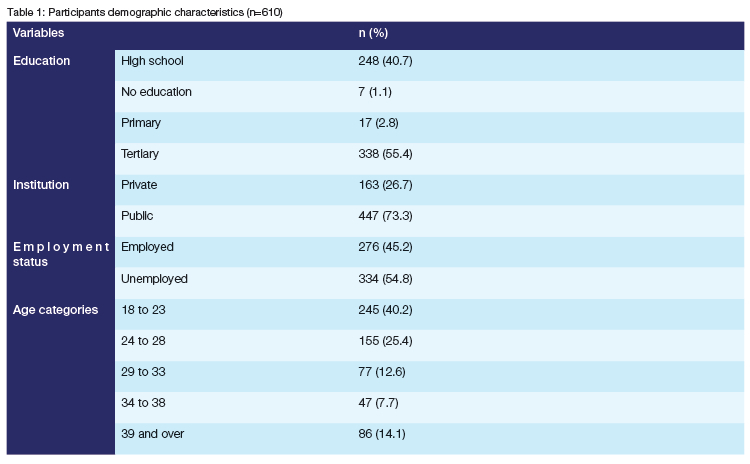
A total of 610 participants responded to the questionnaire. The mean age of participants was 28 years (SD= ±8.92 years) with more than half of them being male 330 (54%). The demographic information of the participants is summarised in Table 1.
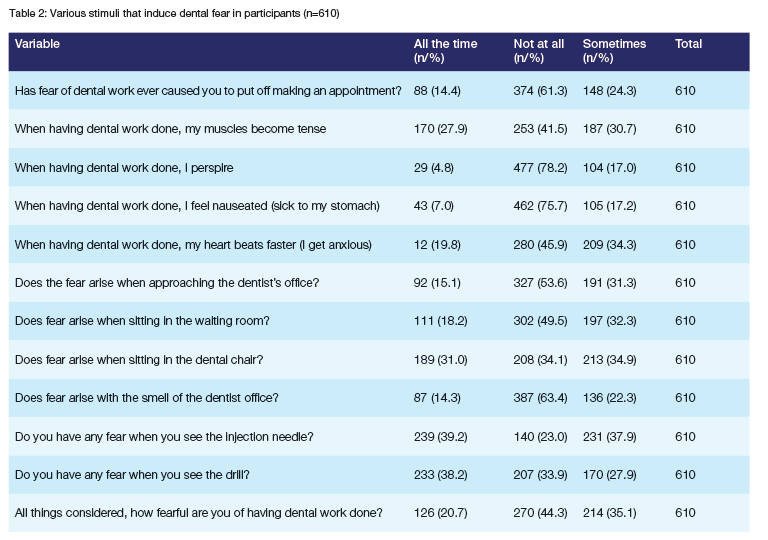
The various stimuli that induce dental fear in patients can be seen in Table 2.
There were various stimuli that induced dental fear in the participants. It was observed that of those who had dental fear, it was mostly when they were in the dental rooms, especially when they observed dental instruments. About 21% of the participants indicated they have dental phobia all the time, while 35% indicated they had dental fear sometimes.
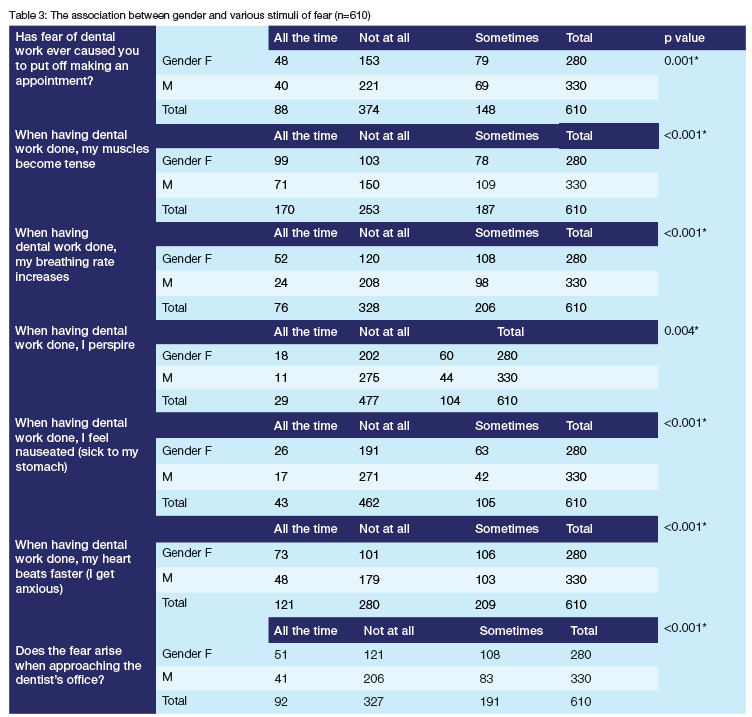
Female participants were statisticaiiy more fearful and more reactive to environmental-related factors such as hearing the sound of the drill, awaiting the dentist (waiting for longer periods), the smell of the dental room, approaching the dental room, being seated on the dental chair, when seeing the dentist walk in and the sight of the needle than their male counterparts, p<0.05. Females also showed a statistically high level of anxiety than males when it came to physiological-related factors such as muscle tension during treatment, perspiration, increase in breathing rate, nausea and tachycardia (increased heart rate) when the needle was being injected and feeling the drill's vibrations, p<0.05.
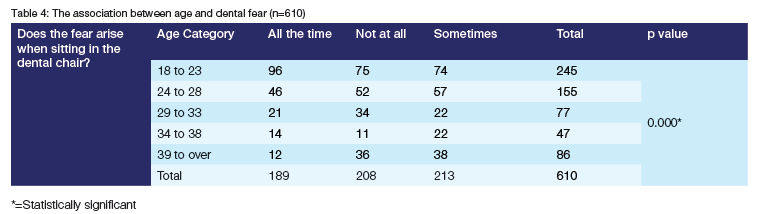
Table 4 indicates the association between age and dental phobia when the participant was sitting on the dental chair awaiting treatment.
Significant age differences were observed, indicating that age can be an attributable factor to dental fear. Significantly more participants in the age range 18 to 23 were fearful all the time and sometimes when sitting in the dental chair as compared to the other age ranges, p= 0.000. When the association between age and the various other stimuli of fear was done there was found to be no association, p>0.05. The was also no association between education level, employment status and dental anxiety, p>0.05.
DISCUSSION
The aim of the study was to investigate dental fear in selected centres in the Gauteng region. The objective was to assess the prevalence of dental fear and identification of phobia induced factors and stimuli in patients visiting selected oral health centres in Gauteng.
The response rate was 100% of the calculated sample size. About 21% of the participants reported to always have dental phobia with 35% being fearful sometimes. This is higher than reported literature.1,2 When it came to delaying making dental appointments due to fear, there was a notable increased number in females compared to male participants, resembling existing literature on gender differences which suggests that females have always been identified as having higher levels of dental anxiety compared to their male counterparts.10 This could be due to the fact that women naturally socialise in groups or circles of friends of which their individual subjective fears may be shared among the groups, inadvertently increasing individual objective fears.
Gender norms and societal expectations could also be contributing factors to this phenomenon, as stereotypes that say men should be more stoic or less expressive of fear or anxiety still exist in particular cultures. This may also have an impact on how men feel about and communicate their dental experiences. Statistics indicate that women are more likely than men to express their emotions honestly. Men may tend to internalise their worries or fears, which could give the impression they are less afraid when, in reality, they may be just as anxious.10
Muscle tension was the most common physiological symptom recorded according to gender, women (n=99), men (n=71) respectively in line with literature.10 The vibration of the drill and sight of the needle were the most fear-provoking stimuli in general for all patients in line with literature.11 It is reported that, in general, procedures that involve the drill and the needle evoke the most fear and this was true for the present study.10
Although literature has proved that dental fear declines with age, the results of the study for all the fear inducing stimuli showed no association between age and dental phobia, p >0.05 except for one stimulus.6,7
This could be due to the fact that there were more participants in the 18 to 23 age group (n=245) (40.2%) compared to 39 and over age group (n=86) (14.1%) that participated in this study. This could partly be attributable to the fact that adolescents have a natural need to look good as they are growing up to adulthood and more inclined to aesthetics than the older generation. They also have a need to be accepted socially, therefore they will seek help more than the older generation, eg patients with braces. When patients were asked whether they were fearful when sitting in the dental chair, statistically more patients in the younger age group were more fearful than the older age group, p=0. 00. The results of this study on this aspect concerning age are in line with published literature. 6,7,10
This study also indicated that employment status and educational level have no association with dental fear, in contrast to published literature which proposes that the degree of education and employment status have a major impact.11 People with low levels of education are more prone to put off or skip dentist appointments. Also, it could be more difficult for people with lower levels of education and work to get regular dental care, insufficient availability of preventive care may cause more serious dental problems to arise, which may increase dental visit anxiety. Socioeconomic status is frequently linked to employment and educational level - for instance, lack of medical aid cover, financial constraints and lack of access to oral health care services may result in people with low socioeconomic status having higher levels of dental fear.11 People with lower levels of education and work experience are more vulnerable to oral health-related stigmas and stereotypes in society; this could cause feelings of guilt or embarrassment, which can lead to dental anxiety and no access to preventative dental visits.12
A comprehensive approach that considers cultural influences, socioeconomic factors and personal experiences is needed to address dental fear. Dental fear can be lessened in a variety of populations by initiatives to enhance oral health education, expand access to reasonably priced dental care and reduce stigma.
Furthermore, to reduce dental anxiety for people with different educational and professional backgrounds, dental practices must foster a supportive and understanding environment.12
CONCLUSION
The study proves that dental fear leads to patients avoiding/ neglecting their much-needed dental care, a concern that is common in most dental practices and government clinics. About 21% of the patients indicated they have dental anxiety all the time. The results demonstrated a significant difference between males and females, with higher levels of anxiety in women than males. There was no association between level of education, employment status and dental fear.
Early identification and interventions towards these patients should be carried out and addressed as soon as possible.
RECOMMENDATIONS
Interventions such as psychotherapeutic or pharmacological interventions could be adopted to manage dental anxiety. The oral health team and relevant health care workers can play a critical role in partnering up and helping the affected individuals overcome dental anxiety by exercising empathy. Also, engaging policymakers and mobilising community action through proper mass awareness programmes such as early school outreach programmes and community mobile clinics could benefit children by providing early exposure to dental treatments and awareness, which will be beneficial in the long term. In addition, further research and attaining knowledge/skills on identifying dental phobia and knowing how to manage it should be encouraged so that routine management approaches can be initiated thus providing better dental care to patients.
This study is limited by the cross-sectional study design and causality cannot be inferred. Response acquiescence is common in questionnaires that tend to determine habits that are considered taboo or have negative connotations. Despite the limitations, the current study provided useful information that may inform future oral health education approaches of patients about dental phobia.
REFERENCES
1. Hakeberg M, Berggren U, Carlsson SG. Prevalence of dental anxiety in an adult population in a major urban area in Sweden. Community Dent Oral Epidemiol. 1992; 20(2):97-101 10.1111/j.1600-0528.1992.tb00686.x [DOI] [PubMed] [Google Scholar] [ Links ]
2. Schuller AA, Willumsen T, Holst D. Are there differences in oral health and oral health behavior between individuals with high and low dental fear? Community Dent Oral Epidemiol. 2003; 31(2):116-21 10.1034/j.1600-0528.2003.00026.x [DOI] [PubMed] [Google Scholar] [ Links ]
3. Kocabasoglu N, Caglayan HB, editors. Anxiety Disorders: From Childhood to Adulthood. BoD-Books on Demand; 2019 Feb 27 [ Links ]
4. Rebecca Alston. latrophobia: Fear of Doctors... But Dentists Seem to Be the Scariest. [Internet]. 2022. [cited 2022 June 19]. Available from: https://www.mamaslikeme.com/iatrophobia-fear-of-doctors-but-dentists-seem-to-be-the-scariest/ [ Links ]
5. Jacobson PH. Horace Wells: discoverer of anaesthesia. Anaesthesia progress. 1995; 42(3-4):73 [ Links ]
6. Sobol-Kwapinska M, Senejko A, Jaskiewicz L, Kwiatkowska A. Dental anxiety -conditions, models, therapy. Journal of Medical Science. 2018 Dec 30;8 (4):209-17 [ Links ]
7. Murad MH, Ingle NA, Assery MK. Evaluating factors associated with fear and anxiety to dental treatment - A systematic review. Journal of family medicine and primary care. 2020 Sep 1;9(9):4530-5 [ Links ]
8. D'Arro C. Mindful Dentist. The International Journal of Whole Person Care. 2018 Jun 18; 5(2) [ Links ]
9. Coolidge T, Arapostathis KN, Emmanouil D, Dabarakis N, Patrikiou A, Economides N, Kotsanos N. Psychometric properties of Greek versions of the modified corah dental anxiety scale (MDAS) and the dental fear survey (DFS). BMC Oral Health. 2008 Dec; 8 (1):1-6 [ Links ]
10. Caltabiano ML, Croker F, Page L et al. Dental anxiety in patients attending a student dental clinic. BMC Oral Health 2018 March 20 [Cited 2023 October 23]. Available from: https://doi.org/10.1186/s12903-018-0507-5 [ Links ]
11. Musalam K, Sohal KS, Owibingire SS, Kileo B. Magnitude and Determinants of Dental Anxiety among Adult Patients Attending Public Dental Clinics in Dar-Es-Salaam, Tanzania. International Journal of Dentistry. 2021;2021(1):9965204 [ Links ]
12. Doughty J, Macdonald ME, Muirhead V, Freeman R. Oral health-related stigma: Describing and defining a ubiquitous phenomenon. Community dentistry and oral epidemiology. 2023 Dec;51(6):1078-83 [ Links ]
 Correspondence:
Thommy Madiba
Email: thommy. madiba@up.ac.za / thommy.madiba@gmail.com