



Services on Demand
Journal

Article
 English (pdf)
 Article in xml format
 Article references
 Automatic translation
 Send this article by e-mail
Indicators
Related links
-
 Cited by Google
 -
 Similars in Google
Share

 Permalink
African Biodiversity & Conservation
On-line version ISSN 3078-8056Print version ISSN 0006-8241
Bothalia (Online) vol.56 n.2 Pretoria 2026
https://doi.org/10.38201/abc.v56.2.a11
ORIGINAL RESEARCH
A preliminary checklist of alien and invasive plant species within protected areas of the City of Johannesburg, Gauteng, South Africa
T. NelufuleI; L. ShirindziII; T.C. ShivambuI
IDepartment of Environmental Sciences, University of South Africa, Private Bag X6, Florida Science Campus, 1710, South Africa
IICity of Joburg, City Parks and Zoo House, 40 De Korte Street, Johannesburg, South Africa, Braamfontein 2017
ABSTRACT
BACKGROUND: Urbanisation has significantly transformed natural landscapes, posing substantial challenges to biodiversity, especially in protected areas managed by municipalities. In South Africa, limited data exist on the diversity and distribution of alien plant species within urban protected areas
OBJECTIVES: This study assesses alien plant species' distribution, abundance and invasion dynamics in protected areas managed by the Johannesburg City Parks and Zoo, Gauteng
METHODS: We systematically surveyed alien plants across 10 protected areas and documented their abundance, life form, pathways of invasion, legal status, degrees of establishment and origins
RESULTS: The alien flora in the surveyed protected areas comprised 175 species from 125 genera and 56 families. Of these species, 82 were herbs, 43 trees and 27 shrubs, with most species forming established populations (48.2%) and few are invasive (10%). Species richness was highest at Albert Farm (n = 72) and Beaulieu (n = 69), with the former also having the highest species abundance. Most alien plant species originate from South (36%) and North America (34%) and were likely introduced to these protected areas as ornamental and horticulture plant escapes. Most species (n = 103) are not listed in the South African Alien and Invasive Species Regulations, while those listed were predominantly Category 1b species (n = 51
CONCLUSION: The study highlights that protected areas in urban areas often have alien plant species, likely because most of the species are introduced by humans as ornamentals and through horticulture. These areas can act as foci for new invasions, and it is therefore important to compile lists of alien species in these areas that can be used to develop appropriate management interventions
Keywords: urbanisation, biodiversity threats, alien plant distribution, invasion dynamics, ecological risks, management strategies.
Introduction
Urban protected areas are increasingly valued for their conservation potential for biodiversity in the wake of increasing pressure from human activities such as urbanisation and biological invasions (Potgieter et al. 2020; Le et al. 2023; Nelufule et al. 2024a). Globally, rapid urban expansion has led to the transformation of natural landscapes through the construction of housing, roads and recreational spaces, leading to habitat fragmentation and the displacement of native species (Lambin et al. 2001; Piano et al. 2020; Milton & Dean 2021; Gao & Song 2022). The rapid rate of urban expansion is particularly high in densely populated cities such as Johannesburg (City of Johannesburg), Pretoria (City of Tshwane) and Durban (eThekwini Metropolitan Municipality), where remnant patches of vegetation are conserved within protected areas such as nature reserves. These protected areas provide refuge for threatened species and perform essential ecosystem services such as carbon sequestration and water regulation (Tallis et al. 2008; Nelufule et al. 2024a; Nxele et al. 2024).
However, these protected areas in urban areas are increasingly invaded by alien plant species that are introduced through ornamental horticulture, garden escapes and accidental dispersal (Foxcroft et al. 2013; Gaertner et al. 2016). For example, Table Mountain National Park, located within Cape Town, Western Cape, has experienced extensive plant invasions, prompting control efforts exceeding ZAR3.2 billion nationally between 1995 and 2008 (Van Wilgen et al. 2008). While Cape Town's urban protected areas have been studied extensively, the degree of invasion in protected areas in municipal areas of Gauteng, including those managed by Johannesburg City Parks and Zoo (hereafter JCPZ), remains poorly quantified (Irlich et al. 2017; Potgieter et al. 2020; Nelufule et al. 2024a, 2024b).
Urban protected areas often act as foci for new invasions due to their proximity to gardens, nurseries and residential zones (Hui et al. 2017; Padayachee et al. 2017). Many alien species establish self-sustaining populations after escaping cultivation (e.g., Bowman Cut-way & Ehrenfeld 2010; Nelufule et al. 2024b). South Africa is a hot spot for plant invasions, with invasions recorded across the country, including protected areas such as national parks (Zengeya & Wilson 2023; Van Wilgen et al. 2026). However, inventories of alien species are often lacking in most municipal nature reserves, hindering effective monitoring and control (Irlich et al. 2017). Without baseline data on which alien species occur in protected areas under their jurisdiction, municipalities cannot assess invasion dynamics or prioritise high-risk species for intervention (Jarosik et al. 2011; Irlich et al. 2020). Checklists of alien species in protected areas also underpin national NEM:BA Alien and Invasive Species Regulations (DFFE 2020) and facilitate reporting to international conventions such as the Kunming-Montreal Global Biodiversity Framework (Egoh et al. 2020; CBD 2022; IPBES 2024). Developing a checklist for urban protected areas is therefore crucial to inform management and evaluations of current and future threats.
To address this gap, this study provides a preliminary inventory of invasive alien plant species across 10 protected areas managed by JCPZ. Specifically, we documented species richness, abundance, life forms, invasion pathways, legal status, degree of establishment and continent of origin. These data will support the development of invasive species control plans that are essential for the management of the protected areas.
Materials and methods
Study area
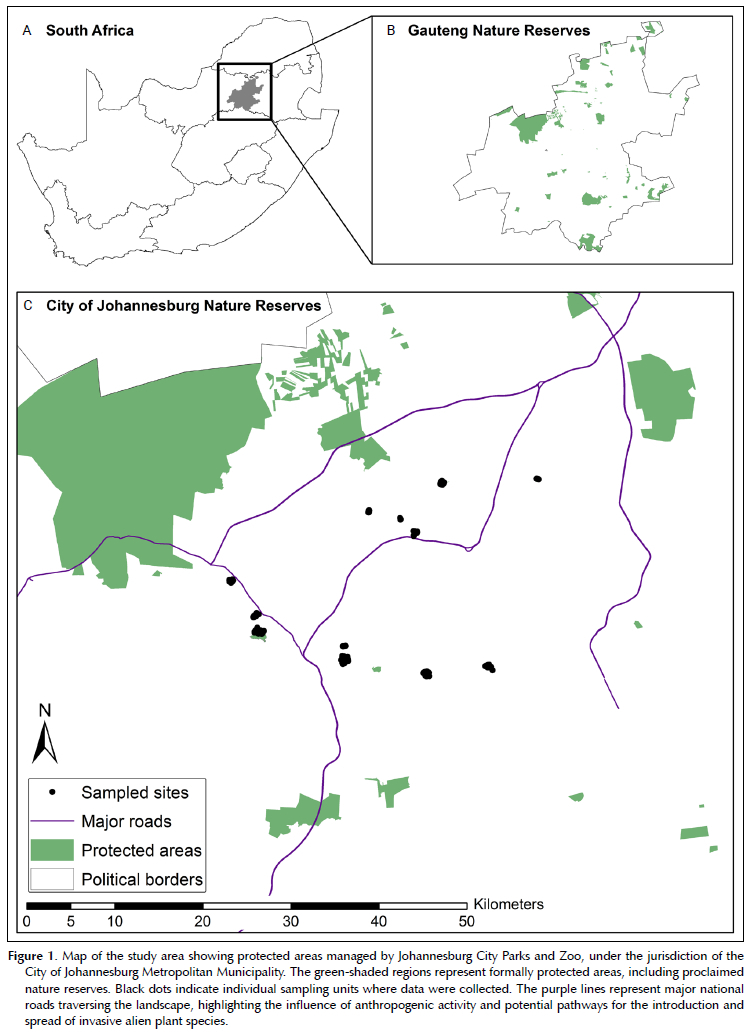
The City of Johannesburg Metropolitan Municipality (CoJ) is located in the south-central of Gauteng (Figure 1). The city is nestled and surrounded by two metropolitans, namely, the City of Tshwane to the north and the City of Ekurhuleni to the east. The total area of Gauteng is 18 178 km2 and it is the smallest of the nine provinces in South Africa, but it is the most densely populated with approximately 15 million people (Stats SA 2022), of which 4.8 million people reside in the City of Johannesburg.
Vegetation types
The JCPZ manages 25 natural protected areas, including nature reserves and conservancy areas, which cover 5 862 ha, equating to 26% of the total (22 278 ha) green land area of the CoJ (JCPZ; Environmental Conservation Department (ECD) 2025, unpublished report). These protected areas lie in two terrestrial biomes, the grassland and savanna biomes. The reserves' vegetation consists of critical biodiversity areas such as the Gauteng Shale Mountain Bushveld, Gold Reef Mountain Bushveld and Egoli Granite grassland (Mucina & Rutherford 2006). These critical biodiversity areas are under increasing pressure from human activities such as urban expansion, mining, pollution and biological invasions (Gauteng C-Plan 2014; DEA 2016).
Rainfall/Climate
Johannesburg experiences cold winters with average lows of 6.1°C and maximum of 16.4°C in winter between June and July and warm to hot summers (from November to March) with mean annual temperatures peaking at 27°C in January reflecting the province's subtropical highland climate (Mucina & Rutherford 2006). The mean annual rainfall is 700 mm, but it varies between 600 and 750 mm depending on altitude (Mucina & Rutherford 2006; Van Rooyen & Van Rooyen 2014).
Sampling techniques
A survey was conducted across 10 protected areas managed by the CoJ between 8 January 2024 and 10 March 2025, spending one day in smaller reserves and two and a half days in bigger reserves (Figure 1). In each protected area, the area was demarcated into management units, depending on the size of the nature reserve (DEA 2014). Management units refer to the size of the area big enough for the management of invasive alien plant species. For example, for small reserves like Lone-hill, the area was divided into two units (A and B), while for larger reserves such as Kloofendal Nature Reserve, it was divided into up to four management units. To identify alien plant species, we walked in a transect 10 m apart from each other in each unit, identifying and recording different alien plant species occurring within one up to 10 m until the next observation zone, taking a GPS waypoint using Garmin GPS (McLean et al. 2018). To avoid double-counting, species recorded at a given waypoint were excluded from subsequent waypoints. In certain locations, dense and impenetrable thickets formed by a mixture of native and alien plant species limited access. In these cases, only species visible and identifiable from the outer edge of the vegetation were recorded, and abundance was estimated without entering the interior of the population. We measured climbing or spreading plants using a square-metre cover estimate, taking 1 m2 of groundcover as equal to one plant for the purpose of the analyses. Species identification in the field was conducted using standard field guidebooks by Bromilow (2018), Henderson (2020) and Spottiswoode (2024, https://kloofendalfriends.org.za/karin-spottiswoode/).
In cases where immediate identification was not possible, photographs were taken alongside voucher specimens to facilitate accurate identification at a later stage. This method was repeated in other management compartment units until the whole area was covered. Species that could not be identified in the field were submitted to the Johannesburg Botanical Garden for identification. We also recorded South African native plant species that have formed native-alien populations in Gauteng (Nelufule et al. 2022, 2023) and treated them as alien plants within these protected areas. Native-alien populations are species that are native to a country but have been moved by humans outside of their natural historical range, where they have established self-sustaining populations (Nelufule et al. 2022). Two experienced observers carried out the surveys at each protected area, assisted by six assistants.
We verified species names using the Global Biodiversity Information Facility Backbone Taxonomy (GBIF: https://doi.org/10.15468/39omei, viewed on 10 January 2024). To ensure consistency and accuracy, all species names were cross-checked against an authoritative taxonomic backbone, with only accepted names included (Spear et al. 2013; Costello & Wieczorek 2014). We obtained written permission to conduct surveys from JCPZ, and ethics approval was obtained from the University of South Africa Health Research Ethics Committee (2025/CAES_HREC/6772).
Abundance and density
For each plant species recorded, the number of individuals was counted, but populations of more than 1 000 individual plants were estimated. This estimation was done by counting the number of target alien plant species in a 1 X 1 m quadrat, which was overlaid on the infested area. The total infested area (m2) was calculated by multiplying the number of occupied quadrats by the quadrat size. For irregularly shaped infestations, an iPhone GPS application was used to trace the perimeter and calculate the polygon area in square metres. The total number of individual plants was then summed for each protected area. To standardise invasion levels across protected areas of varying sizes, invasion density was calculated as the number of individual alien plant records per hectare.
For further analysis, each plant species was categorised according to family, life form, degree of establishment, likely pathways of invasion, regulatory status under NEM: BA A&IS regulation categories and region of origin.
Life forms: For life forms, we classified each species as climber, graminoid, herb, shrub, succulent or tree following the criteria set out by Baard & Kraaij (2014). This information is important for predicting potential negative impacts of invasive alien species (Pysek et al. 2012).
Degree of establishment: In each nature reserve, the degree of establishment was classified as casual, colonising, established, invasive and widespread invasive according to Blackburn et al. (2011) using the wording and description from Groom et al. (2019). Casual population refers to species whose individuals were surviving outside of captivity in a location with no reproduction; Colonising are for 'self-sustaining population outside of captivity or cultivation, with individuals surviving a significant distance from the original point of introduction (the first individual to be recorded was regarded as original point of introduction)'; Established are 'individuals surviving outside of captivity or cultivation in a location, reproduction occurring, and population self-sustaining'; Invasive refers to 'self-sustaining population outside of captivity or cultivation, with individuals surviving and reproducing a significant distance from the original point of introduction'; and widespread invasive was for 'fully invasive species, with individuals dispersing, surviving and reproducing at multiple sites across a greater or lesser spectrum of habitats and extent of occurrence'. This was done for the nature reserves/conservancies and not the country as a whole.
Continent of origin: The native range of each species was noted at a continental level and cross referenced with Global Invasive Species Database (https://www.iucngisd.org/gisd/) and CABI's invasive species compendium (https://www.cabidigitallibrary.org/journal/cabicompendium). A chi-square test was used to test whether the number of species records differs significantly by continent of origin. The statistical analyses were conducted in R Software Version 4.4.3 (R Studio 2020).
Likely pathways of invasion: Information on the use of each species was obtained from online databases such as CABI, Plants of the World Online (https://powo.science.kew.org/, viewed on 10 January 2025) and published literature. This information was then used to classify the possible pathways of invasion following the criteria by Baard and Kraaij (2014) and using the scheme of the Convention on Biological Diversity (CBD 2014) guided by information provided in Harrower et al. (2018). The classifications included: escape:ornamental, escape:horticulture, escape:agriculture, escape:forestry and escape:other. When a single species had multiple uses, each use was categorised separately and separated by a pipe-delimiter.
NEMBA listed species: We also classified each species following the National Environmental Management: Biodiversity Act (NEM:BA, Act 10 of 2004), Alien and Invasive Species Regulations (NEM:BA A&IS Regulations of 2021 as amended; DEA 2021), and assigned them different categories, namely: Category 1a, 1b, 2 or 3 invasive species for Gauteng.
Storage of the dataset
Online repository (figshare.com):https://doi.org/10.6084/m9.figshare.30759383.
License: CC BY 4.0.
Format of dataset: Digital comma-delimited file (.csv).
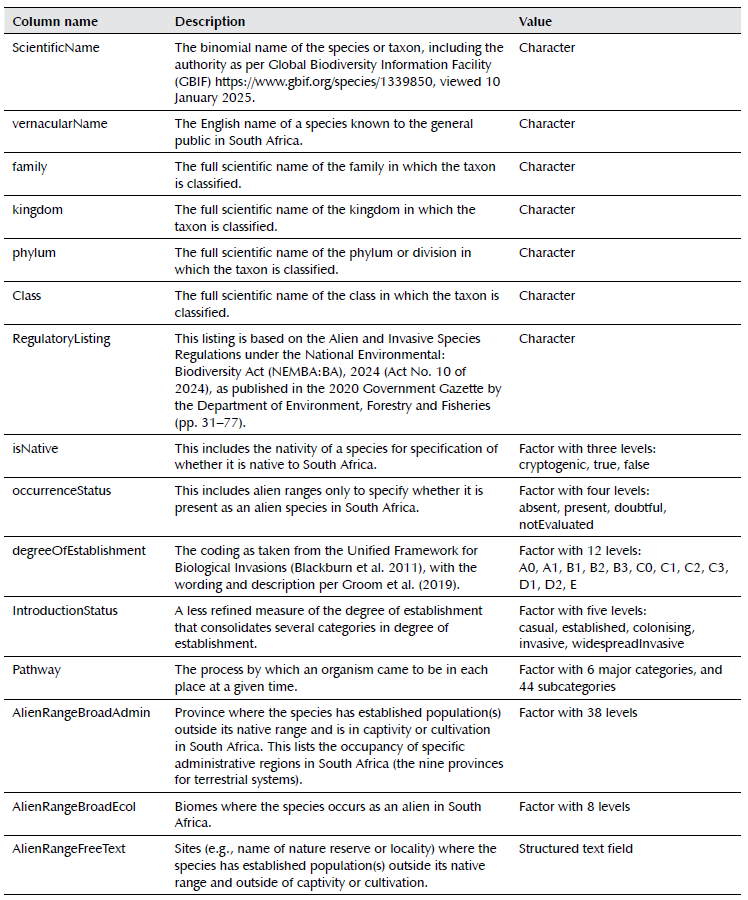
Data structure: This dataset includes two files: a csv file with a list of alien and invasive plant species of the City of Johannesburg Metropolitan protected areas and the metadata in an MS Word document, which contains a full description of each column in the dataset. For this study, we aligned some of the column names with those of the species list of South Africa's national status report on biological invasions (http://dx.doi.org/10.5281/zeno-do.3947659), with those that are marked by an asterisk under the description representing Darwin Core terms. This was done to ensure the data will be FAIR (Findable, Accessible, Interoperable, and Reusable). Each row below the header of Supplementary material 1 represents a record for a single alien species (see Appendix A). If a cell includes multiple values in the inventory (e.g., taxa native to multiple continents will have multiple values for NativeRangeBroadAdmin). A pipe-delimiter separated these values and the categories.
Results
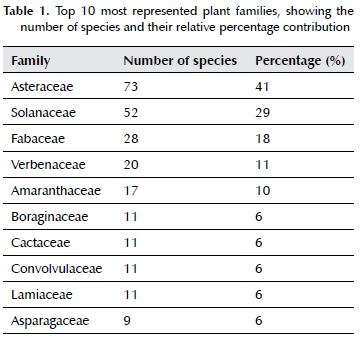
A total of 175 alien plant species were identified, representing 56 plant families and 125 genera (Supplementary material 1). Six of these species have formed native-alien populations in these reserves. Asteraceae was the most represented with 73 species, followed by Solanaceae (n = 52), Fabaceae (n = 28) and Verbenaceae (n = 20) (Table 1). Several families had low representation, with 33 families contributing only one or two records each (Supplementary material 1).
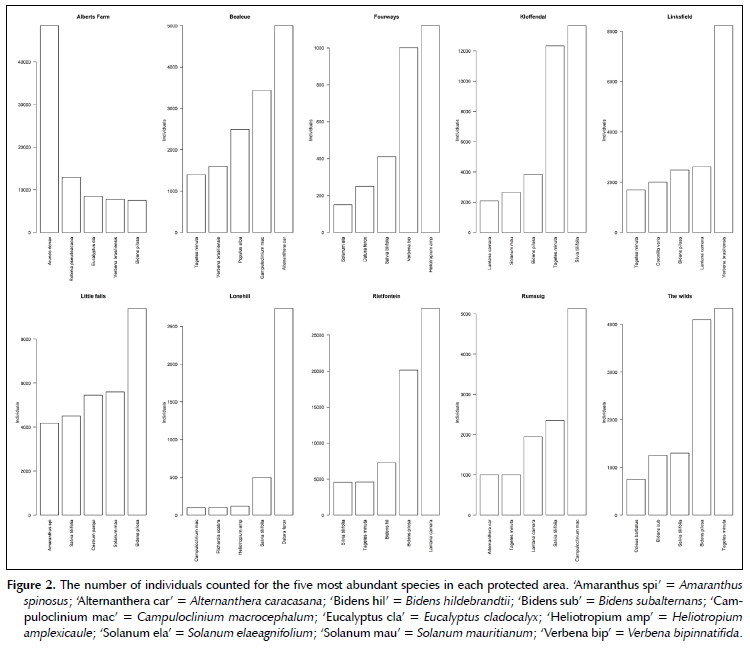
The most frequently recorded species was Heliotropium amplexicaule that occurred in all the 10 surveyed protected areas, followed by several species that occurred in at least seven protected areas. These included Bidens pilosa, Lantana camara, Melia azedarach, Solanum mauritianum, Tagetes minuta, Campuloclinium macrocephalum, Datura stramonium, Morus alba and Physalis peruviana (Supplementary material 1). Many species, however, were rare and occurred in less than two protected areas (e.g., Arundo donax, see Supplementary material 1; A. donax was, however, the most abundant species, with a total of ~48 500 individuals, despite occurring in only one protected area). Other species that were abundant included B. pilosa, L. camara, T. minuta, Salvia tiliifolia and Verbena brasiliensis (Figure 2).
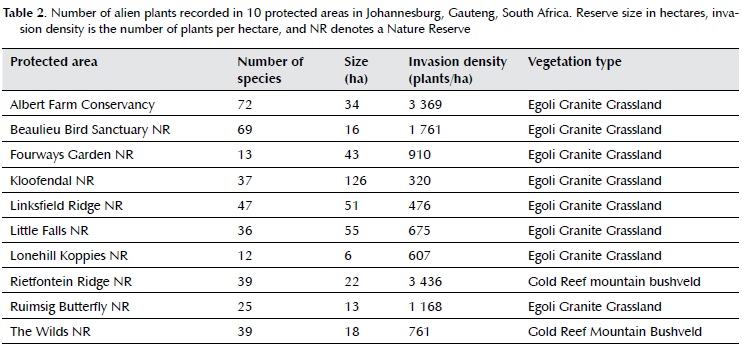
In total, ~356 775 individual plant species were recorded across 10 protected areas, representing 6 786 records or sampling steps (Table 2). Albert Farm had the highest number of recorded species (n = 72), closely followed by Beaulieu (69 species), Linksfield Ridge (47 species), Rietfontein (39 species) and The Wilds (39 species) nature reserves (Table 2). In contrast, Lonehill Koppies and Fourways Garden nature reserves recorded the least number (n < 15) of alien plant species (Table 2). Invasion density was highest in three nature reserves, Rietfontein (3 436.59 plants/ha), Albert Farm (3 369.14 plants/ha) and Beaulieu (1 761.06 plants/ha) (Table 2). The other nature reserves had low to medium plant invasion densities (320-1 168 plants/ha).
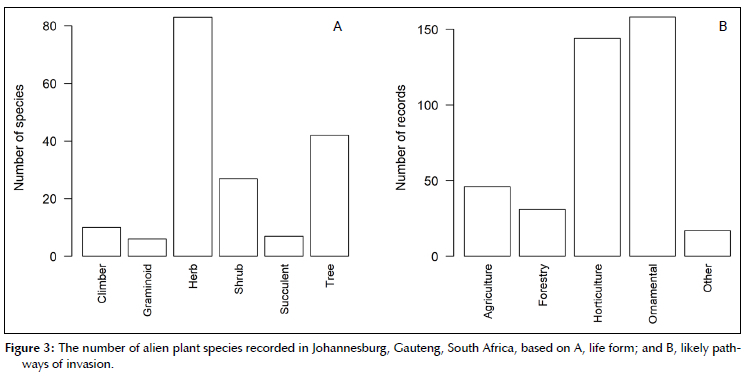
Herbs and trees had a significantly higher number of species than other life forms (x2 = 9.0267, df = 1, p = 0.002661) (Figure 3A). A significantly higher number of species were introduced through ornamental (x2 = 225.69, df = 4, p-value = 2.2e-16) and horticultural (X2 = 49.568, df = 1, p = 1.916e-12) pathways than through agriculture, forestry and other pathways of invasion. (Figure 3B).
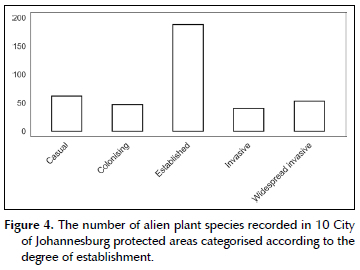
There were significant differences in the degree of establishment of alien plant species across the 10 nature reserves (x2 = 198.28, df = 4, p < 0.0001). The majority of alien plants species were established (48%), while few were categorised as casual (16%), colonising (12%), invasive (10%) and widespread invasive (13%) (Figure 4).
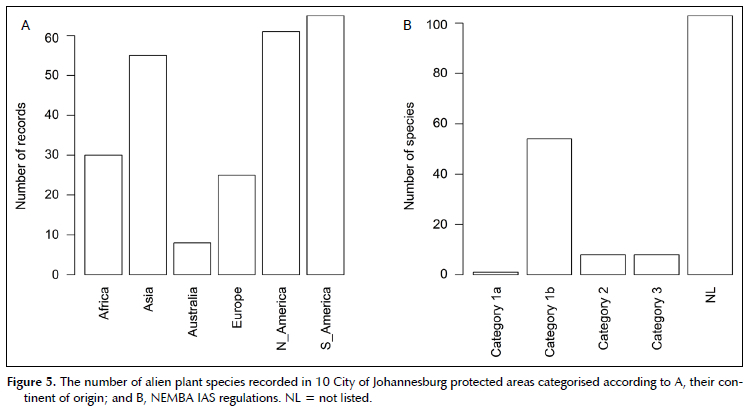
There was significant difference in the continent of origin of alien plant species for the 10 nature reserves (x2 = 77.74, df = 5, p < 0.001). The majority of species were introduced from Asia, North and South America, while comparatively fewer were from Australia and Europe (Figure 5A). Most alien plant species recorded in this study (103 out of 177 species) were not listed under the A&IS Regulations (Figure 5B). Of the 73 species that are listed on the A&IS Regulations, 74% are listed as Category 1b and a few are in the other categories (Figure 5B).
Discussion
This study provides a preliminary checklist of alien plant species that occur in several protected areas managed by the CoJ. Species richness and density varied across the protected areas largely as a result of legacies of historical land use and plant traits. These findings are in line with those reported for the City of Tshwane in Nelufule et al. (2024a) and for the South African National Parks (Van Wilgen & Herbst 2017). Our results suggest that invasion densities are highest in disturbed reserves such as Albert Farm, which was previously used as a farm. This supports the notion that human activities and legacies of historical land-use create favourable conditions for alien species spread. The overlap in dominant species such as L. camara across protected areas in the cities of Tshwane and Johannesburg further suggests that these alien plant species pose a regional threat that requires coordinated responses. High-density invasions, such as those by A. donax, L. camara, B. pilosa, Robinia pseudoacacia and V. brasiliensis, highlight their aggressive colonisation capabilities, even when present in limited locations, are likely to outcompete indigenous plants, threaten ecosystem services provided by these areas, discredit the ability of these areas to resist climate change and alter microhabitats essential for native fauna.
Notably, six species have formed native-alien populations within some of these protected areas. These results add to the increasing observation of native-alien populations in protected areas in South Africa (Baard & Kraaij 2014; Van Wilgen & Herbst 2017; Nelufule 2023; Nelufule et al. 2024a, 2024b). Like in Nelufule et al. (2024a), the present study reported that alien plant species from the families Asteraceae, Fabaceae and Solanaceae were the most dominant. These families are often overrepresented in the alien plant list globally due to their ability to disperse fast, their ability to adapt to different habitats and their popularity in the ornamental horticulture trade (Singh et al. 2010; Foxcroft et al. 2013; Appalasamy & Ramdhani 2020). This pattern is also consistent with other studies, where the ornamental plant trade is recognised as one of the most significant vectors for alien plant invasions and dispersal into protected areas both in urban areas and natural systems (Foxcroft et al. 2008, 2017; Van Wilgen & Herbst 2017; Nelufule et al. 2024a).
Of concern is that most of the alien plants had established a self-sustaining population in the surveyed protected areas. The domination of these established alien species indicates a potential for further spread into adjacent habitats and broader ecological impacts, including competition with native species, alteration of ecosystem processes, and disruption of native community structures.
This is of concern as 24% of the sampled species are already invasive and indicates a high invasion debt in these areas. Furthermore, we observed a high number of unlisted species. Because it is not mandatory to develop control programmes for unlisted species in South Africa, they may go untreated for long periods. As a result, the number of species that could spread further and cause additional impacts is likely to increase.
Most of the listed species are classified under Category 1b, meaning that they require active management. However, many urban municipality-managed protected areas (Nelufule et al. 2024a), including those surveyed here, lack an invasive species monitoring, control and eradication plan, which hinders effective control of these species. As a result, citizen science groups have taken on the task of controlling invasive plants in some of the CoJ's nature reserves in an effort to restore the natural integrity of these areas (Nelufule et al. 2026).
Limitations
Sampling in a single season limits the ability to record all species occurring in these reserves, as flowering of different alien plant species occur at different times of the year. We could not survey the other 15 protected areas due to various reasons, including budgetary constraints and safety concerns, such as the presence of homeless individuals and unauthorised access in some areas. As a result, other parts of the Kloofendal Nature Reserve were not surveyed, leading to an underrepresentation of the total number of species recorded for this reserve. Furthermore, ecological management plans in most of these urban protected areas are outdated (Nelufule et al. 2024a), which hinders progress in updating and implementing effective alien species checklists and control.
To overcome these limitations, future surveys should be conducted across different seasons to capture species that flower or are detectable at different times of the year. Expanding temporal coverage would greatly improve the completeness and accuracy of alien species checklists. Additionally, securing adequate funding and logistical support would enable surveys of all protected areas, including those that were excluded previously. To facilitate more comprehensive sampling, there is a need to collaborate with local authorities to address safety concerns such as regulated access, guided entry or partnering with reserve staff. Improved coordination with municipal environmental departments could further support the revision and implementation of updated ecological management plans, ensuring that invasive species monitoring, control and eradication plans are systematically integrated into protected area ecological management plans. Protected areas in urban areas of Gauteng often have many invasive species. This is likely due to proximity to human dwellings where alien plants are used as ornaments and for horticulture. These areas can act as foci for new invasions and there is therefore a need to develop lists of alien species present in these areas so that appropriate management interventions can be developed.
Acknowledgements
We thank Mr Bishop Ngobeli for supporting the project operations. We also thank Lungisani Giba, Image Moloto, Charity Mkhari, Bongeka Khumalo, Nomcebo Magagula, Happy Vuma, Michell Maliyane and King Solomon Ngoako for assistance with data collection.
Source of funding
Johannesburg City Parks and Zoo (JCPZ) are thanked for funding the study.
Competing interests
The authors have declared that no competing interests exist.
Authors' contributions
TN (University of South Africa) conceptualised, collected and analysed the data, and was responsible for writing and editing the manuscript; CTS (University of South Africa) contributed to writing and editing the manuscript; LS (Johannesburg City Parks and Zoo) was responsible for editing the manuscript.
Data resources
Data for this study are available on request from the authors.
References
Appalasamy, M. & Ramdhani, S., 2020, 'Aliens in the city, towards identifying non-indigenous floristic hotspots within an urban matrix', Flora 269, 151631, https://doi.org/10.1016/j.flora.2020.151631. [ Links ]
Baard, J.A. & Kraaij, T., 2014, 'Alien flora of the Garden Route National Park, South Africa', South African Journal of Botany 94, 51-63, https://doi.org/10.1016/j.sajb.2014.05.010. [ Links ]
Blackburn, T.M., Pysek, P., Bacher, S., Carlton, J.T., Duncan, R.P., Jarosík, V., Wilson, J.R.U. & Richardson, D.M., 2011, 'A proposed unified framework for biological invasions', Trends in Ecology & Evolution 26, 333-339, https://doi.org/10.1016/j.tree.2011.03.023. [ Links ]
Bowman Cutway, H. & Ehrenfeld, J.G., 2010, 'The influence of urban land use on seed dispersal and wetland invasibility', Plant Ecology 210, 153-167, https://doi.org/10.1007/s11258-010-9746-5. [ Links ]
Bromilow, C., 2018, Problem plants and alien weeds of southern Africa, Briza Publications, Pretoria, South Africa. [ Links ]
CBD (Convention on Biological Diversity), 2014, Pathways of introduction of invasive species, their prioritization and management, https://www.cbd.int/doc/meetings/sbstta/sb-stta-18/official/sbstta-18-09-add1-en.pdf. [ Links ]
CBD (Convention on Biological Diversity), 2022, Decision adopted by the conference of the parties to the convention on biological diversity 15/4, Kunming-Montreal Global Biodiversity Framework, https://www.cbd.int/doc/decisions/cop-15/cop-15-dec-04-en.pdf. [ Links ]
Costello, M.J. & Wieczorek, J., 2014, 'Best practice for biodiversity data management and publication', Biological Conservation 173, 68-73, https://doi.org/10.1016/j.bio-con.2013.10.018. [ Links ]
DEA (Department of Environmental Affairs), 2014, National Environmental Management, Biodiversity Act 2004 (Act No. 10 of 2004: Alien and Invasive Species Regulations), Government Gazette, Pretoria, South Africa, pp. 3-32. [ Links ]
DEA (Department of Environmental Affairs), 2016, National Protected Area Expansion Strategy (NPAES) for South Africa 2016, Department of Environmental Affairs, Pretoria, South Africa, https://www.gov.za/sites/default/files/gcis_document/201901/nationalprotectedareasexpansionstrategy2016ofsouthafrica.pdf. [ Links ]
DEA (Department of Environmental Affairs), 2021, National Environmental Management, Biodiversity Act 2004 (Act No. 10 of 2004, Alien and Invasive Species Regulations, Government Gazette, Pretoria, South Africa, pp. 3-32. [ Links ]
DFFE (Department of Environment, Forestry and Fisheries), 2020, National Environmental Management, Biodiversity Act (Act No. 10 of 2004), Alien and Invasive Species Regulations, Government Gazette, Notice 1020 of 2020, no. 43735, 25 September 2020, Pretoria, pp. 14-44. [ Links ]
Egoh, B.N., Ntshotsho, P., Maoela, M.A., Blanchard, R., Ayompe, L.M. & Rahlao, S., 2020, 'Setting the scene for achievable post-2020 convention on biological diversity targets, a review of the impacts of invasive alien species on ecosystem services in Africa', Journal of Environmental Management 261, 1-8, https://doi.org/10.1016/j.jen-vman.2020.110171. [ Links ]
Foxcroft, L.C., Pysek, P., Richardson, D.M., Genovesi, P. & MacFadyen, S., 2017, 'Plant invasion science in protected areas. Progress and priorities', Biological Invasions 19, 1353-1378, https://doi.org/10.1007/s10530-016-1367-z. [ Links ]
Foxcroft, L.C., Richardson, D.M. & Wilson, J.R.U., 2008, 'Ornamental plants as invasive aliens, problems and solutions in Kruger National Park, South Africa', Environmental Management 41, 32-51, https://doi.org/10.1007/s00267-007-9027-9. [ Links ]
Foxcroft, L.C., Witt, A. & Lotter, W.D., 2013, 'Icons in peril, invasive alien plants in African protected areas', in L.C. Foxcroft, P. Pysek, D.M. Richardson & P. Genovesi, Plant invasions in protected areas, pp. 117-143, Springer, New York. [ Links ]
Gaertner, M., Larson, B.M., Irlich, U.M., Holmes, P.M., Stafford, L., Van Wilgen, B.W. & Richardson, D.M., 2016, 'Managing invasive species in cities, a framework from Cape Town, South Africa', Landscape and Urban Planning 151, 1-9, https://doi.org/10.1016/j.landurb-plan.2016.03.010. [ Links ]
Gao, H. & Song, W., 2022, 'Assessing the landscape ecological risks of land-use change', International Journal of Environmental Research and Public Health 19, 1-25, https://doi.org/10.3390/ijerph192113945. [ Links ]
Gauteng C-Plan, 2014, Technical report for the Gauteng conservation plan, Version 3.3, https://conservationcorridor.org/cpb/GDARD_2014.pdf. [ Links ]
Groom, Q., Desmet, P., Reyserhove, L., Adriaens, T., Oldoni, D., Vanderhoeven, S., Baskauf, S.J., Chapman, A., McGeoch, M., Walls, R., Wieczorek, J., Wilson, J.R.U., Zermoglio, P.F.F. & Simpson, A., 2019, 'Improving Darwin Core for research and management of alien species', Biodiversity Information Science and Standards 3, e38084, https://doi.org/10.3897/biss.3.38084. [ Links ]
Harrower, C.A., Scalera, R., Pagad, S., Schonrogge, K. & Roy, H.E., 2018, 'Guidance for interpretation of CBD categories on introduction pathways', Technical note prepared by lUCN for the European Commission, pp. 1-100, https://nora.nerc.ac.uk/id/eprint/519129. [ Links ]
Henderson, L., 2020, Invasive alien plants in South Africa, Agricultural Research Council, Pretoria, https://wwfafrica.awsassets.panda.org/downloads/invasive_alien_plants_in_south_africa.pdf. [ Links ]
Hui, C., Richardson, D.M. & Visser, V., 2017, 'Ranking of invasive spread through urban green areas in the world's 100 most populous cities', Biological Invasions 19, 3527-3539, https://doi.org/10.1007/s10530-017-1584-0. [ Links ]
IPBES (Intergovernmental Science-Policy Platform on Biodiversity and Ecosystem Services), 2024, 'Thematic assessment report on the underlying causes of biodiversity loss and the determinants of transformative change and options for achieving the 2050 vision for biodiversity of the Intergovernmental Science-Policy Platform on Biodiversity and Ecosystem Services', K. O'Brien, L. Garibaldi, & A. Agrawal (eds), IPBES secretariat, Bonn, Germany, https://doi.org/10.5281/zenodo.11382215. [ Links ]
Irlich, U.M., Potgieter, L., Stafford, L. & Gaertner, M., 2017, 'Recommendations for municipalities to become compliant with national legislation on biological invasions', Bothalia - African Biodiversity & Conservation 47, 1-11, https://doi.org/10.4102/abc.v47i2.2156. [ Links ]
Jarosik, V., Pysek, P. & Kadlec, T., 2011, 'Alien plants in urban nature reserves, from red-list species to future invaders?', NeoBiota 10, 27-46, https://doi.org/10.3897/neobiota.10.1262. [ Links ]
Lambin, E.F., Turner, B.L., Geist, H.J., Agbola, S.B., Angelsen, A., Bruce, J.W., Coomes, O.T., Dirzo, R., Fischer, G., Fol-ke, C. & George, P., 2001, 'The causes of land-use and land-cover change, moving beyond the myths', Global Environmental Change 11, 261-269. [ Links ]
Le, H., Zhao, C., Xu, W., Deng, Y. & Xie, Z., 2023, 'Anthropogenic activities explained the difference in exotic plants invasion between protected and non-protected areas at a northern subtropics biodiversity hotspot', Journal of Environmental Management 345, p.118939, https://doi.org/10.1016/j.jenvman.2023.118939. [ Links ]
McLean, P., Wilson, J.R.U., Gaertner, M., Kritzinger-Klopper, S. & Richardson, D.M., 2018, 'The distribution and status of alien plants in a small South African town', South African Journal of Botany 117, 71-78, https://doi.org/10.1016/j.sajb.2018.02.392. [ Links ]
Milton, S.J. & Dean, W.R.J., 2021, 'Anthropogenic impacts and implications for ecological restoration in the Karoo, South Africa', Anthropocene 36, 1-17, https://doi.org/10.1016/j.ancene.2021.100307. [ Links ]
Mucina, L. & Rutherford, M.C., 2006, The vegetation of South Africa, Lesotho and Swaziland, Strelitzia 19, South African National Biodiversity Institute, Pretoria. [ Links ]
Nelufule, T., Robertson, M.P., Wilson, J.R.U. & Faulkner, K.T., 2022, 'Native-alien populations - an apparent oxymoron that requires specific conservation attention', NeoBiota 74, 57-74, http://doi.10.3897/neobiota.74.81671. [ Links ]
Nelufule, T., Robertson, M.P., Wilson, J.R.U. & Faulkner, K.T., 2023, 'An inventory of native-alien populations in South Africa', Scientific Data 10, 213, https://repository.up.ac.za/server/api/core/bitstreams/e94d90b4-1133-420a-8572-b542dbc13e61/content. [ Links ]
Nelufule, T., Shivambu, T.C., Shivambu, N., Moshobane, M.C., Seoraj-Pillai, N. & Nangammbi, T., 2024b, 'Assessing alien plant invasions in urban environments, a case study of Tshwane University of Technology and implications for biodiversity conservation', Plants, 13, 1-22, https://doi.org/10.3390/plants13060872. [ Links ]
Nelufule, T., Shivambu, T.C., Spottiswoode, K.L., Spottis-woode, S.M., Shivambu, N., Shirindzi, L. & Ngobeli, B., 2026, 'An Assessment of Invasive Alien Plant Control by a volunteer group in Kloofendal Nature Reserve, Johannesburg, South Africa', African Biodiversity & Conservation 56(2), a10. http://dx.doi.org/10.38201/abc.v56.2.a10. [ Links ]
Nelufule, T., Thenga, T.C., Shivambu, T.C., Shivambu, N., Moshobane, M.C., Seoraj-Pillai, N. & Nangammbi, T.C., 2024a, 'Alien plant species richness in urban protected biodiversity areas, a case study of Tshwane Metropolitan Municipality, South Africa', Diversity 16, 1-31, https://doi.org/10.3390/d16080461. [ Links ]
Nxele, B.J., Pieterse, P.J. & Larson, D.L., 2024, 'Ecosystem restoration coupled with poverty alleviation in eThekwini Municipality, KwaZulu-Natal province, South Africa', Restoration Ecology 32, 1-7, https://doi.org/10.1111/rec.14224. [ Links ]
Padayachee, A.L., Irlich, U.M., Faulkner, K.T., Gaertner, M., Proches, S., Wilson, J.R.U. & Rouget, M., 2017, 'How do invasive species travel to and through urban environments?', Biological Invasions 19, 3557-3570, https://doi.org/10.1007/s10530-017-1596-9. [ Links ]
Piano, E., Souffreau, C., Merckx, T., Baardsen, L.F., Backeljau, T., Bonte, D., Brans, K.I., Cours, M., Dahirel, M., Debortoli, N. & Decaestecker, E., 2020, 'Urbanization drives cross-taxon declines in abundance and diversity at multiple spatial scales', Global Change Biology 26, 1196-1211, https://doi.org/10.1111/gcb.14934. [ Links ]
Potgieter, L.J., Douwes, E., Gaertner, M., Measey, J., Paap, T. & Richardson, D.M., 2020, Biological invasions in South Africa's urban ecosystems, patterns, processes, impacts and management, in B.W. van Wilgen, J. Measey, D.M. Richardson, J.R. Wilson & T.A. Zengeya (eds), Biological Invasions in South Africa, Springer, Cham, Switzerland, pp. 275-309, https://doi.org/10.1007/978-3-030-32394-3_11. [ Links ]
Pysek, P., Jarosík, V., Hulme, P.E., Pergl, J., Hejda, M., Schaffner, U. & Vilà, M., 2012, 'A global assessment of invasive plant impacts on resident species, communities and ecosystems, the interaction of impact measures, invading species' traits and environment', Global Change Biology 18, 1725-1737, https://doi.org/10.1111/j.1365-2486.2011.02636.x. [ Links ]
R Studio Team, 2020, RStudio: Integrated Development for R, RStudio, PBC, Boston, MA, USA, 2020, available online, http://www.rstudio.com/ (viewed 15 March 2025). [ Links ]
Singh, K.P., Shukla, A.N. & Singh, J.S., 2010, 'State-level inventory of invasive alien plants, their source regions and use potential', Current Science, 99, 107-114, https://www.jstor.org/stable/24108357. [ Links ]
Spear, D., Foxcroft, L.C., Bezuidenhout, H. & McGeoch, M.A., 2013, 'Human population density explains alien species richness in protected areas', Biological Conservation 159, 137-147, https://doi.org/10.1016/j.biocon.2012.11.022. [ Links ]
Spottiswoode, K.L., 2024, Invasive alien & problem plants on the Witwatersrand & Magaliesberg - Field Guide, https://invasives.org.za/wp-content/uploads/2025/02/AlP3Feb25_KarinSpottiswoode.pdf. [ Links ]
Stats SA (Department of Statistics South Africa, (2022), https://www.statssa.gov.za/ (viewed 24 August 2025). [ Links ]
Tallis, H., Kareiva, P., Marvier, M. & Chang, A., 2008, 'An ecosystem services framework to support both practical conservation and economic development', Proceedings of the National Academy of Sciences 105, 9457-9464, https://doi.org/10.1073/pnas.0705797105. [ Links ]
Van Rooyen, N. & Van Rooyen, G., 2014, 'Kloofendal Nature Reserve, ecological evaluation Part 1', https://kloofendalfriends.yolasite.com/resources/1 Final%20Report%20EMP%20PART%201%20KDNR%20Dec%202014.pdf, (viewed 21 August 2025). [ Links ]
Van Wilgen, B.W., Reyers, B., Le Maitre, D.C., Richardson, D.M. & Schonegevel, L., 2008, 'A biome-scale assessment of the impact of invasive alien plants on ecosystem services in South Africa', Journal of Environmental Management 89, 336-349, https://doi.org/10.1016/j.jenvman.2007.06.015. [ Links ]
Van Wilgen, N.J. & Herbst, M. (eds), 2017, Taking stock of parks in a changing world, the SANParks global environmental change assessment 2016, South African National Parks, Cape Town. [ Links ]
Van Wilgen, N.J., Wright, E.J., Baard, J., Ahrends, B., Cole, N., Cheney, C., Foxcroft, L.C. & Spear, D., 2026, 'Streamlining alien species listing processes to enable prioritisation and reporting in protected areas: The case of alien plants in South African National Parks', NeoBiota 105, 177-208, https://doi.org/10.3897/neobiota.105.159101. [ Links ]
Zengeya, T.A. & Wilson, J.R. (eds), 2020, The status of biological invasions and their management in South Africa in 2019, South African National Biodiversity Institute, Kirstenbosch and DSI-NRF Centre of Excellence for Invasion Biology, Stellenbosch, http://dx.doi.org/10.5281/zenodo.3947613. [ Links ]
Zengeya, T.A. & Wilson, J.R., 2023, The status of biological invasions and their management in South Africa in 2022, South African National Biodiversity Institute, Kirstenbosch and DSI-NRF Centre of Excellence for Invasion Biology, Stellenbosch, p. 122, https://zenodo.org/records/8217182. [ Links ]
 Correspondence:
Takalani Nelufule
E-mail: takalani.nelu@gmail.com
Submitted: 30 April 2025
Accepted: 21 January 2026
Published: 31 March 2026
DISCLAIMER: Please note that supplementary materials are not edited, proofread or designed by SANBI Graphics and Editing and is the sole work and responsibility of the author(s).
Appendix A
A summary of the information fields (column names) in the inventory of alien and invasive plant species in the city of Johannesburg protected areas, adopted from Zengeya and Wilson (2020) and Nelufule et al. (2023). We also included column names of the inventory, and for each column, a description and details about the possible values for the data in each column.
Supplementary material
Available online: http://dx.doi.org/10.38201/abc.v56.2.a11.
Supplementary material 1: MS Excel spreadsheet listing the 175 alien plant species identified, representing 56 plant families and 125 genera.