Services on Demand
Journal

Article
 English (pdf)
 Article in xml format
 Article references
 Automatic translation
 Send this article by e-mail
Indicators
Related links
-
 Cited by Google
 -
 Similars in Google
Share

 Permalink
African Biodiversity & Conservation
On-line version ISSN 3078-8056Print version ISSN 0006-8241
Bothalia (Online) vol.56 n.2 Pretoria 2026
https://doi.org/10.38201/abc.v56.2.a10
ORIGINAL RESEARCH
An assessment of invasive alien plant control by a volunteer group in Kloofendal Nature Reserve, Johannesburg, South Africa
Takalani NelufuleI; Tinyiko C. ShivambuI; Karln L. SpottiswoodeII; Steve M. SpottiswoodeII; Ndivhuwo ShivambuIII; Lombard ShirindziIV; Bishop NgobeliIV
IDepartment of Environmental Sciences, University of South Africa, Florida Campus, Private Bag X6, Florida 1710, South Africa
II24 Mail Street, Florida Park, Johannesburg, South Africa
IIIDepartment of Nature Conservation, Faculty of Science, Tshwane University of Technology, Private Bag X680, Pretoria 0001, South Africa
IVCity of Johannesburg, City Parks and Zoo House, 40 De Korte Street, Braamfontein 2017, South Africa
ABSTRACT
BACKGROUND: In South Africa, the management of invasive alien plants (lAPs) is typically undertaken in large, protected areas at a national level. However, most urban protected areas managed by municipalities lack the capacity and funds to record and manage IAPs
OBJECTIVES: This study assesses the control of IAPs undertaken by volunteer citizen scientists and estimates the associated monetary value using the standards of the Working for Water (WfW) programme in Kloofendal Nature Reserve (KNR), Johannesburg
METHODS: Alien plants were first identified through surveys by volunteer citizen scientists, with the species names, dates, abundance and locations recorded using the GPS Essentials application (app). IAPs were then controlled using mechanical and chemical methods in collaboration with the Johannesburg City Parks and Zoo
RESULTS: A total of 58 alien plant species from 28 plant families were recorded in KNR. The most controlled life forms were shrubs, herbs and trees. Approximately 150 798 individual plants belonging to 57 alien plants were removed, with many species removed in the year 2024 (n = 58 318) and 2023 (n = 41 205), at a total cost of R257 110.40, following the WfW Programme. The most removed life forms were shrubs (n = 77 452), herbaceous plants (n = 11 769) and trees (n = 10 883). Most alien plant species (68%) were listed as Category 1b in the South African National Environmental Management: Biodiversity Act 2004 (Act No. 10 of 2004): Alien and Invasive Species Regulations, with the most removed individual alien plants (n = 90 806) belonging to this category
CONCLUSION: This study highlights the importance of stakeholder engagement in managing IAPs in urban protected areas, as shown in the KNR. This research offers a scalable model for African countries to enhance biodiversity conservation through citizen-municipality partnerships
Keywords: citizens, environmental regulations, non-native species, mechanical and chemical control, stakeholder engagement.
Introduction
The global rise in the introduction of invasive alien plant species (IAPs) has become an increasingly urgent challenge (Gentili et al. 2021), largely driven by rapid human population growth and increased mobility, which have facilitated the spread of these species into natural and protected areas (Skocajic & Nesic 2021). This spread often results in habitat invasion and overexploitation, exacerbated by insufficient control measures and inadequate monitoring. The introduction of alien plant species (Capinha et al. 2023) has resulted in significant socio-ecological consequences, particularly in economically constrained regions of the global south and sensitive protected areas such as UNESCO World Heritage Sites, biosphere reserves, Ramsar wetlands and national parks (Braun et al. 2016; Shackleton et al. 2020; Cadotte et al. 2024). In many cases, the severity and scope of these impacts have not been adequately addressed.
Key biodiversity areas and protected sites remain vulnerable to the adverse effects of IAPs, which hinder accessibility and degrade ecosystem services, therefore affecting human well-being (Ruland & Jeschke 2020; Shackleton et al. 2020; Cadotte et al. 2024). In response, local citizens have actively participated in combating IAPs, particularly in heavily affected areas where government management strategies have been ineffective or absent (Dolan et al. 2015; Luigi Nimis et al. 2019; Jubase et al. 2021). While citizen-led efforts can significantly reduce the spread of IAPs, effective management requires collaboration between the public and local biodiversity authorities (Dolan et al. 2015; Irlich et al. 2017; Jubase et al. 2021; Potgieter et al. 2024a). Such cooperation can enhance the effectiveness of control programmes and ease financial and logistical pressure on municipalities by integrating citizen participation into ongoing management efforts, although not all volunteer contributions are entirely cost-free (Novoa et al. 2018; Potgieter et al. 2024a).
Volunteer citizens play a crucial role in detecting and reporting invasive alien species (IAS) across different taxa worldwide (Crall et al. 2015; Encarnação et al. 2021; Jubase et al. 2021; Potgieter et al. 2024a). For example, citizen science programmes have proven effective for monitoring plant invasions by enabling early detection and mapping of invasive species, as demonstrated by the successful identification of invasive acacia species in Portugal (César de Sá et al. 2019), and alien plant distributions in Italy (Luigi Nimis et al. 2019) and South Africa, through volunteer-driven and low-cost approaches (Jubase et al. 2021; Potgieter et al. 2024a). However, challenges persist in integrating these efforts into formal conservation programmes, due to a lack of standardised methods, insufficient training and limited communication between stakeholders (Crall et al. 2013; Irlich et al. 2017). Addressing these barriers through structured training, improved coordination and policy integration could enhance the role of volunteer citizens in managing IAPs in protected areas (Gallo & Waitt 2011; Crall et al. 2013). Additionally, long-term engagement with volunteer citizens has led to sustained ecological benefits, as seen in Indianapolis, Indiana, USA, weed control programmes, where volunteers played a key role in the ongoing removal of invasive Amur bush honeysuckle (Lonicera maackii) (Dolan et al. 2015). Implementing similar strategies could strengthen efforts to combat the ecological and economic impacts of IAPs in South Africa.
South Africa is heavily infested by IAS, with IAPs occupying extensive areas and outcompeting native species across various ecosystems, particularly in terms of species richness and spatial coverage (Henderson 2007; Henderson & Wilson 2017; Nsikani et al. 2020; Pysek et al. 2020). Currently, over 300 IAS have been recorded in South Africa, impacting natural landscapes, protected wetlands and human-inhabited areas (Henderson & Wilson 2017; Zengeya & Wilson 2023). Despite these widespread invasions, mapping efforts remain limited, making it difficult to quantify and track the full extent of the problem. While the government has implemented management and eradication plans, the financial burden of controlling these species remains substantial (Van Wilgen et al. 2022). For instance, over R310 million has been allocated to IAPs' eradication programmes, with a significant portion directed toward the WfW initiative, a key programme facilitating IAPs' control in the country (Van Wilgen & Wannenburgh 2016). Despite these efforts, resource constraints mean that eradication programmes are often selective, focusing on specific regions and target species, leaving many invaded areas unmanaged and further exacerbating the spread of IAS (Nel et al. 2004; Van Wilgen & Wannenburgh 2016).
Recent studies emphasise the importance of citizen science in managing biological invasions in South Africa (Gildenhuys et al. 2024; Potgieter et al. 2024b; Richardson & Potgieter 2024). However, volunteer participation outside formal structures is underutilised, although their involvement holds significant potential to support early detection, ongoing monitoring and control efforts while reducing government costs (Pages et al. 2019; Pocock et al. 2024). Unlike other countries with successful community-driven eradication initiatives (Dolan et al. 2015; César de Sá et al. 2019; Luigi Nimis et al. 2019), South Africa lacks structured volunteer involvement. This absence leads to inefficiencies and disputes, as seen with residents near KNR in Johannesburg, Gauteng, South Africa, who criticise the municipality for inadequately managing IAPs within the reserve (pers. comm.). Although Irlich et al. (2017) provided recommendations for municipalities to comply with national legislation on biological invasions, many municipalities struggle due to limited resources. To address such gaps, community involvement is promoted worldwide, and in South Africa, communities are engaged in decision-making processes related to the management of IAPs (Novoa et al. 2018; Shackleton et al. 2019). Additionally, volunteer citizen initiatives make significant contributions to research and policy (Crall et al. 2010; Hulbert et al. 2023; Potgieter et al. 2024a, 2024b); however, gaps remain in the literature on urban protected areas, particularly where municipal funding is limited. Involving volunteers in these areas can improve conservation outcomes and public participation (Latombe et al. 2017).
The aim of this study was to assess management and occurrence of IAPs in KNR, with particular emphasis on the efforts of volunteer citizens in their control and socio-economic value of their contributions. Specifically, the study sought to document the IAPs targeted for removal and classify them by life forms, invasion pathway and National Environmental Management: Biodiversity Act No. 10 of 2004 (NEMBA) AIS categories. In addition, the study aimed to quantify the types and numbers of IAPs removed across multiple years, disaggregated by life form and NEMBA AIS category, and to estimate the economic value of control efforts by applying the WfW programme framework to calculate the equivalent cost of volunteer labour. Through this approach, the study provides information on both the ecological outcomes of volunteer citizen-led IAPs' management and the broader significance of community participation in supporting urban biodiversity conservation.
Methods
Study area
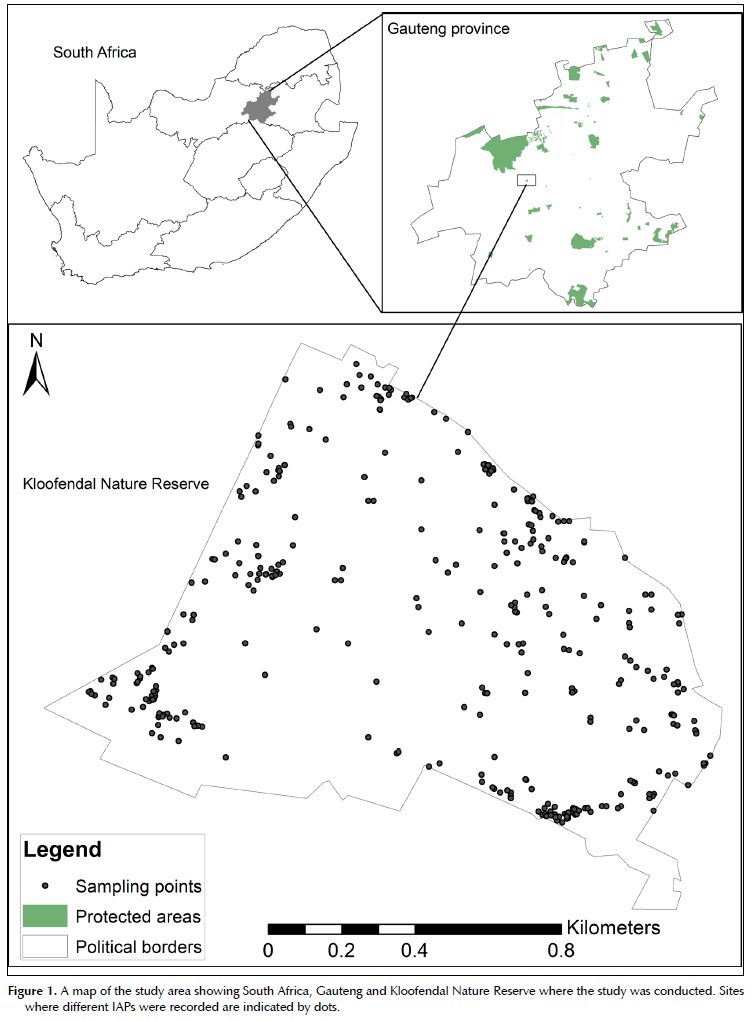
The KNR was selected as a case study site because the Friends of Kloofendal (FroK) have been actively working to control IAPs for more than eight years. The FroK is a non-profit organisation (NPO 92239), founded in August 2002, comprising community members who came together to conserve their local environment. The KNR is a 118 ha nature reserve located in Roodepoort, Gauteng, South Africa (Figure 1), managed by the Johannesburg City Parks and Zoo (JCPZ). According to the National List of Threatened Ecosystems under NEMBA, the vegetation in the reserve is classified as Roodepoort Reef Mountain Bushveld, which is critically endangered vegetation. Bushveld is generally maintained by periodic natural fires, which have not occurred for decades, resulting in heavy bush encroachment over approximately one-third of the reserve.
Identifying IAPs
To identify IAPs, we adopted a study conducted by Van Rooyen (2018), who developed a monitoring system for IAPs. The system involved documenting the number and location of five IAP species within 100 m2 quadrats distributed throughout the reserve (Van Rooyen 2018). These square quadrants were then followed up by Karin Spottiswoode to identify IAPs occurring in KNR. The identified IAPs found within the reserve and nearby areas were then documented in a field guide titled Invasive alien and problem plants on the Witwatersrand and Magaliesberg (Spottiswoode 2024). This guide was developed to enable the correct identification of these invasive plants and to provide recommended removal methods. The location of different IAPs recorded was captured using the GPS Essentials application (https://www.gpsessentials.com), which runs on Android (non-Apple) smartphones. Individual plants that were removed were recorded in the GPS Essentials app by creating waypoints with accurate GPS coordinates of less than 10 m, entering the species name under 'Name', and noting the number of removed individuals, with plant size often noted under 'Description'.
Controlling IAPs
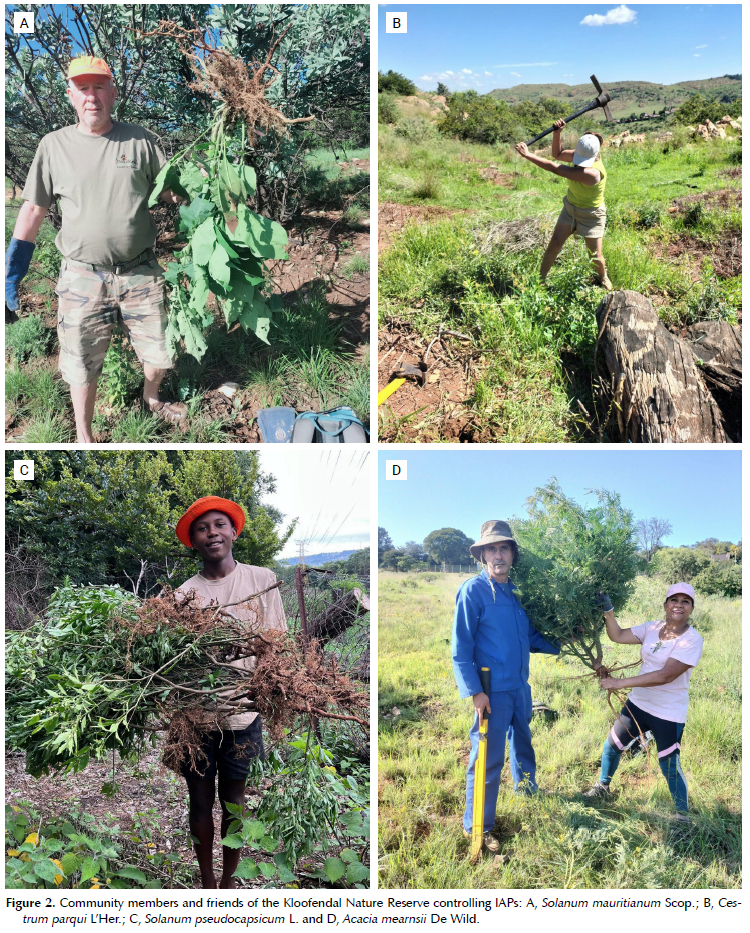
The control of IAPs in KNR was conducted by FroK in partnership with the JCPZ and occasionally by Expanded Public Works Programme (EPWP) employees (Figure 2). Other unpaid volunteer groups, such as members of organisations, school groups, scouts, Voortrekkers and corporate businesses, joined in the control of IAPs. These members were first trained to identify and control IAPs occurring in the area (e.g., including smelling and touching the plants). This was done to avoid mis-identifying congeneric IAPs that look similar to indigenous plants within the reserve.
A total of 21 trained volunteers contributed to IAPs' control. Fieldwork took place three times per week on Mondays, Wednesdays and Fridays, often in groups of two volunteers. Control techniques included hand-pulling, cutting and herbicide treatment, depending on plant size and life form. Larger woody species, such as Acacia mearnsii De Wild. and Acacia melanoxylon R.Br. were treated with appropriate herbicides (e.g., Kaput™). The operational details regarding clothing, equipment and removal procedures are provided in Supplementary material 1.
IAPs' removal records were collected using the GPS Essentials app. For each removal event, volunteers recorded the species names, coordinates, the date and time when the number of individual plants were removed and notes (e.g., large trees, seedlings, or matured for non-woody plants). Data were uploaded after each session as Keyhole Markup Language (KML) files and compiled into a central dataset managed by the FroK. Control activities occurred from January 2020 to December 2024. A data gap exists between September 2021 and July 2022, during which removals were recorded in handwritten logbooks not accessible during data extraction. This information on volunteer effort, such as the number of visits and hours worked for this period, was unavailable. As a result, effort-standardised metrics such as removals per hour or per visit could not be calculated. To assess the extent and scale of IAPs' control activities, the KML data were downloaded in December 2024.
Spatial coverage and sampling effort
Volunteer surveys and removals were conducted across all accessible areas of the reserve, including mapped
lAP clusters, designated walking paths, riparian zones and adjacent grassland and savanna patches. Although not strictly systematic, field activities covered most of the known invasion hotspots identified in previous mapping exercises. Sampling effort was calculated from the CSV database and consisted of approximately 826.5 hours of work, equivalent to 103.3 volunteer field days, with multiple volunteers participating per session. The supervisor worked a total of 427 days up to December 2024, equivalent to approximately 21 months of fulltime work. This included supervisor costs associated with the work conducted by both EPWP workers and FroK volunteers, as well as one month of programme development to convert KML files into a system capable of writing to and updating the CSV database, while ensuring accurate and consistent plant name verification. Effort varied seasonally depending on volunteer availability and vegetation growth.
Data processing and quality control
To ensure taxonomic accuracy, all species names were verified against the Plants of the World Online website (POWO; https://powo.science.kew.org), with accepted names used according to the Global Biodiversity Information Facility (GBIF; https://www.gbif.org/species/6). Only records with verifiable scientific names, curated specimens, valid geographic coordinates and documented numbers of individuals removed were included in the analysis. Records were excluded if they contained common names that could not be matched to a scientific name, lacked coordinates or removal numbers, or represented duplicate entries identified through data merging and geospatial deduplication procedures.
Species native to South Africa but alien to Gauteng were treated as native-alien populations (see Nelufule et al. 2022, 2023) and treated together with IAPs during analysis. These were included in analyses of abundance and life form but interpreted separately when discussing ecological and regulatory implications (Nelufule et al. 2022). An attempt to estimate the remaining IAP abundance using coordinate plotting was discontinued due to insufficient data on plants not yet removed.
Classification of species
For further analysis, all recorded species were categorised according to their life forms (fern, grass, climber, shrub, succulent and tree), following Mokotjomela et al. (2023). This includes pathways of invasion, according to Baard and Kraaij (2014) and the NEMBA AIS categories as described in Mokotjomela et al. (2023). Only the highest category for each species was allocated. These categories include categories 1a, 1b, 2 and 3. Category 1a species are those that should be eradicated as soon as they are identified; Category 1b species require a control and eradication management plan; while categories 2 and 3 are species that require a permit for their use and must be controlled if they occur in riparian zones (DEFF 2020). We used species use as a proxy for the pathway of invasion into the reserve. If a species had more than one means-of-invasion pathway, all pathways were used. Pathways of invasion were classified following the criteria outlined by Baard and Kraaij (2014). Information on these pathways was obtained from POWO and published literature. For the removed individual alien plants, these records were classified according to their life forms and NEMBA categories only. The total number of individual plants removed was also summed up by year using the aggregate function in R (R Core Team 2024). To visualize the occurrence records and locations of IAPs, desktop ArcGIS (version 10.8.1) was used to produce a map (Figure 1).
Estimating the cost associated with controlling IAPs
We applied the WfW programme to estimate the equivalent cost of controlling IAPs in KNR (Jubase et al. 2021). The calculation was based on the average number of hours worked per volunteer (H), the number of volunteers (V) and the number of weeks contributed per year (W). The total labour hours contributed annually (L) were thus estimated using the following formula:
L = H x V x W
The resulting labour hours were then converted into an equivalent economic value by multiplying L by the general worker wage rate (R) prescribed under the WfW programme:
C = L x R
Where C represents the total equivalent cost of labour. Rates used were R145 for a general worker and R245 for a supervisor per day.
Data analysis
We conducted several statistical analyses to evaluate the control records of IAPs in KNR between 2020 and 2024. Data were collected daily by different volunteers during plant removal activities; this operational sampling approach, while comprehensive, was opportunistic rather than randomised. As such, caution is warranted when interpreting inferential statistical tests.
A Chi-square (x2) test of independence was applied to compare the observed numbers of species recorded and individual alien plants removed among different invasive alien plant life forms. Additionally, Chi-square goodness-of-fit tests were performed to assess whether the observed distributions of control records differed significantly from expected uniform distributions. These tests analysed the distribution of recorded species across seven life forms (climber, fern, grass, herb, shrub, succulent and tree) and pathways of invasion, as well as the distribution of controlled individual plants across the same seven life forms and NEMBA categories (1a, 1b, 2, 3 and unlisted species). Expected frequencies were calculated by dividing the total number of species by the number of controlled individual plant records equally across categories.
For all Chi-square tests, effect sizes were calculated using Cramer's V to provide a measure of the strength of association between variables. Given the non-random nature of the data collection, these inferential tests were applied primarily as exploratory tools to detect broad patterns, rather than to make definitive population-level inferences. Descriptive statistics and observed distributions form the primary basis for understanding control efforts, with the tests providing preliminary insights that may guide future studies. All statistical analyses were conducted using the R Statistical Environment version 4.5.2 (R Core Team 2024), with a significance level set at p = 0.01.
Results
A total of 58 alien plant species from 28 different plant families were recorded from KNR. The most dominant plant family was Fabaceae, with eight species, followed by Solanaceae, with seven species, and Rosaceae and Asteraceae, with four species each (Supplementary table 1). Most alien plant species were observed to occur in linear patterns along sewer lines, along the path, fences and around electricity pylons, areas often associated with human disturbances.
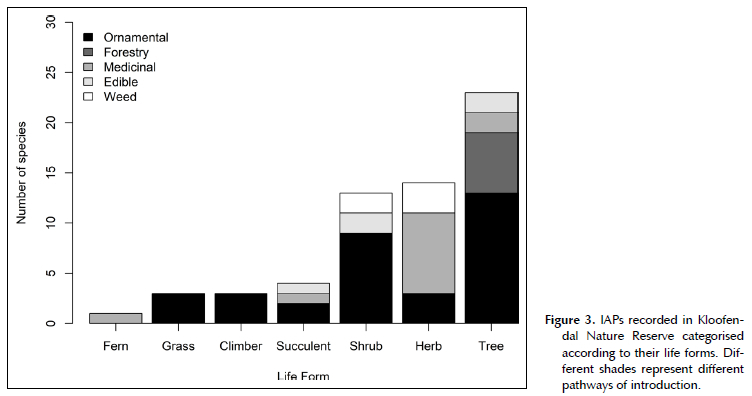
IAPs were recorded across seven life forms and five invasion pathway categories (Figure 3). The differences in the number of species among life forms are statistically significant (x2 (6) = 37. 828, p < 0.0001), with a moderate association strength indicated by Cramer's V = 0.33. Trees (n = 23) were the most species-rich life form and primarily introduced for ornamental purposes (n = 13) and forestry (n = 6), followed by herbs (n = 14) and shrubs (n = 13) (Figure 3).
The differences in the number of species among pathways of introduction were also statistically significant (4) = 47.6, p < 0.0001), with a moderate association indicated by Cramer's V = 0.40. The ornamental pathway was the most important contributor to the presence of alien plants, followed by medicinal uses.
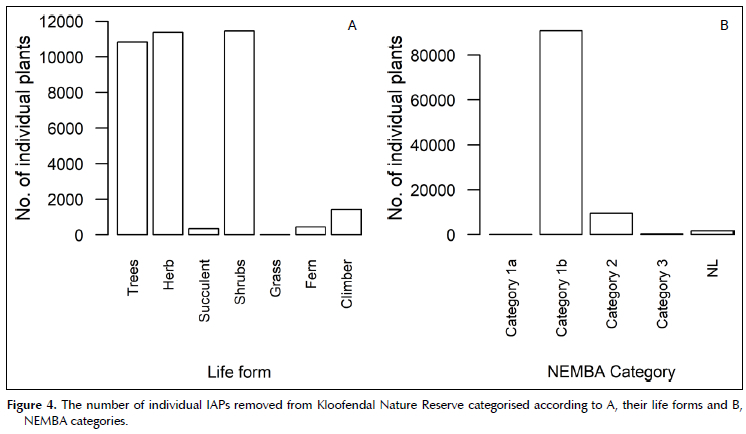
Many species (86%) recorded in KNR were listed in the NEMBA AIS categories, with most species listed as Category 1b (Figure 4B). Only eight species were not listed, and only one species fell under Category 1a (Figure 4B). The differences in the number of species among NEMBA categories were statistically significant (X2 (4) = 86.77, p < 0.0001), with a strong association as indicated by Cramer's V = 0.62, suggesting that species removals are unevenly distributed across regulatory categories.
A total of 150 798 individual plants were removed from KNR between 2020 and 2024. The number of removals differed significantly among life form categories (X2 (6) = 325.849, p < 0.0001), with a very strong association as indicated by Cramer's V = 0.73. Most removals were concentrated on shrubs, followed by trees and herbs (Figure 4A). The species contributing most to removals were Solanum pseudocapsicum L. (n = 43 658) and S. mauritianum Scop. (n = 14 722), while Cestrum parqui L'Her (n = 7 274) and Acacia mearnsii De Wild (n = 6 009) were also notable (Figure 2; Supplementary table 1). One native species, Podranea ricasoliana (Tanfani) Sprague, formed native-alien populations that compete with native vegetation and require effective control (Supplementary material 2). The absence of data for September 2021 to July 2022 means that total removals reported for this period represent a conservative estimate, as removals conducted during this interval could not be quantified. The distribution of removed individual plants across NEMBA categories was also highly uneven (X2 (4) = 304.383, p < 0.0001), with a very strong association indicated by Cramer's V = 0.86. The vast majority of removals occurred in Category 1b, followed by Category 2 (Figure 4B).
KNR contributed both financial and labour resources to the control of IAPs. Records indicate an average annual budget of R4 533.40 between 2020 and 2024, with volunteer labour valued at R252 577.00. Together, these contributions totalled R257 110.40 (approximately $14 729.83).
Discussion
This study provides a quantitative assessment of IAPs' control conducted by citizen scientists in KNR and offers insights into the scale and composition of removals in an urban protected area context. A total of 58 lAP species were targeted for control by volunteers, highlighting both the widespread distribution of IAPs in the reserve and the breadth of community-driven management effort. Our findings contribute to the growing body of literature emphasising the role of volunteers in IAPs' management (Shackleton et al. 2019) and are consistent with similar work conducted in the Western Cape, South Africa (Jubase et al. 2021), and in Brazil (Dechoum et al. 2019).
This collaborative model appears to reduce the spread of IAPs within KNR while simultaneously equipping the municipality with additional trained capacity to address invasions - an important consideration given the limited staff and conservation funding available to many local authorities (Irlich et al. 2017; Dechoum et al. 2019; Van Wilgen et al. 2022). If implemented more broadly across Johannesburg's nature reserves or adopted by municipalities elsewhere in South Africa, this approach could substantially reduce IAPs' management costs and facilitate more efficient allocation of conservation resources (McConnachie et al. 2012).
A high number of tree, herb and shrub species were recorded, indicating that these life forms dominate the reserve. The most frequently controlled IAPs were shrubs, herbs and trees, particularly S. pseudocapsicum, S. mauritianum, C. parqui and A. mearnsii. Similar to findings from the Western Cape and Brazil (Dechoum et al. 2019; Jubase et al. 2021), woody species were among the most actively removed taxa. This highlights that volunteer control efforts are important for reducing the impacts of alien plants in protected areas, especially woody invaders such as trees, which are known to have substantial ecological impacts (Hulme et al. 2014).
The high number of individual shrubs and herbs removed may reflect the ease with which these life forms can be controlled compared to trees. These species can often be uprooted manually or removed using small weeding tools, allowing volunteers to remove them quickly and efficiently (see Supplementary material 1 for methods and tools used). The concentration of species along paths, fences and disturbed linear features reflects their association with repeated human disturbance and propagule movement corridors, highlighting priority zones for targeted management.
Overall, ornamental plants were the most prevalent pathway of species introduction across nearly all life forms, particularly among trees, shrubs and climbers. This dominance reflects the well-documented role of the horticultural trade in driving the introduction of IAPs into protected areas (Van Wilgen & Herbst 2017; Foxcroft et al. 2019; Nelufule et al. 2024; Nelufule et al. 2026). Our findings show that this pathway is significant not only in remote national parks but also in urban protected areas such as KNR. These results highlight the need for coordinated pathway management strategies to curb the continued spread of ornamental alien plants into urban conservation areas.
The control activities also targeted P. ricasoliana (pink trumpet vine or Zimbabwe creeper), a commonly planted ornamental species that has formed a native-alien population within the reserve. Although P. ricasoliana is indigenous to KwaZulu-Natal, it was introduced into Gauteng as an ornamental plant (Nelufule et al. 2022). It has since escaped from cultivation and became invasive in KNR, where its numerous sprouting underground stems make it difficult to control. The species is displacing native vegetation and damaging infrastructure such as perimeter fencing. Their establishment suggests potential shifts in competitive dynamics within KNR, with implications for long-term vegetation structure and restoration planning.
Approximately 63% of the individual plants removed belonged to NEMBA Category 1b species, which also accounted for 65% of the total IAPs recorded in the reserve. Only one Category 1a species, Iris pseudacorus L. (yellow iris), occurred at low density and was removed. Similar patterns have been reported in the Western Cape, where volunteer groups also contributed to the control of low-density Category 1a species, such as Lythrum salicaria L., Spartina alterniflora Loisel. and Melaleuca spp. (Jubase et al. 2021). These findings indicate that community volunteers are playing a meaningful role in implementing South Africa's invasive species regulations and in supporting the management of high-risk species. Public involvement, therefore, remains crucial for the long-term sustainability of protected areas and the effective management of IAPs (Crall et al. 2011; Martin et al. 2019).
The highest number of individual plants removed was recorded in 2024, when 58 318 individual invasive and problematic native plants were removed (Supplementary material 3), reflecting the continued commitment of community volunteers to managing vegetation within the reserve (Figure 2). The sharp increase in removals after 2022 indicates an escalation in volunteer control effort and/or changes in lAP population density, suggesting shifting management pressure over the study period. Although this study highlights the important contribution of volunteers to IAP control in KNR, several limitations of the citizen science approach should be acknowledged.
First, volunteer effort varies over time and can be influenced by weather, personal availability or levels of motivation, which may introduce inconsistencies in detection and removal rates. Second, the dataset relies on volunteer observations and manual identification, which may lead to misidentifications of species, underreporting of difficult to detect taxa, bias toward easily accessible areas and data loss. For example, the data gap noted was reported between September 2021 and July 2022. This means that reported totals represent conservative values, and temporal trends should be interpreted with caution. Thirdly, removals reflect what volunteers encountered rather than a systematic survey of the entire reserve, as shown in Nelufule et al. (2026), meaning that the data may not represent the full spatial distribution or abundance of IAPs within the reserve. These limitations suggest that while citizen science provides valuable large-scale labour and local knowledge, its outputs should be interpreted alongside more systematic ecological surveys. Recognising these constraints helps contextualise the findings and highlights the need for integrated monitoring frameworks that combine volunteer participation with professional oversight. In addition, comparisons with other protected areas in Johannesburg managed by JCPZ show considerably higher abundances of IAPs than those observed in KNR (Nelufule et al. 2026). This contextual comparison suggests that the volunteer-driven management regime at KNR is contributing to lower invasion levels relative to other reserves.
Volunteers contribute directly to the control of IAPs and provide essential services that support both municipalities and broader society (Pagès et al. 2019). Given the chronic underfunding of conservation initiatives at the municipal level in South Africa, including invasive plant management (Van Wilgen et al. 2022), volunteer engagement plays a critical role in sustaining conservation work during periods of budgetary constraint. Although the estimated economic contribution reported in this study is lower than that documented for the Western Cape (Jubase et al. 2021), important similarities emerge: in both cases, volunteer groups provide demonstrable economic value to IAP management in South Africa. This highlights the substantial contribution of community-based conservation in urban protected areas.
In addition to ecological and economic benefits, FroK's work offers meaningful social value. Many volunteers are pensioners, and participation in conservation activities supports both physical and psychological well-being (Koss & Kingsley 2010; Molsher & Townsend 2016), further reinforcing the wide-ranging societal importance of volunteer-led environmental stewardship.
Way forward
Effective management of IAPs depends on clear communication and the active involvement of diverse stakeholders (García-Llorente et al. 2011; Novoa et al. 2018). This study highlights five key stakeholder groups that municipal protected areas should engage to improve lAPs' management, namely private landowners, community members, government agencies, universities and scientists (e.g., invasion biologists). In South Africa, these stakeholders include different tiers of government, state-owned entities, scientific authorities such as the DST-NRF Centre for Invasion Biology, and implementation agencies responsible for detecting and managing biological invasions.
Adopting co-management approaches - where protected areas collaborate with community groups, scientists and government agencies - can enhance transparency, build trust, improve joint planning and reduce conflicts of interest (Shine & Doody 2010; Mason et al. 2018; Shackleton et al. 2019). Collaboration with scientists can help identify research gaps, improve species identification, strengthen monitoring methods and support evidence-based management decisions. Engagement with government agencies promotes compliance with legislative requirements, facilitates inter-governmental coordination, and enables the sharing of resources such as expertise, data and funding. Community members, in turn, can contribute through early detection and hands-on control of emerging invasions.
However, not all nature reserves in Johannesburg have active 'Friends' groups or the social capital needed to sustain regular volunteer involvement. To address this gap, both locally and in other African urban areas, relevant authorities should support the establishment and training of community-based stewardship groups, provide financial incentives where budgets allow, and develop dedicated municipal teams trained to identify, remove and document lAPs systematically.
To maximise the success of lAP management, municipal and government-managed protected areas should develop detailed species inventories to guide monitoring, control and eradication activities (Nelufule et al. 2026). These plans must comply with the requirements of Section 76 of NEMBA (Act No. 10 of 2004) for species listed under Section 70 (DEFF 2020). Integrating the lAPs' control plan into the reserve's ecological management plan and following a structured, evidence-based approach will strengthen the effectiveness and long-term sustainability of control efforts.
Conclusion
Our findings indicate that volunteers often target the lAPs that pose the greatest ecological risk in KNR, especially Category 1b ornamental shrubs, herbs and trees, and that their efforts have intensified over time. By linking life-form traits with invasion pathways, the study identifies which species offer the highest return on control effort and therefore provides a practical framework for prioritising future volunteer and formal management actions. Overall, the evidence demonstrates that volunteer programmes are not merely supplementary but are strategically impactful. They enhance the effectiveness of formal conservation initiatives, accelerate invasive species control, and strengthen urban biodiversity resilience.
Acknowledgements
We acknowledge Friends of Kloofendal for data on alien plant species removed from KNR. We thank Amelia, Andre, Brian, Don, Jonathan, Jeanette, Dumisani, Dear, Frank, Hector, Helene, Junior, MaryJane, Mhlume, Precious, Rico, Scouts South Africa, Simoney, Takalani, Tamaryn, Terry and Friends of Kloofendal for removing alien plant species in KNR and recording data on the GPS Essentials application. We are most grateful to the anonymous reviewers for their constructive comments, which helped improve our manuscript.
Data Resources
Data for this study are available on request from the authors.
Ethic consideration
Ethical approval to conduct this study was granted by the University of South Africa Human Ethics Committee (Ethic number: 2025/CAES_HREC/6772). The Johannesburg City, Parks and Zoo also granted us permission to access the KNR and allowed us to communicate with staff, interns and work-integrated learning students involved in the eradication of lAPs in its reserves.
Funding
The Johannesburg City Parks and Zoos are thanked for funding, noting that this publication does not necessarily represent JCPZ's views or opinions. We also thank the University of South Africa for its logistical support.
Competing interests
The authors have declared that no competing interests exist.
Authors' contributions
TN (University of South Africa) conceptualised, analysed data and wrote the manuscript; TCS (University of South Africa) and NS (Tshwane University of Technology) were responsible for analysing the data and editing the manuscript. KLS and SMS were responsible for collecting and cleaning the data and editing the manuscript (Friends of Kloofendal); LS and BN provided funding and edited the manuscript (Johannesburg City Parks and Zoos).
References
Baard, J.A. & Kraaij, T. , 2014, Alien flora of the Garden Route National Park, South Africa', South African Journal of Botany 94, 51-63, https://doi.org/10.1016/j.sajb.2014.05.010. [ Links ]
Braun, M., Schindler, S. & Essl, F., 2016, 'Distribution and management of invasive alien plant species in protected areas in central Europe', Journal for Nature Conservation 33, 48-57, https://doi.org/10.1016/j.jnc.2016.07.002. [ Links ]
Cadotte, M.W., Alabbasi, M., Akib, S., Chandradhas, P., Gui, J., Huang, K., Li, A., Richardson, D.M. & Shackleton, R.T., 2024, 'Gauging the threat of invasive species to UNESCO world heritage sites relative to other anthropogenic threats', Biological Invasions 26,11, 3959-3973, https://doi.org/10.1007/s10530-024-03424-0. [ Links ]
Capinha, C., Essl, F., Porto, M. & Seebens, H., 2023, 'The worldwide networks of spread of recorded alien species', Proceedings of the National Academy of Sciences 120,1, e2201911120, https://doi.org/10.1073/pnas.2201911120. [ Links ]
César de Sá, N., Marchante, H., Marchante, E., Cabral, J.A., Honrado, J.P. & Vicente, J.R., 2019, 'Can citizen science data guide the surveillance of invasive plants? A model-based test with Acacia trees in Portugal', Biological Invasions 21,6, 2127-2141, https://doi.org/10.1007/s10530-019-01962-6. [ Links ]
Crall, A.W., Jarnevich, C.S., Young, N.E., Panke, B.J., Renz, M. & Stohlgren, T.J., 2015, 'Citizen science contributes to our knowledge of invasive plant species distributions', Biological Invasions 17, 2415-2427, https://doi.org/10.1007/s10530-015-0885-4. [ Links ]
Crall, A.W., Jordan, R., Holfelder, K., Newman, G.J., Graham, J. & Waller, D.M., 2013, 'The impacts of an invasive species citizen science training program on participant attitudes, behavior, and science literacy', Public Understanding of Science 22,6, 745-764, https://doi.org/10.1177/0963662511434894. [ Links ]
Crall, A.W., Newman, G.J., Jarnevich, C.S., Stohlgren, T.J., Waller, D.M. & Graham, J., 2010, 'Improving and integrating data on invasive species collected by citizen scientists', Biological Invasions 12, 3419-3428, https://doi.org/10.1007/s10530-010-9740-9. [ Links ]
Crall, A.W., Renz, M., Panke, B. & Newman, G.J., 2011, 'Is there a role for the public in monitoring invasive species?', CABI Reviews 2011, 1-7. [ Links ]
Dechoum, M.D.S., Giehl, E.L.H., Sühs, R.B., Silveira, T.C.L. & Ziller, S.R., 2019, 'Citizen engagement in the management of non-native invasive pines: Does it make a difference?', Biological Invasions 21, 175-188, https://doi.org/10.1007/s10530-018-1814-0. [ Links ]
DEFF (Department of Environment, Forestry and Fisheries), 2020, National Environmental Management: Biodiversity Act (Act No. 10 of 2004), Alien and Invasive Species Lists, Notice 1003 of 2020, no. 43726, Government Gazette, pp. 31-77. [ Links ]
Dolan, R.W, Harris, K.A. & Adler, M., 2015, 'Community involvement to address a long-standing invasive species problem: Aspects of civic ecology in practice', Ecological Restoration 33,3, 316-325, https://doi.org/10.3368/er.33.3.316. [ Links ]
Encarnação, J., Teodósio, M. & Morais, P., 2021, 'Citizen science and biological invasions: a review', Frontiers in Environmental Science 8, p. 602980, https://doi.org/10.3389/fenvs.2020.602980. [ Links ]
Foxcroft, L.C., Spear, D., Van Wilgen, N.J. & McGeoch, M.A., 2019, 'Assessing the association between pathways of alien plant invaders and their impacts in protected areas', NeoBiota 43, 1-25, https://doi.org/10.3897/neobiota.43.29644. [ Links ]
Gallo, T. & Waitt, D., 2011, 'Creating a successful citizen science model to detect and report invasive species', BioScience 61,6, 459-465, https://doi.org/10.1525/bio.2011.61.6.8. [ Links ]
García-Llorente, M., Martín-López, B., Nunes, P.A., González, J.A., Alcorlo, P. & Montes, C., 2011, 'Analyzing the social factors that influence willingness to pay for invasive alien species management under two different strategies: eradication and prevention', Environmental Management 48, 418-435, https://doi.org/10.1007/s00267-011-9646-z. [ Links ]
Gentili, R., Schaffner, U., Martinoli, A. & Citterio, S., 2021, 'Invasive alien species and biodiversity: Impacts and management', Biodiversity 22(1-2), 1-3, https://doi.org/10.1080/14888386.2021.1929484. [ Links ]
Gildenhuys, C.P., Potgieter, L.J. & Richardson, D.M., 2024, 'The genus Quercus (Fagaceae) in South Africa: Introduction history, current status, and invasion ecology', South African Journal of Botany 167, 150-165, https://doi.org/10.1016/j.sajb.2024.01.066. [ Links ]
Henderson, L., 2007, 'Invasive, naturalized and casual alien plants in southern Africa: a summary based on the Southern African Plant Invaders Atlas (SAPIA)', Bothalia 37,2, 215-248, https://doi.org/10.4102/abc.v37i2.322. [ Links ]
Henderson, L. & Wilson, J.R., 2017, 'Changes in the composition and distribution of alien plants in South Africa: an update from the Southern African Plant Invaders Atlas', Bothalia - African Biodiversity & Conservation 47,2, 1-26, https://doi.org/10.4102/abc.v47i2.2172. [ Links ]
Hulbert, J.M., Hallett, R.A., Roy, H.E. & Cleary, M., 2023, 'Citizen science can enhance strategies to detect and manage invasive forest pests and pathogens', Frontiers in Ecology and Evolution 16,11, 1113978, https://doi.org/10.3389/fevo.2023.1113978. [ Links ]
Hulme, P.E., Pysek, P., Pergl, J., Jarosík, V., Schaffner, U. & Vilà, M., 2014, 'Greater focus needed on alien plant impacts in protected areas', Conservation Letters 7,5, 459-466, https://doi.org/10.1111/conl.12061. [ Links ]
Irlich, U.M., Potgieter, L.J., Stafford, L. & Gaertner, M., 2017, 'Recommendations for municipalities to become compliant with national legislation on biological invasions', Bothalia - African Biodiversity & Conservation 47,2, 1-11, https://doi.org/10.4102/abc.v47i2.2156. [ Links ]
Jubase, N., Shackleton, R.T. & Measey, J., 2021, 'Motivations and contributions of volunteer groups in the management of lAPs in South Africa's Western Cape province', Bothalia - African Biodiversity & Conservation 51,2, 1-13, https://doi.org/10.38201/btha.abc.v51.i2.3. [ Links ]
Koss, R.S. & Kingsley, J.Y., 2010, 'Volunteer health and emotional wellbeing in marine protected areas', Ocean & Coastal Management 53, 447-453. https://doi.0rg/10.1016/j.ocecoaman.2010.06.002. [ Links ]
Latombe, G., Pysek, P., Jeschke, J.M., Blackburn, T.M., Bacher, S., Capinha, C., Costello, M.J., Fernández, M., Gregory, R.D., Hobern, D., Hui, C., Jetz, W., Kumschick, S., McGrannachan, C., Pergl, J., Roy, H.E., Scalera, R., Squires, Z.E., Wilson, J.R.U., Winter, M., Genovesi, P. & McGeoch, M.A., 2017, 'A vision for global monitoring of biological invasions', Biological Conservation 213, 295-308, http://dx.doi.org/10.1016/j.biocon.2016.06.013. [ Links ]
Luigi Nimis, P., Pittao, E., Altobelli, A., De Pascalis, F., Laganis, J. & Martellos, S., 2019, 'Mapping invasive plants with citizen science. A case study from Trieste (NE Italy)', Plant Biosystems 153,5, 700-709, https://doi.org/10.1080/11263504.2018.1536085. [ Links ]
Martin, P., Alter, T.R., Hine, D. & Howard, T. (eds) , 2019, Community-based control of invasive species, CSIRO Publishing, Australia. [ Links ]
Mason, T.H., Pollard, C.R., Chimalakonda, D., Guerrero, A.M., Kerr-Smith, C., Milheiras, S.A., Roberts, M., Ngafack, P.R. & Bunnefeld, N., 2018, 'Wicked conflict: Using wicked problem thinking for holistic management of conservation conflict', Conservation Letters 11,6, e12460, https://doi.org/10.1111/conl.12460. [ Links ]
McConnachie, M.M., Cowling, R.M., Van Wilgen, B.W. & Mc-Connachie, D.A., 2012, 'Evaluating the cost-effectiveness of invasive alien plant clearing: a case study from South Africa', Biological Conservation 155, 128-135, https://doi.org/10.1016/j.biocon.2012.06.006. [ Links ]
Mokotjomela, T.M., Rahlao, S.J., Vukeya, L.R., Baltzinger, C., Mangane, L.V., Willis, C.K., & Mutshinyalo, T.M., 2023, 'The diversity of alien plant species in South Africa's national botanical and zoological gardens', Diversity 15, 1-31, https://doi.org/10.3390/d15030407. [ Links ]
Molsher, R. & Townsend, M., 2016, 'Improving wellbeing and environmental stewardship through volunteering in nature', Ecohealth 13, 151-155, https://doi.org/10.1007/s10393-015-1089-1. [ Links ]
Nel, J.L., Richardson, D.M., Rouget, M.J., Mgidi, T.N., Mdzeke, N., Le Maitre, D.C., Van Wilgen, B.W., Schonegevel, L., Henderson, L. & Neser, S., 2004, 'A proposed classification of invasive alien plant species in South Africa: towards prioritizing species and areas for management action: working for water', South African Journal of Science 100,1, 53-64, https://hdl.handle.net/10520/EJC96213. [ Links ]
Nelufule, T., Robertson, M.P., Wilson, J.R.U. & Faulkner, K.T., 2022, 'Native-alien populations - an apparent oxymoron that requires specific conservation attention', NeoBiota 74, 57-74, https://doi.org/10.3897/neobiota.74.81671. [ Links ]
Nelufule, T., Robertson, M.P., Wilson, J.R.U. & Faulkner, K.T., 2023, 'An inventory of native-alien populations in South Africa', Scientific Data 10,1, 213, https://doi.org/10.1038/s41597-023-02119-w. [ Links ]
Nelufule, T., Shirindzi, L. & Shivambu, T.C., 2026, 'A preliminary checklist of alien and invasive plant species within protected areas of the City of Johannesburg, Gauteng, South Africa', African Biodiversity & Conservation 56(2), a11, http://dx.doi.org/10.38201/abc.v56.2.a11. [ Links ]
Nelufule, T., Thenga, T.C., Shivambu, T.C., Shivambu, N., Moshobane, M.C., Seoraj-Pillai, N. & Nangammbi, T.C., 2024, 'Alien plant species richness in urban protected biodiversity areas: a case study of Tshwane Metropolitan Municipality, South Africa', Diversity 16,8, 461, https://doi.org/10.3390/d16080461. [ Links ]
Novoa, A., Shackleton, R., Canavan, S., Wilson, J.R.U., 2018, 'A framework for engaging stakeholders on the management of alien species', Journal of Environmental Management 205, 286-297, https://doi.org/10.1016/j.jenvman.2017.09.059. [ Links ]
Nsikani, M.M., Geerts, S., Ruwanza, S. & Richardson, D.M., 2020, 'Secondary invasion and weedy native species dominance after clearing invasive alien plants in South Africa: status quo and prognosis', South African Journal of Botany 132, 338-345, https://doi.org/10.1016/j.sajb.2020.05.009. [ Links ]
Pagès, M., Fischer, A., Van der Wal, R. & Lambin, X., 2019, 'Empowered communities or "cheap labour"? Engaging volunteers in the rationalised management of invasive alien species in Great Britain', Journal of Environmental Management 229, 102-111, https://doi.org/10.1016/j.jenvman.2018.06.053. [ Links ]
Pocock, M.J., Adriaens, T., Bertolino, S., Eschen, R., Essl, F., Hulme, P.E., Jeschke, J.M., Roy, H.E., Teixeira, H. & De Groot, M., 2024, 'Citizen science is a vital partnership for invasive alien species management and research', Iscience 27,1, 108623, https://doi.org/10.1016/j.isci.2023.108623. [ Links ]
Potgieter, L.J., Cadotte, M.W., Roets, F. & Richardson, D.M., 2024b, 'Monitoring urban biological invasions using citizen science: the polyphagous shot hole borer (Euwallacea fornicatus)', Journal of Pest Science 93, 2073-2085, https://doi.org/10.1007/s10340-024-01744-7. [ Links ]
Potgieter, L.J., Ter Huurne, M.B. & Richardson, D.M., 2024a, 'Community science can inform invasive species management: Melaleuca (Myrtaceae) in South Africa', Ecological Solutions and Evidence 5,4, e12391, https://doi.org/10.1002/2688-8319.12391. [ Links ]
Pysek, P., Pergl, J., Van Kleunen, M., Dawson, W., Essl, F., Kreft, H., Weigelt, P., Wilson, J.R., Winter, M. & Richardson, D.M., 2020, 'South Africa as a donor of naturalised and invasive plants to other parts of the world', in B.W. van Wilgen, J. Measey, D.M. Richardson, J.R. Wilson & T.A. Zengeya (eds.), Biological invasions in South Africa (pp. 759-785), Springer, Cham, Switzerland, https://doi.org/10.1007/978-3-030-32394-3_26. [ Links ]
R Core Team, 2024, R: A language and environment for statistical computing. R Foundation for Statistical Computing, https://www.R-project.org. [ Links ]
Richardson, D.M. & Potgieter, L.J., 2024, 'A living inventory of planted trees in South Africa derived from iNaturalist', South African Journal of Botany 173, 365-379, https://doi.org/10.1016/j.sajb.2024.08.006. [ Links ]
Ruland, F. & Jeschke, J.M., 2020, 'How biological invasions affect animal behaviour: a global, cross-taxonomic analysis', Journal of Animal Ecology 89,11, 2531-2541, https://doi.org/10.1111/1365-2656.13306. [ Links ]
Shackleton, R.T., Adriaens, T., Brundu, G., Richardson, D.M., 2019, 'Stakeholder engagement in the study and management of invasive alien species', Journal of Environmental Management 229, 88-101, https://doi.org/10.1016/j.jenvman.2018.04.044. [ Links ]
Shackleton, R.T., Bertzky, B., Wood, L.E., Bunbury, N., Jager, H., Van Merm, R., Sevilla, C., Smith, K., Wilson, J.R.U., Witt, A.B.R. & Richardson, D.M., 2020, 'Biological invasions in World Heritage Sites: current status and a proposed monitoring and reporting framework', Biodiversity and Conservation 29,11, 3327-3347, https://doi.org/10.1007/s10531-020-02026-1. [ Links ]
Shine, R. & Doody, J.S., 2010, 'Invasive species control: understanding conflicts between researchers and the general community', Frontiers in Ecology and the Environment 9,7, 400-406, https://doi.org/10.1890/100090. [ Links ]
Skocajic, D. & Nesic, M., 2021, 'Invasive species: routes of introduction, establishment, and expansion', in W. Leal Filho, A.M. Azul, L. Brandli, A. Lange Salvia & T. Wall (eds), Life on Land - Encyclopedia of the UN Sustainable Development Goals, Springer, Cham, pp. 571-582, https://doi.org/10.1007/978-3-319-95981-8_66. [ Links ]
Spottiswoode, K.L., 2024, Invasive alien & problem plants on the Witwatersrand & Magaliesberg, field guide, https://invasives.org.za/wp-content/uploads/2025/02/AlP-3Feb25_KarinSpottiswoode.pdf. [ Links ]
Van Rooyen, C., 2018, Alien Invasive Plant control in a small urban reserve, research portfolio - Group III, University of South Africa. [ Links ]
Van Wilgen, B.W. & Wannenburgh, A., 2016, 'Co-facilitating invasive species control, water conservation and poverty relief: achievements and challenges in South Africa's Working for Water programme', Current Opinion in Environmental Sustainability 19, 7-17, https://doi.org/10.1016/j.cosust.2015.08.012. [ Links ]
Van Wilgen, B.W., Wannenburgh, A. & Wilson, J.R.U., 2022, 'A review of two decades of government support for managing alien plant invasions in South Africa', Biological Conservation 274, 109741, https://doi.org/10.1016/j.biocon.2022.109741. [ Links ]
Van Wilgen, N.J. & Herbst, M., 2017, Taking stock of parks in a changing world: the SANParks Global Environmental Change Assessment, South African National Parks, Cape Town. [ Links ]
Zengeya, T.A. & Wilson, J.R. (eds) , 2023, The status of biological invasions and their management in South Africa in 2022, South African National Biodiversity Institute, Kirstenbosch and DSI-NRF Centre of Excellence for Invasion Biology, Stellenbosch, pp. 122, http://dx.doi.org/10.5281/zenodo.8217182. [ Links ]
 Correspondence:
Takalani Nelufule
E-mail: takalani.nelu@gmail.com
Submitted: 28 February 2025
Accepted: 3 February 2026
Published: 31 March 2026
DISCLAIMER: Please note that supplementary materials are not edited, proofread or designed by SANBI Graphics and Editing and is the sole work and responsibility of the author(s).
Supplementary materials
Available online: http://dx.doi.org/10.38201/abc.v56.2.a10.
Supplementary table 1: Table summarising alien plant species and native-alien population occurring and currently being controlled in Kloofendal Nature Reserve.
Supplementary material 1: Methods and tools used to control IAPs.
Supplementary material 2: Supplementary figure 1.
Supplementary material 3: Supplementary figure 2.