



Services on Demand
Journal

Article
 English (pdf)
 Article in xml format
 Article references
 Automatic translation
 Send this article by e-mail
Indicators
Related links
-
 Cited by Google
 -
 Similars in Google
Share

 Permalink
African Biodiversity & Conservation
On-line version ISSN 3078-8056Print version ISSN 0006-8241
Bothalia (Online) vol.56 n.2 Pretoria 2026
https://doi.org/10.38201/abc.v56.2.a7
ORIGINAL RESEARCH
Alien ornamental plants on sale in Botswana, Namibia and Zimbabwe: potential sources for plant invasions
Diana Rodríguez-CalaI, II, III; John R.U. WilsonIII, IV; Katharina Dehnen-SchmutzI; Jana FriedI; Seoleseng O. TshwenyaneII; Israel A. LegwailaII
ICentre for Agroecology, Water and Resilience, Coventry University, Coventry, UK
IIDepartment of Crop and Soil Science, Botswana University of Agriculture and Natural Resources, Gaborone, Botswana
IIICentre for Invasion Biology, Department of Botany and Zoology, Stellenbosch University, Stellenbosch, South Africa
IVSouth African National Biodiversity Institute, Kirstenbosch Research Centre, Cape Town, South Africa
ABSTRACT
Ornamental gardening has historically been, and continues to be, a primary pathway for plant introductions into southern Africa. Knowing which alien plants are being sold and used as ornamentals in the subregion is important to assess the potential for future biological invasions and conflicts between stakeholders. We compiled a list of all plant taxa on sale across eleven nurseries in Botswana (3), Namibia (2) and Zimbabwe (6) by accessing the plants in stock either on the nurseries' websites, on social media or via stock lists shared by the nursery owners. The compilation was matched with the Global Register of Introduced and Invasive Species to identify invasive taxa. Of 1 193 species that were found to be on sale, 784 are alien to the continental Southern African Development Community (SADC) subregion, 289 have established alien populations in at least one continental SADC country, and 82 are considered invasive in at least one continental SADC country. Many of the established and invasive plants are popular trees and shrubs in the subregion and worldwide. Most of them have a wide native range usually covering more than one continent. This paper provides a quantification of invasion debt due to the ornamental sector in southern Africa and a baseline to identify priorities for risk analysis and potential regulation or control at a sub-regional level.
Keywords: established species, invasive species, non-native plants, plant nurseries, southern Africa.
Introduction
Ornamental plants have accompanied humanity since the early days of civilisations (Wilson et al. 2016). With transoceanic exploration, European colonisation and later industrialisation, ornamental gardening and landscaping became an industry that has moved thousands of plant species around the world (Van Kleunen et al. 2018; Hinsley et al. 2025). This contributed to the introduction and spread of alien plants following trends, fashions and passions (Wilson et al. 2016; Van Kleunen et al. 2018; Altman et al. 2022). In southern Africa, ornamental gardening has been one of the main historical pathways for plant introduction, accounting for 30-70% of the intentional introductions in different countries of the subregion between the 19th and 20th centuries (Henderson 2006; Maroyi 2017; Kobisi et al. 2019). Introduced ornamental plants like Lantana camara, Pontederia crassipes and Tithonia diversifolia have become invasive in the subregion, with complex dynamics of costs and benefits that vary with time, space and stakeholder (Novoa et al. 2018; Shackleton et al. 2019).
Plant introductions for ornamental horticulture into South Africa are predicted to continue increasing (Faulkner et al. 2020), and currently invasive plants have been shown to still be spreading (Henderson & Wilson 2017; Wilson et al. 2007). Given the transboundary nature of the ornamental-related trade and exchange documented in the subregion (Rodríguez-Cala et al. 2025), the high invasion debt seen in South Africa (e.g., Rouget et al. 2016) likely reflects the invasion debt of the subregion as a whole.
Alien plants are generally dominant in gardens and public spaces across the urban areas of the subregion (Mafokate et al. 2013; Shackleton & Shackleton 2016, 2018; Kashe et al. 2022; Richardson & Potgieter 2024; Milton & Dean 2025). People's preferences of ornamental plants tend to favour alien species (Rodríguez-Cala et al. 2025). This intentional spread combined with environmental suitability and species' invasiveness is likely to result in more invasions over time.
Knowing which species are currently on sale and used in the subregion is an essential step to assess the likelihood of some of them becoming invasive or a source of conflict of interest. However, there are a few studies documenting this in the subregion, e.g., Cronin et al. (2017) South Africa, and Mukubu Pika et al. (2024) in the Democratic Republic of Congo. This paper focuses on which plant species are on sale in three countries (Botswana, Namibia and Zimbabwe) in the context of the need to evaluate southern Africa's invasion debt.
Materials and methods
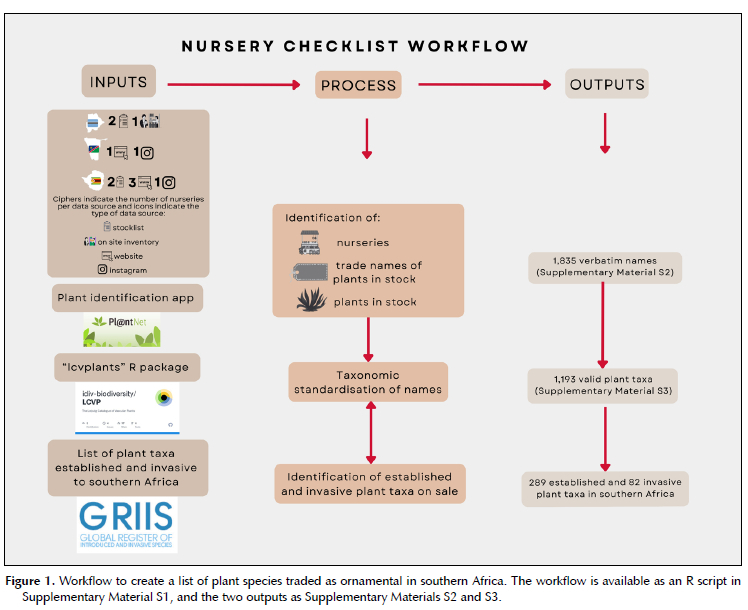
We collected data between July 2022 and July 2024. We (1) identified nurseries in the region; (2) obtained lists of which plants they stock; (3) identified plants; (4) standardised the taxonomy used; (5) compared the lists with lists of alien and invasive alien plants from the region; and (6) used various databases to provide ancillary data on the taxa in the lists. We discuss each of these points in turn below with the overall workflow summarised in Figure 1.
Nursery identification
We used a Google map search, data sharing and validation, and further key informants' input (snowballing sampling) and in situ identification in Botswana, Namibia and Zimbabwe. The Google map search allowed us to identify 18 nurseries in Botswana, two in Zimbabwe and one in Namibia. Key informants indicated nine more nurseries, and we identified a dozen other nurseries in Botswana. In Harare, Zimbabwe, the co-organiser of the Annual Garden Show indicated 33 nurseries. We identified eight other nurseries in the show and another six in the city. In Namibia, we identified 10 nurseries.
Obtaining estimates of which plants were stocked
We accessed the stock of three formal nurseries identified in Botswana, two in Namibia and six in Zimbabwe. Of these 11 nurseries: four shared their list of plants in stock (two in Botswana and two in Zimbabwe); four had up-to-date lists on their websites (one in Namibia and three in Zimbabwe); we identified plants from the Instagram page of two nurseries (one in Namibia and one in Zimbabwe); and we identified plants during a visit to one nursery in Botswana.
Plant identification
Pl@ntNet app (Pl@ntNet n.d.) and plant guides (Pienaar & Smith 2011; Bromilow 2018) were used for plant identification by the first author (who has a background in plant identification including through working as a researcher in the Cuban National Herbarium, Onaney Muñiz).
Taxonomic standardisation
Plant names were standardised by applying the 'lcvplants' R package (Freiberg et al. 2020), using the 2023 version of the Leipzig Plant Catalogue as taxonomic backbone.
Matching with records of establishment in the region
The 'lcvplants' R package (Freiberg et al. 2020) was used to match the resulting plant inventory with the register of introduced and invasive species (GRIIS) for the 12 continental countries belonging to the Southern African Development Community (SADC n.d.; Braun et al. 2020 for Eswatini; Chase & Pagad 2020 for Namibia; Figueiredo et al. 2020 for Angola; Groom et al. 2020 for the Democratic Republic of Congo; Hae & Pagad 2020 for Lesotho; Heath et al. 2020 for Botswana; Maroyi et al. 2020 for Zimbabwe; Mwanyambo et al. 2020 for Malawi; Pagad 2022 for Mozambique; Robinson et al. 2020 for South Africa; Witt & Pagad 2020 for Zambia; Witt et al. 2020 for Tanzania). GRIIS records alien species and native-alien populations of native species that have established in a given country, noting whether the species has evidence of negative impacts on species, ecosystems and services (Pagad et al. 2018). If the species has evidence of negative impacts - which includes being widespread, highly abundant and fast-spreading - GRIIS categorises it as 'invasive'. This definition is different from the Unified Framework for Biological Invasions (Blackburn et al. 2011), but it is in line with the Intergovernmental Science-Policy Platform on Biodiversity and Ecosystem Services (IPBES 2023). We conducted a fuzzy matching that allowed for differences in spellings, with a distance of up to 10 letters to match in the string (Supplementary Material 1). In addition, the matching had a grammar check that fixes common Latin grammar mistakes. The resulted list constitutes a checklist of established and/or invasive plant species currently traded within the ornamental sector across Botswana, Namibia and Zimbabwe.
Ancillary data
We obtained information on the growth form, native range and higher level classification (i.e., family) for those taxa recorded as established and/or invasive in any of the continental SADC countries. We used 'Plants of the World Online' (POWO 2024) to collect information on growth form and geographical origin. We grouped the growth forms found in POWO into seven broad categories: climber (including liana), herb (including geophyte), epiphyte (including lithophyte), shrub (including subshrub), succulent, tree and a combination of shrub-tree. For the biogeographical origin, we used the nine Level 1 botanical regions of the World Geographical Scheme for Recording Plant Distributions of the Taxonomic Databases Working Group (Brummitt 2001).
Results
We compiled 1 835 plant names from 11 formal nurseries in Botswana, Namibia and Zimbabwe. The taxonomic standardisation resulted in 1 193 accepted species names, 320 synonyms, 207 names that could not be found, 12 unresolved names, 85 seem to have typos (e.g., the algorithm recognised two different Agave americana taxa because the space between the genus and the specific epithet was single in one nursery checklist and double in another) and 18 taxa at generic level (Supplementary Material 2). Of the 1 193 valid taxa, 784 (~ 66%) are alien to the continental SADC subregion, 390 (~ 33%) are native to at least one country/province/in-country region in the area and 19 are artificial hybrids (Supplementary Material 3).
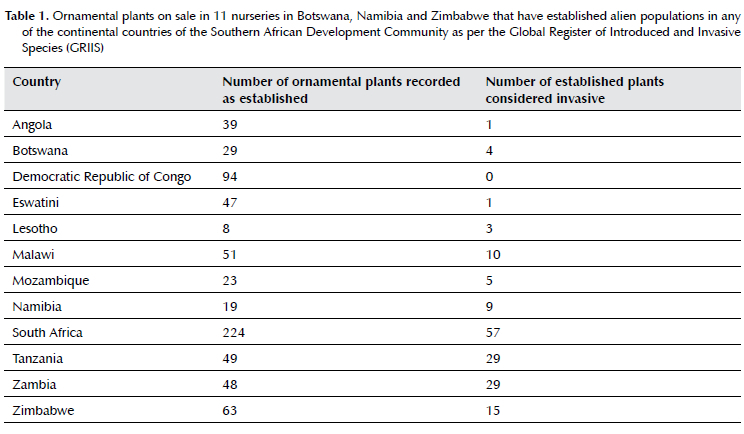
From the inventory, 289 taxa (24%) matched the GRIIS as having established alien populations in at least one continental SADC country (Table 1, Supplementary Material 3). This subset includes 284 taxa alien to the continental SADC subregion, four taxa native to parts of the subregion and three artificial hybrids (Supplementary Material 3). From this subset, 82 taxa are recorded as invasive in at least one continental SADC country (one of which is an artificial hybrid). Approximately 45% (130) of the subset of established species have established alien populations (and/or considered invasive) in more than one continental SADC country. Fifteen species on sale are considered established in eight or more continental SADC countries, e.g., Duranta erecta was offered in six nurseries (two in Botswana, one in Namibia, and three in Zimbabwe) and is considered established in the continental subregion (in 11 of the 12 SADC countries) and invasive in South Africa and Zimbabwe.
Of the plants on sale that are considered established in at least one continental SADC country, shrubs and trees predominate (178 out of 289, 62%), followed by herbs (52 out of 289, 18%) and climbers (40 out of 289, 14%). Only 10 epiphytes and nine succulents were recorded. These taxa come from 86 plant families, with Fabaceae (15), Asteraceae (14), Euphorbiaceae (14), Arecaceae (13), Apocynaceae (12) and Myrtaceae (10) the most frequent (Supplementary Material 3).
The species' native ranges span across eight botanical regions: Africa, Asia-Temperate, Asia-Tropical, Australasia, Europe, Northern America, Pacific and Southern America (the three artificial hybrids were not considered here). Half of the group's ranges spans across more than one botanical region, while the other half only covers a single region. Regardless of whether their ranges include one or more botanical region, most of the species (235 out of 286, 82%) exhibit very wide ranges, especially in latitudinal extent. Forty two per cent (42%) has a native range in the Americas (121 out of 286), followed by Asia (58 out of 286, 20 %), elsewhere in Africa (38 out of 286, 13 %), and Australasia (18 out of 286, 6%).
Discussion
Almost two-thirds of the plant taxa on sale in the 11 surveyed nurseries in Botswana, Namibia and Zimbabwe are alien to the continental SADC subregion, and 24% have been recorded to have self-sustainable alien populations. These plants are part of the ornamental flora traded and used regionally, e.g., 24 of them are amongst the 100 species with the highest average number of offers per day on eBay in 2014 (Humair et al. 2015).
Our survey is, of course, a highly selective one. Of the 52 ornamental-related businesses we identified across Botswana, Namibia and Zimbabwe, we could not obtain lists for 41 of them. Most nursery owners did not share information on which plants they stocked, and in most cases stock lists were not available online. However, the 11 nurseries sampled are amongst the biggest commercial nurseries in their respective countries, evidenced by having multiple employees, multiple branches and outlets in-country, self-identification as amongst the biggest businesses, and/or validation by key informants (e.g., Annual Garden Show in Harare). It is likely these nurseries are broadly representative of the ornamental industry in the three countries. And, despite this limited sampling, the broad insights likely hold, viz. there are many potentially invasive plants species in the trade, and a significant portion of the trade is in alien taxa. The lists presented here should be viewed as a starting point to build on.
Notably many (532 out of 1 193) of the plants listed here were not found in a historical database of 'Cultivated plants of southern Africa' (Glen 2002), though relatively few of these previously not recorded taxa have established (41 out of 289). There are, of course, many (6 233) taxa recorded in Glen (2002) that we did not find in our survey. We suspect these differences are because of changing fashions in what is sold, that Glen (2002) included taxa that are rarely cultivated, that there have been introductions of new ornamental taxa to the regions, and potentially also that the plants sold in Botswana, Namibia and Zimbabwe differ from those cultivated in South Africa [Glen (2002) focussed on South Africa]. Clearly a more comprehensive study would be required to estimate the extent of cultivated plants in the region. This would include: (1) accessing the data of most of the nurseries in the countries, not only the biggest; (2) surveying households and gardens, since all the cultivated flora is not necessarily on sale in nurseries; and (3) including more countries of the continental SADC subregion.
The relative distribution of growth forms across our subset of established taxa follows the general pattern reported for the established and invasive flora across southern Africa (Henderson 2006; Richardson et al. 2020; Omer et al. 2021), where shrubs and trees dominate. The relative distribution of taxonomical families follows another general pattern in the ornamental flora worldwide and across southern Africa (Humair et al. 2015; Semenya & Maroyi 2020; Mukubu Pika et al. 2024) and the established/invasive flora in southern Africa (Henderson 2006; Henderson & Wilson 2017; Richardson et al. 2020), where Fabaceae, Myrtaceae, Euphorbiaceae, Asteraceae and Apocynaceae lead the numbers. Concerning the native ranges, the Americas, Asia and Africa are the main contributors, similar to the reported ornamental flora in Togo (Radji & Kokou 2013) and the established and invasive species in the subregion (Henderson 2006; Omer et al. 2021).
It is noteworthy that most of the subset of established species show a high climatic plasticity based on their widespread native ranges. Moreover, several of these species have a long residence time in the subregion. For instance, according to Henderson (2006), Catharanthus roseus arrived in continental southern Africa before the Dutch colonisation of the Cape in 1652, whereas Opuntia ficus-indica, Quercus robur and Salix babylonica arrived between 1652 and 1700, and Canna indica and Psidium guajava before 1800. During the 1800s, Nerium oleander, Agave americana, Ligustrum lucidum, Oenothera biennis, Lonicera japonica, Lantana camara, Caesalpinia decapetala, and species of Grevillea and Syzygium were introduced (Henderson 2006). Other species reported here have been in the market for a long time (e.g., Catharanthus roseus, Canna indica, Lantana camara, Vinca major), and especially in nurseries in South Africa (Cronin et al. 2017). Likewise, the above-mentioned taxa and others like Jacaranda mimosifolia, Tecoma stans, Schinus molle, Schinus terebinthifolius, Nerium oleander and Casuarina cunninghamiana have been found to be frequently planted in urban areas across South Africa (Shackleton & Shackleton 2016, 2018; Milton & Dean 2025). Species mentioned as garden escapes in Kruger National Park (South Africa) (Keet et al. 2022) that coincide with the ornamental plant inventory reported here (e.g., Agave angustifolia, Clero-dendrum splendens, Euphorbia tithymaloides, Kalanchoe beharensis, Tradescantia pallida, T. spathacea) have been recorded as establishing alien populations in neighbouring countries too (Supplementary Material 3).
Traded species that are not included as established in GRIIS like Dodonaea viscosa subsp. angustifolia, Washingtonia robusta and Cupressus sempervirens are worthy of attention, since they have been reported to self-seed profusely in a town in the South African Karoo (Milton & Dean 2025). In that regard, Keet et al. (2022) highlights that while the number, abundance and distribution of regulated plant taxa decreased in Kruger National Park in the last decade, the number of unregulated alien taxa increased in the last decade based on plant surveys conducted in 1999-2003 and 2020. Although their results could be an artefact of differences in sampling methods between surveys and a greater inclusion of native-alien populations in the latest survey, it hints at the need for regulations that respond to the dynamics of plant uses and people's preferences and contexts, as well as to alien species population dynamics. All these nuances pose significant challenges for environmental regulations to work effectively that requires attention and investment at subregional levels.
Rouget et al. (2016) and Henderson and Wilson (2017) have shown that South Africa has a high invasion debt, which could suggest that the subregion also has a high invasion debt. Our research, along with Semenya and Maroyi (2020), Mukuba Pika et al. (2024) and Milton and Dean (2025)'s provide the baseline to quantify the invasion debt linked to the ornamental sector across the subregion. As we showed above, the subset of established ornamental plants presented in this manuscript is actively traded. The constant propagule pressure and gene flow coming from this exchange could contribute to further invasions by providing genetic diversity or could slow these by continually diluting adaptations to the southern African environments (Wilson et al. 2007, 2009). We recommend range shift assessments of the alien species on sale that we presented here. Furthermore, we quote Vimercati et al. (2025)'s suggestion to use a combination of the complementary frameworks from the Impact Classification for Alien Taxa family (EICAT-Environmental Impact Classification for Alien Taxa/EICAT+, SEICAT-Socio-Economic Impact Classification for Alien Taxa/SEICAT+) to comprehensively assess their multiple and contextual benefits and costs.
Acknowledgements
We are deeply grateful to the nursery businesses involved and those gatekeepers and key informants that helped us locating and accessing the sector in the sub-region, especially Gunhild Voigts from the Botanical Society of Namibia and Lindsay Charter, the co-organiser of the Annual Garden Show in Harare. We also thank the reviewers and editors whose work greatly improved the quality of this article We received a research permit from the Ministry of Environment, Natural Resources, Conservation and Tourism in Botswana [ENT 8/36/4 LII (38)]. We could not process research permits for the other countries involved.
Competing interests
JW was part of the editorial team for the special issue 'Developing lists of alien taxa in Africa', but took no part in the peer review and decision-making process for this paper.
Funding
This work was funded by the Trailblazers Early Career Researcher and Doctoral Studentship Partnering Scheme from Coventry University (subproject codes 13771-14 and 12160-02). Stellenbosch University and Botswana University of Agriculture and Natural Resources also supported this work. In addition, the landscaping unit of the Francistown City Council (Botswana), the Botanical Society of Namibia and nursery businesses in Botswana and Zimbabwe gave logistical support to the first author (DRC). JRUW thanks the South African Department of Forestry, Fisheries and the Environment (DFFE) for funding, noting that this publication does not necessarily represent the views or opinions of DFFE or its employees. Finally, DRC wants to thank the Funds of Women Graduates (FfWG), which provided her with a grant for her living expenses while crafting the final version of this manuscript.
Authors' contributions
All authors contributed to the conception and design of the study. DRC performed material preparation, data collection and analysis. DRC wrote the first draft of the manuscript and all authors commented on following versions of the manuscript. All authors read and approved the final manuscript.
References
Altman, A., Shennan, S. & Odling-Smee, J., 2022, 'Ornamental plant domestication by aesthetics-driven human cultural niche construction', Trends in Plant Science, 27(2), 124-138, https://doi.org/10.1016/j.tplants.2021.09.004. [ Links ]
Blackburn, T.M., Pysek, P., Bacher, S., Carlton, J.T., Duncan, R P., Jarosík, V., Wilson, J.R.U. & Richardson, D.M., 2011, 'A proposed unified framework for biological invasions', Trends in Ecology and Evolution, 26(7), 333-339, https://doi.org/10.1016/j.tree.2011.03.023. [ Links ]
Braun, K., Wong, L.J. & Pagad, S., 2020, Global Register of Introduced and Invasive Species - Eswatini (Swaziland). v1.4, Invasive Species Specialist Group ISSG, https://cloud.gbif.org/griis/resource?r=griis-swaziland&v=1.4. [ Links ]
Bromilow, C., 2018, Problem plants and alien weeds of southern Africa, ed. 4, Briza Publications. [ Links ]
Brummitt, R.K, 2001, World geographical scheme for recording plant distributions, Hunt Institute for Botanical Documentation, Pittsburgh. [ Links ]
Chase, F. & Pagad, S., 2020, Global Register of Introduced and Invasive Species - Namibia. v1.3, Invasive Species Specialist Group ISSG, https://cloud.gbif.org/griis/resource?r=griis-namibia&v=1.3. [ Links ]
Cronin, K., Kaplan, H., Gaertner, M., Irlich, U.M. & Timm Hoffman, M., 2017, 'Aliens in the nursery: assessing the attitudes of nursery managers to invasive species regulations', Biological Invasions, 19(3), 925-937, https://doi.org/10.1007/s10530-016-1363-3. [ Links ]
Faulkner, K.T., Burness, A., Byrne, M.J., Kumschick, S., Peters, K., Robertson, M.P., Saccaggi, D.L., Weyl, O.L.F. & Williams, V.L., 2020, 'South Africa's pathways of introduction and dispersal and how they have changed over time', in B.W. van Wilgen, J. Measey, D.M. Richardson, J.R. Wilson & T.A. Zengeya (eds), Biological Invasions in South Africa (pp. 313-354), Springer, Cham, Switzerland, https://doi.org/10.1007/978-3-030-32394-3_12. [ Links ]
Figueiredo, E., Smith, G., Wong, L.J. & Pagad, S., 2020, Global Register of Introduced and Invasive Species - Angola. v1.5, Invasive Species Specialist Group ISSG, https://cloud.gbif.org/griis/resource?r=griis-angola&v=1.5. [ Links ]
Freiberg, M., Winter, M., Gentile, A., Zizka, A., Muellner-Riehl, A.N., Weigelt, A. & Wirth, C., 2020, 'LCVP, The Leipzig catalogue of vascular plants, a new taxonomic reference list for all known vascular plants', Scientific Data, 7, a416, https://doi.org/10.1038/s41597-020-00702-z. [ Links ]
Glen, H.F., 2002, Cultivated plants of southern Africa: botanical names, common names, origins, literature, Jacana & National Botanical Institute, Durban. [ Links ]
Groom, Q., Wong, L. J. & Pagad, S., 2020, Global Register of Introduced and Invasive Species - Democratic Republic of Congo. v1.4, Invasive Species Specialist Group ISSG, https://cloud.gbif.org/griis/resource?r=griis-democratic-republic-of-congo&v=1.4. [ Links ]
Hae, M. E. & Pagad, S., 2020, Global Register of Introduced and Invasive Species - Lesotho. v1.3, Invasive Species Specialist Group ISSG, https://cloud.gbif.org/griis/resource?r=griis-lesotho&v=1.3. [ Links ]
Heath, A., Heath, R., Taylor, R., Hofmeyr, M., Wong, L.J. & Pagad, S., 2020, Global Register of Introduced and Invasive Species - Botswana. v1.4, Invasive Species Specialist Group ISSG, https://cloud.gbif.org/griis/resource?r=griis-botswana&v=1.4. [ Links ]
Henderson, L., 2006, 'Comparisons of invasive plants in southern Africa originating from southern temperate, northern temperate and tropical regions', Bothalia, 36(2), 201-222, https://journals.abcjournal.aosis.co.za/index.php/abc/article/view/362/305. [ Links ]
Henderson, L. & Wilson, J.R.U., 2017, 'Changes in the composition and distribution of alien plants in South Africa: An update from the Southern African Plant Invaders Atlas', Bothalia, 47(2), a2172, https://doi.org/10.4102/abc.v47i2.2172. [ Links ]
Hinsley, A., Hughes, A.C., Van Valkenburg, J., Stark, T., Van Delft, J., Sutherland, W. & Petrovan, S.O., 2025, Understanding the environmental and social risks from the international trade in ornamental plants, BioScience, https://doi.org/10.1093/biosci/biae124. [ Links ]
Humair, F., Humair, L., Kuhn, F. & Kueffer, C., 2015, 'E-commerce trade in invasive plants', Conservation Biology, 29(6), 1658-1665, https://doi.org/10.1111/cobi.12579. [ Links ]
IPBES, 2023, 'Summary for policymakers of the thematic assessment report on invasive alien species and their control of the Intergovernmental Science-Policy Platform on Biodiversity and Ecosystem Services', in H.E. Roy, A. Pauchard, P. Stoett, T. Renard Truong, S. Bacher, B.S. Galil, P.E. Hulme, T. Ikeda, K.V. Sankaran, M.A. McGeoch, L.A. Meyerson, M.A. Nuñez, A. Ordonez, S.J. Rahlao, E. Schwindt, H. Seebens, A.W. Sheppard & V. Vandvik, (eds), IPBES Secretariat, Bonn, Germany, https://doi.org/10.5281/zenodo.7430692. [ Links ]
Kashe, K., Teketay, D., Mmusi, M., Kemosedile, T., & Khululo Galelebalwe, M., 2022, 'Assessment of diversity and composition of tree species in residential areas of Chobe District, Northern Botswana', Agriculture and Forestry, 68(1), 233-245. [ Links ]
Keet, J.-H., Datta, A., Foxcroft, L.C., Kumschick, S., Nichols, G.R., Richardson, D.M. & Wilson, J.R.U., 2022, 'Assessing the level of compliance with alien plant regulations in a large African protected area', Biological Invasions 24, 3831-3844, https://doi.org/10.1007/s10530-022-02883-7. [ Links ]
Kobisi, K., Seleteng-Kose, L. & Moteetee, A., 2019, 'Invasive alien plants occurring in Lesotho: Their ethnobotany, potential risks, distribution and origin', Bothalia, 49(1), https://www.abcjournal.org/index.php/abc/article/view/39. [ Links ]
Mafokate, D., Mathowa, T. & Mojeremane, W., 2013, 'A survey of the exotic woody plant species in the city of Gaborone, Botswana', International Journal of Research In Agriculture and Food Sciences, 1(2), 1-7, https://www.academia.edu/32703031/A_Survey_of_the_Woody_Plant_Species_in_the_City_of_Gaborone_Botswana. [ Links ]
Maroyi, A., 2017, 'Data on introduced plants in Zimbabwe: Floristic changes and patterns of collection based on historical herbarium records', Data in Brief, 15, 348-369, https://doi.org/x.xx6/j.dib.2x7.9.46. [ Links ]
Maroyi, A., Wong, L.J. & Pagad, S., 2020, GRIIS Checklist of Introduced and Invasive Species - Zimbabwe. v1.4, Invasive Species Specialist Group ISSG, https://cloud.gbif.org/griis/resource?r=griis_zimbabwe&v=1.4. [ Links ]
Milton, S.J. & Dean, W.R.J., 2025, Village aliens: Self-seeding of indigenous and non-indigenous woody garden plants in a small desert village, Journal of Arid Environments, 227, 105295, https://doi.org/10.1016/j.jaridenv.2024.105295. [ Links ]
Mukubu Pika, L., Selemani, T.M., Jesuka, R., To Hulu, J.P.P.M., Sambieni, K.R., Useni Sikuzani, Y. & Bogaert, J., 2024, 'Practice and biodiversity of informal ornamental horticulture in Kinshasa, Democratic Republic of Congo', Ecologies, 5(1), 83-100, https://doi.org/10.3390/ecologies5010006. [ Links ]
Mwanyambo, M., Kamwendo, J.S., Patel, I.H., Kathumba, E.S., Wong, L.J. & Pagad, S., 2020, GRIIS Checklist of Introduced and Invasive Species - Malawi. v1.2, Invasive Species Specialist Group ISSG, https://cloud.gbif.org/griis/resource?r=griis-malawi&v=1.2. [ Links ]
Novoa, A., Shackleton, R., Canavan, S., Cybèle, C., Davies, S.J., Dehnen-Schmutz, K., Fried, J., Gaertner, M., Geerts, S., Griffiths, C.L., Kaplan, H., Kumschick, S., Le Maitre, D.C., Measey, G.J., Nunes, A.L., Richardson, D.M., Robinson, T.B., Touza, J. & Wilson, J.R.U., 2018, 'A framework for engaging stakeholders on the management of alien species', Journal of Environmental Management, 25, 286297, https://doi.org/10.1016/j.jenvman.2017.09.059. [ Links ]
Omer, A., Fristoe, T., Yang, Q., Maurel, N., Weigelt, P., Kreft, H., Bleilevens, J., Dawson, W., Essl, F., Pergl, J., Pysek, P & Van Kleunen, M., 2021, 'Characteristics of the naturalized flora of southern Africa largely reflect the non-random introduction of alien species for cultivation', Ecography, 44,12, 1812-1825, https://doi.org/10.1111/ecog.05669. [ Links ]
Pagad, S., 2022, Global Register of Introduced and Invasive Species - Mozambique. v1.2, Invasive Species Specialist Group ISSG, https://cloud.gbif.org/griis/resource?r=griis-mozambique&v=1.2. [ Links ]
Pagad, S., Genovesi, P., Carnevali, L., Schigel, D. & McGeoch, M.A., 2018, 'Introducing the Global Register of Introduced and Invasive Species', Scientific Data, 5, 170202, https://doi.org/10.1038/sdata.2017.202. [ Links ]
Pienaar, K. & Smith, G., 2011, The Southern African. What flower is that? An essential guide to garden plants, ed. 5, Struik Lifestyle. [ Links ]
Pl@ntNet, n.d., 'Pl@ntNet', application viewed 3 July 2024, https://plantnet.org/en/. [ Links ]
POWO, 2024, Plants of the World Online, facilitated by the Royal Botanic Gardens, Kew. viewed 3 July 2024, https://powo.science.kew.org/. [ Links ]
Radji, R. & Kokou, K., 2013, 'Classification et valeurs thérapeutiques des plantes ornementales du Togo', VertigO, 13(3), https://doi.org/10.4000/vertigo.14519. [ Links ]
Richardson, D.M., Foxcroft, L.C., Latombe, G., Le Maitre, D.C., Rouget, M. & Wilson, J.R., 2020, 'The biogeography of South African terrestrial plant invasions', in B.W. van Wilgen, J. Measey, D.M. Richardson, J.R. Wilson & T.A. Zengeya (eds), Biological invasions in South Africa (pp. 67-96), Springer, Cham, Switzerland, https://doi.org/10.1007/978-3-030-32394-3_3. [ Links ]
Richardson, D.M., & Potgieter, L.J., 2024, 'A living inventory of planted trees in South Africa derived from iNaturalist', South African Journal of Botany 173, 365-379, https://doi.org/10.1016/J.SAJB.2024.08.006. [ Links ]
Robinson, T., Ivey, D.P., Powrie, L., Winter, P., Wong, L.J., & Pagad, S., 2020, Global Register of Introduced and Invasive Species - South Africa. v2.7, Invasive Species Specialist Group ISSG, https://www.gbif.org/dataset/3cab-cf37-db13-4dc1-9bf3-e6f3fbfbbe23. [ Links ]
Rodríguez-Cala, D., Fried, J., Wilson, J.R.U., Dehnen-Schmutz, K., Tshwenyane, S.O. & Legwaila, I., 2025, Links between the ornamental sector and alien plants in southern Africa. Geo: Geography and Environment, 12, e70003, https://doi.org/10.1002/geo2.70003. [ Links ]
Rouget, M., Robertson, M.P., Wilson, J.R.U., Hui, C., Essl, F., Renteria, J.L. & Richardson, D.M., 2016, 'Invasion debt - quantifying future biological invasions', Diversity and Distributions, 22(4), 445-456, https://doi.org/10.1111/ddi.12408. [ Links ]
SADC, n.d., 'Member States', viewed 10 November 2025, https://www.sadc.int/member-states. [ Links ]
Semenya, S.S. & Maroyi, A., 2020, 'Assessment of useful alien plant species cultivated and managed in rural home gardens of Limpopo Province, South Africa', Scientifica, 1, 3561306, https://doi.org/10.1155/2020/3561306. [ Links ]
Shackleton, C.M. & Shackleton, R.T., 2016, Knowledge, perceptions and willingness to control designated invasive tree species in urban household gardens in South Africa, Biological Invasions, 18(6), 1599-1609, https://doi.org/10.1007/s10530-016-1104-7. [ Links ]
Shackleton, R.T., Richardson, D.M., Shackleton, C.M., Bennett, B., Crowley, S.L., Dehnen-Schmutz, K., Estévez, R.A., Fischer, A., Kueffer, C., Kull, C.A., Marchante, E., Novoa, A., Potgieter, L.J., Vaas, J., Vaz, A.S. & Larson, B.M.H., 2019, 'Explaining people's perceptions of invasive alien species: A conceptual framework', Journal of Environmental Management, 229, 10-26, https://doi.org/10.1016/j.jenvman.2018.04.045. [ Links ]
Shackleton, S.E. & Shackleton, R.T., 2018, Local knowledge regarding ecosystem services and disservices from invasive alien plants in the arid Kalahari, South Africa, Journal of Arid Environments, 159, 22-33, https://doi.org/10.1016/j.jaridenv.2017.07.001. [ Links ]
Van Kleunen, M., Essl, F., Pergl, J., Brundu, G., Carboni, M., Dullinger, S., Early, R., González-Moreno, P, Groom, Q.J., Hulme, PIE., Kueffer, C., Kühn, I., Maguas, C., Mau-rel, N., Novoa, A., Parepa, M., Pysek, P., Seebens, H., Tanner, R., Touza, J., Verbrugge, L., Weber, E., Dawson, W., Kreft, H., Weigelt, P., Winter, M., Klonner, G., Talluto, M.V. & Dehnen-Schmutz, K., 2018, 'The changing role of ornamental horticulture in alien plant invasions', Biological Reviews, 93(3), 1421-1437, https://doi.org/10.1111/brv.12402. [ Links ]
Vimercati, G., Probert, A., Kumschick, S. & Bacher, S., 2025, 'SEICAT+: a comprehensive assessment framework for positive socio-economic impacts of alien species', Preprint on EcoEvoRxiv, https://doi.org/10.32942/X28M09. [ Links ]
Wilson, A., Kendal, D. & Moore, J.L., 2016, 'Humans and ornamental plants: a mutualism?', Ecopsychology, 8(4), 257-263, https://doi.org/10.1089/eco.2015.0077. [ Links ]
Wilson, J.R.U., Dormontt, E.E., Prentis, P.J., Lowe, A.J. & Richardson, D.M., 2009, 'Something in the way you move: dispersal pathways affect invasion success', Trends in Ecology and Evolution, 24(3), 136-144, https://doi.org/10.1016/j.tree.2008.10.007. [ Links ]
Wilson, J.R.U., Richardson, D.M., Rouget, M., Proches, S., Amis, M.A., Henderson, L. & Thuiller, W., 2007, 'Residence time and potential range: crucial considerations in modelling plant invasions', Diversity and Distributions, 13(1), 1122, https://doi.org/10.1111/j.1366-9516.2006.00302.x. [ Links ]
Witt, A. & Pagad, S., 2020, Global Register of Introduced and Invasive Species - Zambia. v1.4, Invasive Species Specialist Group ISSG, https://cloud.gbif.org/griis/resource?r=griis-zambia&v=1.4. [ Links ]
Witt, A., Wong, L.J. & Pagad, S., 2020, Global Register of Introduced and Invasive Species - Tanzania. v1.2, Invasive Species Specialist Group ISSG, https://cloud.gbif.org/griis/resource?r=griis_tanzania&v=1.2. [ Links ]
 Correspondence:
Diana Rodríguez Cala
E-mail: dianarodriguezcala@gmail.com
Submitted: 30 April 2025
Accepted: 12 January 2026
Published: 27 March 2026
DISCLAIMER: Please note that supplementary materials are not edited, proofread or designed by SANBI Graphics and Editing and is the sole work and responsibility of the author(s).
List of supplementary materials
Available online: http://dx.doi.org/10.38201/abc.v56.2.a7.
Supplementary material 1. R script with the detailed data processing: taxononomical standardisation, lists matching and established plant taxa description by botanical families, region of origin and plant habit.
Supplementary material 2. Verbatim names of the plants surveyed in eleven nurseries across Botswana, Namibia and Zimbabwe.
Supplementary material 3. Plant taxa on sale in eleven nurseries across Botswana, Namibia and Zimbabwe (nursery checklist) with names standardised using the 2023 version of the Leipzig Plant Catalogue.