



Services on Demand
Journal

Article
 English (pdf)
 Article in xml format
 Article references

 Automatic translation
 Send this article by e-mail
Indicators
Related links
-
 Cited by Google
-
 Similars in Google
Share

 Permalink

African Biodiversity & Conservation
On-line version ISSN 3078-8056Print version ISSN 0006-8241
Bothalia (Online) vol.55 n.1 Pretoria 2025
https://doi.org/10.38201/abc.v55.13
ORIGINAL RESEARCH
Endemic plants and animals are susceptible to extinction in an imperilled alpine hotspot in southern Africa
Peter J. TaylorI; Emile BredenhandI; Ara MonadjemII, III; Adrian J. ArmstrongIV, V; Andrinajoro R. RakotoariveloI; Veli Monday MdluliI; Alexandra HowardI; Serero ModiseI; Samuel N. MotitsoeVI; Pindiwe NtlokoVII, +; Abigail P. KirkaldyVII, VIII; Dewald J. KleynhansIX; Astrid JankielsohnX; Toka MosikidiI, XVI; Maria K. OosthuizenI, IX; Stephanie PayneXI; Thinandavha C. MunyaiV; Clinton CarbuttIV, V; Mpho RamoejaneI; Mosiuoa BerengXII; Michael StillerXV; Charles R. HaddadI; Sandy-Lynn SteenhuisenXI; Musa C. MlamboVII, VIII, +; Sibusisiwe MoyoVIII, XVII; Nthatisi I. NyembeI; Lehlohonolo MofokengI; Johann van AsI; Lesego MalekanaXI, XVIII; Gimo M. DanielIX, XIII, XIV; Onalenna GwateXII; Michelle van AsI; James du Guesclin HarrisonVI; Nokubonga F. ThabetheV; Nozipho KheswaI; Karabo MoloiXI; Nkanyiso SishangeI; V. Ralph ClarkXII
IAfromontane Research Unit and Department of Zoology and Ecology, University of the Free State, Qwaqwa Campus, Phuthaditjhaba, South Africa
IIDepartment of Biological Sciences, University of Eswatini, Private Bag 4, Kwaluseni, Eswatini
IIIMammal Research Institute, Department of Zoology and Entomology, University of Pretoria, Private Bag X20, Hatfield, 0028, South Africa
IVConservation Research & Assessment, Scientific Services, Ezemvelo KZN Wildlife, P.O. Box 13053, Pietermaritzburg 3202, South Africa
VCentre for Functional Biodiversity, School of Life Sciences, University of KwaZulu-Natal, Private Bag X01, Scottsville, Pietermaritzburg, 3209, South Africa
VISchool of Animal, Plant and Environmental Sciences, University of the Witwatersrand, Private Bag 3, Johannesburg, South Africa
VIIDepartment of Freshwater Invertebrates, Albany Museum, Makhanda, 6139, South Africa
VIIIDepartment of Zoology and Entomology, Rhodes University, Makhanda, 6139, South Africa
IXDepartment of Zoology and Entomology, University of Pretoria, Private Bag X20, Hatfield, 0028, South Africa
XAgricultural Research Council-Small Grain, Crop Protection, Bethlehem, South Africa
XIAfromontane Research Unit and Department of Plant Sciences, University of the Free State, Qwaqwa Campus, Phuthaditjhaba, South Africa
XIIAfromontane Research Unit and Department of Geography, University of the Free State, Qwaqwa Campus, Phuthaditjhaba, South Africa
XIIIDepartment of Terrestrial Invertebrates, National Museum, 36 Aliwal Street, Bloemfontein, South Africa
XIVDepartment of Biological & Environmental Sciences, Walter Sisulu University, Mthatha, South Africa
XVAgricultural Research Council-Plant Health and Protection, Biosystematics, Queenswood, South Africa
XVIThe Expanded Freshwater and Terrestrial Environmental Observation Network, 56 Florence Street, Colbyn, Pretoria, South Africa
XVIISchool of Life and Environmental Sciences, Bournemouth University, Fern Barrow, Poole, BH12 5BB, United Kingdom
XVIIIDepartment of Environmental Systems Science, Institute of Integrative Biology, ETH Zürich, Universitätstrasse 16, Zürich CH-8092, Switzerland
+ Deceased
ABSTRACT
BACKGROUND: As global temperatures rise, alpine species at the upper limit of their distribution are at risk of decline and extinction due to shrinking habitats downslope. The alpine (> 2 800 m a.s.l.) biodiversity of the Maloti-Drakensberg is poorly known but may be threatened by climate change
OBJECTIVES: Using expert BioBlitzes, we documented species richness and ele-vational patterns of distribution in 14 plant and animal higher taxa from alpine and upper-montane zones in an unexplored corner of the Maloti-Drakensberg
METHODS: Using standardised methods such as Sherman traps, acoustic monitoring, bird timed counts, pitfall traps, sweep nets, aquatic SASS5 kick-nets, timed searches and herbarium collections, we assessed elevational zonation of flowering plant and selected invertebrate and vertebrate diversity in the Witsieshoek Community Conservation Area (WCCA
RESULTS: GBIF records complemented expert BioBlitz data, together enumerating 1 216 plant, vertebrate and invertebrate species along an elevation gradient from 1 760 m to 3 145 m at WCCA. Birds, insects and plants showed concordant beta diversity patterns from BioBlitz and GBIF data: high turnover compared to nest-edness in more sedentary insects and plants, and the opposite in more mobile birds (GBIF data not available for bats). Although identifications are ongoing, 17% of species or morphospecies were exclusively recorded in the alpine zone, including 82 species of plants and 92 of animals
CONCLUSION: Alpine endemics are vulnerable to the 'escalator to extinction' process due to climate change. Surveys of under-explored alpine hotspots should be prioritised, drawing on mountain tourism-based citizen science. We advocate an ecotourism- and community-centred, restoration and rewilding approach for this strategic and biodiverse community conservation area
Keywords: Drakensberg Mountains; climate change; ecology; escalator to extinction; GBIF.
Introduction
As global temperatures rise, alpine species at the upper edge of their distribution are at risk of decline and extinction due to shrinking habitats downslope, a phenomenon known as the 'escalator to extinction' (Freeman et al. al. 2018; Urban 2018; Watts et al. 2022; Environments [GLORIA] 2024).
Temperate grasslands, globally and in the Maloti-Drakensberg (MD) of southern Africa, are rapidly transforming, and are currently poorly protected (Carbutt et al. 2017; Bengtsson et al. 2019; Scholtz & Twidwell 2022). Comprising both montane (1 800-2 800 m a.s.l.) and alpine (> 2 800 m a.s.l.) elements, the MD is a key area of endemism and diversity for plants (Carbutt & Edwards 2015; Brand et al. 2019; Carbutt 2019), vertebrates (Van As et al. 2014a,b; Kopij 2015), terrestrial invertebrates (Armstrong & Brand 2012; Van der Merwe et al. 2020; Modise 2023) and aquatic invertebrates (Hamer & Brendonck 1997; Martens et al. 1998; Van Damme et al. 2013; Deacon et al. 2020), with ongoing species discoveries of both plants (Clark et al. 2011; 2015; 2016a,b) and animals (Hamer & Martens 1998; Hamer & Slotow 2009; Conradie 2014; Conradie et al. 2018; Taylor et al. 2020; Haddad et al. 2021; Mdidimba et al. 2021; Cornette et al. 2022).
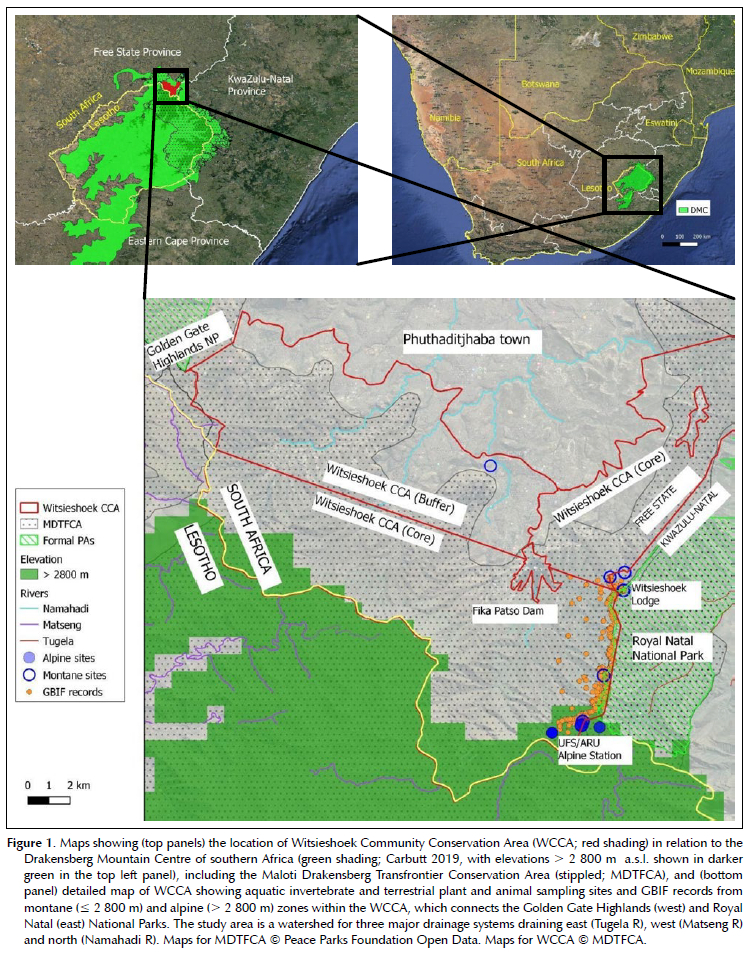
Alpine grasslands and shrublands in Africa are predominantly found in two regions: the tropical Afroalpine 'sky islands' of northeast Africa (3 400-4 600 m) and the higher slopes and plateaux of the MD (2 800-3 482 m). The latter is located within Lesotho (90%) and adjacent areas of South Africa (10%) (Carbutt 2020). Reflecting a biome in crisis, these alpine areas are mostly unprotected and vulnerable to anthropogenic and climate change (Dinerstein et al. 2017; Carbutt 2019, 2020). The Qwaqwa Mountains form a northern outpost of the MD spanning both montane and alpine elevations (Figure 1). Within South Africa, along its Free State province's border with Lesotho, these mountains fall within the Witsieshoek Community Conservation Area (WCCA), which is valuable for ecotourism and biodiversity, but poorly researched with few biological studies (Delves et al. 2021; Shezi et al. 2021; Praeg et al. 2023). The WCCA is an important conservation buffer bordering two protected areas, Royal Natal National Park (RNNP) and Golden Gate Highlands National Park (GGHNP). However, it is being transformed by conversion into settlements, bush encroachment and livestock overgrazing, leading to reduced plant diversity (Shezi et al. 2021), while hunting and competition with people and livestock has reduced populations of larger mammals (Morake 2010). Rewilding of the WCCA from adjacent protected areas is therefore viable in conjunction with community-based sustainable rangeland management. However, conservation efforts in the WCCA require engaged scholarship to understand the multidimensional social, environmental and biodiversity challenges of the area (Delves et al. 2021). This should be underpinned by robust assessments of grassland and rangeland biodiversity, particularly alpine biodiversity potentially at risk from the escalator to extinction.
In 2023, the Witsieshoek Mountain Lodge and the Afromontane Research Unit of the University of the Free State (ARU) established a joint Alpine Research Station, facilitating surveys of hitherto poorly explored alpine biota. Leveraging improved access and conducting five expert BioBlitzes (i.e., surveys by specialist taxonomists; Parker et al. 2018) between October 2021 and November 2023, we documented elevational patterns across 14 animal and plant higher taxa at WCCA. We identified the extent of alpine endemism among these taxa within the scope of our study, and consequently, assessed the risk of extinction for these species. At the time of our study, tourist and scientist visitors to the Witsieshoek Mountain Lodge contributed 3 438 georeferenced biodiversity records to public platforms such as the Global Biodiversity Information Facility (GBIF), mostly concentrated along the hiking trail leading from the lodge to the alpine summit (Figure 1). We compared our BioBlitz data with records from the GBIF database (which were validated by experts in our study), thereby demonstrating the complementarity of the two approaches.
Methods
Study area
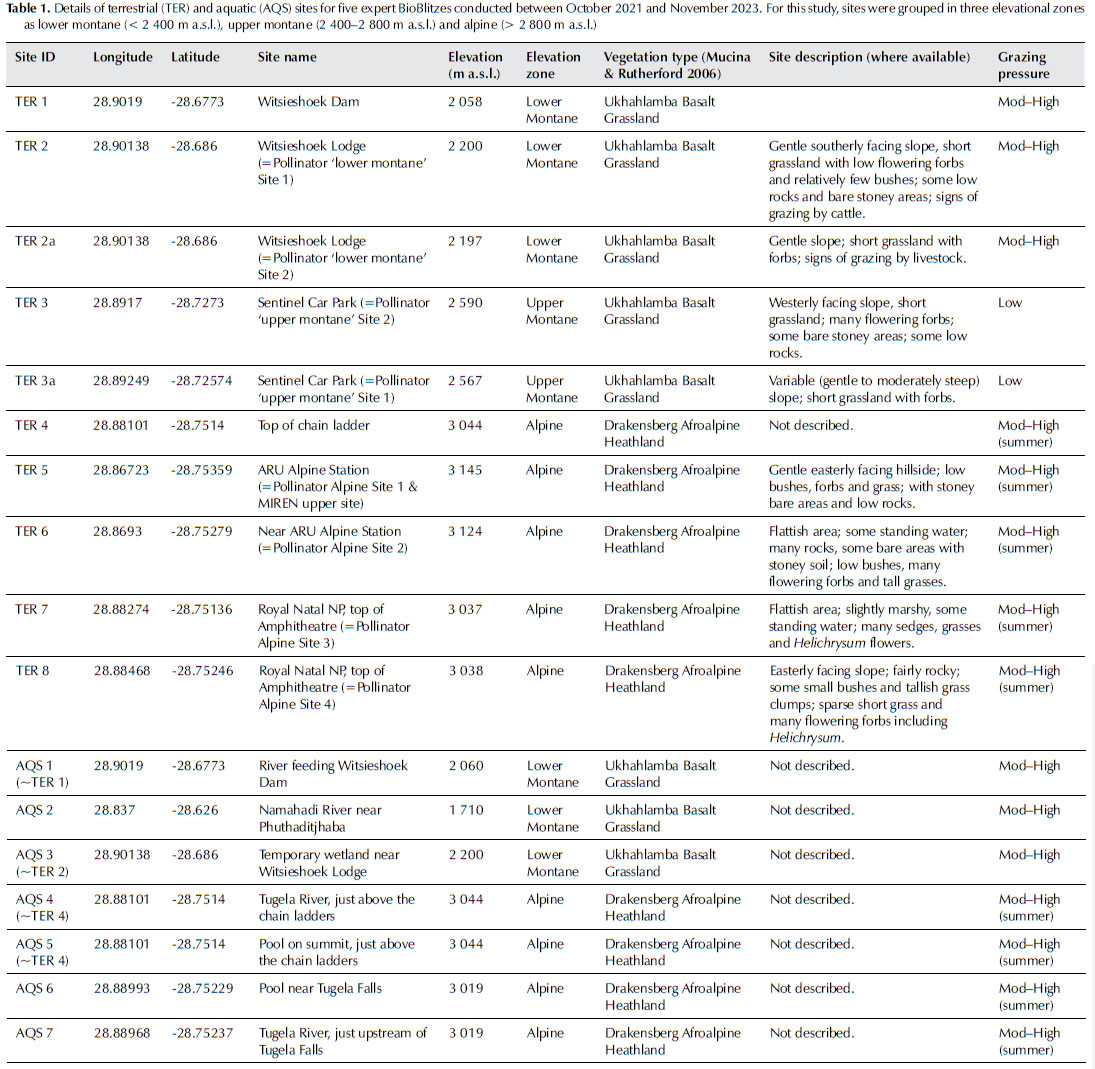
The geographical context of the WCCA is described above (Figure 1). Surveys were conducted from our bases of the Witsieshoek Lodge (at 2 200 m; GPS: 28.6860°S, 28.9014°E) and the ARU Alpine Research Station (at 3 145 m; GPS: 28.7536°S, 28.8672°E). The vegetation of the lower sites is classified as uKhahlamba Basalt Grassland while sites above 2 800 m are classified as Drakensberg Afroalpine Heathland (Table 1). A total of 17 sites (ten terrestrial and seven aquatic) were surveyed within the study area, classified into lower-montane (< 2 400 m a.s.l.), upper-montane (2 400-2 800 m a.s.l.) and alpine (> 2 800 m a.s.l.) zones (Table 1, Figure 1).
The area receives between 1 200 and 1 500 mm annual rainfall, and falls within a cool, wet, summer rainfall region, with cold winters. Precise data were not available for the WCCA, but the mean annual temperature for the adjacent Lesotho Highlands is about 7°C, with a summer mean of 20°C and a winter minimum of -6.3°C (Lesotho Meteorological Services). Five distinct plant communities have been recognised in the study area (Shezi 2014), the Cheche Open Shrubland, the Ledile-Eragrostis plana, the Lodi, the Lekgapu and the Red Grass communities. Generally, the lower-lying Cheche Open Scrub and Ledile-Eragrostis plana communities are dominated by encroaching shrubs (Leucosidea sericea Eckl. & Zeyh; Rosaceae) and grasses (Eragrostis plana Nees; Poaceae) respectively, indicating the effects of over-grazing. The Lodi and Red Grass communities are both characterised by a grass species (Themeda triandra Forssk.; Poaceae) that indicates good rangeland quality. The Lekgapu community is characterised by dwarf shrubs dominated by Erica dominans Killick (Ericaceae), characteristically occurring on the high plateau. In general, lower and gentler slopes showed evidence of overgrazing by livestock from local communities while the summit plateau showed evidence of overgrazing in summer by livestock of Basotho herders from Lesotho (Table 1; Kotzé et al. 2023). The soils of the alpine zone in the Amphitheatre summit area are characterised by exceptionally high soil organic carbon (SOC) (Kotzé et al. 2023).
GBIF records
A search of the GBIF database was conducted on 18 February 2023 for all records within a polygon that defined the study area, using the search term 'Geometry POLYGON((28.867 -28.755, 28.902 -28.755, 28.902 -28.677, 28.867 -28.677, 28.867 -28.755))'. The DOI citation is 'GBIF.org (18 February 2023) GBIF Occurrence Download 10.15468/dl.ykm4r7'. The search yielded 3 438 records. After excluding chromista, fungi and uncertain records, a final list of 3 366 flowering plant and animal records was obtained for 599 species. The geographical and taxonomie accuracy of these records was checked by specialists for mammals, amphibians, reptiles, birds, insects and plants, resulting in 434 fully validated species used for this study.
Sampling
During five expert BioBlitzes between November 2021 and November 2023 (Table 2), we sampled 10 terrestrial (TER 1, 2, 2a, 3, 3a, 4-8) and seven aquatic sites (AQS 1-7), divided into lower-montane (< 2 400 m a.s.l.), upper-montane (2 400-2 800 m a.s.l.) and alpine (> 2 800 m a.s.l.) elevation zones (Table 1). For taxa that lacked data for upper-montane or alpine sites, we further subdivided the lower-montane zone into lower (TER 1; Witsieshoek Dam; 2 058 m a.s.l.) and upper (TER 2; Witsieshoek Mountain Lodge; 2 200 m a.s.l.) sub-zones. This allowed us to maintain three elevational intervals for standardised plotting of Venn diagrams.
Using standard methods, we compiled site and elevation zone checklists of 14 higher taxa: i) small mammals (Sherman traps) and ii) their ectoparasites; iii) bats (acoustic methods); iv) birds (timed counts); v) ants (pitfall traps); vi) insect flower-visitors (timed collections); vii) leafhoppers (sweep nets); viii) dung beetles (baited pitfall traps); ix) grasshoppers (sweep nets and timed counts); x) bugs (sweep nets); xi) flies (sweep nets), xii) spiders (pitfall traps), xiii) aquatic macroinvertebrates (kick-nets) and xiv) flowering plants (herbarium specimens collected during transects or searches). Identification was provided by relevant specialists to species level in plants, vertebrates, dung beetles, insect pollinators and flower visitors, grasshoppers and leafhoppers; to genus level in ants; and to family level in aquatic macroinvertebrates, flies and bugs. Samples identified to genus or family level were further sorted into morphospecies, and all collected specimens were deposited in relevant institutional repositories (Table 2). We conducted sample replication within a site where possible, e.g. two bat detectors, rodent trap grids or arthropod pitfall arrays placed 300-500 m apart at a site. Some invertebrate taxa not mentioned here are still being processed and identified for future publications.
Taxon-specific methods
Small mammals and their ectoparasites
Paired grids of Sherman traps were set at Sites TER 1, TER 2 (lower montane), and TER 3 (upper montane) (Table 1). Each grid was configured in a 3 x 7 layout, with traps 10 m apart (totalling 42 traps per night at each site). Trapping was conducted for three nights per session, repeated three times at Sites TER 1-3 in October 2021, March 2022 and February 2023. Additionally, alpine sites (Site TER 4 and TER 5) were sampled opportunistically in October 2022 and February 2023 for two nights each using 20 Sherman traps and two modified 'Hickman' mole-traps (Hickman 1979). Sherman traps were baited with a mixture of peanut butter and oats and checked every morning and evening. Individual rodents and shrews were identified using Monadjem et al. (2015). Sex and reproductive status were determined, and standard external measurements were taken following McCleery et al. (2021). For all rodents, shrews and bats captured, their fur was inspected and lightly brushed for ectoparasites, collecting mites, fleas and ticks into 95% ethanol for later identification by N.I. Nyembe and L. Mofokeng.
Bats
Pairs of Song Meter Mini-4 (SM4 + ) bat detectors (Wildlife Acoustics), set at least 300 m apart, were deployed at Sites TER 1, TER 2, TER 3 and TER 4, recording passively from dusk until dawn for 2-4 nights. Sampling was repeated in October 2021, March 2022, October 2022 and February 2023. Echolocation calls were saved in '.wav' format and identified manually by V.M. Mdluli using Kaleidoscope Pro (Wildlife Acoustics) and available call reference libraries (P.J. Taylor unpublished; A. Monadjem unpublished; Taylor et al. 2013, Monadjem et al. 2020).
Birds
Bird counts were conducted from 11 to 14 October 2021 across all elevation zones, from Sites TER 1 and TER 2 (lower montane), TER 3 (upper montane) and TER 4 (alpine) recording all species seen (with binoculars) or heard. Each site was visited for at least an hour. To increase species numbers, birds seen or heard while walking between sites were also recorded, creating a preliminary checklist for the area. All bird species were logged on the BirdLasser app, with a new list for each of the four days of sampling. Standardised timed counts of 10 min duration were conducted on three further occasions: 8-12 March 2022 (all sites), 3-6 November 2022 (Sites TER 2 and TER 4) and 6-8 February 2023 (all sites), with between 6 and 12 counts per site per occasion.
Invertebrate sampling method Ί (Focus: Ants)
During the first BioBlitz, following Munyai and Foord (2015), pitfall grid arrays were set at Sites TER 1 (Witsieshoek Dam), TER 2 (Witsieshoek Lodge) and TER 3 (Sentinel Car Park). Each grid consisted of 20 pitfall traps in a 4 x 5 grid. Test-tube shaped plastic containers (30 mm diameter) were half-filled with propylene glycol and left open for 48 hours before collection.
Invertebrate sampling method 2 (Focus: Ground-dwelling insects)
In March 2022 (second BioBlitz) and February 2023 (fourth BioBlitz), pitfall sizes were increased to 250 ml plastic containers (60 mm diameter), half-filled with a 2:1 mixture of 70% ethanol and propylene glycol. Sites TER 1, TER 2 and TER 3 were sampled with 20 pitfalls per site in a random grid to cover surrounding vegetation diversity. Pitfalls were left out for 48 hours. The alpine sites were excluded due to equipment transport difficulties.
Invertebrate sampling method 3 (Focus: Dung beetles)
Dung beetles were collected at Sites TER 1-3 in March 2022, and at Sites TER 1-4 in February 2023, using pitfall traps baited with pig dung. Pitfall traps were made from 2-litre cold drink bottles, cut to form a funnel system. Three plots per site, spaced 50 m apart, each contained four traps, spaced 5 m apart. Traps were left for 48 hours. Samples from the four traps in each plot were pooled. Identification was conducted using published keys and morphological comparison with specimens at the National Museum Bloemfontein (BMSA). Some voucher specimens were deposited at BMSA.
Invertebrate sampling method 4 (Focus: Flying insects)
During pitfall sampling (Sampling method 2 above), Sites TER 1-3 were also sampled using a sweep-net method along 10 x 100 m transects per site. Additional time was spent actively searching for large insects and observing secondary signs of insect activity.
Invertebrate sampling method 5 (Focus: Insect flower visitors and orthopteran herbivores)
Eight 1-ha sampling sites were set up: four in the alpine zone (TER 5-8), two in the upper-montane zone (TER 3, 3a), and two in the lower-montane zone (TER 2, 2a). Sampling was conducted on specific dates in February and March 2023 (fourth BioBlitz) and November 2023 (fifth BioBlitz), with weather conditions noted. Each site was sampled by two people for one hour, one focusing on flower visitors and the other on herbivorous Orthoptera, switching roles at the next site. Specimens were deposited in several museum collections (Table 2). Samples were frozen and later identified using published keys, reference to determined specimens in state collections, and expert consultation (A.J. Armstrong).
Invertebrate sampling method 6 (Focus: Leafhoppers)
Intensive searches for leafhoppers were conducted at lower-montane (TER 2, 2a), upper-montane (TER 3, 3a) and alpine (TER 4-8) sites in November 2023 (fifth BioBlitz). Males provided the best and convenient features for identification, with associated females or nymphs often more difficult to identify. Specimens were deposited in the South African National Insect Collection (SANC). Sweep netting was the common collection method, with some plants vacuumed for leafhoppers.
Invertebrate sampling method 7 (Focus: Aquatic macroinvertebrates)
Aquatic macroinvertebrates were collected from freshwater systems (temporary pools and rivers) in March 2022 and February 2023. Samples were collected using a SASS net (square frame size: 300 x 300 mm, mesh size 1 mm; Dickens & Graham [2002]) and preserved in 80% ethanol. Identification was conducted using published keys (Day et al. 2002; Day & De Moor 2002; De Moor et al. 2003a; b) and the collection will form a preliminary checklist for the Maloti-Drakensberg mountains, accessioned at the Albany Museum, Makhanda.
Flowering plants
Specimens of flowering plants were collected during transect searches at Sites TER 1 and TER 3 in October 2021, and at Sites TER 1 and TER 2 in February 2023. Additional specimens were collected in the alpine zone (TER 5) by MSc and PhD students. An independent dataset was collected using the Mountain Invasion Research Network (MIREN) sampling protocols (Liedtke et al. 2020; Haider et al. 2022) between October 2021 and February 2022, with coordinates recorded for future reference. All vascular plant species were identified and assigned their status as native or alien, and their endemism status. A total of 2 120 specimens were identified and vouchers stored in the Qwaqwa, UFS Herbarium (QWA).
Data analysis
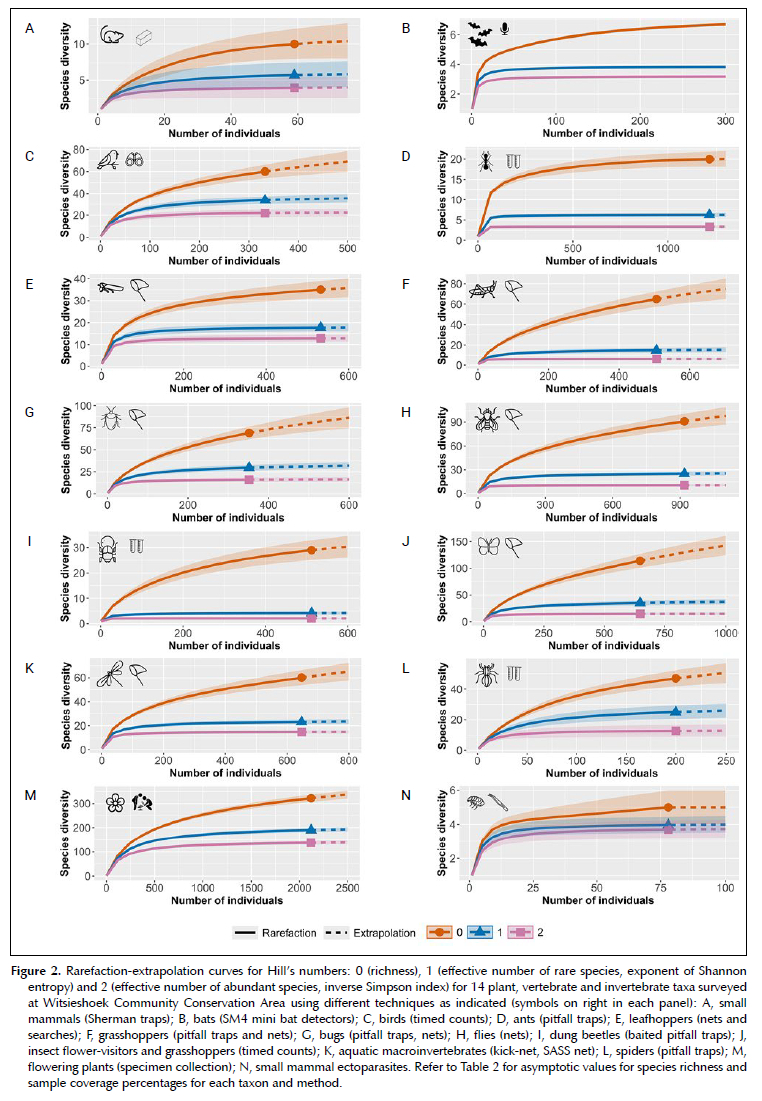
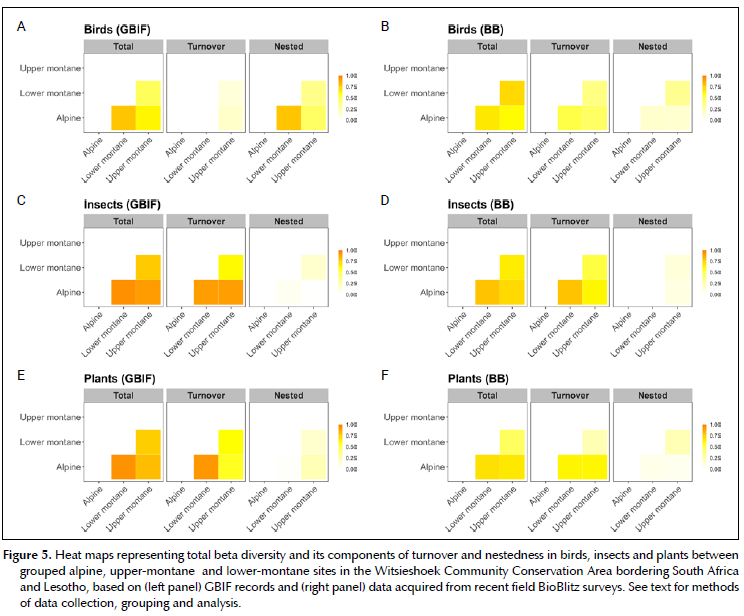
To evaluate the sample coverage of our surveys, we conducted abundance-based rarefaction-extrapolation analyses for each taxon using the R-package, 'iNEXT' (Chao et al. 2014; Hsieh et al. 2022). Venn diagrams were produced using the R-package, 'VennDiagram' v1.7.3 (Chen 2022). After classifying both GBIF and BioBlitz records for birds, flying insects and plants into alpine, upper-montane and lower-montane zones (Table 1), we used a beta-partitioning approach to estimate nestedness, turnover and total taxonomic beta diversity from both sampling approaches using the R-package 'betapart' (Baselga & Oreme 2012). All analyses were performed under RStudio using R Statistical Software (v4.4.0; R Core Team 2024).
Results
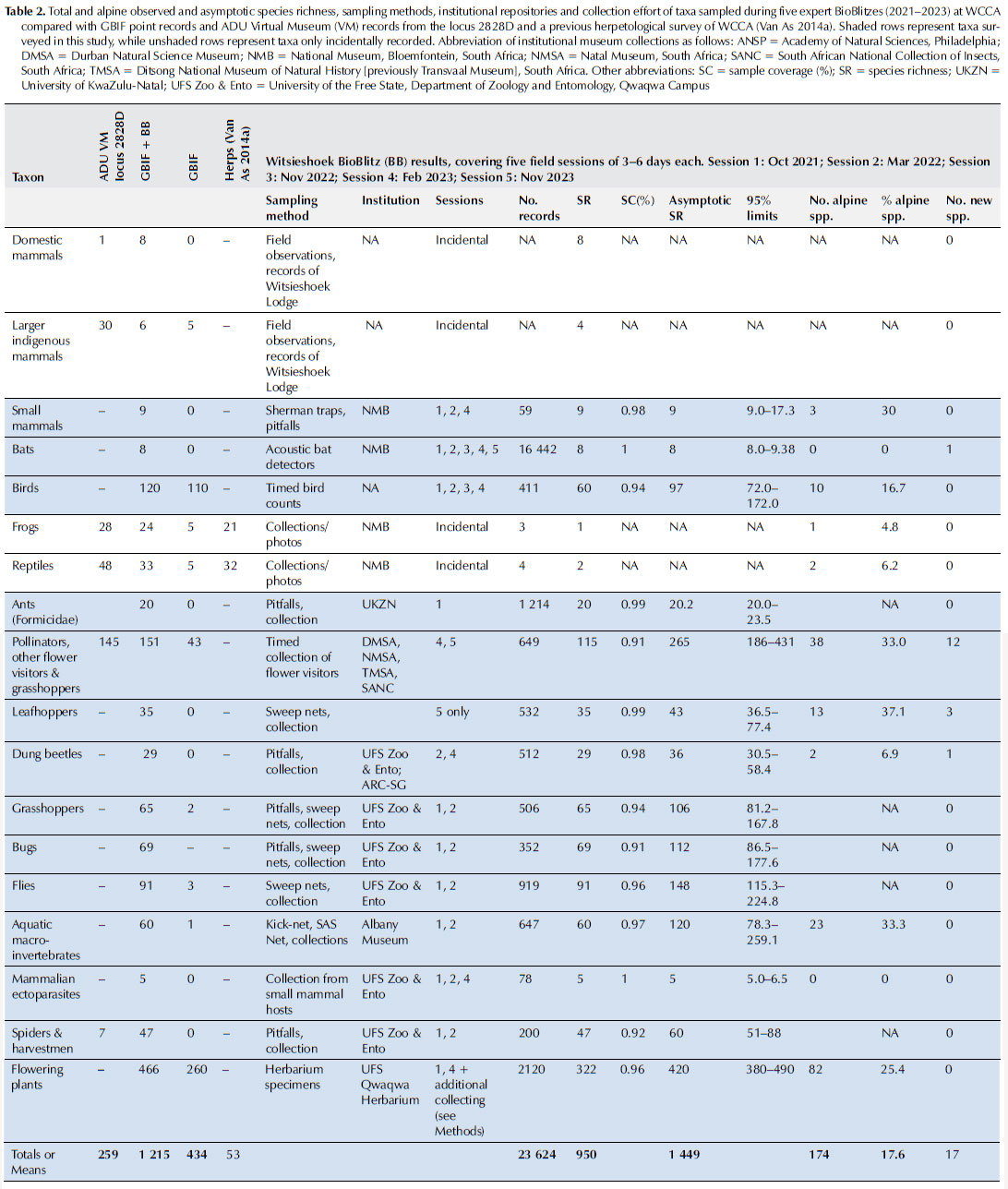
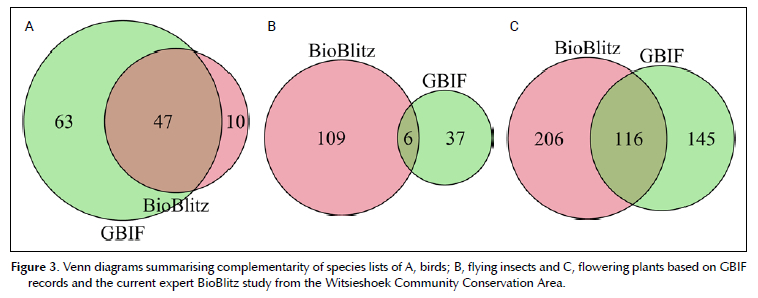
Based on 16 442 bat acoustic calls, 411 bird counts, 5 663 animal and 2 120 plant specimens, and incidental observations of herpetofauna and large mammals, the expert BioBlitzes in WCCA recorded 950 species, including 322 plants, 92 vertebrates, and 536 invertebrates (Table 2). Rarefaction-extrapolation analysis estimated 1 449 species for those taxa here surveyed, with significant increases expected in plants, vertebrates and invertebrates (Figure 2), hence true species richness is likely to be higher. From these analyses, the sample coverage for different taxa was high (Table 2: mean 0.96; range 0.91-1; n = 14). Combined BioBlitz and GBIF data revealed 1 216 species, which is closer to the estimated diversity, and highlights the complementarity of these two approaches (Figure 3; Table 2).
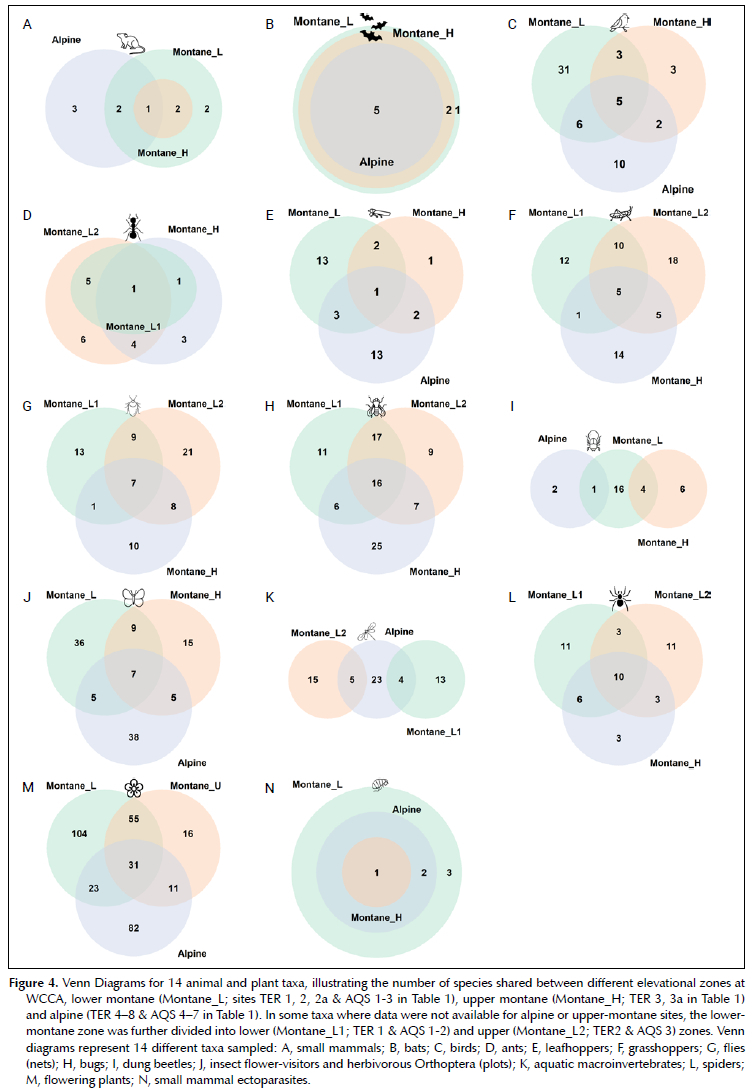
High species turnover between elevational zones was observed for more sedentary taxa such as invertebrates, plants and small mammals, whereas more mobile taxa such as birds and bats showed a more nested pattern (Figures 4, 5). In other respects, for easily identifiable taxa such as birds and flowering plants, based on the congruence in beta diversity patterns between approaches (Figure 5), GBIF data independently and accurately retrieved fine scale patterns of elevation turnover validated by expert BioBlitz data.
In the study, 174 species were found only in the alpine zone, 17.6% of all taxa sampled. This included 3 small mammals, 2 reptiles, 1 amphibian, 10 birds, 38 insect flower-visitors and Orthoptera, 13 leafhoppers, 2 dung beetles, 20 aquatic macroinvertebrates and 82 plants (Table 2). Beta diversity analyses of both BioBlitz and GBIF datasets for birds, flying insects and plants showed that mobile birds had more nested elevational patterns, while low-dispersal insects and plants were influenced by turnover between zones (Figure 5).
Taxonomie considerations
Although taxonomic identifications and reviews are still ongoing and more new species are likely to be recognised in time, specialists identified two new insect genera and 16 new or probably new bat and insect species. This included 11 species exclusive to the alpine zone: 1 leaf beetle (Coleoptera: Chrysomelidae: Odontionopa sp. nov.), 1 dung beetle (Coleoptera: Scarabaeinae: Epirinus sp. nov.), 1 flightless keratin
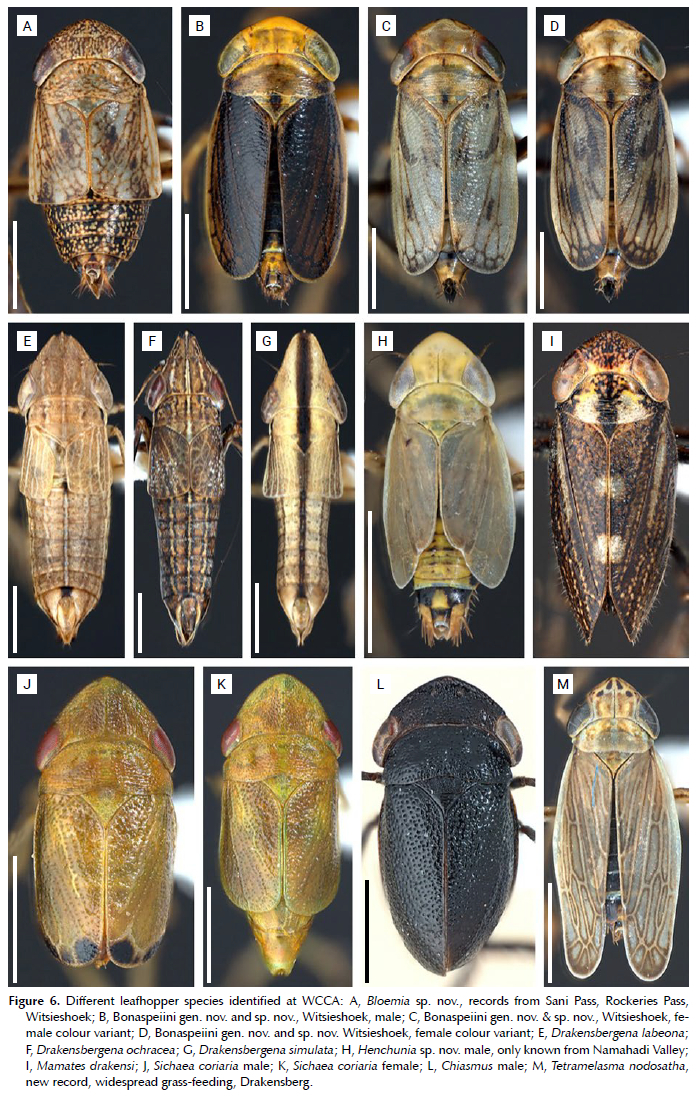
beetle (Coleóptera: Trogidae: Phoberus sp. nov. (Werner Strumpher, Ditsong Museum of Natural History, Pretoria, personal communication), 3 leafhoppers (Hemiptera: Cicadellidae: gen. and sp. nov.: Bloemia sp. nov.; Henchunia sp. nov.), 1 ambush bug (Hemiptera: Phymatidae: Phymatinae: gen. et sp. nov.), 2 hymenopterans (Hymenoptera: Colletidae: Scrapter nitidus (Friese) group sp. nov.; Hymenoptera: Eucharitidae: Eucharitinae: Hydrorhoa sp. nov.) and 1 grasshopper (Orthoptera: Caelifera: Acrididae: Euloryma sp. nov.). At least 6 additional new-to-science species were sampled either in the montane zone or both in the montane and alpine zones: 1 newly described horseshoe bat (Chiroptera: Rhinolophidae: Rhinolophus cervenyi Benda et al. 2024), 1 grasshopper (Orthoptera: Acrididae: Gomphocerinae: Leva sp. nov.), 1 wasp (Hymenoptera: Braconidae: Charmontinae: Charmon sp. nov.), 2 or more weevils [Coleoptera: Curculionidae: Entiminae: Holcolaccus sp. nov. (alpine and montane), Coleoptera: Curculionidae: Bronchus sp. nov. (montane)], and 1 leaf beetle (Coleoptera: Chrysomelidae: Estcourtiana sp. nov.), amongst others. Photographs of a few of the new species are featured in Figure 6.
Discussion
Discussion of taxon-specific results
Mammals
We incidentally recorded five species of native large and medium-sized mammals: baboon [Papio ursinus (Kerr)], klipspringer [Oreotragus oreotragus (Zimmerman)], grey rhebuck [Pelea capreolus (Forster)], rock hyrax [Procavia capensis (Pallas)] and Hewitt's red rock hare (Pronolagus saundersiae Hewitt) and eight domestic species including dogs, cats, rats, sheep, goats, cattle and horses. The WCCA, lacking formal protection or fencing, supported fewer large native mammals
compared to the neighbouring Royal Natal National Park (RNNP) and Golden Gate Highlands National Park (GGHNP). These protected areas host 30 large to medium mammal species, as recorded by the MammalMap database for the 0.5 x 0.5° locus 2828D (which includes both protected areas). This includes 13 antelope species, plains zebra, two suids, three mustelids, two genets, three mongooses, two felids, two canids, rock hyrax and baboon. Many of these species are either extinct or very rare in neighbouring areas of Lesotho (Morake 2010) but would be potential candidates for a rewilding programme in the WCCA.
Out of 10 terrestrial small mammal species recorded, three were alpine endemics in our study area, Sclater's golden mole [Chlorotalpa sclateri (Broom)], the white-tailed rat [Mystromys albicaudatus (A.Smith)] and the ice rat (Otomys sloggetti Thomas). Although not previously recorded from the alpine zone (Lynch 1994; Taylor 1998; Taylor et al. 2020), the vlei rat (Otomys aura-tus Wroughton) was recorded from both montane and alpine zones in our study. Alpine-collected individuals were considerably smaller in body and skull size than montane-collected individuals, although their identity was confirmed by cytochrome-b sequences (Taylor; unpublished data). None of the three alpine endemics in our study have been recorded at either montane or alpine elevations in adjacent GGHNP (Avenant 1997) or RNNP (Taylor 1998), but M. albicaudatus has also been recorded in montane grasslands (ca. 1 500 m a.s.l.) elsewhere in the foothills of the Drakensberg in South Africa and Eswatini (Lynch 1983; Armstrong & Van Hensbergen 1996; Taylor 1998; Simelane et al. 2018) and in both montane and alpine habitats in Lesotho, ca. 1 600-3 000 m a.s.l. (Lynch 1994). Due to its rarity and patchy distribution, M. albicaudatus is listed as Vulnerable on the lUCN Red List (Avenant et al. 2019). Ice rats, O. sloggetti have been widely recorded in alpine habitats in Lesotho and the KwaZulu-Natal Drakensberg (Lynch & Watson 1992; Lynch 1994; Taylor 1998), while Sclater's golden mole, C. sclateri has been recorded from montane elevations in the KZN Drakensberg (Taylor 1998) and montane to alpine elevations (1 750-3 000 m a.s.l.) in Lesotho (Lynch 1994). Elsewhere it is known patchily from montane habitats along the Great Escarpment from Sutherland and Beaufort West to the Sneeuberg Mountains to the Eastern Cape Drakensberg and from the northern Drakensberg in the vicinity of Wakkerstroom (Bronner 2013).
The terrestrial small mammal composition recorded at WCCA was distinctly different from that recorded in the neighbouring protected areas to the west (GGHNP; Avenant 1997) and east (RNNP; Taylor et al. 1998), possibly due to its intermediate geographic position, straddling three major watersheds between drier western and moister eastern slopes of the Drakensberg (Figure 1). Supporting this idea, the more arid-associated rodent, Mastomys coucha (A.Smith) was recorded at WCCA (identified from cytochrome-b sequence, unpublished data), while the more mesic-associated M. natalensis (A.Smith) was recorded at RNNP (Taylor et al. 1998). Taylor et al. (1998) recorded three of the species found in our study (two rodents and one shrew) and an additional two shrews and five rodent species, two of which [Mozambique thicket rat, Grammomys cometes (Thomas & Wroughton) and woodland dormouse, Graphiurus murinus (Desmarest)] were forest-associated. A small forest patch in WCCA was not sampled for small mammals in this study for logistic reasons and could be shown by future sampling to harbour these two rodents. Avenant (1997) recorded six of the small mammals (two shrews and four rodents) recorded by our study and an additional golden mole, hedgehog, two shrews and seven rodents.
Bat activity and species richness declined at the alpine sites compared with the upper- and lower-montane sites. Eight species were recorded at the lower-montane site, seven at the upper-montane site and five at the alpine site (Figure 4B). The eight species recorded in total are all known to occur in the area, except for one species of horseshoe bat, which is a newly described high elevation Drakensberg-endemic species, Rhinolophus cervenyi (Benda et al. 2024), having a distinctive echolocation peak frequency of 81 kHz (Taylor et al. 2024). This species was found at all sites in our study from 2 000 to 3 100 m a.s.l., whereas the congeneric R. acrotis Heuglin was only recorded at the lowermontane site (2 000 m a.s.l).
Birds
Of the 246 bird species known to occur in the KwaZulu-Natal Drakensberg (Little & Bainbridge 1992), some 130 bird species (39 of them endemic) are expected to occur in the Qwaqwa Maloti (Van As 2014b). Based on our time counts at the four sites, we recorded 60 species, which, when combined with GBIF data (110 species), resulted in the detection of all six Malo-ti-Drakensberg strict endemic or near-endemic bird species (see below). Birds commonly recorded at the lower elevations included widespread and abundant species such as Cape Longclaw [Macronyx capensis (Linnaeus)], Dark-capped Bulbul [Pycnonotus barbatus (Desfontaines)] and Cape Robin-chat [Cossypha caffra (Linnaeus)]. In contrast, birds seen at higher elevations included species endemic (or near endemic) to the Drakensberg such as Drakensberg Rockjumper (Chaetops aurantius E.L.Layard) and Sentinel Rock Thrush [Monticola explorator (Vieillot)]. The number of bird species recorded on GBIF for the study area was almost double the number recorded during our surveys.
Near Sani Top in Lesotho, Kopij (2015) recorded 30 bird species in alpine grassland and 69 in uppermontane grassland. The alpine habitat was considered to be much more important from a conservation standpoint since it supported high breeding densities of MalotiDrakensberg endemics, e.g., Mountain Pipit (Anthus hoeschi Stresemann), Drakensberg Rockjumper and Drakensberg Siskin [Crithagra symonsi (Roberts)], and near endemics i.e. the Southern Bald Ibis [Geronticus calvus (Boddaert)], Sickle-winged Chat [Emarginata sinuata (Sundevall)] and Sentinel Rock Thrush, compared with non-alpine habitats. Our BioBlitzes recorded two of the three alpine endemics (all but the Drakensberg Siskin), and two of the three near-endemics (all but the Southern Bald Ibis), while the GBIF list included all six endemics and near-endemics. Kopij (2015) found endemic and near-endemic species to be more abundant/dominant in alpine versus upper-montane grasslands. Our BioBlitz data showed Mountain Pipit and Sickle-winged Chats to be present only at alpine but not upper montane sites, while the Drakensberg Rock-jumper was recorded only at upper-montane sites. The Sentinel Rock Thrush was recorded in both sites but was far more common in alpine sites. None of these four species occurred in any of the lower sites.
Herpetofauna (reptiles and amphibians)
Although not comprehensively surveyed, Van As (2014a) recorded 32 reptile and 21 amphibian species in the study area. Two reptile species from the study area, Lang's Crag Lizard (Pseudocordylus langi Loveridge) and Essex's Mountain Lizard (Tropidosaura essexi Hewitt) can be considered alpine endemics or near-endemics, and both are listed as Least Concern (Tolley et al. 2023). Breyer's Long-tailed Seps (Tetradactylus breyeri Roux) occurs across a broader elevational range in montane grasslands of the Drakensberg but is listed as Near Threatened due to ongoing degradation and loss of grasslands (Tolley et al. 2023). The ice frog [(Amietia vertebralis (Hewitt)] is an alpine endemic and is expected to have been impacted by river impoundment, road construction and wetland degradation. All these alpine or montane endemics are therefore critical sentinels of climate change and should be monitored regularly.
Ants
A total of 20 ant morphospecies from 13 genera, and five subfamilies were sampled during a single sampling of two lower (TER 1, TER 2) and one upper (TER 3) montane sites in October 2021. Myrmicinae was the most dominant subfamily, representing 82% of the total ant abundance. Ponerinae and Formicinae subfamilies had 11% and 7% of the total abundance, respectively. Over half of the abundance was made up of one unidentified species, Pheidole UKZN_04. Six species were exclusively recorded in the vicinity of the Lodge (TER 2) while three were exclusively recorded from the Sentinel Car Park (TER 3). Other species were shared between two or three sites.
Dung beetles (Scarabaeidae)
A total of 29 dung beetle species from 10 genera were collected across montane and alpine elevation zones. Two species were recorded exclusively in the alpine zone, Epirinus pygidialus Scholtz & Howden and Labarrus pseudolividus Balthasar. The species collected in total represented six of the seven functional groups in a dung beetle assemblage (all except large, fast-burying paracoprids - Functional Group III), indicating a relatively intact ecosystem (Doube 1990). The functional groups were diverse and well represented over the elevational change. Ball-rolling dung beetles were present at WCCA but are largely absent from intensive mixed maize and livestock agricultural areas surrounding the WCCA (Astrid Jankielsohn, unpublished data).
Flower-visiting insects and orthopteran herbivores
We recorded 21 species of pollinator insects, 18 species of herbivorous orthopterans and 76 species of other flower-visiting insects at eight sites covering three elevation zones, lower and upper montane and alpine (Table 2; Figure 4). There was little overlap of species between the montane and alpine sites: 38 species were only recorded at alpine sites, 60 only at montane sites (upper and/or lower) and 17 species in both montane and alpine zones. Of the undescribed and probably undescribed species,
four were collected at alpine sites, six at montane sites and two at both alpine and montane sites. The montane sites thus had a different fauna compared to the alpine sites, reflecting the montane and alpine sub-centres of floristic endemism in the Drakensberg Mountain Centre (Carbutt 2019). However, the exact number of species recorded that are alpine endemics has still to be established. The expert and public datasets were highly complementary, with little overlap between the species sampled and those in the citizen science dataset (Figure 3). Overlapping species represented those easily identifiable by citizen scientists. Field guides to less easily identified insect taxa should be published to assist citizen scientists with their identification, leading to more complete public databases of insects.
Leafhoppers
Several new species of leafhoppers have been described in the last 15 years (e.g., Stiller 2009, 2010, 2011, 2012). The first extensive examination of leafhoppers on the Drakensberg alpine summit and adjacent higher slopes identified 35 species, 13 of which were only found in the alpine zone (Figure 4, Table 2). Three new, undescribed species were collected from the alpine summit: Henchunia Vilbaste from grass (Figure 6H), a new species of Bloemia Theron (Figure 6A) and a new genus and species from the tribe Bonaspeiini from shrubs (Figure 6B-D). The latter was recorded from two locations on the alpine summit in this study and has also been recorded at Sehlabathebe National Park in Lesotho and Monks Cowl and possibly the summit of Organ Pipes Pass in the KwaZulu-Natal Drakensberg. Leafhoppers associated with small black-stick lily plants (Xerophyta spp., Velloziaceae) were not collected in this study, but are expected to occur, based on a single record of Xerophytavorus rastrullus Stiller from the summit of the KwaZulu-Natal Drakensberg (2 880 m a.s.l.) near the Orange River source (Stiller 2012).
We sampled shrubs, moribund grass and grass and sedge regrowth after fire. Species could be classified into functional groups based on feeding on grass (20 species), shrubs (11 species) or both (one species), and in the case of grass-feeding species, into Savanna Biome (6 species), Grassland Biome (10, including two wetland species) or both biomes (4 species). Grass-feeding Savanna Biome leafhoppers included Aconurella Ribault, Balclutha Kirkaldy, Chiasmus hyalinus (Evan) (short-winged), Exitianus turneri Ross, Nicolaus Lindberg and Pravistylus exquadratus (Naudé), while wetland-associated species included Afrosteles distans (Linnavuori) and Teyasteles divisifrons (Naudé). Grassland Biome-associated grass-feeders included three species of Drakensbergena, D. labeona Stiller (Figure 6E), D. ochracea Linnavuori (Figure 6F), D. simulata Stiller (short winged) (Figure 6G), as well as Elginus falcatus Stiller, Henchunia sp. nov. (short-winged) (Figure 6H), Naudeus bivittatus (Naudé), Pravistylus
interdiscus Stiller (short winged), Tetramelasma nodosatha Stiller (Figure 6M) and Sandia brevis Theron (short-winged). Shrub-associated species included Basutoia brachyptera Linnavuori, 1961 (short-winged), Bloemia sp. nov. (short winged) (Figure 6A), Chiasmus Mulsant & Rey (short winged) (Figure 6L), Mamates drakensi Theron (short winged) (Figure 6I), Molopopterus Jacobi, Bonaspeiini gen. nov. & sp. nov. (short-winged) (Figure 6B-D), Sichaea coriaria Stâl (short winged) (Figure 6J, K), Typhlocybinae (tree and shrub feeding) and Tzitzikamaia irrorata Linnavuori (short-winged, shrub or forb-feeding). Although considered to be grass-feeding (Stiller 2009), in this study Drakensbergena spp. were collected on shrubs and grass, in regrowth after fire and in moribund grass, but with nymphs only on grass.
Overgrazing and regular burning may be causing a decline in grass-feeding leafhoppers and an increase in shrub-associated ones (Michael Stiller, unpublished observations).
Other arthropods from pitfall traps and associated sweep nets
For logistical reasons, the alpine zone was not sampled for these groups in this study. General collections of spiders and insects from standardised pitfall arrays and sweep netting from lower (TER 1-2) and upper (TER 3-3a) montane sites resulted in 200 spiders (17 families; 47 morphospecies), 352 bugs (Hemiptera: 15 families; 69 morphospecies), 919 flies (Diptera: 30 families; 91 morphospecies) and 506 grasshoppers and other orthopterans (Orthoptera: 9 families; 65 morphospecies). Since most specimens were identified only to family and morphospecies for this study, species numbers are likely to change as specialist identifications are completed. Nevertheless, for all four groups mentioned above, there was low overlap (i.e., high turnover) in species composition of spider and insect assemblages among elevation zones (Figure 4F, G, H, L).
Aquatic macroinvertebrates
The Maloti-Drakensberg region including the WCCA is host to a diverse range of freshwater invertebrates, found in both river systems and temporary water bodies such as rockpools. Many of these species are endemic to the MD (Hamer & Brendonck 1997; Martens et al. 1998; Van Damme et al. 2013; Deacon et al. 2020). Those found in temporary water bodies often exhibit extraordinary eco-physiological adaptations to survive marked wet-dry seasons, harsh cold temperatures and nutrient-limited systems (Mdidimba et al. 2021).
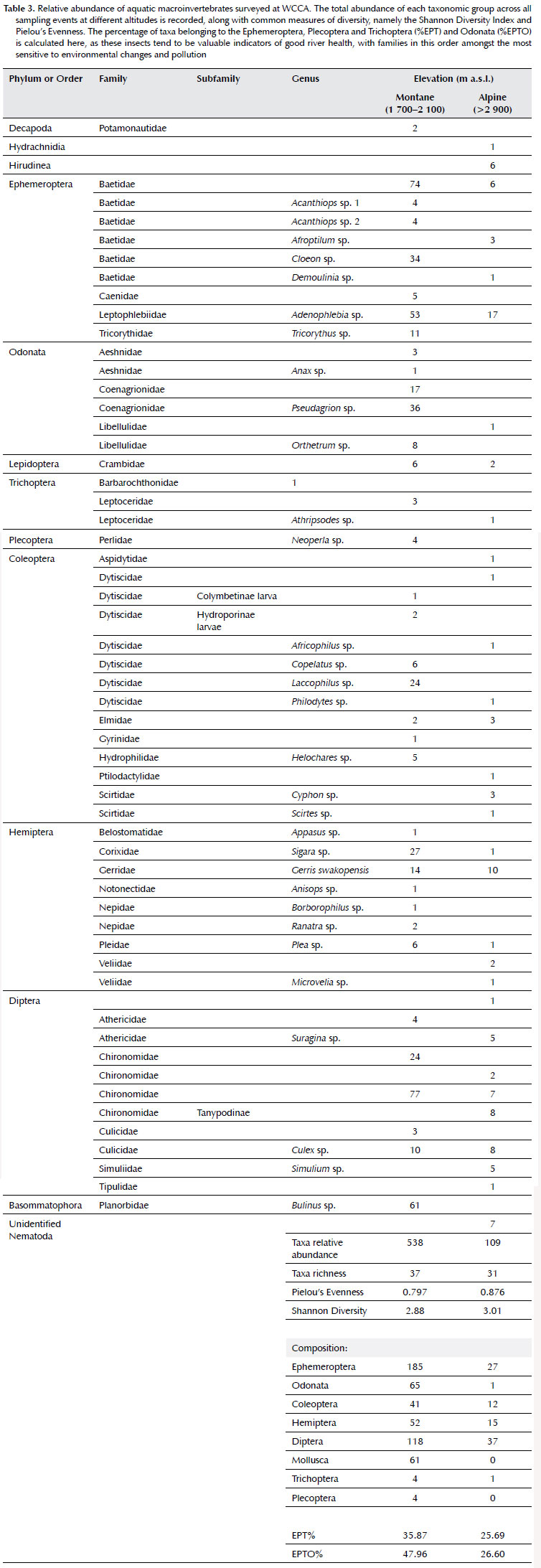
We collected 647 aquatic macroinvertebrates (60 morphospecies from 33 families and 13 orders) from 2 montane (AQS 1-3) and 4 alpine (AQS 4-7) sites.
While 23 species were only recorded in alpine sites, 28 were only recorded in montane sites, and 9 species occurred in both montane and alpine sites (Figure 4K). Montane sites showed higher abundance and richness, but lower evenness and diversity scores, compared to alpine sites (Table 3). Assemblage composition differed, with Ephemeroptera, Plecoptera and Trichoptera (EPT) being most abundant at alpine (36%) compared with montane (26%) sites, and Plecoptera and Mollusca only found in montane sites. As identifications were generally made only to family and morphospecies, these numbers may change as specialist identifications are completed, and potential novel species are described. There were nevertheless clear differences in the insect communities between elevations, with 13 and 9 families only found in montane and alpine sites, respectively.
Aquatic beetles were well represented in these samples. This group has a high diversity in the Drakensberg (Perkins 2005a,b, 2008; Bilton 2017) but are still poorly known from WCCA, where cryptic diversity has been uncovered (Englund et al. 2020). Rockpools and ephemeral wetlands support a surprising diversity of large branchiopods (i.e., Anostraca, Notostraca, Spinicaudata and Laevicaudata) including the tadpole shrimp [Triops granaries (Lucas)] recorded from the Drakensberg summit and 4 out of 5 known Branchipodopsis species that are endemic to Maloti-Drakensberg rockpools (Hamer & Martens 1998). Although no specimens were collected in this study, the desiccation-tolerant chironomid, Polypedilum cranstoni Cornette, Motitsoe & Mlambo, 2022, was originally described from WCCA, near Fika-Patso Dam and seems to be endemic to montane rock pools in the MD (Cornette et al. 2022). Three other related species of desiccation-tolerant chironomid species from the same genus are known from similar elevations in Namibia, Malawi and Nigeria (Cornette et al. 2017).
Preliminary results indicate that freshwater resources in WCCA are largely natural, with a high diversity of sensitive taxa like EPT (Dickens & Graham 2002; Odume et al. 2012). Nevertheless, the absence of some expected genera, such as the endemic Plecopteran genus, Balinskycercella Stevens & Picker, 1995, may point to increased disturbance in the region. Given the importance of these freshwater invertebrates as ecological indicators of ecosystem health, the above examples highlight the rich diversity of aquatic macroinvertebrates from WCCA and the urgent need for future studies to further unravel the hidden diversity that will inform evidence-based conservation and rewilding of the WCCA.
Plants
Combining various local projects, MSc (Lesego Malekana) and PhD (Mosiuoa Bereng) research, and BioBlitz records, 2 120 plant specimens were collected, representing 322 vascular flowering plant species in 59 families and 189 genera. The MIREN transect contributed 86% of the collection, with additional contributions from the PhD collection (6%), MSc project (4%), and general BioBlitz records (4%). Twelve non-native species were recorded. The GBIF database for the WCCA provided 549 records, with 260 plant species, 116 of which overlapped with the BioBlitz surveys.
The combined data from local projects and GBIF include 466 species from 66 families and 215 genera. This current checklist covers about 30% of the potential flora for the 7 000 ha Witsieshoek precinct, with notable gaps in woody habitats below 2 000 m a.s.l., comprehensive fern flora, and C3 grasses above 2 600 m. Additional data sources yet to be incorporated include historical collections, extensive grass work in 2020 (e.g. Sylvester et al. 2020), SANBI's Plants of the Free State (Retief & Meyer 2017), published literature (e.g. Shezi et al. 2021), and data from the 7th Plant Functional Traits Course, which took place in the WCCA in December 2023 (https://plantfunctionaltraitscourses.w.uib.no/). As such, the current data are incomplete and preliminary and do not lend themselves to in-depth analyses at this point. Nevertheless, analyses of elevational patterns of the independently obtained species lists (GBIF and current study) indicate a high turnover between elevation zones in both datasets (Figure 5), with 82 species recorded as alpine-endemic at the scale of the current study (Figure 4).
The most diverse family in our study was Asteraceae (29%), followed by Poaceae (10%), Scrophulariaceae (6%), Iridaceae (6%) and Orchidaceae (4%). This dominance pattern is largely reflected in the total flora of the Drakensberg Mountain Centre (e.g., Carbutt & Edwards 2004). Helichrysum is the most diverse genus with 37 taxa, followed by Senecio with 16 taxa. Other significant genera include Moraea, Erica and Disa.
General discussion
The escalator to extinction
While most studies of climate change impacts on alpine biodiversity are situated in the northern hemisphere and focus on a single taxon (Freeman et al. 2018; Urban 2018; Watts et al. 2022), our study showed correlated responses across various plant and animal taxa to a montane-alpine gradient in southern Africa. Of 11 taxa for which data existed from both montane and alpine sites in this study, nine had alpine endemics (range 0-37%; mean 17.5%). This highlights the systematic biodiversity extinction risk for alpine endemics under climate change, especially small and flightless species. Species that are currently trapped within a narrow range of alpine habitat face a high extinction risk from further climate warming, especially for species that lack phenotypic plasticity or behavioural or physiological flexibility.
Predominantly in northern hemisphere mountain ranges like the European Alps and Himalayas, 227 000 km2 of new lands will emerge by 2100 due to shrinking ice under the high emissions RCP8.5 scenario (Zimmer et al. 2022). Although this can be perceived as a benefit, there are many adverse effects of increased snow melt (Xu et al. 2009). This is not an issue in the Drakensberg Mountain Centre, which lacks current glaciers. Nevertheless, warming conditions may result in non-alpine plant and animal species from lower elevations being able to colonise higher elevation alpine habitats, possibly out-competing more specialised alpine congeners. For example, we were surprised to trap vlei rats Otomys auratus at 3 145 m a.s.l. in our study, occurring sympatrically with ice rats, O. sloggetti. No historical records for O. auratus exist from such a high elevation, and the animals captured were markedly smaller than individuals from lower elevations (Peter John Taylor, unpublished data), suggesting the possibility of phenotypic plasticity towards smaller size to save energy in a demanding cold environment that regularly experiences snow.
As expected and found also by Monadjem et al. (2023), we found that smaller and less mobile organisms such as insects and small mammals showed higher turnover and lower nestedness, than more mobile organisms like birds and bats. We can thus predict that the former are more vulnerable to global warming.
We demonstrated remarkable congruency between citizen science (GBIF, including iNaturalist, eBirds and the Southern African Bird Atlas 2 project) and our expert BioBlitz datasets (Figures 3, 5), validating the importance of mountain tourism-based citizen science in documenting species checklists and elevational patterns in the fauna and flora of imperilled alpine hotspots. Since mountain tourism is an important feature in alpine zones globally such as the Alps, Himalayas, Rockies and Andes, we advocate renewed exploration of citizen science datasets from these regions to document biodiversity at risk from the escalator to extinction.
Climate models may predict varying vulnerability of ecosystems to climate change. For example, the environmentally defined grassland floristic domains of the study area are considered mainly susceptible to climate-induced change according to the down-scaled HadCM2 climate model but robust to climate-induced change according to the downscaled GFDL2.1 climate model (Jewitt et al. 2015). Adaptation strategies vary based on climate model predictions (Mawdsley et al. 2009). For susceptible scenarios, conservationists should focus on expanding protected areas, managing ecosystem functions and land-cover change impacts, and designing climate-resilient protected areas. For robust scenarios, conservationists should focus on improving management of existing protected areas, regularly reviewing conservation policies, and increasing biodiversity representation and replication in protected areas (Jewitt et al. 2015). Future monitoring of our baseline data will help test climate models' predictive powers regarding the susceptibility of different assemblages, guiding appropriate conservation strategies.
Ecological indicators of ecosystem health and the potential for rewilding in WCCA
As they are highly sensitive to environmental conditions and disturbance, taxa such as aquatic invertebrates (Mdidimba et al. 2021) and dung beetles (Botes et al. 2006) are excellent indicators of ecosystem health and biodiversity intactness. The functional and taxonomic diversity of aquatic invertebrates and dung beetles (and plants and animals generally) suggest that montane and alpine grassland ecosystems are largely intact. The almost complete absence of large mammalian herbivores and carnivores in the study area that occur in adjacent protected areas is therefore not due to habitat availability but rather mostly to hunting (Morake 2010) and/or competition with domestic grazers such as cattle, goats, donkeys and sheep. Although grassland ecosystems are currently largely intact, they are threatened by increasing alien invasion and bush encroachment (RangeX project; Mountain Invasion Research Network - RangeX, available online at https://www.mountaininvasions.org/rangex, accessed on 14 February 2024), as well as increasing grazing pressure by livestock of both South African and Basotho herders in the montane and alpine zones respectively (personal observation; Carbutt 2020; Kotzé et al. 2023). As they are dependent on specific shrub or grass plant species, leafhoppers are useful indicators of vegetation changes including shrub (bush) encroachment. In our study, leafhopper assemblages included both shrub and grass-dependent species, providing a good baseline for future assessments of rangeland condition.
Since these threats will impact the experience of, and revenues from, ecotourists, we advocate a mountain tourism and community-centred rewilding approach. Reintroduction of iconic species such as the common eland (Tragelaphus oryx), which has a strong cultural and spiritual connection with local communities (the municipality of 'Maluti-A-Phofung' means 'The Place of the Eland' in the local Sesotho language), can considerably boost tourism revenue. Rewilding has been shown to be an effective strategy for protecting both charismatic large mammalian 'umbrella species' and entire ecosystems, but this requires mitigating conflicts between conservation stakeholders and livestock farmers (Freese et al. 2014). At present, rewilding is focused on large mammals because of the lack of data on what other taxa may be missing from the WCCA that might not be able to recolonise it naturally. In the WCCA, rewilding and reintroduction of large mammals can be achieved either by fencing and/or a community-based conservation plan, but these options need to be explored in partnership with local communities. Since the WCCA borders two countries, the Maloti-Drakensberg Transfrontier Conservation Authority (MDTFCA) is a critical player in conserving this area. Equally important is engaging with local communities and NGOs such as Meat Naturally Africa (https://www.meatnaturallyafrica.com/), to improve communal rangeland quality and sustainability, which directly benefits biodiversity and ecosystem services, as well as revenues from both livestock farming and biodiversity carbon credits (intact rangelands sequester more carbon than degraded rangelands; Preger et al. 2019). Since community conservation areas are critical to conserving alpine grasslands (Carbutt 2020), we propose that the WCCA is a test case that can provide solutions that are applicable to alpine grassland ecosystems globally.
Conclusions
Several groups, such as lepidopterans, were not comprehensively sampled during our expert BioBlitzes, suggesting that our species list will increase considerably as sampling gaps are filled. For example, the LepiMAP project database (Underhill & Navarro 2023) yielded 145 species of Lepidoptera from the 0.5 x 0.5° locus 2828D, which includes WCCA plus the two adjacent protected areas of RNNP and GGHNP, yet our study only recorded a few species, mainly incidentally, and GBIF yielded 29 species for the WCCA.
Area-based conservation requires a detailed understanding of local species, as well as ecosystem processes and should be underpinned by robust biodiversity inventories. Such inventories should be compiled from multiple sources, including field surveys by specialists, citizen science observations, public datasets and published studies. Each approach has its own limitations, and no single approach is comprehensive. There is no substitute for field-based surveys, but due to their costly and time intensive nature, these are often limited to rapid assessments (snapshots in time and space) such as BioBlitzes, carrying an inherent risk of limited data representation. To address this bias, we advocate multiple expert BioBlitzes that draw on a wide range of taxonomic expertise. In this study, we engaged a range of experts from such diverse fields as mammalogy, ornithology, herpetology, arachnology, entomology and botany, resulting in checklists for 14 diverse taxa. These experts also provided an understanding of local species, and corroborated local species lists obtained from public databases.
Data parity and data complementarity between approaches are essential to ensuring an accurate and comprehensive dataset to guide conservation management actions. In this study, we show that inventories obtained from the GBIF and from expert BioBlitzes were highly complementary; the combined species sums were considerably greater than those of either approach alone. Combining datasets resulted in a list of over 1 200 species.
Acknowledgements
This paper is dedicated to Pindiwe Ntloko and Musa Mlambo, who passed away during the preparation of this manuscript. Both were exceptional scientists who brought positivity and goodness to all their work. They are dearly missed.
The project was partly supported from 2022 to 2023 by a Department of Science & Innovation (DSI)-National Research Foundation (NRF) Centre for Global Change award (Grant No. 128386) to the Afromontane Research Unit (UFS), including BioBlitz fieldwork and the Witsieshoek MIREN transect. Data from RangeX was supported by a free-standing EU Biodiversa project through the DSI, including Lesego Malekana's stipend. Mosiuoa Bereng's doctoral bursary has been supported by the Lesotho Highlands Development Agency. The project was also supported by the Departments of Zoology and Entomology and Plant Sciences and the Interdisciplinary Fund of the Deputy Vice Chancellor: Research at UFS. We are extremely grateful to Jan van Niekerk, Hennie van der Colf, Bradley Mason, Glynn O'Leary and Eleanor Muller at Transfrontier Parks Destinations at Witsieshoek Mountain Lodge, and to the property owners, the Batlokoa Royal House, for permission to conduct field work in the Witsieshoek lease area. Prof. Peter le Roux and his team from the University of Pretoria are gratefully acknowledged for contributing botanical records. Authors would like to thank the NRF Thuthuka fund (Grant number TTK 210216586796) for financial support. Corinna Naidoo is thanked for technical assistance in the field. Beth Grobbelaar, Alain Pauly, Roman Borovec and Terry Reynolds are thanked for assistance with insect identifications.
Dr Nico Avenant and Dr Aluwani Nengovhela from the National Museum in Bloemfontein kindly accessioned small mammal specimens from this study in the Mammalogy Collection, and Dr Michael Bates from the National Museum kindly accessioned herpetological specimens.
Declaration of competing interest
The authors declare that they have no known competing financial interests that could have appeared to influence the work reported in this paper.
Ethical considerations
Permission for scientific collecting was provided by Permit No. 202106000007056 of the Free State Province Department of Economic, Small Business Development, Tourism and Environmental Affairs (DESTEA) and from the landowners, the Batlokoa Royal House through a MOU between the ARU/UFS and Transfrontier Parks Destinations (TFD), who manage the Witsieshoek Mountain Lodge on behalf of the Royal Council. Ethical clearance was provided by the UFS Animal Research Ethics Committee (Project numbers: UFS-AED2021/0029/21 and UFS-AED2023/0037), UFS Environment and Biosafety Research Ethics Committee (Clearance no. FS-ESD2021/0233/22), and Section 20 permit from the Department of Agriculture, Land Reform and Rural Development (DALLRD) to conduct research in terms of Section 20 of the Animal Diseases Act, 1984 (Act No. 35 of 1984) [Reference no. 12/11/1/4 (2038 RJ)].
References
Armstrong, A.J. & Brand, R.F., 2012, 'Invertebrates on isolated peaks in the uKhahlamba-Drakensberg Park World Heritage Site, South Africa', Koedoe 54(1), 1-10, http://dx.doi.org/10.4102/koedoe.v54i1.1082. [ Links ]
Armstrong, A.J. & Van Hensbergen, H.J., 1996, 'Small mammals in afforestable montane grasslands of the NE Cape, South Africa', South African Journal of Wildlife Research 26, 11-18. [ Links ]
Avenant, N.L., 1997, 'Mammals recorded in the QwaQwa National Park (1994-1995)', Koedoe 40, 31-40. [ Links ]
Avenant, N., Wilson, B., Power, J., Palmer, G. & Child, M.F., 2019, Mystromys albicaudatus. The lUCN Red List of Threatened Species, https://dx.doi.org/10.2305/IUCN.UK.2019-1.RLTS.T14262A22237378.en. Accessed on 13 October 2024. [ Links ]
Baselga, A. & Orme, C.D.L., 2012, 'Betapart: an R package for the study of beta diversity', Methods in Ecology and Evolution 3, 808-812, https://doi.org/10.1111/j.2041-210X.2012.00224.X. [ Links ]
Benda, PP, Uvizl, M., Eiseb, S.J. & Avenant, N.L., 2024, 'On the systematic position of the horseshoe bats (Mammalia: Chiroptera) from Lesotho', Mammalia 88, 239-258, https://doi.org/10.1515/mammalia-2023-0119. [ Links ]
Bengtsson, J., Bullock, J.M., Egoh, B., Everson, C., Everson, T., O'Connor, T., O'Farrell, PPJ., Smith, H.G. & Lindborg, R., 2019, 'Grasslands - More important for ecosystem services than you might think', Ecosphere 10, e02582, https://doi.org/10.1002/ecs2.2582. [ Links ]
Bilton D.T., 2017, 'Three new species of Crenitis Bedel, 1881 from South Africa, with a revised key to African species (Coleoptera: Hydrophilidae)', Aquatic Insects 38, 101-113. [ Links ]
Botes, A., McGeoch, M.A. & Van Rensburg, B.J., 2006, 'Elephant- and human-induced changes to dung beetles (Coleoptera: Scarabaeidae) assemblages in the Maputaland Centre of Endemism', Biological Conservation 130, 573-583, https://doi.org/10.1016/j.biocon.2006.01.020. [ Links ]
Brand, R.F., Scott-Shaw, C.R. & O'Connor, T.G., 2019, 'The alpine flora on inselberg summits in the Maloti-Drakensberg Park, KwaZulu-Natal, South Africa', Bothalia 49,1, a2386, https://doi.org/10.4102/abc.v49i1.2386. [ Links ]
Bronner, G.N., 2013, 'Chlorotalpa sclateri, Sclater's Golden Mole' in J. Kingdon, D. Happold, M. Hoffmann, T. Butynski, M. Happold, & J. Kalina (eds), Mammals of Africa. Volume I. Introductory Chapters and Afrotheria (pp. 210-215), Bloomsbury Publishing, London. [ Links ]
Carbutt, C., 2019, 'The Drakensberg Mountain Centre: A necessary revision of southern Africa's high-elevation centre of plant endemism', South African Journal of Botany 124, 508-529, https://doi.org/10.1016/j.sajb.2019.05.032. [ Links ]
Carbutt, C., 2020, 'The imperilled alpine grasslands of the Afrotropic realm, in D.A. DellaSala & M.I. Goldstein (eds), Imperilled: The Encyclopedia of Conservation (pp. 243255), https://dx.doi.org/10.1016/B978-0-12-821139-7.00012-X. [ Links ]
Carbutt, C. & Edwards, T.J., 2004, 'The flora of the Drakensberg Alpine Centre', Edinburgh Journal of Botany 60, 581-607. [ Links ]
Carbutt, C. & Edwards, T.J., 2015, 'Reconciling ecological and phytogeographical spatial boundaries to clarify the limits of the montane and alpine regions of sub-Sahelian Africa', South African Journal of Botany 98, 64-75, http://dx.doi.org/10.1016/j.sajb.2015.01.014. [ Links ]
Carbutt, C., Henwood, W.D. & Gilfedder, L.A., 2017, 'Global plight of native temperate grasslands: going, going, gone?', Biodiversity and Conservation 26, 2911-2932, https://doi.org/10.1007/s10531-017-1398-5. [ Links ]
Chao, A., Gotelli, N.J., Hsieh, T.C., Sander, E.L., Ma, K.H., Colwell, R.K. & Ellison, A.M., 2014, 'Rarefaction and extrapolation with Hill numbers: a framework for sampling and estimation in species diversity studies', Ecological Monographs 84, 45-67. [ Links ]
Chen, H., 2022, VennDiagram: Generate High-Resolution Venn and Euler Plots. R package version 1.7.3., https://CRAN.R-project.org/package=VennDiagram. [ Links ]
Clark, V.R., Barker, N.P & Mucina, L., 2011, 'The Great Escarpment of southern Africa: A new frontier for biodiversity exploration', Biodiversity Conservation 20, 25432561. [ Links ]
Clark, V.R., Bentley, J., Dold, A.P, Zikishe, V. & Barker, N.P, 2016a, 'The rediscovery of the Great Winterberg endemic Lotononis harveyi B.-E.van Wyk after 147 years, and notes on the poorly known Amathole endemic Macowania revoluta Oliv. (southern Great Escarpment, South Africa)', PhytoKeys 124, 113-124. [ Links ]
Clark, V.R., Schrire, B.D. & Barker, N.P, 2015, 'Two new species of Indigofera L. (Leguminosae) from the Sneeuberg Centre of Floristic Endemism, Great Escarpment (Eastern and Western Cape, South Africa)', PhytoKeys 48, 29-41. [ Links ]
Clark, V.R., Timberlake, J.R., Hyde, M.A., Mapaura, A., Coates, M., Wursten, B.T., Ballings, P., Burrows, J.E., Linder, H.P., McGregor, G.K., Chapano, C., Plowes, D.C.G., Childes, S.L., Dondeyn, S., Müller, T. & Barker, N.P, 2016b, 'A First Comprehensive Account of Floristic Diversity and Endemism on the Nyanga Massif, Manica Highlands (Zimbabwe - Mozambique)', Kirkia 19, 1-53. [ Links ]
Conradie, W., 2014, 'The King of the Dwarves: a new cryptic species of Dainty Frog (Anura: Pyxicephalidae: Cacosternum) from the eastern Great Escarpment of South Africa', Zootaxa 3785, 3, 438-452, http://dx.doi.org/10.11646/zootaxa.3785.3.6. [ Links ]
Conradie W., Busschau, T. & Edwards, S., 2018, 'Two new species of Acontias from the Mpumalanga Highveld escarpment of South Africa', Zootaxa 4429, 1, 089-106, https://doi.org/10.11646/zootaxa.4429.1.3. [ Links ]
Cornette, R., Motitsoe, S.N. & Mlambo, M.C., 2022, 'A new desiccation-resistant midge from ephemeral rock pools in South Africa, Polypedilum (Pentapedilum) cranstoni sp. nov. (Diptera: Chironomidae)', Zootaxa 5128, 3, 397-410, https://doi.org/10.11646/zootaxa.5128.3.5. [ Links ]
Cornette, R., Yamamoto, N., Yamamoto, M., Kobayashi, T., Petrova, N.A., Gusev, O., Shimura, S., Kikawada, T., Pemba, D. & Okudaa, T., 2017, 'A new anhydrobiotic midge from Malawi, Polypedilum pembai sp. n. (Diptera: Chironomidae), closely related to the desiccation tolerant midge, Polypedilum vanderplanki Hinton', Systematics Entomology 42, 4, 814-825, https://doi.org/10.1111/syen.12248. [ Links ]
Day, J.A. & De Moor, I.J., 2002, 'Guides to the freshwater invertebrates of southern Africa. Volume 5: Non-Arthropods (The Protozoans, Porifera, Cnidaria, Platyhelminthes, Nemertea, Rotifera, Nematoda, Nematomorpha, Gastrotrichia, Bryozoa, Tardigrada, Polychaeta, Oligochaeta and Hirudinea)', Water Research Commission Report no. TT 167/02. Pretoria, South Africa. [ Links ]
Day, J.A., Harrison, A.D. & De Moor, I.J., 2002, 'Guides to the freshwater invertebrates of southern Africa, Volume 9: Diptera', Water Research Commission Report no. TT 201/02. Pretoria, South Africa. [ Links ]
De Moor, I.J., Day, J.A. & De Moor, F.C., 2003a, 'Guides to the Freshwater Invertebrates of Southern Africa, Volume 7: Insecta I.', Water Research Commission Report no. TT 207/03. Pretoria, South Africa. [ Links ]
De Moor, I.J., Day, J.A. & De Moor, F.C., 2003b, 'Guides to the Freshwater Invertebrates of Southern Africa, Volume 8: Insecta II.', Water Research Commission Report no. TT 214/03. Pretoria, South Africa. [ Links ]
Deacon, C., Samways, M.J. & Pryke, J.S., 2020, 'Determining drivers of dragonfly diversity patterns and the implications for conservation in South Africa', Biological Conservation 245, 108548, https://doi.org/10.1016/j.bio-con.2020.108548. [ Links ]
Delves, J.L., Clark, V.R., Schneiderbauer, S., Barker, N.P., Szarzynski, J., Tondini, S., Vidal, De Deus., J., Jr. & Membretti, A., 2021, 'Scrutinising multidimensional challenges in the Maloti-Drakensberg (Lesotho/South Africa)', Sustainability 2021, 13, 8511, https://doi.org/10.3390/su13158511. [ Links ]
Dickens, C.W.S. & Graham, P.M., 2002, 'The South African scoring system (SASS) version 5 rapid bioassessment method for rivers', African Journal Aquatic Sciences 27, 1-10, https://doi.org/10.2989/16085914.2002.9626569. [ Links ]
Dinerstein, E., Olson D., Joshi, A., et al., 2017, 'An ecoregion-based approach to protecting half the terrestrial realm', BioScience 67, 6: 534e545. [ Links ]
Doube, B.M., 1990, 'A functional classification for analysis of the structure of dung beetle assemblages', Ecological Entomology 15, 371-383, https://doi.org/10.1111/j.1365-2311.1990.tb00820.x. [ Links ]
Englund, W.F., Njoroge, L., Biström, O., Miller, K.B., Bilton, D.T. & Bergsten, J., 2020, 'Taxonomic revision of the Afrotropical Agabus raffrayi species group with the description of four new species (Coleoptera, Dytiscidae)', ZooKeys 963, 45-79, https://doi.org/10.3897/zookeys.963.53470. [ Links ]
Freeman, B.G., Scholer, M.N., Ruiz-Gutierrez, V. & Fitzpatrick, J.W., 2018, 'Climate change causes upslope shifts and mountaintop extirpations in a tropical bird community', Proceedings of the National Academy of Sciences of the United States of America 115, 11982-11987. [ Links ]
Freese, C.H., Fuhlendorf, S.D. & Kunkel, K., 2014, 'A management framework for the transition from livestock production toward biodiversity conservation on Great Plains rangelands', Ecological Restoration 32, 3358-368. [ Links ]
Global Observation Research Initiative in Alpine Environments (GLORIA), 2024, https://www.gloria.ac.at/publications (accessed 17 May 2024). [ Links ]
Haddad, C.R., Jin, C., Platnick, N.I. & Booysen, R., 2021, 'Capobula gen. nov., a new Afrotropical dark sac spider genus related to Orthobula Simon, 1897 (Araneae: Trachelidae)', Zootaxa 4942, 1, 41-71, https://doi.org/10.11646/zootaxa.4942.1.2. [ Links ]
Haider, S., Lembrechts, J.J., McDougall, K., Pauchard, A., Alexander, J.M., Barros, A., Cavieres, L.A., Rashid, I., Rew, L.J., Aleksanyan, A., Arévalo, J.R., Aschero, V., Chisholm, C., Clark, V.R., Clavel, J., Daehler, C., Dar, PPA., Dietz, H., Dimarco, R.D. & Seipel, T., 2022, 'Think globally, measure locally: The MIREN standardized protocol for monitoring plant species distributions along elevation gradients', Evolution and Ecology 12, 1-16, https://doi.org/10.1002/ece3.8590. [ Links ]
Hamer, M. & Brendonck, L., 1997, 'Diversity, distribution and conservation of Anostraca in southern Africa', Hydrobiologia 359, 1-12. [ Links ]
Hamer, M. & Martens, K., 1998, 'The large Branchiopoda (Crustacea) from temporary habitats of the Drakensberg region, South Africa', Hydrobiologia 384, 151-165. [ Links ]
Hamer, M. & Slotow, R., 2009, 'A comparison and conservation assessment of the high-altitude grassland and forest-millipede (Diplopoda) fauna of the South African Drakensberg', Soil Organisms 81, 701-717. [ Links ]
Hickman, G.C., 1979, 'Burrow system construction of the bathyergid Cryptomys hottentotus in Natal, South Africa, Zeitschrift für Sãugetierkunde 44, 153-162. [ Links ]
Hsieh, T.C., Ma. K.H. & Chao, A., 2002, iNEXT: Interpolation and Extrapolation for Species Diversity, R package version 3.0.0, http://chao.stat.nthu.edu.tw/wordpress/software-download/. [ Links ]
Jewitt, D., Erasmus, B.F.N., Goodman, P.S., O'Connor, T.G., Hargrove, W.W. & Maddalena, D.M., 2015, 'Climate-induced change of environmentally defined floristic domains: A conservation based vulnerability framework', Applied Geography 63, 33-42, http://dx.doi.org/10.1016/j.apgeog.2015.06.004. [ Links ]
Kopij, G., 2015, 'Avian assemblages in Afro-mountain and Alti-mountain Grasslands in the endemic Maloti/Drakensberg region of Lesotho', Zoology and Ecology 25, 1-8. [ Links ]
Kotzé, J., Mc Lean, C. & Van Tol, J., 2023, 'Digitally mapping soil carbon of the uThukela headwater catchment in the Maloti-Drakensberg, a remote Afromontane mountain region', South African Geographical Journal 106, 498-517, http://dx.doi.org/10.1080/03736245.2023.2272896. [ Links ]
Liedtke, R., Barros, A., Essl, F., Lembrechts, J.J., Wedegärtner, R.E.M., Pauchard, A. & Dullinger, S., 2020, 'Hiking trails as conduits for the spread of non-native species in mountain areas', Biological Invasions 22, 3, 1121-1134, https://doi.org/10.1007/s10530-019-02165-9. [ Links ]
Little, R. & Bainbridge, W., 1992, Birds of the Natal Drakensberg Park, Wildlife Society of Southern Africa (Natal Branch). [ Links ]
Lynch, C.D., 1983, 'The mammals of the Orange Free State', Memoirs van die Nasionale Museum Bloemfontein, 18, 1-218. [ Links ]
Lynch, C.D., 1994, 'The mammals of Lesotho', Navorsinge van die Nasionale Museum Bloemfontein, 10, 4, 177-241. [ Links ]
Lynch, C.D. & Watson, J.P., 1992, 'The distribution and ecology of Otomys sloggetti (Mammalia: Rodentia) with notes on its taxonomy', Navorsinge van die Nasionale Museum Bloemfontein 8, 141-158. [ Links ]
Martens, K., Hamer, M. & Coke, M., 1998, 'A preliminary account of the diversity of non-marine Ostracoda (Crustacea) in KwaZulu-Natal, South Africa', Lammergeyer 45, 17-31. [ Links ]
Mawdsley J.R., O'Malley, R. & Ojima, D.S., 2009, 'A review of climate-change adaptation strategies for wildlife management and biodiversity conservation', Conservation Biology 23, 1080-1089. [ Links ]
McCleery, R., Monadjem, A., Conner, L.M., Austin, J. & Taylor, P.J., 2021, Methods for ecological research on terrestrial small mammals, John Hopkins University Press, Baltimore, USA, https://jhupbooks.press.jhu.edu/title/methods-ecological-research-terrestrial-small-mammals. [ Links ]
Mdidimba, N.D., Mlambo, M.C. & Motitsoe, S.N., 2021, 'Trophic interactions and food web structure of aquatic macroinvertebrate communities in Afromontane wetlands: the influence of hydroperiod', Aquatic Sciences 83, 36, https://doi.org/10.1007/s00027-021-00792-w. [ Links ]
Modise, S.A., 2023, Ecological analysis of Afromontane grasslands in the Eastern Free State using the biotope quality index, PhD thesis, University of the Free State. [ Links ]
Monadjem, A., Taylor, P.J., Cotterill, F.P.D. & Schoeman, M.C., 2020, Bats of southern and south-central Africa: A Biogeographic and Taxonomic Synthesis, 2nd ed., Wits University Press, Johannesburg. [ Links ]
Monadjem, A., Taylor, P.J., Denys, C. & Cotterill, F.P.D., 2015, Rodents of Sub-Saharan Africa: A Biogeographic and Taxo-nomic synthesis, De Gruyter, Berlin. [ Links ]
Monadjem, A., Healy, K., Guillerme, T., & Kane, A., 2023. 'Dispersal ability is associated with contrasting patterns of beta diversity in African small mammal communities', Journal of Biogeography 50, 539-550. [ Links ]
Morake, P., 2010, Documenting historical faunal change in Lesotho and the adjoining eastern Free State of southern Africa, MSc thesis, University of the Witwatersrand. [ Links ]
Munyai, T.C. & Foord, S.H., 2015, 'Temporal patterns of ant diversity across a mountain with climatically contrasting aspects in the tropics of Africa', PLoS ONE 10(3), e0122035, https://doi.org/10.1371/journal.pone.0122035. [ Links ]
Nel, J.L., Le Maitre, D.C., Roux, D.J., Colvin, C., Smith, J.S., Smith-Adao, L.B., Maherry, A. & Sitas, N., 2017, 'Strategic water source areas for urban water security: Making the connection between protecting ecosystems and benefiting from their services', Ecosystem Services 28, 251-259. [ Links ]
Odume, O.N., Muller, W.J., Arimoro, F.O. & Palmer, C.G., 2012, 'The impact of water quality deterioration on macroinvertebrate communities in the Swartkops River, South Africa: a multimetric approach', African Journal of Aquatic Science 37, 2: 191-200. [ Links ]
Parker, S.S., Pauly, G.B., Moore, J., Fraga, N.S., Knapp, J.J., Principe, Z., Brown, B.V., Randall, J.M., Cohen, B.S., & Wake, T.A., 2018, 'Adapting the BioBlitz to meet conservation needs', Conservation Biology 32, 1007-1019, https://doi.org/10.1111/cobi.13103. [ Links ]
Perkins, P.D., 2005a, 'A revision of the south African endemic humicolous beetle genus Discozantaena Perkins and Balfour-Browne (Coleoptera: Hydraenidae)', Zootaxa 915, 1-48. [ Links ]
Perkins, P.D., 2005b, 'A revision of the African hygropetric genus Coelometopon Janssens, and description of Oom-telecopon new genus (Coleoptera: Hydraenidae)', Zootaxa 949, 1-103. [ Links ]
Perkins, P.D., 2008, 'New species and new collection records of Prosthetopine water beetles from southern Africa (Coleoptera: Hydraenidae)', Zootaxa 1864, 1-124. [ Links ]
Praeg, N., Steinwandter, M., Urbach, D., Snethlage. M.A., Alves, R.P., Apple, M.E., Britton, A.J., Bruni, E.P, Chen, T-W., Dumack, K., Fernandez-Mendoza, F., Freppaz, M., Frey, B., Fromin, N., Geisen, S., Grube, M., Guariento, E., Guisan, A. Ji, Q-Q., Jiménez, J.J., Maier, S., Malard, L.A, Minor, M.A., Mc Lean, C.C., Mitchell, E.A.D., Peham, T., Pizzolotto, R., Taylor, A.F.S., Vernon P, Van Tol, J.J., Wu, Y., WU, D., Xie, Z., Weber, B., Illmer, P. & Seeber, J., 2023, 'Biodiversity in mountain soils above the treeline', Biological Reviews, https://doi.org/10.1111/brv.70028. [ Links ]
Preger, A.C., Kosters, R., Du Preez, C.C., Brodowski, S. & Amelung, W., 2019, 'Carbon sequestration in secondary pasture soils: a chronosequence study in the South African Highveld', European Journal of Soil Science 61, 551-562. [ Links ]
R Core Team, 2024, R: A language and environment for statistical computing, R Foundation for Statistical Computing, Vienna, Austria, https://www.R-project.org/. [ Links ]
Retief, E. & Meyer, N.L., 2017, Plants of the Free State: inventory and identification guide, Strelitzia, 38, South African National Biodiversity Institute, Pretoria. [ Links ]
Scholtz, R. & Twidwell, D., 2022, 'The last continuous grasslands on Earth: Identification and conservation importance', Conservation Science and Practice 4, 3, e626, https://doi.org/10.1111/csp2.626. [ Links ]
Shezi, T.A., 2014, The classification, description and ordination of plant communities in the proposed Witsieshoek Protected Conservation area, MSc thesis, University of the Fee State. [ Links ]
Shezi, T.A., O'Connor, T.G., Witkowski, E.T.F., 2021, 'Impact of livestock grazing intensity on plant diversity of montane grassland in the northern Drakensberg, South Africa', African Journal of Range & Forage Science 38, 1, 67-79. https://doi.org/10.2989/10220119.2020.1837956. [ Links ]
Simelane, F.N., Mahlaba, T.A.M., Shapiro, J.T., MacFadyen, D. & Monadjem, A. 2018, 'Habitat associations of small mammals in the foothills of the Drakensberg Mountains, South Africa', Mammalia 82, 144--152, https://doi.org/10.1515/mammalia-2016-0130. [ Links ]
Stevens, D.M. & Picker, M.D., 1995, 'The Notonemouridae (Plecoptera) of southern Africa: description of a new genus, Balinskycercella, and a key to genera', African Entomology 3, 1, 77-83. [ Links ]
Stiller, M., 2009, 'A revision of the South African leafhopper genus Drakensbergena Linnavuori (Hemiptera: Cicadellidae: Drakensbergeninae)', Zootaxa 2132, 1-39. [ Links ]
Stiller, M., 2010, 'Revision of the southern African leafhopper genus Pravistylus (Hemiptera, Cicadellidae, Deltocephalinae)', Zootaxa 2468, 1-81 . [ Links ]
Stiller, M., 2011, 'A new leafhopper genus and four new species from the Grassland Biome of South Africa (Hemiptera, Cicadellidae)', Zootaxa 2794, 1, 35-51, https://doi.org/10.11646/zootaxa.2794.1.2. [ Links ]
Stiller, M., 2012, New leafhopper genera and species which feed on Velloziaceae from Southern Africa, with a discussion of their trophobiosis, Zootaxa 3509, 35-54. [ Links ]
Sylvester, S.P., Soreng, R.J., Sylvester, M.D.P.V. & Clark, V.R., 2020, 'Festuca drakensbergensis (Poaceae): A common new species in the F. caprina complex from the Drakensberg Mountain Centre of Floristic Endemism, southern Africa, with key and notes on taxa in the complex including the overlooked F. exaristata', PhytoKeys 162, 45-69, https://doi.org/10.3897/phytokeys.162.55550. [ Links ]
Taylor, P., 1998, The small mammals of KwaZulu-Natal, University of Natal Press, Pietermaritzburg. [ Links ]
Taylor, P.J., Kearney, K., Dalton, D., Mataruse, G., Kelly, C.M.R. & Barker, N.P., 2020, 'Biomes, geology and past climate drive speciation of laminate-toothed rats on South African mountains (Murinae: Otomys)', Zoological Journal of the Linnean Society 189, 1046-1066, https://doi.org/10.1093/zoolinnean/zlz134. [ Links ]
Taylor, P.J., Kearney, T.C., Clark, V.R., Howard, A., Mdluli, M.V., Markotter, W., Geldenhuys, M., Richards, L.R., Rakotoarivelo, A.R., Watson, J., Balona, J. & Monadjem, A., 2024, 'Southern Africa's Great Escarpment as an amphitheatre of climate-driven diversification and a buffer against future climate change in bats', Global Change Biology 30, e17344, https://doi.org/10.1111/gcb.17344. [ Links ]
Taylor, P.J., Sowler, S., Schoeman, M.C. & Monadjem, A., 2013, 'Diversity of bats in the Soutpansberg and Blouberg Mountains of northern South Africa: complementarity of acoustic and non-acoustic survey methods', South African Journal of Wildlife Research 43, 1, 12-26, https://doi.org/10.3957/056.043.0117. [ Links ]
Tolley, K.A., Conradie, W., Pietersen, D.W., Weeber, J., Burger, M. & Alexander, G.J. (eds), 2023, 'Conservation status of the reptiles of South Africa, Eswatini and Lesotho', Suricata 10, South African National Biodiversity Institute, Pretoria. [ Links ]
Underhill, L.G. & Navarro, R., 2023, 'The Virtual Museum: an African biodiversity database holding more than two million records', Biodiversity Observations 13, 252-269, https://doi.org/10.15641/bo.1443. [ Links ]
Urban, M.C., 2018, 'Escalator to extinction', Proceedings of the National Academy of Sciences of the United States of America 115, 11871-11873, www.pnas.org/cgi/doi/10.1073/pnas.1817416115. [ Links ]
Van As, J., 2014a, Herpetofauna survey from the Batlokwa community and surrounding sites in the Qwaqwa area, in C. Wisemen, P. Taru & W. van Zyl (eds), Tourism potential in the proposed Witsieshoek Conservation Area. Maloti-Drakensberg Transfrontier Park and University of the Free State. [ Links ]
Van As, M., 2014b, Avifauna survey from the Batlokwa community and surrounding sites in the Qwaqwa area, in C. Wisemen, P. Taru & W. van Zyl (eds), Tourism potential in the proposed Witsieshoek Conservation Area. MalotiDrakensberg Transfrontier Park and University of the Free State. [ Links ]
Van Damme, K.E., Bekker, A. & Kotov, A.A., 2013, 'Endemism in the Cladocera (Crustacea: Branchiopoda) of Southern Africa', Journal of Limnology 72, 3, 440-463. [ Links ]
Van der Merwe, S.S., Swart, V.R., Bredenhand, E. & Haddad, C.R., 2020. 'Soil-dwelling arthropods as indicators of erosion in a South African grassland', Pedobiologia, 80, 150647 [ Links ]
Watts, S.H., Mardon, D.K., Mercer, C., Watson, D., Cole, H., Shaw, R.F. & Jump, A.S., 2022. 'Riding the escalator to extinction: Disjunct arctic-alpine plants of open habitats decline as their more competitive neighbours expand', Biological Conservation 272, 109620, https://doi.org/10.1016/j.biocon.2022.109620. [ Links ]
Xu, J., Grumbine, R.E., Shrestha, A., Eriksson, M., Yang, X., Wang, Y. & Wilkes, A., 2009, 'The melting Himalayas: cascading effects of climate change on water, biodiversity, and livelihoods', Conservation Biology 23, 520-530, https://doi.org/10.1111/j.1523-1739.2009.01237.x. [ Links ]
Zimmer, A., Beach, T., Klein, J.A., & Recharte Bullard, J., 2022, 'The need for stewardship of lands exposed by deglaciation from climate change', Wiley Interdisciplinary Reviews: Climate Change 13(2), e753, https://doi.org/10.1002/wcc.753. [ Links ]
 Correspondence:
Peter J. Taylor
E-mail: taylorpj@ufs.ac.za
Submitted: 4 November 2024
Accepted: 7 April 2025
Published: 7 November 2025