Services on Demand
Journal

Article
 English (pdf)
 Article in xml format
 Article references
 Automatic translation
 Send this article by e-mail
Indicators
Related links
-
 Cited by Google
 -
 Similars in Google
Share

 Permalink
African Biodiversity & Conservation
On-line version ISSN 3078-8056Print version ISSN 0006-8241
Bothalia (Online) vol.55 n.1 Pretoria 2025
https://doi.org/10.38201/abc.v55.5
SHORT COMMUNICATION
The Madrid Nomenclature Section: outcomes and important changes to the Code following the XXth International Botanical Congress
Ronell R. KlopperI, II; A. Muthama MuasyaIII; Gideon F. SmithIV
IFoundational Research & Services Directorate, South African National Biodiversity Institute, Private Bag X101, Pretoria 0001, South Africa
IIH.G.W.J. Schweickerdt Herbarium, Department of Plant & Soil Sciences, University of Pretoria, Pretoria, South Africa
IIIBolus Herbarium, Department of Biological Sciences, University of Cape Town, Private Bag X3, Rondebosch 7701, South Africa
IVRia Olivier Herbarium, Department of Botany, Nelson Mandela University, P.O. Box 77000, Gqeberha 6031, South Africa
ABSTRACT
BACKGROUND: The International Botanical Congress takes place more or less every six years. In the week preceding this conference, a meeting of the Nomenclature Section is held to consider proposals, both published and from the floor, to amend the International Code of Nomenclature for algae, fungi, and plants
OBJECTIVES: To report on the most significant outcomes of the deliberations that took place during, and decisions taken at, the Nomenclature Section and the final plenary session of the XXth International Botanical Congress that was held in Madrid, Spain, in July 2024
METHODS: Decisions relevant to workers on South African algae, fungi and plants are summarised from the published reports of the relevant Permanent Nomenclature Committees and the General Committee, as well as from the published report of congress action
RESULTS: This contribution is a summary of the most important decisions taken at the Nomenclature Section meeting and International Botanical Congress in Madrid, specifically highlighting those outcomes that are important for South African phycologists, mycologists and botanists
Keywords: Madrid Code, nomenclature, offensive epithets, registration, typification.
Background
The International Botanical Congress (IBC) is normally held every six years at different venues across the world. Bids from possible host countries are invited, after which the venue for the next conference is chosen by a selection committee. As a result of the impact of the global COVID-19 pandemic, the XXth IBC took place seven years after the 2017 IBC (Shenzhen, China), during the week of 21-27 July 2024, at the conference and events centre of IFEMA MADRID in the Barajas section of Spain's capital. The 2024 IBC was attended by over 3 000 participants from more than 90 countries.
Associated with each IBC is a meeting of the Nomenclature Section (NS), which is the only event where the chapters of the International Code of Nomenclature for algae, fungi, and plants (ICN or the Code) can be amended, based on published and floor proposals. The ICN contains the rules (articles) and recommendations that govern how algae, fungi and plants are named. Chapter F of the ICN contains articles that only relate to fungi and is the only chapter not amended at the IBC NS. The current San Juan Chapter F (May et al. 2019) was amended at the International Mycological Congress (IMC) held in Maastricht, the Netherlands, in August 2024.
Proposals to amend the current version of the ICN, the Shenzhen Code (Turland et al. 2018), mostly have been published in the journal Taxon (mouthpiece of the International Association for Plant Taxonomy, IAPT) from June 2020 to October 2023. Unless automatically rejected in the preliminary mail vote (i.e., receiving more than 75% 'no' votes) and not reintroduced with the requisite support, the proposals were discussed and final votes were cast on them at the NS in Madrid. For any proposal to amend the Code to succeed, a supermajority, i.e., at least 60% of votes cast, must be achieved (see Division III Prov. 5.1(a) of the ICN; Turland et al. 2018).
The NS also has the power to ratify recommendations from the General Committee regarding the conservation or rejection of plant names, suppression of works, and binding decisions on spelling and valid publication of names, among others. Proposals relating to the above-mentioned matters are also published in Taxon, after which they are evaluated by the relevant Permanent Nomenclature Committee, with a final recommendation on the proposals made by the General Committee. During the final session of the NS, the reports of the General Committee are presented for ratification, and the Permanent Nomenclature Committees for the next intersessional period are elected.
Preparatory work
In the lead up to the meeting in Madrid, several discussion sessions were held regarding some of the more controversial proposals to amend the Code. The main purpose of these were to solicit opinions from users of plant names regarding the impact of these proposals, should they be accepted. Two of these sessions are worth highlighting, as they included several taxonomists from various herbaria and university departments in South Africa and Namibia, and were facilitated by at least one or two of the authors of this paper.
The first session (facilitated by A.M.M and also attended by R.R.K) was held during the IAPT Navigating Nomenclature Workshop held in Tulbagh, South Africa, 19-22 October 2023. This workshop was attended by 34 delegates from seven South African institutions (representing 11 herbaria; Sadler 2024). Discussions were mostly centred around the proposals dealing with offensive names.
The second was an online session (facilitated by R.R.K, with assistance from A.M.M) held on 28 May 2024. This meeting was attended by 54 people from 15 institutions (18 herbaria) from across South Africa and Namibia. Information was provided and discussions held on some of the more controversial proposals and those that would have far-reaching effects for herbaria and taxonomists. These included proposals dealing with ethics in nomenclature, offensive names, institutional votes, typification, valid publication, DNA sequences as types, registration of names, automatic correction of spelling errors, gender of names and virtual participation in the Nomenclature Section meetings. The main aim of this session was to inform taxonomists and herbarium curators of the proposed changes to the Code, and to openly discuss these matters to facilitate the guiding of proxy votes from the region.
In addition, G.F.S. conducted more than 50 one-on-one interviews with users of plant names in general on proposals to amend the Code that could be construed as contentious. Interviewees included junior and senior students, university lecturers, collection managers, database managers and members of a range of botanical (broadly defined) societies.
Madrid Nomenclature Section
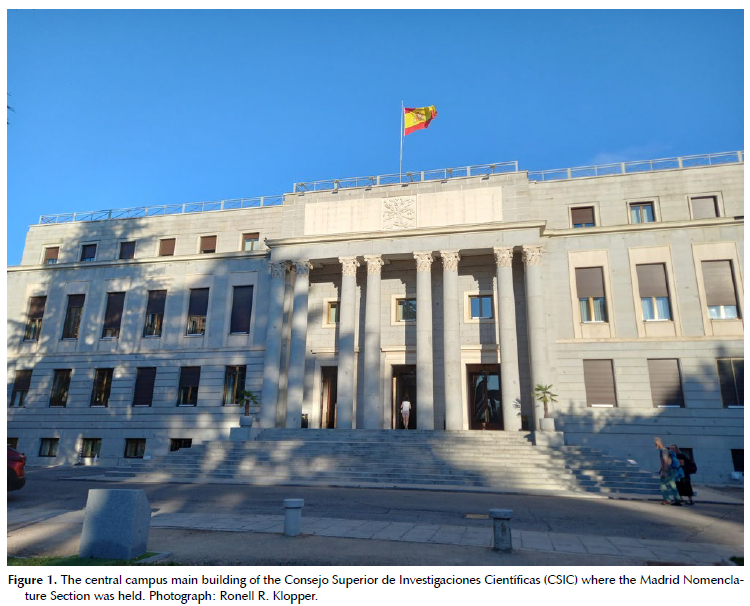
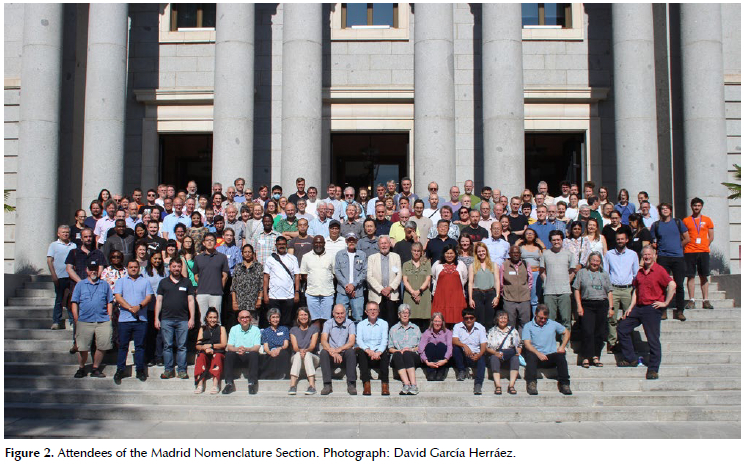
As is tradition, the Nomenclature Section (NS) convened in the week preceding the IBC (15-19 July 2024). The Madrid NS was held in the conference hall of the impressive central campus main building of the Consejo Superior de Investigaciones Científicas (CSIC) (Figure 1). A total of 173 participants, representing 36 countries, attended the 2024 NS meeting in person (Turland et al. 2024b; Figure 2). Among them they carried institutional votes of a total of 192 institutions from 48 countries. The authors of this paper represented South Africa at the NS in Madrid. Between them, the first two authors carried a total of 16 proxy votes from nine southern African herbaria (eight from South Africa, one from Namibia). Other African delegates attending the NS in person were from Liberia (two individual votes) and Nigeria (non-voting), while proxy institutional votes were presented from Cameroon (one vote), Ivory Coast (one vote) and Kenya (four votes) (Turland et al. 2024b).
The Madrid NS was significant in that it was broadcast live on the internet for the first time (Knapp et al. 2024). Participants from across the globe could observe the discussions at the meeting in real time at no cost. This provided a valuable opportunity for people who could not physically attend the meeting to still follow the discussions. However, online observers could not participate in the discussions nor cast votes. A total of 219 unique users accessed the livestream during the course of the week.
The NS had the massive task of discussing and voting on a total of 433 published proposals (plus an additional 14 proposals submitted from the floor) during the five days of the meeting. This is the largest number of proposals submitted to amend the Code at an NS since the Stockholm meeting in 1950 where 550 proposals were tabled. A synopsis of all published proposals with comments from the Rapporteurs was published in February 2024 in Taxon (Turland & Wiersema 2024). Following ICN Division III Provisions 2.5 and 2.6 (Turland et al. 2018), a preliminary guiding vote ('mail vote') was held from February to May 2024, to assess the level of support for all the proposals. Individual members of the IAPT, members of the Permanent Nomenclature Committees, and authors of proposals to amend the Code were entitled to vote in this guiding vote. Results from the preliminary guiding vote were published in July 2024 (Turland et al. 2024a). During the guiding vote (preliminary mail vote), a total of 106 (24.5%) proposals received more than 75% 'no' votes, meaning that they were automatically rejected, and could only be discussed at the NS through a proposal to discuss them being moved at the NS and supported by five people attending the NS (see Division III Provision 5.5 of the ICN; Turland et al. 2018). This left 301 published proposals for discussion at the NS in Madrid.
The final decision of the Madrid NS on the 447 proposals under consideration (433 published, 14 submitted from the floor) are as follows: 142 were accepted, 278 rejected, 22 referred to the Editorial Committee, one referred to a Special-purpose Committee, and five withdrawn. Further detailed information on the outcomes of all proposals are available in the report of IBC action on nomenclature proposals (Turland et al. 2024b; see also Turland 2025). The resolution from the NS was accepted by the final plenary session during the closing ceremony of the IBC on Saturday afternoon 27 July 2024, whereafter the NS decisions came into effect (Turland et al. 2024b).
The most significant changes made to the ICN in Madrid include the following:
• Facilitating voluntary registration of names and types of algae and plants after valid publication to improve the rapid indexing of names and nomenclatural acts, and efficient data exchange (Brinda & Watson 2023).
• Amendments that clarify aspects concerning the nomenclature of fossil plants and remove impediments to their typification (Gravendyck et al. 2020, 2022).
• Creating a mechanism by which offensive names published after 1 January 2026 can be rejected (following substantial amendments to proposals 120 and 121, Hammer & Thiele 2021; see also Thiele & Smith 2024).
• Addition of a new Article 61.6 to permanently and retroactively eradicate epithets with the offensive root 'caf[f][e]r-' by treating them as having been published as 'af[e]r-', meaning from Africa (Smith & Figueiredo 2021; see also Smith & Figueiredo 2024).
• Changing the allocation of institutional votes to one vote per institution, regardless of the size of the collection and taxonomic activity, in order to reduce the geographic imbalance (following amendments to proposal 286, Ulloa Ulloa et al. 2024).
• Changing Provision 5 of Division III to allow for the acceptance of recommendations of the General Committee by a simple majority of votes (50%) (Smith et al. 2022).
• Extending the responsibility to appoint committees to address controversial and other naming issues to the General Committee. Up to now such committees could only be appointed by an NS of an IBC, i.e., at more or less six-yearly intervals. This development has the potential to fast-track the way in which nomenclature issues are dealt with in the future (Smith 2022).
At the 2024 NS, four Special-purpose Committees were established, as follows: on Types and Typification; Typeless Names and DNA Sequences as Types; Naming Ambiregnal Organisms; and Ethics in Nomenclature. During the next intersessional period, these committees should investigate the specific issues allocated to them, and report on these by proposing possible solutions or action at the XXIst IBC, which will be held in Cape Town, South Africa, in 2029.
Seven reports containing 500 recommendations from the General Committee (reports 22-31; Wilson 2021, 2022a, 2022b, 2023a, 2023b, 2023c, 2023d, 2024a, 2024b, 2024c) were accepted at the final session of the NS. These reports included recommendations pertaining to Art. 14 (to conserve 253 names; not to conserve 84 names), Art. 14.13 (to treat six lists of fungal names as conserved), Art. 56 (to reject 79 names; not to reject 15 names), Art. 34 (to suppress 13 publications), Art. 38.4 (to treat eight names as validly published; 11 as not validly published) and Art. 53.5 (to treat seven similar names as homonyms and 24 similar names as not homonymic) (Turland et al. 2024b).
Officials and members of the General and Permanent Nomenclature Committees for the intersessional period leading up to the next IBC were elected during the final session of the Madrid NS. Despite being under-represented at the meeting itself, South Africa is well represented with members on most of these committees, namely on the Nomenclature Committee for Algae (Jonathan Taylor, North-West University), the Nomenclature Committee for Bryophytes [Jacques van Rooy, South African National Biodiversity Institute (SANBI), retired], the Nomenclature Committee for Vascular Plants (Ronell Klopper, SANBI & University of Pretoria and Madeleen Struwig, North-West University), the Committee on Institutional Votes (Muthama Muasya, University of Cape Town), as well as on the Editorial Committee who will produce the new Madrid Code (Ronell Klopper, SANBI & University of Pretoria and Gideon Smith, Nelson Mandela University) (Turland et al. 2024b).
The Madrid IBC was significant for Africa in several ways: an elegant way to permanently and retroactively eradicate offensive racial epithets, i.e., those with the root 'caf[e]r-' or 'caff[e]r-', was accepted by a vote of 63% in favour, despite efforts to retain these epithets. In addition, the next IBC and NS will be hosted on the African continent for the first time, in Cape Town, South Africa, during July 2029 (see https://ibccapetown2029.co.za/).
The new Madrid Code (Turland et al. 2025) is expected to be available from the University of Chicago Press by July 2025.
Summary of decisions relevant to South African Bryophyta and vascular plant names, and all algae and fungi names
A summary of decisions from the General Committee, which was ratified at the Madrid NS, on names that are relevant to South African vascular plants (indigenous and naturalised) and bryophytes, and all algae and fungi names are given below. For information on other decisions from the General Committee, the relevant reports (reports 22-31; Wilson 2021, 2022a, 2022b, 2023a, 2023b, 2023c, 2023d, 2024a, 2024b, 2024c) and the report of congress action from the NS (Turland et al. 2024b) should be consulted. The original proposals, as published in Taxon, or the reports from the relevant Permanent Nomenclature Committee provide further information on these proposals and the impact of the respective committee decisions.
In the following list of names, the number in brackets preceding the decision and names is the number under which the proposal was published and reported on. Abbreviations (publication titles excluded) used are: cons. = conserved; nom. cons. = conserved name; orth. cons. = conserved with a specific spelling (orthography); typ. cons. = conserved with a conserved type; rej. = rejected.
Conserved names
Algae
(2273) cons. Gelidium bipectinatum against Fucus serra (Gelidium serra); (2365) cons. Cyanospira G.Florenz. & al. (Cyanophyceae) against Cyanospira Chodat (Euglenophyceae); (2608) cons. Peridinium splendor-maris ( = Blepharocysta splendor-maris) (Dinophyceae) (typ. cons.); (2711) cons. Gracilariopsis against Gracilariophila (Rhodophyta: Gracilariaceae); (2742) cons. Stenokalyx against Stenocalyx; (2832) cons. Pseudokephyrion Pascher against Dinobryopsis Lemmerm. and Kephyriopsis Pascher (Chrysophyceae: Dinobryaceae); (2833) cons. Phalacroma (Dinophysales: Dinophyceae); (2916) cons. Discosphaera Haeckel (Rhabdosphaeraceae, Prymnesiophyta, Algae) against Discosphaera Dumort. (Hypoxylaceae, Xylariales, Ascomycota, Fungi).
Bryophyta
(2468) cons. Haplocladium (Müll.Hal.) Müll.Hal. against Haplocladium Nägeli.
Vascular plants
(2483) cons. Scilla (Hyacinthaceae) (typ. cons.); (2495) cons. Avena sterilis (Gramineae) (typ. cons.); (2508) cons. Microlepia against Scyphofilix (Dennstaedtiaceae); (2555) cons. Tetraria (Cyperaceae) (typ. cons.); (2580) cons. Astroloba against Poellnitzia (Asphodelaceae); (2594) cons. Selaginella, nom. cons., against additional name Didiclis (Selaginellaceae); (2618) cons. Bulbostylis, nom. cons., against additional name Nemum (Cyperaceae); (2627) cons. Senega against Senegaria, Anthallogea, Corymbula, Leptrochia, Pylostachya and Sexilia (Polygalaceae); (2628) cons. Hedyotis pentandra Schumach. (=Pentodon pentandrus) (Rubiaceae) against H. pentandra (Retz.) Forsyth f. (Vahliaceae); (2631) cons. Commelina erecta (Commelinaceae) (typ. cons.); (2633) cons. Arcto-tis calendula (= Arctotheca calendula) against A. tristis (= Arctotheca tristis) (Asteraceae: Arctotideae); (2654) cons. Aloe glauca (Asphodelaceae: Alooideae) (typ. cons.); (2655) cons. Aloe melanacantha against A. muricata (Asphodelaceae: Alooideae); (2657) cons. Telosma against Stephanotella (Apocynaceae); (2659) cons. Chenopodium giganteum (Chenopodiaceae; Amaranthaceae sensu APG) (typ. cons.); (2676) cons. Lepisorus (Polypodiaceae), nom. cons., against additional name Macroplethus; (2677) cons. Bromus inermis (Poaceae: Bromeae) (typ. cons.); (2692) cons. Zephyran-thes (Amaryllidaceae), nom. cons., against additional name, Sprekelia; (2718) cons. Holothrix (Orchidaceae: Orchideae), nom. cons., against additional name, Bartholina; (2723) cons. Polypodium adiantiforme (=Ru-mohra adiantiformis) against P. adianthoides (Dryopteridaceae); (2724) cons. Lepisorus (Polypodiaceae), nom. cons., against additional names Lemmaphyllum and Neocheiropteris; (2726) cons. Pinus halepensis (Pinaceae) (typ. cons.); (2733) Change conserved type of Withania, nom. cons. (Solanaceae) (typ. cons.); (2745) cons. Mesembryanthemum vanputtenii (= Lampranthus vanputtenii) (Aizoaceae) (orth. cons.); (2746) cons. Cereus imbricatus { = Opuntia imbricata, Cylindropuntia imbricata) (Cactaceae) (typ. cons.); (2750) cons. Panicum crus-galli ( = Echinochloa crus-galli) (Poaceae, Panicoideae) (typ. cons.); (2774) cons. Cassytha baccifera (=RhipsaHs baccifera) against Cactus parasiticus (Cactaceae); (2782) cons. Calanthe, nom. cons., against additional names Phaius, Cyanorkis and Gastorkis (Orchidaceae, Collabieae); (2786) change conserved type of Ipomoea, nom. cons. (Convolvulaceae) (typ. cons.); (2805) cons. Eulophia, nom. cons., against additional name Geodorum (Orchidaceae); (2820) cons. Potentilla (Rosaceae: Potentilleae) (typ. cons.); (2861) cons. Rubus ulmifolius against R. creticus, R. vulgaris and R. inermis (Rosaceae); (2881) cons. Triraphis (Poaceae: Chloridoideae: Triraphideae) (typ. cons.); (2899) cons. Oxalis eckloniana C.Presl against O. eckloniana F.Dietr. and O. bifolia (Oxalidaceae).
Fungi
(1538) cons. Cantharellus tubaeformis (Basidiomycota); (1516) cons. Usnea fulvoreagens (lichenised Ascomycota, Parmeliaceae) (typ. cons.); (2053) cons. Mega-spora verrucosa (Ach.) Arcadia & A.Nordin against M. verrucosa Hafellner & V.Wirth (lichenised Ascomycota); (2072) cons. Lichen fuscovirens (= Collema fuscovirens) against L. pulcher (lichenised Ascomycota); (2235) cons. Leptogium (lichenised Ascomycota) (typ. cons.); (2392) cons. Physaraceae against Fuliginaceae (Myxomycetes); (2394) cons. Metschnikowiaceae against Nectaromycetaceae and Torulopsidaceae (Ascomycota: Saccharomycetes); (2395) cons. Metschnikowia against Torulopsis (Ascomycota: Saccharomycetes); (2412) cons. Peziza medicaginis against Sporonema phacidioides (Ascomycota: Leotiomycetes); (2413) cons. Peziza cinnamomea (= Pezicula cinnamomea) against Naemaspora grisea (Ascomycota: Leotiomycetes); (2415) cons. Cercospora (Ascomycota: Mycosphaerellaceae) (typ. cons.); (2417) cons. Tricholoma sciodes against Agaricus hordus (Basidiomycota); (2418) cons. Agaricus cingulatus (= Tricholoma cingulatum) against A. ramentaceus (Basidiomycota); (2419) cons. Agaricus psammopus (= Tricholoma psammopus) against A. concolor (Basidiomycota); (2425) cons. Discula (Diaporthales: Gnomoniaceae) (typ. cons.); (2465) cons. Blastomyces Gilchrist & W.R.Stokes against Blastomyces Costantin & Rolland (Ascomycota: Onygenales); (2515) cons. Phyllosticta yuccae against Leptodothiorella notabilis (Ascomycota: Dothideomycetes); (2519) cons. Tolypocladium inflatum against Cordyceps subsessilis (Ascomycota: Sordariomycetes: Hypocreales); (2520) cons. Geoglossum uliginosum Hakelier against G. uliginosum (Pers.) P.Crouan & H.Crouan (Ascomycota: Geoglossaceae); (2563) cons. Lichen ferrugineus (= Blastenia ferruginea) (Teloschistaceae, lichenised Ascomycota) (typ. cons.); (2610) cons. Ditiola mucida (= Holwaya mucida) against Acrospermum caliciiforme (= Crinula caliciiformis) (Ascomycota: Leotiomycetes); (2614) cons. Lichen flavus Bellardi (= Pleopsidium flavum) against L. flavus Schreb. (Acarosporaceae: lichenised Ascomycota); (2652) cons. Lecidea parmeliarum (= Abrothallus parmeliarum) against Endocarpon parasiticum (Ascomycota: Dothideomycetes: Abrothallales); (2668) cons. Apioporthe corni (= Aurantioporthe corni, Cryptodiaporthe corni) against Sphaeronaema aurantiacum and Myxosporium nitidum (Ascomycetes, Diaporthales); (2687) cons. Phyllopsora against Triclinum and Crocynia (Ramalinaceae, lichenised Ascomycota); (2712) cons. Lichen cervinus (=Acarospora cervina) (Acarosporaceae, lichenised Ascomycota) (typ. cons.); (2722) cons. Bilimbia (Ramalinaceae, lichenised Ascomycota); (2794) cons. Coccotrema against Lepolichen (Ascomycota, Lecanoromycetes, Coccotremataceae); (2835) cons. Umbilicaria spodochroa (lichenised Ascomycota) (typ. cons.); (2864) cons. Microsphaera alphitoides (= Erysiphe alphitoides) (Ascomycota: Erysiphaceae) (typ. cons.); (2867) cons. Tuber aestivum Vittad. against T. aestivum (Wulfen) Spreng. and T. blotii (Ascomycota: Pezizomycetes); (2868) cons. Tuber magnatum against T. griseum (Ascomycota: Pezizomycetes); (2869) cons. Tuber melanosporum against T. nigrum (Ascomycota: Pezizomycetes); (2874) cons. Typhula (Basidiomycota: Agaricales) (typ. cons.); (2875) cons. Macrotyphula against Sclerotium (Basidiomycota: Agaricales); (2876) cons. Phyllotopsidaceae against Sclerotiaceae (Basidiomycota: Agaricales); (2890) cons. Entoloma sericeum against Agaricus pascuus (=E. pascuum) (Basidiomycota); (2891) cons. Puccinia psidii (=Austropuccinia psidii) against Caeoma eugeniarum and Uredo neurophila (Basidiomycota: Pucciniaceae); (2955) cons. Didymium against Mucilago and Spumaria (Physarales, Myx-omycetes); (2968) cons. Fuscidea against Maronea (lichenised Ascomycota).
Rejected names
Vascular plants
(2494) rej. Salvinia adnata (Salviniaceae); (2509) rej. Allosorus (Pteridaceae); (2527) rej. Kadalia (Melastomataceae); (2546) rej. Solanum rubrum (Solanaceae); (2620) rej. Poa amabilis (=Eragrostis amabilis) (Poaceae); (2634) rej. Arctotis ludwigii (Asteraceae); (2737) rej. Cleome capensis (Cleomaceae); (2658) rej. Atriplex bengalensis (= Chenopodium bengalense) (Chenopodiaceae; Amaranthaceae sensu APG); (2811) rej. Mollugo triphylla Burm.f. (Molluginaceae).
Fungi
(2236) rej. Lichen conspurcatus (Roccellaceae); (2507) rej. Ramularia gibba (Ustilaginomycotina: Entylomatales); (2713) rej. Lecidea cornea (lichenised Ascomycota); (2872) rej. Huea (Ascomycota: Teloschistales); (2877) rej. Sclerotium fulvum (Basidiomycota: Agaricales); (2871) rej. Tuber cibarium (Ascomycota: Pezizomycetes).
Suppressed works
Bryophyta
(23) Stephani (in Hedwigia 27: 276-302. 1888) as to new generic names in that work; (24) Stephani (in Hedwigia 29: 1-23, 68-99, 133-142. 1890) as to new generic names in that work.
Vascular plants
(27) Diels, Plantae Chinenses Forrestianae (in Notes Roy. Bot. Gard. Edinburgh 7: 1-410. 1912-1913).
Fungi
(16-18) Unpaginated index of Traité des champignons and two editions of Tabula plantarum fungosarum by J.-J. Paulet.
Binding decisions regarding confusable names
Algae
Considered confusable (to be treated as homonyms): (104) Actinostephanos Khursevich (Bacillariophyta) and Actinostephanus F.Wen & al. (Gesneriaceae).
Considered not confusable: (72) Cosmarium geminatum FiLundell and C. gemmatum W.B.Turner (Streptophyta: Desmidiaceae); (76) Trigonium Cleve (Bacillariophyta: Trigoniumaceae) and Trigonum A.K.Mahato & FÍMahato (Streptophyta: Zygnemataceae); (85) Argostemma (Rubiaceae) and Agrostemma (Caryophyllaceae).
Vascular plants
Considered not confusable: (48) Scilla (Hyacinthaceae subfam. Hyacinthoideae) and Squilla (Hyacinthaceae subfam. Urgineoideae).
Acknowledgements
Competing interests
The authors declare that they have no financial or personal interests or relationships that may have inappropriately influenced them in writing this article.
Author's contributions
R.R.K. (SANBI & University of Pretoria) conceptualised the manuscript, wrote the initial draft, reviewed the literature and summarised decisions from the Nomenclature Section and Permanent Nomenclature Committees. A.M.M. (University of Cape Town) and G.F.S. (Nelson Mandela University) provided additional input and improved several aspects of the manuscript.
References
Brinda, J.C. & Watson, M.F., 2023, '(377-378) Proposals to improve the indexing and exchange of digital nomenclatural data', Taxon 72(5), 1169-1171, https://doi.org/10.1002/tax.13044. [ Links ]
Gravendyck, J., Bachelier, J.B., Kürschner, W.M. & Herendeen, P.S., 2020, '(009) A proposal to solve a paradox when neotypifying names of fossil-taxa', Taxon 69(3), 628, https://doi.org/10.1002/tax.12249. [ Links ]
Gravendyck, J., Fensome, R.A., Head, M.J., Herendeen, P.S., Riding, J.B. & Turland, N.J., 2022, '(142-148) Proposals to improve the definition, utility, and curation of (type) specimens of fossil algae, fungi, and plants', Taxon 71(3), 705-706, https://doi.org/10.1002/tax.12728. [ Links ]
Hammer, T.A. & Thiele, K.R., 2021, '(119-122) Proposals to amend Articles 51 and 56 and Division III, to allow the rejection of culturally offensive and inappropriate names', Taxon 70(6), 1392-1394, https://doi.org/10.1002/tax.12620. [ Links ]
Knapp, S., Alvarez, I., Monro, A., Prado, J., Turland, N.J. & Wiersema, J.H., 2024, 'Livestreaming the Nomenclature Section at the XX International Botanical Congress in Madrid, 15-19 July 2024', Taxon 73(1), 413-414, https://doi.org/10.1002/tax.13127. [ Links ]
May, T.W., Redhead, S.A., Bensch, K., Hawksworth, D.L., Lendemer, J., Lombard, L. & Turland, N.J., 2019, 'Chapter F of the International Code of Nomenclature for algae, fungi, and plants as approved by the 11th International Mycological Congress, San Juan, Puerto Rico, July 2018', IMA Fungus 10, a21, https://doi.org/10.1186/s43008-019-0019-1. [ Links ]
Sadler, R.T., 2024, 'IAPT and SASSB nomenclature course in South Africa, Taxon 73(1), 415-417, https://doi.org/10.1002/tax.13121. [ Links ]
Smith, G.F., 2022, '(161) Proposal to expand the functions of the General Committee to include the appointment of Special-purpose Committees between International Botanical and Mycological Congresses', Taxon 71(3): 713, https://doi.org/10.1002/tax.12738. [ Links ]
Smith, G.F. & Figueiredo, E., 2021, '(126) Proposal to add a new Article 61.6 to permanently and retroactively eliminate epithets with the root caf[e]r- or caff[e]r- from the nomenclature of algae, fungi and plants', Taxon 70(6), 1395-1396, https://doi.org/10.1002/tax.12622. [ Links ]
Smith, G.F. & Figueiredo, E., 2024, 'Permanently and retroactively eradicating certain offensive epithets from the scientific names of algae, fungi, and plants: 'afr-' is in', Anales del jardín Botánico de Madrid 81(2), e154, https://doi.org/10.3989/ajbm.627. [ Links ]
Smith, G.F., Figueiredo, E., Moore, G., Landrum, L.R., Ge-reau, R.E., Prado, J., Demissew, S., Applequist, W., Quin-tanar, A., Fortunato, R., Friere-Fierro, A., Wen, J. & Deng, Y-F., 2022, '(193) Proposal to democratize aspects of the governance of the International Code of Nomenclature for algae, fungi, and plants', Taxon 71(6), 1344-1345, https://doi.org/10.1002/tax.12855. [ Links ]
Thiele, K.R. & Smith, G.F., 2024, 'Slow progress in mending the laws of botanical nomenclature', Nature Ecology & Evolution 9, 183-184, https://www.nature.com/articles/s41559-024-02569-4. [ Links ]
Turland, N.J., 2025, 'From the Shenzhen Code to the Madrid Code: new rules and recommendations for naming algae, fungi, and plants, American Journal of Botany 112(4), e70026, https://doi.org/10.1002/ajb2.70026. [ Links ]
Turland, N.J. & Wiersema, J.H., 2024, 'Synopsis of proposals on nomenclature - Madrid 2024: A review of the proposals to amend the International Code of Nomenclature for algae, fungi, and plants submitted to the XX International Botanical Congress', Taxon 73(1), 325-404, https://doi.org/10.1002/tax.13114. [ Links ]
Turland, N.J., Kempa, M., Knapp, S., Kralovicova, E. & Wiersema, J.H., 2024a, 'Results of the preliminary guiding vote ('mail vote') on proposals to amend the International Code of Nomenclature for algae, fungi, and plants submitted to the XX International Botanical Congress, Madrid 2024', Taxon 73(4), 1096-1109, https://doi.org/10.1002/tax.13233. [ Links ]
Turland, N.J., Alvarez, I., Knapp, S., Monro, A.M. & Wiersema, J.H., 2024b, 'XX International Botanical Congress, Madrid 2024: Report of Congress action on nomenclature proposals', Taxon 5, 1308-1323, https://doi.org/10.1002/tax.13258. [ Links ]
Turland, N.J., Wiersema, J.H., Barrie, F.R., Greuter, W., Hawks-worth, D.L., Herendeen, P.S., Knapp, S., Kusber, W.-H., Li, D.-Z., Marhold, K., May, T.W., McNeill, J., Monro, A.M., Prado, J., Price, M.J. & Smith, G.F. (eds.), 2018, International Code of Nomenclature for algae, fungi, and plants (Shenzhen Code) adopted by the Nineteenth International Botanical Congress Shenzhen, China, July 2017. Regnum Vegetabile 159, Koeltz Botanical Books, Glashütten, https://doi.org/10.12705/Code.2018. [ Links ]
Turland, N.J., Wiersema, J.H., Barrie, F.R., Gandhi, K.N., Gravendyck, J., Greuter, W., Hawksworth, D.L., Herendeen, P.S., Klopper, R.R., Knapp, S., Kusber, W.-H., Li, D.-Z., May, T.W., Monro, A.M., Prado, J., Price, M.J., Smith, G.F. & Zamora Señoret, J.C., 2025, International Code of Nomenclature for algae, fungi, and plants (Madrid Code). Regnum Vegetabile 162, The University of Chicago Press, Chicago and London. [ Links ]
Ulloa Ulloa, C., Turland, N.J., Friere-Fierro, A., Ge, B-J., Milne, J., Muasya, A.M., Prockow, J. & Iturriaga, T., 2023, '(286-289) Proposals on institutional votes, especially to reduce geographical imbalance', Taxon 72(3), 701-703, https://doi.org/10.1002/tax.12959. [ Links ]
Wilson, K.L., 2021, 'Report of the General Committee: 22', Taxon 70(6), 1360-1362, https://doi.org/10.1002/tax.12625. [ Links ]
Wilson, K.L., 2022a, 'Report of the General Committee: 23', Taxon 71(1), 216-218, https://doi.org/10.1002/tax.12674. [ Links ]
Wilson, K.L., 2022b, 'Report of the General Committee: 24', Taxon 71(6), 1315-1318, https://doi.org/10.1002/tax.12862. [ Links ]
Wilson, K.L., 2023a, 'Report of the General Committee: 25', Taxon 72(2), 422-424, https://doi.org/10.1002/tax.12896. [ Links ]
Wilson, K.L., 2023b, 'Report of the General Committee: 26', Taxon 72(4), 905-907, https://doi.org/10.1002/tax.12994. [ Links ]
Wilson, K.L., 2023c, 'Report of the General Committee: 27', Taxon 72(5), 1112-1114, https://doi.org/10.1002/tax.13068. [ Links ]
Wilson, K.L., 2023d, 'Report of the General Committee: 28', Taxon 72(6), 1353-1354, https://doi.org/10.1002/tax.13100. [ Links ]
Wilson, K.L., 2024a, 'Report of the General Committee: 29', Taxon 73(2), 619-621, https://doi.org/10.1002/tax.13151. [ Links ]
Wilson, K.L., 2024b, 'Report of the General Committee: 30', Taxon 73(3), 897-898, https://doi.org/10.1002/tax.13178. [ Links ]
Wilson, K.L., 2024c, 'Report of the General Committee: 31', Taxon 73(4), 1081-1804, https://doi.org/10.1002/tax.13224. [ Links ]
 Correspondence:
Ronell Klopper
E-mail: R.Klopper@sanbi.org.za
Submitted: 3 October 2024
Accepted: 6 May 2025
Published: 14 July 2025