Controversial Memory and Digital Mediation: Preservice Teachers' Approaches to the Soweto Uprising
Abstract
The controversial topic of the 1976 Soweto Uprising in the South African history curriculum poses significant challenges for teachers seeking to teach it critically. Extensively studied as a historical and political event, little attention has been paid to how it is taught, despite its powerful role in historical thinking. Teachers have the power to present the event as a closed chapter of the past or as a dynamic story that fosters interpretation and reflection. Located within a qualitative, interpretive paradigm, this study examines how preservice history teachers integrate digital tools into their instruction of this event, to foster learner engagement and civic consciousness. The study employs a collaborative design in which 268 students were divided into small groups of approximately 10. Data are generated from 10 purposively sampled Information and Communication Technology (ICT) projects, incorporating online resources and a reflective activity detailing their pedagogical approaches. Findings reveal considerable variation in source selection, teacher positionality, and uneven depth in historical reasoning and in the mediation of contemporary interpretations. Drawing on critical pedagogy (Freire, 2000) and the Technological Pedagogical Content Knowledge framework (Mishra & Koehler, 2006), the study highlights that digital tools can be used to present historical sources, and through a process of sifting, sorting, and critiquing evidence for their reliability and trustworthiness, 'Learning by doing' as a fundamental teaching competency can stimulate learner skills, like multi-perspectivity.
Soweto Uprising; Preservice teachers; Digital tools; Inquiry; Critical pedagogy; Multiperspectivity; Historical thinking
Introduction
While Youth Day (16 June), a public holiday in South Africa, commemorates the Soweto Uprising of 1976 as part of the country's democratic heritage, considerable controversy surrounds this event. Youth Day is widely regarded as a turning point in South Africa's struggle against apartheid (Seroto, 2018). Although the immediate trigger was the enforcement of Afrikaans as a medium of instruction in selected subjects, the protest reflected broader frustrations with the inequalities of the Bantu Education system, which was designed to provide Black learners with an inferior education. Learners understand the origins of contemporary educational inequalities and debates about language, access, and social justice.
The 16 June peaceful protest in Soweto turned violent with police using tear gas, dogs, and live ammunition. Images of learners such as Hector Pieterson, who was fatally shot during the protests, circulated nationally and internationally, drawing attention to the brutality of the apartheid state. Protests spread to other townships across South Africa, resulting in further resistance and many deaths. Historians have subsequently viewed the uprising as a catalyst for renewed political mobilisation and the emergence of a new generation of youth activists who would play a significant role in the anti-apartheid struggle (Ndlovu, 2006).
The inclusion of this event in the South African History (Grades 9-12) and Life Orientation (Grade 6) school curriculum draws on themes of resistance against state oppression. There are multiple theories about its direct causes, which textbooks often condense or narrow, leading to incomplete accounts of this part of history (Seroto, 2018). The Social Sciences Curriculum Assessment and Policy Statement (CAPS), Department of Basic Education (DBE, 2011a:44), lists the event first for Grade 9 learners, as part of the "Turning Points in South African History", and later as part of "Topic 4: Civil Resistance in South Africa 1970s to 1980" within the CAPS History for Grade 12 (DBE, 2011b:29). Teaching the event requires attention to a range of factors, including the accessibility of public domain materials, such as curriculum documents, textbooks, media, and online sources, as well as identifying who is still available to speak about it (oral sources). Kondo (2023) suggests that we reconsider how the Soweto Uprising is recorded to foster a connection between the 1976 generation and today's local youth, enabling the youth to assume the role of storytellers. The role of museums and heritage sites, many of which are endorsed by the democratic government, also presents narratives of the event, adding another layer to consider when selecting sources or field trips to teach the event in either grade. Additionally, the Fourth Industrial Revolution requires teachers to skilfully integrate digital tools to support contemporary learners in inquiry-based, critical analysis of sources and multimodal texts, enabling them to make meaning of the past. Digital mediation, in the current study, refers to how teachers use digital tools and resources to guide learners' interactions with historical content, evidence, and interpretations.
Teeger (2024) highlights how history lessons, in particular contexts, perpetuate unequal power relations in schools, underscoring the subtle reconfiguration of racism. Teachers' desire to avoid conflict may lead to historical distancing from the apartheid past (Teeger, 2024). Pace and Wassermann (2025) argue that teachers are typically not adequately prepared to represent the content, deal with students' reactions, and ward off criticism when teaching a violent and oppressive past. From Teeger's book, teachers spotlight how South African learners receive "a fragmented, distorted, traumatizing and trivialized view of the difficult past" instead of a "coherent history of the colonial roots of apartheid, structural racism, brutalizations of the Black majority population" (Pace & Wassermann, 2025: 1). Pace & Wassermann (2025) write about how teachers enter an avoidance mode, sidestepping difficult feelings to minimise conflict and thereby protect themselves. Preservice history teachers (student teachers) are trained and mandated to teach conscientiously and responsibly, being aware of learners' perceptions and their potential to build a false narrative. Learners who view teachers as authorities and credible sources of information may be inclined to accept a teacher's narrative. This positional power may limit critical engagement with other sources of information.
The post-apartheid South African history curriculum and the controversial topic of the Soweto Uprising require a specialised or disciplinary focus that "aims for learners to develop the skills to analyse historical sources and evidence and to recognize that there are different interpretations of particular events" (Bertram, 2019:125). Additionally, learners need access to knowledge that is reliable and closer to the truth (Young, 2013), one that disciplines offer specialised ways of thinking to investigate the world. South Africa's move away from the memory-history approach to historical inquiry is influenced by its own contested memory and by global trends in history education (Bharath, 2015).
From a pedagogical perspective, teachers must consider how historical events are presented to learners, ensuring that content not only conveys factual knowledge but also promotes critical reflection. This involves pedagogical reasoning, which, for this study, refers to the process through which teachers make instructional decisions about what knowledge to teach, how to teach it, and why particular pedagogical approaches are appropriate in specific classroom contexts. Through the lens of Freire (1970), teaching is never a neutral act, as teachers must actively decide how knowledge is presented. These educational practices can challenge or reproduce existing inequalities and power relations.
The purpose of the current study is to understand how preservice history teachers use digital tools to teach the contentious Soweto Uprising. At the heart of effective teaching lies the educator's commitment to bring the curriculum to life by understanding what is expected and integrating their training and resourcefulness. A certain level of responsibility is expected in selecting sources, and teachers are trained to access, interpret, and integrate them. Without this training, teachers are limited to surface-level textbook narratives and cannot expose learners to the multiple versions of the 1976 event. In this way, learners are taught to think historically, which challenges them in two ways: first, to "think about how historical knowledge claims are constructed"; secondly, it is about challenging students to "think of historians as actively engaged in constructing knowledge claims about the past through argument" (Chapman, 2010:21-22).
Key research questions
The research focuses on two integral questions:
1. How do teachers use ICT to teach the Soweto Uprising as a controversial historical topic?
2. What patterns of pedagogical reasoning are evident in teachers' approaches to teaching this event as a controversial historical topic?
Background
During the oppressive apartheid period of the 1960s, research on South African history textbooks was dominated by Afrikaner Nationalist historiography (Ndlovu, 1993). Like the British and American sociological movements of the 1970s, which viewed schooling as a means of training the working class for their place in society, Chisholm (2008) argued that history textbooks, as representatives of the curriculum, played a critical role in legitimating and promoting apartheid. The shift towards a skills-based approach to the teaching of history in South Africa was influenced by a progressive movement in Britain in 1974. Identified as the Schools' Council Project, this movement aimed to reconsider the nature and relevance of history, effectively replacing the chronological, factual approach to teaching history with a skills-based one.
Following the 1994 reforms, South African historical methodology is characterised by critical perspectives that distance it from colonial narratives. Thus, learning history at school involves both the acquisition of specialised substantive knowledge (sometimes referred to as first-order knowledge) and specialised second-order knowledge (Bertram, 2009). These second-order concepts in the English tradition of historical thinking relate to "broad concepts and modes of thinking that are necessary to build, organise, apply and express historical knowledge and historical thinking" (Chapman, 2017:15). These are essential for the practice of history, for understanding how substantive knowledge is generated in history (through historical inquiry), and for developing the cognitive tools used to organise and structure substantive knowledge (concepts such as change, cause, and significance and historical significance) (Counsell, 2016). This second-order knowledge is essential if learners are to understand history as a particular interpretive account of the past, rather than merely as a series of events that occurred during the Uprising.
The purpose of school history is to develop learners' historical literacy or historical thinking, where learners 'do' history by engaging with evidence from primary sources (Maggioni, 2010). It is about understanding the significance of events before, during, and after, while engaging with ethical dimensions. These are not just 'skills', and cannot be developed without deep substantive content knowledge. Postmodernist theory holds the view that there is no single position from which the study of the past can be told (Southgate, 1996). A historian or a teacher may foreground details they consider relevant, ignoring others. The epistemology of a subject like history can, therefore, be understood as 'fairly objective', 'constructed', or 'subjective'. While it seems contradictory, Kissack (1997:214) states that "knowledge itself is conventionally associated with truth and objectivity". Even the inaccurate or biased versions present a perspective, and learners should be able to use their analytical skills to identify the inaccuracies or bias, considering other evidence.
These theoretical insights have implications for pedagogical decision-making. In the context of the Soweto Uprising, this requires that teachers move learners beyond a factual recounting of the event to critical engagement with the debates.
This section highlights existing historical scholarship on the Soweto Uprising, which emphasises the event's root causes and argues that they cannot be attributed to a single factor. There are varying interpretations regarding the nature of participation, responsibility, and the escalation of violence. There is consensus on youth agency, however, there is tension over how the event is perceived. The teacher's power lies in these perceptions and pedagogical decisions.
Teachers must create opportunities for learners to evaluate competing interpretations of the Soweto Uprising. Part of these interpretations includes how "school children cannot, by themselves, topple a strong intransigent regime" (Hirson, 1979:1). Pohlandt-McCormick (2000) attributes the protests of Black schoolchildren in Soweto to the imposition of Afrikaans as a medium of instruction in their schools. Carrying a political inflection, Pohlandt-McCormick argues that the government crafts an official narrative, particularly the African National Congress (ANC), for situating its role in the dismantling of apartheid. The ANC selectively utilised aspects of the Uprising to support its own cause, appropriating voices and images for its own use, and gradually downplayed and diminished the independent actions of the young participants (Pohlandt-McCormick, 2000). The ANC, thus, emerged as the victor, all but silenced and in exile during the uprising. Simultaneously, Pohlandt-McCormick (2000) considers how those who did the physical violence erased the histories of their victims and contributed to creating a history that denies their culpability. By inference, Pohlandt-McCormick's reference is to the oppressive, authoritarian context of apartheid South Africa, which produced collective memories, sometimes obstructing the ability of individual historical actors and witnesses to place themselves in history. The author concludes that "documents and historical narratives must be scrutinised for the silences they countenanced and the lies they perpetuated" (Pohlandt-McCormick, 2000:24). This duplicity needs to be understood to teach how accounts of events are shaped by power and context, and how to create structured opportunities to engage with competing interpretations rather than presenting a single account.
Teaching controversial topics can challenge historical thinking when emotional responses are provoked. When historical narratives are juxtaposed, learners may struggle to distinguish between evidence-based inquiry and speculative narrative. Historical accounts, such as oral evidence, may be construed as fabricated narratives rather than explanations grounded in experience. Thus, there is a need for multiple testimonies of the past, which can be sifted and critically corroborated using historians' heuristics (Havekes et al., 2012). Digital mediation allows for the exposition of these narratives.
Sapire's (2013) research focused on two bodies of writing: the literature that chronicled the revolt as it unfolded; and the historical literature that explored township politics and culture during the first half of the twentieth century. This highlighted gaps and blind spots, specifically that township rebellions were subordinated to those of the exiled ANC in contemporary public history. The controversies about the ANC's involvement are included in Nieftagodien & Moloi's research (2006:361), where the researchers reveal that some "students also had contact with ANC figures in Soweto, although these connections were not always explicit". Nieftagodien & Moloi (2006:362) also mention that "students were no longer only opposing Afrikaans but were now resisting Bantu education and apartheid in general".
Given the different interpretations, Seroto (2018:14) argues that the design of the history curriculum should enable learners to engage with history without imposing a single dominant view. Learner activities could begin with critical thinking exercises, with questions like: Were the motives political or ideological? Another possible angle was that the National Party considered African schools as strategic sites where Afrikaner hegemony could be established by using Afrikaners as the medium of instruction (Ndlovu, 2006:325). Learners move beyond a descriptive account towards negotiating meaning about the past, justifying and reasoning claims (Van Drie & Van Boxtel, 2008).
Although the current study focuses on ICT approaches to teaching the Soweto Uprising, textbooks remain important, as they contain encoded knowledge about the event that can be used to reinforce or challenge digital resources. Goal 19 of the Action Plan to 2014: Towards the Realization of Schooling 2025 states that the Department of Basic Education (DBE) aims to "ensure that every learner has access to the minimum set of textbooks" (DBE, 2010), reinforcing the role of textbooks, even though some people in the books receive insufficient or no coverage. For instance, Johnson (2025:7) describes the emergence of certain patterns of knowledge about the past, where a gendered narrative of 'youth' of 1976 was implicitly male, a phenomenon which became explicitly noted as young Black men were increasingly visible, and visibly violent, while young women were liminal within the narratives. The history textbook remains a significant resource in contemporary South Africa, as history teachers often 'read from the textbook' or ask learners to summarise and take notes from it (Bharath, 2026). Seroto (2018) argues that textbooks do not provide a balanced view of the causes of the Soweto Uprising. The author highlights how some books emphasised the causes of the Soweto Uprising as the ideology of the Black Consciousness Movement (BCM) and the introduction of Afrikaans as the medium of instruction. Some textbooks portrayed students as being influenced by the ideas of Steve Biko and Black Consciousness. Omissions, according to Seroto (2018), limited the options learners could consider and served as an obstacle to a perspective from which learners could view, examine, and analyse the protest.
Like textbooks, teachers can be ideological and political instruments that shape learners' thinking. Malawana (2019:613) argues that "The youth of 1976, of #FeesMustFall, of #RhodesMustFall, of countless other struggles, and of Equal Education is evidence that children continuously play a vital role as social justice activists both in education and in social justice as a whole", and that "conscientized learners have the power to shape what they want South Africa to be, and what they want the education system to achieve". The history teacher plays a significant role in achieving this.
Some research examines the role of peace education in promoting social justice and sustainable peace within the national curricula of post-conflict societies, weaving these themes into subjects such as Social Studies and History at the university level (Adan, 2025). In countries such as Rwanda and Sierra Leone, there is more structure surrounding peace education and citizenship initiatives (Bertram, 2019; Adan, 2025). While history can promote nationalism and social cohesion, it can also be a wedge that divides and fragments society (Chimbunde & Moreeng, 2024). If history is to play a role in developing social cohesion and citizenship, then teaching it should encourage diverse perspectives rather than a closed view of the past. Adan (2025) argues that the lack of a curriculum that actively teaches conflict resolution and reconciliation is a missed opportunity to equip youth with the essential skills and frameworks needed to navigate post-conflict realities. The role that teachers play in empowering learners to understand citizenship and peaceful coexistence cannot be underestimated.
The way learners perceive the world has changed. Books, papers, and journals no longer provide the exclusive means of passing on historical knowledge. A normal classroom shifts into a virtual archive, turning learners into instant historians who can now investigate their own case studies. Teaching becomes more learner-centred, more active, and more three-dimensional (Jardine, 2011). The digitisation of African materials has made it easier than ever to access primary source materials and conduct research (Kelly & Badsha, 2020). There is limited research on how ICT shapes the teaching of controversial histories. The current study addresses this gap by examining the pedagogical reasoning underpinning preservice teachers' ICT projects on the Soweto Uprising.
Theoretical and conceptual framework
The study is informed by Freire's (2000) critical theory, which acknowledges the teacher's role or power in moving beyond textbook narratives and engaging in a transformative process of dialogue and critical reflection. It moves away from the authoritarian model of teachers depositing knowledge into passive learners, however, it advocates for critical awareness and for functioning as co-constructors of knowledge in pedagogy (Majola et al., 2025). This framework complements the disciplinary requirement that learners interrogate historical narratives in a dialogical manner. The complex knowledge needed for such planning is known as technological pedagogical content knowledge (Mishra & Koehler, 2006), which combines technology, pedagogy, and content knowledge (TPACK). This framework can be extended to include context because effective technological integration also depends on the contextual realities of the classroom and school. This is a powerful instructional tool that alleviates the cost of an actual field trip. It does not take away the impact of an actual field trip to the sites, which are 'living history' in South Africa. A virtual tour can prepare students for the actual tour, bringing history to its full potential. Teachers' pedagogical approaches are shaped or constrained by contextual factors and by the school's infrastructure and organisational policies. Where schools have few or no resources to support an actual or virtual field trip, teacher agency and adaptability are required to work with what is practically feasible. A teacher's 'resourcefulness' is demonstrated by the conversion of the technological script into print. Equally significant is the ability to teach conflict resolution that leverages empathy and respect for different beliefs, using digital techniques to make historical ideas and concepts more accessible and relevant to learners.
Methodology
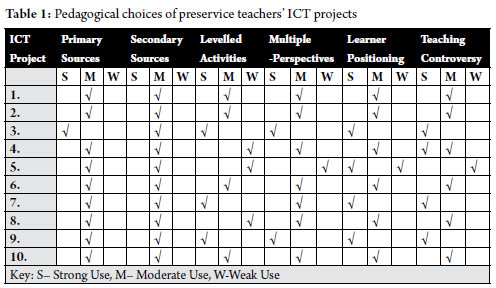
Following established ethical protocols and informed consent outlined in the pilot study by Wassermann and Bentrovato (2018) on the teaching of controversial issues, this qualitative research used a collaborative design, in which 268 final-year Bachelor of Education history methodology students were divided into small groups of approximately 10 to complete an ICT project, with three components for assessment. The first component involved creating a virtual field trip using Google Earth Project Maker to identify sites associated with the Soweto Uprising. The mapped sites were augmented with content and tasks of varying cognitive demand. The second component involved designing a single, pedagogically coherent slide that incorporated clickable elements or hyperlinks to additional online sources and activities on the Soweto Uprising. The slides were expected to include essential historical content knowledge about the causes, effects, key actors, and other contextual details to sustain learning, debate, and activity. Activities set for the first two components of the project were guided by Bloom's revised taxonomy to cater for all levels of questioning, and by the CAPS history policy document for Grades 10-12 on the three levels of source interrogation (DBE, 2011b). Preservice teachers were required to balance primary and secondary sources to ensure a wide spectrum of perspectives for learners to interpret. The third component involved a written reflection on the ICT project, outlining the pedagogical choices the group made and the rationale for those choices. The categories emerging from the reflections would subsequently be developed into themes, providing the analytical framework for interpreting the data. The themes are presented in tabular form, with ticks indicating varying levels of engagement.
Of the 35 groups, 10 were purposively selected for their depth and complexity, allowing for a meaningful analysis of only substantive written reflections. The written reflections would provide insight into the pedagogical reasoning underpinning the digital artefacts and enable an examination of how preservice teachers justified their instructional decisions. Through repeated reading and comparison of the projects and accompanying reflections, categories emerging from these pedagogical choices were identified and refined into themes. The combination of digital artefacts and written reflections enabled the triangulation of data sources, thereby enhancing the credibility of the interpretations. Trustworthiness is enhanced by this triangulation, grounded in both digital artifacts and the written reflection that informs their reasoning.
Each project is identified as Project 1-10, anonymising the contributions. Since much of the slide work juxtaposed images of people and places involved in the protest with other copyrighted materials, students were required to acknowledge all sources with full reference lists. To effectively supervise the projects, teacher training in critical pedagogy was foregrounded. Preservice teachers were introduced to digital archives. They were reminded not to use ICT instruction as "baby-sitters" for classrooms full of students seeking visual and auditory stimulation (Bellan & Scheurman, 1998:36). This multisensory learning project afforded an 'escape' from traditional textbooks while fostering interactive learning. The components of the ICT project served as an accessible mechanism for learners and teachers who lack financial means to undertake field trips.
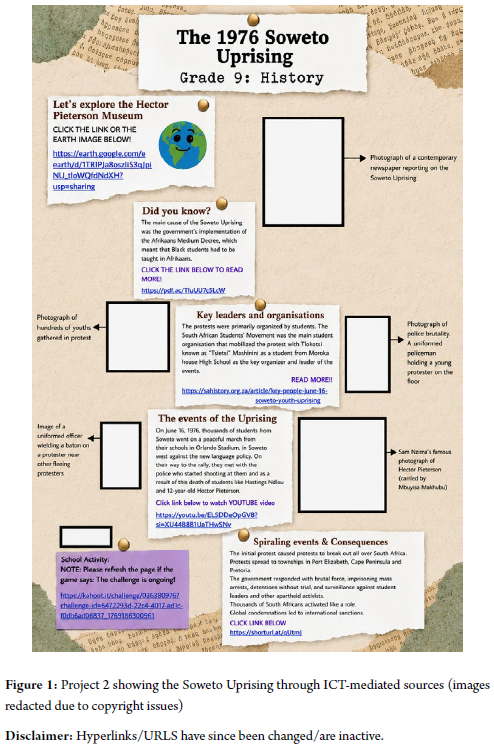
Figure 1 below shows the structure of a single project, illustrating the sources, URLs, and their use. It illustrates how technological, pedagogical, and content knowledge intersect within the project design and provides an example of the kinds of artifacts analysed in the current study. The URLs are hyperlinks that provide more information on the sources and topics. The data in the projects show how substantive and procedural knowledge are combined with technological knowledge and skill. The URLs were verified at the time of the project submission but have since become unavailable.
Findings
The qualitative analysis of 10 ICT projects reveals variations in pedagogical approaches across the sample, with differences and similarities evident in how the Soweto Uprising is historically framed. Preservice teachers used a variety of primary and secondary sources, tangible for understanding the event, and had a plethora of activities, games, and quizzes linked digitally for learners to explore. The findings demonstrate that preservice teachers' pedagogical reasoning and ICT practices significantly shaped how the Soweto Uprising was approached as a controversial historical topic. The seven themes, tabled below, are drawn from the reflections. The themes present preservice teachers' choices regarding how source selection shaped the learner activities they designed. These activities influenced opportunities for multi-perspectivity, which in turn affected how teachers and learners were positioned within the inquiry process. It showed how controversy was mediated and ultimately, the challenges and limitations associated with teaching the Soweto Uprising through ICT.
This exercise positioned learners within an inquiry framework to varying degrees (strong, moderate, or weak) while exploring the event's controversial nature in multiple ways. Table 1 shows the variation in the strength and manifestation of the themes across the ten projects.
This table is not merely a description of the 10 projects, but an intensive analysis, revealing important patterns in how preservice teachers conceptualise the relationships among ICT, historical inquiry, learner agency, and controversy.
What emerged was a variation in approaches-preservice teachers did not use digital sources in the same way. They generally recognised the importance of source work, however, implemented it unevenly. All ICT projects successfully used Google Earth to incorporate actual sites and museums in South Africa. The projects differed in how they treated evidence, with some engaging sources as objects for interpretation, while others used them more illustratively. Project 5, for instance, used the material to show what happened, effectively using ICT as a presentation tool. Project 3, on the other hand, treated the sources as evidence for interpretation. Project 3 placed the Soweto Uprising at the centre of the ongoing resistance, centring African voices and oral histories. This project reflected on how reclaiming these stories could challenge the colonial narrative that has historically marginalised African experiences. Project 3 moves beyond narratives that represented the youth primarily as 'rioters' and instead foregrounded their agency as political actors resisting apartheid education.
Projects 3 and 5 illustrate the broader patterns of the analysis, while the following section presents a more in-depth examination of the pedagogical decisions underpinning preservice teachers' instructional choices.
Use of sources
The sources teachers choose can shape learners' perspectives and influence how they understand historical events. Thus, it is not a neutral exercise, but one that involves intentional choices. Freire's (1970, 1974) critical pedagogy offers a vision of learning through dialogue and critical reflection, in which learners are not passive recipients, but active agents and co-creators of knowledge. In the current study, the selection of sources was calculated, designed to highlight the variation in historical accounts of the same event. In the literature review, these angles are discussed, however, some preservice teachers did not engage with them. All the projects focused on Grade 9 lesson planning, avoiding Grade 12, possibly because it was more challenging to teach. CAPS Social Sciences for Grade 9, allocate five hours on the "causes, leaders, events of 16 June, spiralling events that followed throughout the country, longer-term consequences for resistance and repression" (DBE, 2011a:44). The "debates about whether the students were influenced by Black Consciousness thinking" and "the legacy of Black Consciousness on South African politics" are to be understood later in Grade 12 (DBE, 2011b:29). Teachers may have entered an avoidance mode, sidestepping difficult emotions and contentious issues to minimise conflict. If these controversies are not discussed in the earlier grades, the implication is that the event may be interpreted as closed. Simplified narratives can obscure the complexity of the event, denying learners opportunities to understand how the legacies of colonialism and apartheid continue to shape contemporary society. This is especially true for learners who do not choose History as an elective in Grade 10 and beyond.
Learner tasks on source contextualisation and interpretation suggest that preservice teachers are beginning to understand the importance of historical inquiry. For ICT use, there was access to oral histories, online photographs, newspaper reports, museum collections, and online repositories showing how a digital environment expanded source availability beyond the textbook. ICT provided learners with opportunities to compare and authenticate sources. The idea of controversy, however, seemed limited to who planned and executed the event, rather than who fired the first shot. Some projects lacked classification of sources as primary or secondary, as well as an understanding of how each type of source affects the kind of claims it makes. Preservice teachers thus require further development in source classification, contextualisation, and critical evaluation to move beyond a descriptive engagement towards more sophisticated reasoning.
Learner activities
The project activities were expected to have learners engage with historical evidence and construct their own interpretations of the Uprising. These were to be levelled in terms of cognitive demand and to engage with historical inquiry. The analysis revealed considerable variation in this understanding. Projects 3, 7, and 9 depicted stronger inquiry by incorporating tasks that encourage learners to contextualise evidence and consider issues of reliability. By contrast, Projects 1, 2, 6, and 10 showed moderate engagement, and Projects 4, 5, and 8 showed weak levels, not moving beyond mere factual knowledge acquisition. All projects incorporated activities of varying levels, however, this was uneven in historical inquiry. Digital tools primarily served as mechanisms for content delivery, with preservice teachers using online quizzes, interactive tasks, and hyperlinks to test recall or lower-level cognitive skills. Consequently, opportunities to engage learners in higher-order historical thinking were often underutilised. The findings, therefore, suggest that access to digital tools alone does not guarantee engagement with the past. It depends on the extent to which activities interrogate evidence, identity bias, and justify interpretation. Teachers retain control over the activities and, therefore, opportunities for multiple perspectives. Depending on their understanding of the event and their willingness to engage with controversial interpretations, they may present a descriptive account. By prioritising sources that create a coherent timeline and avoiding any debate, they lose chances for interpretation. For Grade 9 learners, this may be acceptable, since CAPS History (DBE, 2011a) does not require a deeper analysis of the event. More explicit debates are introduced only in Grade 12. The elective nature of History in the Further Education and Training Phase (FET) means that learners may never encounter these discussions.
Multi-perspectivity
Seven of the 10 ICT projects demonstrated a moderate engagement with multiple perspectives. While the projects moved beyond presenting a single, uncontested account of the Soweto Uprising, the inclusion of alternative interpretations was often limited. In many cases, the projects sought to foreground previously marginalised African voices, however, this did not engage differing interpretations of the event. Project 4, for example, illustrates this tendency. The group centred its lesson on the relationship between Bantu Education, the Black Consciousness Movement, and the Soweto Uprising, presenting these as the principal catalysts of the revolt. In their reflections, the preservice teachers acknowledged that their school experiences had been shaped by a single prescribed textbook that portrayed the uprising as a closed, uncontested story. University training prompted them to question this approach and, consequently, to present a more Afrocentric account. The use of ICT expanded opportunities for accessing a wider range of historical voices and digital sources. Although the project acknowledged the controversy surrounding the event, multiple perspectives were largely treated as the inclusion of alternative voices, rather than as a historical inquiry that required evaluating different claims.
This pattern suggests that the preservice teachers understood the importance of challenging singular narratives and recognised the value of representivity. However, their projects revealed a more limited conception of multi-perspectivity, one that prioritised voices and representation over the disciplinary practice. Consequently, the projects reflected an emerging, rather than a fully developed understanding of multi-perspectivity.
Learner and teacher positioning
The ICT projects revealed that teachers' positionality played an important role in determining how controversial issues were framed, which sources were chosen, and how learners engaged with the knowledge. In Projects 3, 5, 7, and 9, digital tools were used to encourage learners to search for evidence, compare perspectives, and develop their own interpretations. In Projects 1, 2, 4, 6, 8, and 10, ICT was mainly used to deliver information, positioning teachers as the primary holders of knowledge. This understanding was more narrowly framed, potentially exposing learners to a partial view of the past and limited opportunities to engage with alternative interpretations. Although CAPS History Grade 9 (DBE, 2011a) requires learners to engage with the causes, consequences, and key actors of the Soweto Uprising, the ICT projects revealed differing views of the teacher's role. In line with Freire's (2000) ideas, ICT can support a shift from learners simply receiving information to actively engaging with it. The findings, however, suggest that balancing learner agency with purposeful teacher guidance remains a challenge. This highlights the importance of reflective practice and an awareness of how teachers' own positionality and pedagogical choices shape learners' understanding of controversial histories.
Teaching controversy
In teaching the controversial event, preservice teachers realise there are unresolved issues and that history is tentative. Therefore, to teach this, there will be more questions based on who one is and how much one engages with the space for alternate views on the same event. Ndlovu (2006:317) argues that various causal factors need to be taken into account when analysing the historical origins of the Soweto uprising. He mentions political, economic, educational and youth-related factors. Project 5 proposes that the principal contribution to the Soweto Uprising was the BCM ideology, based on their sources. This pedagogically naïve, selective portrayal of the uprising simplifies the problems. Omitting important information or presenting events without engaging learners in logical thinking and critical decision-making about historical facts runs counter to the inquiry approach. The event was more than just a protest; it was a struggle for equality and a turning point for liberty and freedom. Having multiple documents with different viewpoints on the same event can be a valuable part of the analysis. ICT connection is revealed in how digital environments expose learners to competing narratives and how teachers and learners require digital literacy to guide the evaluation of evidence and avoid misinformation. Ongoing professional development and research are critical to the understanding of historical events.
Pedagogical choices and narratives
The preservice teacher reflections noted that CAPS was the primary reference for determining what content to teach, however, professional judgment, different interpretations, and technological skills also influenced the approaches taken. Some projects focused on the key ideas of youth resistance and unequal education, and how students protested the use of Afrikaans as a medium of instruction. Others focused on the BCM as the main narrative, promoting interpretations aligned with political ideology.
Another approach was to highlight the victims or those killed in the event to build a narrative. Hector Peterson is often the main character in this portrayal, although he was not the first fatal victim of 16 June 1976. This project highlights that Hastings Ndlovu was the first student to be shot by the police as he crossed the Orlando West Bridge in Soweto. It is unlikely that a learner would know that Ndlovu was the first to be killed unless this is specifically addressed in historical accounts. Hector Pieterson was 12 years old in 1976, which places his birth around 1963-1964. If born in 1963, he would have been 62 or 63 years old in 2026, 50 years after the event. Perhaps there were others as young as him who experienced the event who can still contribute to the contemporary understanding of it. This project sheds light on how obtaining new information can change or augment current narratives. It also emphasises the role of local people who shape history, rather than the voices of political leaders.
Hector Peterson's image dominates both local and international media. While it invokes emotions, there are those voices during apartheid who tried to portray the youth of the time as creating trouble. For example, a newspaper article of the time on how "Soweto pupils' riot- Six dead" does not focus on how the five Blacks died, but describes how one white motorist was dragged from his car by rioting pupils and stabbed to death. The article also includes how another white person in a car was assaulted before escaping (The Argus Correspondent, 1976). Project 5 focused on incorporating second-order concepts of time, cause, and consequence, while paying little attention to higher-level questioning. The focus was on Afrikaans as the language of instruction and the violence of the police to maintain the system of apartheid. Additionally, their activities were more on the 'remember' end of the cognitive demand spectrum. Their reflections acknowledge that online activities expose learners to 'authentic materials', fostering digital literacy alongside historical inquiry skills. However, digital materials are not all 'authentic' and, therefore, training must be ongoing to help students and teachers discern what are facts and what is potentially misleading to the reader.
Preservice teachers acknowledged that the ICT projects were a step away from the traditional way of teaching the event. The method helped develop critical thinking through interactive, multimodal activities that catered to learners who preferred visual stimulation. Spatial contextualisation through digital mapping is a distinctive contribution of ICT.
In this inclusive classroom, learner-centredness accommodated various learning styles and created a nexus of concepts and events with visual representation. Some reflections highlighted the event's historical significance, connecting it to present-day issues affecting youth and education rights, and went further with questions like "How do you think the government or the police could have handled the situation differently?" and "Examine Hector Peterson's death and understand why this image became a symbol of resistance". This type of questioning helps learners think differently about the incident and develops higher-level thinking.
Preservice teachers augmented slide material with debates, group discussions, Kahoot quizzes, worksheets, and a series of online activities, Google Forms, and apps like Padlet, shaping it beyond just answering questions as homework. Teachers considered the planning fun, and the technology-based assessment tasks and games critical for supporting a broader range of learning styles and enhancing conceptual understanding. The use of Google Earth helped learners visualise the geographical layout of Soweto and identify key locations where the protests occurred. With the Adobe Express Poster maker, preservice teachers could enhance their technological knowledge and contextualize content and images. Through spatial movement, learners can locate key sites and engage with places in real time, thereby enhancing their knowledge and experience. A refreshing move away from textbook learning, it is a way to absorb content about context interactively. Additionally, the links to the tasks can be shared with learners to take home, along with opportunities for them to create their own projects. This history is an actual place learners can visit virtually to understand how the event unfolded. The Morrison Isaacson High School (which was central to the mobilisation of learners), Hector Pieterson Square (memorial site for remembrance), Regina Mundi church (a refuge meeting space), Orlando Stadium (where mass gatherings were held), West Rand administrative buildings (apartheid state authority building), are key sites associated with the uprisings spatially sequenced to enable learners to explore how the uprising unfolded across the locations. Each site is accompanied by activities and questions to check whether learners can locate it and understand its significance.
Challenges in teaching controversial histories and ICT use
While ICT expanded access to a wide range of historical resources, the findings suggest that access alone does not guarantee critical historical engagement. Table 1 indicates that although all projects incorporated digital sources and activities, only one project demonstrated a strong use of primary sources. In contrast, most projects relied on moderate engagement with source work, multi-perspectivity, and controversy. This suggests that the challenge is not merely locating digital information, but using it in ways that support historical inquiry. Without guidance, learners may struggle to distinguish between evidence-based historical accounts and misleading or incomplete representations of the past. Teaching controversial histories through ICT, therefore, requires teachers to address not only historical thinking but also misinformation, source verification, and the ethical use of digital information. Contemporary youth, especially those born into democracy, would interpret the uprising differently from the participants in 1976, some of whom are still alive. This would involve negotiating the interpretations and what must be taught, with the curriculum as a 'guide'.
Discussion
The students' ICT projects, as valuable artefacts, demonstrate the connection between historical knowledge and pedagogy. This research acknowledges that each project is a collective effort rather than an individual decision-making process. Consequently, the instructional choices may not fully reflect how individual students would teach in practice. Additionally, the use of ICT as a pedagogical medium introduces a contextual limitation. The instructional choices made within a resource-rich university-supported environment may differ from those in a classroom, limited by technology, resources, or infrastructure, a very real problem in South Africa (Bharath, 2026). The project is part of the students' assessment, which may have encouraged them to invest creatively, a task that individual teachers may not have the time to execute. This does not detract from the value of the task, as it was learning-oriented, enabling students to engage deeply with historical content and fostering greater collaborative effort. This networking method can be replicated in schools, serving as a model for teaching historical thinking with innovative learning materials. Peer interaction, negotiations, and shared problem-solving are skills worth pursuing.
The findings underscore the importance of developing TPACK to teach controversial history. Teacher education programmes provide opportunities for preservice teachers to experiment, reflect on their pedagogical choices, and support historical thinking through collaborative work. Digital mapping tools such as Google Earth help learners understand spatial relationships and the unfolding of events. There is a shift from teaching from text to visual interactions, building learners who learn in multiple ways. Learners are positioned to take perspectives from various sources and are trained to understand the types and relevance of primary and secondary sources. Training on controversial topics also enhances the decisions teachers make when teaching diverse learner populations.
Drawing on critical pedagogy and the TPACK framework, the findings suggest that teaching the Soweto Uprising can be enhanced by integrating digital tools that support inquiry and learner agency. The use of Google Earth demonstrates how, when aligned with content and pedagogy, 'learning by doing' is facilitated. Rather than sticking to one narrative, students are encouraged to consider multiple perspectives based on the evidence.
Conclusion
The findings contribute to history education scholarship by demonstrating how ICT-mediated approaches, such as interactive slides and spatial tools like Google Earth, can enable preservice teachers to frame the Soweto Uprising as a dynamic, inquiry-based learning experience. By foregrounding spatial contextualisation, source evaluation, and learner agency, the study shows how digital pedagogy can support 'learning by doing' and disrupt closed narratives of the past. In doing so, it extends existing work on teaching controversial history by illustrating how technology, when pedagogically aligned, can deepen engagement with complex and sensitive historical events. Perhaps the most significant outcome is the recognition that the past is represented through multiple and often competing narratives. When approaching controversial history, learners must be taught how to critically evaluate digital and historical sources, identify bias and misrepresentation, and apply investigative techniques to distinguish reliable evidence from unreliable or misleading information.
This interpretive qualitative study offers insights drawn from a purposively selected sample of preservice teachers' projects within a teacher education context, focusing on intended pedagogy rather than observed classroom enactment. Future research could explore how such ICT-mediated approaches are implemented in school classrooms, how learners respond to spatial and inquiry-based teaching of the Soweto Uprising, and how similar pedagogical strategies might be applied to other controversial topics in South African and global history curricula.
References
Literature review
-
Adan, MY 2025. The role of peace education in promoting social justice and sustainable peace in post-conflict societies: A 4Rs framework analysis. Frontiers in Political Science, 7. https://doi.org/10.3389/fpos.2025.1650027
» https://doi.org/10.3389/fpos.2025.1650027 - Bellan, JM and Scheurman, G 1998. Actual and virtual reality. Making the most of field trips. Social Education. 62(1):35-40.
- Bertram, C 2009. Procedural knowledge and the construction of knowledge in History Education. Journal of Curriculum Studies, 41(6):767-786.
-
Bertram, C 2019. What is powerful knowledge in school history? Learning from the South African and Rwandan school curriculum documents. The Curriculum Journal, 30(2):125-143. https://doi.org/10.1080/09585176.2018.1557536
» https://doi.org/10.1080/09585176.2018.1557536 - Bharath, P 2015. An investigation of progression in historical thinking in South African history textbooks. Unpublished doctoral dissertation. University of KwaZulu-Natal, Pietermaritzburg.
-
Bharath, P 2026. Exploring South African history textbook access and usage as pathways to inequality in the post-democratic era. Human Rights Education Review, 9(1):39-50. https://doi.org/10.1080/25355406.2025.2563559
» https://doi.org/10.1080/25355406.2025.2563559 - Chapman, A 2010. Understanding historical knowing: Evidence and accounts. Open University Press.
- Chapman, A 2017. Historical interpretations. In: I Davies (ed.). Debates in history teaching (2nd ed., pp. 96-113). Bloomsbury Academic.
-
Chimbunde, P and Moreeng, BB 2024. Can history be used to build the nation? An analysis of the idea of a compulsory school history curriculum in post-apartheid South Africa. Yesterday & Today, 32:154-176. https://doi.org/10.17159/2223-0386/2024/n32a7
» https://doi.org/10.17159/2223-0386/2024/n32a7 - Chisholm, L 2008. Migration, Citizenship, and South African History Textbooks. South African Historical Journal, 60(3):352-374.
- Counsell, C 2016. History teacher publication and the curricular 'what?': Mobilising subject-specific professional knowledge in a culture of genericism. In: C Counsell, K Burn, and A Chapman (eds.). Masterclass in history education: Transforming teaching and learning (pp. 225-231). London: Bloomsbury Publishing.
-
Department of Basic Education 2010. Action Plan to 2014: Towards the Realisation of Schooling 2025 (Goal 19, p. 3). Pretoria: Government of South Africa. https://www.gov.za/sites/default/files/gcis_document/201409/dobeshortened-action-plan-2025031120100.pdf
» https://www.gov.za/sites/default/files/gcis_document/201409/dobeshortened-action-plan-2025031120100.pdf - Department of Basic Education 2011a. Curriculum and Assessment Policy Statement (CAPS): Social Sciences (Grades 7-9). Government Printing Works.
- Department of Basic Education 2011b. National Curriculum Statement Grades 10-12: Curriculum and Assessment Policy Statement (CAPS): History. Government Printing Works.
- Freire, P 1970. Pedagogy of the oppressed. Continuum, New York.
- Freire, P 1974. Education for critical consciousness. Seabury Press.
- Freire, P 2000. Pedagogy of the oppressed (30th Anniversary Edition). New York: Continuum.
-
Havekes, HGF, Arno-Coppen, P, Luttenberg, JM, Van Boxtel, CAM 2012. Knowing and doing history: A conceptual framework and pedagogy for teaching historical contextualization. International Journal of Historical Learning, Teaching and Research, 11(1):72-93. DOI: http://dx.doi.org/10.18546/HERJ.11.1.06
» http://dx.doi.org/10.18546/HERJ.11.1.06 - Hirson, B 1979. Year of fire, year of ash: The Soweto revolt: Roots of a revolution? London: Zed Press.
-
Jardine, V 2011. South African history online's education programme. Yesterday and Today, 6:79-84. Available at http://www.scielo.org.za/scielo.php?script=sci_arttext&pid=S222303862011000100011&lng=en&tlng=en Accessed on 10 June 2026.
» http://www.scielo.org.za/scielo.php?script=sci_arttext&pid=S222303862011000100011&lng=en&tlng=en -
Johnson, RE 2025. Voice, silence and gender in South Africa's anti-apartheid struggle: The shadow of a young woman. University of London Press. https://doi.org/10.14296/rync2520
» https://doi.org/10.14296/rync2520 -
Kelly, JE and Badsha, O 2020. Teaching South African history in the digital age: Collaboration, pedagogy, and popularizing history. History in Africa, 47:297-325. https://doi.org/10.1017/hia.2020.6
» https://doi.org/10.1017/hia.2020.6 - Kondo, K 2023. A place of remembrance in South Africa's post-memory boom: Depicting the Hector Pieterson memorial and museum from everyday life in Soweto. Journal of African Cultural Heritage Studies, 3(1):203-221.
- Kissack, M 1997. Irony as objectivity: Orientations for history teaching in post-Apartheid South Africa. Curriculum Studies, 5(2):213-228.
-
Malawana, T 2019. Children as social justice activists. De Jure Law Journal, 52:610-613. DOI: https://doi.org/10.17159/2225-7160/2019/v52a35
» https://doi.org/10.17159/2225-7160/2019/v52a35 -
Maggioni, L 2010. Studying epistemic cognition in the history classroom: Cases of teaching and learning to think historically. PhD thesis. University of Maryland. DOI: https://drum.lib.umd.edu/handle/1903/10797
» https://drum.lib.umd.edu/handle/1903/10797 -
Majola, E, Rangana, N, and Geduld, D 2025. Rethinking Paulo Freire's critical pedagogy: Challenges and relevance in South Africa's TVET sector. Educational Research for Social Change, 14(1): 26-42. DOI: https://doi.org/10.5281/zenodo.15311357
» https://doi.org/10.5281/zenodo.15311357 -
Mishra, P and Koehler, MJ 2006. Technological pedagogical content knowledge: A framework for teacher knowledge. Teachers College Record, 108(6):1017-1054. DOI: https://doi.org/10.1111/j.1467-9620.2006.00684.x
» https://doi.org/10.1111/j.1467-9620.2006.00684.x - Ndlovu, SM 1993. Perceptions of history and experiences of learning among African students in the early 1990s in the Department of Historical Studies at the University of Natal, Pietermaritzburg. Unpublished master's thesis. University of Natal.
- Ndlovu, SM 2006. The Soweto Uprising. Part 1: Soweto. In: South African Democracy Education Trust (SADET). The Road to Democracy in South Africa. Volume 2 (1970-1980). Pretoria: Unisa Press, 317-350.
- Nieftagodien, N & Moloi, T 2006. The Soweto Uprising. Part 3: Thembisa. In: South African Democracy Education Trust (SADET). The Road to Democracy in South Africa. Volume 2 (1970-1980). Pretoria: Unisa Press, 359-368.
- Pace, J and Wassermann, JM 2025. Distancing the past: Racism as history in South African schools [Review of the book Distancing the past: Racism as history in South African schools, by C. Teeger]. Teachers College Record.
- Pohlandt-McCormick, H 2000. "I saw a nightmare…": Violence and the construction of memory (Soweto, June 16, 1976). History and Theory, 39(4):2344.
-
Sapire, H 2013. Township histories, insurrection and liberation in the late apartheid South Africa. South African Historical Journal, 65(2)167-198. https://doi.org/10.1080/02582473.2013.777089
» https://doi.org/10.1080/02582473.2013.777089 -
Seroto, J 2018. Analysing the presentation of the 1976 Soweto Uprising in Grade 9 history textbooks. Africa Education Review, 15(4):1-19. https://doi.org/10.1080/18146627.2017.1358066
» https://doi.org/10.1080/18146627.2017.1358066 - Southgate, B 1996. History: What & why? Ancient, modern and post-modern perspectives. London and New York: Routledge.
- Teeger, C 2024. Distancing the past: Racism as history in South African schools. Columbia University Press.
-
The Argus Correspondent 1976. Soweto pupils riot - six dead. The Argus, 16 June 1976. South African History Online. https://sahistory.org.za/sites/default/files/soweto_pupils_riot_-_six_dead_16-6-76.pdf
» https://sahistory.org.za/sites/default/files/soweto_pupils_riot_-_six_dead_16-6-76.pdf -
Van Drie, J and Van Boxtel, C 2008. Historical reasoning: Towards a framework for analyzing students' reasoning about the past. Educational Psychological Review, 20(2):87-110, DOI: http://dx.doi.org/10.1007/s10648-007-9056-1
» http://dx.doi.org/10.1007/s10648-007-9056-1 - Wassermann, J and Bentrovato, D 2018. Confronting controversial issues in history classrooms: An analysis of preservice high school teachers' experiences in post-apartheid South Africa. Yesterday and Today, 20:72-90.
-
Young, MD 2013. Overcoming the crisis in curriculum theory: A knowledge-based approach. Journal of Curriculum Studies, 45(2):101-118. Doi:10.1080/00220272.2013.764505
» https://doi.org/10.1080/00220272.2013.764505