Centring African Vocabularies & Terminologies in Representing the Past: Insights from South African School History Textbooks
Abstract
Historical representation, especially in school history textbooks within the African diaspora and other settler-colonial societies, has been shaped by settler grammar. In detail, settler grammar in history refers to how historical narratives are constructed, often relying heavily on colonial languages. These languages influence narratives that uphold colonial perspectives of history. As a result, African ways of knowing and representing their past become marginalised or erased. Along with these colonial languages come colonial vocabularies and terminologies, which play a central role in defining and categorising the world through Eurocentric viewpoints. In the South African context, the writing of history textbooks has been influenced by English vocabularies and terminologies. Through a critical discourse analysis of three selected history textbooks, this paper explores how the development of post-apartheid history textbooks continues to be shaped by settler grammar. Using decolonial theory, the paper argues that it is essential to prioritise African vocabularies and terminologies when constructing African historical narratives. It further contends that historical narratives engaging with colonial discourses should avoid the use of passive language, as it tends to obscure, sanitise, and romanticise the violence inherent in colonialism. The findings show that, because the English language has been universalised and depends on Eurocentric worldviews, it cannot fully capture the nuances, core meanings and deep cultural aspects embedded in African vocabularies and terms when representing their history.
Indigenous; Representation; History; African; Textbooks; Coloniality
Introduction
Research on settler grammar in history education, spanning from basic to tertiary levels, has been conducted in other settler-colonial contexts and the Global South (Calderon, 2014; Cutrara, 2018; Da Silva & Klausen, 2024; Keynes et al., 2021; McGregor, 2017). For example, writing in the context of the United States, Calderon (2014) argues that settler grammar reproduces colonial discourses and narratives in the social sciences curriculum. Building on the work of Weitzer (1990), Calderon (2014) suggests that settler grammar "makes Indigenous peoples absent by promoting a vision of a 'new' world built by immigrants, while also making Indigenous peoples present through the political and legal mechanisms that demonstrate colonial superiority" (Cutrara, 2018: 257). In other words, the discursive structure of settler grammar plays a crucial role in sustaining coloniality, particularly through its impact on historical narratives and ideologies in history and social studies education (Calderon, 2014; Cutrara, 2018).
In South Africa, following the largely youth-led movements of 2015/2016, known as #MustFall, the colonial and settler language has been questioned by scholars through a decolonial turn as a step toward Africanising history education (Bam et al., 2018; Godsell, 2019; Maluleka, 2021). These movements highlighted deep-seated issues with the vocabularies and terminologies that shape the epistemological foundations of history education (Bam et al., 2018; Godsell, 2019; Maluleka & Ramoupi, 2022). Mbembe (2015) insightfully notes that these rebellious movements, which started with #RhodesMustFall, aimed to disrupt and challenge colonial legacies maintained through public archives such as statues. These colonial statues in public spaces play an essential role in "overlapping roles in territorial formation, public memory, social control, and necropolitics" (Mbembe, 2019, in Labadi, 2024: 319). Arguably, what Mbembe (2019) expresses is that colonial statues like that of Cecil John Rhodes symbolise the concept of epistemicide. De Sousa Santos (2005) in Sonkqayi (2024: 1307) describes epistemicide as "a systematic destruction of knowledges and sciences that are not in alignment with the dominant paradigm, which have traditionally been used to pursue a sovereign path of development".
Moreover, drawing on Bennett (2007), epistemicide has sustained the notion that African vocabularies and terminologies are insufficient to represent and narrate history. Their rejection is based on the idea that their existence cannot be incorporated within the dominant paradigm of valid knowledge. As a result, #FeesMustFall, which followed #RhodesMustFall, became a tool to challenge these obsolete forms of knowledge or Eurocentric epistemologies (Griffiths, 2019; Mbembe, 2015). In history education, this movement marked the start of a journey toward epistemic justice to counter the settler grammar that still influences the field (Maluleka, 2021; Maluleka & Ramoupi, 2022). Shabangu (2024) echoes this perspective, arguing that portraying African history should reflect their experiences through Indigenous ideas of history. Here, Shabangu (2024) was addressing the epistemicide in history education caused by "European dominance of what constitutes valid and acceptable knowledge" (Dei, 2008: 245). This hegemonic view of knowledge positions the settler language in history education as a universal way of representing the past. Clearly, colonial vocabularies and terminologies rooted in objective, linear and normative thinking (see Botha et al., 2021; Godsell, 2019) have "...set up interpretive frameworks that make it difficult to think outside these frames" (Mbembe, 2016: 33), which Shabangu (2024) argues should be challenged.
It becomes clear that the writing of history textbooks in South Africa continues to be influenced by settler grammar. This paper critically examines the concept of settler grammar, especially as it appears in colonial vocabularies and terminologies. Consequently, the paper aims to explore strategies for overcoming the ongoing influence of settler grammar in shaping historical knowledge. The structure of the paper is as follows: First, it analyses the presence and role of settler grammar during the colonial and apartheid eras. Then, it considers how elements of this grammar have persisted in post-apartheid history textbooks. Second, the paper introduces epistemic decolonisation as the theoretical framework for questioning settler grammar. Third, it describes the methodological approach used in the study, focusing on the dynamics of power in constructing historical narratives within school textbooks. This is followed by a presentation and analysis of the data, interpreted through the chosen theoretical and methodological frameworks. Finally, the paper offers critical reflections and suggests potential ways to challenge and move beyond settler grammar in history textbooks.
The nature of settler grammar in history textbooks, from apartheid to a democracy
The aim of this section is not to examine the overall nature of history education, but rather to highlight specific manifestations of settler grammar as reflected in the literature on history textbooks.
History textbooks during the colonial-apartheid period, 1658-1993
Settler grammar in history textbooks during the colonial-apartheid1 era was justified and broadly accepted under the assumption that African ideas of history are insufficient to frame the past and narratives (Maluleka & Ramoupi, 2022; Seroto, 2015; Shabangu, 2024). According to Seroto (2015: 169-170), "the history of Indigenous people was largely ignored by textbook authors and, where it was included, it was retold by the settler colonial powers". As a result, the history of Africans became oversimplified through colonial stereotypes (Chernis, 1990; Du Preez, 1983). For example, colonial terms like 'Kaffir'2 and 'uncivilised' were primarily used to describe Africans in textbooks, serving to impose an identity ofinferiority (Chernis, 1990; Shabangu, 2024). A textbook titled: 'South Africa and the British Empire: A Course of Lessons for the Cape Matriculation History Syllabus', authored by AS Bleby in 1912, discusses the expansion of the British Empire and promotes the view that African ways of life, perceived as 'backward', could be transformed through integration into colonial rule. This shows that the history textbook relied on Eurocentric vocabularies and terms when describing Africans. Regarding their 'backwardness', Bleby (1912: 189) suggested that "...the only alternative with the Kaffir (sic) was to conquer and repel him, or to civilise and bring him under colonial control". This aligns with Mbembe's (2019) assertion that settlers create public memories that serve colonial narratives, perpetuating the idea that Africans do not belong to the world of civilisation and, therefore, require a 'white man's intervention'.
Language played a crucial role in these textbooks, especially in constructing derogatory narratives about Africans. It also became a tool to uphold the colonial languages in South Africa. According to Maluleka and Ramoupi (2022), language became part of linguistic imperialism, which fostered settler grammar. During British colonial rule, South Africa experienced a sense of anglicisation, reflected in the history textbooks that propagated British values and norms, often referred to as 'British ideas of civilisation' (Chernis, 1990). EB Sargent, who served as the education advisor from around 1900 to 1910, explicitly stated in a report dated 30 June 1901, that "English must be the paramount, and indeed, the only language throughout South Africa...I have therefore determined to propose that English shall be the medium of instruction on" (Chernis, 1990: 160). What Sargent advocated was the promotion of a colonial discourse that aimed to establish English as a universal language, as noted by Calderon (2014).
Eurocentric perspectives further shaped the representation of the past in history textbooks. The settler grammar, which framed, for example, histories of colonialism, conquest and land theft, relied on vocabularies and terms that justified settler presence. History textbooks that explore the relationship between the Indigenous people at the Cape (i.e., the KhoiKhoi) and Dutch colonial settlers from 1652 to late 1663, portray the conflicts between the groups as neutral and fair. According to Nishino (2011), this portrayal overlooks the agency of these individuals in their resistance against colonial 'expansion'. Instead, their relationship with the colonial settlers is limited to trade and livestock theft, with the settlers positioned as the leading figures in these narratives (Nishino, 2011; Seroto, 2015). An excerpt from a textbook by BE Paynter, written in 1968, titled: 'A New Course in History Standard 6', which is worth quoting in length, states that:
...Van Riebeeck had arrived before the winter rains and the Kaapmans and the 'tobacco thieves', who periodically visited the [Table] Bay with their herds of cattle and sheep in search of grazing, were not there. However, he was able to obtain a few cattle from wandering Hottentots and much bartering took place. A piece of copper wire or a roll of tobacco as long as the distance from the sheep's nose to the tip of its tail was the price of a sheep. The Hottentots were also eager to exchange their animals for beads, mirrors and wine. But the Hottentots were angry that the Whites had come to take their pastures. They sometimes stole back the cattle they had sold. Even Harry, with whom the Commander [van Riebeeck] was friendly, proved treacherous. One Sunday while the people were engaged in worship, he and his people killed the cattle herd and vanished with a large number of cattle. Eventually, van Riebeeck sent a bartering expedition further inland, and they obtained cattle and sheep from the larger Hottentot clans. (Paynter, 1968: 94)
The extract engages with what Du Preez (1983), Chernis (1990) and Calderón (2014) referred to as the oversimplification ofhistory, where the Africans in these narratives became absent while demónstrating cólónial superiórity. Tó achieve that, these narratives were framed using colonial linguistic strategies that served to reinforce European perspectives. The settler grammar in the above extract is unpacked by Nishino (2011: 86), who observes that it refers to "the Dutch settlers' conduct with terms such as 'obtain' and 'barter' to make their 'trade' seem neutral, fair, and mutually agreed between the Dutch and the Khoikhoi. The text describes the Khoikhoi as 'eager to exchange. However, they are introduced as 'tobacco thieves' from the beginning, although the text fails to explain the origins of this reputation".
Post-apartheid history textbooks, 1994-20211
When the newly elected government, the African National Congress (ANC), took power from the apartheid regime, it was anticipated that it would address the issue of settler grammar in the history textbooks (Engelbrecht, 2006; Polakow-Suransky, 2002). However, several scholars have raised the point that the writing of textbooks continues to grapple with the coloniality of settler grammar and its epistemological foundations, which are rooted in Western modernity (Godsell, 2019; Maluleka, 2021; Ndlovu-Gatsheni, 2018; Seroto, 2015; Shabangu, 2024). In other words, the revisions that have been taking place since the advent of democracy still do not reflect the historiographical advances in African history. For example, narratives about the history of South Africa continued to place settlers as the main focus oflife in the 'Cape Colony', which overlooks the fact that African societies were already established in the region (Seroto, 2015). Even the naming of the region, 'Cape Colony', relies on colonial terms that suppress the naming systems that had been in place in the region. This is epitomised in a textbook written by J Bottaro, P Visser and N Worden in 2005 titled 'Oxford in Search of History. Grade 10 Learner's Book'. An extract from the textbook mentions that:
The main aim of the Dutch East India Company was to gain control of the spice trade with the east. They managed this by taking control of the Spice Islands from the Portuguese. They established their headquarters at Batavia on the island of Java. The VOC had a powerful army and fleet and captured Sri Lanka and several ports in India from the Portuguese... Within 20 years the Dutch decided to make the Cape a permanent settlement. This was influenced by rivalry with other European powers: the French were showing interest in the Cape, and had tried to capture Saldanha Bay to the north. So the VOC, which had started off as reluctant colonizers, became the rulers of a colony in Africa. (Bottaro et al., 2005: 78)
According to Seroto (2015), the above extract is rooted in settler grammar, as it presents the history of Africans as beginning with the arrival of settlers at the Cape. This is a colonial narrative that assumes the settlers discovered the Cape, implying it was uninhabited (Chisholm, 2004; Da Cruz, 2005; Seroto, 2015). This aligns with the "Eurocentric, especially the Afrikaner, view that South Africa's history is the history of European settlers" (Nishino, 2011: 86). The issue with this form of settler grammar is that it ignores African histories that existed long before settlers arrived at the Cape (Bam, 1996; Seroto, 2015).
The discursive structures shaping narratives in history textbooks continue to depend on the English language. Ramoupi (2014) describes this as a missed opportunity in post-apartheid society to incorporate African languages into history education. The author references Ngügi wa Thiong'o, who argues that African history should be written in African languages, rather than in colonial languages like English (Wa Thiong'o, 1986). For Wa Thiong'o (1986: 3), a complete rejection of colonial languages is necessary since their imposition led to a "cultural bomb... [meant to] annihilate Indigenous peoples' languages, environments, and heritages". Maluleka and Ramoupi (2022) maintain that relying on colonial languages in history often leads to linguicide. While in South Africa, English promotes Anglonormativity (see McKinney, 2016), the outright rejection of it is unnecessary, as the language has become naturalised in African societies (Jeyifo, 2018), thus, facilitating easy access to the epistemology of the past amongst Africans. Nonetheless, what should be challenged is the dominance of English, as some African narratives and historical concepts cannot be fully understood or expressed through English alone. This is important for Africans, because language is a "reliable source in understanding the thoughts and experiences of the societies which speak it, particularly in relation to their past and the present" (Maseko, 2018: 36).
Furthermore, an excerpt from 'Viva History: Learner's Book. Grade 10', written by KL Angler, JT Hobbs, EA Horner, R.L. Mowatt, G. Nattrass, and JA Wallace in 2011, reveals that the skills of African people were often misunderstood because of relying solely on English when recording their history. The textbook states that:
The first Dutch sent by the VOC were under the command of Jan van Riebeeck and they reached Table Bay in the Cape on 6 April 1652. Van Riebeeck built a fort to protect the Company's employees and fought two wars with the indigenous Khoikhoi people. A five-pointed stone castle was built from where the VOC governed and administered the colony. Over time a number of Dutch artisans and craftsmen such as carpenters, blacksmiths, tailors and cobblers came to settle around the fort and a small town developed. It was called Cape Town. (Angier et al., 2011: 91)
The text above aligns with a settler perspective by highlighting that the KhoiKhoi people possessed the necessary survival skills consistent with their social and economic structures. Seroto (2015: 176) emphasises that the views presented above conform to the "Eurocentric view as the dominant perspective for constructing the world economy. Indigenous people are depicted as lacking skills, which suggests that one reason for the colonisation of the Cape of Good Hope was the transfer of skills to indigenous people." Moreover, for these settler narratives to be credible and trustworthy, authentic vocabularies that truly reflect African history are marginalised, thus, excluding Africans from the narrative (Weitzer, 1990). For instance, the historiography detailing the socio-economic activities of the KhoiKhoi and San-such as pottery-making and trading ivory and cattle with sailors for iron hoops and brass, was disregarded (Marks, 1972; Mountain, 2003; Seroto, 2015).
Theoretical foundation: Epistemic decolonisation
This paper draws on Mignolo's (2009) concept of epistemic decolonisation as its theoretical foundation for interrogating the settler grammar that continues to shape the way narratives are constructed in history textbooks. Rather than accepting Eurocentric ways of knowing as universal, epistemic decolonisation serves as a tool to challenge and disrupt these dominant frameworks (Griffiths, 2019). It critiques and seeks to move beyond forms of epistemic oppression and violence (Godsell & Maluleka, 2025; Ndlovu-Gatsheni, 2018). Mignolo (2009) and Fataar (2018) argue that the assumption of a singular, universal knowledge system-rooted in Western epistemology-must be questioned. In this context, epistemic decolonisation emerges as a form of resistance against the Western knowledge systems that the #MustFall movements sought to confront (Griffiths, 2019). In essence, this paper employs epistemic decolonisation as a direct response to the #MustFall movements, which called for urgent redress of epistemic injustices in history education (see Fricker, 2007; Maluleka, 2021). Addressing these injustices requires recognising the legitimacy and equal validity of diverse knowledge systems and allowing freedom to theorise from those perspectives (Ndlovu-Gatsheni, 2018, in Tobi, 2020).
Consequently, this paper advocates for epistemic disobedience (Mignolo, 2009) as a challenge to settler grammar-the persistent framework that assumes a universal structure for narrating the past using only Eurocentric vocabularies and terminologies. Through epistemic decolonisation, the aim is to move beyond the 'zero point epistemology' (Mignolo, 2009), the belief in a single, objective way of representing history that applies across all cultures (Shabangu, 2024). This approach also addresses forms of epistemic violence such as Anglonormativity, epistemicide, linguicide and linguistic domination (Maluleka & Ramoupi, 2022; McKinney, 2017). Confronting these issues would not only ensure a more accurate and authentic representation of African people using their vocabularies and terminologies, it would also promote epistemic justice. This, in turn, supports a broader diversification of the language and frameworks used to narrate the past, contributing to the rehumanisation ofAfrican subjects (Godsell & Maluleka, 2025; Mkhize, 2018). Ultimately, such a shift moves one away from vocabularies and terminologies that "tell us far less about those who are being represented [in history textbooks] than they [do] about the preconceptions and prejudices of those engaged in the act of representing" (Ogot, 2009: 2).
Methodological considerations
This is a conceptual paper that analyses confined, government-approved history textbooks that are widely used in South African classrooms (Godsell & Maluleka, 2025; Nishino, 2011). The paper aims to expose settler grammar, reinforced by the coloniality of knowledge, in three Grade 10 Curriculum Assessment Policy Statements (CAPS) history textbooks. The coloniality the paper seeks to untangle is rooted in the discursive structures of English, which create epistemic inequalities (Maldonado-Torres, 2007; Maluleka, 2021) through vocabularies and terminologies shaping history. To gain a nuanced understanding of how colonial discursive structures manifest-explicitly linked to ideas of Western superiority and the perceived ability to shape history-the paper uses critical discourse analysis. According to Martin and Wodak (2003: 6), critical discourse analysis is "fundamentally interested in analysing opaque as well as transparent structural relationships of dominance, discrimination, power and control as manifested in language". This paper employs critical discourse analysis to examine how language reinforces settler grammar, thus, contributing to the dominance of Western vocabularies and terminologies in historical narratives. In parallel with epistemic decolonisation, the paper investigates how discursive formations and linguistic choices sustain Anglonormativity in the writing of history textbooks.
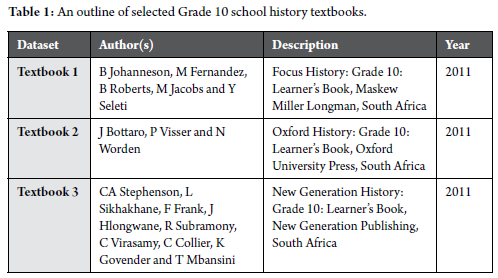
As mentioned, three history textbooks approved by the Department of Basic Education were selected for analysis. These textbooks were chosen because they serve as primary sources that allow for a purposeful analysis of settler grammar. Their selection is based on the fact that history textbooks function as tools for spreading colonial vocabularies and terminologies when narrating history (Da Cruz, 2005; Seroto, 2015)., below, provides a tabular representation of the selected South African school history textbooks for analysis:
Since these textbooks are widely used across the country, the findings will have a broad impact on understanding how settler grammar has been normalised within these books. This can also provide ways for a larger audience to resist and challenge the settler grammar found in the textbooks. The selected textbooks are published by various publishing houses, including Maskew Miller Longman, Oxford University Press and New Generation. Each editorial team's linguistic choices vary, which in turn, influences how settler grammar is constructed. Two themes, which are (a) Topic 4: Transformations in Southern Africa after 1750 (b) Topic 5: Colonial expansion after 1750, were chosen for analysis. These two themes are representative of historical narratives where colonial ideologies or settler grammar may be reproduced. While similar studies have been conducted, the two selected themes have never been examined specifically for settler grammar. These themes will not only reveal how settler grammar continues to be expressed in the textbooks but also suggest possible ways to challenge it. Overall, both themes focus on historical activities and periods that are tied and directly linked to settler colonialism, thus, making the themes more suitable for analysing settler grammar. The data for analysis are arranged below in the sequence presented in the textbooks.
Representation of data and discussion of findings
To have a nuanced understanding of the themes under scrutiny, the paper first provides a historical context of each theme. The focus on these themes is on examining how colonial discursive structures and settler grammar are naturalised when narrating history.
Topic 4: Transformations in Southern Africa after 1750
Historical background
According to the curriculum, which outlines the content that the textbooks should engage with when creating the narrative:
Southern Africa experienced transformation in the 18th and 19th centuries. This was the period that became known as the 'mfecane'. This unit reflects research that helps us to understand how and why transformation occurred at this time. Shaka was regarded as being the major cause of conflict during this period. However, historians are moving away from the idea of mfecane/difaqane, which is linked to outdated, colonial-era ideas of the centrality of the 'wars of Shaka. Wars and disruptions took place, but most of them were not caused by Shaka and the Zulu. This unit investigates the recent research and explores the ways in which historical myths are constructed. (Department of Basic Education, 2011: 16)
The theme discusses historical narratives that explore the transformation that has been taking place in Southern Africa from the eighteenth century onwards. It then acknowledges that colonial historiography has dominated the writing of these narratives. It presents an argument that these colonial narratives (Omer-Cooper, 1966) have shifted from centring Shaka kaSenzangakhona Zulu as the sole cause of the violence and upheavals that were taking place at the time, to a new understanding which explains that issues such as colonial expansion and inadequate resources were part of the problem (Cobbing, 1988; Mvenene, 2014; Peires, 2009).
Textbook approaches
Although major revisions were made in terms of addressing the colonial historiography underlying Theme 4, the settler grammar is still prevalent and shapes the writing of narratives. Speaking of the 'political revolution from 1920 -1835', the textbooks adopt a passive language that silences colonial violence when speaking of the impacts of colonialism in Africa. Notably, there are texts from the textbooks that exhibit a 'zero-point epistemology' identified by Mignolo (2009). The following excerpt from Textbook 2 does not assign responsibility for who and what led to the political revolution:
The competition in southern Africa for resources and control over trade that started in the 1810s continued through until the 1830s. It increased during the 1820s and 1830s, as a result, there was increasing political conflict and change. By the 1830s the smaller chiefdoms had been conquered and the remaining people joined other chiefdoms to form large centralised African states. (Bottaro et al., 2011: 112)
The excerpt obscures the idea that settlers are partly responsible for the political revolutions happening. To achieve this, the authors employ terms such as 'competition' and 'trade' to construct a narrative that suggests conquest was inevitable. It gives the impression that 'competition' and 'trade' are the main reasons for the changes that occurred, which downplays the violence and force used by colonial settlers, confirming what De Sousa Santos (2005) and Maluleka (2021) refer to as epistemicide-the intentional erasure of certain narratives. These narratives are also framed using colonial vocabulary, which distorts the true representation of African people (Ogot, 2009) in history textbooks. Two key aspects of epistemic oppression and violence in history, identified by Ndlovu-Gatsheni (2018) and Maluleka (2021), are clear in the excerpt. First, the statement that ".there was increasing political conflict and change" (Bottaro et al., 2011: 112) dismisses the possibility that African actions were deliberate rather than chaotic, as the language suggests. It overlooks the political and military strategies and innovations that Africans developed. Second, the claim that ".the remaining people joined other chiefdoms to form large centralised African states" (Bottaro et al., 2011: 112) silences the idea that these people were not simply passively absorbed but had the agency to negotiate during the formation of these 'African states'.
Even though efforts have been made to move away from a solely colonial perspective in explaining Theme 4, the textbook still relies on a Eurocentric framework that dominates historical narratives (see Martin & Wodak, 2003). For example, in the section discussing the remembrance and legacy of Shaka kaSenzangakhona, Zulu, Textbook 2 uses biased language to describe his role during the transformation period, while Textbook 3 dismisses the importance of women in shaping Shaka's figure. Overall, Textbook 2 promotes the idea of 'great men in history', rooted in settler grammar that views history as a story of 'important men', which biases and erases the contributions of ordinary people. This is exemplified in the following excerpt from Textbook 2, which states:
It is often said that the history we learn is the history produced by the winners, not the losers. We see this in the different ways Shaka has been portrayed:
• The "military genius": Some people have viewed him as a "genius" who led the Zulu nation to military glory over their enemies and who is still an inspiration to African leaders today.
• The "cruel tyrant": Others have seen him as the cause of great destruction and misery in large parts of southern Africa during the Mfecane, by controlling every aspect of the lives of his subjects and putting them to death when he wanted to.
• The "nation builder": Others have portrayed him as a great leader who built up the Zulu nation. (Bottaro et al., 2011: 124)
The bias is multifaceted; the narrative is biased in that Shaka is portrayed as a central figure in the discussions, where, in some cases, terminologies such as 'genius' are used to describe him. These narratives undermine the collective role played by different African polities and people in governing their societies, which reflects the European conception that history is about 'great men', which oversimplifies history as noted by Chernis (1990) and Calderon (2014). One could argue that these oversimplified narratives, overshadowed by terminologies such as 'genius', 'tyrant' and 'builder', are limiting the understanding of African leadership to Western understandings. For instance, the idea of 'nation-building' has its roots in colonial narratives of what it means to build a society, which in turn, erases the idea that Africans have long engaged in activities of building their societies, thus, erasing the African political imagination (see Mudimbe, 1988).
It could be further argued that the framing of Theme 4 is also shaped by narratives that are rooted in the idea of universal historical narratives, which are pointed out by Mignolo (2009) and Shabangu (2024), who argue that settler grammar tends to present the past in a way suggesting that there is a singular way of understanding it. Here, Textbook 2, as shown above, mentions that "...it is often said that the history we learn is the history produced by the winners, not the losers" (Bottaro et al., 2011: 124), implicitly insinuating that history is always written by winners. It does not consider the power dynamics that come into play when it comes to the construction of historical narratives. Kros et al. (2022: 39) convincingly inferred that framing history in the identified way sustains the settler grammar in that it does not focus on "political conflicts that took place inside African kingdoms, or the lives and politics of ordinary people". Such an absence can be seen as a colonial lens of viewing the past, where the narratives of ordinary Africans tell us less about their complex everyday practices, contributions and navigation of life in history (Ogot, 2009), which can be directly linked to the notion of oversimplifying African history (Calderon, 2014; Shabangu, 2024).
As mentioned earlier, Textbook 3 reflects an erasure of a contribution made by women in the making of Shaka. This historical erasure can be attributed to epistemic injustice (Fricker, 2007; Maluleka, 2021). That can be described as the prejudices of those engaged in the act of representing, which is discussed by Ogot (2009). For instance, Textbook 3 frames the narratives using a vocabulary that is rooted in epistemic sexism, overshadowing the history of women. In speaking of how the figure Shaka was constructed, Textbook 3 poses two crucial questions, which are: "Who was King Shaka?" (Stephenson et al., 2011: 128) and "How did Shaka gain control over the people of the Phongola-Thukela region?" (Stephenson et al., 2011: 128). In answering the questions, Textbook 3, which is worth quoting in length, states the following:
Who was King Shaka?
• Shaka was born into the Zulu clan who lived along the Mhlatuze River. As the illegitimate born son of the chief, Senzangakhona, Shaka was disowned by his father and was not considered heir to the chieftainship.
• He became a soldier in the Mthethwa army where his bravery and leadership qualities were soon noticed by Dingiswayo. When Senzangakhona died in about 1816, Dingiswaso made Shaka chief of the Zulus.
• How did Shaka gain control over the people of the Phongola-Thukela region?
•Shaka gained control of most of the Phongola-Thukela region by conquest and peaceful means. He was able to win the loyalty of many different groups of people and created a well-organised kingdom. (Stephenson et al., 2011: 128)
To understand the settler grammar at play here, it is important to recognise that the two questions and the accompanying narratives describe the making of Shaka. The extract reveals a clear omission of the women who nurtured, guided and advised Shaka in his development. The narrative is undoubtedly male-centred, presenting Shaka as the central figure or as the protagonist, while only acknowledging the role of his father, Senzangakhona, in his formation. Furthermore, the text attributes some influence to Dingiswayo in shaping Shaka as both a political leader and an individual. The presence of settler grammar is evident in the underlying colonial assumption that African history is shaped solely by men, an assumption that has been critically challenged by scholars such as Oyewumi (1997) and Magoqwana (2018).
To think of it, the history of Nandi kaBhebhe, who was Shaka's mother, a prominent person who played an essential role in his upbringing and later advised him as Inkosi, a king in English, is marginalised (Weitzer, 1990). The framing not only echoes the marginalisation of women's histories, it also "resembles the colonial patriarchal structures in erasing African women's contribution in African societies" (Aidoo, 1992, in Magoqwana, 2018: 75). The framing adopted a testimonial injustice (see Fricker 2007), which the linguistic choice of gender reinforces the idea that legitimate history can only come from the discourse of men (Tobi, 2020). This, according to Seroto (2015: 176), who draws from the work of Kim (2001), highlights that the issues with this settler grammar are that it only provides "one side of the coin by highlighting the coloniser's perspective as the central view of the event". In this case, the coloniser's perspectives of history are aligned with the masculinist model of power, where dominance of men is only embraced and glorified as epitomised in the history of Shaka and Van Riebeeck, to some extent, as demonstrated in the paper by Da Cruz (2005) and Nishino (2011).
Topic 5: Colonial expansion after 1750
Historical background
Here, the curriculum discusses the colonial expansion that took place in southern Africa after 1750, and in length, it states that:
The focus is on the impact that the demands of the emerging capitalist economy in Britain had on societies in southern Africa. During this period, southern Africa was drawn into the world economy. A link can be made with the French Revolutionary wars, with Britain having taken control of the Cape in 1795, as well as the consolidation of British control and the impact this had after 1806. Review how the slave trade stimulated Britain's Industrial Revolution, enabling it to develop the technologies of colonialism. A broad understanding rather than detail is needed.
Co-operation and conflict on the Highveld focuses on the fragility of the Boer Republics and the conflicts and alliances between the Boers and the Highveld chiefdoms, in particular with Moshoeshoe. Moshoeshoe emerges at this time as a skilful tactician, balancing military strategy with a policy of generosity in victory, diplomacy and negotiation in his dealings with other African leaders, as well as the Boer trekkers, the British colonisers and the missionaries. Moshoeshoe is celebrated in praise poetry as a military strategist, diplomat, negotiator, reconciler and nation builder. (Department of Education, 2011: 17)
The theme engages with the factors that led to a global colonial expansion, with a focus on Southern Africa (see Thompson, 2014). Several factors are said to have contributed to the emergence of this global capitalist economy. These narratives frame technology as one of the significant forces for colonialism (Leshota & Mushonga, 2023). Although it does not specify, the curriculum seems to project Moshoeshoe as a thoughtful leader who played an essential role during the colonial expansion.
Textbook approaches
Historical representations in this theme are closely connected to settler perspectives, as Western epistemology dominates historical narratives, especially regarding colonial discourses. Pratt (1992) rightly emphasises that stories about the colonial era should not only focus on power relations but also go beyond that. The author clearly states that attention should also be given to the "social space where culture clashes meet and grapple with each other, often in highly unequal relations of domination and subordination" (Pratt, 1992: 48). Seroto (2015: 178) notes that many history textbooks tend to highlight how white settlers centralised political territories and why and how Indigenous people were displaced from their lands. The authors often fail to adequately address the conflicts resulting from cultural clashes. What Seroto (2015) points out is evident in Textbook 1, which does not explore the idea of cultural conflicts (Johanneson et al., 2011). In its introduction, Textbook 1 explains that indigenous groups like the KhoiKhoi and San lived in the Cape region before Europeans arrived. It then shifts focus to the European arrival, marking the beginning of colonialism (Johanneson et al., 2011). The textbook presents a single, dominant historical perspective, as De Sousa Santos (2005) describes. Therefore, the focus is mainly on acknowledging Indigenous people and the European arrival, without addressing the cultural clashes (Seroto, 2015).
Euphemistic language, linked to Anglonormativity-the idea that historical narratives should reflect worldviews and ideas of history aligned with the English language, is evident in the textbooks. Terminologies that minimise the violence and brutality of European colonisation are used to describe these events. For example, Textbook 2 begins with the question: "How did colonial expansion in the interior transform South Africa?" (Bottaro et al., 2011: 134). Words like 'expansion' and 'transform' are used to obscure the atrocities associated with colonialism. More accurate terms like 'invasion' and 'destructive' should have been used to better reflect the reality of colonialism. Additionally, the narratives in these textbooks tend to endorse colonial systems, which is clear in the subsequent content extract:
Between 1750 and the 1830s important changes took place in the Cape Colony. The Cape became part of the British Empire at a time when Britain was the leading trading and industrial nation. New policies led to the abolition of slavery and its replacement by wage labour and the growth of commercial farming. Land become sought after, especially in the eastern frontier region. By the 1850s the Xhosa were defeated and much of their land occupied by new European settlers. Meanwhile, Boer farmers (trekkers) had left the colony and moved into the interior. They defeated the Zulu and settled in Natal until the British took over in 1843. (Bottaro et al., 2011: 134)
The vocabulary underpinning the extract provides a Eurocentric view of colonialism, which ignores the consequences of colonialism on the livelihood of the Indigenous people who were residing in the region (Da Cruz, 2005). This is evident in the close examination of the linguistic choices, which shows that the authors present colonisation as progress instead of highlighting that Britain's colonial efforts at the 'Cape' were primarily about securing trade routes while disrupting indigenous ways of life in the region, as noted by Seroto (2015). The narratives from the extract further create an impression that the land was fought for fairly, instead of projecting it as a colonial conquest, where land was violently and forcibly seized from the African people. It does that by using vocabulary such as "Land became sought after, especially in the eastern frontier region" (Bottaro et al., 2011: 134). This view sanitises and suppresses the view that there was an encroachment from settlers in Southern Africa, which led to the loss of land and dispossession. What is appalling is that it draws from African vocabularies, which would provide a view on how this colonial invasion led to their demise and resistance. Textbook 3 adopts a similar approach as it introduces the theme by mentioning that:
As an emerging capitalist economy Britain began to colonise countries to obtain raw materials for factories. This led to Britain taking control of the Cape in 1795 and establishing a colony in South Africa in 1908. The British objective in South Africa was to control the Cape sea-route to the east. It was only when it was realised that South Africa had large deposits of minerals that the British took keen interest in developing the South African economy. (Stephenson et al., 2011: 150)
Similarly, these narratives use vocabularies that centralise the experiences of Settlers centred around the notion of progress. This is explained using terms such as 'developing', which undermines the idea that the African people were already living in developing societies. It becomes clear that development here is understood under the colonial universalistic terms (Dei, 2008). Seroto (2015: 177) similarly critiques these historical accounts, noting that:
...Authors present the historical development of socioeconomic conditions at the Cape as something to which the indigenous people made no contribution. Yet indigenous people were involved with pastoral and artistic activities: the Khoi did not only keep cattle and sheep, they were also pottery-makers.
The point Seroto (2015) is raising is evident in the discursive structures of the extract, describing that "Britain began to colonise countries to obtain raw materials for factories" (Bottaro et al., 2011: 150). This narrative can be linked to the coloniality of knowledge, where historical vocabularies describing the history of Europe are rationalised, legitimised and positioned at the top of the hierarchy (Mignolo, 2009). In the extract, the economic progression of Britain, which is justified by the idea of developing the economy of South Africa, seeks to rationalise and legitimise colonisation, while silencing the violence that came with it.
Conclusion: A move towards recognising African Vocabularies and terminologies
Many questions were raised during the #MustFall movement regarding a way forward for addressing the identified epistemic issues. For example, Bam et al. (2018: 6) note that the following question arose: "what would a transformed curriculum look like?". Building on the work of Bam et al. (2018), Godsell (2019) and Maluleka (2021), it can be observed that these questions in relation to history education sought to highlight that history in Africa has been written from a Eurocentric perspective, which should be transformed. The history written from a Eurocentric viewpoint fails to articulate and accurately capture the realities of Africans (Bam et al., 2018; Godsell, 2019; Maluleka, 2021). It does not end there; a history written using a colonial framing tends to distort and conceal the violence, land dispossession, and disruption brought by colonial settlers in Africa (Ogot, 2009; Seroto, 2015) using colonial vocabularies and terminologies. Thus, Godsell (2019) was correct that the construction of historical narratives is not only about whose voice is heard; it goes beyond that. In essence, "it is about whose framing, whose narrative, whose language, whose terminology, whose world view, and definitions of reality and humanity are used in the curriculum and in the classroom" (Godsell, 2019: 8).
The question that this paper poses is related to what Godsell (2019) raises, and it is equally pertinent to addressing some of the epistemic issues identified by the #MustFall movement: In what ways can settler grammar be dismantled when constructing narratives in history textbooks? Like in the case of the #MustFall movement, the question raises that settler grammar, as shown in this paper, denies "the presence of Indigenous epistemologies as legitimate ways for understanding the past, while also demonstrating the need for Western logic, Western epistemic rule, to organise and make sense of the past" (Cutrara, 2018: 257). Thus, the start in transcending settler grammar in history textbooks should be recognising African vocabularies and terminologies. These vocabularies and terminologies will reflect their worldviews, ideas of engaging with history and historical agency as noted by Godsell (2019), which will accurately represent their past, while moving away from Eurocentric views of history that sanitise the history of Europeans. For instance, the idea of using passive voice, which downplays responsibility and obscures agency, can be addressed by recognising the legitimacy of African vocabularies (Ndlovu-Gatsheni, 2018). Instead of claiming that "smaller chiefdoms had been conquered, and their remaining populations were absorbed into larger chiefdoms" (Bottaro et al., 2011: 112), it could also be said during the reign of Shaka Zulu, African leadership structures made use of imbizo-public gatherings/councils-to deliberate on political matters, resolve disputes and consult with communities and possibly consolidate power.
Moreover, centring African agency, as shown above, addresses the issue of epistemic oppression and violence (Godsell & Maluleka, 2022; Ndlovu-Gatsheni, 2018), where a Eurocentric, universal way of understanding systems of governance is often narrated. The discursive structures framing these narratives will now present African systems of governance as political systems that were structured and legitimate at that specific time and place. It will also demonstrate that these systems were consultative, not merely chaotic, as portrayed by colonial vocabulary and terminology. It will show that these consultative processes involved the voices, narratives and terminologies of women. For example, the part discussing who Shaka kaSenzangakhona Zulu was, and the role he played in forming the isizwe sika Zulu (the Zulu polity) (see Kros et al., 2022), can be recentred to include the role played by women such as his mother, Indlunkulu (the great house), under the guardianship of Umfazi wokuqala (the first wife) in that particular polity. This can be supported by the fact that "Shaka's reign tends to be traced back to his paternal grandmother, Mthaniya... who influenced Zulu royal affairs" (Magoqwana, 2018: 82). In other words, the concept of Imbokodo (a grindstone symbolising power from women) as an African term should be adopted to represent how women in African societies like the Zulu polity, managed to influence governance and leadership as central figures.
Challenging Anglonormativity, which depicts colonisation as a civilising mission aimed at progress and development, requires terminology grounded in the perspectives and lived experiences of the formerly colonised. According to Godsell (2019: 8), this means there is a need for "historical narratives which shift ideas of 'civilisation,' 'development,' or 'progress' away from the Global North". Achieving this involves using African vocabularies to describe what it meant to be civilised and progressive in the past. This is a step toward rehumanising African subjects, who have long been perceived and described as 'backward' and 'uncivilised' in history textbooks (Bleby, 1913; Paynter, 1968). It means that future narratives would better reflect the perspectives of Africans, as those narratives would now be informed by their vocabularies, terminologies and languages (Godsell, 2019; Ogot, 2009). In conclusion, the paper has identified settler grammar in selected post-apartheid history textbooks and proposed ways to address this grammatical influence.
Reference list
- Aidoo, AA 1992. The African woman today. Dissent, 39: 319-325.
- Angler, KL, Hobbs, JT, Horner, EA, Mowatt, RL, Nattrass, G & Wallace, JA 2011. Viva History: Learner's Book. Grade 10. Florida: Vivlia Publishers.
- Bam, J 1996. A critique of the interim history curriculum for schools. In: Unpublished paper presented at Future of the Past Conference, University of the Western Cape, Belville, South Africa.
- Bam, J, Ntsebeza, L & Zinn, A (eds.) 2018. Whose history counts: Decolonising African pre-colonial historiography. African Sun Media, SUN PReSS.
- Bennett, K, 2007. Epistemicide! The tale of a predatory discourse. The Translator, 13(2): 151-169.
- Bleby, AS 1912. South Africa and the British Empire: A course of lessons for the cape matriculation history syllabus. Cape Town: JC Juta.
- Botha, L, Griffiths, D & Prozesky, M 2021. Epistemological decolonization through a relational knowledge-making model. Africa Today, 67(4): 50-73.
- Bottaro, J, Visser, P & Worden, N 2005. Oxford in search of history: Grade 10 learner's book. Oxford: Oxford University Press.
- Bottaro, J, Visser, P & Worden, N 2011. Oxford in search of history: Grade 10 learner's book. Oxford: Oxford University Press.
- Calderon, D 2014. Uncovering settler grammars in curriculum. Educational Studies, 50(4): 313-338.
- Chernis, RE 1990. The past in service of the present: A study of South African school history syllabuses and textbooks 1839-1990. Doctoral dissertation. University of Pretoria.
- Chisholm, L 2004. Changing class: Education and social change in post-apartheid South Africa. Cape Town: HSRC Press.
- Cobbing, J 1988. The mfecane as alibi: Thoughts on dithakong and mbolompo1. The Journal of African History, 29(3): 487-519.
- Cutrara, SA 2018. The settler grammar of Canadian history curriculum: Why historical thinking is unable to respond to the TRC's calls to action. Canadian Journal of Education/ Revue canadienne de l'éducation, 41(1): 250-275.
- Da Cruz, P 2005. From narrative to severed heads: The form and location of white supremacist history in textbooks of the apartheid and post-apartheid eras: A case study. Master's thesis. University of Cape Town.
- Da Silva, AL & Klausen, SW 2024. Convergence and divergence: Depictions of indigenous peoples in secondary school history textbooks from Brazil and Norway. Research in Comparative and International Education, 19(1): 3-22.
- De Sousa Santos, B (ed.) 2005. Democratizing democracy: Beyond the liberal democratic canon (Vol. 1). London: Verso books.
- Department of Basic Education, RSA 2011. Curriculum and Assessment Policy Statement, Grades 10-12: History. Pretoria: Government Printer.
- Du Preez, JM 1983. Africana Afrikaner: Meestersimbole in Suid-Afrikaanse skool handboeke (Master symbols in South African school textbooks). Alberton, Librarius.
- Engelbrecht, A 2006. Textbooks in South Africa from apartheid to post-apartheid: Ideological change revealed by racial stereotyping. Promoting social cohesion through education: Case studies and tools for using textbooks and curricula (pp. 71-80).
- Fataar, A 2018. Decolonising education in South Africa: Perspectives and debates. Educational Research for Social Change, 7(SPE): vi-ix.
- Fricker, M 2007. Epistemic injustice: Power and the ethics of knowing. Oxford university press.
- Godsell, S & Maluleka, P 2025. Student voice in history teacher education: A means to build pedagogies around marginalized historical narratives. Historical Thinking, Culture, and Education, 2(1): 54-69.
- Godsell, S 2019. Poetry as method in the history classroom: Decolonising possibilities. Yesterday and Today, 21: 1-28.
- Godsell, S., & Maluleka, P. (2025). Student voice in history teacher education: A means to build pedagogies around marginalized historical narratives. Historical Thinking, Culture, and Education, 2(1), 54-69.
- Griffiths, D 2019. #FeesMustFall and the decolonised university in South Africa: Tensions and opportunities in a globalising world. International Journal of Educational Research, 94: 143-149.
- Jeyifo, B 2018. English is an African language-Ka Dupe![for and against Ngügï]. Journal of African Cultural Studies, 30(2): 133-147.
- Johanneson, B, Fernandez, M, Roberts, B, Jacobs, M & Seleti, Y No Date. Focus History: Grade 10: Learner's Book. South Africa: Maskew Miller Longman.
- Keynes, M, Åström Elmersjö, H, Lindmark, D & Norlin, B 2021. Introduction: Connecting historical justice and history education. In: Historical justice and history education (pp. 1-20). Cham: Springer International Publishing.
- Kim, MS 2001. The history of the Atlantic civilization.
- Kros, C., Wright, J., Buthelezi, M., & Ludlow, H. (2022). Exploring the Archive of the Times before Colonialism. Archives of Times Past: Conversations about South Africa" s Deep History, 3-23.
- Labadi, S 2024. Colonial statues in post-colonial Africa: A multidimensional heritage. International Journal of Heritage Studies, 30(3): 318-331.
- Leshota, P & Mushonga, M 2023. Subverting the hegemony of Western 'theological' and cultural domination: King Moshoeshoe I and 'hidden transcripts' of resistance. Critical African Studies, 15(3): 325-341.
- Magoqwana, B 2018. Repositioning uMakhulu as an institution of knowledge. Whose history counts: Decolonising African pre-colonial historiography (pp.75-90). African Sun Media.
- Maldonado-Torres, N 2007. On the coloniality ofbeing: Contributions to the development of a concept. Cultural Studies, 21(2-3): 240-270.
- Maluleka, P & Ramoupi, NLL 2022. Towards a decolonized school history curriculum in post-apartheid South Africa through enacting legitimation code theory. In: Decolonising knowledge and knowers: Struggles for university transformation in South Africa (pp. 82-65). Routledge.
- Maluleka, P 2021. Fallism as decoloniality: Towards a decolonised school history curriculum in post-colonial-apartheid South Africa. Yesterday and Today, 26: 68-91.
- Marks, S 1972. Khoisan resistance to the Dutch in the seventeenth and eighteenth centuries. The Journal of African History, 13(1): 55-80.
- Martin, JR & Wodak, R (eds) 2003. Re/reading the past: Critical and functional perspectives on time and value (Vol. 8). John Benjamins Publishing.
- Maseko, P 2018. Language as source of revitalisation and reclamation of Indigenous epistemologies: Contesting assumptions and re-imagining women identities in (African) Xhosa society. Whose history counts: Decolonising African pre-colonia historiography (pp. 35-55).
- Mbembe, A 2015. Decolonizing knowledge and the question of the archive.
- Mbembe, A 2019. Necropolitics. Duke University Press.
- Mbembe, AJ 2016. Decolonizing the university: New directions. Arts and Humanities in Higher Education, 15(1): 29-45.
- McGregor, HE 2017. One classroom, two teachers? Historical thinking and Indigenous education in Canada. Critical Education, 8(14).
- McKinney, C 2016. Language and power in post-colonial schooling: Ideologies in practice. Routledge.
- Mignolo, WD 2009. Epistemic disobedience, independent thought and decolonial freedom. Theory, Culture & Society, 26(7-8): 159-181.
- Mkhize, N 2018. The missing idiom of African historiography: African historical writing in Walter Rubusana's Zemk'inkomo Magwalandini. In: Whose history counts: Decolonising African pre-colonial historiography (pp. 57-74). African Sun Media: SUN PReSS.
- Mountain, A., 2003. The First People of the Cape: A look at their history and the impact of colonialism on the Cape's indigenous people. New Africa book.
- Mudimbe, VY 1988. The invention of Africa: Gnosis, philosophy and the order of knowledge. Bloomington and Indianapolis: Indiana University Press.
- Mvenene, J 2014. A social and economic history of the African people of Gcalekaland, 1830-1913. Historia, 59(1): 59-71.
- Ndlovu-Gatsheni, S 2018. The dynamics of epistemological decolonisation in the 21st century: Towards epistemic freedom. The Strategic Review for Southern Africa, 40(1).
- Nishino, R 2011. Changing histories: Japanese and South African textbooks in comparison (1945-1995). V&R Unipress.
- Ogot, BA 2009. Rereading the history and historiography of epistemic domination and resistance in Africa. African Studies Review, 52(1): 1-22.
- Omer-Cooper, JD 1966. The Zulu aftermath: A nineteenth-century revolution in Bantu Africa. Northwestern University Press.
- Oyèwùmí, O 1997. The invention of women: Making an African sense of western gender discourses. University of Minnesota Press.
- Paynter, BE 1968. A new course in history: Standard 6. [n.p.]: [n.pub.
- ].
- Peires, J 2009. Shaka the great. Historia, 54(1): 159-179.
- Polakow-Suransky, SS 2002. Historical amnesia? The politics of textbooks in post-apartheid South Africa.
- Pratt, M. . (1992). Imperial Eyes: Travel Writing and Transculturation. London:
- Ramoupi, N. L. L. (2014). African research and scholarship: 20 years of lost opportunities to transform higher education in South Africa. Ufahamu: A Journal of African Studies, 38(1). Routledge.
- Sefa Dei, GJ 2008. Possibilities in African schooling and education. New Directions in African Education: Challenges and Possibilities (pp. 229-248).
- Seroto, J 2015. An analysis of the depiction of indigenous people during the early colonial conquest in South African history textbooks. Indilinga African Journal of Indigenous Knowledge Systems, 14(2), pp.169-184.
- Shabangu, B., 2024. Re-thinking the South African school history curriculum: Theorising indigenous archives of history. In: History education in Africa: Research, perspectives and practices (pp. 90-69). Cham: Springer Nature Switzerland.
- Sonkqayi, G 2024. Revisiting the debates on 'epistemicide': Insights from the South African school curriculum. Educational Review, 76(5): 1307-1324.
- Stephenson, CA, Sikhakhane, L, Frank, F, Hlongwane, J, Subramony, R, Virasamy, C, Collier, C, Govender, K & Mbansini, T 2011. New generation history: Grade 10: Learner's book. South Africa: New Generation Publishing.
- Thompson, L 2014. A history of South Africa. Yale University Press.
- Tobi, AT 2020. Towards a plausible account of epistemic decolonisation. Philosophical Papers, 49(2): 253-278.
- Wa Thiong'o, N 1986. The writer in a neocolonial state. The Black Scholar, 17(4): 2-10.
- Weitzer, RJ 1990. Transforming settler states: Communal conflict and internal security in Northern Ireland and Zimbabwe. University of California Press.
2 The term 'Kaffir' in South Africa is deeply offensive and pejorative. Historically, it was primarily used by colonial settlers to refer to Africans in a derogatory manner, implying that they were inherently barbaric and uncivilised.