When History Education and English Literature Merge: Teaching the 1976 Soweto Uprising through Athol Fugard's "My Children! My Africa!"
Abstract
Literature transcends mere literary analysis and aesthetics. This is what I always tell my students. It plays a crucial role in shaping responsible, empathic, and cultured citizens in a non-racial and non-prejudiced society. In reference to the quote, "those who do not learn history are doomed to repeat it" by George Santayana (1905), it is important, therefore, to reflect on and constantly conscientize ourselves about our histories. However, in South Africa, as in many nations that have experienced oppression and segregation, debates or discussions on race relations and the violent past still spark considerable rage among those who were oppressed, thus making it difficult to carry out constructive dialogues on the current state of the nation and the envisioned future. Drawing on personal experience as a lecturer of English literature for education or applied literature studies, this reflective practitioner article aims to demonstrate how the play "My Children! My Africa! (MCMA)" by Athol Fugard succeeds in narrating, commemorating, and motivating discussions or debates on hot-potato issues, such as race, racism, race relations, and other related matters, as well as historical events such as the 1976 Soweto Uprising. These are issues and events that most of the population still finds difficult to engage with without their blood boiling or pointing a finger at the 'other'. Such a demonstration entails a discussion on the appropriateness of the text as an enabler of discussions of this nature. Subsequently, the author discusses the method used in his English literature classes to facilitate race-related discussions and the type of questions that enable students to look beyond what the text means in the classroom and to use the text to engage in discussions that may potentially promote and contribute to a socially cohesive society.
Athol Fugard; My Children! My Africa!; 1976 Soweto Uprising; Social justice language education (SJLE); Fiction-based social justice pedagogy/practice
Introduction
Positioning the article within social justice pedagogy or practice
This article draws inspiration from the method-fiction-based social justice pedagogy or practice-used by the author to teach and facilitate the learning and remembering of historical events such as the 1976 Soweto Uprising, using literature or literary texts. Social justice is defined in this article as the act of treating all people with dignity and fairness. Social justice pedagogy or practice is therefore defined as the explicit and implicit teaching of past and present systems, policies, and events that affect people's educational and economic opportunities, survival, and political freedom. It is also argued that social justice pedagogy or practice is often a means to an end, and not an end in itself. In other words, learning about apartheid or the 1976 Soweto Uprising, for example, is not only about learning the details and facts of events. It is also about advancing greater causes such as social cohesion and responsible citizenship, the cultivation of empathy and critical thinking, and the preparation of future professionals in diverse settings to interact with people from diverse economic and racial backgrounds with care and humility.
Since the proposed approach (fiction-based social justice pedagogy or practice) emerged from the language literature classroom, this article is positioned within the interdisciplinary field of social justice language education (SJLE). SJLE is a discipline that "explores the ways in which language classrooms can be transformed to disrupt the existing oppressive policies and practices in schools and in society at large" (Yilmaz et al., 2024:1).
The proposed intervention can also be implemented in history classes. The intervention's adaptation to history classes may help facilitate discussions on difficult topics, which many history teachers tend to tiptoe around because of the divisions and conflicts characterising countries with painful pasts (Twala, 2005). The failure to critically and creatively treat topics such as race may, in turn, easily create and breed tensions among students in history classes (Twala, 2005; Stacey et al., 2025). Therefore, the formulation of creative methods and frameworks for teaching difficult and controversial histories, such as the one proposed in this article, remains significant, as there is still a huge pedagogical gap in this area of research (Maluleka, 2023).
Justifying the article's contribution to social justice pedagogy or practice and the current special issue
As a practice-sharing article, the Community of Practice Theory (COPT) is adopted as a compass or theoretical justification for a contribution of this nature. Jean Lave and Etienne Wenger-Trayner initially conceptualised this theory in 1991. Since then, it has been reformulated multiple times to reflect subsequent developments. According to Wenger-Trayner et al. (2023), communities of practice consist of like-minded individuals in a specific sector or field whose intention is to learn from one another.
… a tribe learning to survive, a band of artists seeking new forms of expression, a group of engineers working on similar problems, a clique of pupils defining their identity in the school, a network of surgeons exploring novel techniques, a gathering of first-time managers helping each other cope (Wenger-Trayner & Wenger-Trayner, 2015:11)
The alternative definition describes communities of practice as "groups of people who share a concern or a passion for something they do and learn how to do it better as they interact regularly" (Wenger-Trayner & Wenger-Trayner, 2015).
In my (the author) view, the concept of Community of Practice (COP) goes beyond groups of people who are working jointly on a common issue or goal, or working towards developing their competencies. COP can also refer to the amalgamation of specialists' thoughts and ideas that could potentially pave the way to a solution, or simply expand a focused pool of literature or knowledge that others could draw from for their future research and practices. That is, knowledge-sharing communities of practice (KCOP) refer to the practice of sharing timely and relevant practical knowledge, or knowledge that can be put into practice or tried expeditiously. Through shared knowledge or expertise, other individuals within the same community (who share similar interests) learn from the contributors.
According to the COPT, for successful learning to occur, three integrated conditions, prerequisites, or elements must be in place, namely domain, community, and practice (Wenger-Trayner et al., 2023:12-13):
Domain: What is the community about? What do people identify with?
Community: Who should be at the table? What relationship should they form?
Practice: What should they do together? How can they make a difference in practice?
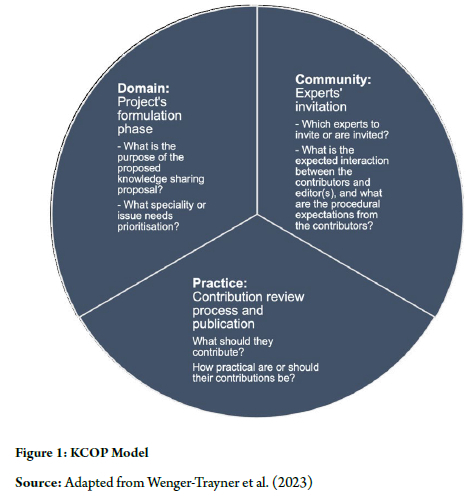
For the purposes of this article, these elements are adapted or reconceptualised to reflect KCOP, as Figure 1 demonstrates.
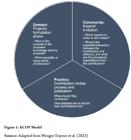
KCOP domain: This refers to the guest editors' and editors' foundational mandate, which entails discussions about the necessity of the special issue (SI) or book, and may involve decisions about the SI or book's niche.
KCOP community: This phase entails decision-making about potential contributors, and the drafting of the call and its distribution through channels such as the journals' websites, associations' websites, LinkedIn, and other social media platforms such as Facebook.
KCOP practice: This is the review phase, which entails the evaluation of the manuscript's contribution and the practicality of such a contribution. Based on the reviewers' feedback, the manuscript is either rejected; revised and eventually accepted for publication; or accepted without revisions.
By default, SI and book chapter calls create a temporary professional environment that allows individuals from similar or different fields of study with shared interests to come together as "occasional invitees" (Wenger-Trayner et al., 2023:13) and discuss or contribute towards a common topic, theme, or issue. Specifically, the current issue invited practitioners from schools, universities, museums, and community settings to contribute towards a deeper understanding and advancement of history education, hence a contribution of this nature.
A Tribute to Athol Fugard: The voice of the oppressed, the silenced, and the deliberately unheard
This part of the article aims to commemorate the absolute brilliance of one of the greatest and most highly decorated playwrights that South Africa has ever produced: the gift to the global literary world, Harold Athol Lanigan Fugard, famously known as Athol Fugard.
Athol Fugard was born on 11 June 1932, in Middelburg in the Eastern Cape Province, South Africa, to an English-speaking father and an Afrikaans-speaking mother (Mathe, 2025). However, he spent most of his upbringing in Port Elizabeth (now known as Gqeberha), the city located in the Eastern Cape Province, as portrayed in "Master Harold and the Boys". Following the completion of his basic education (Grades 1-12) and a course in motor mechanics, he travelled to Cape Town, where he enrolled in a humanities degree at the University of Cape Town (UCT). He, however, did not complete his studies at UCT: a few months before his final examinations in 1953, Fugard dropped out in an attempt to find himself and discover his true calling. After dropping out of UCT at the age of 20, Fugard travelled across continents, and it was during this time that his calling or passion for writing was conceived (Mathe, 2025). However, his breakthrough into a writing career was not immediate.
On his return to South Africa, he worked as a freelancer for organisations such as the South African Broadcasting Corporation (SABC) and the Evening Post. Subsequently, he worked as a clerk at the Native Commissioner's Office in Johannesburg in 1958 (Mathe, 2025). The injustices and inhumanity towards Africans that he witnessed as a clerk deeply troubled him, and they were the catalysts that launched his professional writing career (Mathe, 2025). From then on, he never looked back and published a series of literary works, with his writing career spanning more than six decades.
Although descriptors such as 'playwright', 'novelist', 'actor', and 'director' emerge when one searches for 'Athol Fugard', one can argue that Fugard was more than that. In the true essence of his work, Fugard was also a political activist, history teacher, and historical narrator.
Through storytelling, Fugard delicately and creatively preserved the sensitive history of South Africa. He made historical knowledge accessible and enjoyable through his remarkable writing skills. Fugard used his extraordinary gift of writing to craft what may be described as 'timeless' narratives that depict a vivid picture of the struggles of ordinary and often oppressed people in South Africa. He walked in the shoes of those who could not speak for themselves and embodied sincere and passionate resistance against the injustices of the past perpetuated by apartheid (a government system founded on principles of racial segregation). Fugard's plays are still 'alive', serving as a necessary, relevant, and constant reminder of our unfortunate past.
Athol Fugard:
[was] a titan of South African and world theatre whose voice and vision shaped the landscape of storytelling both at home and abroad. (The Market Theatre Foundation, 2025)
[was] ferocious in his devotion to theatre and social justice, but unfailingly kind and gracious for others, he stood as a moral compass-and not just for apartheid-era South Africa. (Mann, 2025)
[was] the great South African playwright who captured what it means to be human. All Fugard's people - tramps, discarded people, poor people, people on the fringes - they are connected with all the people we know of today who are refugees. Who are going around the world looking for a safe home. (Walder, 2025)
…hoisted the flag of this country during the madness and anarchy of the apartheid years. He penned stories that gave ordinary, faceless people a pedestal. He inspired multitudes of playwrights, not only in South Africa, but internationally. (James Ngcobo quoted by Spector, 2025)
South Africa's greatest playwright as well as theatrical craftsman, Athol Fugard made the comprehension of the apartheid regime's style of perfidy, turpitude, moral corruption, hypocrisy and almost unspeakable oppression clear and performatively visible on stages and screens throughout the world.
His sharp-witted, ironic prose crystallised humanity's issues like no else's. He was credibly called the greatest playwright in the English language during his lifetime. (David Coplan quoted by Spector, 2025)
… an extraordinary storyteller in extraordinary times, and the moral conscience of a generation.
… will be remembered for being an outlier amongst the millions of white South Africans who blithely turned a blind eye to the injustices being perpetrated in their name. (Republic of South Africa, 2025)
… fearlessly exposed the devastation and distortion of living under apartheid, chronicling the lives of poor, disempowered and dysfunctional South Africans, sharing the complex relationships between ordinary people shaped by the apartheid and post-apartheid years, and questioning what being human means. (Nelson Mandela University, 2025)
… sacrificed so many of his privileges to tell the story of South African pain under apartheid with honesty and bravery.
… [and gave] a voice to those silenced by oppression. (Republic of South Africa, 2025)
His work:
…serve as cultural documents which testify to the lived realities of the everyday experience of apartheid beyond the level of historical information. (Flockemann, 2025:1)
…confronted what it is to be human in an imperfect world, and offered a study of relationships that are unsurpassed. His collaborative plays … challenged injustice and held a mirror to our society that was recognised globally.
[…] continues to inspire generations of playwrights who strive to tell stories with courage and conviction. (The Market Theatre Foundation, 2025)
… was deeply political but did not solely stay at the level of its immediate politics but transcended them.
… still have huge, universal resonance for audiences today. (Royal Court Theatre, 2025)
… helped people to understand the world we live in and the human condition. (Walder, 2025)
… was not merely about reflecting society but about interrogating it, questioning injustices, and urging change. His work illuminated the lives of those marginalized by apartheid and explored universal human struggles of identity, belonging and conscience. (Ngowi, 2025)
Humanity was always at the core of Fugard's art. (McNulty, 2025)
No one can tell the story of protest theatre without mentioning the names of Athol Fugard, Winston Ntshona, and myself. (Kani, 2025)
These tributes not only highlight Fugard's absolute brilliance, they also demonstrate the role and importance of Fugard's writing's calling or higher purpose, and work, in advancing the social justice struggle and teaching, which the current article deliberates on.
In conclusion, Athol Fugard came and taught us what it means to be umuntu ebantwini (selflessly giving oneself to others), to have Ubuntu (being one with others), to live a principled life guided by values of justice, and to be kind in a cruel world. Fugard embodied empathy and was therefore, the true definition of an empath. He also left us with a legacy that will live forever. Athol Fugard died at the age of 92 on 8 March 2025 in Stellenbosch, South Africa. May the 'Athol-Fugard-spirit', characterised by selflessness and Ubuntu, live eternally.
Why "My Children! My Africa!"?
Within the five and a half years (2015-2020) that I worked as a high school English Second Language teacher in Phuthaditjhaba, Free State Province, South Africa, I was fortunate to teach, for the first time, the play "My Children! My Africa!" (MCMA) by Athol Fugard to one of the Grade 12 classes in 2017. I instantly fell in love with it. A few years later, I prescribed the same text to my university English major students, training to become Senior Phase and Further Education and Training Phase teachers. For context, MCMA is a play that was first published in 1989 and highlights the past injustices and educational inequalities perpetuated by the apartheid system. At the centre of the play is the symbolic 1976 Soweto Uprising, which Fugard uses to highlight the clash of resistance ideologies and the inevitable consequences resulting from suppressed voices. As an audience, one can deduce the play's commemorative intent regarding the 1976 Soweto Uprising through several commonalities shared between the events in the play and the actual events of the 1976 protest, such as Bantu Education as a trigger, the violent nature of the protests, and the inferior learning conditions, to name a few. The discussion of the 1976 Soweto Uprising's finer details, which may exceed the scope of this article, is thoroughly outlined by Brown (2016) and Ndlovu (2017). Therefore, the author could not think of a better reference suited to commemorate the 1976 Soweto Uprising, which took place 50 years ago, than using MCMA as a case study.
What makes MCMA the appropriate text for teaching or facilitating dialogues about past events such as the 1976 Soweto Uprising and social justice in universities is that it is a young adult literature (YAL) text driven by young adult protagonists (Short et al., 2015). Although YAL's description is contentious, and there is still confusion regarding its precise definition, it is often associated with the transition from youth to adulthood, hence the descriptive markers of its definition, such as puberty, adolescence, and teenager (Short et al., 2015). Given these descriptive markers, one may be tempted to define it as the literature read by teenagers or young adults, which is not always the case, as adults also read and find these texts meaningful and enjoyable (Dinnison, 2015). In this article, YAL is defined by the author as the kind of literature or texts that speak to the immediate challenges that young adults often contend with, such as relationship problems, identity issues, issues of belonging, career choices, mental health issues, finding one's voice, friendship, bullying, sexuality, political association and views (as portrayed in MCMA), and many others. These texts often act as companions to young adults who may otherwise feel like they are the only ones dealing with certain challenges. This relatability is accomplished through main characters who are young adults and through carefully chosen and thoroughly addressed themes that universally resonate with young adults. Furthermore, YAL can also be used in classrooms to create awareness, sensitise the young audience to certain issues, and ultimately cultivate empathy. For example, bullies may not often comprehend the magnitude of their detrimental actions toward others. Exposing them to YAL that addresses bullying, and subsequent discussions emanating from the text, may teach them about the unacceptability and negative consequences of bullying, and ultimately foster empathy. YAL can be any genre (drama, novel, poetry) that is centred on the young adult protagonist and narrates the struggles of young adults. Therefore, there is no doubt that the young adult audience (students) in universities may find MCMA relatable to their lives.
Secondly, the text's events set in Brakwater (a Black township) and Camdeboo (a predominantly white suburban area) are representative of the historical and contemporary realities of South Africa. That is, more than thirty years into democracy, South Africa remains one of the most highly unequal countries in the world, with a 31.4 per cent unemployment rate recorded in the last quarter of 2025 (Business Tech, 2026).
Finally, Fugard cleverly and implicitly mitigates potential rage emanating from the text's discussion or interpretation by portraying different races in a non-prejudiced and non-racist manner, an approach that eases the difficulty often associated with race relations dialogues. In other words, through character portrayal, Fugard avoids painting Black people as the 'uncivilised', 'unintelligent', or 'rebellious' race. This is evident, for instance, through the creation of two Black characters: Thami, who is Mr M's favourite intelligent learner, and Mr M, a Zolile High School English teacher who believes in the power of words to resolve conflicts. Similarly, although Fugard does an excellent job of revealing the evils of apartheid, he also convincingly demonstrates that not all white people were evil and that not all of them supported apartheid. He achieves this through Isabel, who gets along very well with the Black domestic workers, Aunty and Samuel, who work at her home and her father's chemist shop. Furthermore, at the end of the play, we witness Isabel's full transformation into a young and open-minded white girl who is against the 'madness' happening in the country. This more mature version of Isabel also represents the new generation of young white South Africans who are hopeful about the future of South Africa as a 'rainbow nation' or a melting pot, as Isabel articulates in Act 2, Scene 5:
[Isabel alone. She stands quietly, examining the silence. After a few seconds she nods her head slowly.]
Isabel: Yes! Thami was right, Mr M. He said I'd feel near you up here. He's out there somewhere, Mr M … travelling north. He didn't say where exactly he was going, but I think we can guess, can't we? I'm here for a very 'old fashioned' reason, so I know you'll approve. I've come to pay my last respects to Anela Myalatya. I know the old-fashioned way of doing that is to bring flowers, lay them on the grave, say a quiet prayer and then go back to your life. But that seemed sort of silly this time. You'll have enough flowers around here when spring comes … which it will. So instead, I've brought you something which I know will mean more to you than flowers or prayers ever could. A promise. I am going to make Anela Myalatya a promise. You gave me a little lecture once about wasted lives … how much you didn't want that to happen to Thami and me. I sort of understood what you meant at the time. Now, I most certainly do. Your death has seen to that. My promise to you is that I am going to try as hard as I can, in every way that I can, to see that it doesn't happen to me. I am going to try my best to make my life useful in the way that yours was. I want you to be proud of me. After all, I am one of your children, you know. You did welcome me to your family.
[A pause] The future is still ours, Mr M. (Fugard, 2020:102-103)
Although this narration style may somewhat be perceived as a 'both sides of the story' approach, which Teeger (2015) perceives as problematic, this notion is not portrayed explicitly in the play. Fugard leaves it to the audience to conclude the characterisation of the characters.
Arguably, Isabel's transformation could also be a symbol of South Africa's transition from being a racially segregated nation to a democratic state, as characterised by the 1994 watershed election. In his own words, Athol Fugard confirms these sentiments in a documentary interview, stating:
In writing My Children, My Africa I tried to deal with something which has been a source of great courage, inspiration, and hope to me over the years, which is quite simply young South Africans: White and Black and Coloured and brown and all the other colours. Even during the years of apartheid, somehow or other, I had the good fortune to keep on encountering young South Africans - as I say, of all skin colours, - who had somehow miraculously escaped the evil indoctrination of apartheid. They remained open, outward-going, decent human beings. I mean, a lot of people, a lot of young South Africans were trapped and ended up repeating the sins of their fathers, but there were just enough of those exceptions to constantly inspire me and give me faith in the eventual future decency of this country. And I wrote My Children, My Africa in the sense of acknowledging that debt to young South Africa, and it was a play I also wrote before President de Klerk made his speech, and it was very rewarding for me to then watch the events of the past two years because they have certainly vindicated my faith in this country, my refusal to be one of the prophets of despair. We haven't solved any of our problems yet. All our problems still lie ahead of us, but I mean, problems and challenges are what life is about, and our art will respond. Our art will be vigorous to the extent that our life is vigorous, and I foresee a very, very vigorous life for us South Africans. (Tekweni, 2019).
The "most bleak, depressing, dingy classroom" (Fugard, 2020:52) described by Isabel in Scene 2 represents the current state of education in South Africa, characterised by vast inequalities due to the lack of essential resources such as laboratories, prescribed textbooks, libraries, advanced and modern technology, and proper ablution facilities, among others, mostly in previously disadvantaged schools (Spaull & Jansen, 2019).
Essentially, MCMA is "a good book" (Glasgow, 2001:54), which Glasgow (2001:54) defines as a book that "unsettle[s] us, make[s] us ask questions about what we thought was certain; [and does not] just reaffirm everything we already know".
Literature and social justice teaching: Advancing history education through literature and enabling race relations dialogues in learning spaces
I agree with George Santayana (1905) that "those who do not learn history are doomed to repeat it", which got me thinking and asking: How can we ensure that learning about our past or history lives on? This part of the article aims to answer this question by sharing the practice that I (the author) use in my own university English literature classes. However, first, a justification for adopting literary texts to promote safe dialogues about past and current injustices is provided.
As initially articulated, literature transcends mere literary analysis and aesthetics. It plays a crucial role in shaping responsible, empathic, and humanistic citizens in a non-racial and non-prejudiced society. Glasgow (2001) affirms these sentiments by stating that, to promote tolerance of individual differences and cultivate socially responsible citizens, educators must create democratic and critical spaces in classrooms where students can openly discuss and debate viewpoints that either reinforce or challenge social justice viewpoints. Glasgow (2001) further argues that young adult literature is capable of conscientizing students about their worldviews and that it offers alternative lenses that enable them to view the world differently or from other people's perspectives, thereby enhancing their understanding of human relations.
Advocating for the use of fiction-based social justice pedagogy or practice, dramatization of children's literature specifically, to promote social justice, Yilmaz et al. (2024) argue that this approach has the potential to cultivate perspective-taking, empathy, and self- and identity awareness. It also challenges stereotypes and prejudice, and enables students to see others for who they truly are. Finally, dramatization may also enhance students' knowledge about socio- and geopolitical issues, which in turn, shapes their global citizenship (Yilmaz et al., 2024). These are essential skills and attributes that young people need in order to survive and thrive in a diverse world, and through social justice education, teachers can assist students in developing these competencies (Pillay & Pillay, 2018; Banas & Gershon, 2022).
However, despite the persisting and unfortunate racial tensions in South Africa's schools (Madlingozi et al., 2024)-which serve as reminders of the importance of continuous reflections and progressive debates on the successes and failures of the democratic government in improving citizens' lives, as well as the need for dialogues that promote social cohesion-some students may still not be inclined or may find such discussions uncomfortable (Yilmaz, 2024). Kapp (2025) points out that even History teachers, especially in private schools, find race-related discussions uncomfortable to facilitate. In instances where attention is afforded to topics such as "apartheid and systematic racism; colonisation, eugenics and land dispossession; geopolitical conflicts; gender and sexuality topics; and current South African politics," this is often done in a superficial manner (Kapp, 2025:192). It appears that this reluctance is a global phenomenon, especially in countries with a history of an oppressive and violent past. Carman Williams and Boyd (2023) note that even in the United States of America, particularly in states such as Florida, there is often discomfort associated with social justice topics.
Learners' unwillingness could be due to the sensitive nature of the dialogues, as well as the fear of being judged and becoming outcasts because of their unique or liberal views. In the case of teachers, reasons could include attempts to avoid tension in class, which may negatively affect the relationships that learners have with one another or disrupt classroom camaraderie. Teachers also fear being politically incorrect or having their views or methods of facilitating sensitive discussions misconstrued, which may have serious consequences, such as the loss of livelihood as a result of student complaints or public uproar (Kapp, 2025). Because schools are aware of such risks, they may caution against or restrict teachers from facilitating sensitive dialogues (Kapp, 2025). Furthermore, school cultures, religious affiliations, teachers' backgrounds and beliefs, and learners' perceptions of and sense of relatability to teachers may influence teachers' motivation to facilitate discussions on sensitive topics (Kapp, 2025). Kapp (2025) also highlights the lack of proper training in facilitating sensitive discussions, which often leaves teachers feeling ill-equipped, a notion shared by Maluleka (2023). Maluleka (2023) argues that the current South African History curriculum fails to capacitate History teachers with the creative teaching methods or frameworks necessary to handle and deal with difficult and controversial topics delicately and with love, while cultivating "empathy, cognitive, social epistemic justice, inclusivity, critical thinking, respect, love, and tolerance for others, as well as promotion for knowledge co-construction" (Maluleka, 2023:31).
Therefore, as a potential intervention, this article proposes that schools and universities should capitalise on fiction texts as drivers of historical consciousness and as tools for advancing race relations and social cohesion.
Practical intervention
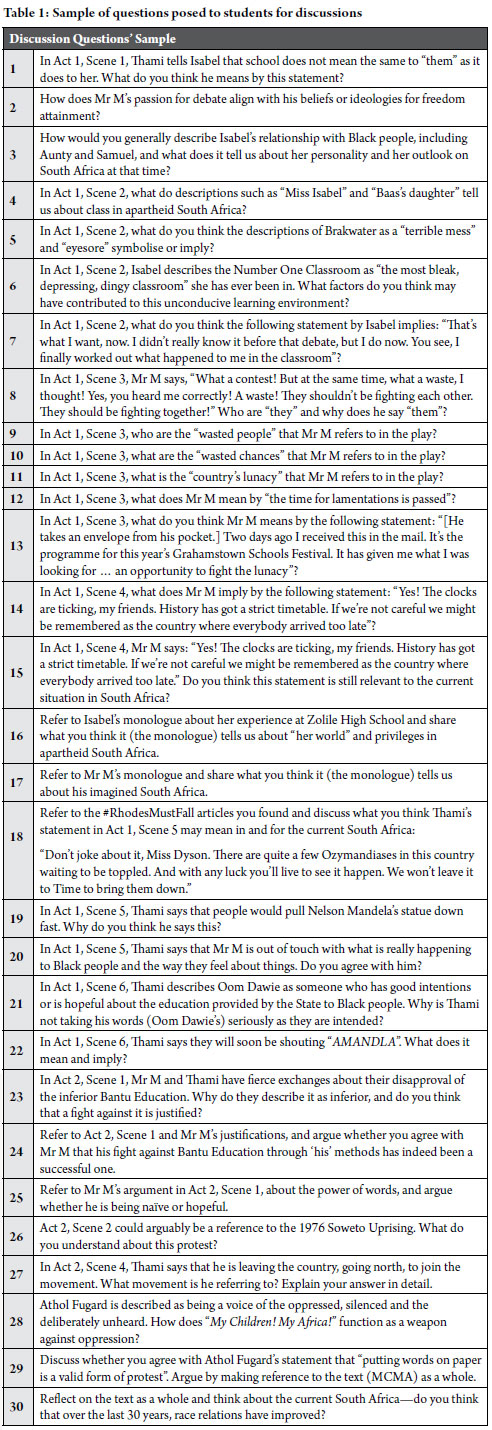
In my English literature classes, we have what we call "text reading feedback" sessions. These are semi-formal sessions, because even though the discussions are highly significant, I try to maintain fluidity and bring a bit of 'enjoyment' into them. As a result, I have observed that many students enjoy these sessions because of their relaxed nature and because a classroom is one of the few platforms where they can freely voice their genuine views about the current political, socio-economic, and social relations of South Africa. To facilitate the sessions, students are first tasked with reading the entire text on their own and making notes if they wish. During the sessions, I initially asked specific students at random to respond to the posed questions. However, this approach did not seem to work well, as students preferred the questions 'to be thrown in the air' (their words), allowing whoever felt confident or capable to respond. A sample of the questions that are posed to students with the aim of facilitating text comprehension, cultivating empathy (the ability to put oneself in others' shoes and remain patient and non-judgmental), and cultivating social cohesion (the ability to tolerate differences and intercultural competence) is presented in Table 1.
From an autoethnographic perspective (Poulos, 2021), the fiction-based social justice pedagogy or practice has the potential to be one of the effective strategies that can facilitate healthy teaching of difficult or controversial historical content. The pronounced confidence in this approach is supported by the observed strong engagement in my classes. I have noted on multiple counts that the discussions often evoke a variety of emotions and levels of engagement, ranging from frank enthusiasm to saying only what feels safe, and implicit and explicit defensiveness. In the end, everyone leaves the lecture room having learned something from others' diverse views and with a better or enhanced comprehension of the text. Other important outcomes include opportunities to develop one's voice and express one's views confidently. Students also leave the lecture room with their views vindicated. As a facilitator, I always feel a great sense of contribution towards training socially conscious future teachers who are sensitive to the realities of all people. Finally, it is important to mention that entirely smooth and tension-free discussions cannot always be guaranteed, and it is in such instances that the role of a lecturer as a facilitator becomes crucial in ensuring constructive and respectful engagement.
Subsequently, students in my English literature classes prepare for the literary analysis presentations on the same text. This task contributes 80 per cent to the component's term mark.
In history classrooms, a similar approach could be adopted. A teacher may recommend a text such as MCMA to amplify discussions of specific topics that may have been taught prior, such as:
a. class, and superiority and inferiority complexes in apartheid South Africa - addressed by question 4;
b. Group Areas Act of 1950 - addressed by question 5;
c. socio-economic inequalities - addressed by questions 5 and 16;
d. Bantu Education - addressed by questions 6 and 23;
e. race relations or social cohesion - addressed by question 8;
f. apartheid - addressed by question 11;
g. students' awareness of the past or history through past-and-present comparisons - addressed by questions 15 and 17;
h. post-apartheid education protests - addressed by question 18;
i. political figures and their causes - addressed by question 19;
j. the 1976 Soweto Uprising - addressed by question 26;
k. movements and organisations that fought for freedom and their methods - addressed by question 27; and
l. students' lived experiences in post-apartheid South Africa - addressed by question 30.
Amplification, in this instance, refers to finding creative ways to engage students in a classroom. For example, students may be reluctant to engage in difficult or controversial discussions from an immediate personal perspective, as they may fear being judged or isolated because of their personally held strong views. Arguably, they may be more inclined to participate if they take on the perspective of characters. For example, as opposed to asking, "Would you participate in a mob to voice your dissatisfaction about specific issues?" a teacher could phrase the question as follows: "Do you think that the mob, as portrayed in the text, is justified, or a justified means of protest?"
In addition to facilitating 'putting' oneself in others' shoes (empathy), these questions cultivate the ability and willingness to 'walk' in others' shoes. That is to say, to not only imagine what it must be like to be in specific situations, but also to engage critically and willingly in difficult or controversial discussions, no matter how unsettling that may be, with the aim of becoming sensitised to others' struggles. Therefore, the use of fiction to initiate and facilitate difficult or controversial discussions may not only ease potential tensions in a classroom, it may also motivate students to engage freely because of the excitement that such texts evoke, as I have witnessed in my own classes. Lecturers need to capitalise on this 'fun' aspect, as it is likely to enhance learning, teaching, and overall engagement.
Motivating students to participate
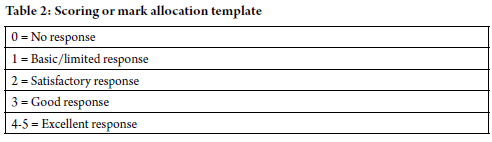
Since these are semi-formal discussions, which primarily aim to create a peer-to-peer learning, educational, healing, and unifying platform, less emphasis is placed on marks. The most important element is the dialogue itself. However, students do receive a mark out of five, which counts for 20 per cent of the term mark, and is structured as shown in Table 2.
Although the marks do motivate students to a certain extent, I have observed that as the sessions progress, they tend to find them enjoyable, with everyone wanting to jump into discussions even when they have already had an opportunity to voice their views. What this essentially means is that the mark is potentially an initiator of motivation, while the atmosphere that these discussions evoke is the sustainer of such motivation.
Closing remarks
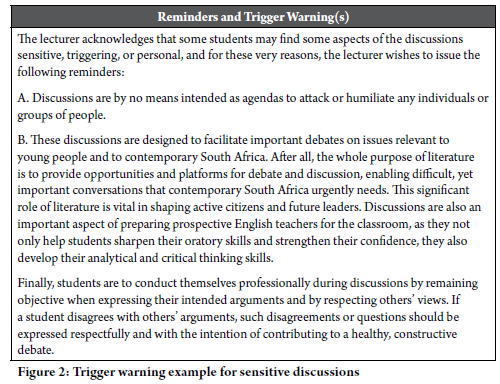
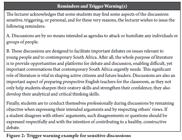
Before commencing with the task, it is important to ensure that students understand that discussions of this nature are meant to facilitate the collective reflection on the past and progressive dialogue, rather than create division and animosity. In my classes, the trigger warning (see Figure 2) forms part of the task instructions.
Facilitating difficult race discussions can be daunting. However, the fortunate aspect is that there are numerous scholarly publications that provide guidance such as Maluleka (2023), Wassermann and Bentrovato (2018), Twala (2005), Glasgow (2001), and many others. Furthermore, a simple search for 'facilitating difficult race discussions' yields several useful tips that instructors can use to facilitate fair, respectful, and unbiased discussions in their classes.
Conclusion
Essentially, the message that this reflective article aims to communicate is that teachers have a responsibility to cultivate and prepare responsible and empathic citizens and professionals. These are the essential graduate attributes that help individuals adapt to a working environment consisting of people from different racial and economic backgrounds. They also have the potential to improve individuals' interpersonal skills, which are highly valued in the workplace.
The prescription or recommendation of texts such as "My Children! My Africa!" does not serve English majors alone. It could also be recommended by history teachers to enhance engagement and narrative depth in the learning of certain controversial topics that are taught or discussed in their learning spaces.
Finally, the article only presented findings from an autoethnographic perspective, contextualised within a higher education setting. In the future, it may be worth investigating the benefits of fiction-based social justice pedagogy or practice from students' perspective and in schools.
References
- Banas, J and Gershon S 2022. A Novel approach to social justice education. Mid-Western Educational Researcher, 34(2).
- Brown, J 2016. The road to Soweto resistance and the Uprising of 16 June 1976. Johannesburg: Jacana Media.
-
Business Tech 2026. Two provinces in South Africa where more people are unemployed than working. Available at https://businesstech.co.za/news/government/851236/two-provinces-in-south-africa-where-more-people-are-unemployed-than-working/ Accessed on 15 March 2026.
» https://businesstech.co.za/news/government/851236/two-provinces-in-south-africa-where-more-people-are-unemployed-than-working/ - Carman Williams, LI and Boyd, AS 2023. Teaching social justice through gothic young adult literature. Language Arts Journal of Michigan, 38(2).
-
Dinnison, K 2015. Young adult literature belongs to everyone. Available at https://www.youtube.com/watch?v=bYRsq1YzTtU Accessed on 5 July 2026.
» https://www.youtube.com/watch?v=bYRsq1YzTtU - Flockemann, M 2025. (Re)living moments with Athol Fugard (1932-2025). South African Journal of Science, 121(5/6).
- Fugard, A 2020. My children! My Africa! Johannesburg: Pearson South Africa & Wits University Press.
- Glasgow, JN 2001. Teaching social justice through young adult literature. The English Journal, 90(6):54-61.
-
Kani, J 2025. John Kani's tribute to Athol Fugard. Available at https://www.litnet.co.za/press-release-john-kanis-tribute-to-athol-fugard/ Accessed on 15 March 2026.
» https://www.litnet.co.za/press-release-john-kanis-tribute-to-athol-fugard/ - Kapp, M 2025. Discomfort as a pedagogical mirror - views of a history teacher. Yesterday & Today, (35).
-
Madlingozi, T, Booi, S, and Tumbo A 2024. Persistent racism in South African Schools: A cry for urgent intervention measures beyond formal instruments. Human Rights Commission. Available at https://www.sahrc.org.za/index.php/sahrc-media/opinion-pieces/item/4185-persistent-racism-in-south-african-schools-a-cry-for-urgent-intervention-measures-beyond-formal-instruments. Accessed on 15 March 2026.
» https://www.sahrc.org.za/index.php/sahrc-media/opinion-pieces/item/4185-persistent-racism-in-south-african-schools-a-cry-for-urgent-intervention-measures-beyond-formal-instruments - Maluleka, P 2023. Teaching and learning sensitive and controversial topics in history through and with decolonial love. Yesterday & Today, (29).
-
Mann, E 2025. Athol Fugard was my hero. Available at https://www.americantheatre.org/2025/03/19/athol-fugard-was-my-hero/ Accessed on 15 March 2026.
» https://www.americantheatre.org/2025/03/19/athol-fugard-was-my-hero/ - Mathe, S 2025. Athol Fugard: 1932-2025 (Obituary). South African Theatre Journal, 37(2):169-173.
-
McNulty, C 2025. Appreciation: Playwright Athol Fugard proved the pen could be mightier than the sword. Los Angeles Times, 10 March 2025. Available at https://www.latimes.com/entertainment-arts/story/2025-03-10/playwright-athol-fugard-blood-knot-master-harold-boys-valley-song-apartheid Accessed on 15 March 2026.
» https://www.latimes.com/entertainment-arts/story/2025-03-10/playwright-athol-fugard-blood-knot-master-harold-boys-valley-song-apartheid - Ndlovu, SM 2017. The Soweto Uprisings: Counter memories of June 1976. Johannesburg: Pan Macmillan South Africa.
-
Nelson Mandela University 2025. Statement on the passing of Dr Athol Fugard on 8 March 2025. Available at https://news.mandela.ac.za/News/Statement-on-the-passing-of-Dr-Athol-Fugard-on-8-M Accessed on 15 March 2026.
» https://news.mandela.ac.za/News/Statement-on-the-passing-of-Dr-Athol-Fugard-on-8-M -
Ngowi, K 2025. The final curtain: Remembering Athol Fugard's theatre of conscience. Mail & Guardian, 10 March 2025. Available at https://mg.co.za/friday/2025-03-10-the-final-curtain-remembering-athol-fugards-theatre-of-conscience/ Accessed on 15 March 2026.
» https://mg.co.za/friday/2025-03-10-the-final-curtain-remembering-athol-fugards-theatre-of-conscience/ - Pillay, P and Pillay T 2018. Using South African stories to create understanding and appreciation of diversity. African Renaissance, 15 (Special Issue 1).
- Poulos, CN 2021. Essentials of autoethnography. American Psychological Association.
-
Republic of South Africa 2025. Statement on the passing of global great Athol Fugard. Ministry of Sport, Arts and Culture in Republic of South Africa. Available at https://www.dsac.gov.za/Statement%20on%20the%20Passing%20of%20Global%20Great%20Athol%20Fugard Accessed on 15 March 2026.
» https://www.dsac.gov.za/Statement%20on%20the%20Passing%20of%20Global%20Great%20Athol%20Fugard -
Royal Court Theatre 2025. A tribute to Athol Fugard, 1932 - 2025. Available at https://royalcourttheatre.com/stories/a-tribute-to-athol-fugard-1932-2025/ Accessed on 15 March 2026.
» https://royalcourttheatre.com/stories/a-tribute-to-athol-fugard-1932-2025/ - Santayana, G 1905. The life of reason: Reason in art. Vol. 1. New York: Charles Scribner's Sons.
- Short, KG, Tomlinson, CM, Lynch-Brown, C, and Johnson, H 2015. Essentials of young adult literature, 3rd ed. Pearson.
- Spaull, N and Jansen JD (eds.) 2019. South African schooling: The enigma of inequality (A study of the present situation and future possibilities). Cham: Springer.
-
Spector, JB 2025. Athol Fugard's plays offered hope where there was despair, courage where there was dismay. Daily Maverick, 11 March 2025. Available at https://www.dailymaverick.co.za/article/2025-03-11-athol-fugards-plays-offered-hope-where-there-was-despair-courage-where-there-was-dismay/ Accessed on 15 March 2026.
» https://www.dailymaverick.co.za/article/2025-03-11-athol-fugards-plays-offered-hope-where-there-was-despair-courage-where-there-was-dismay/ - Stacey, M, Wood, J, Amazan, R and Baker, S 2025. Teaching social justice education: The nature, role and future of discomfort, Critical Studies in Education, 66(4):449-462.
- Teeger, C 2015. "Both sides of the story": History education in post-apartheid South Africa, American Sociological Review, 80(6).
-
Tekweni 2018. Inside the mind of Athol Fugard: A master playwright's journey. YouTube, 2 July 2018. Available at https://www.youtube.com/watch?v=YtkbPMd6Mks&t=929s Accessed on 15 March 2026.
» https://www.youtube.com/watch?v=YtkbPMd6Mks&t=929s -
The Market Theatre Foundation. 2025. A tribute to Athol Fugard from the market theatre foundation. Available at https://markettheatre.co.za/a-tribute-to-athol-fugard-from-the-market-theatre-foundation/ Accessed on 15 March 2026.
» https://markettheatre.co.za/a-tribute-to-athol-fugard-from-the-market-theatre-foundation/ - Twala, C 2005. Race and ethnicity in the teaching of history: Challenges to history educators in the new dispensation. (2005). Southern Journal for Contemporary History, 30(2):19-36.
-
Walder, D 2025. Athol Fugard: The great South African playwright who captured what it means to be human. The Conversation, 10 March 2025. Available at: https://theconversation.com/athol-fugard-the-great-south-african-playwright-who-captured-what-it-means-to-be-human-251829 Accessed on 15 March 2026.
» https://theconversation.com/athol-fugard-the-great-south-african-playwright-who-captured-what-it-means-to-be-human-251829 - Wassermann, J and Bentrovato, D 2018. Confronting controversial issues in History classrooms: An analysis of preservice high school teachers' experiences in post-apartheid South Africa. Yesterday & Today Journal, (20).
-
Wenger-Trayner, E and Wenger-Trayner, B 2015. Introduction to communities of practice: A brief overview of the concept and its uses. Available at https://www.wenger-trayner.com/introduction-to-communities-of-practice/ Accessed on 15 March 2026.
» https://www.wenger-trayner.com/introduction-to-communities-of-practice/ - Wenger-Trayner, E, Wenger-Trayner, B, Reid, P and Bruderlein, C 2023. Communities of practice within and across organisations: A guidebook. Sesimbra: Social learning Lab.
- Yilmaz, A, Hart, DO and Sonmez, N 2024. Promoting social justice through dramatizing children's literature: Lessons from EFL classrooms in Turkiye. TESOL Journal, 15(4):e857.