Exploring Anti-Bantu Education Protests in Grahamstown/Makhanda Through Drama-in-Education Techniques with Grade 9 Learners
Abstract
The paper explores how Drama-in-Education (D-i-E) served as a decolonial and creative pedagogical tool to recontextualise local anti-Bantu Education histories within the Grade 9 South African History curriculum. The study foregrounds the largely understudied Grahamstown (now Makhanda) youth protests between 1975 and 1985, thus offering them as critical narratives that complement the 1976 Soweto Uprising. Through a Drama-in-Education production titled A Childhood in Chalk (2025), learners from a local high school in Makhanda engaged with these forgotten histories by assuming the fictional role of journalists reporting on the events depicted in the production. Following a participatory case study design, the D-i-E intervention combined a theatre production and audience participation techniques to foster historical inquiry, empathy, and critical reflection. Learners' written scene reflections and forum discussions served as data, which were analysed thematically using a decolonial framework alongside Bertram's (2020) concepts of recontextualisation and relocation. The findings reveal that embodied, participatory, and creative pedagogical approaches, such as D-i-E, enhance learners' historical understanding, contextual awareness, and emotional engagement with the past. By repositioning local stories within national narratives, the paper argues for the inclusion of community-based histories and creative pedagogies in the school curriculum to decolonise history education and humanise the forgotten voices of youth.
Grade 9 History; Anti-Bantu Education protests; History education; Drama-in-Education
Introduction
The National Party (NP) introduced the Bantu Education policy as a recommendation by the government to offer Africans an "inferior type of education that was designed to maintain the subordinate and marginal status of the majority racial group of the country" (Thobejane, 2013:2). The policy was part of the NP's agenda, emanating from the 1950s apartheid policies designed to enforce separate developments and provisions according to people's racial and ethnic groups (Booyse, 2011). Christie and Collins (1982) state that the NP conceptualised this policy in 1949 as part of the Commission on Native Education under the leadership of Dr Eiselen until 1951 (Christie & Collins, 1982:59). Eiselen's report informed the decision taken by the then Minister of Native Affairs, Hendrik Verwoerd, to announce the nationalist government's support of Bantu Education in 1953 as a pragmatic strategy to maintain white dominance (Thobejane, 2013). The public declarations by both Eiselen and Verwoerd to maintain white dominance set in motion plans to pass the Bantu Education Act in parliament in 1953, which the nationalist government gradually implemented.
However, as Christie and Collins (1982:60) explain, English-speaking liberals opposed the act because it ran counter to their "liberal ideals of integration". This opposition, however, did not have enough traction to stop the full implementation of the racially segregated education. The deliberate separatist design meant that African children would receive inferior education, thus relegating them to low-paying jobs and a low social status in society. Other than the need for nationalist Afrikaners to maintain racial supremacy, the policy was also a response to the supposed threat that the increasing number of Black people in urban areas meant competing for good jobs with their white counterparts (Booyse, 2011; Christie & Collins, 1982).
This internalised fear was further exacerbated when South Africa entered "an economic depression in the 1970s", followed by "black labourer protests causing a shortage of skilled labour" (Booyse, 2011:216). These circumstances fast-tracked and solidified the implementation of Bantu Education. As such, in 1974, the nationalist government added a recommendation that saw Afrikaans become a mandatory language of instruction in all African schools in apartheid South Africa (Maedza, 2019). Many young people across South Africa rejected this amendment and took to the streets to express their discontent. Against the background of the activities of several liberation movements, including the Sharpeville protest and the police massacre in 1960, as well as the launch of the African National Congress (ANC)'s Umkhonto we Sizwe, the African youths from various township spaces of South Africa organised themselves to boycott Bantu Education, thus deeming it generally unacceptable. Thobejane (2013) states that, as early as the 1950s, various political groups, such as the ANC, Pan Africanist Congress of Azania (PAC), and Azanian People's Organisation (AZAPO), opposed Bantu Education and its implementation. However, the national youth revolts intensified around 1975. They continued into the latter part of the 1980s, and the well-known story of the revolts is that of the events that unfolded in 1976 in Soweto, a township in Johannesburg.
Maedza (2019) notes that the 1976 Soweto protest was the most significant march in the '70s since the Sharpeville massacre on 21 March 1960; hence, it tends to receive more attention. The attack on African children soon hit the airwaves and made headlines across South Africa and the world. About "20,000 black students joined the protest on June 16, 1976, leading to thousands of injuries, 23 deaths, and 176 students died" (Maedza, 2019:235). Booyse (2011:251) adds that the boycott and unrest lasted for eight months, and by then "575 people had died, with 3907 injured and inestimable damage to government and private property". Arguably, these accounts paint a grim picture of the human cost of freedom and the overwhelming sadness of the young lives lost in pursuit of quality and fair education. One of the well-known young lives that died that day was 12-year-old Hector Pieterson, whom the world got to know through the famous photograph by Sam Nzima depicting "young Antoinette Sithole in her school uniform, running alongside Mbuyisa Makubhu carrying a fatally injured 12-year-old Hector Pieterson in his arms while fleeing from the apartheid police" (Simbao, as cited in Maedza, 2019:236).
While all the camera lenses and the world focused on the Soweto events, similar stories were unfolding in Fingo Village, a multi-racial township in Grahamstown (renamed Makhanda in 2018). In 1979, Mercia Wilsworth produced a master's thesis entitled, Transcending the culture of poverty in a Black South African township (1979), which has a chapter on educational challenges and rebellion in Makhanda during the late 1970s. There, the story of the Nathaniel Nyaluza school boycott in 1975 is narrated. It provides a local context for youth protests, offering additional sources that help learners and school pupils understand the impact of political unrest on the development of education in South Africa. Thus, looking beyond the 1976 Soweto marches, conscientizing local stories that contribute to the narratives of the Bantu Education youth revolt in South Africa is essential.
The aim of the study was, therefore, to use A Childhood in Chalk production as a teaching intervention to highlight the educational value of engaging learners with local history through performance and reflective writing. This aimed to address the problem identified regarding the lack of local history teaching in schools, especially the neglect of anti-Bantu Education stories outside the Soweto context. The paper, therefore, reports on how the authors used a play titled A Childhood in Chalk (2025) as a catalyst for Grade 9 learners at a local high school in Makhanda in the Eastern Cape province of South Africa, engaged with a local anti-Bantu Education story from their context, thus gaining historical insight and knowledge to a pivotal historical event that forms part of the larger youth revolts narratives in South Africa.
Literature review: The inclusion and exclusion of anti-Bantu Education stories in the history curriculum
The South African Grade 9 History curriculum is mandated by the Curriculum and Assessment Policy Statements (CAPS), which outlines the content teachers must teach. Other than the various topics presented under each grade, there is a set of history skills and concepts that the teacher needs to facilitate, thus teaching learners how to Find a variety of kinds of information about the past; Selecting relevant information; Deciding about whether information can be trusted; Seeing something that happened in the past from more than one point of view; Explaining why events in the past are often interpreted differently; Debating about what happened in the past based on the available evidence; Writing history in an organised way, with a logical line of argument; Understanding the importance of heritage and conservation. (Department of Basic Education [DBE], 2011:10)
In recent years, there has been much debate over what content should be included or excluded from the history curriculum. According to Maluleka (2021:80), since the national revision of CAPS in 2010, many subjects, such as History, underwent a transformation process that saw the revised CAPS embrace and encouraged a more "plurality of knowledge forms". This meant that some previously excluded content, such as women's stories and histories, was now included. However, there is a consensus that the change has not fully materialised, as many other stories are not featured in the curriculum (Maluleka, 2021; Ndlovu-Gatsheni & Ndlovu, 2021).
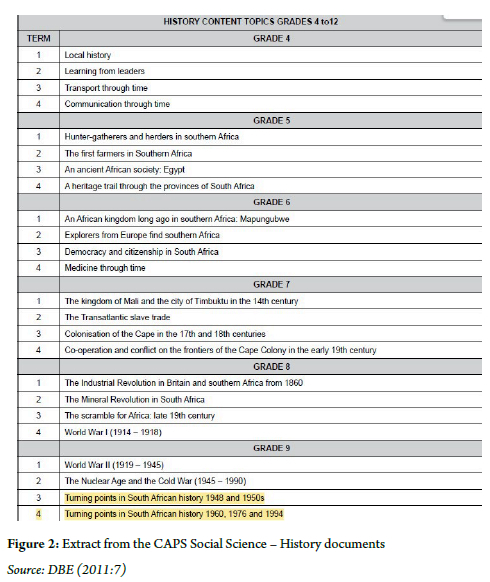
Therefore, in 2015, the Department of Basic Education (DBE) created a history ministerial task team (MTT) to recommend which content areas needed strengthening and to critique how teachers teach history in schools, among other priorities (Maluleka, 2021). Discussing the MTT in detail is beyond the scope of this study; however, the article addresses the latter part of the MTT's focus. As such, the review provides articulation of history; the Grade 9 History, particularly the Bantu Education component, is currently being taught in South Africa as mandated by CAPS, thus revealing which anti-Bantu Education stories are centred and which are excluded. Although the social science CAPS do not outrightly name Bantu Education as a topic under the curriculum, it is taught under the Grade 7-9 Social Science curriculum under term 4, whereby Grade 9 learners are required to learn about the turning points in South African history, 1960, 1976, and 1994 (DBE, 2011:16).
In this topic, learners and teachers explore the 1976 Soweto Uprising as a pivotal turning point in South African education history. Very little is written on how teachers approach this topic in their classrooms. The literature review, therefore, presents two examples of how the Soweto uprising has been presented in Grade 9 textbooks, which are sources that teachers rely on to teach history content. The first example is by Mutheiwana (2020), who studied the Grade 9 History curriculum and its pedagogical resources, such as textbooks, that teachers often use to teach historical content knowledge. Mutheiwana analysed three learners' textbooks and three teachers' guides (see Mutheiwana, 2020:12-13). Mutheiwa does not mention the Soweto Uprising event in her analysis. The second example is by Johannes Seroto, who focuses on how the Soweto Uprising is presented in five textbooks (see Seroto, 2018:4).
Mutheiwana (2020:38) notes that Bantu Education appears in the textbook, but primarily as a social science concept that provides learners with some conceptual knowledge and understanding of the NP, which operated through various oppressive laws and impositions. The author notes that other aspects of the textbooks, such as newspaper extracts, aim to show how Bantu Education affected people. However, they do not use easy language or everyday concepts that make learning accessible. The use of complex language is alienating, whereas everyday concepts are spontaneous language drawn from pre-existing knowledge the learner acquires at home (Mutheiwana, 2020).
In his analysis of the presentation of the Soweto Uprising history in textbooks, Seroto (2018) acknowledges that the event is one of the most important historical moments during the Bantu Education era, and as such, how writers present it influences how learners acquire historical knowledge and understanding. The textbooks Seroto analysed provide a more detailed engagement with the effects of Bantu Education by centralising the knowledge around a specific event. The author notes that the textbooks engage with the Soweto Uprising through a cause-and-effect interpretation, which positions the uprising as driven by two factors: the Black Consciousness Movement and opposition to Afrikaans as the language of teaching and learning. Seroto (2018) critiques the textbooks for offering few opportunities for learners to develop historical thinking skills, and none of the learner activities stimulates critical thinking. Mutheiwana (2020:38) states that some of the textbooks are sufficient at teaching some of the intended skills outlined, such as finding a variety of kinds of information about the past in the history curriculum, but often are "insufficient when it comes to allowing learners to develop full scientific/historical concepts".
The challenges noted above are further addressed in Carol Bertram's (2020) research, which examined the shifting discourse in history education in South Africa. As noted above, issues of decontextualised knowledge and concepts continue to plague the implementation of effective history teaching, further delaying the inclusion of other histories in the curriculum. According to Bertram (2020), the issues of history education in South Africa are best viewed through Bernstein's pedagogical device, which acknowledges that epistemological issues in history arise from the fields of production, recontextualization, and reproduction. Accordingly, production refers to where knowledge is made, recontextualization to where knowledge is selected and put into the curriculum, and reproduction to where knowledge is transmitted and evaluated (Bernstein & Solomon, 1999, as cited in Bertram, 2020). Bertram's analytical approach is interesting because it allows for multiple viewpoints to see where history education is 'struggling'.
When applied to the two studies reviewed here, one can see that both were indeed concerned with the production of historical knowledge by examining various textbooks by researchers and institutions to see how they teach Bantu Education. Additionally, Seroto (2018) and Mutheiwana (2020) allude to the challenges embedded in textbooks as pedagogical tools that teachers use as curriculum guidelines, which convey selected knowledge. As Bertram (2020) states, this selected knowledge creates a social order of what knowledge is important and what is not, putting teachers in an uncomfortable position of either teaching official knowledge or expanding on it unofficially. This also depends on whether the teacher has the agency or autonomy to teach beyond what the curriculum prescribes. This stage is the reproduction stage, in which teachers' teaching autonomy, interpretation and "own experiences of learning and beliefs about the purposes of teaching history" meet (Bertram, 2020:5).
What is apparent is that the neglect of teaching about local stories continues in all stages of the pedagogical device, as narrated by Bertram (2020). This means that if one wants to introduce these stories into the curriculum, one must consider how to integrate them across all three stages. Consequently, this is a decolonial issue. Maluleke (2021) argues that colonialism has mastered the art of neglecting marginalised stories from the knowledge production process. This challenge is present in the history education curriculum as well; hence, there is a need to decolonise the curriculum, knowledge production, and the contextualisation phase. Accordingly, in this article, decolonisation of the history curriculum is positioned within i) embedding local histories in the Grade 9 History curriculum when exploring the turning points in history content; ii) using creative pedagogies such as Drama-in-Education (D-i-E) techniques like a theatre production and writing activities as active learning tools that make historical content relatable and relevant to the learners. As Maluleke (2021) adds, this form of decolonisation seeks epistemic justice while decentring Western knowledge and ways of knowing by disrupting them and using creative pedagogies such as stories, indigenous knowledge, and dissemination methods that transcend academia.
Evidently, the MTT is striving to address the issue of selection, which, as authors of this paper, we have no influence over. However, as researchers and teachers working in the field of the history of education, we (the authors) can help teachers and learners in the contextualisation and reproduction stage by working collaboratively to make the stories/knowledge visible. To do so, a decolonial framework proposed by Maluleke (2021) was adopted, which disrupts and uses creative pedagogies to make sense of stages two and three of Bernstein's (1999) pedagogical devices, helping both methodologically and pedagogically.
Decolonising peripheral histories: Why teaching, writing and learning beyond the 1976 Soweto Uprising is imperative
As mentioned earlier, in South African school protest history, the 1976 Soweto Uprising continues to receive more attention than any other youth protest. Here, we borrow Dei's argument on how blackness and its stories have been "appropriated, commodified and packaged within the culture of modern capital" (2018:120). As such, the story of the Soweto Uprising has indeed been commodified and used to meet the demands of modern capital, with many artists and politicians benefiting from it ever since the event unfolded in 1976. Accordingly, as Maedza (2019) reports, photojournalist Sam Nzima, who took the image of injured Hector Peterson, became famous from that iconic image, propelling theatre productions such as the 1987 and 1992 Sarafina! The Sounds of Liberation and the 1987 Cry for Freedom documentary drama film by Richard Attenborough (Maedza, 2019).
In more recent times, the story has continued to live on through the works of contemporary theatre makers such as Mandla Mbothwe's 2016 production 1976 Spirits and the 2013 19-Born-76-Rebels production by Mamela Nyamza and Faniswa Yisa (Maedza, 2019). As such, it is evident that the story has received more attention, overshadowing similar stories that are less well-known or publicised. This is not to suggest that the story is not important, but rather to note that more stories like that one continue to exist in the peripheries. Within this understanding, there is a need for an epistemic justice that disrupts the sidelining of other youth protest stories, thus bringing the forgotten story of youth protest in Makhanda to the fore. Ruiz and Baca (2017:227) argue that part of doing decolonial work and writing involves reclaiming and re-centring "forgotten or erased histories".
To explore this idea of forgotten histories, Bertram's (2020) adaptation of Bernstein's (1999) pedagogic device and the concept of relocation are drawn on to unpack how the official recontextualising, pedagogic recontextualising, and field of production determine how history is taught in South Africa. According to Bertram (2020:3), de-location describes a process in which knowledge is constructed within a specific discourse. At the same time, relocation refers to the discourse in which this knowledge is "selected and sequenced into a curricular".
It is within these processes that forgotten histories are either explored or researched to generate new knowledge, or, if there is already research on them, they are selected or sequenced into the curriculum. However, as Bertram (2000) points out, these processes are run by agents of what the author calls actors, who serve as official and pedagogic recontextualizers and then enlist a field of production agents to implement the knowledge. Official recontextualising agents are the state and ministers. In contrast, pedagogic recontextualising involves actors in university spaces, such as teachers and researchers, however, does not exclude other agents such as journalists and textbook writers. These agents hold power over the choices and selection of knowledge in the curriculum, but teachers implement it. They do so, not in a passive way, but rather in a fashion that allows them to "enact, interpret and adapt" the knowledge as agents in the field of production (Bertram, 2020:4).
The potential gap, therefore, in creating forgotten histories lies in these two processes by which some histories are prioritised over others, as we see with the 1976 youth uprising narratives. One way is through the relocation process and the recontextualization process. As Bertram (2020:4) explores, the relocation process can be a space of "struggle, conflict and competition". Colonial hierarchical knowledge has long been accepted as the norm. Ruiz and Baca (2017) argue that hierarchical knowledge is a colonial design that seeks to control the narrative by deeming it legitimate or illegitimate, thereby determining which stories can dominate discourse and which face alienation. In the case of Soweto, the narrative gained attention because it was crafted and shaped a certain way, through the art, specifically to preserve memories, but also to 'romanticise' the art as a tool to fight apartheid, which presented an opportunity for the media to gain control of the narrative in and outside South Africa.
The school curriculum is one area where the story receives more attention than others, as noted in the earlier literature review. This, in itself, is a lingering effect of colonialism, which sought to legitimise and delegitimise knowledge, as explained earlier. Therefore, to decolonise, as Mpofu and Styne (2001:2) argue, is to "search for completeness through the recovery, restoration and recognition of the equal belonging of black people to the world". The research and recovery of other Black people's stories are ongoing, and through research such as this, more stories of local Black people can be restored, recognised, and legitimised. By doing this, we (the authors) are also resisting, refusing, and speaking back to the apartheid writing that also polarised history to cause more division among African people by individualising or singling out stories of certain ethnic groups or geographical locations. Therefore, plurality of stories is necessary.
Mpofu and Steyn (2001) argue that this way of writing is a form of coloniality of knowledge, in which African thinkers also fall into the trap of writing about African people through a singular story, which could inherently perpetuate stereotypes and simplify the stories of the oppressed. As also shown in the examples of various theatre productions on anti-Bantu Education, it is the Soweto 1976 story that tends to take centre stage, and effectively so. Given the effectiveness of theatre productions as communication and education tools, it was only fitting to produce and stage a play on the anti-Bantu Education youth revolts in Makhanda as a visual and educational approach that represents the story beyond the written text. Therefore, D-i-E became a desirable research and teaching method that brought history content on anti-Bantu Education youth revolts in Fingo Village, Makhanda, to the Grade 9 learners at Andrew Moyake School of Excellence and the greater Makhanda community.
Historical context of anti-Bantu Education youth protests in Makhanda
A Childhood in Chalk (2025) was inspired by the true event that took place in Makhanda from 1975 until the latter part of the 1980s. Our search for the stories of protest led to notable contributions made by scholars such as Wilswoth (1979), Hyslop (1986), Roux and Helliker (1986), and Nishino (2002). From these authors, one can get a comprehensive overview of the various events that took place during the decade, even though they did not receive national media coverage like the Soweto Uprising.
According to Wilsworth (1979), the first revolt in Makhanda took place at a local high school, Nathaniel Nyaluza, which became the landmark for other protest events in the 1980s. Because Wilsworth's research was the first to document the events academically, it provides an entry point into the political and socio-economic challenges students faced during this time. Wilsworth notes that the 1974 era was marked by poor job markets that failed to match most people's abilities, leading many young people to leave their communities in search of work elsewhere (Wilsworth, 1979). Parallel to that struggle, the students felt that the education they were receiving was also inadequate in preparing them to participate in the dwindling job market. Therefore, the introduction of Bantu Education exacerbated the growing frustrations. As Hyslop (1986:21) explains, the students, especially those in urban areas, became weary of the introduction of Afrikaans as a medium of instructions and critical of the elimination of the last year of primary school from 1975, which meant that the "numbers in the first year of secondary school doubled" in the beginning on 1976 with inadequate financial and teaching resources.
According to Hyslop (1986), both the urban students in the Eastern Cape and the Rand were politically active in organising protests to challenge the Bantu Education implementation. As Wilsworth (1979:370) affirms, the political activism was a way to a "serious yearning for a better life and a good education that the youth perceived as a major escape from poverty". It was within this shared mission that the youth at Nyaluza High School mobilised to challenge the school and the government.
In 1975, Nyaluza reported having 700 high school students and 19 teachers, of whom only two were university graduates, with the remainder having only primary teaching qualifications, which did not allow them to teach History and English (Wilsworth, 1979). The challenges kept mounting, leading to teachers resigning due to a lack of teaching resources and to being overworked, as they were expected to teach 45 periods a week (Wilsworth, 1979). As unbearable as the teaching conditions were for the teachers, they also disadvantaged the township students, who were already economically and politically at risk. The students were unable to thrive in this educational environment. Nishino (2002:20) notes that the discrepancy was due to their schools receiving less funding than their "white counterparts, they were in overcrowded classrooms with a lack of teaching equipment and poor provision of and political bias in the textbooks, as well as a lack of electricity in the classrooms". Economically, this meant that Black township students could not adequately participate in the job market. As such, joblessness became a source of concern and frustration for both students and parents, leading to the first protest in Makhanda (Nishino, 2002; Wilsworth, 1979).
On 20 May 1975, the Nyaluza students staged an all-night sit-in protest on the school's rugby field, refusing to write mid-year exams they had not been prepared for, given the circumstances described above (Wilsworth, 1979). This was the first time that students brought forward grievances they had experienced under Bantu Education and articulated them clearly and in an organised way, leading them to "occupy the buildings and hold mass meetings to discuss progress" (Hyslop, 1986). These were peaceful demonstrations that gave the youth a platform to challenge the status quo. As Roux and Helieker (1986) explain, the culture of protest during this era became a way for Black communities to build a social and political movement that challenged apartheid and raised political consciousness among the Black majority. Hence, the rise of the Black Consciousness movement by Steve Biko.
The government, through the acting regional director of Bantu Education, shut down the school protests at Nyaluza and called the police, stating that the students were influenced by political outsiders, hence, they were evicted from the school (Wilsworth, 1979). It was at this point that there was a looming threat of violence enacted by the police and the government. Because the students were not allowed to return to school, the local non-governmental organisation, GRADA Education, stepped in to facilitate extra lessons for students away from the school grounds during this period, which ran until July and was led by white volunteers (Wilsworth, 1979). The help of white volunteers was a temporary solution to a much bigger issue. During the school closure, the Bantu Education director established a commission of inquiry (consisting of school inspectors) to investigate the nature and reasons behind the protest; however, the report was not shared with the public or the school principal, even though 15 students were identified as protest ring leaders (Wilsworth, 1979). In July, the director ordered the children to return to school, and they took exams at the end of the year.
Tension continued to rise as students and teachers lost trust in each other. Wilsworth notes other incidents that point to the ever-growing political and social tension in Makhanda. For example, at the beginning of 1976, most schools were reported to have been vandalised during the school holidays, which preceded the June 16 protests in Soweto (Wilsworth, 1979). It was not clear who was to blame for the vandalism. Initially, the Nyaula students were also determined to protect their school property, as their protests had never been violent. As Hyslop (1986) contends, the 1976 protests were the continuation of previous student movements, however, they became violent as tensions between students, parents, teachers, and the police escalated.
After the 16 June 1976 protests, and well into the 1980s, more youth revolts spread across the country. As Nishino (1999) reports, the 1980s school boycotts were larger than the 1976 protests, with 1980, 1984, and 1985 as pivotal moments in Makhanda and only subsiding in 1986. The boycotts were heightened by greater formal organisation and alignment between student bodies and external political organisations such as the UDF, COSAS, the ANC, and AZASM1 attached to Black Consciousness bodies (Nishino, 1999). For the current study, focus was placed on the May 1980 event. This event presents multiple viewpoints on the effects and the intersection of the various actors involved in the Bantu Education school boycotts. Nishino's research influenced this approach because their oral history study focused on interviewing parents and former students of Nyaluza and other local schools to share their memories and experiences of events in the 1980s. Upon further investigation, the story of Mthantiso Alfred Soya was found, a parent who died during one of the school boycotts in Makhanda. This story featured in Volume 3, Chapter 2 of the Truth and Reconciliation Commission (TRC) of South Africa Report (1998) as part of the commission's consolidation of vigilante activity and TRC hearings in the Eastern Cape. Beyond this documentation, there has been no coverage or articles on this event; hence, we chose to focus on it.
From the TRC records and Nishino's article, it is evident that parental involvement became a prominent feature in the Makhanda 1980s boycotts. Accordingly, Nishino (2002) notes that parents expressed losing authority over their children during the '80s boycotts, because the children grew more boisterous and suspicious of parents as the police presence intensified in the township. Parents were genuinely concerned about their children's safety; hence, they formed a vigilante group, the Peacemakers. According to the TRC Report (1998), Alfred Soya was part of the Peacemakers vigilante group, formed in response to the lack of school attendance in the early months of the '80s. According to Nishino (1999), the Peacemakers forced students back into schools, sparking conflict between students and parents and becoming a landmark feature of the '80s boycott. Alfred's widow, Nomilile Philis Thandiwe Soya, testified before the commission about the events that led to her husband's death.
In her testimony, Nomilile narrated how the parents asked the Peacemakers to convince the students to return to class during the confrontation between the police and the children outside Andrew Moyake Primary, which is next to Nyaluza High School (TRC Report, 1998:6). As Nishino (1999) states, the students agreed to return to school, however, refused to attend classes because the government had not met their demands for better education and qualified teachers. It was at this interaction on 14 May 1980 that the primary school children stoned the Peacemakers, and the police responded violently, leading to a chaotic altercation that led to the death of Alfred Soya (Nishino 1999). From this moment, the boycott involved primary school children, and they were terrified to attend school.
Nishino (2002) goes further into other developments in school boycotts and the increasing violence, culminating in the pivotal state of emergency in Makhanda in 1985. The article offers detailed accounts of the various political groups and student organisations involved, thus painting a picture of the key role players in the fight for better education for African children. However, as Roux and Helieker (1986) point out, the school protests could have ended earlier had it not been for the violent confrontations between the students and the state. Hence, other township residents joined the protests, which in turn sparked consumer boycotts. Because of this, there was a "spill over of students into township politics from school politics", as township residents expressed their grievances by boycotting white-owned shops to put pressure on the state (Nishino, 1999:15).
Nishino (1999) also notes other incidents that take place in 1984, such as the death of a 15-year-old Ntsika student after the police opened fire with rubber bullets. As boycotts increased across the country, the students in Makhanda were in step. By November, only 5 per cent of students in the Eastern Cape wrote matric exams, as they were being boycotted nationally (Nishino, 1999). As previously expressed, primary school children were not exempt from the chaos. Nishino (1999:14) notes how by 1985, "the involved grew from three primary schools to ten primary schools, involving 6300 primary school learners". The unrest took a toll on both children and parents, as streets and schools became unsafe. The students expressed how the police's presence made schools unsafe, thus, demanding that the police and security forces be removed from school grounds and their detained peers be released, and for the state of emergency to end (Nishino, 1999). However, the remaining were intertwined with consumer boycotts, as the rise of political activism in the township led to more children missing school. The conflict continued in 1986 as students grew bolder in confronting the local police; however, by March of that year, the first state of emergency expired, and another was declared on 12 June 1986 out of fear of another political uprising in commemoration of the 1976 riots (Nishino, 1999).
The political uncertainty and chaos led to the formation of the Grahamstown Education Crisis Committee (GECC), a branch of the National Education Crisis Committee (NECC), at the end of 1986 (Nishino, 1999). This was an attempt to bring order and peace into the town. The efforts yielded fruit when the NECC agreed to negotiate with the Department of Education and Training, as the administrator of education for Black schoolchildren, thereby leading the GECC to convene negotiations on the return to schools in 1987 (Nishino, 1999). The students were also involved in negotiations with the GECC. By this time, students were tired, and approximately 400 of them subsequently agreed to return to school, even though their decade-long demands had not been fully met (Nishino, 1999).
The events narrated in this section led us (the authors) to create a play called A Childhood in Chalk (2025), which sought not only to map the school boycott stories over the decade, but also to disseminate this important part of Makhanda's history. To do so, an intervention case study was followed, which employed the D-i-E approach.
D-i-E as a creative and decolonial pedagogy in history education
D-i-E stems from Theatre-in-Education (T-i-E), a theatre art form that uses theatre as an educational tool to deliver content, and is widely practised in countries such as Australia, the United Kingdom, Turkey, and South Africa. This method was pioneered by John O'Toole (Morris, 2002). Morris (2002) states that T-i-E in a school context seeks to expose learners to theatre productions that are often devised with them in mind; thus, it is often theatre for educational purposes. Devising is a way of working in which the director and producer create a theatre production from scratch, with no script, and develop the script as the work progresses with the performers (Mermikides, 2013). In essence, devised work is experimental theatre work. Perry (2010) explains T-i-E in a similar manner, defining it as theatre that can teach. According to Morris (2002), a South African T-i-E practitioner, T-i-E often has an intended audience and explores a certain topic through a performance process and a product. However, T-i-E is often used synonymously with D-i-E.
Hellemann (2022) defines D-i-E as a drama process that extends beyond traditional theatre plays, since it invites the audience or participants to work in or out of a fictional role. In another study, Hellemann and Heshu (2024) used D-i-E teaching techniques, such as teacher-in-role and games, to explore and re-enact the 1819 Battle of Egazini between the amaXhosa and the British in Makhanda. The researchers worked with Grade 10 History learners from four local high schools in Makhanda. They used the CAPS History curriculum requirements on warfare and conquest topics, aligned with the Battle at Egazini (Hellemann & Heshu, 2024). The researchers found these strategies effective in helping learners become active participants who developed historical perspectives and challenged dominant Western narratives about the battle and its key characters through fictional roles. This became a decolonial way of working that encourages plurality of perspectives.
As such, drawing on Hellemann's experience and expertise in D-i-E, we (the authors) adopted this approach with the Grade 9 History learners. The aim was to make students active participants by using fictional roles to invite them into the world of A Childhood in Chalk. In D-i-E, it is not uncommon for spectators to also take on fictional roles. This is called person-in-role, in which the audience, like trained actors, takes on a role, shifting them from neutral spectators to active spectators (Firring et al., 2022). This allows for the main actors and the spectators to interact through a role that allows them to ask questions and explore emotions in the 'imagined if' world of the play (Firring et al., 2022).
According to Perry (2010), T-i-E and D-i-E approaches are similar; however, they differ in that one tends to focus on drama as a learning process, while the other emphasises learning through a theatre production or process. For this study, the D-i-E model was adopted, which involves using both a theatre production and drama techniques as learning processes for the Grade 9 History learners. Below, the methodology is explained in detail.
Research design and methodology
This qualitative, participatory case study was conducted in Makhanda (formerly Grahamstown), the Eastern Cape province, South Africa. It was a collaborative, interdisciplinary study between Rhodes University's Department of Primary and Early Childhood Education and the Department of Drama. This case study research focused on Grade 9 History learners' experiences of learning about the anti-Bantu Education youth protests of the 1970s and 1980s, particularly highlighting protest events in Makhanda. The case study introduced the learners to the local history by exploring the youth protests in Fingo Village from 1975 to 1985.
Moreover, the study explored how the drama production A Childhood in Chalk (2025) enhanced the learners' local historical content knowledge and how a scene reflection write-up exercise helped the learners find a variety of kinds of information about the past; selecting relevant information, debating, and writing about what happened in the past in Fingo Village. The learners had to draw on the evidence presented in the play to write a reflection. In essence, this case study has intrinsic interest, as the Fingo Village youth protest contributes to the broader national narrative on the role of anti-Bantu Education protests in advancing democracy in South Africa (Bertram & Christiansen, 2014).
The first phase of the research process involved sourcing literature and archival records that piece together the youth protest events that took place in Makhanda from 1975 to 1985. The documents worked with were Volume Three: Truth and Reconciliation Commission of South Africa Report, Nishino's 1999 article titled The dynamics of school protests: Grahamstown school boycotts c. 1984-87, and a chapter from Mercia Wilsworth's Master of Arts thesis titled Transcending the culture of poverty in a Black South African Township. Further, images from Peter Magubane's 1987 book, The Fruit of Fear: June 16, were used, which commemorated the tenth anniversary of the 16 June 1976 student revolts in Johannesburg, South Africa. Two YouTube videos (AP Archive, 2015a, 2015b). It was from these records that a working script, with a plot and characters, was created. The characters were drawn from TRC records and YouTube videos. The process of this phase is presented in another article elsewhere; thus, discussing the play-making process is beyond the scope of this study. However, the play synopsis is as follows:
The play explores the period of school boycotts in Fingo Village (in Makhanda, formerly known as Grahamstown) from 1975 to 1985. The narrative follows the experiences of seven 12-year-old learners from a local primary school who find themselves caught in the escalating conflict of anti-Bantu Education revolts. Their lives are forever changed by a single event that interrupts their childhood. This work delves into themes of memory, as the characters recall and piece together their childhood experiences amidst the invisible costs of struggle. Ultimately, the production focuses on the untold stories of the individuals affected by this pivotal event in their community.
Phase two of the research involved working with 90 Grade 9 History learners from Andrew Moyake School of Excellence in Makhanda. Andrew Moyake is a new art high school in Makhanda. The school is located in Fingo Village on A Street, Makhanda. It was a primary school established in 1927; however, it "closed down in 2020, due to a lack of resources and learner numbers" (Zono, 2023).2 The school reopened as a high school in 2023 and has continued to operate as an art school, offering subjects such as drama, music, and art in addition to traditional subjects such as mathematics, history, and science. The school's location is paramount to the research, as it was the hub of the 1975 and 1980 school boycotts. It was in A Street that a local man, Alfred Blaai Soya, died during the 1980 school protests and young learners from Andrew Moyake Primary School and Nathaniel Nyaluza High School between the ages of 12 and 18 were arrested for his murder (Nishino, 1999).
For the current study, a decision was made to work with learners from this school to also conscientize them about the history of their school, now a new school. Considering that the school is also an art school, the D-i-E approach that utilised the technique of enrolling learners as journalists to report on the historical events portrayed in the production was used. As mentioned earlier, journalists played an important role in reporting and documenting anti-Bantu Education protests in South Africa; therefore, it made sense to use that role as a catalyst for learners to make sense of the events in the stories and to write about them from that perspective. As Morris (2002) adds, often taking on a role does not necessarily mean acting out that role; sometimes it is about "metaphorically stepping into the shoes of another and assuming a social position or profession different from his or her own" (298). This allows the audience participants to view the play or the events before them from a different perspective.
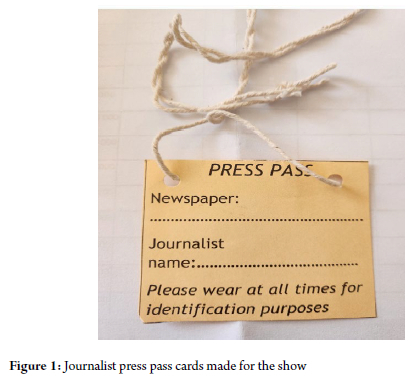
The researchers first met with the learners the day before the performance to introduce themselves and gauge the learners' knowledge of local history. During the first meeting, an exercise concerning prior knowledge was conducted using basic questions about what the learners knew about the history of anti-Bantu Education school protests in Makhanda. The YouTube archival school protest videos (AP Archive, 2015a) were used to start the conversation. Questions allow the teacher to gauge learners' prior knowledge, and social science subjects like history are designed to "train learners also to ask questions" (DBE, 2011:8). The exercise also helped learners familiarise themselves with the content to be explored in the play. It was at this meeting that we (the authors) worked with the learners to create the journalist characters and filled out the enrolment card shown in the image below.
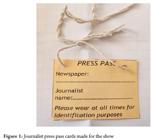
On the day of the play, the learners arrived in role, already wearing their journalist access cards around their necks. They watched the show; afterwards, PJ Hellemann facilitated a discussion between the 'journalists' and the performers, who remained in character for the forum theatre session. Forum theatre is a theatre technique pioneered by Augusto Boal, a Brazilian theatre practitioner who conceptualised the Theatre of the Oppressed games for actors and non-actors. Forum theatre allows audience members to interact with performers through various games (Boal, 1992). Performers can use the interrogation game to interact with the audience. Accordingly, in the interrogation game, each performer has an opportunity to sit before the audience and answer their questions (Boal, 1992:227). The interrogation questioning style follows that of a court proceeding, and the actors can be asked questions "about what they think of the other characters, what they think about the events in the play, anything" to do with the content covered in the play (Boal, 1992:227).
The questioning style was adapted to be more journalistic by introducing ourselves (the authors) and the fictional newspaper outlet we worked for, which helped remind the learners of their role as journalists witnessing the event. This Q&A lasted 15 minutes and followed the 45-minute play. The audience's questions and the performers' responses were noted. This session aimed to have learners witness events from the past through multiple points of view, specifically the school boycotts in Makhanda, and how they impacted the lives of young learners during and after those events. The Q&A session particularly allowed learners to ask questions about events in the past, based on the evidence presented to them through the play and the local history discussions held at the school the previous day.
The learners recognised that they had not received any formal training in writing a scene analysis; therefore, a post-production lesson was conducted with them. The lesson served to introduce the learners to the performers and give them an opportunity to ask the performers and the production team questions about the play. Data was collected through a scene reflection write-up, which formed part of the post-performance teaching and learning activity.
Ethical considerations
The production and research team applied for ethical clearance through the Education Faculty Research Ethics Committee (EF-REC) in 2024 as part of the larger research project, 'Robbed of a Childhood', funded under the National Research Foundation Thuthuka Post-PhD Track grant. In the ethics application, the authors requested permission to conduct research with Andrew Moyake Grade 9 learners, in consultation with the DBE and the school principal. Both the school, DBE, and the learners gave their consent to participate in the research on the condition that no pictures or names of the learners would be used in publications or presentations, thus ensuring the confidentiality of the participants. As such, all the data collected and presented here have no identifying markers, such as names or pictures, that allow for facial recognition. Participants are referred to using synonyms that start with the Learner, then assign an alphabet after the prefix. EF-REC approved the ethics application listed under the following number: 2024-8026-8875.
Data presentation
The data in the current study are analysed thematically, with the researchers organising them into themes derived from Bertram's theory explored earlier in the paper. According to Kushnir (2025), thematic analysis is deductive in nature, as it allows the researcher to identify themes from patterns in the data, giving these patterns meaning through organising concepts from theory. The concepts drawn from come from a mixture of Bertram's (2020) take on relocation and de-location of knowledge, and Mpofu and Steyn's notion of writing beyond a single story. Thematic analysis is "a method of systematically identifying, organising, and offering insight into patterns of meaning (themes) across a dataset" (Clarke & Braun, 2012:2). The responses from the scene reflection write-up form the dataset. Through a review of these responses, with patterns drawn from theory, it can be identified what is common in how learners understand and talk about past events. Before delving into the discussion, the dataset below is presented in two interaction moments: the preshow interaction and the post-show activity.
Pre-show meeting: Learners' prior knowledge of Bantu Education and youth protests in Makhanda
On 30 July 2025, a day before the performance of A Childhood in Chalk (2025), the morning was spent visiting the group of Grade 9 learners from Andrew Moyake School of Excellence. The visit served two purposes: to get a sense of their history and prior knowledge, and to lead them in a theatre-based activity that enrolled them as journalists preparing to report on an event they witnessed. Shing and Brod (2016) define prior knowledge as a psychological construct that explains the relationship between memory schemas and the processes of consolidating and retrieving information. This process is recognised in CAPS as a legitimate way to assess what learners already know before learning new material. CAPS, as stated in the DBE (2011), encourages teachers to ask the who/where/what/why/show/how questions to assess what learners already know informally, their perceptions and concerns on the topic the teacher is exploring. By asking these questions, the teacher creates learning conditions in which new information can be "integrated into the individual's existing knowledge structures" (Shing & Brod, 2016:154). Therefore, since the learners were in Grade 9, they had some prior historical knowledge of apartheid South Africa; however, it was necessary to find out how much they knew.
It was in this exploratory visit that we (the authors) learnt that indeed the learners have some basic knowledge of oppressive apartheid laws like Bantu Education from interactions with peers and family members. However, the learners had not covered the topic formally in the previous grade (Grade 8), as shown in Figure 3 below.
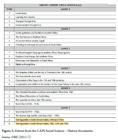
Therefore, it was understandable that the learners were not familiar with events like the TRC. However, they knew about Bantu Education from watching movies like Sarafina! where they informally learnt about the major anti-Bantu Education youth protest that took place on 16 June in Soweto in 1976. Hence, the learners also knew about the image of Hector Peterson explained earlier. However, they had neither heard of nor learned about anti-Bantu Education youth protests in Makhanda.
The visit and the play, therefore, were timely, as they preceded the teaching of Topics 3 and 4 highlighted in the image above. The learners' responses gave a sense of their existing knowledge of the events, thereby solidifying why the play was a fitting intervention strategy for educating Grade 9 learners about the history of the Makhanda protests. This encounter affirmed what we already had a sense of, that there is not much known or shared in the curriculum about the events of school protests in Makhanda.
As mentioned before, for this study, it was decided to enrol the learners as journalists, because journalists are one of the key actors that Bertram (2020) identified as agents that influence the de-location and relocation processes of knowledge construction. We (the authors) talked to the learners about their responsibilities as journalists when reporting on the events of 14 May 1980. They were, however, provided with predetermined questions that served as guidelines for writing their report. As shown in the image, the learners had a fictional journalist access card; they had to use that card to come up with a fictional name and choose a real or fictional media house they work for. These choices were made in class, and each student had a chance to introduce themselves using their fictional names and workplace.
Post-show scene analysis questions
On the performance day, learners received a two-page scene-response leaflet to encourage journalistic note-taking. The scene response had nine questions, divided into three categories. The first set of questions pertained to the journalist's research; the second elicited the journalist's response to a specific scene of their choice in the play; and lastly, the questions probed for the journalist's overall reflections.
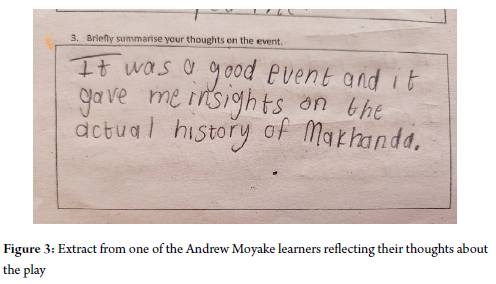
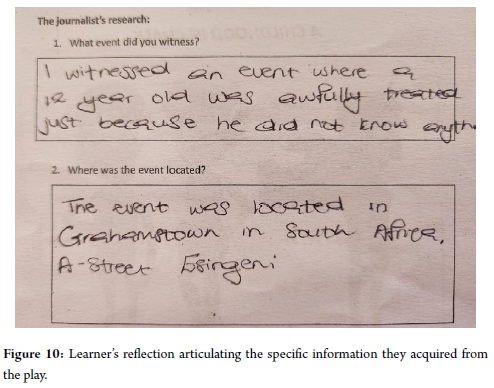
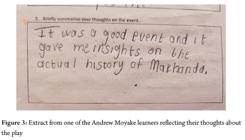
The preceding paragraphs articulate and summarise the responses to the questions as listed in the scene response leaflet. The first question asked the learners/journalists to state the event they had witnessed in the play. Their responses ranged from stating that they witnessed the anti-Bantu Education protests in 1980, to talking about witnessing Mr Jola's death (the character based on Mr Alfred Blaai Soya, who died during the protest in 1980). Among other responses, the learners noted that the protests were about fighting for education and that school learners were at the centre of these protests during the apartheid era. Overall, the overarching response to this question was that they had witnessed the history of Makhanda and Bantu Education and the fight against unfair laws, thus, gaining insight, as noted in the image below.
When asked "who were the people of this event?", a question that was intended to interrogate the learners' ability to identify key role players and those who were most impacted by the protests, the responses identified the learners from Andrew Moyake and Nathaniel Nyaluza and members of the concerned parents' group, the Peacemakers, as key players in the event. Question three probed the learners' ability to engage with the production's metaphorical staging of violence and trauma. The learners were not only able to identify the material use of the tins, however, they were able to identify their representational use on stage, for example, the use of the tins to show explosions, to portray the violent stoning and explosions that took place, alongside symbolising telephones used for communication inside prisons.
A notable comment came from a student who identified that "the way the tins were thrown around, in random patterns, showed the unpredictability of violence". This comment is a sophisticated interpretation of the use of the tins in staging the violence of the student protests and affirms the learners' ability in deductive reasoning.
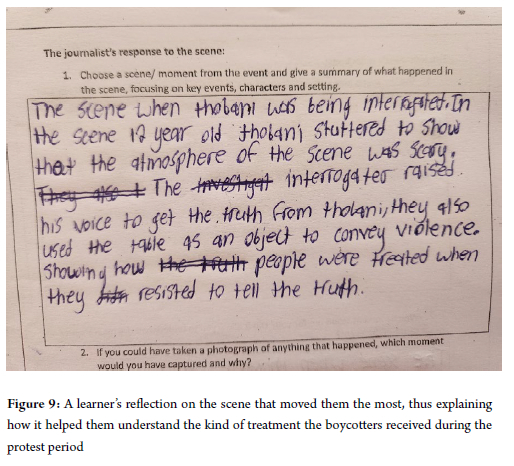
The second set of questions asked the journalists to articulate their responses to the event. They were asked to choose a scene or moment and summarise what they saw. This set of questions encouraged learners to explain their reasoning for selecting the scenes. The dominant responses reflected that the scenes that were central to the learners' understanding were the moment Tony threw the stone that killed Mr Jola. The learners noted all the instances of staged protest action; one can assume it was due to the energised singing and toyi-toyi (high-kneed, foot stomping protest dance and chant) movements that represented the learners' struggle. The learners identified the moment when the peacemakers spoke to one another about their concerns for their children's safety, alongside the moments when Tony's mother called him into the house from the street, pleading with him to stop his involvement in the protests.
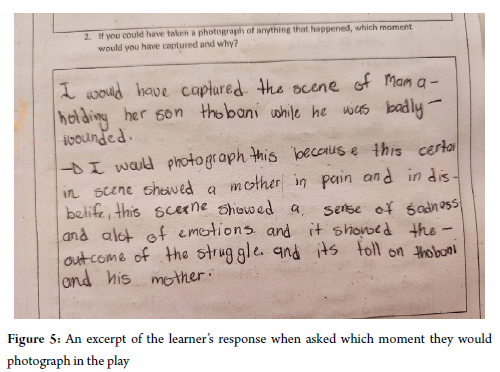
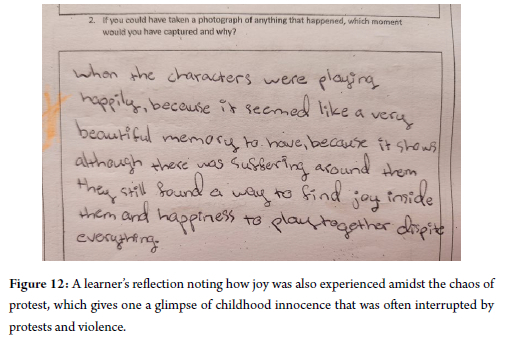
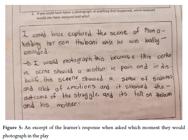
There were many other instances that the learners said they would have taken a photograph of, yet the dominant responses were that they would take a photograph of the student protests and the death of Mr Jola. There was also a notable response from one student, who said they would have taken a photograph of the characters playing happily to highlight that even joy existed in hard times.
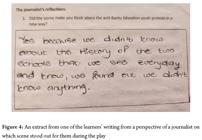
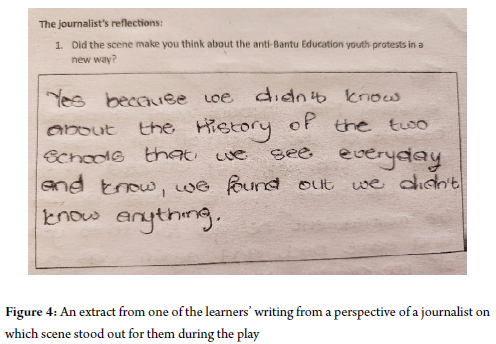
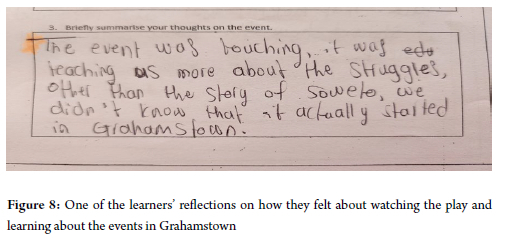
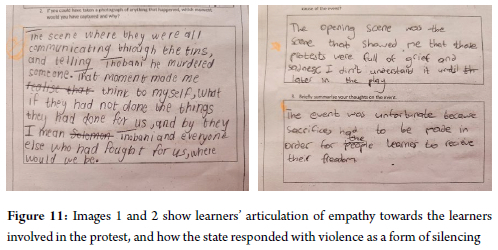
The 'journalists' identified that the production had encouraged new ways of thinking about the protest action of the 1980s. As seen in the image above, they did not know about Andrew Moyake and the Nyaluza school children's involvement in the protests, and because they did not know, the new information inspired most learners to learn more about what had happened on their school grounds. In addition, the learners reflected on new ways of thinking about the emotional turmoil faced by both parents and school children, identifying the major sacrifices they had made to secure liberation from Bantu Education.
The moment that stood out to the 'journalists' was the death of Mr Jola. It is important to note that the death was staged in a protest sequence that culminated in one character, Tony, striking Mr Jola with a tin, killing him instantly. This was a brief moment in the context of the 45-minute production; as a result of this, it is believed that the response, "Mr Jola's death", could be understood as a way to signal to all the events that ensued after his death, in a sense marking the consequences of the protest action of 14 May 1980. The other moments that stood out reaffirm the significance of what the learners identified for themselves earlier, such as Tony's mother's pleas for Tony to stop his involvement in the protest, the police arresting the learners, and the naming of victims during Tony's mother's TRC testimony.
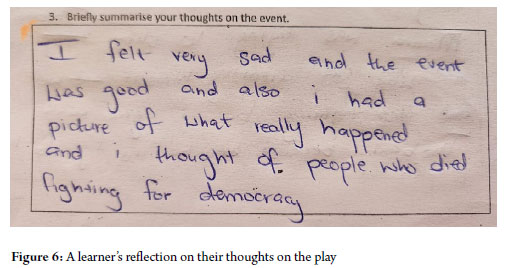
The general response shown in Figure 6 summarises their thoughts on the event, which centred on the learners. The learners noted that they connected with the event's high emotional intensity, felt immersed in the action, and found it interesting to learn about Makhanda. The learners were, however, saddened by the event, yet still inspired to learn more about the history of Makhanda.
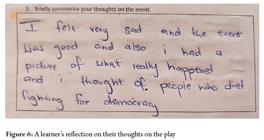
Data analysis: Discussion and themes
This section draws on themes and concepts from decolonial theory and the pedagogic device. For the pedagogical device, data on participants' relocation experiences were examined, noting how informative and exciting it was to learn about the protest events that occurred outside their school.
Theme 1: Relocating and reclaiming a forgotten youth protest story through 'A Childhood in Chalk' (2025) production
The nature of the relocation process lies in recontextualising content by making choices about how it is "selected and sequenced into curriculum documents or textbooks" (Bertram, 2020:120). As established earlier, there is no specific selection or sequencing of Bantu Education in CAPS, however, it is only briefly articulated in the textbooks reviewed by Seroto (2018) and Muthiewana (2020). Moreover, there is no mention of using local anti-Bantu Education stories as additional knowledge sources to support the broader anti-Bantu Education youth protests in South Africa. This means local stories continue to be excluded from CAPS and classrooms. Therefore, given that learners' prior knowledge served well in establishing this, it is important to relocate, reclaim, and recover local historical moments, such as the protest events of 1975 to the 1980s, in Makhanda. The play became a tool for relocating, reclaiming, and recontextualising the forgotten Makhanda anti-Bantu Education protests.
From the data, one can see that the play indeed allowed learners to consistently transfer knowledge from the play to historical/political contexts by zooming in on the real-life stories of youth involved in the anti-Bantu Education protests. As O'Toole (2002) explains, drama often allows the audience to experience the event; although fictional, they often find the information presented to them relatable. This moment of connecting the staged events in the play with the historical context of youth protest became a learning moment. During the 1970s and 1980s, learner enrolment at schools fluctuated alongside issues of underqualified teachers (Nishino, 1999:8). Moreover, according to Roodt (2005:234), there was an increase in violence between the learners and the police; the decade was characterised by "cycles of teargas, gunshots, barricades, riot police and funerals" through the play, the learners were able to get a sense of the real-life events that took place in this decade. Through props, sounds, videos, and lights, learners were immersed in the world of the Makhanda youth protests.
Moreover, through the play, learners acquired specific knowledge of their school and the street on which it is located. As seen in the response in the image above, most learners did not know that the street and their school hold a rich history of youth protests. As noted in the literature review, Nishino (1999:21) mentioned how learners from Andrew Moyakhe School located in A Street "stoned a Peacemaker group member on school grounds", Alfred Soya. This led to the arrest of 23 learners from Andrew Moyakhe School and Nathaniel Nyaluza High School. The play staged these events and their consequences. Throughout the play, the learners gained knowledge they could transfer to their classroom context in Term 4, when they are learning about turning points in South African history. Andersen (2004) affirms that this transfer of knowledge between the drama domain and the school context often helps mediate what the learners did not know and what they now know. As one of the learners noted, in the scene response, the play made them think about the anti-Bantu Education youth protests and how the Andrew Moyakhe School learners and Nyaluza High School learners played a role in fighting for freedom. As Sallis (2007) further argues, the strength of using drama productions as learning tools lies in their ability to facilitate the acquisition of new knowledge.
Although the production is not a textbook or a curriculum document, it became a tool that enabled us to show that local stories should be selected for inclusion in the curriculum to conscientize learners about their local history. In its full sense, recontextualising often occurs in a formal setting such as the MTT (Maluleke, 2021). Through the production, it was shown that this process can start informally in settings such as staged historical dramas. As Maluleke (2021) further adds, indeed, knowledge is not always produced in formal fields of production, but can also start in pedagogic practices that recontextualise forgotten histories. Through this engagement, the learners also developed historical consciousness by being immersed in the world of the performers, as if they were experiencing the youth protests live.
Overall, by selecting this local Makhanda story, learners were made aware of other youth protest stories beyond the widely accepted Soweto Uprising as the only major anti-Bantu Education youth protest. The learners also noted how they took note of the victims' names that were recited in the last scene, thus, expanding their knowledge of various anti-Bantu Education youth protest activists and learners beyond the well-known Hector Peterson, who died during the Soweto Uprising on 16 June 1976. As one of the learners reflected, "… one of my favourite moments was when the victims' names were called at the end of the production". This rehumanised the forgotten victims of the struggle, who were mostly children. Accordingly, this restaging and remembering of forgotten histories and activists is a rehumanising process (Ndlovu-Gatsheni & Ndlovu, 2021). The hope is that more stories like this one can be shared in schools as a starting point, indicating to the MTT that there is a need for better selection and sequencing of history content drawn from local stories.
Theme 2: Contextualising as de-locating local anti-Bantu Education youth protests knowledge through theatre
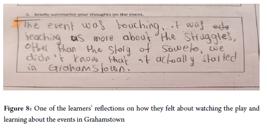
Given that the teaching of local histories is not explicitly articulated in CAPS, it is essential that theatre productions, such as the one explored in this study, serve as sites where knowledge is constructed within a specific discourse (Bertram, 2020). Here, the Childhood in Chalk T-i-E event as a specific learning site was located. The audience, in this case, the Grade 9 learners, could construct and acquire knowledge of local history, as seen in the image above, through the two interactive moments had with them. According to Bertram (2020), learning history involves engaging with concepts of space, place, and time. The play offered the learners this content by clearly stating the place the event took place, Esingeni/A-street, the space, which was in a multiracial township in Makhanda, and the 10-year period from 1975-1985, as one of them noted in the figure below. Other than learning about Bantu Education, the learners also acquired history knowledge on the TRC, how the state enacted violence on Black people during apartheid and key events such as the state of emergency. All this information or knowledge was new to the learners, as they had expressed in the prior learning workshop that they were not familiar with these key historical events.
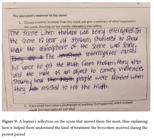
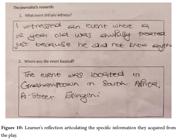
The learners were taken from a basic level of prior knowledge to an adequate level of knowledge about Bantu Education. The data shows that the learners were able to better understand the impact and effect of Bantu Education on Africans by unpacking themes of violence, sacrifices and what apartheid meant. It was in the forum theatre-inspired Q&A session that the learners asked more questions for clarity, thus showing that they are conceptually and emotionally engaged in the learning process. According to Bird and Donelan (2020:220), drama events that have interactive activities give the audience a chance to ask questions and make meaning, because they can "interrogate and reflect on the world of the 'other' as well as their own 'moral stance' and beliefs". As seen in the data presented, the learners were not only able to learn about the effects of Bantu Education, but could also understand the complexities of being involved in the struggle for better education and the cost thereof. According to Nishino (1999), by 1985, the learners expressed a loss of direction and frustration with an education system that would not change. This time, however, the students redirected their attention to the state system, spending more time forming activist groups that took them further from their families, causing divisions between parents and children.
One of the key history skills intermediate learners need to learn is to see something that happened in the past from more than one point of view. It is believed that the play facilitated the exploration of this skill, especially when learners wrote their scene responses. Some empathised with Tony, while others thought Tony was causing trouble for his mother. The learner, in the scene responses, was able to identify the impact the protest action had on the parents through the inclusion of the Peacemaker group, the concerned parents.
The theatre space became a classroom space, where knowledge was acquired. As Bertram (2020) states, knowledge can be created across multiple fields of production, and in this case, the theatre space is one such field. As one learner reflected in their journalist report, "It was amazing to learn about Makhanda… the event was eye-opening". Their reflection is a testament to the power of theatre as a field of production. The event gave learners the opportunity to learn outside the conventional classroom. They still had the opportunity to ask questions when they did not understand something. Through this, they developed a language to conceptualise and contextualise Bantu Education in Makhanda, thus no longer viewing it as an abstract concept or event that only took place in Soweto, countering/contributing to Mutheiwana's analysis of the textbooks. Accordingly, Bertram (2020) acknowledges that de-location is also about challenging the social order of how knowledge is produced or acquired (Bertram, 2020). Therefore, A Childhood in Chalk (2025) became a legitimate space for knowledge production, where learners gained a better understanding of the enacted Bantu Education law and of apartheid as an oppressive system.
Mutheiwana (2020) notes that Bantu Education appears in the textbook, but primarily as a social science concept that provides learners with some conceptual knowledge and understanding of the NP, which operated through various oppressive laws and impositions.
Theme 3: Tony's character as a catalyst for collective storying
As mentioned before, the Makhanda youth protest forms part of the larger youth protest stories in South Africa. Therefore, it is essential that these narratives continue to be written. As Mphofu and Steyn (2001) argue, collective storytelling is a tool for humanising Africans. This is because collective storytelling challenges colonial stereotypes that portray Africans as a problem (Mpofu & Steyn, 2001). Therefore, showing the youth protest from a Makhanda context helped learners see the connections between this event and the one in Soweto in 1976. Movements such as the anti-Bantu Education revolts often carry associations with Black consciousness and Black identity. As Ndlovu-Gatsheni and Ndlovu (2021) argue, Black people often carry the 'problematic state' because anytime they rise against oppression, coloniality uses more force to silence them, thus posing them as rebellious. The data revealed two views of Tony and his comrades.
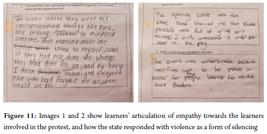
Therefore, this way of seeing the Black youth dehumanises them, and this is a "monopolised view of what it means to be human by the West" (Ndlovu-Gatsheni & Ndlovu, 2021:28). One reflection, however, stands out as particularly humanising the learners, as they reflect on the joy the school learners had before their lives were interrupted, as seen in the figure below.
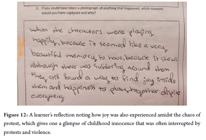
It was interesting to see that most of the learners saw Tony beyond the 'troubled teenager' lens, as they tended to reflect on his challenges, how the other learners in that period also faced similar challenges, and their families had to navigate those. They tended to reflect from an empathetic view, as shown in the image above, thus humanising Tony's experience. Hellemann and Heshu (2024) argue that emotions often arise in historical dramas and events, such as re-enactments, because they elicit responses that contribute to the development of historical empathy. However, not all the learners saw Tony's actions as heroic. Still, rather as a child who was causing his mother stress, when they asked him about his actions in the Q&A hot seating interaction, both the young and old Tony were able to provide clarity on why the struggle was more important than maintaining good family relations. Barone (2002) noted a similar response in their drama production, in which the students initially saw the young schoolchildren in a negative, stereotypical way, but then had the chance to challenge their own perceptions. As affirmed by Bird and Donelan (2020:226), ethno-graphic productions do evoke emotions in the audience, even more so when the audience is given an opportunity to ask the performers questions because they gain "access to the character's thinking". And through this 'thinking', the audience gains empathy and allows themselves the gift to imagine different perspectives.
Conclusion
Having noted the gaps that exist in the curriculum, those still being worked through by MTT and those noted by Seroto (2018) and Mutheiwana (2020), the production A Childhood in Chalk (2025) contributes towards MTT's goals of strengthening content using D-i-E intervention. Therefore, this intervention, the D-i-E event, aimed to bridge the knowledge gap about the events, ensuring that, alongside the Soweto Uprisings, these learners were also learning about their local history and its impact on their community. The current study showed how useful this was, as evidenced by the scene's response, reflections, and emerging themes, indicating that learners were able to learn in both the relocation and de-location phases. Through 'witnessing' the event as journalists and engaging in the phases from pre-production to the post-show forum theatre-inspired Q&A, the learning outcomes outlined in the History CAPS curriculum, were achieved. Consequently, the learners could view historical events from multiple perspectives, those of parents and learners. It is proposed that theatre productions with local historical content be integrated into the school curriculum, making context-based productions a pedagogical tool that enhances history education in South Africa.
References
-
Andersen, C 2004. Learning in 'as-if' worlds: Cognition in drama in education. Theory Into Practice, 43(4):281-286. https://doi.org/10.1207/s15430421tip4304_8
» https://doi.org/10.1207/s15430421tip4304_8 -
AP Archive 2015a. Synd 19 05 80 fatality in Grahamstown protests [Video]. YouTube, 24 July 2015. https://www.youtube.com/watch?v=G_El82a1gZs
» https://www.youtube.com/watch?v=G_El82a1gZs -
AP Archive 2015b. Unused 29 7 80 funeral in Grahamstown, South Africa [Video]. YouTube, 24 July 2015. https://www.youtube.com/watch?v=vq4BDBHdE2A
» https://www.youtube.com/watch?v=vq4BDBHdE2A - Boal, A. (2002). Games for actors and non-actors (2nd ed.). Routledge.
-
Barone, T 2002. From genre blurring to audience blending: Reflections on the field emanating from an ethnodrama. Anthropology & Education Quarterly, 33(2):255-267. https://doi.org/10.1525/aeq.2002.33.2.255
» https://doi.org/10.1525/aeq.2002.33.2.255 -
Bertram, C 2020. Remaking history: The pedagogic device and shifting discourses in the South African school history curriculum. Yesterday and Today, 23:1-29. https://doi.org/10.17159/2223-0386/2020/n23a1
» https://doi.org/10.17159/2223-0386/2020/n23a1 - Bernstein, B, Solomon, J 1999. Pedagogy, identity and the construction of a theory of symbolic control: Basil Bernstein questioned by Joseph Solomon. British Journal of Sociology of Education, 20:265-279.
- Bertram, C and Christiansen, I 2014. Understanding research: An introduction to reading research. Van Schaik.
-
Bird, J and Donelan, K 2020. An interactive ethnographic performance: Using research-based theatre and drama pedagogy to enhance meaning making. Research in Drama Education: The Journal of Applied Theatre and Performance, 25(2):218-235. https://doi.org/10.1080/13569783.2020.1722598
» https://doi.org/10.1080/13569783.2020.1722598 - Boal, A 2002. Games for actors and non-actors (2nd ed.). Routledge.
- Booyse, JJ 2011. Education provisioning during the period of National Party rule. In: JJ Booyse, CS le Roux, J Seroto and CC Wolhuter (eds.). A history of schooling in South Africa: Method and context (pp. 1-12). ABC Press.
-
Christie, P and Collins, C 1982. Bantu education: Apartheid ideology or labour reproduction? Comparative Education, 18(1):59-75. https://doi.org/10.1080/0305006820180107
» https://doi.org/10.1080/0305006820180107 - Clarke, V and Braun, V 2012. Thematic analysis. In: NM Seel (ed.). Encyclopedia of critical psychology (pp. 1947-1952). Springer.
-
Dei, GJ S, 2018. "Black Like Me": Reframing Blackness for Decolonial Politics. Educational Studies, 54(2), 117-142. https://doi.org/10.1080/00131946.2018.1427586
» https://doi.org/10.1080/00131946.2018.1427586 - Department of Basic Education 2011. Curriculum and assessment policy statement (CAPS): Grades 7-9 social sciences. Government Printing Works.
-
Firing, K, Thorkelsdóttir, RB, & Chemi, T 2022. The Theatre of War: leader development between personal identity and person-in-role. Culture and Organization, 28(3-4), 330-344. https://doi.org/10.1080/14759551.2022.2028146
» https://doi.org/10.1080/14759551.2022.2028146 -
Hellemann, PC 2022. Towards a problem-posing pedagogy: Using teacher-in-role in a special needs classroom, South African Journal of Childhood Education, 12(1):1205. https://doi.org/10.4102/sajce.v12i1.1205
» https://doi.org/10.4102/sajce.v12i1.1205 -
Hellemann, PC and Heshu, M 2024. Beyond reenactment: Exploring the Battle at Egazini with grade 10 history learners using applied theatre. Yesterday and Today, 32(1), 39-75. https://doi.org/10.17159/2223-0386/2024/n32a3
» https://doi.org/10.17159/2223-0386/2024/n32a3 - Hyslop, J 1986. Food, authority and politics: Student riots in South African schools, 1945-1976. University of the Witwatersrand. African Studies Institute.
-
Kushnir, I 2025. Thematic analysis in the area of education: A practical guide. Cogent Education, 12(1):2471645. https://doi.org/10.1080/2331186X.2025.2471645
» https://doi.org/10.1080/2331186X.2025.2471645 -
Maedza, P 2019. Sarafina!: The children's revolution from Soweto to Broadway. South African Theatre Journal, 32(3):235-256. https://doi.org/10.1080/10137548.2018.1544503
» https://doi.org/10.1080/10137548.2018.1544503 -
Maluleka, P 2021. Fallism as decoloniality: Towards a decolonised school history curriculum in post-colonial-apartheid South Africa. Yesterday and Today, 26:68-91. https://doi.org/10.17159/2223-0386/2021/n26a4
» https://doi.org/10.17159/2223-0386/2021/n26a4 -
Mermikides, A 2013. Brilliant theatre-making at the National: Devising, collective creation and the director's brand. Studies in Theatre and Performance, 33(2):153-167. https://doi.org/10.1386/stap.33.2.153_1
» https://doi.org/10.1386/stap.33.2.153_1 -
Morris, G 2002. Reconsidering theatre-making in South Africa: A study of theatre in education in Cape schools. Theatre Research International, 27(3):289-305. doi:10.1017/S0307883302000354
» https://doi.org/10.1017/S0307883302000354 - Steyn, M, and Mpofu, W 2021. The trouble with the human. In: M Steyn and W Mpofu (eds.), Decolonising the mind: Reflections from Africa on difference and oppression (pp. 1-24). Wits University Press.
- Mutheiwana, P 2020. A cultural-historical analysis of Grade 9 history curriculum and its pedagogical resources for learners' conceptual development. Master's thesis, University of Cape Town.
- Ndlovu-Gatsheni, SJ and Ndlovu, PP 2021. The invention of blackness on a world scale. In: M Steyn and W Mpofu (eds.), Decolonising the mind: Reflections from Africa on difference and oppression (pp. 25-45). Wits University Press.
- Nishino, R 1999. The dynamics of school protests: Grahamstown school boycotts c. 1984-87. Grahamstown.
- Nishino, R 2002. An oral history project: Recording recollections of the school boycotts c. 1984 to 1987 in Grahamstown, South Africa. Australasian Review of African Studies, 24(1):20-26.
-
O'Toole, J 2002. Drama: The productive pedagogy. Melbourne Studies in Education, 43(2):39-52. http://hdl.handle.net/10072/6601
» http://hdl.handle.net/10072/6601 -
Perry, M 2010. Theatre as a place of learning: The forces and affects of devised theatre processes in education. Doctoral dissertation, University of British Columbia. https://open.library.ubc.ca
» https://open.library.ubc.ca - Roodt, MJ 2005. Rhodes University From Apartheid Vastrap to African Swing. African Sociological Review/Revue Africaine de Sociologie, 9(1), pp.234-239.
- Roux, A and Helliker, K 1986. Voices from Rini. Rhodes University, Institute of Social and Economic Research.
-
Ruiz, I and Baca, D 2017. Decolonial options and writing studies. Composition Studies, 45(2):226-229. https://www.jstor.org/stable/26402796
» https://www.jstor.org/stable/26402796 -
Sallis, R 2007. From data to drama-The construction of an ethnographic performance. NJ, 31(2):7-20. https://doi.org/10.1080/14452294.2007.11649514
» https://doi.org/10.1080/14452294.2007.11649514 -
Seroto, J 2018. Analysing the presentation of the 1976 Soweto uprising in Grade 9 history textbooks. Africa Education Review, 15(4):1-19. https://doi.org/10.1080/18146627.2017.1358066
» https://doi.org/10.1080/18146627.2017.1358066 -
Shing, YL and Brod, G 2016. Effects of prior knowledge on memory: Implications for education. Mind, Brain, and Education, 10(3):153-161. https://doi.org/10.1111/mbe.12110
» https://doi.org/10.1111/mbe.12110 - Thobejane, TD 2013. History of apartheid education and the problems of reconstruction in South Africa. Sociology Study, 3(1):1-12.
- National Archive (NA), Pretoria, Department of Education (DoE), Vol.10, Reference 8/1/3/452: Letter, K Lewis (Director General) / P Dlamini (Teacher, Springs College), 12 June 1960.
-
Truth Commision Special Report, South African Broadcasting Commission, Truth and Reconciliation Commission (TRC) of South Africa Report (1998), Vol. 3, Chapter 2, 29 October 1998. Available at https://sabctrc.saha.org.za/reports.htm. Accessed 24 April 2025
» https://sabctrc.saha.org.za/reports.htm - Wilsworth, MJ 1979. Transcending the culture of poverty in a black South African township. Master's thesis, Rhodes University.
-
Zono, S 2023. A new start for a new school in the new year: The story of the Andrew Moyake School of Excellence, Grocott's Mail, January. Available at https://grocotts.ru.ac.za/2023/01/23/a-new-start-for-a-new-school-in-the-new-year/. Accessed on 24 April 2024.
» https://grocotts.ru.ac.za/2023/01/23/a-new-start-for-a-new-school-in-the-new-year/
2 https://grocotts.ru.ac.za/2023/01/23/a-new-start-for-a-new-school-in-the-new-year/