Prompting change: Reflections on third-year archaeology students use of generative AI at a distance university
Abstract
Generative AI (GenAI) has undeniably become part of a continuum of everyday use with apps, chatbots and curated content to optimise online experiences. In higher education, AI is reshaping teaching pedagogies and holds the potential to augment learning and provide personalised learning experiences. However, an ongoing challenge is getting students to make the connection that GenAI is a tool to support learning, rather than a crutch to replace thinking processes. This paper draws on Kolb's experiential learning theory to assess personal experiences of teaching undergraduate archaeology to students in the era of GenAI. Using reflection as a method with Driscoll's three-step reflection cycle, this reflection provides insight into the pedagogical implications of over-reliance on GenAI tools. Reflection further serves as an (introspective) didactic tool for assessing teaching strategies for scaffolding responsible use of GenAI. Based on the nuanced insights, the reflection suggests that a prompt, copy and paste approach characterises student use of these tools. The pedagogical challenges for fostering the suite of critical thinking skills pertinent in archaeology and history education are also highlighted.
Archaeology; distance learning; generative AI; over reliance on AI; structured reflection; student use of AI
Introduction
In the context of Education 4.0 and Education 5.0 frameworks, there is increasing demand for educators to harness technology to enhance teaching and learning (Rane et al., 2024). Developing a suite of twenty-first century skills is a part of this and encompasses "computational thinking, technology and big data, communication and humanities, lifelong learning, and creativity" (Kuka et al., 2022:569). Integrated into this skillset is the AI ecosystem comprising generative artificial intelligence (GenAl), which is trained to generate content in response to a user prompt (Zewe, 2023).
Within higher education, the growing body of literature on GenAI and augmented learning highlights the potential for personalised learning (Mulaudzi & Hamilton, 2024), student feedback (Holdcroft, 2024), assessment design and practices (Khlaif et al., 2025), instructional strategies (Conrad & Hall, 2024), language learning (Creely, 2024), and curriculum design (Owoseni et al., 2024a). There are also prospects for automatic grading in African languages (Agyemang & Schlippe, 2024).
Integrating AI into higher education also shows promise for innovative student support, particularly for streamlining administrative processes for students with special education needs and disabilities (Coughlan & Iniesto, 2025). In addition, GenAI might also have potential for reducing loneliness by fulfilling social support roles (Crawford et al., 2024). Furthermore, the growth in Digital Humanities has provided new opportunities for humanistic disciplines to leverage AI to automate data extraction and enhance analysis and interpretation (Luhmann & Burghardt, 2022).
History-specific AI applications include CorDeep, a web-based deep-learning model trained for extracting visual elements from corpora (Büttner et al., 2022) and Ithaca, which augments epigraphic analysis of texts pertinent to ancient Greek history (Assael et al., 2022). Recently, Aeneas, described as a generative neural network, was introduced for contextualising Latin inscriptions (Assael et al., 2025). Together, these tools serve as historical research aids for restoring damaged or missing texts to enhance interpretability (Assael et al., 2022). In addition, educational applications such as Fabricus, integrate gamification activities to teach learners about encoding and annotating ancient Egyptian hieroglyphics (Kelly, 2021). Furthermore, Character.ai and Hello History, allow users to interact with deceased historical figures from Charles Darwin to René Descartes and Nelson Mandela, and hold potential for fostering student engagement that brings history to life (DaCosta, 2025, cf. Hutson & Ratican, 2023). Podcasts have additionally demonstrated positive outcomes for enhancing student learning beyond traditional history classrooms (Alegi, 2012).
From an archaeological perspective, engagement with digital technologies dates to the development of the earliest computers in the 1950s (Adigun et al., 2021; Bickler, 2021). Scholars at the intersection of computational archaeology began exploring the domains of artificial intelligence before the global proliferation of GenAI (Bickler, 2021; Tenzer et al., 2024). Some of the key areas of application include integrating machine learning and deep learning (including convolutional neural networks) to enhance archaeological prospecting, field research methods and remote sensing. To illustrate, ArchAIDE is an image recognition tool for optimising pottery analysis (Anichini, et al., 2021). Archaeoscape has also shown practical utility for site surveying in densely vegetated and inaccessible locations (Perron et al., 2024, cf. Gattiglia, 2025). In addition, the application of machine learning to remote sensing imaging data holds promise for optimising the detection of new sites, such as mound signatures in Pakistan's Cholistan Desert (Orengo et al., 2020). In a proof-of-concept application using early twentieth-century colonial maps, deep learning approaches demonstrate potential for automatically identifying and extracting geo-referenced data of archaeological features (Garcia-Molsosa et al., 2021). Furthermore, image recognition models trained on optical satellite data were used to identify early Iron Age Saka burial mounds of pre-Silk Road cultures in present-day Kazakhstan (Caspari & Crespo, 2019). In maritime archaeology, machine learning algorithms demonstrate utility for automating the detection and mapping of shipwrecks (Character et al., 2021). Additional applications include 3D modelling of underwater archaeological surveys and object detection (Drap et al., 2019). Digitisation of collections has also enhanced accessibility and preservation, with suggestions that leveraging digital tools in this way promotes democratisation of access (Taylor & Gibson, 2017).
Since OpenAI's official release of ChatGPT in 2022, the gaps in respect of what GenAI tools can do are rapidly closing. The evolving ecosystem of GenAI has spawned a host of other tools that can humanise text and automate academic literature review searches. These tools can also create a diverse range of new content across different formats including images, videos and audio (Ferrara, 2024).
However, the proliferation of GenAI is not just a higher education problem. Educators working in South Africa's basic education system are grappling with similar issues around the possibilities and risks. Key amongst this is how these tools might impact writing skills development in history classrooms (Brookbanks, 2023) and potentially erode computational knowledge of coding and robotics teachers (Tshidi & Dewa, 2024). While some educators have shared insights for classroom strategies to mitigate excessive use (Netshiungani, 2023), others have lamented the role of AI for the expanding digital divide (Mekhoe, 2023).
Generative AI, therefore, represents challenges across the education spectrum. The expanding corpus shows that while GenAI holds promise, it represents a proverbial double-edged sword. Some scholars have called for a balanced approach to the widespread integration of AI in higher education and closer scrutiny of the challenges (Al-Zahrani, 2024). Growing ethical concerns are emerging around the role of GenAI in disseminating deepfakes (Kietzmann et al., 2020; Ferrara, 2024) and the implications for academic integrity (Cotton et al., 2023). In addition, the role ofAI as a tool of "digital neocolonialism" (Zembylas, 2023: 29) that reinforces Eurocentric epistemologies is also being underscored. Furthermore, concerns have been expressed about algorithmic bias (Fui-Hoon Nah et al., 2023) and the pedagogical outcomes linked to excessive use (Zhao et al., 2024; Pitts et al., 2025).
It is within this milieu that nuanced insights from undergraduate archaeology teaching are used to reflect on the pedagogical implications of GenAI for archaeology and history education.
Positionality and reflective approach
I am a lecturer at a South African distance learning university, and since 2016, I have been teaching third-year archaeology modules at exit-level 7 on the National Qualifications Framework (NQF). In approaching this topic, my perspective on student use of GenAI is informed by the proliferation of the technology in higher education, the pervasiveness of AI in society more broadly, and institutional drivers for leveraging AI. It also includes personal observations gleaned from teaching notes on student use in third-year archaeology assessments.
Using reflection as a method, this paper explores micro-level, nuanced insights into teaching practice in the context of student use of generative AI. This methodological approach is underpinned by Kolb's experiential learning theory (Kolb, 1984). Here, learning is conceptualised as a continuous process where: "...ideas are not fixed and immutable elements of thought but are formed and re-formed through experience" (Kolb, 1984:26). My position also aligns with Moon's (2004:6) view that: "... all learning is experiential in one sense ... and reflection is itself a form of learning".
The concept of reflection is widely attributed to the work of Dewey who first defined it as the: "active, persistent and careful consideration of any belief or supposed form of knowledge in light of the grounds that support it" (Dewey, 1910:6). Since Dewey's seminal work, other scholars have expanded on the notion of reflection, however, there is no consensus definition, since it is understood and applied differently across professional contexts (Rogers, 2001; Clara, 2015; De la Croix & Veen, 2018; Marshall, 2019). In higher education, reflective practice refers to an active, cyclical process where tacit knowledge is articulated explicitly (Mohamed et al., 2022) to demonstrate new ways of thinking and doing (Ryan, 2012). Given these variations, this paper uses a working definition proposed by Rodgers and LaBoskey (2016). Here, reflection is conceptualised as being concerned with "transforming what we are already doing, first and foremost by becoming more aware of ourselves, others, and the world within which we live" (Rodgers & LaBoskey, 2016:101). This definition is preferred, because it provides a useful lens for exploring the permutations of teaching (archaeology) in the age of GenAI.
In this paper, the reflection is guided by Driscoll's three-step reflection cycle (Driscoll, 1994, 2007), originally conceptualised by Borton (1970). The rationale for utilising Driscoll's framework is based on its simplicity and ease of use. It is commonly used as a foundational threshold for novice reflective practitioners to develop reflection skills. A strength of Driscoll's also lies in its broad application across various disciplinary and professional contexts, including higher education. Driscoll's reflective cycle was also integrated in a case study published in November 2024, which evaluated Master's students use of GenAI in an essay assessment with a reflection component (Fisher et al., 2024).
However, the versatility of Driscoll's reflection has been criticised as a potential caveat that may produce superficial reflection (Edwards, 2017). To mitigate this, the described experience will be evaluated at a deeper level by interrogating each of Driscoll's guiding questions. Still, others have cautioned against adopting an overly prescriptive approach to reflection. Notably, De la Croix and Venn (2018:395) claim that preoccupation with rigidly following steps may produce "reflective zombies" with insights that lack depth.
In this paper, a reflective approach has several perceived strengths. Firstly, it provides an opportunity to explore the discipline and context-specific pedagogical implications of AI use. It further serves as an (introspective) didactic tool for assessing teaching strategies for scaffolding responsible use, which may inform teaching praxis around AI use. The insights from the reflection could potentially contribute towards fostering communities of practice around GenAI use in archaeology and history education.
Within this ambit, the core objectives of the reflection are to:
Describe and draw on module/course-level insights of student use of AI from teaching notes and personal observations of past marked assessments.
• Reflect on current teaching practice in terms of scaffolding responsible use of AI.
• Interpret personal observations and teaching experience within broader academic conversations of AI in higher education.
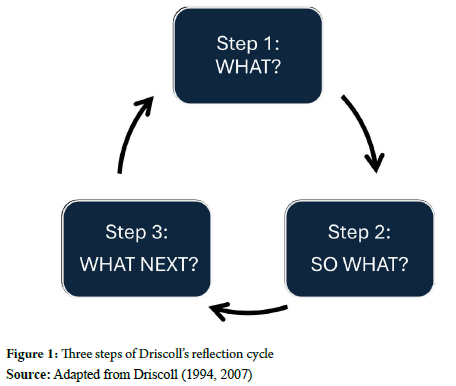
Each objective is aligned with one of the steps in Driscoll's reflective cycle which asks three basic questions from a personal experience: 'What?, 'So what?' and 'What next?'. This is illustrated in Figure 1.
In this paper, the discussion is structured thematically. The first question contextualises the experience with a focus on the pervasiveness of AI in routine activities. It also prompts for a detailed description of an event, which is addressed by situating the experience within a distance learning context. By describing institutional professional development initiatives and policy gaps, context-specific personal observations of student use of GenAI
are introduced. Together, this is mapped onto the first objective and is presented as Theme 1. Question two, 'So what?', requires analysis and interpretation. Here, the observations are framed around the pedagogical issue of over-reliance. This responds to the second objective presented under Theme 2. The final element in Driscoll's reflective cycle, 'What next?', aligns with the third objective. In this step, the broader implications of the experience are assessed along with potential action plans, which are presented under Theme 3.
Theme 1: What?
Artificial intelligence in everyday life
Artificial intelligence is pervasive and already integrated into everyday routines and interactions. There are AI-powered gadgets to monitor fitness, including music and video streaming platforms that provide personalised recommendations. On social media, content monitoring algorithms can also track preferences and actively target users to optimise their online experience. In essence, AI is in everything from household appliances to smart devices. Although it is ubiquitous, the technology is much broader than just chatbots and apps. The use of GenAI has evolved rapidly, arguably due to the combined influence of its ubiquity in mainstream society (Elliott, 2019), national priorities (Department of Communications and Digital Technologies, 2023) and integration into higher education (Zawacki-Richter et al., 2019).
The context specific factors that have shaped the observations and experience that form the basis for this reflection are presented in the following section.
Generative AI in the distance learning context: Lecturer readiness, institutional policy gaps and individual teaching strategies
In nearly ten years at the university, the institution has progressively moved away from a "paper-behind glass model" (Marais, 2022:64). With this approach, study material is provided in a downloadable PDF format with generally limited (real-time) online interaction between students and lecturers. At the university, the drive towards fully online delivery has taken place against a post-pandemic learning context, institutional targets, international best practices, and national imperatives. Online teaching toolkits have consequently evolved, and many lecturers have developed course sites into an interactive, collaborative learning space that includes:
• virtual classes (e.g., on MS Teams or integrated in a learning management system like Moodle's Big Blue Button or Blackboard's Collaborate),
• automated assessment marking and feedback,
• interactive H5P lesson content, infused with game-based learning (gamification) elements in course design,
• engaging videos created with tools such as Camtasia and
• analytics visualised on platforms such as PowerBI, to track student submissions and assist with early identification of at-risk students who may require targeted support.
• Increasingly, at this institution, professional development training initiatives on GenAI focus on developing effective prompting skills with 'AI Skillsfests', AI prompting Masterclasses' and 'Generative AI in Education Bootcamps' and more recently, 'Create your own AI agent '. These workshops often include show-and-tell elements for using GenAI to craft course outcomes, design assessments, develop draft lesson plans and produce chapter summaries. For larger courses, where enrolment may exceed 30 000 students, lecturers are also being trained on how to utilise chatbots to automate responses to common student queries.
The use of chatbots trained on course-specific knowledge has a two-fold goal: to reduce the administrative burden of responding to a high volume of e-mails and enhance student support (Popenici & Kerr, 2017). In addition, lecturers are also being equipped with basic 'AI detection skills'.
Building a level of AI literacy through training to boost readiness is at the core of these initiatives. In the literature on GenAI in higher education, the role of lecturer readiness and proficiency with AI tools is recognised as an important implementation strategy (Owoseni et al., 2024b). Furthermore, with redefined roles as "learning environment designers", Kuka et al., (2022:569) assert that developing familiarity with using different technologies is integral to providing an enhanced learning experience for students. This is premised on the notion that we can't teach what we don't know. As Kirschner et al., (2022) maintain, effective teaching extends beyond content knowledge, because educators "don't just need to understand ... but they should understand in several ways" (Kirschner et al., 2022:184).
The crux of this view is that educators can only guide students in using AI tools to support their learning once they are adept at using the technology themselves. While I (Jane Adigun) support this perspective, Maimela and Mbonde (2025) raise an important
consideration around the uneven adoption of AI in South African higher education institutions. At an institutional level, the authors identified resource limitations, a lack of uniform AI policy frameworks, technological scepticism and the digital divide as key structural barriers to AI adoption across South African universities (Maimela & Mbonde, 2025).
However, beyond targeted AI training for academic staff, institutional policy and explicit guidelines around AI use are still required to provide a cohesive implementation framework (Owoseni et al., 2024b; Maimela & Mbonde, 2025).
Although the university in question is in the final stages of adopting an overarching AI policy framework, there are currently no guidelines on acceptable use. Consequently, approaches vary because student guidelines around GenAI use are set by individual lecturers. As a result, some colleagues may have a zero-tolerance approach, while others may allow it for specific purposes.
Informal conversations with colleagues also reveal contextual insights around GenAI, which further emphasise the crucial role of institutional guidelines. This includes some scepticism around the technology, ethical concerns, fears of being replaced by AI teacher bots (Popenici & Kerr, 2017) and the implications of GenAI for graduateness. These concerns capture, albeit in very broad-brush strokes, some of the tensions around GenAI. The challenges are, however, not unique to the university. Similar concerns surrounding ethical implications and academic integrity have emerged from a systematic review undertaken from 2017 to 2023 of forty other institutions worldwide (Zhao et al., 2024).
In addition, just less than a year after ChatGPT's diffusion, slightly less than half of the top fifty-ranked universities globally had provided GenAI guidelines (Moorehouse et al., 2023); granted, institutions might have been caught on the back foot. In the existing literature, however, the absence of institutional policy and a lack of targeted educator training in AI are consistently identified as major barriers (Zhao et al., 2024).
A more recent study examining the global adoption of institutional AI policies and guidelines found that only six African institutions, including two from South Africa, published AI policy-related documents on their websites (Jin et al., 2025). Most importantly, these findings emphasise that challenges with AI policy development and implementation are ubiquitous across the global higher education landscape.
Returning to the university in question, with AI guidelines and a policy framework still being developed, one college set up an AI work group to engage on departmental issues pertinent to AI use. From these engagements, an informal AI self-disclosure instrument was created and freely circulated for dissemination at an internal tuition committee meeting in April 2024.
For context, "self-disclosure" as defined by Jourard (1971:19), refers to "...the act of making yourself manifest, showing yourself so others can perceive you". In an education context, it has been hypothesised as a useful pedagogical tool for creating learning environments that facilitate student engagement (Qin, 2022). While there are important ethical considerations when disclosing deeply personal information (Esjing, 2007), evidence suggests that self-disclosure may foster positive student-teacher interactions (Mazer et al., 2007).
In the case of the AI self-disclosure instrument referred to in this paper, it was originally conceptualised to assist lecturers in reviewing student work for potential breaches of academic integrity. The instrument was, therefore, considered to be multi-purpose because it:
• serves as a basic tool to encourage students to be open about their use of generative AI tools;
• provides lecturers with general insights into how students are using tools like ChatGPT and
• assists in avoiding punitive marking in instances where students self-disclose using Grammarly or Quillbot.
In terms of the archaeology case study under discussion, an adapted version of the AI self-disclosure has been used since June 2024 across both third-year courses. In the almost 18 months of its use, student uptake has been persistently low. It was observed that, for the most part, students tend to complete the form as a compliance exercise, possibly to satisfy lecturer expectations (Fisher et al., 2024). Oftentimes, it is signed by students who did not indicate any of the available options for GenAI use. Another subset of students also tends to under report actual use. This was inferred from self-disclosure forms where .AI grammar assistance was ticked, however, the AI report scores substantially exceeded Turnitin's 20 per cent false positive threshold. In these instances, a student's self-reported use of GenAI tools contradicted the Turnitin AI report. This phenomenon has also been reported in the literature (Fisher et al., 2024; Combrinck & Loubser, 2025). From the observations, it was inferred that the AI self-disclosure instrument, on its own, has limited utility for fostering self-disclosure and scaffolding responsible use.
An empirical study on the relationship between student self-reflection on AI use, lecturer grading decisions, and AI writing report scores provides useful insights for understanding the failure to self-disclose (Combrinck & Loubser, 2025). Based on their findings, Combrinck and Loubser (2025) suggest that transparent student disclosure may help lecturers make informed marking decisions and potentially scaffold responsible use. However, they also noted that not all students are forthcoming about exactly how they utilise GenAI. Interestingly, AI writing detection scores above 20 per cent and Turnitin's false positive threshold, were associated with an increased risk of over reliance and failure to disclose and self-reflect (Combrinck & Loubser, 2025).
The personal observations from the archaeology case study, to some extent, align with Combrinck and Loubser's (2025) empirical findings. This prompts bigger questions about how a failure to self-disclose reflects a growing pedagogical issue around AI over-reliance.
Prompt, copy and paste: Personal observations on student interactions with GenAI
Since the widespread use of GenAI tools, I (Jane Adigun) have observed that the third-year cohort I teach was primarily adopting what could be described as a 'prompt, copy and paste' approach. There is a general lack of critical evaluation of the generated output: it is simply copied and reproduced in its entirety. Students also frequently include meta-statements, generated by these tools, when completing written assessments. This is a glaringly obvious indicator that the information was taken verbatim from a GenAI source. To illustrate, some examples of these statements generated directly from ChatGPT are listed below:
"My knowledge is current up to June 2024, and I may not have information on developments after that date."
• "I don't have access to real-time data or updates. You may want to consult a current source."
• "I couldn't find a specific reference to that. You may want to consult your study guide or course materials for clarification."
• "I don't have access to the specific dataset mentioned, but I can provide general assistance based on the information you share."
• "CCP is not widely recognised as a standard acronym in mainstream archaeological literature."
Instances were also observed where students used AI tools to write their assignments along with fabricated sources. These references either include a URL link to an unrelated source or have a credible author linked to a fabricated article! In the literature, this phenomenon is AI confabulation or AI hallucinations (Zhai et al., 2024). Of concern is that some students seemingly regard GenAI as an authoritative voice, which scholars refer to as anthropomorphising AI (Owoseni et al., 2024b). It occurs when users start to view AI as real human beings, which might lead to reliance on GenAI tools as a primary source of information and answers.
The observations for a prompt, copy and paste approach broadly align with findings from an empirical study conducted by Stojanov et al. (2024). The authors investigated the dynamics of student interactions with ChatGPT and identified five different user profiles. These were categorised as "versatile low reliers", "all-rounders", "knowledge seekers", "pro-active learners" and "assignment delegators" (Stojanov et al., 2024: 4) The group designated assignment delegators routinely outsourced work to ChatGPT, tended to over rely on GenAI tools and were not critical of the output.
Stojanov et al. (2024) also highlighted that student reliance on GenAI tools is not uniform. It varies depending on individual levels of AI literacy and overall attitudes towards the technologies. Combrinck and Loubser (2025) share congruent views, noting that students struggling to grasp content knowledge might have academic challenges and lack the skills to use AI tools effectively or responsibly.
Nevertheless, for archaeology students using GenAI tools to complete entire assignments without verifying content authenticity, might well be symptomatic of an issue with over reliance.
Theme 2: So what?
A chatbot ate my brain: The negative consequences of an over-reliance on AI tools
Recently, Visser et al. (2025) presented a conceptual framework for understanding 'trust, distrust and reliance', in the context of AI. They define reliance as "a human decision or action that takes into consideration the decision or recommendation of an AI" (Visser et al., 2025:4). In other words, for the user, relying on AI outputs also involves the cognitive tasks of evaluating and reviewing for accuracy. Visser et al. (2025) further differentiate between the concepts of disuse and overtrust-terms widely used in automation and AI contexts.
Disuse refers to situations where a user does not rely on an AI output even when it may be potentially helpful to do so; it is simply not used. By contrast, over trust describes instances in which a user relies on AI in a situation where it is potentially wrong to do (Visser et al., 2025). The authors do not refer explicitly to the notion of 'over reliance', however, for the purpose of this paper, it is reasonable to think about over reliance on AI as a product of overtrust (Buçinca et al., 2021).
Over reliance refers to the disproportionate use of AI tools to the extent where AI generated content and recommendations are accepted without question (Pitts et al., 2025). The term is increasingly discussed in higher education scholarship, where excessive use of AI tools is linked to negative consequences for intellectual skills development (Chan & Hu, 2023).
In the literature on AI over reliance, evidence from several systematic reviews of empirical studies from 2017 to 2023 has consistently linked these tools to diminished problem solving, reasoning and decision-making capacities (Zhai et al., 2024; Zhao et al., 2024: 126;). In extreme cases, over reliance may also lead to detachment from cognitive tasks requiring higher-order thinking (Zhai et al., 2024). Scholars are increasingly expressing concerns about excessive dependency on pre-formulated GenAI answers (Al-Zahrani, 2024; Zhai et al., 2024). The recurring themes are that over reliance may inhibit creativity and unique perspectives (Chan & Hu, 2023; Zhai et al., 2024), foster uncritical consumption ofgenerated content (Owoseni et al., 2024b) and ultimately erode intellectual skills over time (Chan & Hu, 2023; Tshidi & Dewa, 2024). Furthermore, insights from other empirical studies support these assertions. For example, a mixed methods study by Gerlich (2025) showed a significant negative correlation (r = -0.68) between GenAI tool use and critical thinking abilities. This was attributed to cognitive offloading, which reportedly occurs when tasks are routinely assigned to AI tools. As Gerlich (2025) explains, over time, this may lead to diminished or poorly developed cognitive abilities related to memory retention, critical analysis and analytical skills.
While Buçinca et al. (2021) also acknowledge the negative consequences of over reliance, they provide an alternative perspective for understanding the gross stressors and motivators associated with over reliance. The authors draw on Cacioppo and Petty's (1982) psychological concept of the need for cognition, which simply refers to an individual's disposition to engage in and enjoy thinking. Buçinca et al. (2021) reported that individuals with a low need for cognition are more likely to over rely on AI suggestions and recommendations compared to those with a high need for cognition. By contrast, results from a meta-analysis of published research between November 2022 and February 2025, suggest that GenAI tools like ChatGPT can have an overall positive impact on learning and higher-order thinking (Wang & Fan, 2025). Putting it all together, the picture that emerges on over reliance and GenAI use more broadly, is multifaceted and complex. While it is evident that intensive use of GenAI tools has negative consequences, the intersection of this with individual cognitive and behavioural drivers is still poorly understood.
Theme 3: What next?
Unpacking archaeological insights for history education
As indicated in earlier sections, GenAI tools have the potential to enhance archaeology and history through various applications and AI driven solutions. Both disciplines share core areas of overlap to scaffold competencies in diverse perspectives, contextual analysis, primary source evaluation and archival interpretation. However, as inferred from personal observations, it is becoming increasingly difficult to identify student use of GenAI in written work and oral tasks. This may be compounded in instances where students have developed effective prompting skills. By contrast, when students use a prompt, copy and paste approach, there are obvious indicators that the response was AI generated.
As Combrinck and Loubser (2025) have pointed out, students will find workarounds to avoid detection. It is, therefore, becoming increasingly important to help students make the connection that GenAI is a tool to support learning, not a crutch to replace thinking processes.
For educators in archaeology and history, teaching in the age of GenAI requires a pedagogical shift (Popenici & Kerr, 2017). In these disciplines where written and oral tasks are foundational teaching instruments, it is becoming important to reconceptualise traditional assessment practices (Fisher et al., 2024). In addition, scholars have highlighted the importance of communicating expectations around permissible AI in courses (Combrinck & Loubser, 2025), while adopting a more holistic approach that foregrounds responsible and ethical use (Owoseni et al., 2024b).
An outright ban on usage is punitive and not a feasible long-term solution (Moorehouse et al., 2023) due to the demand for twenty-first century skills (Kuka et al., 2022). There is also the simple fact that AI is not going anywhere (Elliot, 2019) and students may already be interacting with GenAI at different points in their learning journey (Stojanov et al., 2024).
In my (Jane Adigun) view, GenAI presents a flashpoint for teaching praxis in archaeology and history. On one end, AI should be leveraged to scaffold skills for new jobs in an AI-driven future (UNESCO, 2021). However, the risk of cognitive offloading that accompanies AI over reliance, may have consequences for developing the very skills that archaeology and history foster, namely, critical thinking skills for source analysis and evaluation, artefact interpretation, narrative construction and evidence-based reasoning.
Together, history and archaeology provide complementary insights about human societies across spatial and temporal boundaries, although methodological approaches and pedagogical strategies may vary. In this context, over reliance on AI might inhibit the nuance and contextual depth that emerge from analysing historical sources and archaeological records and artefacts (Wineburg, 2001; Reisman & Wineburg, 2008; Gattiglia, 2025). Overtime, this might diminish historical thinking skills. In addition, relying on GenAI solutions to address questions in history and archaeology could potentially produce confabulations or misinterpretations, as there may be challenges generalising when algorithms are trained on specific archaeological and historical data (Gattiglia, 2025). Students of history and archaeology who tend to over rely on GenAI might also risk curtailing their unique insights and interpretations (Chan & Hu, 2023; Zhai et al., 2024; Tenzer et al., 2024). Another risk for historical disciplines relates to the potential of perpetuating algorithmic bias through homogenised perspectives and privileging dominant (colonial) narratives (Tenzer et al., 2024). This is in part because obtaining the Big Data required for algorithmic training could potentially involve reusing legacy data (Gattiglia, 2025). With that comes the risk of repeating ideas, rhetoric and interpretations that were normalised in colonial taxonomies (Tenzer et al., 2024). As Gattiglia (2025) notes, to facilitate computational processing, Big Data is predisposed to over simplify the complexity inherent in historical and archaeological data. As a result, it currently lacks the capabilities to capture the fluidity of human experience and agency (Gattiglia, 2025). This is contrary to the skill of contextualisation, which is central to archaeology and history education, which places facts, events, artefacts and sources within a temporal context shaped by nuanced social-cultural and political dimensions (Reisman & Wineburg, 2008). This, in turn, guides historical thinking to consider the plurality of voices (Wineburg, 2001) and challenge long-standing conceptual and theoretical frameworks (Reisman & Wineburg, 2008).
To mitigate this, Wineburg and Reisman (2015) suggest affirming disciplinary literacy. For students in historical disciplines, this comprises tools and strategies for sourcing, contextualisation, corroboration, and critical evaluation (Wineburg, 2001). With the burgeoning adoption of GenAI, concomitant issues around over reliance, and ethical/academic integrity concerns, scaffolding disciplinary literacy, may well present an opportunity for tempering these challenges.
While there is a growing body of literature on the benefits of AI, the rush to adopt and integrate GenAI into teaching strategies should still be underpinned by pedagogy. As Zawacki-Richter et al. (2019:21) reminds us: "We should not strive for what is technically possible, but always ask ourselves what makes pedagogical sense". With that in mind, perhaps it might be time for educators in archaeology and history to consider going back to basics to recentre fundamental disciplinary literacies. By balancing twenty-first century skills development with pedagogically relevant technology-focused teaching modalities, we might nurture a mindset around utilising AI tools collaboratively to support learning. To echo Popenici and Kerr (2017: 3), "education is eminently a human-centric endeavor, not a technology centric solution". Therefore, supporting students to maintain a level of oversight through scepticism and critical awareness of AI confabulations is crucial.
Conclusion
GenAI and the tools that comprise the AI ecosystem have become pervasive since ChatGPT's mainstream diffusion and are increasingly being harnessed in higher education contexts. Despite the promise of this technology for teaching and learning, there are institutional policy gaps for guiding usage, and growing ethical/academic integrity concerns. This includes issues with algorithmic bias and AI confabulations/hallucinations, along with over reliance challenges. This paper drew on experiential insights from an archaeological case study, self-reflected on approaches to scaffold responsible use, and focused on the pedagogical implications of AI over reliance. Based on the observations, it was found that a subset of third-year archaeology students is mostly using a prompt, copy and paste approach when utilising GenAI. Consequently, written work and possibly oral tasks are being offloaded to GenAI tools and reproduced without any critical evaluation. With the growing demand for twenty-first century skills that build AI competencies for the future world of work, educating students on responsible use plays an important role in mitigating the negative consequences of over reliance. By refocusing on disciplinary literacies that scaffold source analysis, contextualisation and evaluation, students might reconfigure a mindset to use GenAI collaboratively, while maintaining human oversight on the generated content. For educators, this may require evaluating traditional forms of assessment to leverage AI and other technologies where it is pedagogically relevant and effective.
Acknowledgements
Ethical clearance was granted by the College of Human Sciences Research Ethics Committee (Ref #: 9321). The use of GPT40-mini, Version 18 July 2024, is acknowledged to generate additional examples of meta-statements using zero-shot prompting.
References
- Adigun, J, Wurz, S & Antonites, A 2021. Archaeology and the Fourth Industrial Revolution (4IR): Reflecting on the role of the Association of Southern African Professional Archaeologists (ASAPA) in stimulating public interest and enhancing access to archaeological education and training. SAQA Bulletin, 20(1):181-198.
- Agyemang, A & Schlippe, T 2024. AI in education: An analysis of large language models for Twi automatic short answer grading. In: A Gerber, J Maritz & AW Pillays (eds.). Southern African Conference for Artificial Intelligence Research. Cham: Springer Nature Switzerland.
- Alegi, P 2012. Podcasting the past: Africa past and present and (South) African history in the digital age. South African Historical Journal, 64(2):206-220.
- Al-Zahrani, AM 2024. Unveiling the shadows: Beyond the hype of AI in education. Heliyon, 10(9):e30696.
- Anichini, F, Dershowitz, N, Dubbini, N, Gattiglia, G, Itkin, B & Wolf, L 2021. The automatic recognition of ceramics from only one photo: The ArchAIDE app. Journal of Archaeological Science Reports, 36:102788.
- Assael, Y, Sommerschield, T, Cooley, A, Shillingford, B, Pavlopoulos, J, Suresh, P, Herms, B, Grayston, J, Maynard, B, Dietrich, N, Wulgaert, R, Prag, J, Mullen, A & Mohamed, S 2025. Contextualizing ancient texts with generative neural networks. Nature, 645:141147.
- Assael, Y, Sommerschield, T, Shillingford, B, Bordbar, M, Pavlopoulos, J, Chatzipanagiotou, M, Androutsopoulos, I, Prag, J & De Freitas, N 2022. Restoring and attributing ancient texts using deep neural networks. Nature, 603:280-283.
- Bickler, SH 2021. Machine learning arrives in archaeology. Advances in Archaeological Practice, 9(2):186-191.
- Borton, T 1970. Reach, touch and teach. London: Hutchinson.
- Brookbanks, G 2023. Teaching and learning of history at a high school level- the reality of AI/ChatGPT and the process of assessing understanding. Yesterday & Today, 29(1):120-123.
- Buçinca, Z, Malaya, MB & Gajos, KZ 2021. To trust or to think: Cognitive forcing functions can reduce overreliance on AI in AI-assisted decision-making. Proceedings of the ACM on Human-computer Interaction, 5(CSCW1):1-21.
- Büttner, J, Martinetz, J, El-Hajj, H & Valleriani, M 2022. CorDeep and the Sacrobosco dataset: Detection of visual elements in historical documents. Journal of Imaging, 8(10):285.
- Cacioppo, JT & Petty, RE 1982. The need for cognition. Journal of Personality and Social Psychology, 42(l): 116-131.
- Caspari, G & Crespo, P 2019. Convolutional neural networks for archaeological site detection - finding "princely" tombs. Journal of Archaeological Science, 110:104998.
- Chan, CKY & Hu, W 2023. Students' voices on generative AI: perceptions, benefits, and challenges in higher education. International Journal of Educational Technology in Higher Education, 20(43): 1-18.
- Character, L, Ortiz Jr, A, Beach, T & Luzzadder-Beach, S 2021. Archaeologic machine learning for shipwreck detection using Lidar and Sonar. Remote Sensing, 13(9): 1759.
- Clarà, M 2015. What is reflection? looking for clarity in an ambiguous notion. Journal of Teacher Education, 66(3): 261 - 271.
- Combrinck, C & Loubser, N 2025. Student self-reflection as a tool for managing GenAI use in large class assessment. Discover Education, 4(1):72.
- Conrad, EJ & Hall, KC 2024. Leveraging generative AI to elevate curriculum design and pedagogy in public health and health promotion. Pedagogy in Health Promotion 10(3).
- Cotton, DR, Cotton, PA & Shipway, JR 2023. Chatting and cheating: Ensuring academic integrity in the era of ChatGPT. Innovations in Education and Teaching International, 61(2):228-239.
- Coughlan, T & Iniesto, F 2025. What should I know? Analysing behaviour and feedback from student use of a virtual assistant to share information about disabilities. The Internet and Higher Education, 66:101002.
- Crawford, J, Allen, KA, Pani, B & Cowling, M 2024. When artificial intelligence substitutes humans in higher education: The cost of loneliness, student success, and retention. Studies in Higher Education, 49(5):883-897.
- Creely, E 2024. Exploring the role of generative AI in enhancing language learning: Opportunities and challenges. InternationalJournal of Changes in Education, 1(3):158-167.
- DaCosta, B 2025. Speaking with the past: Constructing AI-generated historical characters for cultural heritage and learning. Heritage, 8(9):387.
- De la Croix, A & Veen, M 2018. The reflective zombie: problematizing the conceptual framework of reflection in medical education. Perspectives on Medical Education, 7(6): 394-400.
-
Department of Communications & Digital Technology. October, 2023. South Africa's artificial intelligence (AI) planning. Available at https://www.dcdt.gov.za/images/phocadownload/AI_GovernmentSummit/National_AI_GovernmentSummit_Discussion_Document.pdf Accessed on 4 April 2025.
» https://www.dcdt.gov.za/images/phocadownload/AI_GovernmentSummit/National_AI_GovernmentSummit_Discussion_Document.pdf - Dewey, J 1910. How we think. New York: DC Heath & Co Publishers.
- Drap, P, Papini, O, Merad, D, Pasquet, J, Royer, J, Nawaf, MM, Saccone, M, Ellefi, MB, Chemisky, B, Seinturier, J, Sourisseau, J, Gambin, T & Castro, F 2019. Deepwater archaeological survey: an interdisciplinary and complex process. In: J McCarthy, J Benjamin, T Winton, & W van Duivenvoorde (eds.). 3D Recording and Interpretation for maritime archaeology, pp. 135-153. Cham, Switzerland: Springer.
- Driscoll, J 1994. Reflective practice for practise - A framework of structured reflection for clinical areas. Senior Nurse, 14(1):47-50.
- Driscoll, J 2007. Supported reflective learning: The essence of clinical supervision. In: Practising clinical supervision: a reflective approach for healthcare professionals, pp. 27-50. London: Bailièrre Tindall ElsevierHealth.
- Edwards, S 2017. Reflecting differently: new dimensions reflection before action and reflection beyond action. International Practice Development Journal, 7(1):1-17.
- Ejsing, A 2007. Power and caution: The ethics of self-disclosure. Teaching Theology & Religion, 10(4):235-243.
- Elliott, A 2019. The culture of AI: Everyday life and the digital revolution. New York: Routledge.
- Ferrara, E 2024. GenAI against humanity: Nefarious applications of generative artificial intelligence and large language models. Journal of Computational Social Science, 7:549569.
- Fischer, I, Sweeney, S, Lucas, M & Gupta, N 2024. Making sense of generative AI for assessments: Contrasting student claims and assessor evaluations. The International Journal of Management Education, 22(3):101081.
- Fui-Hoon Nah, F, Zheng, R, Cai, J, Siau, K & Chen, L 2023. Generative AI and ChatGPT: Applications, challenges, and AI-human collaboration. Journal of Information Technology Case and Application Research, 25(3):277-304.
- Garcia-Molsosa, A, Orengo, HA, Lawrence, D, Philip, G, Hopper, K & Petrie, CA. 2021. Potential of deep learning segmentation for the extraction of archaeological features from historical map series. Archaeological Prospection, 28(2):187-199.
- Gattiglia, G 2025. Managing artificial intelligence in archeology: An overview. Journal of Cultural Heritage, 71:225-233.
- Gerlich, M 2025. AI tools in society: Impacts on cognitive offloading and the future of critical thinking. Societies, 15(1):6.
- Holdcroft, C 2024. Can generative AI improve the standardisation of student feedback across a business school faculty? In: L Uden & D Liberona (eds.). Learning technology for education challenges, pp. 364-376. Cham, Switzerland: Springer.
- Hutson, J & Ratican, J 2023. Life, death, and AI: Exploring digital necromancy in popular culture-Ethical considerations, technological limitations, and the pet cemetery conundrum. Metaverse, 4(1): 1-12.
- Jin, Y, Yan, L, Echeverria, V, Gasevic, D & Martinez-Maldonado, R 2025. Generative AI in higher education: A global perspective of institutional adoption policies and guidelines. Computers and Education: Artificial Intelligence, 8:100348.
- Jourard, SM 1971. The transparent self. Van Nostrand Reinhold: New York.
- Kelly, B 2021. Innovations in machine learning: a case study of the Fabricius Workbench. Unpublished Master's dissertation. Australia: Macquarie University.
- Khlaif, ZN, Alkouk, WA, Salama, N & Abu Eideh, B 2025. Redesigning assessments for AI-enhanced learning: A framework for educators in the Generative AI era. Education Sciences, 15(2):174.
- Kietzmann, J, Lee, LW., McCarthy, IP & Kietzmann, TC 2020. Deepfakes: Trick or treat? Business Horizons, 63(2):135-146.
- Kirschner, PA, Hendrick, C & Heal, J 2022. Why you can't teach what you don't know: Lee Schulman on teacher knowledge. In: How teaching happens: Seminal works in teaching and teacher effectiveness and what they mean in practice. London: Routledge.
- Kolb, DA 1984. Experiential learning: experience as the source of learning and development. Prentice Hall: New Jersey.
- Kuka, L, Hörmann, C & Sabitzer, B 2022. Teaching and learning with AI in higher education: A scoping review. In: ME Auer, A Pester & D May (eds.). Learning with technologies and technologies in learning: Experience, trends and challenges in higher education, pp. 551-571. Switzerland: Springer-Nature.
- Luhmann, J & Burghardt, M 2022. Digital humanities-A discipline in its own right? An analysis of the role and position of digital humanities in the academic landscape. Journal of the Association for Information Science and Technology, 73(2): 148-171.
- Maimela, C & Mbonde, P 2025. Artificial intelligence (AI) in South African universities: Curriculum transformation and decolonisation-aid or obstacle? Frontiers in Sociology, 10:1543471.
- Marais, IE 2022. Institutionalisation of academic integrity: experiences at a distance education university in South Africa during COVID-19. Critical Studies in Teaching and Learning, 10(2):57-79.
- Marshall, T 2019. The concept of reflection: A systematic review and thematic synthesis across professional contexts. Reflective Practice 20(3):396-415.
- Mazer, JP, Murphy, RE & Simonds, CJ 2007. I'll see you on "Facebook": The effects of computer-mediated teacher self-disclosure on student motivation, affective learning, and classroom climate. Communication Education, 56(1): 1-17.
- Mekhoe, C 2023. ChatGPT in the history classroom - A position paper of township school teacher. Yesterday & Today, 29(1):117-118.
- Mohamed, M, Ab Rashid, R & Alqaryouti, MH 2022. Conceptualizing the complexity of reflective practice in education. Frontiers in Psychology, 13.
- Moon, JA 2004. A handbook of reflective and experiential learning: Theory and practice. London: Routledge Falmer.
- Moorehouse, BL, Yeo, MA & Wan, Y 2023. Generative AI tools and assessment: guidelines of the world's top-ranking universities. Computers and Education Open, 5(15): 100151.
- Mulaudzi, L & Hamilton, J 2024. Student perspectives on optimising AI tools to enhance personalised learning in higher education. Interdisciplinary Journal of Education Research, 6(sl):1-15.
- Netshiungani, MP 2023. Thinking about ChatGPT and assessment in my history classroom. Yesterday & Today, 29(1):119.
- Orengo, HA, Conesa, FC, Garcia-Molsosa, A, Lobo, A, Green, AS, Madella, M & Petrie, CA. 2020. Automated detection of archaeological mounds using machine-learning classification of multisensor and multitemporal satellite data. Proceedings of the National Academy of Sciences, 117(31):18240-18250.
- Owoseni, A, Kolade, O & Egbetokun, A 2024a. Applications of Generative AI in lesson preparation and content development. In: Generative AI in higher education: innovation strategies for teaching and learning, pp. 27-62. Cham, Switzerland: Palgrave Macmillan/Springer Nature.
- Owoseni, A, Kolade, O & Egbetokun, A 2024b. Responsible use of Generative AI for educators and students in higher education institutions. In: Generative AI in higher education: innovation strategies for teaching and learning, pp. 151-172. Cham, Switzerland: Palgrave Macmillan/Springer Nature.
-
Perron, Y, Sydorov, V, Wijker, AP, Evans, D, Pottier, C & Landrieu, L 2024. Archaeoscape: Bringing aerial laser scanning archaeology to the deep learning era. Available at: https://doi.org/10.48550/arXiv.2412.05203 Accessed on 11 October 2025.
» https://doi.org/10.48550/arXiv.2412.05203 -
Pitts, G, Rani, N, Mildort, W & Cook, E-M 2025. Students' reliance on AI in higher education: Identifying contributing factors. University of Warwick. Available at: https://www.arxiv.org/pdf/2506.13845 Accessed on 10 October, 2025.
» https://www.arxiv.org/pdf/2506.13845 - Popenici, SA & Kerr, S 2017. Exploring the impact of artificial intelligence on teaching and learning in higher education. Research and Practice in Technology Enhanced Learning, 12(22).
- Qin, J 2022. A theoretical review on the role of English as a foreign language teachers' self-disclosure in shaping classroom climate and immediacy. Frontiers in Psychology, 13:945046.
- Rane, NL, Choudhary, SP & Rane, J 2024. Education 4.0 and 5.0: Integrating artificial intelligence (AI) for personalized and adaptive learning. Journal ofArtificial Intelligence and Robotics, 1(1):29-4 3.
- Reisman, A & Wineburg, S 2008. Teaching the skill of contextualizing in history. The Social Studies, 99(5):202-207.
- Rodgers, C & LaBoskey, VK 2016. Reflective practice. In: J Loughran & M Hamilton (eds.). International Handbook of Teacher Education. Singapore: Springer.
- Rogers, RR 2001. Reflection in higher education: a concept analysis. Innovative Higher Education, 26: 37-57.
-
Ryan, M 2013. The pedagogical balancing act: teaching reflection in higher education. Teaching in Higher Education, 18(2):144-155. https://doi.org/10.1080/13562517.2012.694104
» https://doi.org/10.1080/13562517.2012.694104 - Stojanov, A, Liu, Q & Koh, JHL 2024. University students' self-reported reliance on ChatGPT for learning: a latent profile analysis. Computers and Education: Artificial Intelligence, 6(4): p.100243.
- Taylor, J & Gibson, LK 2017. Digitisation, digital interaction and social media: Embedded barriers to democratic heritage. International Journal of Heritage Studies, 23(5):408-420.
- Tenzer, M, Pistilli, G, Bransden, A & Shenfield, A 2024. Debating AI in archaeology: Applications, implications, and ethical considerations. Internet Archaeology, 67.
- Tshidi, M & Dewa, A 2024. The promise and peril of coding & robotics education in South Africa: A scoping review of teacher preparation and generative artificial intelligence's potential for delivering equity. Journal of Education 96:140-164.
-
UNESCO 2021. AI and education: Guidance for policy-makers. Paris: UNESCO. Available at: https://doi.org/10.54675/PCSP7350 Accessed on 12 October 2025.
» https://doi.org/10.54675/PCSP7350 - Visser, R, Peters, TM, Scharlau, I & Hammer, B 2025. Trust, distrust, appropriate reliance in (X)AI: A conceptual clarification of user trust and survey of its empirical evaluation. Cognitive Systems Research, 91:101357.
- Wang, J & Fan, W 2025. The effect of ChatGPT on students' learning performance, learning perception, and higher-order thinking: Insights from a meta-analysis. Humanities and Social Sciences Communications, 12(621):1-21.
- Wineburg, S 2001. Historical thinking and other unnatural acts: Charting the future of teaching the past. Temple University Press.
- Wineburg, S & Reisman, A 2015. Disciplinary literacy in history: A toolkit for digital citizenship. Journal of Adolescent & Adult Literacy, 58(8):636-639.
- Zawacki-Richter, O, Marín, VI, Bond, M & Gouverneur, F 2019. Systematic review of research on artificial intelligence applications in higher education-Where are the educators? International Journal of Educational Technology in Higher Education, 16(39):1-27.
- Zembylas, M 2023. A decolonial approach to AI in higher education teaching and learning: Strategies for undoing the ethics of digital neocolonialism. Learning, Media and Technology, 48(1):25-37.
-
Zewe, A 2023. Explained: Generative AI. November, 2023. Massachusetts Institute of Technology News. Available at https://news.mit.edu/2023/explained-generative-ai-1109. Accessed on 16 May 2025.
» https://news.mit.edu/2023/explained-generative-ai-1109 - Zhai, C, Wibowo, S & Li, LD 2024. The effects of over-reliance on AI dialogue systems on students' cognitive abilities: A systematic review. Smart Learning Environments, 11(28).
- Zhao, J, Chapman, E & Sabet, PG 2024. Generative AI and educational assessments: A systematic review. Education Research and Perspectives, 51:124-155.