Teaching and learning history through thinking maps
Abstract
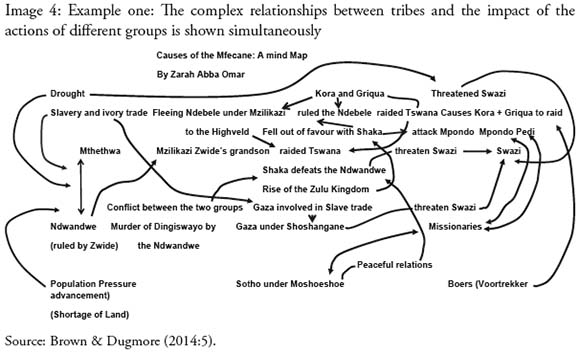
The use of thinking skills is gaining ground in many South African schools and the challenge is how to use these tools so that they really assist learners without becoming prescriptive or forced. Over six months, Marj Brown and Charles Dugmore have been using thinking maps with various classes, and have found their worth is palpable. Many of the maps used come from the Habits of Mind (HoM) (Costa & Kallick, 2008)andThinkingMaps (Hyerle &Yeager, 2007), andareusedin conjunction with HoMapproaches to a task, while others have been devisedby the authors, or adapted from the original maps to suit the task. The maps have been used by pupils to preparefor essays, short tasks in class, as well as to summarise or understandconcepts, politicalstands, cause and effect, the flow of events, with examples at each stage, and to compare and contrast people, and groups, or events. The presentation is offered as a way of inspiring possibilities in learners to learn by mindmapping History so that it does not become a series of facts to be rote learnt.
Thinking maps; History teaching and learning; Circle Map; Double Bubble Map; Tree Map; Brace Map; Flow Map; Multi- Flow Map; Bridge Map
 Thumbnail