Representations of colonial ideologies in textbooks for history: A case of Northern Rhodesia from 1925-1963
Abstract
The continent of Africa began to experience colonialism by European countries such as Britain, France, Portugal and Germany after the 'Scramble for Africa' that took place in Europe in 1885. Notably, these colonial governments had different administrative policies in their colonies. For instance, the policies of the British were different from those of the French, Portuguese and German. This study explored the representations of colonialism in textbooks for history that were used in Northern Rhodesia (modern day Zambia) at primary and secondary school level from 1940-1963. Postcolonial theory was used as a lens to understand the representations of colonial ideologies in textbooks that were used in the colonial period. The study used a qualitative approach and textbooks were used for document analysis. Eight history textbooks were conveniently selected and analysed using content analysis. The findings of the study revealed that the content taught in the colonial period was Eurocentric and mainly focused on the British Empire, European history, and the achievements of the Empire. This paper could contribute to debates on the decolonisation of education in Zambia.
Colonialism; history; ideology; Northern Rhodesia; representations; textbooks
Introduction
Textbooks are inherently biased because they are a product of what has been selected and legitimatised by the government for official use in schools and are, therefore, recognised to be factual and truthful (Foster & Crawford, 2006). The ideological nature of textbooks could pose a danger to learners as it provides a limited perspective on historical events, biases and stereotypes due to lack of other perspectives (Apple & Christian-Smith, 1991). Thus, there is a need to examine the biases in textbooks. This paper explores the colonial ideologies that were in the history textbooks of Northern Rhodesia, present day Zambia, which were under control of the British Colonial government. Kallaway (2022) argues that the starting point for the process of decolonisation of the school curriculum in Africa should consider an examination of the colonial curriculum. This would help identify the aspects of the curriculum that would need to be worked on.
History textbook research developed as a response to abuses in the subject of history such as extreme nationalism after the First World War in Europe (Ferro, 1984). It was noted that, after the war, the teaching of history was used as a means of achieving "aggressive nationalism, to reignite rivalry, mistrust and xenophobia among European nations" (Benini, 2023:22). Textbooks provide a means to analyse the values that a nation is promoting in the education system (Bentrovato, 2015). History textbooks may promote ideologies such as Eurocentric, Capitalist, Communist, Democratic, Africanist, Islamic or Socialist values and as such, textbooks should never be treated as a neutral entity (Bertram & Wassermann, 2015). Research shows that history as a subject is inclined to propagandist and ideological tendencies that could serve as a potential vehicle for promoting hegemonic values and practices (Ferro, 1984; Engelbrecht, 2008; Benini, 2023). Ideology in this paper is defined as representations of the interests of a dominant group or the ruling group as valid and universal (Mannheim, 1954). Textbooks are conceptualised as one of the ways a curriculum can be presented in public forms for use in school classrooms for learners (Crawford, 2004). This paper argues for cognisance of colonial ideologies in textbooks to inform decolonisation debates and processes in Zambia, formerly Northern Rhodesia.
The literature review in this section discusses the teaching of history in the colonial period, history textbooks in the colonial period and the ideological nature of textbooks.
Teaching and learning of history in the colonial period in Northern Rhodesia 1925-1963
Formal education was introduced in Northern Rhodesia by missionaries in the nineteenth century (Chita, 2011). There seems to be no official history curriculum during the era of the missionaries and the British South Africa Company (BSAC) as missionaries had a different focus for education (Chita, 2011). In 1924, the British government took over the administration of Northern Rhodesia from the BSAC after the joining of Eastern and Northwest territories and became a British Protectorate (Snelson, 1974). The British Colonial government then decided to take control of the education system and set up a sub-department of Native Education in 1925 (Mukoboto, 1978, Snelson, 1974). Education was to be planned by the recommendations given by the Phelps Stock Commission and to be based on the Adaptation policy that was an education meant to prepare the African learners for their new environment, convert them to Christianity and create a labour force that could work with the colonial government (Mukoboto,1978; Masinire, 2020). The policy was anchored on Jesse Jones's four essentials of education, health, hygiene, agriculture and character development (Jones, 1925). In essence, it meant that the education system provided for the Africans was expected to be basic. Thus, the teaching of history was not a priority. Even though the British took over the education system in 1925, the curriculum was not uniform in all schools.
A new syllabus was then introduced in 1928 and was based on the Ugandan syllabus in schools that were introduced by the colonial government (Mutumba, 1984). The curriculum of the Baroste National School provided insight into what was taught in history during this period. Mutumba (1984:44) shows that the teaching and learning ofhistory was done in a subject called 'Discussion' which was offered at lower and middle primary school. The pupils were taught general knowledge, history and geography (National Archives of Zambia (NAZ), Sec1/507 1930). The history taught was based on the districts of origin of the learners as well as where they lived, their tribal history and the geographical formations of the districts and rivers. For instance, the Baroste National School was in Barotseland, thus, the pupils learnt about the history of the Lozi people. The subject of history was then removed from the syllabus because there were no textbooks for local history in the 1930s (NAZ EDU Sec1/507, 1930).
At secondary school level Seri-Hersch (2014) noted that English and European history were predominant in the history curricula that was prescribed and taught in secondary schools across British Africa after the Second World War. For example, Seri-Hersch (2014) argued that the history curriculum in Northern Rhodesia that was used for teaching and learning in African secondary schools in the late 1940s and early 1950s, was mainly based on a British imperial history. For instance, until 1954, the history curriculum taught at Munali Secondary School (Lusaka) had the main topics taught apart from African ancient history and these were "British imperial history (the industrial and agrarian revolutions in Britain, the historical development of self-governing countries and dependencies in the Commonwealth with case studies of South Africa and Northern Rhodesia" (Seri-Hersch, 2014:188).
It should be noted that during colonial period, teachers had freedom to choose what to teach in Form I and II. However, what was prominent is that British history and European history took centre stage in the teaching and learning of history (NAZ EDU 1/8/33, 1956). Though the focus was British history, it should be noted that the curriculum varied from one school to another, for instance, the syllabi for junior secondary school education at Malole in Kasama and at St Canisius secondary school in Chikuni, Southern province differed from each other (NAZ EDU 1/8/43, 1957c).
A clear delineated syllabus for history is seen after the post-war period in Northern Rhodesia in the 1950s. The examination pupils wrote was set in England and a candidate had to compete for the Cambridge Overseas School Certificate or the General Certificate of London University. External candidates were also allowed to sit for the final examinations. The local examinations were prepared by teachers from other regions and marked by the wives of civil servants using a marking key, irrespective of their qualification (Bullington, 1964).
By the 1960s the syllabus for history was uniform for all schools, unlike in the 1950s when teachers had the freedom to choose what to teach from one school to another (Correspondence, by Little, NAZ EDU 1/8/43, 1961a). This syllabus was made from the 1950s curriculum review that was called upon by the British Colonial government (NAZ EDU 1/8/43, 1961b). The content for history at secondary school level included the Voyages of the Portuguese, the Coming of the Dutch, English and Portuguese, Explorations into the interior of Africa, Islam in Africa, Slave trade by Arabs and Europeans, Abolition of the Slave trade, Partition of Africa, Stories of Egypt, Greece and Rome, Rise of Christianity, Islam and Crusades, the Middle Ages, the Discoveries and the Renaissance period, Agriculture and Industrial Revolution, Growth of the British Commonwealth and European History up to 1920 (NAZ EDU 1/8/43, 1961b). The next section discusses the nature of history textbooks in the colonial period.
The nature of history textbooks in the colonial period
Research on history textbooks in Europe, Latin America and Asia from the colonial period concentrates on the identity of European sailors, explorers, the coloniser and the indigenous people they found in Africa, Latin America or Asia (Grindel, 2017; Van Nieuwenhuyse, 2022; Choque Apaza & Robinson 2024). For example, Choque Apaza and Robinson (2024) have argued that textbooks for history from the colonial period focus on the European sailors, such as Christopher Columbus, Vasco Dagama, Ferdinand Magellan, Bartholomew Diaz and many others. Similarly, Van Nieuwenhuyse (2022) argued that textbooks for history in Belgium represent King Leopold as a hero who brought civilisation to the Congo. This study sought to find out the content for textbooks for history that were used in the colonial period in Northern Rhodesia.
Studies conducted on history textbooks also focus on the legacy of the colonisers. For example, the history textbooks in Germany represented colonies as possessions and symbols of national strength (Grindel, 2017). In contrast, textbooks from the British Empire were also used to reconcile the integrity of the empire as an institution that provided self-determination as a result of the growing number of colonies that were gaining independent (Kusabs, 2023). This study, however, sought to find out how the colonisers and the colonised were represented in the textbooks written for the history in Northern Rhodesia.
There are several studies in Southern Africa on the nature of history textbooks from the colonial period in countries such as South Africa, Zimbabwe and Congo (Engelbrecht, 2008; Nishino, 2008; Seroto 2015; Plescia, Wassermann & Bentrovato, 2020; Van Nieuwenhuyse, 2022). For example, Seroto (2015) noted that the main focus in the textbooks in the colonial period in South Africa was the representation of the white settlers and the Dutch India East Company (DIEC) while indigenous people in South Africa were not represented all. In Southern Rhodesia, the history textbooks during the colonial period did not prioritise the learning of local history in the early days of colonialism, the history concentrated on European history and how it fit in the imperial history of Rhodesia (Plescia, Wassermann & Bentrovato, 2020). However, later, the Rhodesian 2160 syllabus which was based on European history and Central African history, was prepared according to the United Kingdom system of Ordinary Level and marked by Cambridge University Syndicate (Pwiti, 1994; Moyo & Modiba, 2013). This study intended to find out the nature of textbooks for history in Northern Rhodesia.
Apart from focusing on European history, the textbooks that were used in the colonial period in Africa were loaded with colonial ideologies (Engelbrecht, 2008; Nishino, 2008; Van Nieuwenhuyse, 2022). For instance, the textbooks that were used in South Africa were loaded with Afrikaner ideology (Engelbrecht, 2008; Nishino, 2008). Afrika ners carried notions of European superiority over the indigenous people, because the colonial masters believed that they had the right to settle in South Africa and spread Christianity to the local people who were seen to be inferior and barbaric, while the Europeans were superior and civilised (Nishino, 2008). The study also sought to investigate the colonial ideologies in textbooks that were used in Northern Rhodesia. In the next segment the ideological nature of textbooks is explained.
The ideological nature of textbooks
Textbooks are a useful tool to analyse colonial narratives and ideologies in the field of education (Grindel, 2017), since the prevalent political and social discourses are etched in them (Hellmuth, 2021). For instance, Apple and Christian-Smith (1991:1) argued that, apart from being educational materials, textbooks are "the results of political, economic and cultural activities, battles and compromises". The production process of textbooks is so complex, in that it involves the process of considering the interests of different parties on what should be included and excluded (Foster & Crawford, 2006). The selection of content for the textbooks is as a result of complex power relations and what is selected is the knowledge of the powerful (Apple & Christian-Smith, 1991). Textbooks reveal the purpose and ideology of that time (Chiponda, 2014; Fru, 2017; Halsall 2023; Kim & Lee, 2023) Thus, textbooks are legitimatised politically (Brait, 2024). It could be argued that textbooks conveyed the ideologies of the dominant or powerful people in society.
Textbooks aim to push the agenda of the dominant groups in society (Foster & Crawford, 2006). For instance, textbooks produced during the apartheid era in South Africa were based on Afrikaner ideology and white supremacy. The history textbooks at that time celebrated the Afrikaner's achievements and excluded the accounts of African people (Engelbrecht, 2008). Aft er independence in 1994, there was an ideological shift to an African nationalist ideology (Engelbrecht, 2008). Recent works in Africa on history textbooks show that ideology is embedded in history textbooks. For instance, Fru's (2017) work on history textbooks in Cameroon shows that there is an ideological bias on the representation of the unification of Cameroon between Anglo and Francophone at the expense of the local people in Cameroon. The biases are presented using a single master narrative. Halsall (2023) noted that the representation of Brazil, Russia, India and China (BRICS) in South African history textbooks was due to South Africa's ideological position in the geopolitics. Educators must pay attention to ideologies in textbooks. The next section discusses the theoretical framework of the study.
Theoretical framework
This study used the postcolonial theory as a lens to understand the colonial ideologies in textbooks that were used in the colonial period in Northern Rhodesia. This paper used Edward Said's (1978) theoretical framing of Orientalism specifically. Orientalism is a systematic discourse on how Europe or the West produced the Orient or the colonised "politically, sociologically, militarily, ideologically, scientifically, and imaginatively" after enlightenment period (Said, 1987:11). Postcolonial theory contends that colonial ideologies were used to dominate the colonised people in the colonial period (Said, 1978). The colonisers used the ideologies in colonial administration and other institutions such as schools, universities, churches and legal systems ((Ndlovu-Gatsheni, 2013). This theory is important in that it shows how colonial ideologies were passed on in schools through textbooks during the colonial and postcolonial period.
The Orient defined Western Europe's position in history and the representations of the other (Said, 1987). Thus, "colonial texts have depicted the Indians, the Egyptians, the Palestinians, the Latin Americans, and many others as almost the same, the Orient, the 'Other', in juxtaposition with 'Us', the Occidental" (Hamadi, 2014:40). This theory is essential as it provides insights on how the colonisers viewed the colonised people. The Orient and Occident are man made; they did not exist before. Thus, this study sought to find out the colonial ideologies that were entrenched in history textbooks in Northern Rhodesia.
Orientalism was strengthened by Western Hegemonic ideas that Europeans were superior over the oriental and the oriental were backward (Said, 1978). In Western Hegemony the representation of the Occident is portrayed as "highly biased, depicting the Orient as the irrational, strange, and weak, feminized 'Other', contrasted with the rational, familiar, strong, masculine 'West' (Hamadi, 2014:40-41). In terms of the representation of women, Said (1978), noted that they could not speak for themselves and were misrepresented, while Islam was seen as a religion against Christianity. This theory is useful in that it has highlighted the colonial ideologies in how the coloniser viewed the colonised and the representations used a lens to find out the representations of colonial ideologies in the textbooks for history that were used during the colonial period. In the next section the research design and methodology of the study is discussed.
Research design and methodology
A qualitative approach and document analysis was adopted for the current study. The study used a case study design. Aware that other studies have been done on history textbooks in Africa on the colonial period, this study sought to find out the representation of the colonial ideologies in Northern Rhodesia only. Hence, the study is a case of Northern Rhodesia. The study adopted qualitative research, since it is inductive in nature and the researcher is expected to explore meanings and insights in a given context. Qualitative research involves an interpretive and naturalistic approach to its subject matter (Denzin & Lincoln, 2005). It also focuses on in-depth understanding of the phenomenon under study (Creswell & Creswell, 2018). In qualitative research, reality is a social construction that can be understood through interpretation of meaning from a given culture or society (Denzin & Lincoln, 2018). Thus, the construction of reality is done through the understanding of a historical or cultural context. In this study, history textbooks were viewed as a social construction and the colonial period is a social and cultural context the textbooks were created from. A qualitative approach was chosen for this study, because it focuses on a specific phenomenon and context, which suited the study as it would help to understand representations of colonial ideologies in textbooks for history in the colonial period. Thus, in this study, history textbooks were the phenomenon under study and the colonial period was the context.
The study was underpinned by the interpretivist paradigm, as it sought to understand the phenomenon (textbooks for history) and interpretation of the context (Yilmaz, 2013). In the interpretivist paradigm, knowledge and truth are subjective, because people have different experiences and come from different cultures (Ryan, 2018). Interpretivist argue that knowledge is a social construction through language and culture is a means to invent facts (Berryman, 2019). In the interpretive paradigm, researchers must see themselves as social participants and understand the world their going to explore.
The researchers incorporate their subjective notions and beliefs into research, as they believe that meaning can be found through language and culture in society (Pervin & Mokhtar, 2022). Hence, the interpretivist paradigm is very subjective. Thus, it can be noted that interpretivist emphasis is on understanding how individuals construct and interpret social reality. Therefore, it can be noted that regarding this study, textbooks are a social construction and the constructions can be interpreted to find out what they mean.
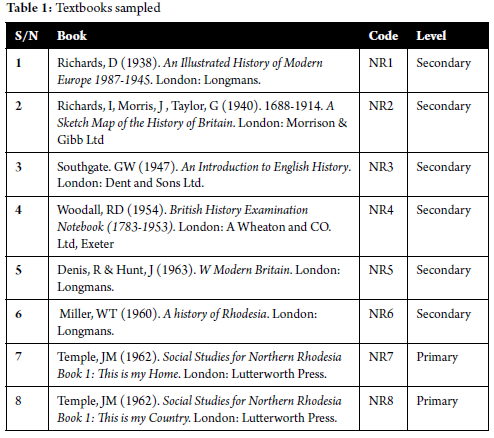
In the interpretivist paradigm, researchers must be aware of their biases (Creswell & Creswell, 2018). In the context of this study, triangulation was used by using other sources to counter the bias and provide detail on how the data will be collected and analysed. Given that textbooks from the colonial period were difficult to find, eight textbooks were conveniently selected, thus, convenience sampling was used to sample the textbooks used for this study. Convenience sampling involves choosing samples that are easily accessible (Teddlie & Yu, 2007). Table 1 below, provides details on the textbooks that were sampled.
The research methodology adopted for this study is content analysis. Textbooks were used to investigate the representations of colonial ideologies and content that was taught in the colonial period in Northern Rhodesia. Content analysis was used to analyse the textbooks and ascertain the representation of the colonial ideologies in the textbooks. Content refers to the words, pictures, meanings, symbols or any other communicated messages found in the textbooks (Kohlbacher, 2006). This study focused on words only. Content analysis is an inductive and iterative process where similarities and differences are identified in the text that would corroborate or disconfirm theory (Nieuwenhuis, 2007). In this regard, texts indicating Western or Eurocentric ways of thinking were selected. Open coding was used to analyse the textbooks. Open coding is a process that enables the researcher to retrieve and collect data they have associated with some theme so that the sorted bits can be examined together, and different cases are compared (Nieuwenhuis, 2007). A priori code was also used to analyse data. Nieuwenhuis (2007:109) concludes by stating that "you identify the themes before you categorise the data, and you search the data for text that matches the themes". In the current study, the researcher looked for data that was aligned to Eurocentric or Western perspectives in the textbooks.
Since qualitative research is subjective, this study ensured that the study is trustworthy by following a criteria of credibility, transferability, dependability and confirmability. Credibility was ensured through confirming with secondary sources. Transferability and dependability were provided by giving an account of the context in which the study was carried out through a proper research design and methodology. Confirmability was ensured by providing a detailed account of the study from data collection to data analysis through audit trail. In the next segment the results of the study are presented.
Result of the study
Representation of colonial ideologies in textbooks for history in Northern Rhodesia
The following themes emerged from the data after a content analysis of the textbooks selected and used in Northern Rhodesia for the school history curriculum from 1925 to 1963. The themes include the use of Western periodisation, focus on Western rulers, the agricultural, industrial and scientific revolutions, imperial expansion, great men and negative portrayal of Muslims1 and Africans.
Eurocentric or Western periodisation
All the textbooks sampled used the Gregorian Calendar to date historical events (NR1; NR2; NR3; NR4; NR5; NR6; NR7; NR8). For instance, in one of the textbooks by George W. Southgate, An Introduction to English History , shows a time chart depicting the history of the English presented using timelines before the Birth of Christ (BC) and after the death of Christ (AD), that is from the time of Caesar (Roman period), The Anglo-Saxon period, Norman period, Plantagenet period, Tudor period, Stuart period and Hanoverian period (NR3).
All eight textbooks use Eurocentric periodisation of events from classic period, mediaeval period, early modern and modern times. The events are presented in periods related heavily to the Eurocentric ideology. For instance, in one of the textbooks the Middle Ages is presented as a period when the English people did not know much about the world (NR3). The English people were farmers and owned animals, however, they did not use scientific methods of farming (NR1).
The rulers in England
The textbooks focus on the rulers of England and Europe (NR1; NR2; NR3; NR4 NR5). For instance, one of the textbooks states who the rulers were in England from the Tudor's line of kings and queens. The Tudors ruled for more than a century in England, and they were Henry VII, 1485-1509, Henry VIII, 1509-1547, Edward VI 1547-1553, Mary I, 1553-1558 and Elizabeth 1558-1603. Other rulers were kings of the House of Stuart that reigned in Scotland for more than two hundred years before James of VI became king of England (NR3). Only noble women and women of stature are represented in the history books: Elizabeth I, Elizabeth II, Catherine of Aragon, Queen Anne, Mary I, Mary II. Sophia Dorothea German Princess and Queen Caroline, Lady Masham, Sarah Churchill and Maria Theresa (NR3).
Great focus on the age of discovery in Europe
The study revealed that the textbooks largely concentrated on the Age of Discovery in Europe around the fifteenth to eighteenth century (Paine, 2020). The textbooks that were analysed celebrate the Age of Discovery by Europeans (NR1; NR2; NR3; NR4; NR5). The textbooks devoted a large section of content on the discoveries by the Portuguese, Spanish and English in other continents (NR3). Most of the textbooks focus on the prominent sailors being Bartholomew Diaz, Vasco da Gama and Cabral that led to discoveries. The textbooks highlighted the voyages of several sailors. For example, one textbook indicated that "in 1486, Bartholomew Diaz reached the southern point of Africa and sailed around it" (NR3:5). Therefore, it can be argued that the focus of teaching history in the colonial period concentrated on the achievements of Europe.
Emphasis on the agricultural revolution
Some of the textbooks focused on the achievements of the agricultural revolution in England (NR2; NR3; NR5). For example, textbooks concentrated on the leaders of the Agriculture Revolution such as Jethro Tull, Viscount Townshend, Robert Bakewell, Thomas Coke of Holkham and Arthur Young (NR2; NR3; NR5). Jethro Tull introduced the drilling machine and deep ploughing that brought significant development in the field of agriculture. Most of the people in England lived in the country and worked on land before it became known as "the workshop of the world" (NR3:79). Viscount introduced crop rotation and Thomas William Coke of Holkham was the patron of new farming methods (NR5).
Great focus on the Industrial Revolution in Europe
The textbooks devoted a great space to the earliest inventors and inventions in the clothing industry (NR1; NR2; NR3; NR4). For example, a large space is provided for inventors, such as John Kay, James Hargreaves, Richard Arkwright, Samuel Compton and Edward Cartwright for inventing the flying shuttle, spinning jenny, water frame, mule and power loom for weaving (NR4). The textbooks also focused on inventions in the field of communication, such as the telephone, telegraph, wireless and newspaper. Additional to communication and transport, the textbooks highlighted the innovations in the field of health, education and general welfare of the people in society.
Emphasis on the Scientific Revolution
The textbooks that were used in Northern Rhodesia concentrated on the scientific discoveries (NR1; NR2; NR3, NR4; NR 5). The textbooks concentrate on inventions such as the atomic theory, chlorine, iodine, elector-magnet and Darwinism by inventors such as Dalton, Thomson, Rutherford, Bohr, Humphrey Davy, Micheal Faraday, James Prescott Joule and Charles Darwin (NR4). Focus is also placed on the discovery of vaccines, inoculation, radiation, penicillin, X-rays, anti-septic surgeries and anti-malaria drugs by Jennes Vaccine, Pasteur, Amroth Wright, Lister, Curie, Fleming and Manchester scientists (NR4).
Strongfocus on imperial expansion
The textbooks devoted much space to the imperial expansion of Britain and other European countries (NR1; NR2; NR3, NR4; NR 5). Colonies were represented as symbols for national greatness. In the textbooks it is demonstrated that Britain had colonies in North America, Canada, Australia, New Zealand, India and Africa. For example, after 1815, Britain gained thirteen colonies in North America (NR2), while in Canada, the creation of the Dominion of Canada was made up of provinces such as Quebec, Ontario, New Brunswick and Nova Scotia with the help of Sir John MacDonald in 1867 (NR2; NR5). In 1768-1779 Captain Cook took possession of South Wales and New Zealand as a possession of Britain. In 1823, India was under the control of Britain, while in Africa, Britain took control of the Suez Canal, Sudan, South Africa and Kenya (NR2; NR5). Northern Rhodesia is represented as a possession in terms of being acquired as a colony by the British South African Company and the British government (NR3; NR4; NR5). This is in line with Bentrovato (2015) who argues that colonies are presented in a Eurocentric manner as they are seen as objects and symbols of prestige in most textbooks for African History on World War One.
Emphasis on great men in history
The textbooks concentrated on the accounts of great men in England such as prime ministers and other political leaders like William Pit the Earl of Chatham, Lord Castlereagh, Lord George Canning, Lord Palmerstone, Lord William Gladstone, Lord Benjamin Disraeli, Lord Robert Cecil Marques and many more (NR2; NR4). For example, Lord Castlereagh hoped to construct a political order which could preserve society from the destructive violence of revolutions and war. While Gladstone considered that "peace and isolation were more beneficial to England and to her prosperity than futile gestures of war" (NR2:109). It can be argued that colonial history did not include the contribution of women in history unless they were queens.
Islam as threat to Western Europe
The textbooks represent Islam as a threat to European countries, such that European countries had to find ways to curb the growing strength of Muslims in Eastern Europe (NR1; NR2; NR3). The Muslims are also presented as violent, barbaric and uncivilised in textbooks (NR1).
Negative portrayal of the colonised people
The African people were represented as hostile and barbaric (NR2; NR5; NR6) For instance, in textbook NR5, the people are represented as "people sunk in superstition and barbarism" (NR5:394). The people are represented as tribes; for example, in one textbook it is stated that "Here Livingstone found a number of great tribes, some small and some great almost constantly fighting each other" (NR6:140). The wars of the local people were called savagery (NR6). The native African people who were defending their land were represented as hostile cannibals during the exploration of Africa (NR2:145).
Discussion on the findings
One of the findings of this study revealed that textbooks for history that were used in the colonial period were written from a Eurocentric point of view using the world view of the colonisers. For example, the textbooks for history that were used in Northern Rhodesia showed that they used a Eurocentric construction of time and dating by using the Gregorian calendar. The findings of the current study concur with the findings of McNutt (2014), Nakip, (2014) and Xypolia (2016). For instance, Xypolia (2016) argued that Europe timed the world by standardising world to follow the Greenwich Mean Time in London. Xypolia (2016) highlighted that Greenwich Mean Time is a Eurocentric notion of time as it recognises England as a source of global time. The Gregorian calendar was adopted by Europe as a means of dating in the sixteenth century. Eurocentric thinking was seen to be superior to any other (McNutt, 2014).
Apart from time, the textbooks used a Eurocentric concept of development in describing societies in that, societies development from the Middle Ages to Modern day. Thus, Davis and Puett (2015:1) have contested that "the Middle Ages is a European historiographical category". This was a Eurocentric concept of development that all societies developed in a linear way from under developed societies to modern societies.
The findings of this study show that textbooks that were developed and used for history in the colonial period, like other colonies, mostly paid attention to European events and European people, than Indigenous people. These findings are line with the argument of scholars such as Seroto (2015), Bentrovato and Van Nieuwenhuyse (2020), Wassermann, Bentrovato, (2020); Van Nieuwenhuyse (2022) and Choque Apaza and Robinson, (2024). For instance, it can be noted that the textbooks in the colonial period provided much space on the key explorers during the Age of Discovery in Europe, such as Vasco da Gama, Bartholomew Diaz, Christopher Columbus and many others.
The results from this study have indicated that textbooks from the colonial period concentrated on the achievement of the British Empire and the West, in that large sections of textbooks focused on the Age of Discovery, the Agricultural, Industrial and Scientific Revolution in Europe. These findings are consistent scholars such as Simukoko and Chishimba (2000), Seri-Hersch (2014) and Mambwe and Lufungulo (2022). The emphasis on Agriculture and the Industrial Revolution reinforced the notion of the 'European Miracle' or 'Great Divergence', the process whereby European countries gradually grew to become the most powerful global economies, overcoming China, is considered Eurocentric (Xypolia, 2016:3). The European Miracle notion is an idea that the European culture, political practices and institutions led to the industrial growth of Northwestern Europe (Xypolia, 2016). However, it should be noted that textbook NR7 and NR8 devoted space to the local history people in Northern Rhodesia who are teaching the history of ethnic groups.
From the findings of the current study, it can be noted that the textbooks used in the colonial period concentrated on the representations of men, other than women. These findings concur with scholars such as Said, (1978), Ndlovu-Gatsheni (2013), Chiponda (2014), Jackson-Lowman (2014), and Naidoo (2014) that women were not represented in a Western or Eurocentric discourse. The representations focused on the achievements of the great men. The only women mentioned were those from royal families and nobility. The reason why women were not represented was that the ideology that was used in the colonial period was patriarchal (Ndlovu-Gatsheni, 2013). Women could not speak for themselves and represent themselves during the colonial period (Said, 1978), thus, the contributions of ordinary women are missing in textbooks for history in the colonial period. This is because during the nineteenth and twentieth century, the study of history focused on nation-state and the history of great leaders (Ninno, 2016; Boldt, 2017). According to Von Ranke (1886), great men represented the spirit of an age. The study of history was based on the top-bottom approach. The Eurocentric worldview was grounded on the patriarchal domination of men over women (Jackson-Lowman, 2014). Thus, the focus of studying history was on rulers.
The study revealed that Islam was portrayed in a negative manner in the textbooks. Islam was seen as a threat and 'other' in that Eurocentric ideology is centred on Christianity that began in the fourteenth century with Christian civilisation followed by the Enlightenment period to the period of industrial revolution (Said, 1978; Plaatjie, 2013). Christianity was considered an important development in Europe that needed to spread to other parts of the world by Europeans (Dussel, 2011; Plaatjie, 2013). Colonialism was built on a Eurocentric, American-centric, Christian-centric, sexist, patriarchal and hetero-normative power structure of the world system (Grosfoguel, 2011). Thus, Eurocentrism spread in the colonial period spiritually through Christianity in colonies (Ndlovu-Gastheni, 2013). In colonialist discourse, Islam is judged using the values of Enlightenment and is placed outside the civilised world (Creutz-Kömppi, 2008). Such a representation of Islam goes back to the medieval period in Europe, and Islam is viewed as unchangingly hostile (Creutz-Kömppi, 2008). Moran Cruz (1999:56) noted "that many of the most ill-informed views of Islam in the Middle Ages were precisely those that gave rise to legendary and long-lived images and prejudices that have continued to inform European attitudes".
The findings of this paper are consistent with Edward Said's (1978) post-colonial theory of Orientalism, that the West created an image and way of writing about the colonised people in that the colonised were always represented in a binary way to the West using the Eurocentric ideology. Maposa (2020) noted that Africans continued to be represented in a negative way in most history textbooks in Africa. Thus, there was a need for Africans to be represented well in African textbooks. The purpose was to instil the colonial mentality in learners and justify the spreading of the Eurocentric ideologies or Western culture as a model for a civilised culture in the colonies (Choque Apaza & Robinson, 2024).
The school history curriculum in the colonial period aimed to alienate Africans from their history, cultures, language and religion and indigenous knowledge because it was considered inferior (Masinire 2020; Dube & Moyo, 2022). Africans were to discard their indigenous knowledge and embrace modernity. Thus, it can be argued that representations of colonial ideologies in textbooks for history for Northern Rhodesia were mainly Eurocentric. For the most part, textbooks put more emphasis on the civilisations of the West such as the Agricultural, Industrial and Scientific Revolution in Europe as well as the political system in Europe, and sidelined the contribution of the indigenous societies. This was in line with Trevor-Roper's (1965:871) motto that "there is only the history of the Europeans in Africa; the rest is largely darkness-and darkness is not a subject for history". Textbooks concentrated on highlighting the perspective of the coloniser that is the Western paradigm of knowledge.
It can be noted that textbooks during the colonial period were written from a single perspective, like in other colonies in Africa (Seroto, 2015). Morgan and Henning (2011:176) argued that indigenous knowledge from within the colonies were not included in textbooks as "a matter of fear". The publishers of the textbook did not want to upset the colonial administrators and colonialists on their superiority over the local people in the colonies. Though some textbooks used in the colonial period did try to imitate critical thinking as a way of helping pupils to develop critical thinking (Morgan & Henning, 2011).
Conclusion and implication
In conclusion, it can be argued that textbooks for history that were used in Northern Rhodesia carried much authority and colonial ideologies. The history textbooks were centred on the Western paradigm of knowledge. Although the history of ethnic groups was taught at primary school, much of the content of the textbooks was centred on Western-centric knowledge. Textbook developers must take heed not to write from a single perspective and include other perspectives in the school history curriculum. They should also include local knowledge of the people as a way of giving space to knowledge that was sidelined in the past due to colonial education policies in Africa.
References
Review of literature
- Benini, S 2023. The idea of the nation in post-colonial history textbooks. A comparative analysis of Senegal and Zambia. Unpublished PhD thesis, University of Pavia.
- Bentrovato, D & Van Nieuwenhuyse, K 2020. Confronting "dark" colonial pasts: A historical analysis of practices of representation in Belgian and Congolese schools, 1945-2015. Paedagogica Historica, 56(3):293-320.
- Bentrovato, D 2015. Teaching World War I: An exploratory study of representations of the Great War in contemporary African textbooks. Yesterday & Today, (14), 175-207.
- Berryman, DR 2019. Ontology, epistemology, methodology, and methods: Information for librarian researchers. Medical Reference Services Quarterly, 38(3):271-279.
- Bertram, C & Wassermann, J 2015. South African history textbook research - A review of the scholarly literature. Yesterday & Today, 14:151-174.
- Boldt, AD 2017. Leopold von Ranke on Irish history and the Irish nation, Cogent Arts & Humanities, 4(1):1314629.
- Brait, A 2024. Colonialism and imperialism in Austrian history curricula and textbooks (19452023). Historical Thinking, Culture, and Education, 1(1):11-30.
- Bullington, RA 1964. African education in Northern Rhodesia. Science Education., 48(4):320-326.
- Chiponda, AF 2014. An analysis of the portrayal of women in junior secondary school history textbooks in Malawi. Unpublished, PhD thesis, University of Kwa-Zulu Natal.
- Chita, J 2011. The role of missionaries in the development of the Zambian religious education curriculum. Unpublished, Master's dissertation, University of Zambia.
- Choque Apaza, J & Robinson, N 2024. Representation, responsibility and legacy: A comparative analysis of how colonial history is narrated in Bolivian social science textbooks, pre and post-070 educational reform. History Education Research Journal, 21(1):13.
- Crawford, K 2004. Inter-cultural education: The role of school textbooks analysis in shaping a critical discourse on nation and society. Paper presented at the Pacific Circle Consortium, 27th Annual Conference, 21st -23rd April, 2004, Hong Kong Institute of Education.
- Creswell, JW & Creswell, JD 2018. Research design qualitative, quantitative, and mixed methods approaches. California: Thousand Oaks Sage Publishers.
- Creutz-Kömppi, K 2008.The othering of Islam in a European context: Polarising discourses in Swedish-language dailies in Finland. Nordicom Review, 29(2):295-308.
- Davis, K & Puett, M 2015. Periodization and "the medieval globe": A conversation. The Medieval Globe, 2(1):1-14.
- Denis, R & Hunt, J (1963). Modern Britain. London: Longmans.
- Denzin, NK & Lincoln, YS. 2005. Introduction: The discipline and practice of qualitative research. In NK Denzin & YS Lincoln (eds.). The Sage handbook of qualitative research (3rd ed.), pp. 1-32. Thousand Oaks, CA: SAGE Publications.
- Dube, B & Moyo, N 2022. A decolonial reading of the history curriculum: towards undoing historicide for curricular justice for the Zimbabwean learner. Research Papers in Education, 38(6):865-885.
- Dussel, E 2011. Politics of liberation: A critical world history: Translated by Thia Cooper. London: SCM Press.
- Engelbrecht, A 2008. The impact of role reversal in representational practices in history textbooks after Apartheid. South African Journal of Education, 28:519-541.
- Ferro, M 1984. The use and abuse of history or how the past is taught. London, Routledge & Kegan Paul.
- Foster, S & Crawford, K 2006. The critical importance of history textbook research. In S Foster & K Crawford (eds.). What shall we tell the children?: International perspectives on school history textbooks, pp. 1-23. USA: Information Age Publishing Inc.
- Fru, NR 2017. A comparative analysis of reunification discourses in selected Cameroonian history textbooks. Unpublished PhD thesis, University of Kwa-Zulu-Natal.
- Grindel, S 2017. Colonial and postcolonial contexts of history textbooks. In M Carretero, S Berger & M Grever (eds.). Palgrave handbook of research in historical culture and education, pp. 259-273. London: Palgrave Macmillan.
- Grosfoguel, R 2011. Decolonizing post-colonial studies and paradigms of political economy: transmodernity, decolonial thinking, and global coloniality. Journal of Peripheral Cultural Production of the Luso-Hispanic World, 1(1):1-36.
- Halsall, TC 2024. The representation of BRICS countries in South African school history textbooks. Unpublished PhD thesis, University of Pretoria.
- Hamadi, L 2014. Edward Said: The postcolonial theory and the literature of decolonisation. European Scientific Journal [Special Edition], 2:39-46.
- Hellmuth, T 2021. Fröhlicher eklektizismus: Diskursanalytische schulbuchforschung als beitrag zu einer kritischen geschichtsdidaktik (joyful eclecticism: discourse analytical textbook research as a contribution to a critical history didactics). In J Breitfuß, T Hellmuth & I Svacina-Schild (eds.). Diskursanalytische schulbuchforschung: beitrãge zu einer kritischen geschichtsdidaktik (Discourse Analytical Textbook Research: Contributions to a Critical History Didactics), 15-56. Wochenschau.
- Jackson-Lowman, H 2014. An analysis of the impact of eurocentric concepts of beauty on the lives of Afrikan American women. In H Jackson-Lowman, Afrikan American Women: Living at the crossroads of race, gender, class, and culture, pp. 155-172. Florida: Cognella Academic Publishing.
- Jones, TJ 1925. The whiteman's burden in Africa. Current History (1916-1940), 23(2):213-221.
- Kallaway, P 2022. Knowledge for the people: Understanding the complex heritage of colonial education in South Africa. Yesterday & Today, 28(1):44-81.
- Kim, HS & Lee, DB 2023. Japanese surveillance in colonial Korea: Analysis ofJapanese language textbooks for Korean Students during the colonial era. Cogent Education, 10(2): Article 2286415.
- Kohlbacher, F 2006. The use of qualitative content analysis in case study research. Forum Qualitative Sozialforschung Forum: Qualitative Social Research, 7(1):1-30.
- Kusabs, JR 2023. Education to secure empire and self-government: Civics textbooks in Australia and Aotearoa, New Zealand, from 1880 to 1920.History of Education Review),52(2/3):85-98.
- Mambwe, R & Lufungulo, ES 2022. The evolution of social studies education in Zambia. Multidisciplinary Journal of Language and Social Sciences Education, 5(1): 1-18.
- Mannheim, K 1954. Ideology and Utopia: An introduction to the sociology of knowledge. Harcourt Brace Jovanovich.
- Maposa, MT 2020. The experiences of post-colonial Africa as represented in South African history textbooks. In D Bentrovato & J Wassermann (eds.). Teaching African history in schools, experience and perspectives from Africa and beyond, pp. 64-87. Brill.
- Masinire, A 2020. The historical burden of rural education: reflections of colonial legacy on current rural education in South Africa. In AP Ndofirepi & A Masin ire. Rurality, Social Justice and Education in Sub-Saharan Africa Volume II: Theory and Practice in Higher Education, 2738. Switzerland: Palgrave Macmillan.
- McNutt, J 2014. What is modernization? Eurocentrism and periodisation. Encounters in Theory and History of Education, 15:121-136.
- Miller, WT (1960). A history of Rhodesia. London: Longmans.
- Apple, MW & Christian-Smith, LK 1991. The politics of the textbook. In MW Apple & LK Christian-Smith (eds.). The politics of the textbook, pp. 1-21. New York: Routledge.
- Moran Cruz, JAH 1999. Popular attitudes toward Islam in medieval Europe. In DR Blanks & M Frassetto (eds.). Western views of Islam in medieval and early modern Europe, perception of other, pp. 55-81. New York: Palgrave Macmillan.
- Morgan, K & Henning, E 2011.How school history textbooks position a textual community through the topic of racism. Historia, 56(2):169-190.
- Moyo, N & Modiba, M 2013.Who does this history curriculum want you to be? Representation, school history and curriculum in Zimbabwe. Yesterday & Today, 10:1-24.
- Mukoboto, S (1978). The British Adaption of Education Policy for Africans in Zambia 1925-1964. A problem in Synthesis. Masters of Arts, Marquette University Milwaukee Wisconsin.
- Mutumba, HK 1984. The history of the Baroste National School, 1907-1934. Unpublished Master's dissertation, The University of Zambia.
- Naidoo, A 2014. An analysis of the depiction of "big men" in Apartheid and post-Apartheid school history textbooks. Unpublished Master's dissertation, University of Kwa Zulu-Natal.
- Nakip, T 2014. Eurocentrism in world history textbooks: The case of Canada. Islam Arastirmalari Dergisi (The Turkish Journal of Islamic Studies), 32:127-154.
- National Archives of Zambia (NAZ) EDU 1/8/33 1956. Loc 856. Junior secondary school syllabus: To Principles from Mr Little W.G Little Acting Director of African Education, 31st December, Lusaka, Zambia.
- National Archives of Zambia (NAZ) EDU 1/8/4 1961a. Loc 858. Lower form six work. Department of African Education. Lusaka. Zambia.
- National Archives of Zambia (NAZ) EDU 1/8/43 1957a. Loc 858. Canisius Secondary School: form i history syllabus. Department of African Education. Lusaka, Zambia.
- National Archives of Zambia (NAZ) EDU 1/8/43 1957b. Loc 858. Kasama secondary school: form i history syllabus. Department of African Education. Lusaka, Zambia.
- National Archives of Zambia (NAZ) EDU 1/8/43 1957c. Loc 858. Malole Secondary School: form i history syllabus. Department of African Education. Lusaka, Zambia.
- National Archives of Zambia (NAZ) EDU 1/8/43 1957d. Loc 858. Mongu junior secondary school: form i history syllabus. Department of African Education. Lusaka, Zambia.
- National Archives of Zambia (NAZ) EDU 1/8/43 1957e. Loc 858. St Marks College Mapanza: form i history syllabus. Department of African Education. Lusaka, Zambia.
- National Archives of Zambia (NAZ) EDU 1/8/43 1961b. Loc 858. The present history syllabus in Northern Rhodesia. Lusaka, Zambia.
- National Archives of Zambia (NAZ) EDU1/8/33 1957. Loc 856. Correspondence between Sr M Bernard O.S. F and Mr W. G. Little Acting Director African Education, 10th January. Lusaka, Zambia
- National Archives of Zambia (NAZ) Sec1/507 1930. General introduction of the revised syllabus for elementary schools 1930. Lusaka, Zambia.
- Ndlovu-Gatsheni, SJ 2013. Eurocentrism, coloniality and the myths of decolonisation ofAfrica. Politics, 59:35-39.
- Nieuwenhuis, J 2007. Qualitative research designs and data gathering techniques. In K Maree (ed.). First steps in research (First ed.) pp. 70-79. Pretoria: Van Schaik Publishers.
- Ninno, M 2016. The historiographical challenge of globalization, how the bottom up approach can suit the needs of historians. Unpublished Master's dissertation, Aarhus Universiteit.
- Nishino, R 2008. George Mccall Theal and South African History textbooks: Enduring influence of settler historiography in descriptions of the fifth 'frontier war' 1818-19. Monash University Express.
- Paine, L 2020. Rediscovering the age of discovery. In J Clare, C Lambert, & S Mintz (eds.). The Routledge companion to marine and maritime worlds, 1400-1800, pp. 50-66. London: Routledge.
- Pervin, N & Mokhtar, M 2022. The interpretivist research paradigm: A subjective notion of a social context. International Journal of Academic Research in Progressive Education and Development, 11(2):419-428.
- Plaatjie, SR 2013. Beyond Western-centric and Eurocentric development: A case for decolonizing development. Africanus, 43(2):118-130.
- Pwiti, G 1994. Prehistory, archaeology and education in Zimbabwe. In PG Stone & Molyneaux BL (eds.). The presented past, heritage, museum and education, 338-348. London: Routledge.
- Richards, D (1938). An Illustrated History of Modern Europe 1987-1945. London: Longmans.
- Richards, I Morris, J & Taylor, G (1940). 1688-1914. A Sketch Map of the History of Britain. London: Morrison & Gibb Ltd.
- Ryan G 2018. Introduction to positivism, interpretivism and critical theory. Nurse Researcher, 25(4):14-20.
- Said, E 1978. Orientalism. Pantheon Books.
- Seri-Hersch, I 2014. Sudan and the British Empire in the era of colonial dismantlement (19461956): History teaching in comparative perspective. In T Ali Souad, et al. (eds). The road to the two the Sudans: New Castle Upon Tyne, pp. 177-219. London: Cambridge Scholars Publishing.
- Seroto, J 2015. An analysis of the depiction of indigenous people during the early colonial conquest in South African History Textbooks, Indilinga - African Journal of Indigenous Knowledge Systems, 14(2):169-182.
- Snelson, PD 1974. Educational development in Northern Rhodesia 1883-1945. Lusaka: Neczam.
- Southgate. GW(1947). An Introduction to English History. London: Dent and Sons Ltd.
- Teddlie, C & Yu, F 2007. Mixed methods sampling: A typology with examples. Journal of Mixed Methods Research, 1(1):77-100.
- Temple, JM (1962). Social Studies for Northern Rhodesia Book 1: This is my Country. London: Lutterworth Press.
- Temple, JM(1962). Social Studies for Northern Rhodesia Book 1: This is my Home. London: Lutterworth Press.
- Trevor-Roper, HR 1965. The rise of Christian Europe (History of European Civilization series). New York: Harcourt, Brace & World.
- Van Nieuwenhuyse, K 2022. Teaching history as an interpretation, by using textbooks in a diachronic perspective: The research case of the representation of the Belgian-Congolese colonial past. Annals of Social Studies Education Research for Teachers, 3(2):25-36.
- Von Ranke, L 1886. Proceedings of the American academy of arts and sciences. Volume 22, pp. 542558.
- Woodall, RD (1954). British History Examination Notebook (1783-1953). London: A Wheaton and CO. Ltd, Exeter.
-
Xypolia, I 2016. Eurocentrism and orientalism. In S Ray, H Schwartz, J L, V Berlanga, A Moreiras & A Shemak (eds.). The Encyclopedia of Postcolonial Studies. Wiley-Blackwell Encyclopedia of Literature. Available at https://abdn.elsevierpure.com/en/publications/eurocentrism-and-orientalism/ Accessed on 10 November 2024.
» https://abdn.elsevierpure.com/en/publications/eurocentrism-and-orientalism/ - Yilmaz, K 2013. Comparison ofquantitative and qualitative research traditions: Epistemological, theoretical, and methodological differences. European Journal of Education, 48(2):311-325.