Influence of the feeding regime on the start-up and operation of the autotrophic nitrogen removal process
Abstract
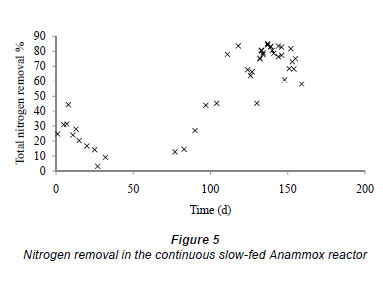
The autotrophic nitrogen removal process (partial nitritation combined with the Anammox process) is a sustainable nitrogen removal technique for nitrogen-rich streams. A modelling and experimental study was performed to define optimal process conditions for the autotrophic nitrogen removal process. Special attention was given to the influence of feeding characteristics on the performance of both the partial nitritation reactor and the Anammox reactor. It was revealed that the feeding regime is an important factor in the successful start-up of the Anammox process. Nitrite concentration peaks at the beginning of a feeding period will lead to an unsuccessful start-up, while a slow input of nitrogen speeds up the process. Feeding regimes are less important in partial nitritation reactors since laboratory results show that slow or fast supply of influent does not influence the growth of ammonium oxidisers.
Anammox; autotrophic nitrogen removal; modelling; optimisation; start-up analysis
 Thumbnail
 Thumbnail
 Thumbnail
 Thumbnail
 Thumbnail
 Thumbnail