Life-history traits of Streptocephalus purcelli Sars, 1898 (Branchiopoda, Anostraca) from temporary waters with different phenology
Abstract
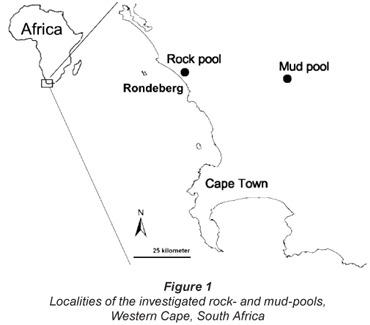
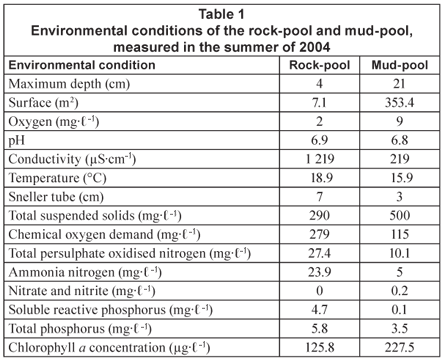
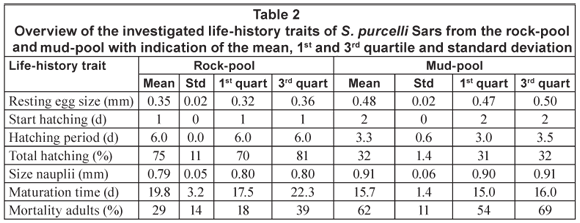
Rock-pools have specific environmental characteristics, usually with multiple short and unpredictable hydroperiods in 1 season. This requires a specific set of life-history adaptations of their permanent inhabitants, which affects species occurrence. In Southern African rock-pools, large branchiopods are usually represented by Branchipodopsis species. During an intensive sampling campaign in 2004 in the Western Cape of South Africa, a population of Streptocephalus purcelli Sars, 1898 was discovered for the first time in a clear rock-pool with a short hydroperiod. Its usual habitat is a more turbid mud-pool with a longer hydroperiod. We investigated under standard laboratory conditions the differences in early life-history traits between the rock-pool population and a conspecific mud-pool population. Dormant eggs of the rock-pool population were smaller than those of the mud-pool population. The smaller larvae also hatched earlier. These characteristics are in accordance with what is expected for populations living in ephemeral systems. The rock-pool population, on the other hand, also exhibited a higher total hatching percentage, a longer hatching duration, a longer maturation time and a lower mortality. Although, deduced from the last mentioned life-history traits, S. purcelli seemed not well-adapted to unpredictable and ephemeral rock-pool habitats, they could probably occur due to the absence of the competitively stronger species in the region or due to dispersal and mass effects.
Streptocephalus; temporary rock-pools; Anostraca; South Africa
 Thumbnail