Subsidence and evaporation in South African dry spells
Abstract
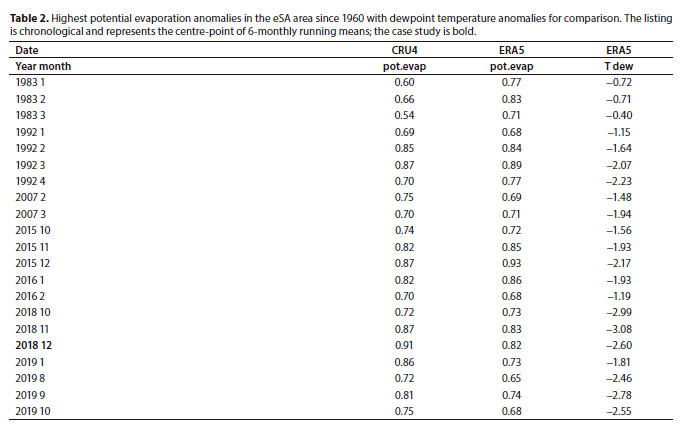
The intensity of dry spells in South Africa is evaluated with monthly European Reanalysis potential evaporation which describes the rate of soil moisture depletion. Filtered time series of potential evaporation averaged over eastern South Africa for 1960-2022 provide a basis for meteorological analysis. After ranking, a representative dry summer (Oct 2018 - Feb 2019) and case study (10-14 Dec 2018), emerged. The synoptic circulation was dominated by upper level equatorward airflow and mid-level subsidence of -0.1 m/s. Back-trajectory analysis shows how warm, dry, dusty air spreads eastward from the Namib Desert to the Orange River Valley, while sinking from 3 000 to 1 000 m. Diurnal evaporation exceeded 0.6 mm/h and dewpoint temperatures of -9°C were recorded in the Free State Province. Global statistics confirm that Pacific El Niño and warm phase Indian Ocean Dipole lead to unusually dry summer weather. Terrestrial runoff and river discharge across eastern South Africa are equally correlated with rainfall and potential evaporation (±0.74), suggesting that operational monitoring and applied research should put greater emphasis on hydrological losses and surface water demand.
subsidence; Namib airmass outflow; South African drought; potential evaporation
 Thumbnail