Optimising retention time and gravel media in ebb-and-flow filter for post-anaerobic digester brewery effluent treatment
Abstract
Breweries produce large volumes of wastewater, which requires recycling to offset water scarcity. An ebb-and-flow filter is a filter system that creates aerobic and anaerobic conditions essential for the transformation and removal of nutrients. Optimising constructed wetland design and operation improves treatment efficiency and reduces operation costs. This study examined the combined effect of retention time (RT: 10, 20 and 40 min) and gravel size (7, 13, and 19 mm) on nutrient removal from a brewery effluent using a single-pass ebb-and-flow system design. These factors were tested for the reduction of chemical oxygen demand (COD), ammonia-N, nitrite-N, nitrate-N, and orthophosphate removal. The 10-min RT at 19-mm gravel achieved the highest removal efficiency, of 7.7% ammonia-N and 8.2% COD reduction. The 40-min RT at 7-mm gravel had the highest nitrate-N removal, at 18.6%. Orthophosphate removal was below 5% in all treatment combinations. The peak removal for ammonia was after 8 weeks, suggesting that the efficiency of the ebb-and-flow design for nutrient removal is time-dependent. Based on the results of this study a short effluent retention time of 10 min on 19-mm gravel is recommended for improved nutrient removal in the ebb-and-flow system design.
constructed wetland; ebb-and-flow; retention time; gravel particle size; post-anaerobic digester effluent
INTRODUCTION
Water is a worldwide scarce resource, and its availability affects economic, social and environmental sustainability (Naik, 2017; Manungufala, 2021). Wastewater treatment and recycling are the potential strategies to address water scarcity (Almuktar et al., 2015; Riera-Vila et al., 2019). Breweries produce large volumes of effluent containing mainly organic and inorganic contaminants (Simate et al., 2011). The limited water availability, high cost of freshwater and strict effluent discharge regulations justify the recycling and treatment of brewery effluent (Götz et al., 2014; Jaiyeola and Bwapwa, 2016).
South African Ibhayi Brewery (SAB) effluent is treated on-site using a commercial-scale anaerobic digester (AD) and activated sludge units before it is sent to a municipal sewer (Almuktar et al., 2018; Taylor et al., 2018). The anaerobic digester treatment has high operation costs and requires further treatment to meet environmental discharge standards (Jaiyeola and Bwapwa, 2016). The effluent has high concentrations of dissolved organic matter, inorganic nitrogenous compounds and inorganic phosphorus. A portion of the post-AD effluent is treated and reused in a research facility at the brewery (Cilliers, 2012; Jones et al., 2014; Taylor et al., 2018). Ebb-and-flow filter design is a technology that resembles the concept of a constructed wetland (CW). The filter operates by filling with and draining water, thereby creating alternating aerobic and anaerobic conditions essential for nutrient transformation and removal (Behrends, 2000; Saeed and Sun, 2012). The ebb-and-flow cycles promote biofilm formation on the substrate and diverse microbial consortia on the substrate, which help purify wastewater (Behrends, 2000; Saeed and Sun, 2012). Nutrient removal from wastewater involves processes such as of nitrification, anaerobic ammonia oxidation, denitrification, physical adsorption and assimilation by microorganisms (Vymazal, 2007; Saeed and Sun, 2012). The configuration and efficiency of the ebb-and-flow filters is based on the number of fill-and-drain cycles, linked to oxygen transferred into the system (Austin, 2003). This system design works effectively with pre-treated wastewater as this minimises clogging of the wetland bed (De La Varga et al., 2016).
Clogging of a CW is related to design, operation, substrate type and flow configuration (Knowles et al., 2011; Nivala et al., 2012; Vymazal, 2018). Wetland substrate accounts for high investment and operation costs. Consequently, an appropriate choice of substrate can influence the quantity and space requirements for wastewater treatment in a CW (Akratos and Tsihrintzis, 2007; Dong et al., 2012). Physical and chemical properties such as particle size, surface area, porosity and ion exchange capacity have been used to choose the CW substrate (Akratos and Tsihrintzis, 2007; Miranda et al., 2017; Wang et al., 2021). The substrate particle surface area influences porosity, biofilm development and treatment efficiency (Almuktar et al., 2018). Hydraulics refers to water movement through wetlands as determined by flow volumes, velocities, rates and flow patterns (USEPA, 2000). Cilliers (2012) defined hydraulic retention time (HRT) as the average time an effluent remains in the wetland bed. The hydraulic loading rate (HLR) is determined by the average water flow rate (m3·day−1) in a given wetland area (m2), expressed in m·day−1 (Wallace, 2009). The HRT is determined by the wetland surface area (A), substrate porosity (p) and flow depth (Dong et al., 2012).
Laboratory and full-scale effluent treatment studies on wetland hydraulics have resulted in improved nutrient removal and prompted further optimisation of CW design (Dong et al., 2012; Li et al., 2015; Al-wahaibi et al., 2021; Zhang et al., 2021). Dong et al. (2012) examined dissolved oxygen profiles and nutrient removal efficiency in unaerated, continuous and intermittently aerated CWs, operated at hydraulic loading rates (HLR) of 19, 38 and 76 cm·day−1. High removal efficiencies above 80% for ammonia and chemical oxygen demand (COD) were achieved at an HLR of 19 cm·day−1 in a continuously aerated system. The intermittently aerated system at HLR of 38 cm·day−1 had the highest total nitrogen removal, at 57%, at reduced energy costs. Li et al. (2015) investigated nitrogen removal in a tidal CW under varying effluent filling times of 12 to 48 h. The system achieved a 77-94% reduction in COD, 55-82% ammonia removal and 60-84% total nitrogen removal, thus eliminating the energy required for aeration. De Jong (2019) examined the effect of filling and draining time (FDT) (15, 30, and 60 min) on dissolved oxygen profiles and nutrient removal in the effluent of an anaerobic brewery digester using a tidal CW filled with 19-mm gravel substrate. The highest dissolved oxygen concentration was at 15 min FDT (6.52 ± 0.09 mg·L−1), followed by 30 and 60 min FDTs (5.74 ± 0.09 mg·L−1 and 5.40 ± 0.09 mg·L−1, respectively). High dissolved oxygen concentrations in 15- and 30-min FDTs removed ammonia faster than in the 60-min cycle of tidal CWs.
The high cost of land and limited space affect wetland operations (Dong et al., 2012). High hydraulic loading rates in a tidal wetland design point to the smaller land area required, hence increasing its feasibility in wastewater treatment (Austin, 2006; Kizito et al., 2017; Li et al., 2019). Gravel substrate commonly used in CWs has competitive demand and provides a varied surface area that influences wastewater treatment in terms of space requirement and treatment efficiency. Therefore, optimization of HRT and gravel surface area provides diverse pathways for nitrogen transformation and removal with small space requirement. To contribute to the design characteristics and the efficiency of operating conditions of an ebb-and-flow system, the present study extended the filling and draining time (FDT) range used by De Jong (2019). The present study also examined the combined effect of retention time (10, 20 and 40 min) and gravel size (7, 13 and 19 mm) on the efficiency of nutrient removal from the post-AD effluent.
MATERIALS AND METHODS
Study site
The study was conducted at Ibhayi Brewery (Pty, Ltd) (33.8378°S, 25.5419°E) in Gqberha, Eastern Cape Province, South Africa, from October to December (summer).
Wastewater treatment process as an influent source for the experiment
The treatment at the factory starts by screening the effluent through drum filters to remove solid waste. The screened effluent is delivered to an equalisation basin to control water flow into the anaerobic digester by breaking down dissolved organic matter without oxygen to produce energy (biogas), carbon dioxide, and traces of hydrogen sulphide. A portion of post-AD effluent is diverted for further on-site treatment at the Project Eden research facility, using low-cost alternative technologies of primary facultative ponds, high-rate algal ponds and CWs (Cilliers, 2012; Power and Jones, 2016). Project Eden has 6 rectangular (320 m2), serially connected tidal wetland cells. Each cell (0.8 m depth) has an underground drainage system, with in-built manholes fitted with water pumps (Aqua Drive 670-SPECK Pump-6452NTL-A12X).
Acquisition of gravel for the experiment
Three graded sizes of crushed gravel (7, 13, and 19 mm) were purchased from a quarry in Gqberha, Eastern Cape Province, South Africa. The gravel sizes were chosen based on the range of pebble sizes used as filter media in CWs and on the availability in the area.
The experimental set-up
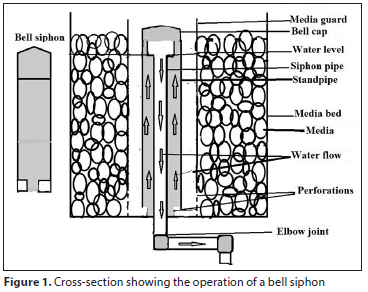
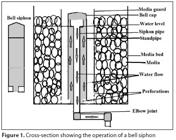
The CWs were set on top of a wetland cell filled with gravel, and 27 ebb-and-flow systems were built using 1 000-L plastic tanks (1 m x 1 m x 1 m). Each tank was fitted with an overflow outlet pipe (1 m height) that regulated the water level during flood cycles. A 75-mm polyvinyl chloride (PVC) pipe was installed on top of the systems as a water supply line, with 50-mm PVC water taps to allow the effluent to trickle through the gravel-filled systems (Fig. 1). The post-AD effluent was pumped into the ebb-and-flow units using a submersible water pump (AquaDrive 670-SPECK Pump-6452NTL-A12X). The water flow from the supply line into each system was uniformly controlled using a 75-mm PVC water valve. All units were covered with shade cloth (50% shade factor) to create uniform lighting.
Ebb-and-flow system components and operation
A bell siphon is a mechanical device that automatically regulates water flow using pressure and gravity. The media guard PVC (110-mm diameter) prevents pebbles from clogging the siphon. A standpipe (diameter 75 mm) was uniformly perforated at the bottom to regulate the maximum water level in the substrate bed. The siphon pipe was firmly fixed through a hole at the base of the media bed. A siphon pipe of 50-mm diameter PVC was fitted with end caps to create low pressure enabling the water level to rise within the substrate bed. The media guard and stand pipe were perforated at the base of the system to allow water flow. At the bottom of the siphon pipe was a 50-mm elbow joint connected to the drainage pipe (Fig. 1). During the filling phase, water is forced from the base of the substrate bed to the maximum level of the standpipe via the perforations of the media guard. As its level reaches the height of the standpipe, low pressure is created in the bell cap allowing water to drain. Air is then sucked in at the perforated tip, and the pressure difference created breaks the siphon. The substrate bed is refilled with water in repeated cycles (Fig. 1).
Study design
The two main effects investigated were of gravel size (7, 13, 19 mm) and retention time (10, 20 and 40 min), respectively. Each treatment combination (gravel size with retention time) was replicated 3 times in a completely randomized block design. The experiment lasted 12 weeks.
Data collection
Water temperature (°C) and dissolved oxygen (mg·L−1 O2) were measured daily using a portable Lutron PDO-519 DO meter. Water pH and electrical conductivity (mS·cm−1) were measured weekly at the inlet and outlet of the systems using a Lutron conductivity meter, code PCD-432, and a pH Lutron-electrode meter, Model: PH-220, respectively. Water samples were collected at the inlet and outlet every week and analysed for chemical oxygen demand (COD), ammonia-N, nitrite-N, nitrate-N and orthophosphate using a spectrophotometer (DR2800-01B1, Hach (Pty) Ltd, USA). The concentrations were calculated according to the standard procedures outlined in the test kit manuals (Hach (Pty) Ltd, product numbers; 21259-15, 26069-45, 21075-69, 21061-69, 22441-00).
The nutrient removal efficiency was calculated weekly using Eq. 1.

where Ci is inflow concentration, Ce is outflow concentration.
Data analysis
All data were checked for equality of variance and normality of residuals using Levene's test for equality of variance and the Shapiro-Wilk test for normality, respectively. If the assumptions were not met, data were log- or arcsine-transformed. The means of the weekly data were compared between treatments using multifactorial ANOVA. Treatment means were compared using Tukey's post-hoc multiple range test. If interaction terms were significant, the means of all factorial combinations were compared. The second-order polynomial regression models described the relationship between percentage nutrient removal and time. The inflection point (i) was calculated using the formula i = b2 / (2 × b3) and substituting (i) into the polynomial model y = a + b1x + b2x2 to determine the number of weeks by which a model reached a maximum value. Here, b2 and b3 are the regression coefficients on the changes of the independent variable (weeks). Analysis of variance was used to compare values for those weeks with the highest means between treatments or treatment combinations. The statistical analyses were performed using Statistica, Version 14.
RESULTS
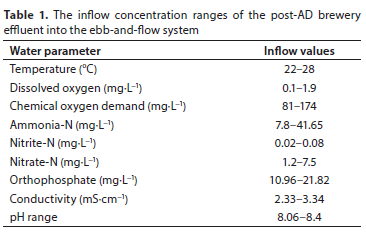
Means of the physicochemical water variables from post-AD effluent into the ebb-and-flow system are presented in Table 1.
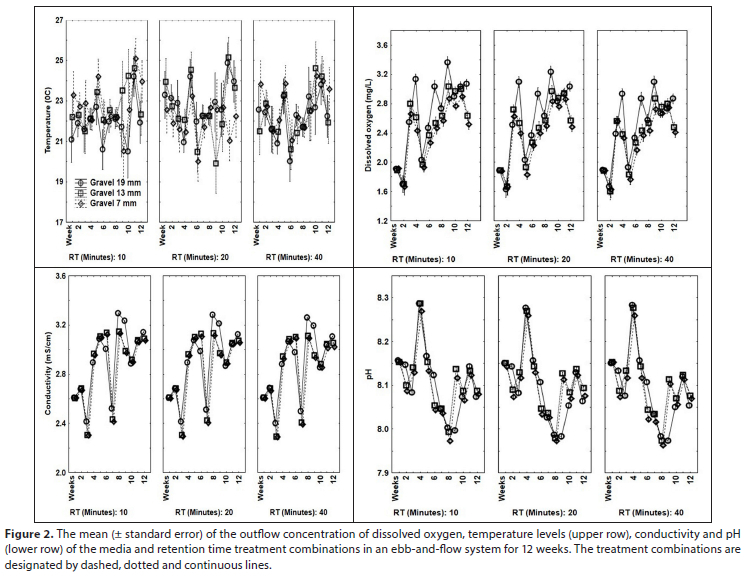
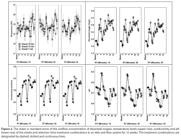
Retention time and gravel particle size influenced the physicochemical water variables at the outflow of the CW. Water temperature was influenced by changes in weather conditions ranging from 22-26°C (Fig. 2). The interaction between weeks, RT and gravel size did not affect the changes in dissolved oxygen concentration (repeated measures ANOVA, F (44, 198) = 0.6, p = 0.99, Fig. 2) while these values differed between retention treatment combinations (p < 0.001). The highest mean DO was at 10-min RT (3.00 ± 0.03 mg·L−1), followed by 20-min RT (2.56 ± 0.04 mg·L−1) and 40-min RT (2.47 ± 0.02 mg·L−1), respectively (Fig. 2). The highest mean DO was 3.07 ± 0.03 mg·L−1 with 19-mm gravel size at 10-min RT, while the lowest was 2.45 ± 0.01 mg·L−1 with the 7-mm gravel at 40-min RT. There were no significant differences between treatments for the outflow conductivity and pH, p > 0.05. Conductivity at the outflow of the CWs ranged from 3.05 ± 0.01 to 3.12 ± 0.01 ms·cm−1, and pH averaged 8.08 ± 0.01 (Fig. 2).
There was no significant interaction between RT and gravel size for the reduction of COD and ammonia-N (multifactorial ANOVA, p > 0.05, Figs 3i, 3ii). The efficiency of a reduction in COD and ammonia-N removal decreased with increasing RT and gravel surface area. An RT of 10-min with 19-mm gravel had the highest mean percentage reduction for both COD (8.16 ± 0.35%) and ammonia-N (7.66 ± 0.05 %). The lowest reduction for COD (6.03 ± 0.35%) and ammonia-N (5.58 ± 0.18%) was at an RT of 40-min with 7-mm gravel (Fig. 3i-ii).
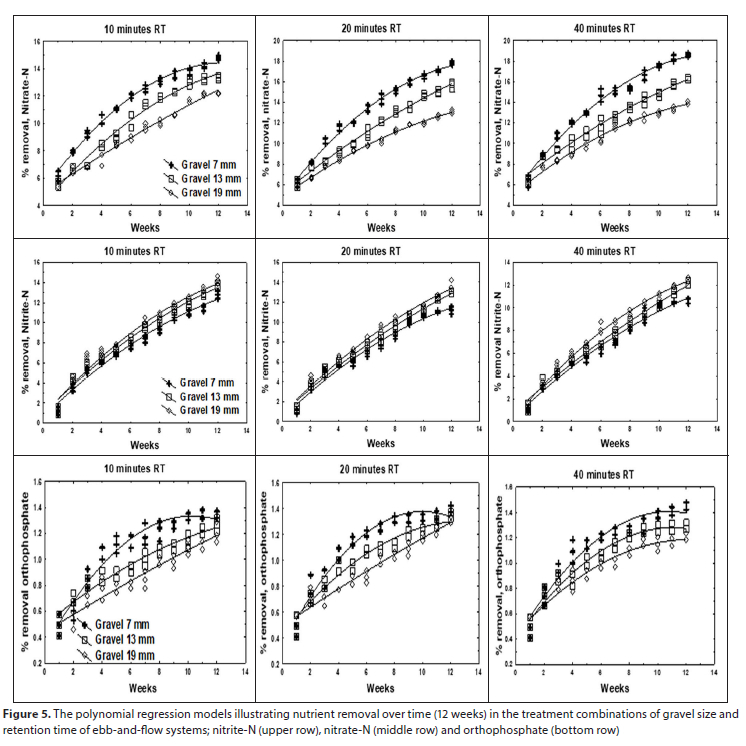
The mean removal for nitrite-N, nitrate-N and orthophosphate was influenced by an interaction between RT and gravel size (multifactorial ANOVA, p < 0.001, Fig. 3iii-v). Nitrite-N removal decreased with increasing retention time and gravel surface area, with the highest mean removal of 14.23 ± 0.22% at an RT of 10-min with 19-mm gravel and the lowest removal of 10.53 ± 0.13% at 40-min RT with 7-mm gravel (Fig. 3iii).
Nitrate-N removal increased with increasing RT and gravel surface area (Fig. 3iv). The highest mean nitrate-N removal was 18.63 ± 0.09% at an RT of 40 min combined with 7-mm gravel and the lowest mean was 12.20 ± 0.02% at 10-min RT with 19-mm gravel size. Orthophosphate removal was below 5% in all treatment combinations (Fig. 3vi).
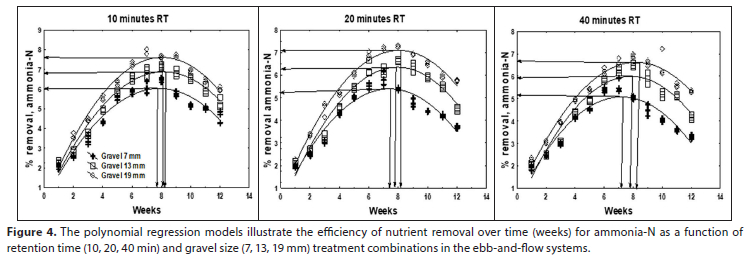
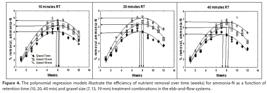
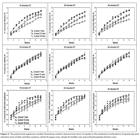
Figure 4 shows polynomial regression models illustrating the estimated number of weeks and the peak values for ammonia-N removal. Ammonia-N removal was highest at 19-mm gravel, achieving a maximum removal efficiency after 8 weeks, while 7-mm and 13-mm gravel treatment combinations peaked between Weeks 7 and 8 (Fig. 4).
Nitrite-N and nitrate-N removal increased as a function of time with maximum values at Week 12 with different peaks between treatments (p < 0.001, Fig. 5). The 19-mm gravel treatment combinations had the highest maximum values for nitrite-N removal while the 7-mm gravel had the highest nitrite-N removal in all the treatment combinations (Fig. 5).
DISCUSSION
The dissolved oxygen (DO) concentration at the inflow originated from a single source, while the outflow concentration differed between retention time and gravel size treatments. The higher concentration of DO at the outflow than at the inflow may be caused by the ebb-and-flow operation that diffuses atmospheric oxygen into the system to occupy voids left between the gravel particles in subsequent drain phases (Austin et al., 2006; Li et al., 2015).
The combined effect of retention time and gravel size influenced the removal of nutrients from the post-AD effluent in the ebb-and-flow systems. The higher removal efficiencies for ammonia-N, nitrite-N and COD at 10-min RT with 19-mm gravel could be attributed to the large interstitial spaces between gravel particle sizes, which could allow more oxygen transfer in the drain cycles. The small gravel particles have smaller interstitial spaces, potentially limiting the suction of atmospheric oxygen for the oxidation of ammonia-N and COD. Austin (2006) and Gregory et al. (2012) explained that ammonia adsorption onto the biofilm of the substrate in a tidal wetland occurs during flooding, while the drain phase facilitates rapid oxidation of the adsorbed ammonium to nitrite and nitrate through nitrification. Similarly, De Jong (2019) reported that the high DO profiles at 15- and 30-min RTs oxidised ammonia more rapidly than at the 60-min RT. The 40-min RT and 7-mm gravel treatment combinations may have restricted oxygen supply, limiting the oxidation of ammonia-N and organic matter.
Some authors suggested that the short effluent retention reduces the contact time between microorganisms and nutrients, thereby limiting system performance (Akratos and Tsihrintzis, 2007; Lee and Fletcher, 2009; Saeed and Sun, 2012). However, according to Fick's law, rapid diffusion of oxygen at the air-water interface and across biofilms (<100 μm) occurs within a few seconds (USEPA, 2000; Austin, 2006). In the present study, the short effluent retention time had rapid aeration cycles on the biofilm attached to the gravel in the ebb-and-flow system.
Temperature ranged from 22-28°C, which is within the range for effective microbial growth and metabolism for diverse microorganisms. Truu et al. (2009) reported the optimal temperature for nitrification activity as 28-36°C. Meng et al. (2014) reported fast growth of ammonia-oxidizing bacteria at temperatures above 15°C.
The higher removal efficiency of nitrate-N at 40-min RT and 7-mm gravel could be ascribed to a longer flooding phase that depleted dissolved oxygen, thus more nitrate-N was transformed to nitrite-N. Heterotrophic denitrifying microorganisms use nitrate as an electron acceptor for anaerobic respiration (Seifi and Fazaelipoor, 2012; Ni et al., 2017), which could also contribute to nitrate-N removal. Effective denitrification is not only influenced by oxygen concentration but also by adequate carbon in the effluent (Wang et al., 2015; Winkler and Straka, 2019). Determining the organic carbon to nitrogen ratio (C:N) of the post-AD brewery effluent will help to evaluate denitrification efficiency in these filter systems. Low nitrate-N removal at 10-min RT and in the 19-mm gravel size could be associated with more nitrate produced from the rapid oxidation of ammonia.
Orthophosphate removal was below 5% in all treatments. The inflow concentration ranged from 10.96-21.82 mg·L−1. Phosphoric acid used as a cleaning detergent in upstream activities could have contributed to high influent concentration (Cilliers, 2012; Simate et al., 2011). The gravel substrate used in this study has unreactive surfaces for phosphorus adsorption. Xu et al. (2006) compared gravel and iron slag-filled wetlands at an HLR of 0.1 m·d−1 for a pre-treated domestic effluent and reported 44% and 1% orthophosphate removal, respectively, similar to the low removal rate in this study. Phosphorus removal in CW can be improved by using high cation exchange capacity substrates, regular plant harvest, and assimilation by phosphorus-accumulating organisms (PAOs) (Vymazal, 2010; Vohla et al., 2011; Shukla et al., 2020). PAOs grow slowly and can be enriched under aerobic and anaerobic conditions (De-Bashan and Bashan, 2004; Winkler and Straka, 2019).
Recent studies have mainly focused on the efficiency of tidal wetlands in nutrient removal, while the period of efficiency during operation was not reported. This study contributes to effluent treatment by estimating the period for maximum nutrient removal in the ebb-and-flow filters. A decrease in ammonia-N removal after 8 weeks of operation could be contributed by biofilm formation between the interstitial spaces of gravel particles over time. The thick biofilm layers can limit the diffusion of atmospheric oxygen for the oxidation of ammonia-N within the system. Microorganisms produce extracellular polymeric substances and, in excess, could reduce the porosity of the substrate (Zhou et al., 2020). Dense biofilm loses stability and may detach aggregates of slow-growing nitrifying bacteria through sloughing (Chaudhary et al., 2003; Knowles et al., 2011), thus affecting the removal efficiency. The reduced ammonia-N removal efficiency suggests that treatment of the brewery effluent requires further system design optimization, which can be evaluated for a longer period. The progressive trends for nitrite-N, nitrate-N and orthophosphate removal could be associated with reduced oxygen transfer into the substrate, favouring the growth of denitrifying and anammox microorganisms in removing these nutrients (Ni et al., 2017; Guo et al., 2020). In addition, anammox bacteria do not need external carbon for metabolism (Winkler and Straka, 2019; Guo et al., 2020), which may have improved the removal efficiencies.
Estimating the nitrogen removal based on the three inorganic nitrogenous compounds measured in this study may result in values that differ from the total nitrogen removal. Other nitrogen compounds which were not measured should be considered in future studies. The breakdown of organic matter/mineralization also contributes to organic nitrogen, which can be transformed to inorganic nitrogen in the wastewater treatment process (Vymazal 2007). Kizito et al. (2017) reported a low total nitrogen removal of 22% in gravel media and 47% in corn cob biochar in the tidal systems treating anaerobically digested effluent. The biochars' carbon content and large surface area for attachment of heterotrophic denitrifying bacteria improved nitrogen removal. Zhang et al. (2021) compared lab-scale tidal systems of gravel and a mixture of gravel and zeolite media, operated at 2, 3 and 4 m·d−1 hydraulic loading rates. The total nitrogen removal range (5.4-11.4%) for combined gravel and zeolite (24-43%) was attributed to the inflowing water's low carbon:nitrogen ratio. These studies have indicated low nitrogen removal on gravel media. Therefore, effective nitrogen removal in tidal wetlands requires sequential nitrification and denitrification, with an optimal carbon supply.
A study by De Jong (2019) on effluent retention times of 15, 30, and 60 min in tidal CW treating anaerobically digested brewery effluent recommended shorter RTs of 15-min and 30-min. An extension of the shorter RTs from a study by De Jong (2019) has been confirmed to improve ammonia-N removal and COD reduction. The overall treatment efficiency differed in these studies and could be attributed to system design and the study period. The author used a 5-day batch cycle tidal design over 5 months, while the current study used a single-pass tidal design for 3 months. The anaerobic digester effluent is a unique effluent with varied compositions of pollutants, depending on the season and circumstances of the anaerobic digester system breakdown. The high concentration of ammonia and phosphorus, high conductivity, and high pH contributed to the CW's performance for nutrient removal in this study. Therefore, the recycling of effluent, incorporation of plants, and high cation exchange capacity substrates should be tested to improve nutrient removal in the ebb-and-flow systems.
CONCLUSION
The ebb-and-flow operation, effluent retention time and gravel particle size influenced nutrient removal from a post-anaerobic digester effluent. A 10-min RT in a CW with 19-mm gravel achieved removal efficiencies of 7.7% for ammonia-N, and 8.2% for COD reduction. The 40-min RT with 7-mm gravel had the highest nitrate-N removal, at 18.6%. Orthophosphate removal was below 5%. The peak removal efficiency for ammonia-N was after 8 weeks, while nitrite-N and nitrate-N removal was progressive over time. Therefore, the efficiency of ebb-and-flow design for nutrient removal from a brewery effluent was time-dependent.
RECOMMENDATIONThe study recommends a short effluent retention time of 10-min with 19-mm gravel to improve nitrogen removal and reduction of COD in a single-pass ebb-and-flow filter. The effluent to be treated was high strength and the system performance was effective after 8 weeks. The ebb-and-flow filter design characteristics in this study can be applied to treating other industrial and aquaculture effluents, depending on the effluent's nature and strength. When maximum nutrient removal is reached, a restoration strategy of backwashing the gravel should be considered for continued operation. Further optimisation is required to examine substrates with high cation exchange capacity, and incorporation of plants and earthworms to degrade clogged organic matter on the wetland substrate.
AUTHOR CONTRIBUTIONSDr Richard Taylor and Prof. Horst Kaiser were responsible for the conceptualisation, study design and data analysis. Dr Richard Taylor participated in setting up the experiment and procuring reagents and chemicals. Elizabeth Obado participated in setting up the experiment, data collection, analysis and writing the manuscript. Prof. Liti, Prof. Manyala, Dr Agembe and Dr Nyiko supervised the study and reviewed manuscript drafts.
ACKNOWLEDGEMENTS
This research was funded by the European Commission/African Union's Inter-Africa Academic Mobility Scheme (EACEA/05/2017), the Research Technology Fund (RTF) at Rhodes University and TaylorMade Water Solutions (Pty) Ltd. Special thanks to the University of Eldoret, the Department of Ichthyology and Fisheries Science at Rhodes University, South African Brewery Ltd, the employees and the Project Eden research facility at the brewery.
REFERENCES
-
AKRATOS CS and TSIHRINTZIS VA (2007) Effect of temperature, HRT, vegetation and porous media on removal efficiency of pilot-scale horizontal subsurface flow constructed wetlands. Ecol. Eng. 29 (2) 173-191. https://doi.org/10.1016/j.ecoleng.2006.06.013
» https://doi.org/10.1016/j.ecoleng.2006.06.013 -
AL-WAHAIBI BM, JAFARY T, AL-MAMUN A and STEFANAKIS AI (2021) Operational modification of a full-scale experimental vertical flow constructed wetland with effluent recirculation to optimize total nitrogen removal. J. Clean. Prod. 296 126558. https://doi.org/10.1016/j.jclepro.2021.126558
» https://doi.org/10.1016/j.jclepro.2021.126558 -
ALMUKTAR SAAAN, SCHOLZ M, AL-ISAWI RHK and SANI A (2015) Recycling of domestic wastewater treated by vertical-flow wetlands for irrigating chillies and sweet peppers. J. Agric. Water Manage. 149 1-22. https://doi.org/10.1016/j.Agwat.2014.10.025
» https://doi.org/10.1016/j.Agwat.2014.10.025 -
ALMUKTAR SAAAN, ABED SN and SCHOLZ M (2018) Wetlands for wastewater treatment and subsequent recycling of treated effluent: a review. Environ. Sci. Pollut. Res. 25 23595-23623. https://doi.org/10.1007/s11356-018-2629-3
» https://doi.org/10.1007/s11356-018-2629-3 - AUSTIN D, LOHAN E and VERSON E (2003) Nitrification and denitrification in a tidal vertical flow wetland pilot. In: Proceedings of the Water Environment Federation Technical Conference, Los Angeles. 1-25.
-
AUSTIN D (2006) Influence of cation exchange capacity (CEC) in a tidal flow, flood and drain wastewater treatment wetland. Ecol. Eng. 8 35-43. https://doi.org/10.1016/j.ecoleng.2006.03.010
» https://doi.org/10.1016/j.ecoleng.2006.03.010 -
BEHRENDS L, HOUKE L, BAILEY E, JANSEN P and BROWN D (2000) Reciprocating constructed wetlands for treating industrial, municipal, and agricultural wastewater. Water Sci. Technol. 44 (11-12) 399-405. https://doi.org/10.2166/wst.2001.0858
» https://doi.org/10.2166/wst.2001.0858 -
CHAUDHARY DS, VIGNESWARAN S, NGO HH, SHIM WG and MOON H (2003) Biofilter in water and wastewater treatment. Korean J. Chem. Eng. 20 (6) 1054-1065. https://doi.org/10.1007/BF02706936
» https://doi.org/10.1007/BF02706936 - CILLIERS A (2012) The treatment of brewery effluent using an integrated high-rate algal ponding system. Masters thesis, Rhodes University. 160 pp.
-
DE-BASHAN LE and BASHAN Y (2004) Recent advances in removing phosphorus from wastewater and its future use as fertilizer (1997−2003). Water Res. 38 (19) 4222-4246. https://doi.org/10.1016/j.watres.2004.07.014
» https://doi.org/10.1016/j.watres.2004.07.014 - DE JONG M (2019) The integration of effluent treatment using constructed wetlands, with crop production and aquaculture. Masters thesis, Rhodes University. 154 pp.
-
DE LA VARGA D, SOTO M, ARIAS CA, VAN OIRSCHOT D, KILIAN R, PASCUAL A and ÁLVAREZ JA (2016) Constructed wetlands for industrial wastewater treatment and removal of nutrients. In: Technologies for the Treatment and Recovery of Nutrients from Industrial Wastewater. IGI Global Book Series Advances in Environmental Engineering and Green Technologies. 203-230. https://doi.org/10.4018/978-1-5225-1037-6.ch008
» https://doi.org/10.4018/978-1-5225-1037-6.ch008 -
DONG H, QIANG Z, LI T, JIN H and CHEN W (2012) Effect of artificial aeration on the performance of vertical-flow constructed wetland treating heavily polluted river water. J. Environ. Sci. 24 (4) 596-60. https://doi.org/10.1016/S1001-0742(11)60804-8
» https://doi.org/10.1016/S1001-0742(11)60804-8 -
GÖTZ G, GEIßEN SU, AHRENS A and REIMANN S (2014) Adjustment of the wastewater matrix for optimization of membrane systems applied for water reuse in breweries. J. Membr. Sci. 465 68-77. https://doi.org/10.1016/j.memsci.2014.04.014
» https://doi.org/10.1016/j.memsci.2014.04.014 -
GREGORY SP, DYSON PJ, FLETCHER D, GATLAND P and SHIELDS RJ (2012) Nitrogen removal and changes to microbial communities in model flood/drain and submerged biofilters treating aquaculture wastewater. Aquacult. Eng. 50 37-45. https://doi.org/10.1016/j.aquaeng.2012.03.006
» https://doi.org/10.1016/j.aquaeng.2012.03.006 -
GUO Y, CHEN Y, WEBECK E and LI YY (2020) Towards more efficient nitrogen removal and phosphorus recovery from digestion effluent: Latest developments in the anammox-based process from the application perspective. Bioresour. Technol. 299 122560. https://doi.org/10.1016/j.biortech.2019.122560
» https://doi.org/10.1016/j.biortech.2019.122560 -
JAIYEOLA AT and BWAPWA JK (2016) Treatment technology for brewery wastewater in a water-scarce country: A review. S. Afr. J. Sci. 112 (3-4) 1-8. https://doi.org/10.17159/sajs.2016/20150069
» https://doi.org/10.17159/sajs.2016/20150069 - JONES CLW, BRITZ PJ, SCHEEPERS R, POWER S, CILLIERS A and LAUBSCHER R (2014) Environmentally sustainable beneficiation of brewery effluent: Algal ponding, constructed wetland, hydroponic vegetables and aquaculture. WRC Report No. TT601/14. Water Research Commission, Pretoria.
-
KIZITO S, LV T, WU S, AJMAL Z, LUO H and DONG R (2017) Treatment of anaerobic digested effluent in biochar-packed vertical flow constructed wetland columns: Role of media and tidal operation. Sci. Tot. Environ. 592 197-205. https://doi.org/10.1016/j.scitotenv.2017.03.125
» https://doi.org/10.1016/j.scitotenv.2017.03.125 -
KNOWLES P, DOTRO G, NIVALA J and GARCÍA J (2011) Clogging in subsurface-flow treatment wetlands: Occurrence and contributing factors. Ecol. Eng. 37 (2) 99-112. https://doi.org/10.1016/j.ecoleng.2010.08.005
» https://doi.org/10.1016/j.ecoleng.2010.08.005 -
LEE C and FLETCHER TD (2009) Nitrogen removal in constructed wetland systems. Eng. Life. Sci. 9 (1) 11-22. https://doi.org/10.1002/elsc.200800049
» https://doi.org/10.1002/elsc.200800049 -
LI L, HE C, JI G, ZHI W and SHENG L (2015) Nitrogen removal pathways in a tidal flow constructed wetland under flooded time constraints. Ecol. Eng. 81 266-271. https://doi.org/10.1016/j.ecoleng.2015.04.073
» https://doi.org/10.1016/j.ecoleng.2015.04.073 -
LI J, HU Z, LI F, FAN J, ZHANG J, LI F and HU H (2019) Effect of oxygen supply strategy on nitrogen removal of biochar-based vertical subsurface flow constructed wetland: Intermittent aeration and tidal flow. Chemosphere 223 366-374. https://doi.org/10.1016/j.chemosphere.2019.02.082
» https://doi.org/10.1016/j.chemosphere.2019.02.082 -
MANUNGUFALA TE (2021) Water scarcity: classification, measurement and management. Clean Water Sanit. 1-15. https://doi.org/10.1007/978-3-319-70061-8
» https://doi.org/10.1007/978-3-319-70061-8 -
MENG P, PEI H, HU W, SHAO Y and LI Z (2014) How to increase microbial degradation in constructed wetlands : Influencing factors and improvement measures. Bioresour. Technol. 157 316-326. https://doi.org/10.1016/j.biortech.2014.01.095
» https://doi.org/10.1016/j.biortech.2014.01.095 -
MIRANDA ST, MATOS AT, MATOS MP, BORGESAC and BAPTESTIN GCF (2017) Characterization of clogging material from horizontal subsurface flow constructed wetland systems. Eng. Agríc. Jaboticabal 37 (3) 463-470. https://doi.org/10.1590/1809-4430-eng.agric.v37n3p463-470/2017
» https://doi.org/10.1590/1809-4430-eng.agric.v37n3p463-470/2017 -
NAIK PK (2017) Water crisis in Africa: myth or reality? Int. J. Water Resour. Dev. 33 (2) 326-339. https://doi.org/10.1080/07900627.2016.1188266
» https://doi.org/10.1080/07900627.2016.1188266 -
NI BJ, PAN Y, GUO J, VIRDIS B, HU S, CHEN X and YUAN Z (2017) Denitrification processes for wastewater treatment. RSC Metallobiol. 9 368−418. https://doi.org/10.1039/9781782623762-00368
» https://doi.org/10.1039/9781782623762-00368 -
NIVALA J, KNOWLES P, DOTRO G, GARCÍA J and WALLACE S (2012) Clogging in subsurface-flow treatment wetlands: Measurement, modeling and management. Water Res. 46 (6) 1625-1640. https://doi.org/10.1016/j.watres.2011.12.051
» https://doi.org/10.1016/j.watres.2011.12.051 -
POWER SD and JONES CLW (2016) Anaerobically digested brewery effluent as a medium for hydroponic crop production - the influence of algal ponds and pH. J. Clean. Prod. 139 167-174. https://doi.org/10.1016/j.jclepro.2016.07.189
» https://doi.org/10.1016/j.jclepro.2016.07.189 -
RIERA-VILA I, ANDERSON NO, HODGE CF and ROGERS M (2019) Anaerobically-digested brewery wastewater as a nutrient solution for substrate-based food production. Horticulturae 5 (2). https://doi.org/10.3390/horticulturae5020043
» https://doi.org/10.3390/horticulturae5020043 -
RONAN E, AQEEL H, WOLFAARDT GM, and LISS SN (2021) Recent advancements in the biological treatment of high-strength ammonia wastewater. J. Micro. Biotech. 37 (9) 1-17. https://doi.org/10.1007/s11274-021-03124-0
» https://doi.org/10.1007/s11274-021-03124-0 -
SAEED T and SUN G (2012) A review on nitrogen and organics removal mechanisms in subsurface flow constructed wetlands : Dependency on environmental parameters, operating conditions and supporting media. J. Environ. Manage. 112 429-448. https://doi.org/10.1016/j.jenvman.2012.08.011
» https://doi.org/10.1016/j.jenvman.2012.08.011 -
SEIFI M and FAZAELIPOOR MH (2012) Modeling simultaneous nitrification and denitrification (SND) in a fluidized bed biofilm reactor. J. Appl. Math. Model. 36 (11) 5603-5613. https://doi.org/10.1016/j.apm.2012.01.004
» https://doi.org/10.1016/j.apm.2012.01.004 -
SHUKLA S, RAJTA A, SETIA H and BHATIA R (2020) Simultaneous nitrification-denitrification by phosphate accumulating micro-organisms. World J. Microb. Biotechnol. 36 (10) 1-17. https://doi.org/10.1007/s11274-020-02926-y
» https://doi.org/10.1007/s11274-020-02926-y -
SIMATE GS, CLUETT J, IYUKE SE, MUSAPATIKA ET, NDLOVUS, WALUBITA LF and ALVAREZ AE (2011) The treatment of brewery wastewater for reuse: State of the art. Desalin. 273 (2-3) 235-247. https://doi.org/10.1016/j.desal.2011.02.035
» https://doi.org/10.1016/j.desal.2011.02.035 -
TAYLOR RP, JONES LW, LAING M and DAMES J (2018) The potential use of treated brewery effluent as a water and nutrient source in irrigated crop production. J. Water Res. Ind. 19 47-60. https://doi.org/10.1016/j.wri.2018.02.001
» https://doi.org/10.1016/j.wri.2018.02.001 -
TRUU M, JUHANSON J and TRUU J (2009) Microbial biomass, activity and community composition in constructed wetlands. Sci. Tot. Environ. 407 (13) 3958-3971. https://doi.org/10.1016/j.scitotenv.2008.11.036
» https://doi.org/10.1016/j.scitotenv.2008.11.036 - USEPA (United States Environmental Protection Agency) (2000) Constructed wetland treatment for municipal wastewater. EPA/625/R-99/010. Office of Research and Development. USEPA, Cincinnati, OH. 166 pp.
-
VOHLA C, KÕIV M, BAVOR HJ, CHAZARENC F and MANDER Ü (2011) Filter materials for phosphorus removal from wastewater in treatment wetlands - A review. Ecol. Eng. 37 (1) 70-89. https://doi.org/10.1016/j.ecoleng.2009.08.003
» https://doi.org/10.1016/j.ecoleng.2009.08.003 -
VYMAZAL J (2007) Removal of nutrients in various types of constructed wetlands. Sci. Tot. Environ. 380 48-65. https://doi.org/10.1016/j.scitotenv.2006.09.014
» https://doi.org/10.1016/j.scitotenv.2006.09.014 -
VYMAZAL J (2010) Constructed wetlands for wastewater treatment. Water 2 530-549. https://doi.org/10.3390/w2030530
» https://doi.org/10.3390/w2030530 -
VYMAZAL J (2018) Does clogging affect the long-term removal of organics and suspended solids in gravel-based horizontal subsurface flow-constructed wetlands? Chem. Eng. J. 33 663-674. https://doi.org/10.1016/j.cej.2017.09.048
» https://doi.org/10.1016/j.cej.2017.09.048 - WALLACE SD (2009) Treatment Wetlands (2nd edn). Taylor and Francis Group, CRC Press, Boca Raton. 153 pp.
-
WANG H, SHENG L and XU J (2021). Clogging mechanisms of constructed wetlands: A critical review. J. Clean. Prod. 295 126455. https://doi.org/10.1016/j.jclepro.2021.126455
» https://doi.org/10.1016/j.jclepro.2021.126455 -
WANG X, TIAN Y, ZHAO X, PENG S, WU Q and YAN L (2015) Effects of aeration position on organics, nitrogen and phosphorus removal in combined oxidation pond-constructed wetland systems. Bioresour. Technol. 198 7-15. https://doi.org/10.1016/j.biortech.2015.08.150
» https://doi.org/10.1016/j.biortech.2015.08.150 -
WINKLER MK and STRAKA L (2019) New directions in biological nitrogen removal and recovery from wastewater. Curr. Opin. Biotechnol. 57 50-55. https://doi.org/10.1016/j.copbio.2018.12.007
» https://doi.org/10.1016/j.copbio.2018.12.007 -
XU D, XU J, WU J and MUHAMMAD A (2006) Studies on the phosphorus sorption capacity of substrates used in constructed wetland systems. Chemosphere 63 344-352. https://doi.org/10.1016/j.chemosphere.2005.08.036
» https://doi.org/10.1016/j.chemosphere.2005.08.036 -
ZHANG Q, YANG Y, CHEN F, ZHANG L, RUAN J, WU S and ZHU R (2021) Effects of hydraulic loading rate and substrate on ammonium removal in tidal flow constructed wetlands treating black and odorous water bodies. Bioresour. Technol. 321 124468. https://doi.org/10.1016/j.biortech.2020.124468
» https://doi.org/10.1016/j.biortech.2020.124468 -
ZHOU X, CHEN Z, LI Z and WU H (2020) Impacts of aeration and biochar addition on extracellular polymeric substances and microbial communities in constructed wetlands for low C/N wastewater treatment: Implications for clogging. Chem. Eng. J. 396 125349. https://doi.org/10.1016/j.cej.2020.125349
» https://doi.org/10.1016/j.cej.2020.125349
Accepted: 12 June 2026