Degradation of methyl orange by the Fenton-like reaction of pyrite-activated hydrogen peroxide forming the Fe(lll)/Fe(ll) cycle
Abstract
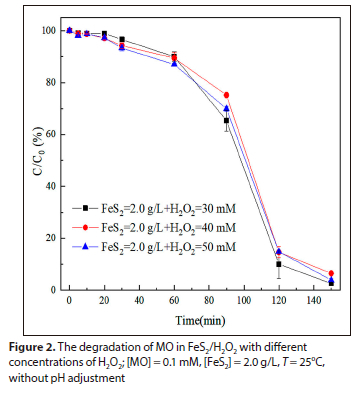
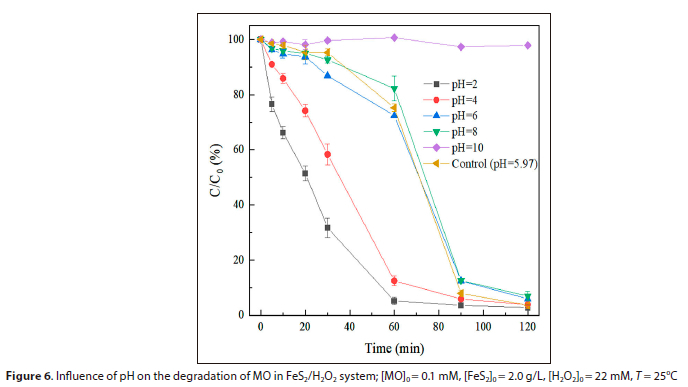
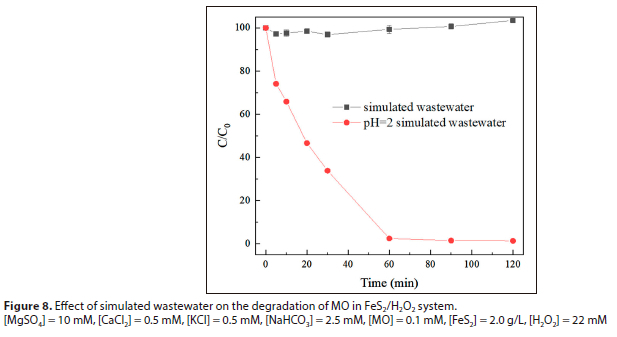
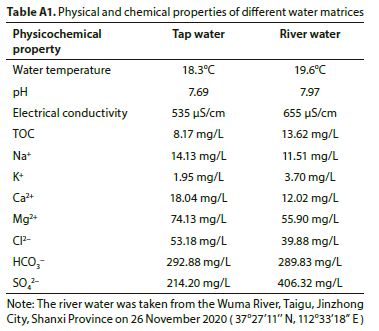
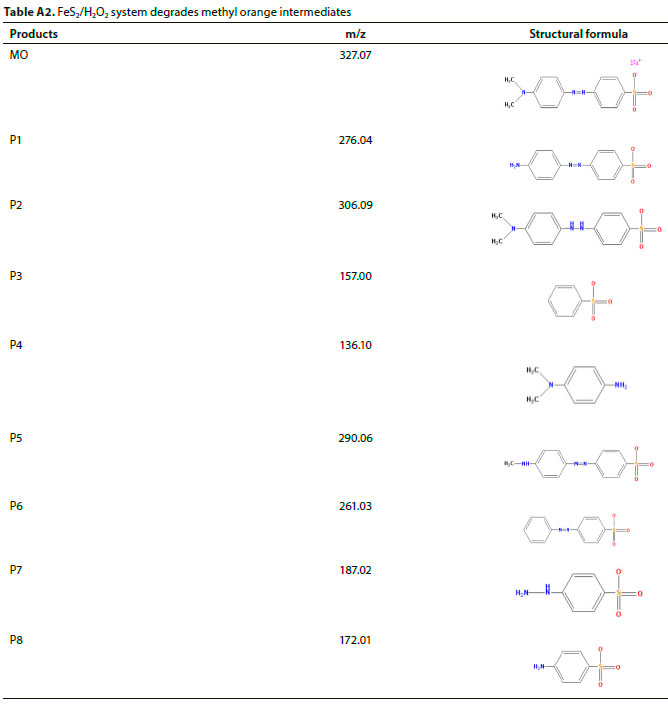
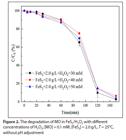
In this study, the typical azo dye methyl orange (MO) was degraded by pyrite (FeS2) activated by hydrogen peroxide (H2O2). When [MO] = 0.1 mM, [FeSJ = 2.0 g/L and [H2O2] = 22 mM, 96.4% MO was removed in 120 min and the TOC removal rate was higher than 50%. HO* was the primary radical responsible for MO degradation, in addition, the acid condition promoted the degradation of MO in the FeS2/H2O2 system. MO in tap water and river water was not effectively degraded, whereas acidification could weaken the inhibitory effect on the FeS2/ H2O2 system to enable the degradation of MO in tap and river water. The OD600 indicated that the solution was environmentally friendly after the reaction, and three degradation pathways of MO were discussed. In summary, Fe(ll) could be dissolved from FeS2, which activated H2O2 to generate Fe(lll) and HO*. FeS2 could reduce Fe(lll) into Fe(ll), thus realizing the Fe(lll)/(ll) cycle and efficiently activating H2O2 to degrade MO.
pyrite; hydrogen peroxide; methyl orange; advanced oxidation processes
 Thumbnail
 Thumbnail
 Thumbnail
 Thumbnail
 Thumbnail
 Thumbnail
 Thumbnail
 Thumbnail
 Thumbnail