Irrigation water rights trade and irrigation efficiency: evidence from China
Abstract
As an important market-oriented mechanism for allocating water resources, water rights trading has the potential to promote more efficient agricultural water use. Using city‑level panel data from China, this study first employs stochastic frontier analysis (SFA) to estimate irrigation efficiency. This study then applies a combination of difference‑in‑differences (DID) and event study approaches to identify the causal effect of irrigation water rights trading (IWRT) on irrigation efficiency. The empirical results show that IWRT leads to an average increase of 4.44% in irrigation efficiency. This finding remains robust after controlling for confounding policies and excluding cases involving water rights conversion. Heterogeneity analysis further reveals that the positive impact of IWRT is more pronounced in relatively arid regions and in areas characterized by small‑scale planting. Overall, these findings provide important policy implications for the design of water rights markets and for efforts to promote agricultural water conservation.
water scarcity; water rights trade; irrigation efficiency; China
INTRODUCTION
As a traditional strategic resource, water resources are an important material basis for human survival and sustainable economic and social development (Loucks, 2000). With the uncertainty brought about by climate change and the advancement of urbanization, under the objective condition that the total amount of water resources cannot be increased, competition for water resources will inevitably arise, which will also become an important factor affecting economic development (Flörke et al., 2018). In China, the total water resources are relatively abundant, but per capita water resources are relatively low, at only one-fourth of the world's per capita level, and China is also listed as one of the 13 water-poor countries by the United Nations (Ge et al., 2011). Therefore, China's water resources problem is one of the important issues that inhibit China's economic development. China has a large agricultural sector, so water resource management has always been an important issue in governing the country. In China, the agricultural sector is a major water user, accounting for more than 60% of the country's total water consumption (Kahrl and Roland-Holst, 2008).
Due to the uneven distribution of water resources around the world, some countries are facing a great shortage, which poses a water resource constraint to the economic development of countries in arid regions (Qadir et al., 2007). In particular, with the rapid economic development of developing countries, the reduction of arable land, climate change and water shortages will constrain the use of water for agricultural production, and even create water resource conflicts between the agricultural sector and the non-agricultural sector (Flörke et al., 2018). Agriculture is the production sector with the largest water consumption, accounting for about 70% of total demand. Therefore, water conservation in the agricultural sector is an important way to alleviate water resource conflicts (Grafton et al., 2018). In order to alleviate these conflicts between the agricultural and non-agricultural sector, efficiency of irrigation can be improved by adopting water-saving irrigation, thereby achieving agricultural water conservation while ensuring agricultural production (Deng et al., 2006).
Existing research on the influencing factors of irrigation efficiency mostly focuses on the personal internal characteristics of farmers, and there are relatively few studies in the literature exploring external influencing factors. From the perspective of farmers, per capita disposable income and education level are key factors affecting irrigation efficiency (Wang et al., 2019). In addition, factors such as total crop planting area, total reservoir capacity, water-saving machinery, and the number of electric and diesel engines also have a certain impact on irrigation efficiency (Wang et al., 2019). In addition, farmers will develop economies of scale as their production rate of return continues to increase, thereby saving input costs. In this context, they will improve water resource utilization efficiency by adopting efficient water-saving irrigation systems for agricultural production (Gadanakis et al., 2015).
Reform of the water rights system based on market-oriented tools may also become an important way to promote the improvement of irrigation efficiency (Rosegrant and Binswanger, 1994). Water rights reform can achieve the transfer of water resources from the agricultural sector to the non-agricultural sector. However, the transfer of water rights does not mean giving up agricultural irrigation. Instead, through efficient water-saving irrigation and strengthened management, the agricultural sector can obtain compensation from the non-agricultural sector after transferring water resources to the non‑agricultural sector. These compensations can be used for investment and management of water‑saving irrigation in the agricultural sector (Wang, 2012). Fang and Zhang (2020) used provincial panel data to find that water rights pilot projects are conducive to the popularization of water-saving irrigation technology. Therefore, water rights reform may promote the adoption of water-saving irrigation technology, and thus promote the improvement of irrigation efficiency. Based on this, this study uses municipal panel data to further analyse the impact of irrigation water rights trade (IWRT) on irrigation efficiency, and adopts a variety of estimation methods to ensure the robustness of the estimation results.
CONTEXT OF WATER RIGHTS REFORMHistory of water rights reform in China
At the beginning of the founding of New China, agriculture in the Yellow River Basin developed rapidly and the demand for irrigation water became more vigorous (Xin et al., 2024). During this period, China's water conservancy facilities were built, with emphasis on construction and neglected management, with facility construction being given priority while water resource management was relatively weak. During the entire planned economy period, the irrigated area increased to 5 times that of the early years of the People's Republic of China (China Water, 2011). At the same time, water conservancy facilities were further improved, but water use was relatively extensive. Up until the eve of reform and opening up, water consumption reached 4 times that of the early days of the founding of the People's Republic of China (Biswas, 1982). With the increase in water consumption, the mismatch between water supply and demand in the Yellow River Basin gradually emerged. In order to cope with the gap between water supply and demand of the Yellow River, the State Planning Commission organized the preparation of the Yellow River Basin Comprehensive Utilization Plan in 1954, which allocated the water resources of the entire river for the first time and allocated the expected amount of water diverted from the Yellow River to each province (Chinese People's Political Consultative Conference, 2017).
Since the reform and opening up, China's economic system has also undergone important changes, along with China's water resource management system. Water resource management in the Yellow River Basin has also been gradually improved during this period. Since the 1980s, with the rapid development of the non‑agricultural economy and the large proportion of agricultural water use, the overall water consumption has increased significantly, resulting in the interruption of the lower reaches of the Yellow River (Nakayama, 2010). In order to alleviate the contradiction between water supply and demand, the State Council issued the "Notice of the General Office of the State Council on Forwarding the Report of the State Planning Commission and the Ministry of Water Resources on the Yellow River Water Supply Plan" in 1987. The plan stipulates the water use share of the provinces along the Yellow River, referred to as the "87 Water Divide" plan. The water diversion plan involves 11 provinces (autonomous regions and municipalities) along the Yellow River. Specifically, Qinghai, Sichuan, Gansu, Ningxia, Inner Mongolia, Shaanxi, Shanxi, Henan and Shandong were allocated 14.1, 0.4, 30.4, 40.0, 58.6, 38.0, 43.1, 55.4 and 70.0 billion cubic meters of water, respectively (Ministry of Water Resources of the People's Republic of China, 2006).
In the early 21st century, the non-agricultural economy in Ningxia and Inner Mongolia developed rapidly, but the allocated water resources could not support the development of the non‑agricultural economy. Since the agricultural sector obtained a large proportion of initial water rights, but the efficiency of agricultural water resources utilization was low and the water conservancy facilities were not perfect, the agricultural sector had great potential for water conservation. Based on this, Ningxia and Inner Mongolia proposed that the industrial production sector invest in water conservancy facilities and agricultural water-saving technologies, and then transfer the water resources of the agricultural sector to the industrial sector to support the economic development of the non-agricultural sector (Ministry of Water Resources of the People's Republic of China, 2004). This plan was called "water rights conversion". The plan was also supported by the Ministry of Water Resources of China and the Yellow River Conservancy Commission. Against this background, Ningxia started a pilot project of water rights conversion in 2004, and mainly supported the development of the non-agricultural economy based on the conversion of power plants and agricultural water rights.
In 2014, in order to implement the new water conservancy policy of "water conservation first, spatial balance, system governance, and two-pronged approach", the Ministry of Water Resources of China issued the "Notice on Carrying out Water Rights Pilot Work", and selected 7 provinces (regions), including Ningxia, Jiangxi, Hubei, Gansu, Henan, Inner Mongolia, and Guangdong, to carry out water rights pilot projects (Xu and Yang, 2025). At the same time, many local provinces also started provincial water rights system reforms according to local conditions, including Hebei and Shandong. Therefore, in 2014, many places across the country started pilot work on water rights system reform, and officially began to allocate water resources through market forces, making the water rights system reform gradually mature.
In theory, as the scarcity of water resources increases, the value of water resources is gradually reflected, which provides conditions for the emergence of a new system that clarifies the division of rights (Speelman et al., 2010). At the same time, the development of modern water distribution and water measurement technology also provides technical support for the emergence of new systems, which can more reasonably allocate and trade water rights (Hu et al., 2021). In particular, the establishment of the China Water Rights Exchange in 2016 provided technical support for China's water rights trading. The platform gives full play to the important role of the market mechanism in the allocation of water resources, promotes the rational allocation, efficient utilization and effective protection of water resources, and is a national water rights trading platform that conforms to national conditions and has international influence (Lyu et al., 2024). Modern technological progress has promoted the possibility of water rights allocation and water rights trading on the one hand, and reduced the cost of the operation of the new system on the other (Xu et al., 2023). Therefore, under the favourable conditions of modern technology, the implementation of water rights system reform is conducive to promoting the effective allocation of water resources, thereby promoting economic development.
In summary, in the market-oriented water rights system construction, China's water rights system reform after reform and opening up mainly took the "87 Water Divide" plan as an important advance. The "water rights conversion" in the early 21st century was a beneficial attempt at water rights system reform. Only in 2014 did the water rights system reform gradually mature and formally introduce market forces to allocate water resources. The evolution of China's water rights system was also caused by changes in the scarcity of water resources. The "87 Water Divide" plan was proposed to deal with the problem of the Yellow River's dry-up, while the "water rights conversion" was to deal with the water resource conflicts caused by the rapid development of the non-agricultural economy. The water rights pilot proposed in 2014 was to promote ecological and environmental protection on the one hand and to promote high-quality economic development on the other.
Typical characteristics of China's current water rights reform
Water rights allocation under water rights reform
The allocation of water rights is achieved through the confirmation and registration of water resource property rights (Hartwig et al., 2018). This method can further clarify the property rights of water resources, create the mechanism for the transfer of water resource property rights, which is the prerequisite for establishing a water rights trading mechanism, and is also an important measure for the reform of water resource ownership management. The property rights registration system can protect water resources to the greatest extent, promote the optimal utilization of water resources, effectively improve water use efficiency and water resource allocation efficiency, realize the sustainable utilization of water resources, and prevent the occurrence of the "tragedy of the commons" (Crase et al., 2003).
The confirmation and registration of water resource property rights mainly refer to the clear definition and institutional arrangement of various rights and their ownership in the water resource property rights system, including the division or allocation of water resource rights. The confirmation of water resource property rights refers to the process in which the water administration department examines and confirms whether the usufruct rights of water can be established (Deng et al., 2023). In the entire confirmation and registration process, confirmation of rights is in the dominant position. Only through confirmation of rights can the relevant rights have the foundation for establishment. Registration is the formal recognition of power by the state. The registration of water resource property rights refers to the procedure in which the water administration department formally recognizes the usufruct rights of water resources that have been reviewed and confirmed through the confirmation procedure and publicizes them to society (Deng et al., 2023). The public announcement of water withdrawal rights through registration is a prerequisite for water withdrawal rights transactions. At the same time, registration and publicity are also an important basis for the priority of water withdrawal rights.
Water rights trading under the water rights reform
An important aspect of the reform of the water rights system is that it can promote water rights allocation and water rights trading. Water rights allocation can reduce the risk of water resource utilization through the initial allocation of water resources, thereby promoting an increase in factor inputs, while water rights trading is conducive to the reconfiguration of water resources, which can realize more efficient allocation of water resources (Tisdell and Harrison, 1992). The largest platform for recording water rights trading information in China is the China Water Rights Exchange Company Limited. The establishment of this platform promotes the standardized and orderly development of water rights trading, to improve the efficiency of water resource utilization, and support for the sustainable use of water resources and the sustainable development of the economy and society.
There are three main forms of water rights trading: irrigation water user water rights trading, water withdrawal rights trading, and regional water rights trading. Among them, irrigation water user water rights trading occurs within the agricultural sector. Water rights trading for irrigation water users is a water rights trading between irrigation water users or water use organizations within the irrigation area with clear water use rights and interests (Lyu et al., 2024). The irrigation area management unit shall create conditions for the conduct of water rights trading for irrigation water users, and shall publish the water use rights and interests determined in accordance with the law and their changes (Xu et al., 2023). The water administration department and the irrigation area management unit may repurchase the water rights of irrigation water users or water use organizations, which can be used for the reconfiguration of water rights in the irrigation area or for water rights trading (Ministry of Water Resources of the People's Republic of China, 2016).
Water withdrawal rights trading refers to the transfer of corresponding water rights to other qualified units or individuals for a fee within the validity period of the water withdrawal permit and withdrawal limit by units or individuals (including water rights holders in industry, agriculture, and service industries other than urban public water supply enterprises) who have obtained water rights and save water resources by adjusting product and industrial structure, technology reform, and water‑saving measures.
TYPICAL CASE OF IRRIGATION WATER RIGHTS TRADECase 1: Irrigation water rights trade in Yuanshi County, Hebei Province
Yuanshi County is located in the south-central part of Hebei Province in China, which is a large agricultural county. Groundwater extraction accounts for 83% of the county's water use. At the same time, Yuanshi County is a water-scarce area, and the per capita water share is only a seventh of the national average. Due to the scarcity of water resources and the increasing demand for water due to social and economic development, the groundwater level has continued to decline due to over-exploitation over many years. Since Yuanshi County was listed as a pilot area for comprehensive management of groundwater over-exploitation in 2016, it has also begun to reform the water rights system.
In February 2016, the Yuanshi County Government approved the "Yuanshi County Water Resources Use Rights Allocation Plan" (People's Government of Yuanshi County, 2016). After carefully analysing the county's water resources, water supply and use, and water resources management, the county determined the total amount of water that can be allocated for rights confirmation in the county to determine the total groundwater and water use indicators (People's Government of Yuanshi County, 2016). According to calculations and verification, the county's annual agricultural water allocation is 73.54 million cubic meters, and the average amount of water allocated per mu (a Chinese unit of area; 1 mu = 666.67 m2) of cultivated land is 172 cubic meters (People's Government of Yuanshi County, 2016). The water rights saved by farmers at the end of the year can be traded or carried over to the next year. The county's water rights allocation has been completed, and 86 600 water rights certificates have been issued (People's Government of Yuanshi County, 2016).
In accordance with the requirements of the 2018 Groundwater Overexploitation Comprehensive Management Implementation Plan, Yuanshi County improved water rights registration and promoted the construction of a water rights market as the key work goals in 2019, and entrusted the Water Exchange to build the Yuanshi County Water Rights Trading Platform System (Great Wall Network, 2019). The platform includes a water rights trading business database, a water rights trading system, and a water rights trading backend management system, with functions such as water rights registration, actual water use, water rights trading, and transaction summary.
Under the joint guidance and review of the Yuanshi County Water Conservancy Bureau and the Water Exchange, and after publicity and mobilization by the Water User Association, a total of 26 water users from Miaozhuang Village, Xihao Village, and Donghantai Village participated in the irrigation water rights transaction (China Water Exchange, 2020). In 2019, a total of 13 irrigation water rights transactions were completed, with a transaction volume of 2 600 cubic meters and a transaction amount of 156 yuan (China Water Exchange, 2020). Water-saving farmers transferred the surplus water rights of the year to farmers who used more water, and obtained water-saving benefits. Farmers who used more water had to pay for irrigation water, which stimulated the endogenous motivation of farmers to actively save water, and used market means to improve the efficiency and benefits of water resources. Water users have greatly improved their understanding of water rights and have a deeper understanding of the market value of water resources, which will promote the cultivation of agricultural water rights transactions between associations and across industries in the future. In summary, the water-saving farmers sold surplus rights to high-usage farmers, creating a market incentive that stimulated endogenous motivation to save water and improved irrigation efficiency.
Case 2: Irrigation water rights trade in Liangzhou County, Gansu Province
In 2014, an online water rights trading platform was established and started to operate. Liangzhou County in Gansu Province of China selected Qingyuan Irrigation District as a pilot. The irrigation district is a well irrigation district, covering 15 administrative villages, with a total of 297 wells and a total irrigation area of 38 550 mu (Ministry of Water Resources of the People's Republic of China, 2023). Water rights have been confirmed and water rights certificates have been issued to 120 villager groups in the irrigation district. The Water Rights Exchange has built a water rights trading system in Liangzhou District and allocated transaction review accounts to pilot irrigation district managers. Water users in the irrigation district can trade irrigation water rights through mobile phone software. From the demonstration and promotion in July of that year to the end of 2019, the total trading volume of water was 407 100 cubic meters (Ministry of Water Resources of the People's Republic of China, 2023).
The "Implementation Plan for the Reform of the Water Rights System" issued by the local government clearly states that all counties must implement all water rights to water use groups or water users and issue water rights certificates. Qingyuan Irrigation District is a well irrigation district, which is measured by wellheads, and the water distribution area of farmland is based on the area of land use certificates issued in the second round of land contracting. Therefore, the main transaction subjects of this irrigation district are water use groups in each administrative village in the irrigation district. Qingyuan Irrigation District currently confirms water rights once a year. Starting from the fourth quarter of each year, water rights confirmation for the next year will be carried out. After the confirmed water volume is reviewed by the irrigation district water management office and the township (town) water resources management office, water rights certificates will be issued to each group. The issuance of water rights certificates must be completed before the next irrigation period. Water users reasonably arrange their use in accordance with the principle of "saving for themselves, no compensation for overuse, coordinated use, and paid transfer", so the transaction targets are all the surplus agricultural irrigation water indicators in each group this year.
The transactions conducted in Qingyuan Irrigation District are all agricultural water rights transactions between water use groups for the current year. According to the "Interim Measures for the Management of Water Rights Transactions", this type of transaction is an irrigation water right transaction. In terms of transaction methods, transactions in the irrigation district are all transactions in which the buyer and seller reach a transaction intention offline in advance, the transaction object is clear, the transaction price is determined, and there is no one-way bidding. According to the "Water Rights Trading Rules of China Water Rights Exchange", the transaction method belongs to the category of agreement transfer. The current transaction price of Qingyuan Irrigation District is based on the current water price. According to the relevant requirements of Liangzhou County on water rights transactions, the maximum transaction price shall not be higher than 3 times the current water price (China Water Exchange, 2021). The groundwater price in this area is 0.05 yuan/m3. Judging from the actual situation of water rights transactions in 2019, there was no premium in the transaction price, and all transactions were completed at 0.05 yuan/m3. In summary, the completion of irrigation water rights transactions enabled groups with surplus water to transfer their unused quotas to those with higher demand, creating a market incentive that encourages water conservation and more efficient on‑farm allocation, thereby demonstrating that water rights trading enhances irrigation efficiency.
EMPIRICAL ANALYSISMethod
We constructed a difference-in-differences (DiD) model to estimate the impact of irrigation water rights trade (IWRT) on irrigation efficiency. Referring to the existing literature (Jia, 2014; Cao and Chen, 2022), the benchmark model can be expressed as:

where: i represents city, t represents time; Yit is the irrigation efficiency of city i in year t, which is specifically calculated using the stochastic frontier analysis (SFA); α is a constant term; Reformit indicates whether city i is in the stage of the IWRT in year t; δi and σt are regional and time fixed effects respectively; Xit is a vector of control variables, including regional water resources, meteorological conditions, population conditions and agricultural economic structure, among which regional water resources are represented by the total amount of water resources, meteorological conditions are represented by average rainfall, average temperature, sunshine duration and average wind speed, population conditions are represented by urbanization rate, and agricultural economic structure is measured by the proportion of cash crops; εit is a residual term; λ is the coefficient vector of the control variables; β is the coefficient of water rights system reform, which describes the average treatment effect of the IWRT on irrigation efficiency.
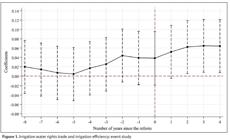
To verify the parallel trend hypothesis of the DID model, the event study method is further used for analysis. Referring to the approach of Cao and Chen (2022), the specific estimation model can be expressed as follows:

where: Reformiτ represents the τth year of the irrigation water rights trade in city i; βτ is the difference between cities that participated in the water rights reform in different years before and after the water rights reform and other reforming cities. Following Cao and Chen (2022), we treat the period more than 8 years as the reference group. If there is no significant difference in irrigation efficiency between cities participating in the water rights reform and other cities before the water rights reform, it means that the DID model used in this section is consistent with the parallel trend hypothesis.
Based on Wang et al. (2019), we use the stochastic frontier analysis (SFA) to estimate irrigation efficiency. Assuming that agricultural production requires water resources (W), machinery (M), labour (L), land (A) and fertilizer (F), agricultural value added (Y) is the output variable. The specific model can be expressed as follows:

In the equation, uit is a non-negative variable related to the inefficient part of agricultural water use.
According to Eq. 3, after making distribution assumptions for vit and uit, the maximum likelihood method can be used to estimate the parameters in the equation. In the analysis of this study, the random error term vit is assumed to follow a normal distribution, which captures measurement errors, random shocks, and any uncontrollable statistical noise, while the technical inefficiency term uit is assumed to follow an exponential distribution, an assumption that offers computational simplicity and an easily tractable likelihood function while ensuring that the inefficiency term is non‑negative and unimodal (Aigner et al., 1977). After estimation, the specific irrigation efficiency can be expressed as:

where: IE is the irrigation efficiency, which is a value between 0 and 1. The larger the value, the higher the irrigation efficiency.
Data
The explained variable is the irrigation efficiency, which is calculated by the stochastic frontier analysis. The production factors include agricultural water use, total agricultural mechanization power, agricultural labour, agricultural sown area and fertilizer application, while the output variable is the real agricultural value added, and the real agricultural value added is calculated at the constant price of the year 2000. Among the variables for calculating irrigation efficiency, the data on agricultural water use comes from the water resources bulletins of each province (autonomous region, municipality), and the data on other variables come from the statistical yearbooks of each province (autonomous region, municipality). It should be noted that since the number of agricultural labourers cannot be accurately quantified, the agricultural labourers in this method are replaced by the number of rural populations. The data on water rights reform are obtained from the Ministry of Water Resources of the People's Republic of China (2017), and the data are authoritative.
The control variables of the estimation model include regional water resources, meteorological conditions, population conditions and agricultural economic structure. The regional water resources are represented by the total amount of water resources, the meteorological conditions are represented by the average rainfall, average temperature, sunshine duration and average wind speed, the population conditions are represented by the urbanization rate, specifically the ratio of urban population to permanent population, and the agricultural economic structure is measured by the proportion of cash crops, specifically the ratio of cash crop planting area to agricultural planting area. The data on the total amount of water resources comes from the water resources bulletin of each province (autonomous region, municipality), the data on meteorological variables comes from the National Meteorological Science Data Centre, and the data required for the calculation of urbanization rate and agricultural economic structure come from the statistical yearbooks of each province (autonomous region, municipality).
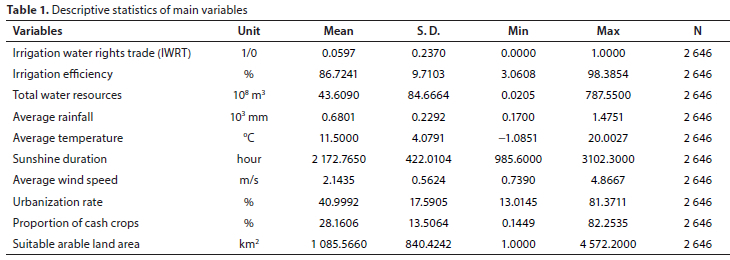
In the robustness analysis, in order to avoid the impact of the introduction of the agricultural water conservation programme on the estimation of the impact of irrigation water rights trade on irrigation efficiency, the impact of the agricultural water conservation programme policy will be further considered. As in the previous article, the specific use of suitable arable land area is used to reflect the intensity of the policy (Xu and Yang, 2022). The descriptive statistics of the variables used in this paper are shown in Table 1.
Empirical results
Baseline results
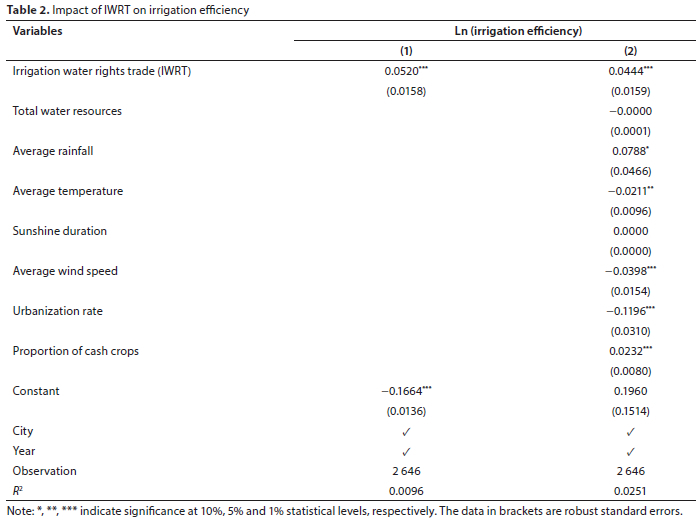
Table 2 estimates the impact of IWRT on irrigation efficiency. Column (1) estimates the impact of IWRT on irrigation efficiency without incorporating control variables. It was found that even without incorporating any control variables, IWRT can significantly promote the increase in irrigation efficiency at the 1% level. Specifically, IWRT can increase irrigation efficiency by an average of 5.20%. Column (2) further estimates the impact of IWRT on irrigation efficiency after incorporating control variables. After further incorporating control variables, IWRT can still significantly promote the improvement of irrigation efficiency. Specifically, IWRT can increase irrigation efficiency by an average of 4.44%, which is a slightly lower estimate than that in Column (1). In summary, regardless of whether the inclusion of control variables is considered, IWRT can improve irrigation efficiency.
According to the influence of control variables on irrigation efficiency, average rainfall, average temperature, average wind speed, urbanization rate and cash crop proportion all have significant influence on irrigation efficiency. Specifically, average rainfall has a significant positive influence on irrigation efficiency, while average temperature and average wind speed have a significant negative influence on irrigation efficiency. The influence of these meteorological variables on irrigation efficiency may come from the influence of meteorological conditions on the water resource demand of crops; urbanization rate has a significant negative influence on irrigation efficiency. The possible reason is that the higher the urbanization rate, the more likely farmers are to engage in non-agricultural part-time jobs, which is not conducive to improving the level of water resource management; cash crop proportion has a significant positive influence on irrigation efficiency. The possible reason is that since cash crops have greater economic benefits, agricultural producers will pay more attention to the effective use of water resources, and may even adopt water‑saving irrigation technology to ensure the growth of cash crops, thereby ensuring the improvement of irrigation efficiency.
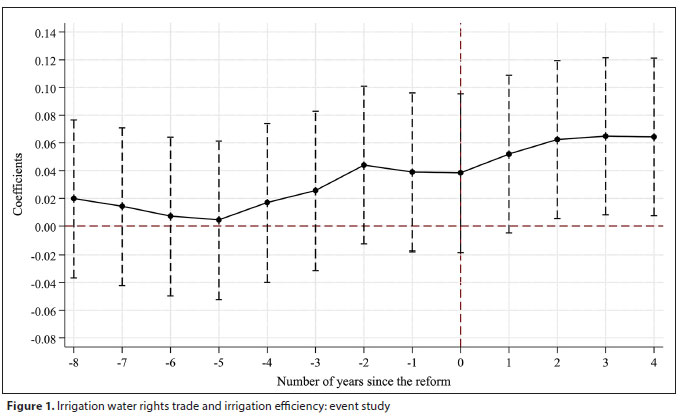
In order to further examine whether the DID model constructed meets the parallel trend hypothesis, the model expression that includes all control variables was used, and the event study method used for re-estimation. The specific estimation results are shown in Fig. 1. In this figure, the black dots represent the estimated coefficients of the impact of IWRT on irrigation efficiency in different periods, and the black dotted line represents the 90% confidence interval of the corresponding estimated coefficient. It can be found that before the water rights reform, whether or not to participate in the water rights reform has no significant effect on irrigation efficiency at the 10% level. This shows that the treatment group and the control group have parallel trends in irrigation efficiency before the introduction of the water rights pilot policy. In addition, starting from the second year after the water rights reform, the water rights reform can significantly promote the improvement of irrigation efficiency at the 10% level. Based on this, it can be found that participating in the water rights reform will not significantly affect the irrigation efficiency before the reform, so the DID model meets the parallel trend hypothesis, and the estimation results based on the DID model are more credible.
Robustness check
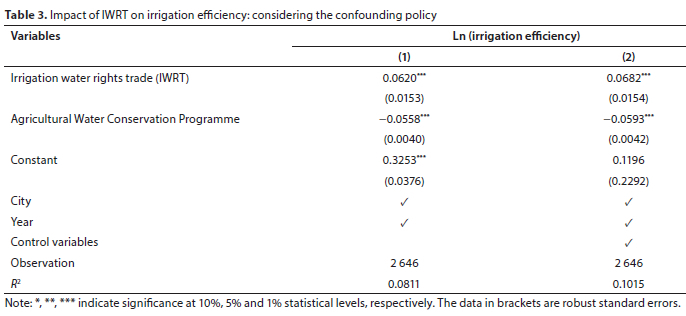
In order to avoid the estimation results being caused by other confounding policies, the impact of possible confounding policies was further considered below. The main policy that is confused with the water rights reform in affecting the efficiency of agricultural water resources utilization is the introduction of the Agricultural Water Conservation Programme, which promotes the popularization of water-saving irrigation technology through subsidies. Therefore, the introduction of the Agricultural Water Conservation Programme may affect the estimation results. Table 3 further estimates the impact of IWRT on irrigation efficiency after incorporating the impact of the Agricultural Water Conservation Programme, represented by the logarithm of the suitable arable land area multiplied by a dummy variable of whether it is after 2012.
Column (1) of Table 3 only includes regional and time fixed effects, and Column (2) further includes all control variables. The estimation results show that after considering the impact of the Agricultural Water Conservation Programme, IWRT can still significantly promote the improvement of irrigation efficiency. Specifically, according to the estimation results of Column (2), IWRT can increase irrigation efficiency by 6.82% on average, which is higher than the estimation results of the baseline model. In addition, the Agricultural Water Conservation Programme policy has a significant negative impact on irrigation efficiency. The negative relationship between the policy and irrigation efficiency does not imply that the water-saving policy itself is a failure. A more reasonable interpretation is that the implementation process suffers from mechanisms such as mismatches between technology promotion and grassroots capacity, rebound effects (expanding production water use after water savings), and incentive distortions (water pricing subsidies not linked to actual water conservation). These factors collectively weaken the net short-term effects of the policy, suggesting that future policy efforts should strengthen targeted incentives and process management. In summary, after further considering the agricultural water conservation outline policy, IWRT can still significantly promote the improvement of irrigation efficiency.
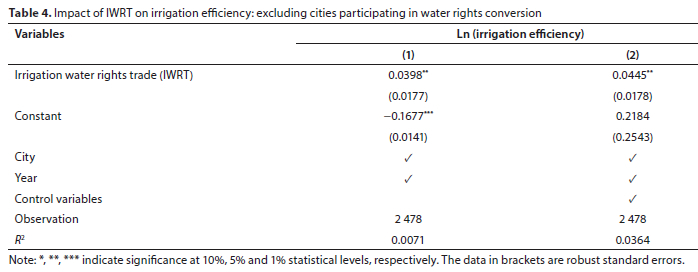
Before water resources were formally allocated through market forces, some regions attempted to promote the allocation of water resources between agriculture and non-agricultural sectors through water rights conversion under government coordination. This water rights conversion policy may also affect the estimation results. Based on this, the following were re-estimated after deleting the samples of cities that participated in water rights conversion. The specific estimation results are shown in Table 4. Column (1) only includes regional and time fixed effects, while Column (2) further includes control variables. The estimation results show that after deleting the samples of cities that have participated in water rights conversion, IWRT is still shown to significantly promote the increase in irrigation efficiency. Specifically, according to the estimation results of Column (2), IWRT can increase irrigation efficiency by 4.45% on average. This estimated coefficient has not changed much compared with the estimated value of the entire sample. Therefore, the existence of the previous water rights conversion pilot policy does not affect the estimation results. In summary, after further excluding the impact of water rights conversion, IWRT can still significantly promote the improvement of irrigation efficiency.
DISCUSSION
The previous analysis only explored the average impact of IWRT on irrigation efficiency. The following explores the heterogeneous impact of IWRT on irrigation efficiency, specifically, water resource endowment and agricultural scale. For water resource endowment, we mainly analyse the two aspects of groundwater overexploitation and total water resources.
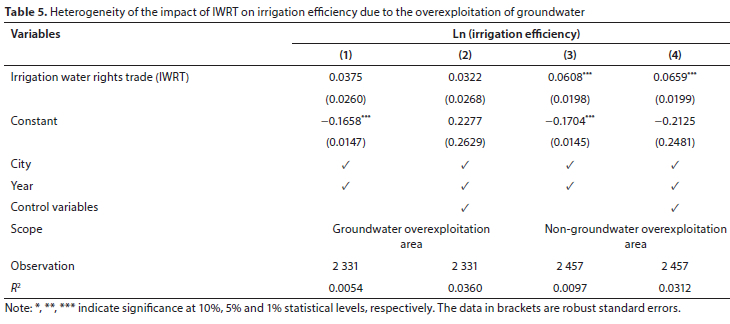
Table 5 estimates the heterogeneity of the impact of IWRT on irrigation efficiency due to the overexploitation of groundwater. Columns (1) and (2) were re-estimated after removing the water rights reform samples in areas that are not groundwater overexploitation areas. The estimated results can be regarded as the impact of IWRT on irrigation efficiency in areas that are groundwater overexploitation areas. It was found that IWRT in areas that are groundwater overexploitation areas has a positive impact on irrigation efficiency. Specifically, according to the model incorporating control variables, IWRT in these areas can increase irrigation efficiency by an average of 3.22%, but this result was not statistically significant in this sample. Columns (3) and (4) were re‑estimated after removing the water rights reform samples in areas that are groundwater overexploitation areas. The estimated results can be regarded as the impact of IWRT on irrigation efficiency in areas that are not groundwater overexploitation areas. It can be found that IWRT in areas that are not groundwater overexploitation areas has a significant promoting effect on irrigation efficiency. Specifically, according to the estimation model incorporating control variables, IWRT in non-groundwater overexploitation areas can increase irrigation efficiency by an average of 6.59%. In summary, the impact of IWRT in non-groundwater overexploitation areas on irrigation efficiency is not only significant, but the estimated coefficient is also greater than that in groundwater overexploitation areas. The possible reason is that in non-groundwater over-exploitation areas, the contradiction between water supply and demand is relatively moderate, and there is greater room for transactions not only among farmers but also between farmers and other water users such as industrial and ecological sectors. Surplus water rights can readily find buyers, and price signals can be effectively transmitted, thereby incentivizing farmers to adopt water-saving technologies and participate in trading.
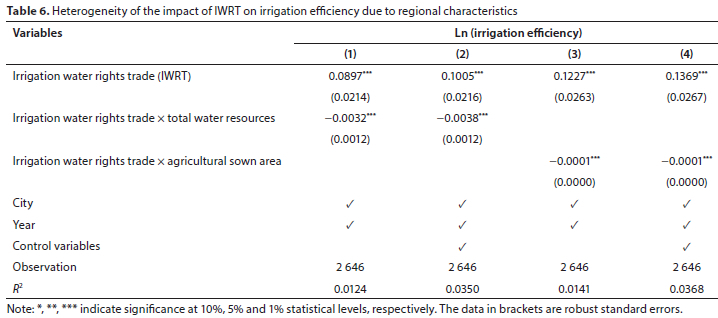
Table 6 presents estimates of the heterogeneity of the impact of IWRT on irrigation efficiency due to regional characteristics. Columns (1) and (2) further estimate the impact of IWRT on irrigation efficiency after incorporating the interaction term between IWRT and total water resources. It can be found that the impact of IWRT on irrigation efficiency is heterogeneous due to the water resources endowment. Specifically, in areas with lower volumes of total water resources, the IWRT will have a better promoting effect on irrigation efficiency. The possible reason is that in water-scarce areas, the benefit of saving one unit of water is much higher than in water-abundant areas. As a result, farmers are more willing to adopt water-saving irrigation technologies and sell the saved water rights in the market. This positive feedback mechanism is more prominent in water-scarce environments, thereby significantly improving irrigation efficiency. Columns (3) and (4) further estimate the impact of IWRT on irrigation efficiency after incorporating the interaction term between IWRT and agricultural sown area. According to the estimated results, the smaller the planting scale, the greater the promoting effect of IWRT on irrigation efficiency. The possible reason is that farmers with small-scale planting have greater flexibility in adjusting crop types, planting structures, and irrigation methods. When the IWRT generates an effective water price signal, these farmers can more quickly shift water resources away from inefficient, water-intensive crops toward high-efficiency, water-saving, or high-value-added crops, thereby significantly improving output efficiency per unit of water. In summary, in relatively arid or small-scale planting areas, the IWRT has a greater promoting effect on irrigation efficiency.
CONCLUSION
Water rights reform has gradually become an important instrument for countries around the world to achieve the efficient allocation of water resources. Facing increasing water scarcity and growing demand, many nations have turned to market-based mechanisms to optimize the distribution of this vital resource. As a developing country with significant regional and seasonal water imbalances, China has also begun to allocate water resources through a water rights system. By defining tradable water entitlements, this market-oriented approach is highly conducive to improving the overall efficiency of water resource utilization. Agriculture constitutes a major productive sector in China, accounting for a substantial share of total water consumption. Therefore, enhancing irrigation efficiency is a crucial aspect of ensuring the effective and sustainable use of water resources. Based on this context, this study empirically analysed the impact of irrigation water rights trading (IWRT) on irrigation efficiency, drawing on municipal-level panel data from China.
The empirical results yield several key findings. First, the IWRT increases irrigation efficiency by an average of 4.44%, indicating a statistically and economically meaningful improvement. Second, after accounting for the potential influence of confounding policies, such as agricultural water pricing reforms and subsidy programmes and excluding the effect of water right conversions (i.e., transfers that do not involve active market transactions), the positive role of the IWRT in promoting irrigation efficiency remains robust. This suggests that the observed efficiency gains are genuinely attributable to the market-based trading mechanism rather than to other concurrent interventions or definitional changes. Third, the results of heterogeneity analysis reveal notable variations across different contexts. In groundwater over‑exploitation areas, the IWRT has failed to effectively improve irrigation efficiency. Moreover, in relatively arid regions or areas characterized by small‑scale planting, the IWRT plays a more pronounced role in boosting irrigation efficiency, highlighting the importance of local environmental and structural conditions in shaping policy outcomes. Therefore, developing countries can, based on their specific national conditions, adopt market-based allocation of irrigation water as an important way to improve irrigation efficiency and achieve agricultural water conservation.
AUTHOR CONTRIBUTIONSHang Xu: conceptualization, methodology, interpretation of results, writing of the initial draft, revision after review. Rui Yang: data collection, data analysis, writing of the initial draft, interpretation of results.
CONFLICT OF INTERESTThe authors declare no conflict of interest.
ACKNOWLEDGEMENTS
This work was funded by Humanities and Social Science Fund of Ministry of Education of China (25YJC630160).
REFERENCES
-
AIGNER D, LOVELL CK and SCHMIDT P (1977) Formulation and estimation of stochastic frontier production function models. J. Econ. 6 (1) 21-37. https://doi.org/10.1016/0304-4076(77)90052-5
» https://doi.org/10.1016/0304-4076(77)90052-5 -
BISWAS AK (1982) Long distance water transfer: the Chinese plans. GeoJournal 6 (5). https://doi.org/10.1007/bf00185352
» https://doi.org/10.1007/bf00185352 -
CAO Y and CHEN S (2022) Rebel on the canal: Disrupted trade access and social conflict in China, 1650-1911. Am. Econ. Rev. 112 (5) 1555-1590. https://doi.org/10.1257/aer.20201283
» https://doi.org/10.1257/aer.20201283 -
CHINA WATER (2011) A comprehensive review of urban and rural water supply in China. URL: https://www.chinawater.com.cn/ (Accessed 24 June 2011).
» https://www.chinawater.com.cn/ -
CHINA WATER EXCHANGE (2020) The water rights trading among farmers for irrigation water in Yuanshi County, Hebei Province. URL: https://www.cwex.org.cn/ (Accessed 27 October 2020).
» https://www.cwex.org.cn/ -
CHINA WATER EXCHANGE (2021) The water rights trading among irrigation water users in Qingyuan Irrigation District, Shiyang River Basin, Gansu Province. URL: https://www.cwex.org.cn/ (Accessed 21 October 2021).
» https://www.cwex.org.cn/ -
CHINESE PEOPLE'S POLITICAL CONSULTATIVE CONFERENCE (2017) A new blueprint for harnessing the Yellow River. URL: http://www.china.com.cn/cppcc/ (Accessed 27 June 2017).
» http://www.china.com.cn/cppcc/ -
CRASE L, DOLLERY B and LOCKWOOD M (2003) Watering down property rights for the sake of the environment: A consideration of the environmental benefits of attenuated water rights in NSW. Australas. J. Environ. Manag. 10 (1) 25-34. https://doi.org/10.1080/14486563.2003.10648570
» https://doi.org/10.1080/14486563.2003.10648570 -
DENG J, JIA S and SONG Z (2023) Institutional change in water rights in China: A study of water rights confirmation and registration in Delingha City. Water 15 (3) 406-406. https://doi.org/10.3390/w15030406
» https://doi.org/10.3390/w15030406 -
DENG XP, SHAN L, ZHANG H and TURNER NC (2006) Improving irrigation efficiency in arid and semiarid areas of China. Agric. Water Manage. 80 (1-3) 23-40. https://doi.org/10.1016/j.agwat.2005.07.021
» https://doi.org/10.1016/j.agwat.2005.07.021 -
FANG L and ZHANG L (2020) Does the trading of water rights encourage technology improvement and agricultural water conservation? Agric. Water Manage. 233 106097. https://doi.org/10.1016/j.agwat.2020.106097
» https://doi.org/10.1016/j.agwat.2020.106097 -
FLÖRKE M, SCHNEIDER C and MCDONALD RI (2018) Water competition between cities and agriculture driven by climate change and urban growth. Nat. Sustain. 1 (1) 51-58. https://doi.org/10.1038/s41893-017-0006-8
» https://doi.org/10.1038/s41893-017-0006-8 -
GADANAKIS Y, BENNETT R, PARK J and AREAL FJ (2015) Improving productivity and water use efficiency: A case study of farms in England. Agric. Water Manage. 160 22-32. https://doi.org/10.1016/j.agwat.2015.06.020
» https://doi.org/10.1016/j.agwat.2015.06.020 -
GE L, XIE G, ZHANG C, LI S, QI Y, CAO S and HE T (2011) An evaluation of China's water footprint. Water Resour. Manage. 25 2633-2647. https://doi.org/10.1007/s11269-011-9830-1
» https://doi.org/10.1007/s11269-011-9830-1 -
GRAFTON RQ, WILLIAMS J, PERRY CJ, MOLLE F, RINGLER C, STEDUTO P, UDALL B, WHEELER SA, WANG Y, GARRICK D and ALLEN RG (2018) The paradox of irrigation efficiency. Science 361 (6404) 748-750. https://doi.org/10.1126/science.aat9314
» https://doi.org/10.1126/science.aat9314 -
GREAT WALL NETWORK (2016) The Yuanshi model of agricultural water-saving reform. URL: http://www.sjz.hebccw.cn/ (Accessed 18 May 2019).
» http://www.sjz.hebccw.cn/ -
HARTWIG L, JACKSON S and OSBORNE N (2018) Recognition of Barkandji water rights in Australian settler-colonial water regimes. Resources 7 (1) 16-16. https://doi.org/10.3390/resources7010016
» https://doi.org/10.3390/resources7010016 -
HU X, LI Y, SUN Y, ZHANG C, DING W and DENG J (2021) Water permits trading framework for urban water demand management based on smart metering. J. Environ. Manage. 304 114208. https://doi.org/10.1016/j.jenvman.2021.114208
» https://doi.org/10.1016/j.jenvman.2021.114208 -
JIA R (2014) The legacies of forced freedom: China's treaty ports. Rev. Econ. Stat. 96 (4) 596-608. https://doi.org/10.1162/REST_a_00458
» https://doi.org/10.1162/REST_a_00458 -
KAHRL F and ROLAND-HOLST D (2008) China's water-energy nexus. Water Polic. 10 (S1) 51-65. https://doi.org/10.2166/wp.2008.052
» https://doi.org/10.2166/wp.2008.052 -
LOUCKS DP (2000) Sustainable water resources management. Water Int. 25 (1) 3-10. https://doi.org/10.1080/02508060008686793
» https://doi.org/10.1080/02508060008686793 -
LYU H, HONG-FEI X and DUAN T (2024) Optimizing water resource allocation for food security: An evaluation of China's water rights trading policy. Sustainability 16 (23) 10443. https://doi.org/10.3390/su162310443
» https://doi.org/10.3390/su162310443 -
MINISTRY OF WATER RESOURCES OF THE PEOPLE'S REPUBLIC OF CHINA (2004) The guidelines on pilot water rights conversion in the yellow river mainstream in inner Mongolia and Ningxia issued. URL: http://szyzx.mwr.cn/ (Accessed 21 May 2004).
» http://szyzx.mwr.cn/ -
MINISTRY OF WATER RESOURCES OF THE PEOPLE'S REPUBLIC OF CHINA (2006) The water allocation plan for the Yellow River. URL: http://szyzx.mwr.cn/ (Accessed 24 July 2006).
» http://szyzx.mwr.cn/ -
MINISTRY OF WATER RESOURCES OF THE PEOPLE'S REPUBLIC OF CHINA (2016) The interim measures for the administration of water rights trade. URL: http://szyzx.mwr.cn/ (Accessed 19 April 2016).
» http://szyzx.mwr.cn/ -
MINISTRY OF WATER RESOURCES OF THE PEOPLE'S REPUBLIC OF CHINA (2017) The pilot policy of water rights trading in China. URL: http://szyzx.mwr.cn/ (Accessed 10 June 2017).
» http://szyzx.mwr.cn/ -
MINISTRY OF WATER RESOURCES OF THE PEOPLE'S REPUBLIC OF CHINA (2023) The Liangzhou District, Wuwei City, Gansu Province: a typical case of comprehensive agricultural water pricing reform. URL: http://szyzx.mwr.cn/ (Accessed 3 February 2023).
» http://szyzx.mwr.cn/ -
NAKAYAMA T (2010) Simulation of the effect of irrigation on the hydrologic cycle in the highly cultivated Yellow River Basin. Agric. For. Meteorol. 151 (3) 314-327. https://doi.org/10.1016/j.agrformet.2010.11.006
» https://doi.org/10.1016/j.agrformet.2010.11.006 -
PEOPLE'S GOVERNMENT OF YUANSHI COUNTY (2016) The Yuanshi county water resources use rights allocation plan. URL: http://www.yuanshi.gov.cn/ (Accessed 8 February 2016).
» http://www.yuanshi.gov.cn/ -
QADIR M, SHARMA BR, BRUGGEMAN A, CHOUKR-ALLAH R and KARAJEH F (2007) Non-conventional water resources and opportunities for water augmentation to achieve food security in water scarce countries. Agric. Water Manage. 87 (1) 2-22. https://doi.org/10.1016/j.agwat.2006.03.018
» https://doi.org/10.1016/j.agwat.2006.03.018 -
ROSEGRANT MW and BINSWANGER HP (1994) Markets in tradable water rights: Potential for efficiency gains in developing country water resource allocation. World Dev. 22 (11) 1613-1625. https://doi.org/10.1016/0305-750X(94)00075-1
» https://doi.org/10.1016/0305-750X(94)00075-1 -
SPEELMAN S, FAROLFI S, FRIJA A, D'HAESE M and D'HAESE L (2010) The impact of the water rights system on smallholder irrigators' willingness to pay for water in Limpopo province, South Africa. Environ. Dev. Econ. 15 (4) 465-483. https://doi.org/10.1017/s1355770x10000161
» https://doi.org/10.1017/s1355770x10000161 -
TISDELL J and HARRISON SR (1992) Estimating an optimal distribution of water entitlements. Water Resour. Res. 28 (12) 3111-3117. https://doi.org/10.1029/92wr01795
» https://doi.org/10.1029/92wr01795 -
WANG F, YU C, XIONG L and CHANG Y (2019) How can irrigation efficiency be promoted in China? A spatial-temporal analysis. Resour. Conserv. Recycl. 145 411-418. https://doi.org/10.1016/j.resconrec.2019.03.017
» https://doi.org/10.1016/j.resconrec.2019.03.017 -
WANG Y (2012) A simulation of water markets with transaction costs. Agric. Water Manage. 103 54-61. https://doi.org/10.1016/j.agwat.2011.10.017
» https://doi.org/10.1016/j.agwat.2011.10.017 -
XIN J, YUE X, WU H and ZHOU S (2024) Predicting the spatiotemporal evolution characteristics of future agricultural water demand in the Yellow River Basin under climate-change conditions. Water 17 (1) 31. https://doi.org/10.3390/w17010031
» https://doi.org/10.3390/w17010031 -
XU H and YANG R (2022) Does agricultural water conservation policy necessarily reduce agricultural water extraction? Evidence from China. Agric. Water Manage. 274 107987. https://doi.org/10.1016/j.agwat.2022.107987
» https://doi.org/10.1016/j.agwat.2022.107987 - XU H and Yang R (2025) The impact of water rights reform on economic development: Evidence from city-level panel data in China. J. Environ. Manage. 374 124082.
-
XU X, CHEN Y, ZHOU Y, LIU W, ZHANG X and LI M (2023) Sustainable management of agricultural water rights trading under uncertainty: An optimization-evaluation framework. Agric. Water Manag. 280 108212. https://doi.org/10.1016/j.agwat.2023.108212
» https://doi.org/10.1016/j.agwat.2023.108212
Accepted: 22 July 2026