Removal of Escherichia coli from biological effluents using natural and artificial mineral aggregates
Abstract
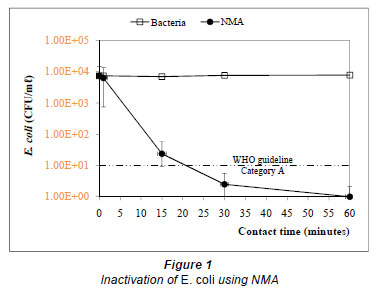
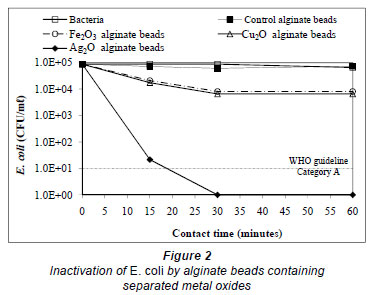
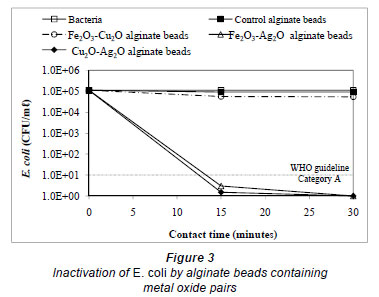
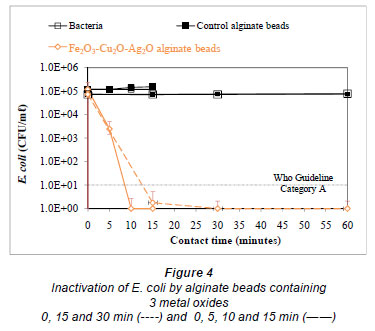
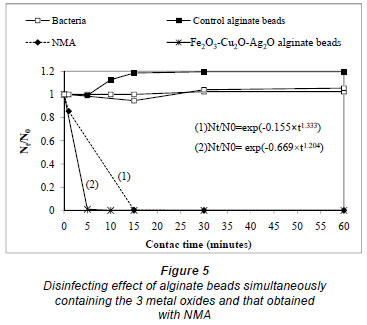
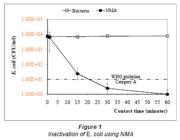
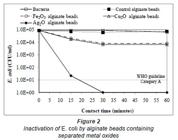
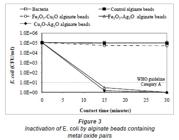
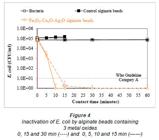
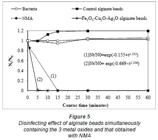
Ability for disinfecting sterile biological effluents inoculated with Escherichia coli ATCC 25922 at concentrations of 105 CFU/mℓ, using a natural mineral aggregate (NMA) and artificial mineral aggregates (AMA's) consisting of individual oxides as FeO, CuO y Ag2O and combined oxides as Fe2O3-Cu2O, Fe2O3-Ag2O, Cu2O-Ag2O, Fe2O3-Cu2O-Ag2O, contained alginate beads, was compared. The results indicate that Ag2O and Fe2O3-Ag2O, Cu2O-Ag2O combinations, as well as NMA, inactivated 100% of E. coli in 30 min, whereas the oxides mixture, Fe2O3-Cu2O-Ag2O, took 13 min. It was observed that redox potential values were closely related to the disinfection level achieved. The advantage resulting from using alginate beads was that these allow the formation of AMA, which has higher disinfectant ability relative to NMA.
disinfection; biological effluent; Fe2O3; Cu2O and Ag2O; alginate beads; Escherichia coli; natural mineral aggregate; artificial mineral aggregate
 Thumbnail
 Thumbnail
 Thumbnail
 Thumbnail
 Thumbnail