The simple modelling method for storm- and grey-water quality management applied to Alexandra settlement
Abstract
Discharges from informal settlements cause numerous adverse water quality impacts on urban areas and on receiving waters. These problems reflect local conditions with respect to economic development, level of environmental protection (including the associated infrastructure), institutional arrangements and public awareness. Development of comprehensive tools for selection of drainage management interventions, even at planning levels, is still at its early stages in South Africa. Municipalities in South Africa face many challenges in identifying, assessing and selecting the right interventions and/or strategies to address the impacts of land use on receiving waters. A spreadsheet-based model was developed in this study specifically to assist in identifying, selecting and evaluating interventions to manage storm- and grey-water quality. The model also consists of modules: to quantify water quality management objectives (load reduction targets) of pollutants of concern, to formulate implementation strategies by combining different mixes of interventions at different levels of implementation, and to cost and select the optimum management strategy. In the Alexandra settlement investigated, the identified interventions to achieve management objectives optimally consist of educational programmes, erosion and sediment control, street sweeping, removal of sanitation system overflows, impervious cover reduction, downspout disconnections, removal of illicit connections to storm drains, establishment of riparian buffers, use of rainwater tanks and exfiltration systems.
stormwater quality; non-structural control; structural control; management interventions
Introduction
Discharges from informal settlements cause numerous adverse water quality impacts on urban areas and on receiving waters, including erosion, sedimentation, dissolved oxygen depletion, nutrient enrichment and eutrophication, toxicity, reduced biodiversity, high drinking water purification costs, and the associated impacts on beneficial water uses. These problems reflect local conditions with respect to economic development, level of environmental protection practice (including the associated infrastructures), institutional arrangements and public awareness.
Development of comprehensive tools for evaluation of drainage management interventions even at planning levels is still at an early stage in South Africa. Municipalities therefore face many challenges in assessing interventions put in place (or yet to be implemented) to address the impacts of land use on receiving waters. As a result, stormwater management strategies have often been based on ad hoc, single measure-focus approaches (usually end-of-pipe measures). In informal settlements, storm- and grey-water quality management is not planned in advance; the need arises when conditions are extremely deplorable and are adversely impacting on human health. In formal settlements, single measure-focus approaches such as ponds are usually employed. The nature of pollutants emanating from different land uses is different and, as a consequence, management interventions to improve stormwater quality would necessarily involve a number of measures as their effectiveness is variable for different pollutants. The pollution controls and management strategies investigated under this study were based on the following principles:
- Sustainability, which recognises the necessity to balance the economic, social and environmental needs and to protect resources for future generations, when planning, constructing and operating infrastructure
- Hierarchical management approach which requires stormwater quality management to be carried out firstly at source, thereafter proceeding down to the end-of-pipe, and in each case employing firstly non-structural technologies and thereafter proceeding to structural technologies if necessary
- Public consultation which assumes that all affected stakeholders are consulted and given the opportunity to provide input to decisions
- Adaptive management which recognises that we are dealing with very complex natural and man-made systems whose responses are not fully predictable with the currently available science-based tools. Best practice therefore requires selecting and designing technologies on the basis of best available data, ongoing monitoring and data collection, and revisiting decisions to produce improved technology selections and designs.
Settlement stormwater and greywater quality management requires community-level involvement and often includes the use of both structural and non-structural control interventions to protect or restore catchments exposed to chemical, physical, or biological stressors.
A number of studies on stormwater quality from Alexandra catchment and its pollution threat to the receiving environment have been undertaken by the Water Research Commission of South Africa (e.g. Ashton and Bhagwan, 2001; Campbell, 2001), the Water System Research Group of the University of the Witwatersrand (e.g. Owusu-Asante and Stephenson, 2006) and by Stephenson and Associates (2002). Those studies mostly identified the pollutants of concern, sources and causes of pollution, and threats of the pollution to the aquatic environment and health of the residents of Alexandra as well as other users of water from the Jukskei River. This study uses mostly the information from these previous studies to:
- Identify water quality management issues and their causes
- Quantify water quality management objectives (load reduction targets) for Alexandra catchment
- Identify water quality management interventions to control the pollution
- Formulate and evaluate strategies involving different mixes of interventions
- Recommend different mixes of interventions with quantified benefits to achieve the desired objectives
Description of the study area
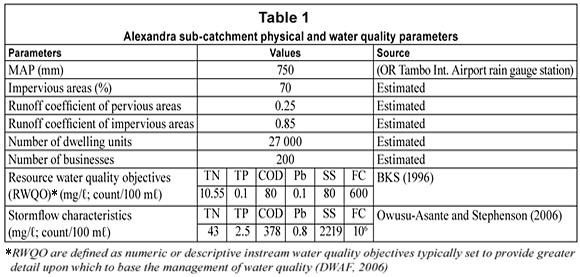
The Alexandra township is located 12 km north-east of central Johannesburg and 4 km east of Sandton central business district. The township is split into a west and east bank by the Jukskei River; the west bank is completely developed whereas the east bank is undeveloped. The west bank, which is the principal focus of this study, covers a total surface area of about 350 ha. The official population of Alexandra is estimated at 166 971 according to the 2001 population census of South Africa. This translates to a population density of 477 persons/ha and 80 dwelling units/ha (assuming 6 persons/dwelling unit). Land-use characteristics are dominated by a high-density residential development. The township is serviced by stormwater drains which mostly consist of culverts and an underground pipe network. The main drainage channels are 3 rectangular box culverts that drain to the Jukskei River. A water-borne sewage system services the formal settlements whereas in the informal settlements sewage is removed in buckets and taken to the Alexandra Sewage Works. The area slopes steeply in a west-east direction towards the Jukskei River, with slopes varying from 12.5% in the western sections to 3.3% in the sections closer to the Jukskei River. The area is underlain by highly weathered and decomposed rocks of the Achaean granite forming the Johannesburg/Pretoria dome. The rock has decomposed to form a residual soil layer of loamy sand which varies in depth from 0.5 to 6.0 m. Overlying these residual soils are various transported soils, as well as unconsolidated fill material in some areas. Alluvial wash material occurs in the gully and floodplain of the Jukskei River. Other catchment physical and water quality parameters are summarised in Table 1.
Pollution loads discharged from Alexandra sub-catchment are due to overcrowding, poor living conditions and inadequate sanitation and drainage services. The backlog in sanitation and drainage includes solid waste, sewage, grey-water and severely contaminated stormwater runoff. The paths of these waste streams are to a large extent merged; solid waste, sewage, greywater and contaminated runoff enter surface drains and eventually discharge into the Jukskei River. Studies by Owusu-Asante and Stephenson (2006) and Campbell (2001) have indicated elevated concentrations of nitrogen, phosphorus, COD, lead, suspended solids, and faecal coliforms in stormwater which are well in excess of the resource water quality objectives of the Jukskei River.
Analysis of some management issues and identification of management interventions
This section of the study involved identifying factors that result in pollution to the receiving Jukskei River, to provide an understanding of the cause-effect relationships of pollution issues in the settlement. The significance of this analysis was to ensure that the right intervention, that takes account of the identified problems and their root causes, was identified, selected and implemented. The analysis was undertaken by a combination of:
- Desk-top study, involving a review of existing information contained in reports, studies and monitoring programmes
- Field-work, involving an inspection of the settlement and undertaking an approximate settlement audit through flow and quality monitoring
- Interviews conducted with community representatives to obtain information on pollution issues
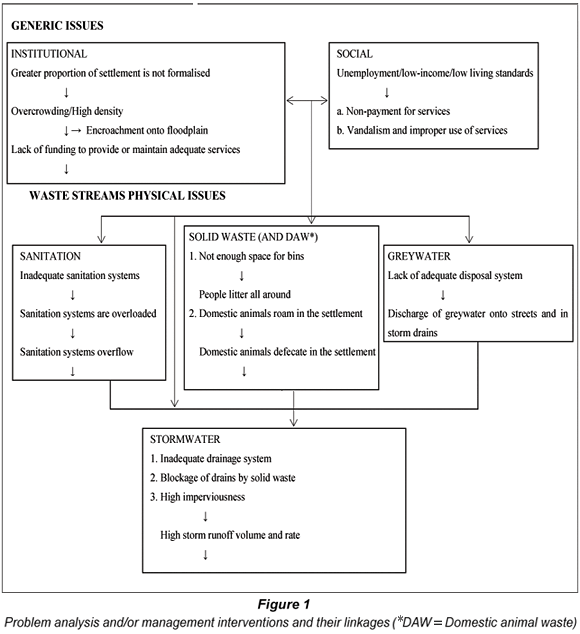
The analysis of water quality issues in Alexandra settlement is summarised in Fig. 1 and is described as follows. The causes of pollution for the 4 waste streams (i.e. solid waste, sewage, greywater and stormwater) are situated within the institutional and social environment of the settlement. A large proportion of the settlement is not formalised and this is seen as a major root cause of pollution. A formal settlement is one that has been planned with laid-out stands, a defined road network, water reticulation system (into houses or at least a standpipe per stand), solid waste disposal systems, wastewater disposal system (either waterborne system, septic tanks and soak-aways or pit latrines), and space for runoff treatment facilities.
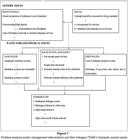
Other important institutional concerns include a lack of funds within the local authority to address the problems and lack of capacity to operate and maintain the services. Social issues include poor living standards, non-payment or illegal use of services, vandalism and lack of awareness and involvement with respect to the proper use of the services and water quality issues. A linkage exists between institutional and social causes of pollution; for example, the non-payment of services adds to the local authority's inability to provide funds and capacity to operate and maintain the services. Similarly, the neglect or inability of the local authority to formalise the settlement attracts non-payment and overloading of services and also lack of community awareness and involvement in water quality issues. The institutional and social issues are manifested in the 4 waste streams. The inadequate services for sanitation, solid waste, greywater and stormwater result in significant build-up of pollutants on the catchment surfaces which are eventually washed by storm runoff into the Jukskei River.
Management interventions needed to be selected to deal with the issues/causes of pollution outlined in Fig. 1. The social issues, such as non-payment and vandalism of services and lack of awareness and community involvement in water quality issues, can be managed through combinations of education and awareness programmes, economic empowerment, service delivery and improvements in maintenance. The local authority is formalising the settlement through relocation of many households. This will involve: provision of a public spatial structure to provide relief from overcrowding; creation of public gathering places and riparian buffers (RB); catchment erosion and sediment controls (CESC); and improvement in engineering services. Although this intervention is currently underway, the value of effective capacity building of the local authority to operate and maintain the services cannot be overemphasised. Formalisation of the settlement will in turn open up opportunities for other specific interventions to deal with issues resulting from the 4 waste streams.
Street sweeping (SS) and domestic animal waste education (DAWE) programmes are interventions to control pollution from the solid waste stream in addition to the provision and frequent emptying of skip bins. Sewer or sanitation overflow repairs (SSOR) intervention may be employed to arrest pollution from the sewage waste stream. After formalisation of the settlement (with improved engineering services), illicit connections (ILL) to storm drains can be removed to deal with pollution from the grey-water waste stream. A number of specific interventions are required for the stormwater waste stream and they can be incorporated in the formalisation process or afterwards. They include impervious cover reduction (ICR), downspout disconnection (DD), exfiltration systems (ExS), use of rainwater tanks (RT) and riparian buffers (RB). These interventions are described below.
Domestic animal waste education intervention: A common problem in low-income settlements in developing countries, in terms of pollution to the receiving water environment, is defecation from domestic animals such as dogs, sheep, goats, cattle, pigs, chickens, ducks, turkeys, donkeys, horses and others. Many of these animals roam about in the settlements while some of them are kept in smallholdings in backyards. Loads from domestic animal waste are estimated based on 'typical' average daily mass production of waste and concentrations of pollutants in a unit mass of waste. The loads reduced are estimated based on the fraction of owners who clean up or properly dispose of their domestic animals' waste.
Street sweeping (SS) intervention: The efficiency of street sweeping depends on the type of sweeper used (e.g. broom, brush-type mechanical, vacuum-assisted) and frequency of sweeping. The loads reduced per sweep are the product of load accumulated in the street and efficiency of street sweeping.
Downspout disconnection intervention: This involves disconnection of downspout and redirection of roof runoff to lawn or pervious areas. By returning the roof runoff to soils through infiltration, this intervention reduces runoff volume and pollutant loadings to surface water resources. Groundwater is protected by infiltration and percolation through the soils by processes such as filtration, adsorption and biodegradation. Downspout disconnection load reduction is estimated based on the proportion of rooftop area to the total impervious cover.
Riparian buffers (RB) intervention: Riparian vegetation reduces pollutant load through treatment mechanisms of vegetative filtration, adsorption, biological uptake of nutrients, and sometimes infiltration. The load reduction is obtained by direct application of removal efficiency of RB intervention to the total urban annual storm load.
Impervious cover reduction (ICR) intervention: ICR involves better site design techniques such as permeable pavements, narrowing street widths and reducing the number and size of parking spaces to reduce the total impervious cover in urban catchments. Formalisation of low-income and high-density settlements through relocation of households to create space (converted to pervious areas) for stormwater management options is also a technique to reduce impervious cover. Reduction of impervious cover reduces the amount of runoff, which in turn reduces the catchment pollutant loads delivered to streams. Load reduction is estimated based on the proportion of impervious cover reduced.
Illicit connection removal (ILLC) intervention (Brown et. al, 2004): Non-storm flows discharging from storm drainage systems can contribute significant pollutant loadings to receiving waters. If these flows are ignored (by only considering storm flow, for example), little improvement in receiving water conditions may occur. Illicit non-storm flows originate from residential, commercial and industrial land uses and they typically include grey-water and sewage. This intervention requires municipalities to identify and locate sources of non-storm flow discharges into storm drains and institute appropriate actions to eliminate them. Load reduction is estimated based on the proportion of non-storm flow removed.
Sanitary sewer overflow repair/abatement (SSOR) intervention: Sanitary sewer overflows (SSOs) occur both during and between storms; that is, they contribute to both storm and non-storm loads. Non-storm loads are caused by breakages and blockages while the storm loads are caused by lack of capacity due to infiltration of rainfall into the sewer pipes (Stephenson and Barta, 2005). SSO loads are extrapolated from data about the sewer system; for example, flow is estimated as a product of number of overflows per unit length (No), total sewer length (l), and a typical overflow volume (V).
Catchment surface erosion and sediment control (CatchESC) intervention: This intervention emphasises erosion control measures, including grassing, tree planting and other practices that limit clearing and grading, to reduce the concentration of sediment in runoff leaving the settlement. The modified Universal Soil Loss Equation (USLE) is used to calculate sediment load from settlement pervious surfaces. The product of the sediment load and the efficiency of control measures yields the loads reduced.
Rainwater tanks (RT) intervention: Use of rainwater tanks allows for stormwater harvesting and reuse strategies, which may have benefits both for potable water conservation and also for reduction of runoff volume. Stormwater stored in tanks can be used for non-potable household water use, watering of gardens (trees, flowers, grass, vegetables). The reduction in runoff volume in turn reduces pollutant loads washed off from the catchment surface. The RT intervention is suitable especially in high-density residential settlements where downspout disconnection is not feasible. It can also be used in conjunction with downspout disconnection in medium- and low-density settlements. Rainwater tanks intervention load reduction is estimated based on the proportion of rooftop area captured to the total impervious cover.
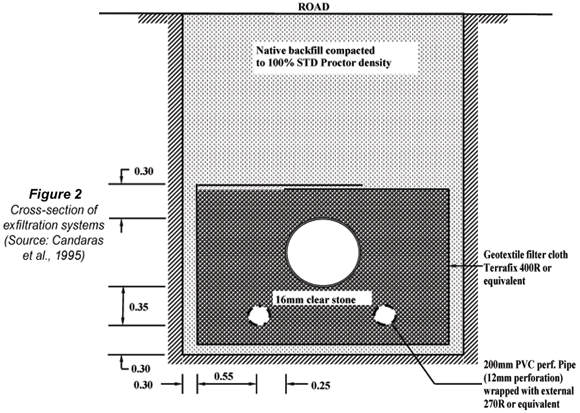
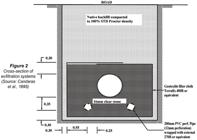
Stormwater exfiltration systems (ExS): ExS were developed to improve the stormwater quality from fully urbanised areas (Li et al., 1997). The system consists of 2 x 200 mm perforated pipes, plugged at the downstream end, which are laid below the storm sewer at the upstream section of the sewer system. The sewer and the perforated pipes are encased in a granular stone trench wrapped with filter fabric. Figure 2 shows a typical cross-section of an exfiltration system. The first flush of runoff will be directed to the perforated pipes with plugged ends. Together with the surrounding granular bedding, this pipe-trench system can store the runoff of a 15 mm rainfall event and allow exfiltration within a certain period of time depending on the permeability of the host soil. Excess runoff will bypass the perforated pipe system and travel through the storm sewer. The perforated pipes can be cleaned with a hydraulic nozzle. Pre-treatment of storm runoff using screening at the perforated pipe inlet can also reduce the maintenance requirements. The stormwater exfiltration system can be constructed within the right-of-way and integrated with storm sewer replacement or road rehabilitation projects. Load reductions are estimated by applying the interventions efficiency to the fraction of storm load from the contributing areas.
River assimilative capacity (RAC): Natural water bodies are able to serve many uses, including the transport and assimilation of waterborne wastes. But as natural water bodies assimilate these wastes, their quality changes. If the quality drops to the extent that other beneficial uses are adversely affected, the assimilative capacities of those water bodies have been exceeded with respect to those affected uses. Water quality management interventions are actions taken to ensure that the total pollutant loads discharged into receiving water bodies do not exceed the ability of those water bodies to assimilate those loads, while maintaining the levels of quality specified by resource water quality objectives for those waters. RAC intervention depends on natural instream processes, such as sedimentation, adsorption, aeration and biological degradation, as its removal mechanisms. Providing opportunities for turbulent flow may enhance aeration. Cascades and small weirs can help to increase physical entrainment of oxygen into the water column, and the inclusion of riverine habitats with significant roughness will also promote turbulence and aeration.
Goals and objectives of the water quality management
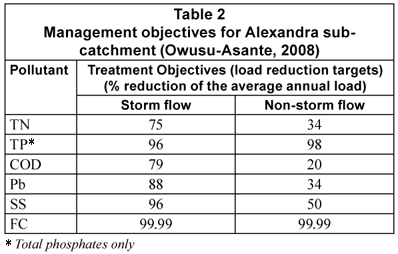
Management objectives (Table 2) were developed by Owusu-Asante (2008) to protect the water quality in the Jukskei River and its catchment, with regards to Jukskei River water quality guidelines and objectives (BKS, 1996). The management objectives, based on the principle of sustainability, include both long-term and short-term objectives. The long-term objectives represent the goal for the catchment and short-term objectives represent quantifiable load reduction targets that form the basis of actions or interventions to be implemented in order to achieve the goals. The goal is to achieve the resource water quality objectives of Jukskei River by minimising the impacts of pollution from Alexandra settlement on the aquatic ecosystem and other water users.
The load reduction targets for storm and non-storm flows were determined as given by Eq. 1 and Eq. 2 respectively, by comparing the load estimated from monitored data (less the load reduced by existing interventions) with the load estimated from the set water quality objectives of the Jukskei River.


where:
Lred = Pollutant storm load reduction target
Lsl = Pollutant storm load estimated using monitored concentrations
L'sl = Pollutant storm load estimated using resource water quality objective concentrations
Lslext = Pollutant storm load reduced by existing interventions. If monitoring was undertaken downstream of interventions (or outfall) then Lslext = 0
L'red = Pollutant non-storm load reduction target
Lnsl = Pollutant non-storm load estimated using monitored concentrations
L'nsl = Pollutant non-storm load estimated using resource water quality objective concentrations
Lnslext = Pollutant non-storm load reduced by existing interventions. If monitoring was undertaken downstream of interventions then Lnslext = 0
Formulation of alternative water quality management strategies
Alternative strategies for Alexandra settlement were developed by combining different mixes of the interventions identified above. The strategies were formulated with respect to:
- Two implementation phases, i.e., short-term (up to 5 years), and medium to long-term (more than 5 years)
- Different magnitudes of implementation of each intervention.
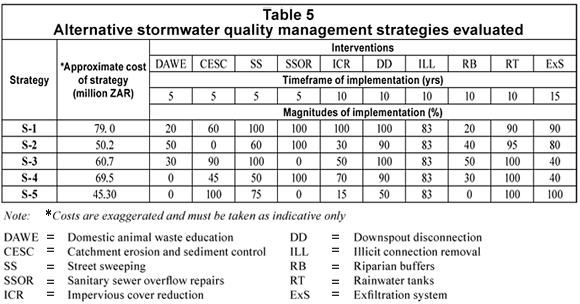
Different strategies were formulated by altering the implementation magnitude (factor) and timeframe of some or all of the interventions identified. The process of formulating the strategies in the model and the search for the 'best' management strategy in this study were achieved through 'trial and error' but, in principle, a strategy formulated has to meet the local authority's budget (or cash flow) and development plans.
- For example, the 2nd strategy (S-2 in Table 5) evaluated in this study was formulated as follows:
- 50% of the households will be reached with an education and awareness programme, in particular, to deal with domestic animal waste issues in the first 5 years
- Daily street sweeping (including refuse removal) will be accomplished in 60% of all feasible streets in the settlements in the first 5 years
- 100% maintenance and repair of all broken, blocked, and overflow sewers and other sewage systems to be achieved within the next 5 years
- De-densification and formalisation of the settlement will be completed in the next 10 or more years with 30% of the feasible impervious cover reduced. De-densification and formalisation of the settlements were launched in a 7-year project (Alexandra Renewal Project) in 2001. Much has been done to date but there is still more to do to achieve the desired goal.
- 90% of feasible areas will have downspouts disconnected after formalisation of the settlement
- 83% of all illicit connections will be removed after formalisation of the settlement
- 40% of the riparian buffer zone will be available and established to treat storm flow or protect the Jukskei River after formalisation of the settlement
- 95% of the feasible households will be provided or equipped with rainwater tanks after formalisation of the settlement
- 80% of the feasible roads will be retrofitted with stormwater exfiltration system during the formalisation of the settlement.
Evaluation of alternative water quality management strategies
In order to facilitate the evaluation of alternative strategies with respect to pollutant load removal effectiveness, a model was developed (Owusu-Asante, 2008). The program can be used as a decision-support system for rapid assessment of various catchment water quality management interventions at planning level. The model was developed using macros in Visual Basic for Applications (VBA) and is interfaced with an EXCEL spreadsheet for data input and output of results. The program applies the Simple Modelling Method – an approach whose data requirements and level of accuracy are appropriate for preliminary planning of water quality management interventions. Continuous simulation models such as SWMM5 (Rossman, 2004) are more versatile and can model complex processes in detail and test the system response to different types of inputs and system configurations on a continuous basis. However, they do not incorporate non-structural interventions and other sources of pollution such as illicit connections and overflows from sewage systems, and are unduly sophisticated and time-consuming for preliminary planning purposes.
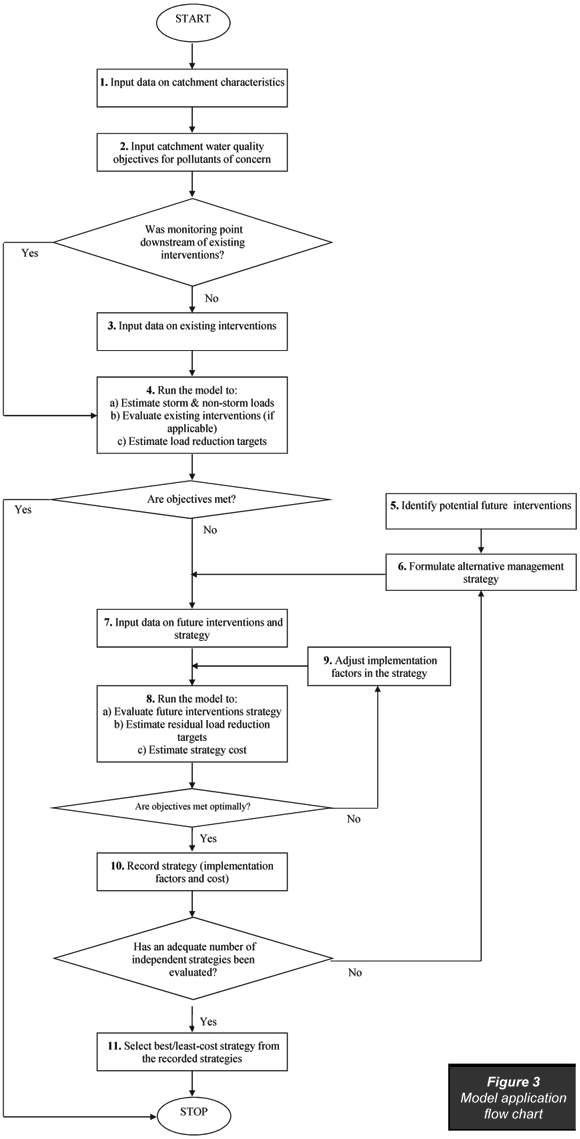
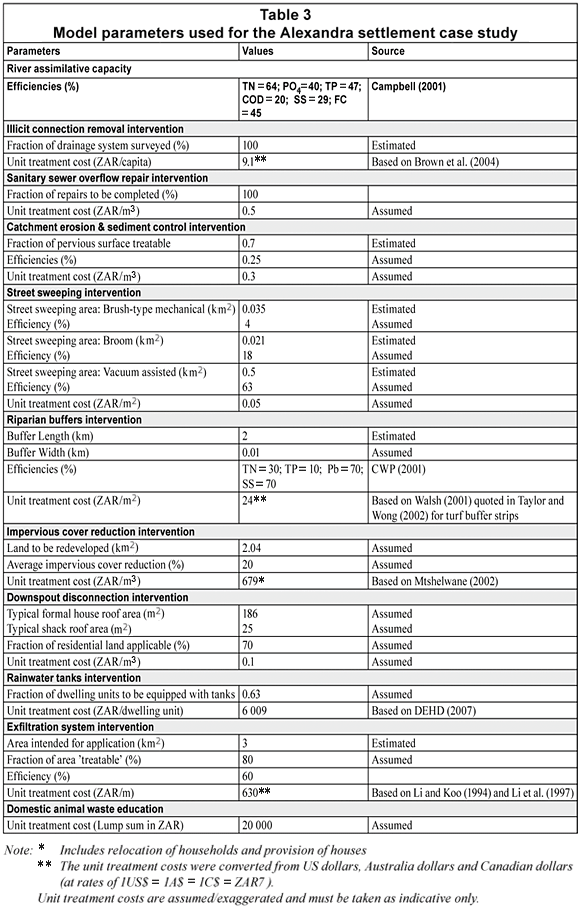
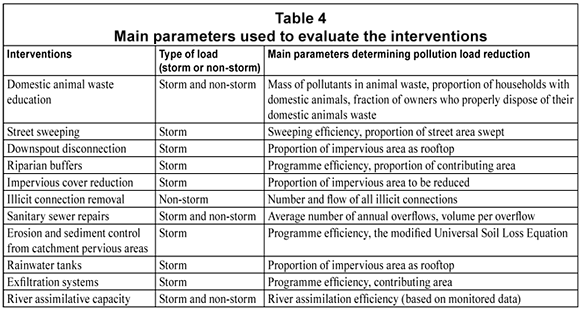
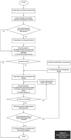
The model application flowchart is presented in Fig. 3 and the sequential steps involved are described herein. The 1st step in the model application is catchment data (Table 1) input. The 2nd step involves input of resource water quality objectives for pollutants of concern. At this point, it is assumed that the resource water quality objectives for the catchment have been established and pollutants of concern have been defined. The methods to establish resource water quality objectives and identify pollutants of concern are described elsewhere, e.g. DWAF (2006). The 3rd step involves input of data (shown in Table 3) on existing management interventions. Due to financial constraints, many of the data in this study could not be obtained and as such they were assumed in the model based on professional judgement. To estimate the load reduction target, the load from monitored data (less the load reduced from existing interventions) is compared with the load from the set resource water quality objectives. Hence the 3rd step is not required if the monitoring point is downstream of the existing interventions, as the load estimated from the monitoring data would have already accounted for the load reduced by the existing interventions. The 4th step is to run the model to evaluate the existing interventions and determine the catchment load reduction targets. Computational methods to estimate load reductions for each intervention are described comprehensively in Owusu-Asante (2008) and the main factors involved are summarised in Table 4. Steps 5 and 6 are about identifying future management interventions and formulating alternative management strategies, respectively, as described above. Step 7 consists of input of data (shown in Table 3) of the identified strategies. In step 8 the model is run to: evaluate each strategy, estimate residual load reduction targets, and estimate the strategy cost. If the objective is met optimally, that is, the residual load reduction targets are zero or close to zero, the strategy (implementation factors and cost) is recorded in the 10th step. If the water quality objectives are not met optimally, the implementation factors are successively adjusted/improved in Step 9, before repeating Step 8. The process of meeting the objectives optimally (Steps 7 to 10) is based on best judgement or trial and error. Steps 7 to 10 are repeated for different independent strategies formulated. In the last step, the strategy with the minimum cost is selected.
Average annual runoff volume and pollutant loading is estimated in the model by The Simple Modelling Method, which is a modified version of The Simple Method (Schueler, 1987). This method estimates the average annual pollution load of stormwater and grey-water, commonly expressed in kilograms of pollutant exported per year. It is a relatively simple modelling technique, which relates land use, mean annual precipitation, catchment runoff characteristics and average pollutant concentrations to estimate the annual pollutant load. In the Simple Modelling Method, the runoff volume and pollution load is obtained from pervious and impervious areas, in contrast to The Simple Method applied in CWP (2001), which estimates runoff volume and load from impervious areas only. Pervious areas in developing areas contribute substantial loads to the receiving environments (due to intense thundershower activity with inherent high rainfall erosivity, shallow erodible soils, limited vegetation cover and/or poor conservation management techniques); hence the application of The Simple Method in South African conditions would most likely underestimate runoff volume and pollutant loads.
The Simple Modelling Method estimates storm loads as a product of annual runoff volume and pollutant concentration, as given in Eq. 3.

where:
L = Annual storm load (kg/yr)
R = Annual runoff (mm)
Co = Pollutant event mean concentration (mg/ℓ).
A = Area (km2)
For bacteria, the conversion factor is modified, so that the loading is defined by Eq. 4:

where:
L = Annual load (m. count/yr)
R = Annual runoff (mm/yr)
Cb = Bacteria concentration (m. count/100 mℓ).
A = Area (km2)
10 = A conversion factor
Annual runoff is estimated as a product of annual runoff volume and runoff coefficient, as given in Eq. 5.

where:
R = Annual runoff (mm)
P = Mean annual precipitation (mm)
Pf = Fraction of annual precipitation events that produce runoff (assume 0.9)
C = Runoff coefficient (weighted average of pervious and impervious areas)
Percentage impervious area is used to compute a weighted runoff coefficient for the catchment. Non-storm loads (i.e. loads derived from dry-weather flows) are also estimated as a product of flow and concentration using the same basic methodology of the Simple Modelling Method. Because non-storm flows are location-specific, the accuracy of estimates depends on monitored information about the system being studied.
Results and discussion
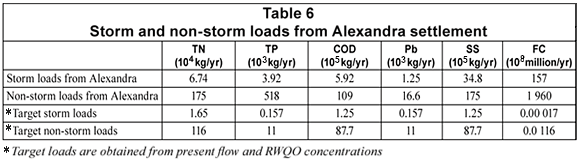
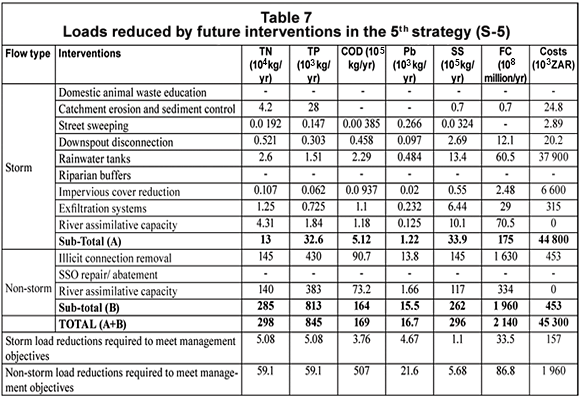
Twenty strategies were evaluated and those which achieved the management objectives (Table 2) are shown in Table 5 indicating the costs, implementation factor and timeframe of each intervention. The 5th strategy (S-5) came out with the minimum cost and hence represents the 'best' strategy out of those considered (Table 5). Most of the unit treatment costs were assumed in the analysis; hence the cost figures must be taken as indicative only. Table 6 shows estimates of storm and non-storm loads from Alexandra settlement compared with the target loads. The comparison yielded loads to be retained which were set as management objectives in Table 2. Only evaluation results of the 5th strategy are presented in this paper and are shown in Table 7. The Jukskei River system has enormous capacity to treat pollution from Alexandra catchment. In all the strategies evaluated, the river assimilative capacity is more effective than any of the interventions modelled, except illicit connection removal intervention (Table 7). For storm loads, interventions found to be most effective were: use of rainwater tanks, impervious cover reduction, downspout disconnection, exfiltration systems, and catchment erosion and sediment control. Non-storm loads from Alexandra result mostly from illicit connections to the drainage system and hence are reduced effectively by illicit connection removal intervention. The evaluation also indicated that for non-storm flows a threshold of 83% implementation of illicit connection removal intervention was required to meet management objectives for bacteria. The critical pollutants to reduce in storm and non-storm flows were suspended solids (SS) and bacteria (FC), respectively. In Table 7, comparison of Row 11 with Row 17 and Row 15 with Row 18 shows that the loads reduced by the interventions exceed the load reductions required to meet management objectives. This was due to the assumption made in the model conceptualisation that non-structural interventions do not act in series (because the points of their applications are very diffuse), and it reflects a shortcoming of the model which requires attention in future refinements.
Conclusions and recommendations
There have been a number of studies on stormwater quality from Alexandra catchment (Johannesburg, South Africa) and its pollution threat to the receiving environment. These studies mostly identified the pollutants of concern, source and causes of pollution, and threats of the pollution to the aquatic environment and health of the residents of Alexandra as well as other users of water from the Jukskei River. The case study presented in this paper uses mostly the information from the previous studies to:
- Estimate storm and non-storm loads for Alexandra catchment
- Quantify water quality management objectives (load reduction targets) for Alexandra catchment
- Formulate alternative management strategies involving different mixes of identified interventions
- Evaluate the strategies by quantifying their load reductions
- By using a trial-and-error approach, select the best strategy from those considered based on least cost analysis
The analysis was carried out using a spreadsheet-based model specifically designed for the task. A sequence of actions (Strategy 5) that the municipality may implement to improve and manage stormwater quality as part of capital and operational projects includes:
- 100% of feasible pervious surface area (i.e. after formalisation of the settlement) will be managed with erosion and sediment control techniques in the first 5 years
- Daily street-sweeping (including refuse removal) will be accomplished in 75% of all feasible streets in the settlements in the first 5 years
- Formalisation of the settlement will be completed in the next 10 or more years with 15% of the feasible impervious cover reduced
- 50% of feasible areas will have their downspouts disconnected after formalisation of the settlement
- 83% of all illicit connections will be removed after formalisation of the settlement
- 100% of the feasible households will be provided or equipped with rainwater tanks after formalisation of the settlement
- 100% of the feasible roads will be retrofitted with stormwater exfiltration system during the formalisation of the settlement
Non-structural and operational controls such as educational programmes, erosion and sediment control, frequent street sweeping and refuse removal, and maintenance operations should be ongoing procedures since they are preventive measures, cost-effective and constitute good house-keeping. As part of a de-densification and relocation of dwellings project, feasible residential and commercial areas should gradually have impervious cover areas reduced (converted to pervious areas) and downspouts disconnected. Ways to achieve higher per cent coverage of impervious cover reduction, downspout disconnection, illicit connection removal, and rainwater tanks should also be further investigated as well as the use of subsidies, regulatory measures and soak-away pits to enhance the implementation of these interventions. It will take time to de-densify and formalise Alexandra settlement and also to confirm the cost and effectiveness, under local conditions, of emerging interventions such as exfiltration systems, impervious cover reduction, downspout disconnection, illicit connection removal, and riparian buffer interventions. Thus they should be implemented gradually over a long period of time.
The main limitations of the model are:
- The model is analytically based on lumped parameters which are subject to many assumptions and limitations as opposed to continuous modelling
- The model provides estimates of many source loads and load reductions for which reliable monitoring or performance data is not yet available especially in developing areas. It must be recognised, however, that the model defaults are nothing more than informed judgments or heuristics based on literature review. They have been included in the framework to help stormwater managers, who would otherwise not have access to these data, to evaluate as many sources and treatment/management options as possible.
- The model makes simplified assumptions and employs analytical methods for the calculation of loads and load reductions (Owusu-Asante, 2008) for which much more complicated analyses may be conducted. The simplifications in the model lead to 'uncertainty' in the results. Hence output values are subject to imprecision.
- The model tracks only 6 pollutants: nitrogen, phosphorus, chemical oxygen demand, lead, suspended solids and faecal coliforms
The following recommendations are made towards enhancement of the model developed under this research:
- The general scarcity of appropriate quantitative information on urban water quality characteristics and management interventions (including design parameters, costs, and removal effectiveness) hampers the selection of suitable management interventions that can be deployed to manage the impacts of urban water quality pollution. Consequently, it is essential that carefully targeted research should be conducted to fill these information gaps. The input parameters into the model can be used to guide the type of information needs.
- Development of a database to capture all monitored information is crucial to water quality management in settlements. This should include a database on structural treatment measures' performance to help establish their important design parameters and elucidate the parameter effects on the structural treatment measures' performance. A database on non-structural programmes will help to establish the factors that are critical to their effectiveness and sustainability. Any developed database should be readily available to the public or at least all stakeholders and should be a driving force for knowledge sharing.
- The original research proposal included an undertaking of field treatability tests of some interventions as a case study. This action was initiated in Kliptown, a township in Johannesburg, but could not be completed due to financial constraints. Hence all the interventions identified and included in the model have not been tested locally to ascertain their applicability and suitability. It is therefore recommended that the model be tested using actual monitored data from a selected settlement. This will require a long-term data collection programme.
- The extent to which geographic information systems (GIS) can be locally used as appropriate management and communications technologies to quantify urban runoff, identify and select appropriate management interventions and communicate choices to decision-makers needs further research
- The model will be greatly enhanced if it can be re-designed to run continuous simulation to accommodate temporal and spatial variation of input parameters
- Selection of least-cost strategy with the model is presently achieved by a process of trial and error. The selection process can be improved if the model can be linked to an optimiser, and research into this aspect is recommended.
- The model has enormous input data requirements, each of which have their own uncertainties. Classical uncertainty analysis may not be feasible for this type of model but further elucidation of how uncertainty can be accounted for remains an important research gap.
A methodology for evaluating the benefits of the interventions to the Jukskei River, health and wellbeing of the people of Alexandra should be developed. This would also require continuous performance monitoring to assess the actual performance of the interventions relative to their expected performance. Most of the information used in the model was assumed and sourced from other international studies. It is recommended that future data capture should be encouraged and this data substituted in the model to enhance the accuracy in the parameter estimations. Thus the study's recommendations are only preliminary and should be examined rigorously before adoption, and reviewed and updated periodically as part of the capital and operational budget process.
References
- ASHTON PJ and BHAGWAN J N (2001) Guidelines for the Appropriate Management of Urban Runoff in South Africa. Integrated Report. WRC Report No. TT/155/01. Water Research Commission, Pretoria, South Africa.
- BKS INC. (1996) Jukskei River Water Quality Management: Development of Water Quality Management Objectives. Final Report to the Department of Water Affairs and Forestry, Directorate of Water Quality Management, South Africa.
- BROWN E, CARACO D, CENTER FOR WATERSHED PROTECTION and PITT R (2004) Illicit Discharge Detection and Elimination. A Guidance Manual for Program Development and Technical Assessments. Centre for Watershed Protection, Ellicott City, M.D. USA.
- CAMPBELL LA (2001) A Study on the Fate of Urban/Stormwater Runoff from Alexandra Township in the Jukskei River. WRC Report No. 598/3/01. Water Research Commission, Pretoria, South Africa.
- CANDARAS AM, CARVALHO MJ and MAN-KIT KOO (1995) City of Etobicoke Exfiltration and Filtration Systems Pilot/Demonstration Project. In: James W (ed.) Modern Methods for Modeling the Management of Stormwater Impacts. Computational Hydraulics International, Guelph, Ontario.
- CWP (CENTRE FOR WATERSHED PROTECTION) (2001) Watershed Treatment Model. Centre for Watershed Protection, Ellicott City, M.D. USA.
-
DEHD (DEPARTMENT OF ECONOMIC AND HUMAN DEVELOPMENT, SOUTH AFRICA (2007) The Economic Imperatives of Environmental Sustainability. City of Cape Town, South Africa. December 2007. URL: www.capetown.gov.za/en/ehd/Documents/ EHD_-_The_Economic_Imperatives_of_Environmental_Sustainability_161200813435_.pdf (Accessed January 2008).
» www.capetown.gov.za/en/ehd/Documents/ EHD_-_The_Economic_Imperatives_of_Environmental_Sustainability_161200813435_.pdf - DWAF (DEPARTMENT OF WATER AFFAIRS AND FORESTRY, SOUTH AFRICA) (2006) Resource Directed Management of Water Quality: Management Instruments. Volume 4.2. Guideline for Determining Resource Water Quality Objectives (RWQOs), Allocatable Water Quality and the Stress of the Water Resource. (2nd edn.). Water Resource Planning Systems Series, Sub-Series No. WQP 1.7.2. Department of Water Affairs and Forestry, Pretoria, South Africa.
- LI J and KOO M (1994) Development of stormwater percolation technology. Proc. Environmental Engineering Conf. 1994. Winnipeg, Manitoba, Canada. 278-288.
- LI J, TRAN J, HENRY D, and LIANG W (1997) Development and evaluation of the City of Etobicoke Exfiltration System. Proc. The Operational Water Management Conf. 1997. Copenhagen, Denmark. 407-413.
-
MTSHELWANE Z (2002) Thousand new houses in Alex upgrades. City of Johannesburg website. URL: www.joburg.org.za/Thousand New Houses in Alex Upgrades.htm (Accessed June 2007).
» www.joburg.org.za/Thousand New Houses in Alex Upgrades.htm - OWUSU-ASANTE Y (2008) Decision Support System for Managing Stormwater and Greywater Quality in Informal Settlements in South Africa. Ph.D. Thesis. School of Civil and Environmental Engineering, University of the Witwatersrand, South Africa.
-
OWUSU-ASANTE Y and STEPHENSON D (2006) Estimation of storm runoff loads based on rainfall-related variables and power law models – case study in Alexandra. Water SA 32 (2) 137-143. http://www.wrc.org.za/downloads/watersa/2006/April%2006/1818.pdf.
» http://www.wrc.org.za/downloads/watersa/2006/April%2006/1818.pdf - ROSSMAN LA (2004) Stormwater Management Model, Version 5, User Manual. United States EPA, Cincinnati.
- SCHUELER TR (1987) Controlling Urban Runoff – A Practical Manual for Planning and Designing Urban BMPs. Metropolitan Washington Council of Governments, Washington DC.
- STEPHENSON and ASSOCIATES (2002) Investigation of stormwater culverts on the tributaries of the Jukskei River in the Alexandra Township. Consolidated report to City of Johannesburg, South Africa. Final report.
- STEPHENSON D and BARTA B (2005) Impacts of Stormwater and Groundwater Ingress on Municipal Sanitation Services. WRC Report No. 1386/1/05. Water Research Commission, Pretoria, South Africa.
- WALSH G (2001) quoted in TAYLOR A and WONG THF (2002) Non-structural Stormwater Quality Best Management Practices – A Literature Review of Their Value and Life cycle Costs. Technical Report 02/13, Cooperative Research Centre for Catchment Hydrology. Melbourne, Australia.