Mortality associated with Acute Appendicitis at a Tertiary Academic hospital in Johannesburg, South Africa
Abstract
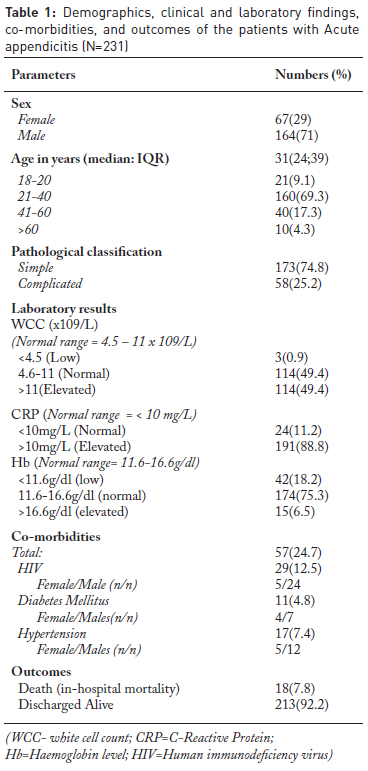
BACKGROUND: Mortality secondary to acute appendicitis (AA) is reported to be less than 6% but is higher in patients with a complicated presentation or those who have co-morbidities OBJECTIVE: To determine factors associated with mortality in patients presenting with acute appendicitis to a large tertiary hospital in Johannesburg, South Africa METHODS: Records of patients 18 years and older, admitted with AA over 5 years, were reviewed retrospectively. Data collected included demographic information, co-morbidities, clinical and laboratory findings, surgical treatment, and clinical outcomes RESULTS: Two hundred and thirty-one patients met the inclusion criteria. Of this cohort, 71% (164/231) were males. The mean age of the study group was 31 ± 12.2 years, and 69.3% were between 20 and 40 years old. Twenty-nine (12.6%) patients were HIV positive, the majority (82.8%) of whom were male. Fifty-eight (25.3%) had complicated AA. Eighteen (7.8%) patients died, of whom 83.3% (15/18) were male. Fifty percent (9/18) of the deaths occurred in the 40-60 age group (p=<0.001). Thirteen (72.2%) of those who died presented to the hospital more than 72 hours after the initial onset of symptoms. The median CRP of those who died (247.5 mg/L) was significantly higher compared to the survivors (99 mg/L) (p= 0.001 CONCLUSIONS: In this study, a quarter of the patients with AA presented with a complicated disease. Mortality secondary to AA was higher in individuals in the 21- 60-year age group and in patients who presented later than 72 hours following the onset of symptoms
Acute appendicitis; co-morbidities; low- and middle-income countries; mortality
INTRODUCTION
Acute appendicitis (AA) predominately occurs in adolescents and young adults.(1-3) Acute appendicitis may be simple or complicated. Complicated forms include a gangrenous appendix, inflammatory mass, appendix abscess, or rupture with generalised peritonitis.(1,4) Diagnosing simple or complicated AA relies on a combination of clinical features and findings of imaging investigations such as ultrasound, CT scan, or magnetic resonance imaging (MRI).(2-5) There is a higher likelihood of complicated appendicitis in patients with delayed presentation.(1) The rate of AA complications is higher in patients over 60 years of age, and they present earlier in this age group.(6)
While appendectomy remains the gold standard for treating AA, conservative antibiotic therapy has demonstrated efficacy in selected cases with uncomplicated disease.(7,8) All instances of complicated AA require surgical intervention or percutaneous drainage, except for an inflammatory mass.(1,4) Mortality due to AA ranges from 0% to 5.6% but is higher in some low- and middle-income countries (LMICs) and in patients with co-morbidities.(1,2,9) The high mortality of AA in LMICs is related to factors such as delayed presentation and lack of access to quality health-care.(1,3,9,10) As there are only a few published studies on the outcomes associated with AA in middle-income countries, we sought to analyse the factors associated with mortality in patients who presented with AA to a central academic hospital in Johannesburg, South Africa.
METHODS
We conducted a retrospective study at a tertiary academic hospital (Charlotte Maxeke Johannesburg Academic Hospital) in Johannesburg, South Africa, over 5 years from 01 January 2017 to 31 December 2021. Demographic and clinicopathological data were retrieved from the clinical notes and Redcap data and then captured onto an Excel spreadsheet. All patients over 18 years old with features of AA were included in the study. The clinical presentation, time of onset of symptoms, common laboratory-related investigations, and surgical procedures were all documented. The associated co-morbidities, in-hospital length of stay, and mortalities were also reported. Complicated AA was defined as transmural appendiceal necrosis with associated perforation and local complications. Noteworthy co-morbidities considered significant for analysis included hypertension, diabetes, and a positive HIV status.
The cohort was stratified into two groups based on the outcome of either successful discharge from the hospital or death. Categorical data were summarized using frequencies and percentages. The mean with standard deviation and median plus interquartile range was used to consolidate parametric and non-parametric data, respectively. The Shapiro-Wilk test was used to test the normality distribution of the data. Fisher's exact or Chi-squared test was used to check the significance level of the difference between categorical findings. The student's t-test compared the continuous and normally distributed data sample means.
Mann-Whitney and Kruskal-Wallis rank test was used for comparison of the medians of non-parametric continuous data. The level of significance was set at a p-value below 0.05. Multivariate logistic regression analysis assessed the association between mortality and independent variables, which returned a p-value of 0.2 or less following univariate analysis. Analysis of the data was performed using the STATA Release 17 version 17.0.
Ethical approval for the study was obtained from the Human Research Ethics Committee of the University of the Witwatersrand (M210927).
RESULTS
Of the 294 patient records initially identified, 231 were suitable for analysis after excluding 63 due to incomplete data. One hundred and sixty-four (71%) of these were males. The mean age was 31 ± 12,2 years, and 69.3% were in the 20 to 40 age range. Fifty-seven patients of the 231 in the study group (24.7%) had significant co-morbidities. Twenty-nine (29/231; 12.6%) were HIV positive, the majority (24/29) of whom were male.
Complicated AA was observed in 25.3% (58/231) of patients. The median white cell count (WCC) of the patients who were admitted and treated for AA was 10.88 x 10⁹/L (IQR: 8.36 -14.33 109/L), C-reactive protein (CRP) 100mg/L (IQR 42 - 180 mg/L) and haemoglobin (Hb) 13.9 g/dL (IQR 12.1;15.3 g/d). Eighteen (18/231; 7.8%) patients died (Table 1).
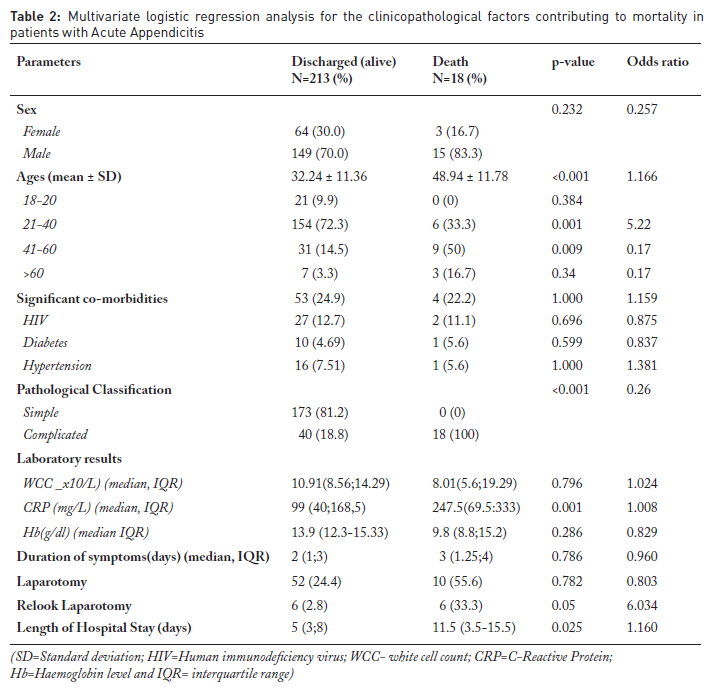
The majority (15/18; 83.3%) of the deaths occurred in male patients, but the difference in the mortality rate between males and females was not significant (p= 0.232). Nine (9/18; 50%) of the deaths occurred in the 40-60 years age range. The mortality across the age groups 21-60 was statistically significant (p-value < 0.001 for 21-40 and 0.009 for 41-60 age groups). The median duration of symptoms prior to presentation for patients who died was 3 days (range: 1-14 days) compared to 2 days (range: 1-30 days) in those who survived, but the difference was not statistically significant (p-value = 0.786). There was no statistical difference in survivors' and non-survivors median white cell count and haemoglobin levels. However, C-reactive protein levels were significantly elevated in those who died (p-value 0.001). Patients who needed relook laparotomy had a substantially higher risk of dying (p=0.05 and Odds ratio of 6.034) (Table 2).
Fourteen of the eighteen patients (77.8%) who died had no significant co-morbidities, and ten of those who died (55.6%) underwent laparotomy. The median length of stay for the patients who died was significantly longer at 11.5 days (2-42 days), compared to 5 days (1-35 days) for survivors (p= 0.025).
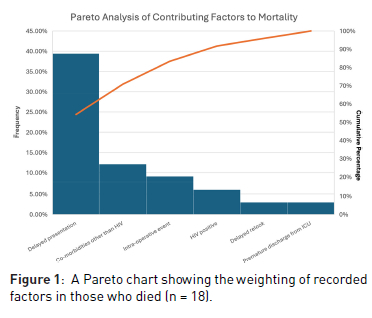
Thirteen (72.2%) of the patients who died presented beyond 72 hours after the onset of symptoms. A Pareto analysis assessed which other factors were most likely to impact mortality significantly (Figure 1). Based on the Pareto principle, two factors, i.e., delayed presentation and co-morbidities (hypertension and diabetes), were found to be the most critical factors to address to reduce mortality.
The left X-axis represents the individual percentage contribution per event, the Y-axis represents events associated with mortality, and the right X-axis represents the accumulative percentage of all events. The red line crosses the 80% level for Delayed presentation and Co-morbidities other than HIV (Hypertension and Diabetes mellitus).
DISCUSSION
The primary objective of this study was to identify factors associated with mortality in patients admitted and treated for AA. The study findings reveal that 71% of AA patients were male, with the majority falling within the 18-40 age range, and 25% of patients had co-morbidities. The overall mortality rate in AA patients was 7.8%. Although mortality was not statistically significantly higher in those presenting 3 days after symptom onset, the Pareto analysis strongly suggested that addressing this factor was highly important in reducing mortality in patients presenting with AA. Also addressing co-morbidities such as hypertension and diabetes could also reduce mortality.
Globally, the lifetime risk of developing AA is 8.6% for men and 6.7% for women, with a male-to-female ratio ranging from 1:1 to 3:1.(11-13) The male-to-female ratio of patients presenting with AA of 2.4:1 in the current study is in keeping with the previous findings.(2-5) AA is more prevalent in high-income countries in the 10-19 age group. (14) The high percentage of patients between the ages of 20 and 40 in our setting is most likely related to the fact that the surgical unit at the treating facility only admitted patients 18 years or older.
The observed mortality rate of 7.8% in the current study is significantly higher than the 0- 5.6% reported within and outside of South Africa.(1,9,15,16) This higher mortality rate is not surprising, as our institution is a tertiary referral hospital serving fourteen hospitals in the referral chain. Thus, it is likely to receive more clinically complicated and complex cases requiring specialist management.
The mortality in the current study was higher in patients aged 21 to 60 years. The diagnosis of AA is more challenging in older patients due to atypical clinical features and broader differential diagnoses.(17) Atypical presentation of AA may contribute to the delay in presentation, contributing to 39.4% of mortality in the current study. A delay in the presentation of AA increases the risk of developing complicated AA.(15,18,19) One in four of the patients in this study had complicated AA. The rate of occurrence of perforated appendicitis is reported to be 20% but increases to 70% in the elderly. (20) A hospital stay of patients above the age of 60 years has the propensity to be longer because of co-morbidities and higher rates of complications.(21)
Relook laparotomies were associated with higher mortality with an odds ratio of 6.03. Delayed relooks of greater than 24 hours only contributed to mortality in 3% of patients. Delayed relook was not a significant factor associated with mortality in our study.
HIV was the most prevalent co-morbidity in the study cohort at 12.6%, and it has been known to be associated with other conditions that may mimic AA.(22,23) Mahmood et al. in 2021 reported that the prevalence of AA is higher in the HIV population compared to HIV-uninfected individuals.(22) Our study does not support this finding as the prevalence of HIV in our study cohort is similar to the overall prevalence of HIV in the South African population.
LIMITATIONS OF THE STUDYAs this was a retrospective study, the limitations of retrospective studies also apply to the current study. Only adults were included in the survey. Therefore, those under 18 years were not part of the analysis in this study. Surgical complications related to the procedures were not specified. As our institution is a major referral site for primary and secondary hospitals, there is potential for bias towards more complicated cases, resulting in skewed data. Also, the study sample, constrained to one tertiary hospital, underscores the need for caution in generalising findings to other hospitals. Interrogation of other factors delaying presentation within the healthcare system was not explored.
CONCLUSION
The observed overall mortality rate of 7.8% surpasses previous reports, emphasising the gravity of this condition. Mortality in AA was notably higher in men aged 40 years and above and those presenting more than 3 days after symptom onset. These findings underscore the importance of vigilant preventative and management strategies, particularly in specific demographic groups, to improve outcomes and reduce mortality related to AA. Timely diagnostic scrutiny, coupled with swift surgical referral, can potentially curtail the risk of perforation and forestall the emergence of complications.
CONFLICT OF INTERESTThe authors of this study declare no conflict of interest.
ACKNOWLEDGMENT
We would like to acknowledge Ms. Jodie Retief for her assistance with the study.
REFERENCES
- 1. Balogun OS, Osinowo A, Afolayan M, et al. Acute perforated appendicitis in adults: management and complications in Lagos, Nigeria. Ann Afr Med. 2019; 18(1):36-41.
- 2. Schildberg CW, Reissig K, Hunger R, et al. Diagnostic, therapy and complications in acute appendicitis of 19,749 cases based on routine data: a retrospective multicenter observational study. J Clin Med. 2022:11(15):4495.
- 3. Seow CS, Chan DKH, Bohari A, Guo JW, Sy LL. Predictors of clinical outcomes in acute appendicitis: a retrospective study. Med J Malaysia. 2022; 77(3):331-337.
- 4. Bom WJ, Scheijmans JCG, Salminen P, Boermeester MA. Diagnosis of uncomplicated and complicated appendicitis in adults. Scand J Surg. 2021; 110(2):170-179.
- 5. Snyder MJ, Guthrie M, Cagle S. Acute appendicitis: efficient diagnosis and management. Am Fam Physician. 2018; 98(1):25-33.
- 6. Calis H. Morbidity and mortality in appendicitis in the elderly. J Coll Physicians Surg Pak. 2018; 28(11):875-878.
-
7. Pedziwiatr M, Lasek A, Wysocki M, et al. Complicated appendicitis: risk factors and outcomes of laparoscopic appendectomy - Polish laparoscopic appendectomy results from a multicentre, large-cohort study. Ulus Travma Acil Cerrahi Derg. 2019; 25(2):129-136. doi: 10.5505/tjtes.2018.80103
» https://doi.org/10.5505/tjtes.2018.80103 - 8. Moris D, Paulson EK, Pappas TN. Diagnosis and management of acute appendicitis in adults: a review. JAMA. 2021; 326(22):2299-2311.
- 9. Williams BM, Purcell LN, Varela C, Gallaher J, Charles A. Appendicitis mortality in a resource-limited setting: issues of access and failure to rescue. J Surg Res. 2021; 259:320-325.
- 10. Kong VY, Sartorius B, Clarke DL. Acute appendicitis in the developing world is a morbid disease. Ann R Col Surg Engl. 2015; 97(5):390-395.
- 11. Krzyzak M, Mulrooney SM. Acute appendicitis review: background, epidemiology, diagnosis, and treatment. Cureus. 2020; 12(6):e8562.
- 12. Petroianu A. Diagnosis of acute appendicitis. Int J Surg. 2012; 10:115-119.
- 13. Téoule P, de Laffolie J, Rolle U, Reissfelder C. Acute appendicitis in childhood and adulthood. Dtsch Arztebl Int. 2020; 117:764-774.
- 14. de Wijkerslooth EML, van den Boem AL, Wijnhoven, BPL. Disease burden of appendectomy for appendicitis: a population-based cohort study. Surg Endosc. 2019; 34(1):116-125.
- 15. Nshuti R, Kruger D, Luvhengo TE. Clinical presentation of acute appendicitis in adults at the Chris Hani Baragwanath Academic Hospital. Int J Emerg Med. 2014; 7(1):12.
- 16. Selassie HG, Selassie HT, Ashebir D. Pattern and outcome of acute appendicitis: observational prospective study from a teaching hospital, Addis Ababa, Ethiopia. Open Access Emerg Med. 2021; 13:265-271.
- 17. Jalil A, Shah SA, Saaiq M, et al. Alvarado scoring system in prediction of acute appendicitis. J Coll Physicians Surg Pak. 2011; 21(12):753-755.
- 18. Ditillo MF, Dziura JD. Is it safe to delay appendectomy in adults with acute appendicitis? Ann Surg. 2006; 244(5):656-660.
- 19. Narsule CK, Kahle EJ, Kim DS, et al. Effect of delay in presentation on rate of perforation in children with appendicitis. Am J Emerg Med. 2011; 29:890-893.
- 20. Sheu BF, Chiu TF, Chen JC, et al. Risk factors associated with perforated appendicitis in elderly patients presenting with signs and symptoms of acute appendicitis. ANZ J Surg. 2007; 77:662-666.
- 21. Omari AH, Khammash MR, Qasaimeh GR, et al. Acute appendicitis in the elderly: risk factors for perforation. World J Emerg Surg. 2014;9(1):6.
- 22. Mahmood A, Raza SH, Elshaikh E, Mital D, Ahmed MH. Acute appendicitis in people living with HIV: what does the emergency surgeon needs to know? SAGE Open Med. 2021; 9:2050312120982461.
- 23. Bedada AG, Eshetu AB. The clinical characteristics and outcomes of appendicitis in a population with a high HIV-infection prevalence. Afr J Emerg Med. 2022; 12(4):418-422.