Commentary on the 2025 AHA/ACC and 2024 ESC Hypertension Guidelines: Comparisons and Adaptations for South Africa
INTRODUCTION
The 2025 American Heart Association/American College of Cardiology (AHA/ACC) guideline and the 2024 European Society of Cardiology (ESC) guideline represent the most recent major international updates on hypertension prevention, diagnosis, and treatment.(1,2) The guidelines emphasise intensified blood pressure (BP) targets, risk stratification, and comprehensive lifestyle interventions amid rising global cardiovascular burdens. South Africa (SA) faces a complex burden. Hypertension affects 40-50% of adults, with control rates below 50%.(3) There is a high communicable disease comorbidity, marked socioeconomic inequality, urbanisation, obesity and persistent salt excess.(4)
The most recent formal South African guidance remains the South African Hypertension Society (SAHS) Practice Guideline published in 2014, which was appropriately rational and resource-sensitive for its time.(5) However, the emergence of the 2024 ESC and 2025 AHA/ACC recommendations highlights the need to reassess several aspects of the South African approach. Future local guidance will likely retain the practical diagnostic threshold of ≥140/90 mmHg, while recognising 130-139/80-89 mmHg as an at-risk category requiring structured intervention in selected patients. It is also likely to support lower BP targets for high-risk groups, greater use of home and ambulatory BP monitoring, earlier initiation of combination therapy, stronger integration of chronic kidney disease (CKD) and cardiovascular risk stratification, and renewed emphasis on population-level prevention. Consequently, these international updates provide an important opportunity to modernise the 2014 SAHS framework while preserving its relevance to local healthcare realities.
PRINCIPLES SHARED BY THE AHA/ACC AND ESC GUIDELINES
Despite their differences, the guidelines share several core principles. First, hypertension is recognised as a continuous risk factor rather than a binary state; cardiovascular risk rises progressively with increasing BP. Second, lifestyle modification remains the cornerstone of prevention and treatment. Both guidelines emphasise sodium restriction, weight reduction, and regular physical activity, moderation of alcohol intake, smoking cessation, and healthy dietary patterns. These measures are especially relevant in SA, where rapid urbanisation has been accompanied by sedentary behaviour and increased consumption of processed foods.(1,2,6)
Third, both guidelines stress the importance of accurate BP measurement. Standardised office techniques, repeated readings, and greater use of home or ambulatory monitoring are recommended to reduce misclassification and identify white-coat or masked hypertension. Fourth, treatment decisions should be informed by total cardiovascular risk rather than BP values alone. Patients with diabetes, CKD, established cardiovascular disease, or multiple risk factors warrant more intensive intervention than otherwise healthy individuals with similar BP levels.
Finally, both guidelines endorse similar first-line drug classes: angiotensin-converting enzyme inhibitors (ACE inhibitors), angiotensin receptor blockers (ARBs), calcium channel blockers (CCBs), and thiazide diuretics.(1,2)
AHA/ACC GUIDELINE APPROACH
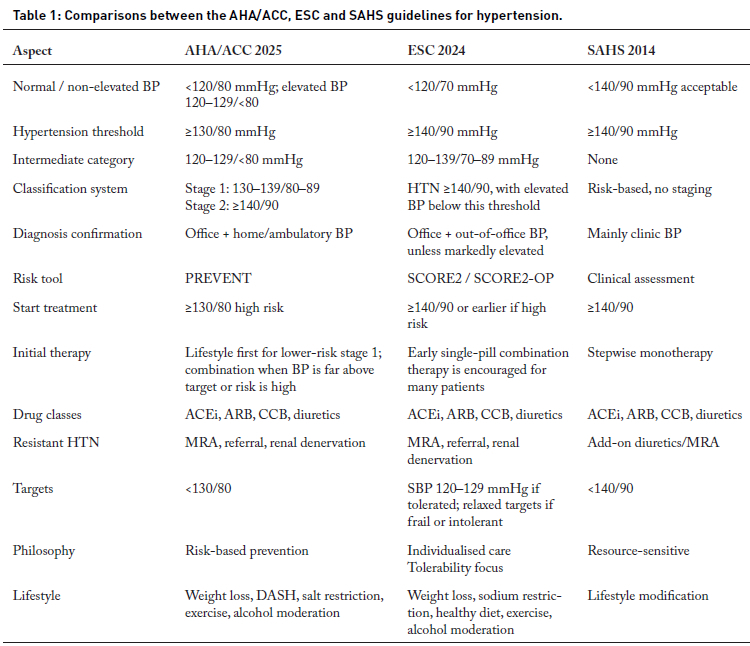
The AHA/ACC approach is strongly preventive and seeks earlier intervention across the population. Hypertension is defined as a threshold of ≥130/80 mmHg, with stage 1 hypertension encompassing systolic BP 130-139 mmHg or diastolic BP 80-89 mmHg. This lower threshold reflects evidence that cardiovascular risk begins well below traditional cut-offs and aims to identify patients before organ damage develops.(1) Treatment is risk-based. The guideline recommends pharmacological treatment for patients with BP ≥130/80 mmHg when cardiovascular risk is elevated, including those with diabetes, CKD, or increased estimated 10-year risk. For lower-risk individuals with stage 1 hypertension, lifestyle therapy is prioritised before medication is considered. Treatment targets generally remain <130/80 mmHg for most adults.(1)
A further strength is its emphasis on structured cardiovascular risk prediction, with PREVENT (Predicting Risk of Cardiovascular Disease Events) recommended as the preferred contemporary risk assessment tool. PREVENT is a newer risk calculator that estimates an individual's 10-year risk of major cardiovascular events, including myocardial infarction, stroke, heart failure, or cardiovascular death, using routinely available variables such as age, sex, blood pressure, lipids, diabetes status, smoking, kidney function, and body mass index. Derived from large, contemporary, diverse cohorts, it provides a more comprehensive estimate of absolute risk than older models, notably by including heart failure. Its use shifts hypertension management beyond BP thresholds alone by recognising that patients with similar BP levels may have substantially different cardiovascular risk and therefore different benefits from treatment intensification.(7) This approach is especially relevant to South Africa, where hypertension frequently coexists with diabetes, obesity, CKD, and other cardiometabolic risks.(8) Additional refinements include stronger endorsement of renin-angiotensin-aldosterone system inhibition in CKD with albuminuria, the use of potassium-enriched salt substitutes where appropriate, and selective use of mineralocorticoid receptor antagonists or renal denervation in resistant hypertension. Overall, the AHA/ACC framework emphasises earlier diagnosis, standardised targets, and proactive population-level prevention.(1)
ESC GUIDELINE APPROACHThe 2024 ESC guideline uses a more traditional diagnostic threshold. It classifies BP below 120/70 mmHg as non-elevated, 120-139/70-89 mmHg as elevated, and BP at or above 140/90 mmHg as hypertension. This preserves a higher diagnostic threshold while still recognising risk in the intermediate range. The approach seeks to avoid overtreatment in lower-risk populations while maintaining the focus on patients most likely to benefit. For treated patients, the ESC recommends targeting a systolic BP of 120-129 mmHg if tolerated. The guideline allows less-aggressive targets for patients with frailty, orthostatic symptoms, intolerance to treatment, or limited life expectancy, making its approach more explicitly individualised while allowing more flexible targets for older adults. The ESC recommendations place greater emphasis on patient-centred flexibility and fixed-dose combinations to improve adherence and accelerate BP control.(9) The guideline uses the Systematic Coronary Risk Estimation 2 (SCORE2) and Systematic Coronary Risk Estimation 2-Older Persons (SCORE2-OP) to estimate an individual's risk of future cardiovascular events.(9,10) SCORE2 is used for adults aged 40-69 years, while SCORE2-OP is designed for those aged 70 years and older. A key improvement is that these tools take into account competing risks of death from non-cardiovascular causes, which is important in older people, where overall mortality risk can influence the likelihood of experiencing a cardiovascular event. This provides a more accurate and balanced estimate of risk, helping clinicians avoid over- or under-treatment in elderly patients. The principle of tailoring treatment based on age-specific risk remains highly relevant in a setting with an ageing and increasingly multimorbid population.(9,10) Collectively, the ESC framework emphasises practical thresholds, early combination therapy, and individualised targets that can be adapted across diverse healthcare settings.
KEY DIFFERENCES IN DIAGNOSTIC THRESHOLDS AND TREATMENT PHILOSOPHY BETWEEN THE GUIDELINESThe AHA/ACC and ESC guidelines differ mainly in how early they label and treat hypertension: AHA/ACC takes a more preventive, risk-driven approach by defining hypertension at ≥130/80 mmHg and prioritising earlier intervention for people at higher cardiovascular risk, whereas ESC uses a higher diagnostic threshold of ≥140/90 mmHg, places more emphasis on tolerability and individualisation, and accepts a broader "elevated" range before calling it hypertension. In practice, the AHA/ACC strategy is more aggressive and population-focused. At the same time, the ESC approach is more conservative in diagnosis but more flexible in treatment targets, especially for older, frail, or treatment-intolerant patients.(1,2)
RELEVANCE TO SAHypertension in SA is highly prevalent, frequently unrecognised, inadequately treated and poorly controlled. This burden is driven by urbanisation, obesity, and lifestyle transitions.(11) Despite available therapies, BP control remains suboptimal, generally below 50%, largely due to poor adherence and health system constraints within primary care settings.(3) Hypertension also commonly coexists with HIV infection, particularly among older individuals with multimorbidity, further complicating long-term management. Although integration of HIV and hypertension services within antiretroviral therapy programmes has improved access and may enhance BP control, systematic screening for target organ damage, especially CKD, remains inconsistently implemented.(12) Socioeconomic barriers, transport costs, food insecurity, and fragmented continuity of care further complicate long-term BP control.(13) Collectively, these background realities suggest that neither of the international guidelines can be fully adopted in SA. A careful and selective integration of the most relevant and feasible components of these guidelines is required to optimise BP care within the SA health system.
GUIDELINE INTERPRETATION AND ADAPTATION CHALLENGES
Adoption of the lower AHA/ACC threshold of 130/80 mmHg may substantially increase the burden on already-constrained public-sector services. The SAHS recommendation of <140/90 mmHg offers a practical approach that supports task shifting in resource-limited, understaffed primary care settings.(1,5) The ESC target of 120-129 mmHg is ambitious and may be achievable in selected low-risk, urban populations. However, its broader implementation is constrained in rural settings, where salt-sensitive hypertension remains prevalent, driven by high dietary sodium intake often exceeding 10 g/day.(2,14)
In settings with a high burden of HIV and CKD, both guidelines consistently emphasise renin-angiotensin-aldosterone system inhibition; however, cost constraints in SA necessitate prioritisation of generic agents. Fixed-dose combination therapies, although underutilised, have been shown to improve adherence by approximately 20-30%.(1,2,15) Context-specific strategies are essential to improve BP control in resource-limited settings, particularly through decentralised, community-based models of care. Programmes such as HealthRise have shown that community screening, supported by task-sharing with community health workers, can effectively identify individuals with previously undiagnosed or poorly controlled elevated BP outside of traditional healthcare facilities. By bringing screening closer to households and linking affected individuals to primary care services, these initiatives facilitate earlier diagnosis, improve linkage to care, and support more sustained BP control among populations often underserved by facility-based healthcare systems.(16)
PROPOSED TREATMENT ADAPTATIONS FOR SAIn SA, where public health services face significant resource pressures, a balanced use of the AHA/ACC and ESC guidelines is appropriate. The lower AHA threshold of 130/80 mmHg may improve early risk detection but would greatly increase the number of people needing follow-up and treatment. By contrast, the ESC threshold of 140/90 mmHg is more useful for primary care services. A workable local approach would therefore retain ≥140/90 mmHg as the diagnostic threshold, while recognising 130-139 mmHg as a higher-risk range requiring strong lifestyle intervention. Treatment targets may be <140/90 mmHg for most patients, with <130/80 mmHg for those at higher risk, including people with CKD, diabetes, or younger patients. Thiazide diuretics and calcium channel blockers remain effective first-line therapies, while renin-angiotensin system blockers are especially valuable in CKD and proteinuria. Combination therapy is often needed early because many patients present late. Broader adoption of dual therapy through public-sector procurement should be implemented.(5)
Since international risk tools are not fully validated in African populations, simple clinical risk markers such as diabetes, HIV, CKD or previous cardiovascular disease remain useful. Strengthening implementation is critical and can be achieved through improved guideline dissemination, digital decision-support tools, and expanded nurse-led home and ambulatory blood pressure monitoring in primary care.(17) At a policy level, subsidising fixed-dose combination therapies and integrating hypertension care into established HIV programmes offer scalable strategies to improve adherence and BP control in high-burden settings.(18-20)
IMPLEMENTATION BARRIERS AND STRATEGIESImplementation of hypertension guidelines in SA remains constrained by high clinical workloads, intermittent medicine stockouts, and limited familiarity with SAHS recommendations.(3,5,21) Addressing these barriers will require rational strategies, including audit-driven quality improvement, expanded task-shifting within primary care, and the use of telehealth to support follow-up and continuity of care.(18,21) Given the disproportionate burden of hypertension among Black South Africans, more focus should be on mobile and community-based services, which would offer a means to improve access and early detection.(11,22) Important evidence gaps remain, particularly the need for locally relevant research to evaluate intensive BP targets, such as those proposed by the ESC, in the SA population.(2)
CONCLUSION
The AHA/ACC and the ESC represent two valid, complementary approaches and philosophies to hypertension care. The AHA/ACC approach is more prevention-focused and risk-adapted at lower blood pressure thresholds. In contrast, the ESC approach is more conservative in its diagnostic criteria but more explicit about tolerability and individualised targets. For SA, where BP control remains suboptimal and resources are limited, selective adoption of the most relevant elements of both frameworks offers the most rational path forward. A balanced local strategy would define hypertension as ≥140/90 mmHg, identify 130-139/80-89 mmHg as a high-risk range requiring prevention, aim for <140/90 mmHg in most patients, and target <130/80 mmHg in high-risk groups. Earlier use of combination therapy, together with strengthened primary care delivery and population-level prevention, is likely to yield the greatest gains in BP control while reducing cardiovascular and kidney morbidity. Achieving meaningful improvements will require coordinated collaboration with national health authorities, aligned with the 2030 global targets for non-communicable diseases.
REFERENCES
-
1. Jones DW, Ferdinand KC, Taler SJ, et al. 2025 AHA/ACC/AANP/AAPA/ABC/ACCP/ACPM/AGS/AMA/ASPC/NMA/PCNA/SGIM guideline for the prevention, detection, evaluation and management of high blood pressure in adults: a report of the American College of Cardiology/American Heart Association Joint Committee on Clinical Practice Guidelines. Hypertension. 2025; 82(10):e212-e316. doi:10.1161/HYP.0000000000000410.
» https://doi.org/10.1161/HYP.0000000000000410 -
2. McEvoy JW, McCarthy CP, Bruno RM, et al. 2024 ESC guidelines for the management of elevated blood pressure and hypertension. Eur Heart J. 2024; 45(38):3912-4018. doi:10.1093/eurheartj/ehae178.
» https://doi.org/10.1093/eurheartj/ehae178 - 3. Jordaan B, Theron B, Owusu E, Bronkhorst E. Hypertension in South Africa: a growing epidemic and evolving treatment paradigms. S Afr Gen Pract. 2025; 6(1):21-26.
-
4. Oni T, Youngblood E, Boulle A, et al. Patterns of HIV, TB, and non-communicable disease multimorbidity in peri-urban South Africa: a cross-sectional study. BMC Infect Dis. 2015; 15(1):20. doi:10.1186/s12879-015-0750-1.
» https://doi.org/10.1186/s12879-015-0750-1 -
5. Seedat Y, Rayner B, Veriava Y. South African hypertension practice guideline 2014. S Afr J Diabetes Vasc Dis. 2014; 11(4):139-144. doi:10.1080/20786204.2014.10844579.
» https://doi.org/10.1080/20786204.2014.10844579 -
6. Godbharle S, Kesa H, Jeyakumar A. Processed food consumption and risk of non-communicable diseases (NCDs) in South Africa: evidence from Demographic and Health Survey (DHS) VII. J Nutr Sci. 2024; 13:e19. doi:10.1017/jns.2024.15.
» https://doi.org/10.1017/jns.2024.15 -
7. Khan SS, Matsushita K, Sang Y, et al. Development and validation of the American Heart Association's PREVENT equations. Circulation. 2024; 149(6):430-449. doi:10.1161/CIRCULATIONAHA.123.067626.
» https://doi.org/10.1161/CIRCULATIONAHA.123.067626 -
8. Wand H, Moodley J, Reddy T, Vujovich-Dunn C, Naidoo S. Quantifying impact of obesity on cardiometabolic comorbidities and public health implications: insights from South Africa. Obes Res Clin Pract. 2023; 17(2):122-129. doi:10.1016/j.orcp.2023.01.003.
» https://doi.org/10.1016/j.orcp.2023.01.003 -
9. SCORE2 risk prediction algorithms: new models to estimate 10-year risk of cardiovascular disease in Europe. Eur Heart J. 2021; 42(25):2439-2454. doi:10.1093/eurheartj/ehab309.
» https://doi.org/10.1093/eurheartj/ehab309 -
10. SCORE2-OP risk prediction algorithms: estimating incident cardiovascular event risk in older persons in four geographical risk regions. Eur Heart J. 2021; 42(25):2455-2467. doi:10.1093/eurheartj/ehab312.
» https://doi.org/10.1093/eurheartj/ehab312 -
11. Nulu S, Aronow WS, Frishman WH. Hypertension in Sub-Saharan Africa: a contextual view of patterns of disease, best management, and systems issues. Cardiol Rev. 2016; 24(1):30-40. doi:10.1097/CRD.0000000000000083.
» https://doi.org/10.1097/CRD.0000000000000083 -
12. Peck RN, Shedafa R, Kalluvya S, et al. Hypertension, kidney disease, HIV and antiretroviral therapy among Tanzanian adults: a cross-sectional study. BMC Med. 2014; 12(1):125. doi:10.1186/s12916-014-0125-2.
» https://doi.org/10.1186/s12916-014-0125-2 -
13. Charlton KE, Steyn K, Levitt NS, et al. A food-based dietary strategy lowers blood pressure in a low socio-economic setting: a randomised study in South Africa. Public Health Nutr. 2008; 11(12):1397-1406. doi:10.1017/S136898000800307X.
» https://doi.org/10.1017/S136898000800307X -
14. Swanepoel B, Schutte AE, Cockeran M, Steyn K, Wentzel-Viljoen E. Sodium and potassium intake in South Africa: an evaluation of 24-hour urine collections in a white, black, and Indian population. J Am Soc Hypertens. 2016; 10(11):829-837. doi:10.1016/j.jash.2016.08.004.
» https://doi.org/10.1016/j.jash.2016.08.004 -
15. Burnier M, Egan BM. Adherence in hypertension: a review of prevalence, risk factors, impact, and management. Circ Res. 2019; 124(7):1124-1140. doi:10.1161/CIRCRESAHA.118.313220.
» https://doi.org/10.1161/CIRCRESAHA.118.313220 -
16. Wollum A, Gabert R, McNellan CR, et al. Identifying gaps in the continuum of care for cardiovascular disease and diabetes in two communities in South Africa: baseline findings from the HealthRise project. PLoS One. 2018; 13(3):e0192603. doi:10.1371/journal.pone.0192603.
» https://doi.org/10.1371/journal.pone.0192603 -
17. Muthathi IS, Rispel LC. Policy context, coherence and disjuncture in the implementation of the Ideal Clinic Realisation and Maintenance programme in the Gauteng and Mpumalanga provinces of South Africa. Health Res Policy Syst. 2020; 18(1):55. doi:10.1186/s12961-020-00567-2.
» https://doi.org/10.1186/s12961-020-00567-2 -
18. Tucker KL, Sheppard JP, Stevens R, et al. Self-monitoring of blood pressure in hypertension: a systematic review and individual patient data meta-analysis. PLoS Med. 2017; 14(9):e1002389. doi:10.1371/journal.pmed.1002389.
» https://doi.org/10.1371/journal.pmed.1002389 -
19. Webster R, Salam A, De Silva HA, et al. Fixed low-dose triple combination antihypertensive medication vs usual care for blood pressure control in patients with mild to moderate hypertension in Sri Lanka: a randomized clinical trial. JAMA. 2018; 320(6):566-579. doi:10.1001/jama.2018.10359.
» https://doi.org/10.1001/jama.2018.10359 - 20. World Health Organization. WHO guideline on HIV service delivery: updated guidance on the integration of diabetes, hypertension and mental health services, and interventions to support adherence to antiretroviral therapy. Geneva: World Health Organization; 2025.
-
21. Ditlhabolo KI, Lion-Cachet C, Variava E. Hypertension guideline implementation and blood pressure control in Matlosana, South Africa. S Afr Fam Pract. 2024; 66(1):5964. doi:10.4102/safp.v66i1.5964.
» https://doi.org/10.4102/safp.v66i1.5964 -
22. Omboni S, McManus RJ, Bosworth HB, et al. Evidence and recommendations on the use of telemedicine for the management of arterial hypertension: an international expert position paper. Hypertension. 2020; 76(5):1368-1383. doi:10.1161/HYPERTENSIONAHA.120.15873.
» https://doi.org/10.1161/HYPERTENSIONAHA.120.15873