Hypertension management in the older adults: A narrative literature review
Abstract
In older adults, hypertension is not only common but also a significant contributor to adverse cardiovascular and cognitive outcomes. However, in the presence of concomitant geriatric syndromes and reduced physiological reserve, managing blood pressure in later life becomes increasingly complex. While landmark clinical trials demonstrate that treatment reduces cardiovascular events and mortality in selected older populations, intensive blood pressure lowering is shown to increase adverse events such as hypotension, syncope, and acute kidney injury. Against the backdrop of reverse epidemiology, where tighter blood pressure control has been associated with higher mortality, particularly in frail older individuals, it is noted that optimal blood pressure target is not a one-size-fits-all strategy. Recent international hypertension guidelines reaffirm the importance of tight blood pressure control for most patients, while placing greater emphasis on more relaxed targets in the context of frailty and advanced age. This narrative review summarises the key evidence and discusses a pragmatic, patient-centred approach to blood pressure management in older adults.
INTRODUCTION
In 2025, South Africa had more than 6.6 million individuals aged 60 years and older, representing approximately 10.5% of the total population.(1) Hypertension is among the most prevalent conditions in this group.(2) A 2013, a national population-based study (n= 3840) reported that 77,3% of individuals aged > 50 years were hypertensive.(3) Older adults represent a heterogeneous group, ranging from robust individuals to those with frailty, multimorbidity, and limited life expectancy, all of which influence both the pathophysiology and management of hypertension.
Ageing is associated with increased arterial stiffness, resulting in isolated systolic hypertension and widened pulse pressure, thereby increasing the risk of strokes, heart failure, and vascular dementia.(4) Concurrently, age-related attenuation of baroreflex responses to postural changes predisposes older adults to orthostatic hypotension and blood pressure (BP) variability.(4)
A key challenge in managing hypertension in older adults is translating evidence from randomised controlled trials into routine clinical practice. Although several landmark trials have evaluated treatment in older populations, individuals with advanced frailty, cognitive impairment, and those residing in long-term care facilities remain underrepresented. Consequently, uncertainty persists regarding optimal BP targets in the very old and in those with complex health comorbidities.
This narrative review highlights key geriatric considerations and proposes a pragmatic approach to hypertension management in older adults.
This narrative literature review included peer-reviewed publications on hypertensive management in older adults. Case reports and non-peer-reviewed sources were excluded. Recent guidelines and landmark clinical trials were prioritised to ensure contemporary relevance.
PAST AND PRESENT EVIDENCE ON HYPERTENSION MANAGEMENT IN OLDER ADULTSSeveral landmark trials have shaped current understanding and guideline recommendations for hypertension management in older adults. Early randomised trials, including the Systolic Hypertension in the Elderly Program (SHEP) and the Systolic Hypertension in Europe Trial (Syst-Eur), demonstrated that treatment of isolated systolic hypertension in adults aged ≥ 60 years significantly reduces the risk of stroke and major cardiovascular events.(5,6) In SHEP, a diuretic-based regimen reduced stroke risk by 36%, while in Syst-Eur, a calcium-channel-blocker-based therapy reduced stroke by 42%, establishing the benefit of treating systolic hypertension in older adults.(5,6)
The Hypertension in the Very Elderly Trial (HYVET) evaluated indapamide, with or without an angiotensin-converting enzyme inhibitor (ACE-I), in individuals aged ≥ 80 years. This randomised control trial demonstrated significant reductions in stroke, heart failure and all-cause mortality (30%, 64%, and 21% respectively), supporting the benefits of antihypertensive therapy even in the very older individuals.(7)
These trials generally adopted more conservative blood pressure targets. SHEP aimed for systolic blood pressure (SBP) <160 mmHg or a reduction of ≥ 20 mmHg ( if baseline SBP was 160-179 mmHg ); Syst-Eur targeted SBP <150mmHg; and HYVET targeted < 150/60mmHg. Despite these less intensive targets, substantial reductions in stroke and cardiovascular events were observed. Importantly, participants were predominantly healthier, community-dwelling older adults, while those with frailty, significant disability, orthostatic hypotension, significant cognitive impairment, or complex multimorbidity were largely excluded.
More intensive targets, as in the Systolic Blood Pressure Intervention Trial (SPRINT), showed that among participants aged ≥ 75 years (28% of the cohort), targeting SBP < 120 mmHg resulted in a lower incidence of major cardiovascular events and all-cause mortality compared with a target of SBP < 140 mmHg.(8) However, similarly to earlier trials, individuals with advanced frailty, nursing home residence, or cognitive impairment were excluded, as were participants with conditions common in older adults, including decompensated heart failure, prior stroke, and diabetes mellitus. Furthermore, the intensive-treatment group experienced higher rates of adverse events, including hypotension, syncope, electrolyte imbalances, and renal dysfunction.(8)
Observational data from the Predictive Values of Blood Pressure and Arterial Stiffness in Institutionalized Very Aged Population Study (PARTAGE) reported higher mortality among frail institutionalised older adults with SBP <130 mm Hg receiving ≥2 antihypertensive drugs (32.2%) compared with those receiving 0-1 agents (19.7%) (adjusted hazard ratio, 1.78; 95% CI, 1.34-2.37; P < .001).(9)
The RETREAT-FRAIL Trial enrolled frail nursing home residents aged ≥ 80 years receiving ≥ 2 antihypertensive agents with SBP <130mmHg. Protocol-guided deprescribing resulted in only a modest increase in SBP (4.1 mmHg) and did not significantly affect mortality or cardiovascular outcomes.(10) These contrasting findings suggest that routine deprescribing may not improve survival but also does not cause significant harm and may still be appropriate in the presence of adverse outcomes (e.g., hypotension), polypharmacy, or when aligned with patient-centred goals of care.
FRAILTY, MULTIMORBIDITY AND OVERTREATMENT
In older adults with multimorbidity, a disease-orientated approach may lead to overtreatment and iatrogenesis.(5) Geriatric syndromes, such as falls, cognitive impairment and functional decline, sit at the interface between what the guidelines say and real-world practice.
Frail older adults with multimorbidity may demonstrate patterns consistent with reverse epidemiology.(11) Several observational studies suggest that higher SBP may be protective in frail individuals, especially those with a slow walking speed. At the same time, low blood pressure is associated with increased mortality, disability and can lead to institutionalisation.(12,13) This phenomenon challenges the application of very strict adherence to guidelines in frail older adults.
Tight blood pressure control reduces long-term cardiovascular events; however, in frail individuals, it may precipitate clinically significant harms, including falls and functional decline.(5) The immediate harm from these complications can far outweigh the delayed benefit of cardiovascular risk reduction. Other geriatric syndromes, including delirium and incontinence, may emerge as the initial manifestation of treatment burden or as medication side effects.
Functional outcome may therefore take precedence over the traditional cardiovascular endpoints, including myocardial infarction, stroke and heart failure. Preserving mobility, independence, continence, and cognitive function is often more meaningful to the frail older adult than long-term risk reduction.(14)
The goal of care in treating frail older adults with multimorbidity is to match treatment intensity to physiological and functional reserve, in the context of competing risks and patient priorities.
Figure 1 illustrates the complex interplay among frailty, intensive blood pressure lowering, and geriatric harm in older adults.
GUIDELINE TARGETS AND WHERE THEY DIFFER IN THE GERIATRIC POPULATION
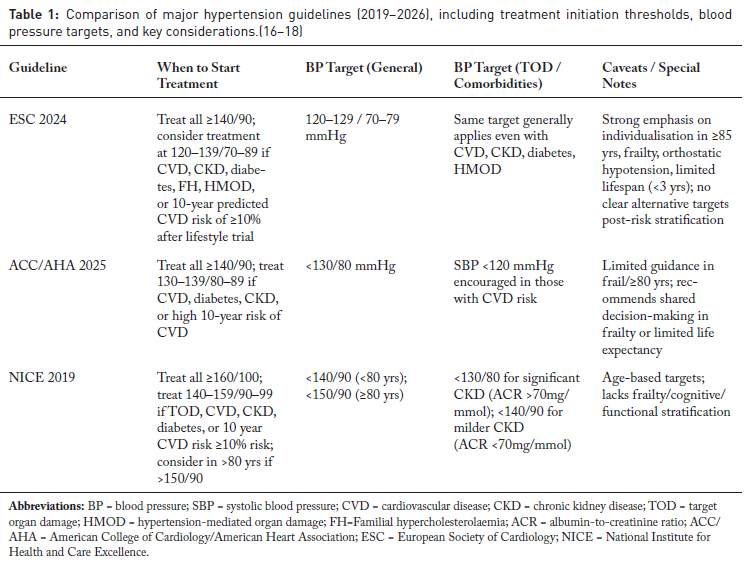
South African guidelines (2011) recommend a target BP of <140/90 mmHg, emphasise gradual BP reductions, and promote assessment for orthostatic hypotension in older adults, but provide limited guidance for frail or multimorbid populations.(15) Between 2019 & 2026, three major international hypertension guidelines were published.(16-18) While all share fundamental principles, they differ in their approach, reflecting the heterogeneous nature of BP management in older adults. Table 1 compares the major hypertension guidelines (2019-2026), including treatment initiation threshold BP targets, and key considerations about older adults.
PRACTICAL CLINICAL APPROACH
Drug review and deprescription of non-beneficial or harmful drugs is a crucial step in the comprehensive geriatric assessment. Increasing evidence suggests that certain patients may benefit from deprescribing, especially when the treatment burden outweighs the potential benefits.(19,20) This is especially relevant in the context of orthostatic hypotension (OH), a common and often under-recognised condition in older adults.
OH is associated with an increased risk of falls, cardiovascular events, and mortality.(21) In all older adults, BP should be measured after 5 min of supine rest and again at 1min and 3 min after standing. Failure to assess for OH may lead to overtreatment based on seated readings, increasing the risk of iatrogenic harm, particularly in frail individuals.
The following framework outlines a practical approach to populations underrepresented in clinical guidelines.
ROBUST OLDER ADULTSa) A robust older individual with hypertension, without orthostatic hypotension or falls, should be managed according to standard guidelines, including lifestyle modification and pharmacotherapy. Blood pressure targets vary by guideline, as mentioned above.
b) Management may differ for an otherwise robust individual presenting with recurrent falls and orthostatic hypotension. This may reflect iatrogenesis, a well-recognised geriatric syndrome, commonly associated with antihypertensive therapy. Current guidelines provide limited direction on BP targets in this context. Management should, however, prioritise fall prevention, including medication review and consideration of dose reduction or deprescribing. When initiating BP treatment, start with the lowest effective dose and titrate slowly to reach the target BP level. Less stringent BP targets may be appropriate, with individualised decision-making that balances cardiovascular risk reduction, fall risk, and quality of life.
PREFRAIL / MULTIMORBID ADULTS
a) Pre-frailty is potentially reversible. Management should focus on reversing this state through multifactorial interventions, including physical, nutritional, and social strategies. The patient's updated frailty status should then guide hypertension management - managed as robust if improved, or frail if progression occurs.
b) In individuals with multimorbidity, hypertension management is guided by comorbid conditions. Drug choice and BP targets should align with disease-specific recommendations. Hypertension with chronic kidney disease and proteinuria, first-line therapy includes an ACE inhibitor or an ARB.(22) However, the Kidney Disease Improving Global Outcomes (KDIGO) guideline recommends a SBP of <120 mmHg (standardised measurement), with limited guidance for older, multimorbid, or high-risk patients.(22) A more pragmatic and personalised approach, considering frailty status, therapeutic goals, cardiovascular benefits, and risk of adverse events, should be recognised.
c) In the absence of specific indications or contraindications, ACE inhibitors, angiotensin receptor blockers (ARBs), and calcium channel blockers (CCBs) are generally preferred in older adults. Alpha - and beta-blockers are associated with a higher risk of orthostatic hypotension, while diuretics may also contribute.(21)
FRAIL OLDER ADULTS / ADVANCED COGNITIVE IMPAIRMENT/NURSING HOME RESIDENTS
In frail older adults, evidence remains limited; however, there is consensus that in those with advanced frailty, significant cognitive impairment, or limited life expectancy, the benefits of antihypertensive treatment may be minimal - particularly in the presence of adverse effects. In such cases, clinicians, in consultation with patients and their families, may prioritise comfort and quality of life, including deprescribing. Here, the potential cardiovascular benefit is often outweighed by treatment burden and polypharmacy.(23)
SPECIAL CONSIDERATIONS WHEN DEPRESCRIBING ANTIHYPERTENSIVESDeprescribing is the process of withdrawal of an inappropriate medication, supervised by a health care professional, to manage polypharmacy and improve outcomes.(24) It requires knowledge of potential adverse effects and consideration of patient factors across physical, social, and psychological domains.(25) It is appropriate when antihypertensive therapy no longer corresponds with care objectives, especially in end-of-life, where preventive benefits are limited.
Importantly, while medication review is essential, discontinuation of antihypertensives prescribed for other indications (e.g., beta-blockers for heart failure or atrial fibrillation, ACE inhibitors for cardiac or renal protection, or alpha-blockers for prostatic symptoms) without careful consideration can worsen underlying conditions.(26)
As a guide to these challenges, tools such as STOPP/START(27) and the American Geriatrics Society Beers' Criteria(28) assist in evaluating the appropriateness of medications, identifying potentially inappropriate medications (e.g., central alpha-2 receptor agonists and non-selective peripheral alpha-1 blockers), and recommending suitable alternatives, particularly for this high-risk older population.
CONCLUSION
Managing hypertension in older patients presents a challenge due to the heterogeneity of this population. While antihypertensive therapy clearly reduces cardiovascular events and mortality, older individuals are more vulnerable to iatrogenic harm, particularly in the presence of frailty, multimorbidity, and polypharmacy.
Treatment decisions should extend beyond chronological age to include frailty, comorbidities, polypharmacy, and life expectancy. Blood pressure targets must balance cardiovascular risk reduction with preservation of function, independence, and quality of life.
Frail individuals and those with limited life expectancy often require less stringent targets, whereas robust older adults may benefit from more intensive control. Ultimately, management should be individualised, aligning treatment intensity with physiological reserve and competing risks.
REFERENCES
LITERATURE SEARCH STRATEGY
-
1. Statistics South Africa. Mid-year population estimates, 2025 (Statistical Release P0302) [Internet]. Pretoria: Statistics South Africa; 2025 Mar 31 [cited 2026 Mar 8]. Available from: https://www.statssa.gov.za/publications/P0302/P03022025.pdf
» https://www.statssa.gov.za/publications/P0302/P03022025.pdf - 2. Statistics South Africa. Marginalised groups series. Volume VI, The social profile of older persons, 2017-2021. Pretoria: Statistics South Africa; 2023. Report No.: 03-19-08.
-
3. Peltzer K, Phaswana-Mafuya N. Hypertension and associated factors in older adults in South Africa. Cardiovasc J Afr. 2013; 24(3):67-71. doi:10.5830/CVJA-2013-002.
» https://doi.org/10.5830/CVJA-2013-002 - 4. Aronow WS. Management of hypertension in older adults. In: Halter JB, Ouslander JG, Studenski SR, High KP, Asthana S, editors. Hazzard's geriatric medicine and gerontology. 7th ed. New York: McGraw-Hill; 2021: 1125-1136.
-
5. SHEP Cooperative Research Group. Prevention of stroke by antihypertensive drug treatment in older persons with isolated systolic hypertension. JAMA. 1991; 265(24):3255-3264. doi:10.1001/jama.1991.03460240051027.
» https://doi.org/10.1001/jama.1991.03460240051027 -
6. Staessen JA, Fagard R, Thijs L, et al. Randomised double-blind comparison of placebo and active treatment for older patients with isolated systolic hypertension. Lancet. 1997; 350(9080):757-764. doi:10.1016/S0140-6736(97)05381-6.
» https://doi.org/10.1016/S0140-6736(97)05381-6 -
7. Beckett NS, Peters R, Fletcher AE, et al. Treatment of hypertension in patients 80 years of age or older. N Engl J Med. 2008; 358(18):1887-1898. doi:10.1056/NEJMoa0801369.
» https://doi.org/10.1056/NEJMoa0801369 -
8. Williamson JD, Supiano MA, Applegate WB, et al. Intensive vs standard blood pressure control in adults aged 75 years or older. JAMA. 2016; 315(24):2673-2682. doi:10.1001/jama.2016.7050.
» https://doi.org/10.1001/jama.2016.7050 -
9. Benetos A, Labat C, Rossignol P, et al. Treatment with multiple blood pressure medications and mortality in older nursing home residents. JAMA Intern Med. 2015; 175(6):989-995. doi:10.1001/jamainternmed.2014.8012.
» https://doi.org/10.1001/jamainternmed.2014.8012 -
10. Benetos A, Gautier S, Freminet A, et al. Reduction of antihypertensive treatment in nursing home residents. N Engl J Med. 2025; 393(20):1990. doi:10.1056/NEJMoa2508157.
» https://doi.org/10.1056/NEJMoa2508157 -
11. Ahmadi SF, Streja E, Zahmatkesh G, et al. Reverse epidemiology of traditional cardiovascular risk factors in the geriatric population. J Am Med Dir Assoc. 2015; 16(11):933-939. doi:10.1016/j.jamda.2015.07.014.
» https://doi.org/10.1016/j.jamda.2015.07.014 -
12. Delgado J, Masoli JAH, Bowman K, et al. Outcomes of treated hypertension at age 80 and older: cohort analysis of 79,376 individuals. J Am Geriatr Soc. 2017; 65(5):995-1003. doi:10.1111/jgs.14712.
» https://doi.org/10.1111/jgs.14712 -
13. Uchmanowicz I, Chudiak A, Jankowska-Polanska B, Gobbens R. Hypertension and frailty syndrome in old age: current perspectives. Card Fail Rev. 2017; 3(2):102-107. doi:10.15420/cfr.2017:9:2.
» https://doi.org/10.15420/cfr.2017:9:2 -
14. Clegg A, Young J, Iliffe S, Rikkert MO, Rockwood K. Frailty in elderly people. Lancet. 2013; 381(9868):752-762. doi:10.1016/S0140-6736(12)62167-9.
» https://doi.org/10.1016/S0140-6736(12)62167-9 - 15. Seedat YK, Rayner BL. South African hypertension guideline 2011. S Afr Med J. 2012; 102(1):60-83.
-
16. Jones DW, Ferdinand KC, Taler SJ, et al. 2025 AHA/ACC guideline for the prevention, detection, evaluation and management of high blood pressure in adults. Circulation. 2025; 152(11):e114-e218. doi:10.1161/CIR.0000000000001356.
» https://doi.org/10.1161/CIR.0000000000001356 -
17. McEvoy JW, McCarthy CP, Bruno RM, et al. 2024 ESC guidelines for the management of elevated blood pressure and hypertension. Eur Heart J. 2024; 45(38):3911-4018. doi:10.1093/eurheartj/ehae178.
» https://doi.org/10.1093/eurheartj/ehae178 -
18. National Institute for Health and Care Excellence. Hypertension in adults: diagnosis and management (NG136) [Internet]. London: NICE; 2019 [cited 2026 Apr 8]. Available from: https://www.nice.org.uk/guidance/ng136
» https://www.nice.org.uk/guidance/ng136 -
19. Jing B, Liu X, Graham LA, et al. Deprescribing of antihypertensive medications and cognitive function in nursing home residents. JAMA Intern Med. 2024; 184(11):1347-1355. doi:10.1001/jamainternmed.2024.4851.
» https://doi.org/10.1001/jamainternmed.2024.4851 -
20. Sheppard JP, Temple E, Wang A, et al. Effect of antihypertensive deprescribing on hospitalisation and mortality: long-term follow-up of the OPTiMISE trial. Lancet Healthy Longev. 2024; 5(8):e563-e573. doi:10.1016/S2666-7568(24)00131-4.
» https://doi.org/10.1016/S2666-7568(24)00131-4 -
21. Wiersinga J, Jansen S, Peters MJL, et al. Hypertension and orthostatic hypotension in the elderly: a challenging balance. Lancet Reg Health Eur. 2024; 48:101154. doi:10.1016/j.lanepe.2024.101154.
» https://doi.org/10.1016/j.lanepe.2024.101154 -
22. Kidney Disease: Improving Global Outcomes (KDIGO) Blood Pressure Work Group. KDIGO 2021 clinical practice guideline for the management of blood pressure in chronic kidney disease. Kidney Int. 2021; 99(3 Suppl):S1-S87. doi:10.1016/j.kint.2020.11.003.
» https://doi.org/10.1016/j.kint.2020.11.003 -
23. Perez-Tamayo G, Sirole M, Fernandez E, et al. Approaches to deprescribing cardiovascular medications in patients receiving palliative care: a scoping review. Clin Hypertens. 2026; 32:e3. doi:10.5646/ch.2026.32.e3.
» https://doi.org/10.5646/ch.2026.32.e3 -
24. Reeve E, Gnjidic D, Long J, et al. A systematic review of the emerging definition of deprescribing. Br J Clin Pharmacol. 2015; 80(6):1254-1268. doi:10.1111/bcp.12732.
» https://doi.org/10.1111/bcp.12732 -
25. Aggarwal P, Woolford SJ, Patel HP. Multimorbidity and polypharmacy in older people: challenges and opportunities. Geriatrics (Basel). 2020; 5(4):85. doi:10.3390/geriatrics5040085.
» https://doi.org/10.3390/geriatrics5040085 -
26. Oliveira MG, Moreira PM, Amorim WW, Boockvar K. Deprescribing hypertension medication in older adults: can it lower drug burden without causing harm? Clin Geriatr Med. 2024; 40(4):659-668. doi:10.1016/j.cger.2024.04.012.
» https://doi.org/10.1016/j.cger.2024.04.012 -
27. Oliveira MG, Amorim WW, de Jesus SR, et al. A comparison of the Beers and STOPP criteria for identifying potentially inappropriate medications among elderly patients in primary care. J Eval Clin Pract. 2015; 21(2):320-325. doi:10.1111/jep.12319.
» https://doi.org/10.1111/jep.12319 -
28. American Geriatrics Society. 2023 updated AGS Beers Criteria® for potentially inappropriate medication use in older adults. J Am Geriatr Soc. 2023; 71(7):2052-2081. doi:10.1111/jgs.18372.
» https://doi.org/10.1111/jgs.18372