The effect of the COVID-19 Lockdown levels on trauma cases in a South African district hospital emergency department
Abstract
BACKGROUND: In response to the Coronavirus disease (COVID-19) outbreak, the South African government implemented lockdown alert levels based on the prevailing status of the pandemic. This study aimed to assess the effect of these measures on the number and profile of trauma presentations to a district hospital in Gauteng, South Africa METHODS: A retrospective analysis of trauma admissions was performed at the emergency department of a public district hospital in Gauteng from April 1, 2020, to September 30, 2021. Data collected from the trauma registers were segmented into intervals according to the adjusted alert levels 1 to 5 (5 being the strictest alert level) and compared to changes in trauma incidence across the different lockdown levels. Data were further stratified according to the mechanism of trauma RESULTS: The study included 3359 patients. Alert level 5 resulted in the fewest trauma presentations, and alert level 1 the most. Assault, followed by road accidents, accounted for the majority of presentations, the fewest being trauma-related falls from height CONCLUSION: During the COVID-19 pandemic, this study showed that strict lockdown measures implemented during alert level 5 resulted in the fewest trauma admissions to a Gauteng district hospital. This resulted in freeing healthcare resources to address other health issues related to the pandemic. However, trauma injury patterns remained the same as prior to COVID-19. emphasizing the need for a national plan to reduce assault related trauma burden in South Africa
COVID-19; trauma; lockdown levels; alcohol use; gender-based violence
INTRODUCTION
Coronavirus disease (COVID-19) is an infectious disease caused by the SARS-CoV-2 virus, first reported in November 2019 in Wuhan, China. The high transmissibility associated with COVID-19 saw the outbreak progress rapidly, as sporadic cluster outbreaks throughout China and subsequently to the rest of the world.(1) The rapid spread and clinical burden of COVID-19 prompted the declaration of the epidemic as a global pandemic by the World Health Organisation (WHO) on March 11, 2020.
(2) The first case of COVID-19 in South Africa (RSA) was diagnosed on March 5, 2020. Many countries worldwide enforced national lockdowns, social distancing, and other routine hygiene practices to help curb the spread of the virus.(3) Similarly, South Africa introduced a set of measures to contain the virus that included various levels of lockdown.(4)
Among the measures South Africa implemented against the COVID-19 pandemic was declared a National State of Disaster and a 5-level-risk-alert lockdown protocol.(5) The lockdown levels ranged from level 5, which was the most stringent, to level 1, closer to the normal daily activities before the COVID-19 pandemic regulations were instituted. Lockdown Level 5 began on 26 March 2020 and lasted until the end of April 2020. During this period, only essential services were permitted. Movement restrictions included no interprovincial or local movement travel except under exceptional circumstances. Lockdown level 4 began at the beginning of May 2020 and ended at the end of May 2020; it allowed for all essential services and a few other sectors at limited capacity. Every person was confined to their homes from 8 pm to 5 am, and exercise was allowed between 6 am and 9 am within a 5km radius of one's residence and not in a group. Lockdown levels 4 and 5 included a ban on the sale of alcohol.(6) Risk levels were adjusted based on factors such as presumed stress on the health system, national pandemic preparedness, and rate of viral transmission.
Both levels, 4 and 5, were classified as hard lockdown due to stringent restrictions, which were then followed by the transition to soft lockdown with the implementation of level 3 on 1 June 2020.
Lockdown level 3 allowed for the sale of alcohol within restricted hours. Inter-provincial travel was still prohibited except in exceptional circumstances. Level 2 lockdown allowed for interprovincial and domestic air travel. Lockdown level 1 allowed all sectors to return and international and domestic air travel to resume. All levels of lockdown included strict hygiene rules and masks in public, as well as the closure of shebeens and bars, sit-in restaurants and hotels, conference and convention centres, sporting events, and religious, cultural, and social gatherings.
The lockdown restrictions reduced the spread of COVID-19 by limiting social contact and regional travel. These measures were also effective in reducing other endemic healthcare system stressors. Trauma is a significant burden in South African hospitals and is estimated to be around seven times higher than the global average. (7) This study aimed to assess the effect of the COVID-19 lockdown and its different alert levels on the number and profile of trauma patients presenting to an Emergency Department of a district hospital in South Africa.
METHODS
A retrospective analysis was conducted of all trauma cases at the emergency department of the Bertha Gxowa Hospital (a district hospital in Gauteng, South Africa) at the height of the COVID-19 pandemic. The study period was from April 1, 2020, to September 30, 2021. The data was collected from the hospital's emergency department trauma registry. All data collected were anonymised. Inclusion criteria included presenting with one of 10 pre-determined traumatic injuries during the determined lockdown time frame. Demographic information and the types of trauma injuries were captured onto a Microsoft Excel spreadsheet. Collected data were segmented into intervals according to the adjusted alert levels. The data were further stratified according to the mechanism of trauma, which included gunshot, assault, stab, fall, fall from height, domestic violence, motor vehicle accident (MVA), and pedestrian-vehicle accident (PVA).
For this study, we considered lockdown levels 4 and 5 hard lockdowns and levels 1 to 3 soft lockdowns. A chi-squared (χ2
The overall associations were analysed using Pearson χ222
Ethical clearance for the study was obtained from The University of the Witwatersrand Human Research Ethics Committee (Medical) (reference number: M220651).
RESULTS
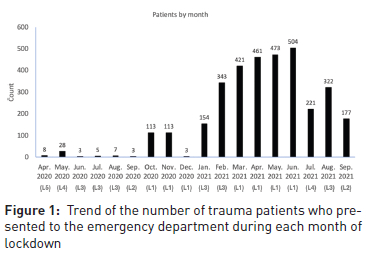
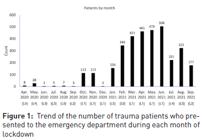
A total of 3359 patients fulfilled the criteria for inclusion in the study. Only 57 trauma patients (range: 3-28/month) presented during the first six months of the COVID-19 pandemic. Most patients with trauma (2202; 83%) presented to the emergency department from February 1, 2021, to June 30, 2021 (Figure 1). Of these patients, 504 (15%) were seen in June 2021, the most of any month. The fewest (3; 0.08%) were seen in June, September and December 2020 (Figure 1).
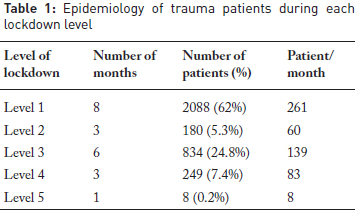
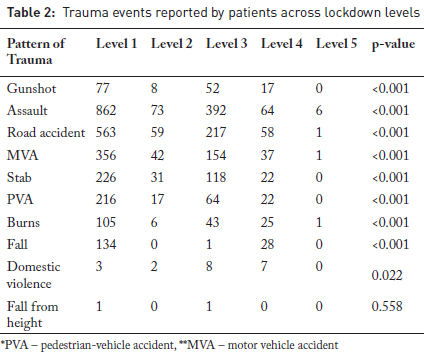
The number of trauma patients seen during each of the five lockdown periods is highlighted in Table 1. It also highlights the number of months per lockdown level and the number of patients seen per month during each lock-down level. Of the total cohort, 2088 (62%; 261 per month) patients presented with trauma to the emergency department during level 1, while only 8 (0.2%) patients presented during level 5 (Table 1). These eight patients accounted for nine trauma events in level 5, as some experienced multiple mechanisms of injury (e.g., assault and burns), as detailed in Table 2.
Table 2 further stratifies the categories of trauma presentation. Assault, followed by road accidents, accounted for the majority of presentations, the fewest being trauma-related falls from height.
A total of 4130 trauma events, including cases with multiple mechanisms of injury per patient, were recorded in the trauma registry and summarized by mechanism in Table 2.
All patterns of trauma, except domestic violence and falls from height, were significantly more prevalent during soft lockdown (1,2,3 alert levels) as compared to the hard lockdown (4,5 alert levels) (Table 2).
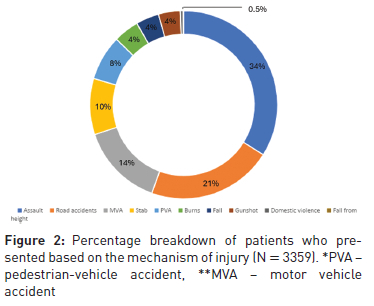
Figure 2 is a graphical presentation of the type of injury during the entire study period. Assault, 1398 incidents (33.8%%), accounted for the primary form of traumatic injury.
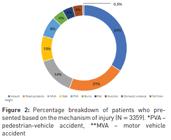
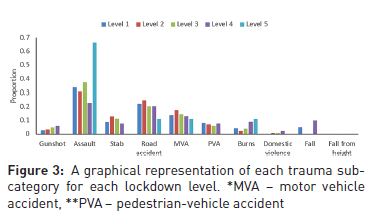
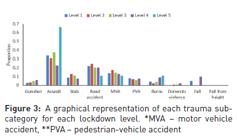
Figure 3 is a graphical representation a specific trauma category during the different levels of lockdown, highlighting that assault was the most common form of trauma during all five levels of the lockdown, and fall from height being the least common.
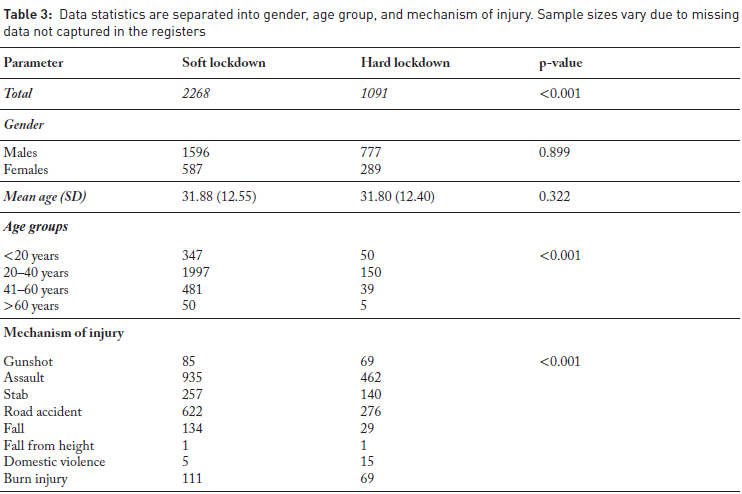
Hard lockdown refers to when alcohol was banned (levels 4 and 5), and soft lockdown refers to when alcohol was available (levels 1, 2, and 3). Over half the patients were seen during soft lockdown (2268; 67.5%), while 32.5% (1091) were seen during hard lockdown. The majority of patients were males (2 373; 70.6%), and most patients were between 20-40 years (63.9%; 2147) (Table 3).
DISCUSSION
During national lockdowns, the incidence of trauma has been shown to decrease significantly, as reported from a single-centre study in the Western Cape of South Africa, with the decrease amplified where lockdowns included an alcohol ban.(6) The authors suggested that a more tightly controlled sale of alcohol could be a tactic used to reduce health facility traffic during national emergencies.(6) Another South African study from Mitchell's Plain, in the Western Cape, also demonstrated temporal changes in trauma according to alcohol sale restrictions during COVID-19 lockdown periods, with fewer trauma cases presenting during periods associated with a complete alcohol sales ban compared to times when alcohol sales were only restricted.(8)
During lockdown level 5, when the most stringent measures were in place, including a complete alcohol ban and restricted movement, the level of trauma levels decreased significantly compared to lockdown level 1, when the majority of trauma cases were seen. Thus, the easing of strict lockdown restrictions increased trauma presentations. Similar findings have been reported internationally and in other parts of South Africa. A Spanish study showed a 75% decrease in patients presenting with traumatic injuries to a level 1 trauma centre during the lockdown.(9) Another study in northwest England reported a 37.6% reduction in traumatic injuries during lockdown.(10) In the Netherlands, during the first months of the COVID-19 pandemic, there was a 32% decrease in traumatic injury admissions to emergency departments compared to previous years.(11) A study in the Western Cape reported a decline of more than 50% of transported trauma patients during level 5 alert level compared to a similar period before lockdown.(12) Another study from Groote Schuur Hospital also found that the number of trauma patients decreased by 53% during the hard lockdown period. (13) A study at Edendale Hospital in Kwazulu-Natal also reported a 47% reduction in trauma patients presenting to their emergency department during level 5 lockdown.(14) When assessing the different mechanisms of trauma, during alert level 5 (hard lockdown), there was an overall very low level of trauma. However, assaults comprised the majority of these traumatic events. Despite lockdown level 5 having the lowest overall trauma presentations, it exhibited the highest proportional incidence of assaults relative to other trauma mechanisms, highlighting a persistent burden of interpersonal violence even under very strict restrictions. It has been suggested that these could be related to higher stress levels, intra-family disputes, and intimate-partner violence.(15) A systematic review of the Medline, EMBASE, and Cochrane databases investigating the presentation and management of trauma during the COVID-19 pandemic also found an increase in trauma caused by assault during the lockdown period.(16) Many studies have estimated the effects of the COVID-19 pandemic on mental health and have linked financial stress, food insecurity, fear of infection, and increased time spent with a partner as risk factors for violence.(17) A study in Pakistan found a fourfold increase in assaults during the four months of COVID-19 lockdown in 2020 compared to the same period in 2019.(18)
It has been speculated that people would be more inclined to perform activities at home and remain indoors during lockdown, resulting in less traffic and road congestion during peak hours.(19) Our study found that the lowest number of MVAs and PVAs occurred during the hard lockdown period, and the highest number of MVAs and PVAs occurred during the lowest alert level 1 as people became more active and mobile. A study conducted in South Africa in 2020 at Greys Hospital, comparing trauma patterns during the COVID-19 lockdown, presented results similar to ours, showing a significant decrease in MVAs and PVAs during the hard lockdown period.(20) Another South African study found that road traffic collision-related trauma presentations to the Helen Joseph Hospital emergency department decreased by 25% during the lockdown period from February to June 2020 compared to the same period in 2019.(21)
Trauma is a significant burden in lower- and middle-income countries, with South Africa being one of these. The burden of trauma in South Africa has received little focus from the South African government. Some of the unexpected benefits of the COVID-19 pandemic and its lockdown levels are that it reduced the risk of driving under the influence of alcohol or drugs and having fewer cars on the roads, resulting in a decreased number of MVA cases presenting to hospitals and thereby lowering the burden on the overwhelmed healthcare system.(22) The lockdown levels implemented in South Africa during the pandemic provide thoughtful insights for further investigation into the effect of such social interventions on decreasing the trauma burden in the country.(23)
LIMITATIONSThis is a retrospective study, and the limitations of retrospective studies also apply to this study. Limited data is recorded in the registry, which often fails to attribute the mechanism of injury; for example, head injury is recorded, but the cause is not noted. This study is limited by the duration of the alert levels, which varied, and the number of times the alert levels occurred during the sampling period. Alert levels 1-4 occurred numerous times during the sample period, whereas alert level 5 occurred only briefly.
CONCLUSION AND RECOMMENDATIONS
This study's main finding is that the trauma burden was significantly lower when stringent lockdown measures were implemented. This translates to fewer hospital visits, allowing for more resources available for COVID-related health problems. In a country such as South Africa, where there is a high burden of trauma coupled with limited resources, stringent lockdown measures were crucial to decrease pressure on the health system during the pandemic. Studies such as ours add to the body of evidence that strongly suggests that South Africa needs innovative interventions that target excessive alcohol usage, improved road safety and policing and violence prevention programmes.
ACKNOWLEDGEMENTS
Special thanks to the Department of Surgery at Bertha Gxowa Hospital for their cooperation and assistance throughout the data collection process, analysis, and manuscript writing.
REFERENCES
- 1. Maclntyre CR. Global spread of COVID-19 and pandemic potential. Glob Biosecur. 2020; 2(1).
-
2. World Health Organization. WHO delivers advice and support for older people during COVID-19 [Internet]. World Health Organization. 2020 [cited 2023 April 16]. Available from:https://www.who.int/news-room/feature-stories/detail/who-delivers-advice-and-support-for-older-people-during-covid-19
» https://www.who.int/news-room/feature-stories/detail/who-delivers-advice-and-support-for-older-people-during-covid-19 - 3. Koh D. COVID-19 lockdowns throughout the world. Occup Med. 2020; 70(5):322-324.
- 4. Moonasar D, Pillay A, Leonard E, et al. COVID-19: lessons and experiences from South Africa's first surge. BMJ Glob Health. 2021; 6(2):e004393.
-
5. Zuma D. Declaration of a national state of disaster. Affairs DoC-OGaT, editor South Africa. 2020. https://www.gov.za/sites/default/files/gcis_document/202003/43096gon313.pdf
» https://www.gov.za/sites/default/files/gcis_document/202003/43096gon313.pdf - 6. Chu KM, Marco JL, Owolabi EO, et al. Trauma trends during COVID-19 alcohol prohibition at a South African regional hospital. Drug Alcohol Rev. 2022; 41(1):13-19.
- 7. Moultrie T, Dorrington R, Laubscher R, et al. Unnatural deaths, alcohol bans, and curfews: evidence from a quasi-natural experiment during COVID-19. S Afr Med J. 2021; 111(9):834-837.
- 8. van Hoving DJ,van Koningsbruggen C,de Man M,Hendrikse C. Temporal changes in trauma according to alcohol sale restrictions during the South African national COVID-19 lockdown. Afr J Emerg Med. 2021; 11(4):477-482.
- 9. Nuñez JH, Sallent A, Lakhani K, et al. Impact of the COVID-19 pandemic on an emergency traumatology service: experience at a tertiary trauma centre in Spain. Injury. 2020; 51(7):1414-1418.
- 10. Rajput K, Sud A, Rees M, Rutka O. Epidemiology of trauma presentations to a major trauma centre in the North West of England during the COVID-19 level 4 lockdown. Eur J Trauma Emerg Surg. 2021; 47:631-636.
- 11. Nia A, Popp D, Diendorfer C, et al. Impact of lockdown during the COVID-19 pandemic on number of patients and patterns of injuries at a level I trauma center. Wien Klin Wochenschr. 2021; 133:336-343.
- 12. Pettke A, Stassen W, Laflamme L, Wallis LA, Hasselberg M. Changes in trauma-related emergency medical services during the COVID-19 lockdown in the Western Cape, South Africa. BMC Emerg Med. 2023; 23(1):72.
- 13. Navsaria P, Nicol A, Parry C, et al. The effect of lockdown on intentional and non-intentional injury during the COVID-19 pandemic in Cape Town, South Africa: a preliminary report. S Afr Med J. 2021; 111(2):110-113.
- 14. Morris D, Rogers M, Kissmer N, Du Preez A, Dufourq N. Impact of lockdown measures implemented during the COVID-19 pandemic on the burden of trauma presentations to a regional emergency department in Kwa-Zulu Natal, South Africa. Afr J Emerg Med. 2020; 10(4):193-196.
- 15. Bhattaram S, Shinde VS, Lamba I, Gladwin RS, Sharma KVS. Impact of COVID-19 lockdown on self-harm and violence among patients presenting to the emergency department. Am J Emerg Med. 2022; 51:262-266.
- 16. Waseem S, Nayar S, Hull P, et al. The global burden oftrauma during the COVID-19 pandemic: a scoping review. J Clin Orthop Trauma. 2021; 12(1):200-207.
- 17. Ivandic R, Kirchmaier T, Linton B. Changing patterns of domestic abuse during COVID-19 lockdown. A discussion paper. Centre for Economic Performance, No. 1729. 2020.
- 18. Shahid E, Fasih U, Taqi U, Jafri AR. An unusual rise in cases of assault in ophthalmic practice during COVID-19 lockdown in a tertiary care hospital. Oman J Ophthalmol. 2022; 15(3):309.
- 19. De Vos J. The effect of COVID-19 and subsequent social distancing on travel behavior. Transp Res Interdiscip Perspect. 2020; 5:100121.
- 20. Zsilavecz A, Wain H, Bruce J, et al. Trauma patterns during the COVID-19 lockdown in South Africa expose vulnerability of women. S Afr Med J. 2020; 110(11):1110-1112.
- 21. Venter A, Lewis C, Saffy P, Chadinha L. Locked down: impact of COVID-19 restrictions on trauma presentations to the emergency department. S Afr Med J. 2021; 111(1):52-56.
- 22. Hoo HE, Loh HC, Ch'ng ASH, Hoo FK, Looi I. Positive impacts of the COVID-19 pandemic and public health measures on healthcare. Prog Microbes Mol Biol. 2021; 4(1).
- 23. Mahoney SH, Steyn E, Lategan H. Informing future policy for trauma prevention: the effect of the COVID-19 'National state of disaster lockdown' on the trauma burden of a tertiary trauma centre in the Western Cape of South Africa. Afr J Emerg Med. 2021; 11(3):361-365.