Is Renal denervation a good option for my patient with uncontrolled hypertension?
Abstract
This manuscript examines the current guideline-recommended management of resistant arterial hypertension. It emphasises the role of sympathetic overactivity, its harmful effects on the cardiovascular system, and the use of renal denervation (RD) to treat uncontrolled hypertension. Landmark RD studies are summarised, which have contributed to the current IIb European Society of Cardiology recommendation for RD, and the South African experience with RD is discussed.
INTRODUCTION
Arterial hypertension remains a significant global risk factor for both cardiovascular morbidity and mortality. The number of people aged 30-79 affected by hypertension has more than doubled since 1990, reaching 1.4 billion.(1) The 2023 World Health Organization (WHO) global report estimates that only 23% of these individuals have their blood pressure adequately controlled.(1) Despite the availability of various medications and lifestyle modifications, hypertension control rates appear to be declining worldwide.(2) Factors such as medication non-adherence, therapeutic inertia, financial difficulties, psychological issues, and true resistant hypertension all contribute to poor blood pressure management.
Resistant hypertension is defined by the European Society of Cardiology (ESC) as uncontrolled blood pressure (≥ 140/90 mmHg) despite optimised medical treatment-including at least three antihypertensive drugs, one of which should be a diuretic-administered at the maximally tolerated doses.(3) The presence of resistant hypertension significantly increases the risk of target organ damage and contributes to early cardiovascular events.(4) The American Heart Association (AHA) uses a lower blood pressure threshold (i.e., 130/80 mmHg) to define this condition.(5) While the exact prevalence of resistant hypertension is difficult to determine, it is estimated to affect about 10% of the hypertensive population. Importantly, inadequate treatment adherence and secondary causes should be ruled out before diagnosing resistant hypertension. Intensive follow-up, personalised treatment strategies, and innovative approaches may be required to achieve blood pressure control in these patients.
PATHOPHYSIOLOGY OF RESISTANT HYPERTENSIONThe pathophysiology of resistant hypertension involves complex interactions among several neurohumoral factors, including increased sympathetic activity, aldosterone, and vasopressors such as endothelin-1 and vasopressin. This results in increased sodium retention, intravascular volume expansion, elevated peripheral vascular resistance, arterial stiffness, and endothelial dysfunction, primarily driven by heightened renin-angiotensin-aldosterone system (RAAS) activity.(6) Contributing factors include obesity, excessive salt intake, physical inactivity, and poor sleep quality (notably obstructive sleep apnoea). Certain medications, such as non-steroidal anti-inflammatory agents, steroids and oral contraceptives, may amplify the mechanisms described above.
MANAGEMENT OF RESISTANT HYPERTENSIONNon-pharmacological
Lifestyle interventions remain a crucial component of hypertension management. Reducing dietary sodium, increasing potassium intake, increasing physical activity, and reducing body weight all help control blood pressure and ultimately lower cardiovascular risk.(3)
Pharmacological
Four main drug classes are commonly used as first-line treatments for blood pressure control in the general population: angiotensin receptor blockers or angiotensin-converting enzyme inhibitors, calcium channel blockers, and diuretics (thiazide or thiazide-like agents). Cardioselective or vasodilating beta-blockers are preferred in patients with specific indications, such as angina, heart failure, post-myocardial infarction, or rate control in arrhythmias. If blood pressure remains uncontrolled despite maximum tolerated doses of three drugs, the patient should be considered to have resistant hypertension. In such cases, the addition of spironolactone is recommended. Eplerenone may be an alternative if spironolactone causes undesirable effects.(6)
Renal denervation
The six-month results of the Renal Denervation in Patients with Uncontrolled Hypertension (SYMPLICITY-HTN3) trial, which enrolled more than 500 patients with resistant hypertension, randomised the patients to RD or a sham procedure.(7) Both groups experienced a similar decrease in blood pressure. Thus, the SYMPLICITY-HTN3 was judged to have failed in proving a statistically significant reduction in blood pressure in the RD group.
Why did SYMPLICITY-HTN3 fail?
Several confounders may have influenced the initial negative results. Although patients were blinded to the type of therapy they received, it remains possible that the sham group may have realised that they had not received active RD due to the absence of pain. RD is a painful procedure, and the lack of pain during the process might have unblinded sham patients. Blood pressure medication adherence was not monitored, which could have contributed to the so-called Hawthorne effect, where the sham group increased their medication intake. In contrast, the RD group could have been less compliant with therapy. Technical issues may also have reduced RD efficacy, including inexperienced operators, failure to treat distal renal arteries, and incomplete circumferential denervation due to catheter design.
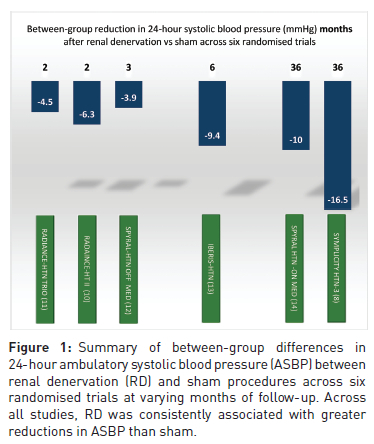
More recent evidence, however, has shown better outcomes with RD. Despite the non-significant difference in blood pressure at 6 months, the three-year follow-up of patients enrolled in the SYMPLICITY-HTN3 trial showed that the RD group had significantly lower blood pressure than the sham group.(8) In addition, a meta-analysis of recent trials has shown that RD lowers blood pressure by at least 5 mmHg, both in the absence and in the presence of antihypertensive drugs and similar results were achieved with different energy sources, such as radiofrequency and ultrasound.(9) Injection of alcohol into the subintimal space also modestly lowered blood pressure.(9) Our own meta-analysis of the between-group 24-hr systolic BP across six randomised controlled trials, including more than 1200 patients, indicates that months after the procedure, RD consistently lowers blood pressure compared to a sham procedure, and the blood pressure reductions also increased over time (Figure 1).(8,10-14) These studies have led to a recent class IIb recommendation from the ESC for catheter-based renal denervation in the management of resistant hypertension.(3)
How do we perform renal denervation?
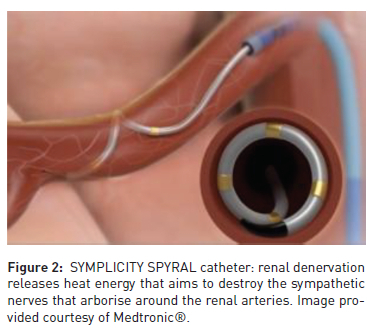
RD is performed via arterial access using the modified Seldinger technique. A guidewire is advanced into the abdominal aorta, followed by a 6-French guiding catheter that is advanced over the wire. A diagnostic renal angiogram is performed to delineate the arterial anatomy and identify accessory, polar arteries that will also require denervation. A steerable guidewire is subsequently threaded into each renal artery. The denervation catheter is advanced over the steerable wire, beyond the distal arterial bifurcation. The guidewire is then withdrawn, allowing the catheter to assume a spiral shape and conform to the interior vessel contour. (Figure 2) Radiofrequency energy (heat) is then delivered through four gold-plated electrodes. The energy penetrates to the subendothelial space, heating the perivascular adipose tissue and searing the sympathetic nerve supply. Denervation reduces brain-kidney sympathetic crosstalk, thereby decreasing overall sympathetic tone. This vital step has several physiological effects, including lowering renin levels, which reduces activation of the RAAS cascade. Vasodilation and improved organ perfusion follow. Reduced cardiac afterload may also decrease left ventricular hypertrophy and enhance left ventricular diastolic function.(15) The potentially "always on" effect of RD is believed to be beneficial in patients with poor medication adherence.(12)
South African perspective
In South Africa, 46% of women and 44% of men are found to have arterial hypertension in a nationwide survey. Only 9% of women and 6% of men reach target blood pressure levels on medication.(16) This is supported by a study of over 10,000 individuals in sub-Saharan Africa, where South Africa had the highest prevalence of hypertension, as well as a very high rate of uncontrolled blood pressure (55.4% women and 68.1% men).(17) Although the specific causes of these low rates of blood pressure control were not investigated, this highlights an opportunity for improvement.
A position statement on RD was jointly published by the Southern African Hypertension Society and the South African Society of Cardiovascular Intervention in 2020,(18) recommending consideration of RD for the following indications: 1) patients with uncontrolled blood pressure, with or without documented intolerance to one or several antihypertensive agents; 2) patients with uncontrolled blood pressure that is not remediable to long-term drug adherence, despite extensive counselling; and 3) in hypertensive patients considered to be at very high risk of a significant adverse cardiac event, according to the 2018 ESC Hypertension Guidelines. Despite the position statement, medical funders have not yet approved RD for routine use in the private healthcare sector, and RD is also unavailable in the public sector, mainly due to cost constraints.
Unique contributions to RD technology have been made in South Africa. While arterial access is usually transfemoral, brachial and radial approaches have been described by Heradien and co-workers.(19) Trans-radial access may enable same-day discharge, particularly in a resource-constrained environment.
In a randomised, sham-controlled trial of patients with resistant arterial hypertension, RD reduced the incidence of subclinical atrial fibrillation (hazard ratio 0.40; 95% confidence interval 0.17-0.96; P = 0.031), atrial fibrillation burden (0% [0-0] vs 0% [0-0.3]; P = 0.043) and fast atrial fibrillation (>100bpm) (2% vs 26%; P = 0.002). These differences were independent of blood pressure control.(20) Given limited access to electrophysiology services in South Africa, renal denervation remains an attractive approach to reducing the local burden of atrial fibrillation.
CONCLUSION
Renal denervation is a safe and effective treatment for patients with resistant arterial hypertension. Although long-term safety and efficacy data are still needed, renal denervation shows promise not only for managing resistant hypertension but also for possibly reducing the burden of atrial fibrillation in this group of patients. Greater adoption in South Africa could potentially reduce the high burden of hypertensive heart disease and its complications.
REFERENCES
- 1. World Health Organization. Global report on hypertension: high stakes - turning evidence into action. Geneva: WHO; 2023.
-
2. Cluett JL, Blazek O, Brown AL, et al. Renal denervation for the treatment of hypertension: a scientific statement from the American Heart Association. Hypertension. 2024; 81(10):e135-e148. doi:10.1161/HYP.0000000000000230.
» https://doi.org/10.1161/HYP.0000000000000230 -
3. McEvoy JW, McCarthy CP, Bruno RM, et al. 2024 ESC guidelines for the management of elevated blood pressure and hypertension. Eur Heart J. 2024; 45(38):3912-4018. doi:10.1093/eurheartj/ehae178.
» https://doi.org/10.1093/eurheartj/ehae178 -
4. Cluett JL, William JH. Evaluation and management of resistant hypertension: core curriculum 2024. Am J Kidney Dis. 2024; 84(3):374-387. doi:10.1053/j.ajkd.2024.03.012.
» https://doi.org/10.1053/j.ajkd.2024.03.012 -
5. Jones DW, Ferdinand KC, Taler SJ, et al. AHA/ACC/AANP/AAPA/ABC/ACCP/ACPM/AGS/AMA/ASPC/NMA/PCNA/SGIM guideline for the prevention, detection, evaluation and management of high blood pressure in adults: a report of the American College of Cardiology/American Heart Association Joint Committee on Clinical Practice Guidelines. Hypertension. 2025; 82(10):e212-e316. doi:10.1161/HYP.0000000000000249.
» https://doi.org/10.1161/HYP.0000000000000249 -
6. Buso G, Agabiti-Rosei C, Lemoli M, Corvini F, Muiesan ML. The global burden of resistant hypertension and potential treatment options. Eur Cardiol. 2024; 19:e07. doi:10.15420/ecr.2023.51.
» https://doi.org/10.15420/ecr.2023.51 -
7. Bhatt DL, Kandzari DE, O'Neill WW, et al. A controlled trial of renal denervation for resistant hypertension. N Engl J Med. 2014; 370(15):1393-1401. doi:10.1056/NEJMoa1402670.
» https://doi.org/10.1056/NEJMoa1402670. -
8. Bhatt DL, Vaduganathan M, Kandzari DE, et al. Long-term outcomes after catheter-based renal artery denervation for resistant hypertension: final follow-up of the randomised SYMPLICITY HTN-3 trial. Lancet. 2022; 400(10361):1405-1416. doi:10.1016/S0140-6736(22)01787-1.
» https://doi.org/10.1016/S0140-6736(22)01787-1 -
9. Vukadinovic D, Lauder L, Kandzari DE, et al. Effects of catheter-based renal denervation in hypertension: a systematic review and meta-analysis. Circulation. 2024; 150(20):1599-1611. doi:10.1161/CIRCULATIONAHA.124.069709.
» https://doi.org/10.1161/CIRCULATIONAHA.124.069709 -
10. Azizi M, Saxena M, Wang Y, et al. Endovascular ultrasound renal denervation to treat hypertension: the RADIANCE II randomized clinical trial. JAMA. 2023; 329(8):651-661. doi:10.1001/jama.2023.0713.
» https://doi.org/10.1001/jama.2023.0713 -
11. Azizi M, Sanghvi K, Saxena M, et al. Ultrasound renal denervation for hypertension resistant to a triple medication pill (RADIANCE-HTN TRIO): a randomised, multicentre, single-blind, sham-controlled trial. Lancet. 2021; 397(10293):2476-2486. doi:10.1016/S0140-6736(21)00788-1.
» https://doi.org/10.1016/S0140-6736(21)00788-1 -
12. Böhm M, Kario K, Kandzari DE, et al. Efficacy of catheter-based renal denervation in the absence of antihypertensive medications (SPYRAL HTN-OFF MED Pivotal). Lancet. 2020; 395(10234):1444-1451. doi:10.1016/S0140-6736(20)30554-7.
» https://doi.org/10.1016/S0140-6736(20)30554-7 -
13. Jiang X, Mahfoud F, Li W, et al. Efficacy and safety of catheter-based radiofrequency renal denervation in Chinese patients with uncontrolled hypertension: Iberis-HTN trial. Circulation. 2024; 150(20):1588-1598. doi:10.1161/CIRCULATIONAHA.124.069215.
» https://doi.org/10.1161/CIRCULATIONAHA.124.069215 -
14. Mahfoud F, Kandzari DE, Kario K, et al. Long-term efficacy and safety of renal denervation in the presence of antihypertensive drugs (SPYRAL HTN-ON MED). Lancet. 2022; 399(10333):1401-1410. doi:10.1016/S0140-6736(22)00455-X.
» https://doi.org/10.1016/S0140-6736(22)00455-X -
15. Brandt MC, Mahfoud F, Reda S, et al. Renal sympathetic denervation reduces left ventricular hypertrophy and improves cardiac function in patients with resistant hypertension. J Am Coll Cardiol. 2012; 59(10):901-909. doi:10.1016/j.jacc.2011.11.034.
» https://doi.org/10.1016/j.jacc.2011.11.034 - 16. National Department of Health (South Africa), Statistics South Africa, South African Medical Research Council, ICF. South Africa demographic and health survey 2016. Pretoria: NDoH; 2019.
-
17. Gómez-Olivé FX, Ali SA, Made F, et al. Regional and sex differences in the prevalence and awareness of hypertension: H3Africa AWI-Gen study. Glob Heart. 2017; 12(2):81-90. doi:10.1016/j.gheart.2017.01.007.
» https://doi.org/10.1016/j.gheart.2017.01.007 -
18. Southern African Hypertension Society, South African Society of Cardiovascular Intervention. Position statement on renal denervation in South Africa. 2020. Available from: https://www.hypertension.org.za/uploads/files/RDN-Position-Statement-on-Renal-Denervation-in-South-Africa-2020-Reviewed-2021.pdf
» https://www.hypertension.org.za/uploads/files/RDN-Position-Statement-on-Renal-Denervation-in-South-Africa-2020-Reviewed-2021.pdf -
19. Heradien MJ, Augustyn J, Saaiman A, Brink PA. First reported cases: renal denervation with a second-generation multi-electrode catheter via brachial and radial access. Cardiovasc J Afr. 2016; 27(1):53-55. doi:10.5830/CVJA-2015-089.
» https://doi.org/10.5830/CVJA-2015-089 -
20. Heradien M, Mahfoud F, Greyling C, Lauder L, Van der Bijl P, et al. Renal denervation prevents subclinical atrial fibrillation in patients with hypertensive heart disease: randomized, sham-controlled trial. Heart Rhythm. 2022; 19(11):1765-1773. doi:10.1016/j.hrthm.2022.06.031.
» https://doi.org/10.1016/j.hrthm.2022.06.031

CONFLICTS OF INTEREST
Marshall Heradien is a Hamilton Naki Scholar and reports study support and consultancy fees from Medtronic ®.
The other authors have nothing to disclose.