Why are we still not there? Understanding the hypertension control gap in South Africa
Abstract
Hypertension remains one of the leading preventable causes of cardiovascular disease, especially heart failure, stroke and chronic kidney disease, which contribute to premature morbidity and mortality in South Africa. Yet despite the availability of effective antihypertensive therapy, blood pressure control remains poor across large segments of the population. South Africa's control gap is sustained by measurement problems, under-detection, poor continuity of care, inadequate treatment escalation, and insufficiently supported self-management, all within highly unequal care environments. These challenges are amplified by obesity, high salt intake, alcohol use, multimorbidity, socioeconomic disadvantage, transport and cost barriers, staff shortages, inconsistent medicine supply, and weak health information systems. Global evidence further shows that uncontrolled primary hypertension in practice is often driven by poor measurement, pseudo-resistance, and therapeutic inertia rather than true biological refractoriness. In South Africa, the public-health burden and economic costs are substantial, making improved control a clinical and fiscal imperative. This review synthesises South African and selected international evidence to argue that hypertension should be understood as an enduring control failure across the continuum of care. It proposes a practical agenda centred on accurate blood pressure measurement, earlier and broader case-finding, simplified treatment protocols, greater use of combination therapy where appropriate, task-sharing/shifting, home- or community-linked models of care, improved retention and adherence support, and stronger routine data systems. Better hypertension control in South Africa is achievable, but only if health-system delivery is treated with the same seriousness as pharmacological efficacy.
INTRODUCTION
Blood pressure (BP) is strongly and continuously associated with cardiovascular risk, even within the normal range, with each 20/10 mmHg increase above 115/75 mmHg doubling the risk of fatal events.(1) Undiagnosed and poorly controlled hypertension remains a leading preventable cause of heart attack, heart failure, stroke, chronic kidney disease, and dementia.(2) The primary aim of managing elevated BP and hypertension is to reduce cardiovascular disease, improve quality of life, and prevent premature death.(2)
Hypertension is a significant public health issue in South Africa (SA), affecting approximately 40-50% of adults, yet less than half achieve adequate BP control despite the availability of effective therapies.(3) It remains a major contributor to cardiovascular disease and death, especially among populations facing challenges such as limited access to healthcare, poor adherence to treatment, and a high burden of comorbid conditions like diabetes and obesity.(3) Hypertension in SA is more prevalent, poorly controlled, and has an earlier onset of complications compared to high-income countries.(4) Recent studies have shown that its prevalence is shifting toward younger age groups, a significant number of whom are unaware and not treated.(4)
In this perspective, we summarise pertinent available data on BP control in SA over the last 30 years and discuss obstacles to achieving BP targets and future strategies to overcome these barriers to hypertension control in SA.
-
DEFINITION AND EPIDEMIOLOGY
Sustained hypertension generally refers to BP that remains consistently elevated over time when assessed under appropriate conditions, reflecting a stable chronic phenotype rather than a transient or context-dependent rise in BP.(1) In clinical practice, however, the apparent "persistence" of hypertension is strongly shaped by how hypertension is defined, how BP is measured, and whether clinic findings are confirmed with out-of-office monitoring. The 2014 SA guidelines and the 2024 European Society of Cardiology (ESC) guidelines define hypertension as persistent office blood pressure ≥140/90 mmHg, confirmed by repeated measurements and, ideally, home or ambulatory BP monitoring.(2,5) This definitional issue is not merely semantic. Divergence between major guidelines directly influences prevalence estimates, treatment eligibility, and the proportion of patients considered uncontrolled. For example, the 2017 American College of Cardiology and American Heart Association (ACC/AHA) guideline(6) lowered the diagnostic threshold to ≥130/80 mmHg, thereby increasing the number of adults classified as having hypertension and uncontrolled BP, whereas the 2024 ESC guideline retained the traditional office threshold of ≥140/90 mmHg while separately introducing an "elevated blood pressure" category. These differences mean that the same population may appear to have substantially different levels of hypertension burden depending on the diagnostic framework applied. Similarly, treatment decisions and assessments of control should not be based on a single casual clinic reading. Guideline-based diagnosis requires averaged readings obtained using a standardised technique across repeated encounters, and recent ACC/AHA guidance reiterates that clinical decisions should be based on the average of at least two readings at two or more visits.(7)
In 2024, about 1.4 billion people aged 30-79 worldwide were living with hypertension, yet fewer than 20% had it adequately controlled.(8) The economic burden is substantial and growing, with cardiovascular diseases projected to cost low- and middle-income countries around US$3.7 trillion (ZAR 59.94 trillion) between 2011 and 2025-approximately 2% of their total gross domestic product.(8) National surveys in SA have reported an increase in hypertension prevalence, rising from 38.4% in 2012 to 48.2% in 2016. Although national guidelines outline recommended therapies and emphasise treatment adherence for optimal management, 50% or higher of hypertensive patients are uncontrolled nationally, as overall control rates are reported to be below 50%.(3,9)
The consequences for South Africa's public healthcare system are substantial. Kohli-Lynch et al. estimated that approximately 8.2 million adults, or 30.8% of the public-sector adult population, have hypertension, contributing annually to excess cardiovascular and renal complications, including ischaemic heart disease, stroke, and chronic kidney disease.(10) The associated direct healthcare costs were estimated at approximately ZAR 10.1 billion, while total societal costs, including productivity losses, reached around ZAR 29.4 billion.(10) These figures highlight hypertension not only as a clinical problem, but also as a health-system sustainability challenge, particularly in the context of constrained public-sector resources.
Yet a critical question remains: how much of what is described as "persistent" hypertension reflects truly sustained pathophysiology, and how much reflects persistent uncertainty caused by imperfect measurement? Clinic-only assessment is particularly vulnerable to misclassification. In the International Database on Home BP in relation to Cardiovascular Outcome study, 25.2% of individuals with high office BP had white-coat hypertension, indicating that office-based assessment alone would have labelled a substantial proportion of individuals as hypertensive despite the absence of sustained elevation on ambulatory monitoring.(11) Conversely, apparently controlled clinic BP may conceal masked uncontrolled hypertension, particularly when nocturnal BP remains elevated. This phenotype is common enough in treated populations to make clinic BP alone inadequate for confirming true control status.(11) Home and ambulatory BP monitoring are therefore not peripheral additions to care; they are central to distinguishing sustained hypertension from white-coat and masked phenotypes, and to avoiding both over-treatment and under-treatment.
Measurement method further alters the apparent burden of persistent hypertension. Automated office BP techniques tend to yield lower readings than routine office measurements and align more closely with home or ambulatory values, illustrating how poor technique, observer effects, and non-standardised clinic workflows may inflate estimates of uncontrolled or persistent hypertension.(11) At the same time, reliance on routine clinic readings may underestimate persistence when masked or nocturnal hypertension is missed. Thus, "persistent hypertension" should not be interpreted only as a failure of patients to respond to lifestyle advice or pharmacological therapy. In many settings, particularly where health systems are overstretched, it may also reflect diagnostic imprecision, inconsistent measurement practices, limited access to out-of-office monitoring, therapeutic inertia, and structural barriers to long-term care. Out-of-office BP measurement is rarely performed in the public sector due to a lack of equipment and expertise, and it represents a real failure of the public health system.
The practical implication is that hypertension should be understood as both a biological and a health-system phenomenon. True sustained hypertension represents chronic vascular risk requiring long-term management, but the persistence observed in routine care may be amplified or obscured by how blood pressure is measured, classified, and followed over time. Improving hypertension control, therefore, requires more than intensifying treatment. It also requires standardised measurement, repeated assessment, wider use of home and ambulatory monitoring, and context-appropriate models of care that can distinguish true uncontrolled hypertension from white-coat effects, masked hypertension, and measurement artefact. Only then can the burden of hypertension in SA and other low- and middle-income settings be measured accurately, managed efficiently, and reduced meaningfully.
WHAT HAVE WE LEARNT IN THE LAST 30 YEARS?
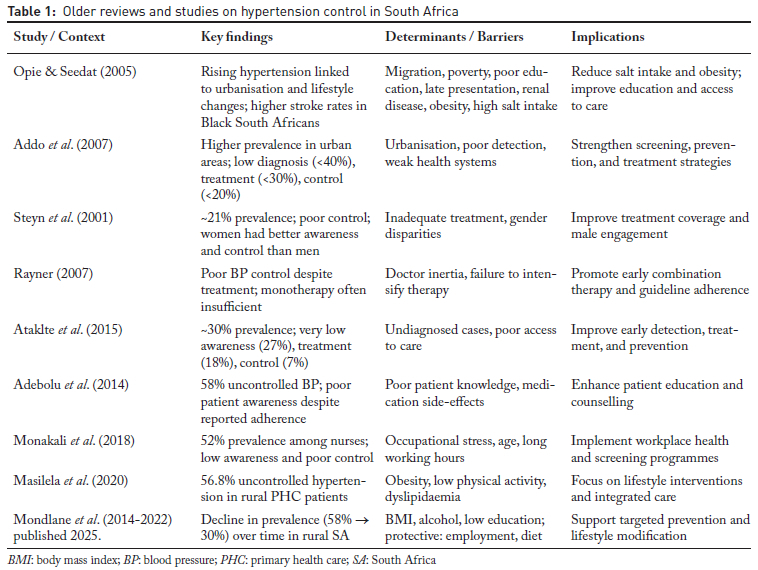
From earliest research studies (Table 1),(12-20) hypertension in sub-Saharan Africa and South Africa (SA) was thought to be driven by urbanisation, lifestyle changes, and socioeconomic factors, with consistently low awareness, treatment, and control rates. Later, it was noted that uncontrolled hypertension became a major health concern in both rural and urban SA. Key gaps identified included poor patient education, inadequate treatment intensification, and weak health systems. Emphasis was put on effective strategies that centre on early screening, lifestyle modification, combination therapy, and health system strengthening.
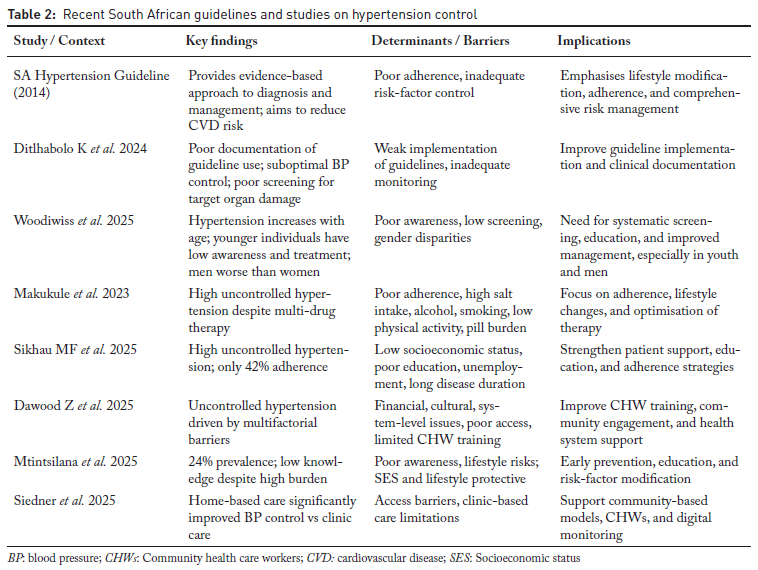
The 2014 SA hypertension guidelines and newer SA studies(4,5,9,21-25) (Table 2) consistently show that hypertension in SA is still marked by high prevalence and poor control, driven by low awareness, poor adherence, unhealthy lifestyles, and weak health system implementation of guidelines. Effective solutions require integrated approaches, including improved screening, patient education, adherence support, task shifting to community health workers, and strengthening primary healthcare systems. Siedner et al. demonstrated that, in a controlled research setting, even in rural SA, home-based hypertension care resulted in a significantly lower mean systolic blood pressure at 6 months than standard clinic-based care.(23) Support from the Department of Health and relevant stakeholders, through strengthening primary healthcare systems and empowering community health workers, can help translate these findings into meaningful improvements in real-world hypertension management.
HOW DO WE COMPARE TO INTERNATIONAL CONTROL OF HYPERTENSION?
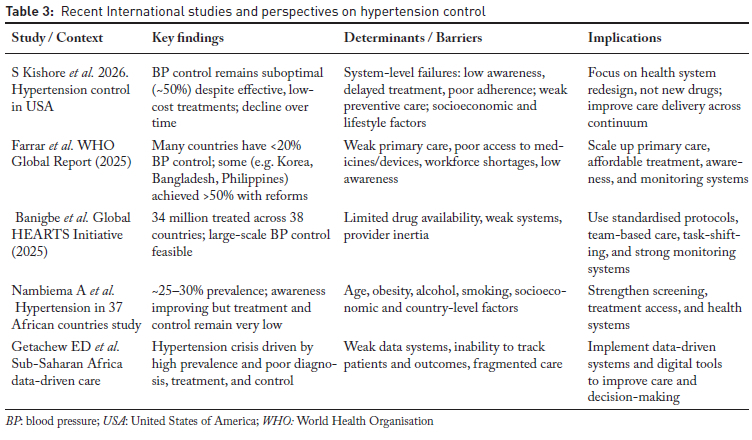
It is interesting to note that barriers to hypertension control are not unique to SA. Across international studies (Table 3) and observations, hypertension emerges as a major global health challenge driven primarily by health system failures rather than lack of effective treatments.(26) Even in high-income settings like the United States, BP control remains suboptimal due to gaps across the care continuum, including poor awareness, delayed treatment, and weak long-term adherence.(26)
Globally, the WHO highlights low control rates in most countries, largely due to weak primary healthcare systems, limited access to affordable medicines, workforce shortages, and low public awareness.(8) A randomised clinical trial conducted in sub-Saharan Africa evaluated three dual-drug regimens for managing hypertension in black patients.(27) Among 728 participants, combinations that included amlodipine with either hydrochlorothiazide or perindopril were more effective in reducing 24-hour systolic blood pressure over six months than the combination of perindopril and hydrochlorothiazide. There was no meaningful difference in effectiveness between the two amlodipine-based treatments. Overall, these results indicate that amlodipine-based combinations offer better blood pressure control in this population and, importantly, that all these medications are readily available and affordable in the South African context.(27) However, in sub-Saharan Africa, the burden of hypertension remains severe, with high and increasing prevalence alongside very low treatment and control rates, influenced by factors such as age, obesity, lifestyle risks, and socioeconomic inequalities.(28)
Evidence from the Global HEARTS Initiative demonstrates that large-scale improvement is achievable through standardised protocols, team-based care, task-shifting, strong primary healthcare, and reliable medicine supply.(29) Additionally, emerging data-driven approaches emphasise the importance of robust health information systems to improve detection, monitoring, and decision-making. Overall, these studies consistently show that effective hypertension control requires system-level reforms, improved access to care, better use of data, and integrated, scalable interventions, rather than new treatments alone. Successful examples from low- and middle-income countries (Korea, Bangladesh, Philippines) demonstrate that integrating hypertension care into primary health systems, ensuring affordable medicines, and adopting structured treatment programmes can significantly improve control rates. These countries face similar challenges in hypertension control; thus, it stands to reason that these strategies can be implemented in the SA setting.
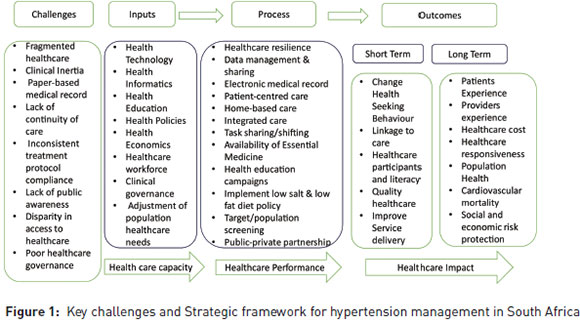
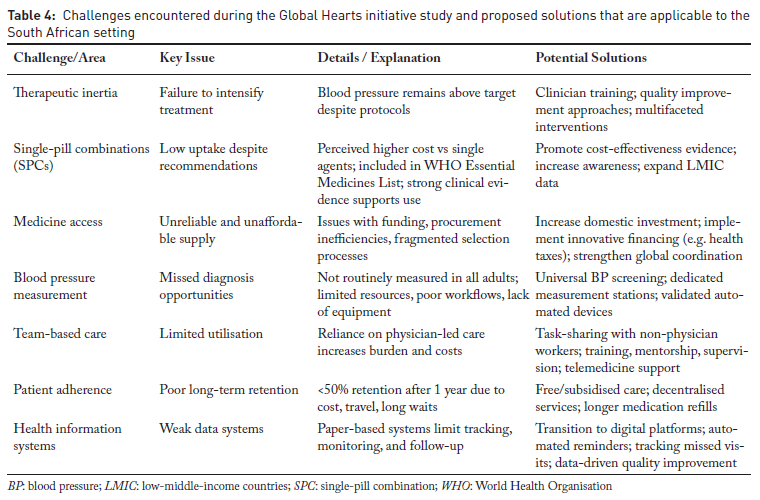
FUTURE DIRECTIONSOver the past three decades, studies on hypertension control in SA have generated substantial evidence identifying the causes of poor blood pressure control, clearly demonstrating that it is a widespread and urgent public health concern requiring decisive action to reduce associated morbidity and mortality. However, effective solutions to this complex and multifactorial problem remain limited. Drawing on successful examples from other low- and middle-income countries that have improved hypertension control despite resource constraints could provide valuable guidance.(29) These experiences offer reassurance that, with the right strategies, meaningful control of hypertension is both achievable and sustainable (Table 4 and Figure 1). Indeed, according to the Global Hearts initiative study, BP control is within reach for 50% of the community if global organisations and national health programmes prioritise implementing the World Health Organisation HEARTS programme.
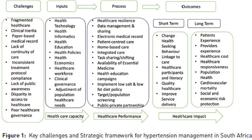
The main issues that make hypertension control challenging in sub-Saharan Africa are a lack of strong data systems, which limit the ability to track patients, monitor outcomes, and guide effective decision making.(30)
In 2016, the World Health Organisation (WHO), together with its partners, introduced the HEARTS technical package as a primary public health strategy to improve hypertension control in primary healthcare settings.(30) It comprises six key components:
1. Healthy lifestyle counselling,
2. Evidencebased treatment protocols,
3. Access to essential medicines and technologies,
4. Riskbased cardiovascular disease management,
5. Team-based care, and
6. Systems for monitoring and evaluation
PATIENT-CENTRED APPROACH TO HYPERTENSION
Health system structures act as the "scaffolding" that supports or undermines BP control, emphasising that persistent hypertension often reflects system failure rather than patient failure. When these structures are weak, they create barriers that make it nearly impossible for patients to achieve control. The ESC hypertension guidelines(2) emphasise a patient centred approach that involves shared decision making, tailoring treatment to individual risk profiles, comorbidities, and patient preferences. Care should focus on improving adherence through education, simplified treatment regimens, for example, single pill combinations that are still not available in the SA public sector, and regular followup. The guidelines also highlight the importance of lifestyle modification, psychosocial factors, and empowering patients through home BP monitoring, which still remains a challenge in the SA setting. A multidisciplinary, team based approach is encouraged to optimise long-term BP control and cardiovascular outcomes.
PREVENTION IS BETTER THAN CURE: TACKLING OBESITY IN SOUTH AFRICA
Overweight and obesity have increased significantly worldwide.(31,32) Overall, the data show a growing global burden of overweight and obesity across all age groups. Both obesity and hypertension are preventable risk factors for cardiovascular disease and place a significant economic strain, especially in developing nations.(32) Hypertension is highly prevalent across Africa and is strongly linked to obesity. Analysis of over 30,000 individuals from 13 countries in Africa showed that obese individuals are more than twice as likely to have hypertension, with the risk increasing significantly with age. These findings highlight obesity as a key driver of hypertension across the continent.(33)
The Human Sciences Research Council study found that nearly half of adult South Africans are either overweight or obese, highlighting a significant and growing public health concern.(34) This high prevalence increases the risk of non-communicable diseases such as hypertension, diabetes, and cardiovascular conditions, emphasising the need for urgent national interventions focused on healthier lifestyles and prevention strategies. Addressing obesity demands coordinated, multisectoral action, including policy changes, improved food systems, stronger health services, and industry efforts to reduce unhealthy ingredients, promote nutritious foods, and encourage healthier behaviours.
CONCLUSION
Three decades of data confirm that South Africa has mastered an understanding of the hypertension epidemic; the next decade must be defined by an implementation strategy. Health care system failures must be addressed through a Patient-Centred Approach that utilises shared decision-making and a simplified single-pill combination rather than complex multidrug regimens. The transition from clinic-bound, doctor-centric care to an integrated, data-driven, and community-based model is the only viable path. By fostering multisectoral synergy among clinical care, community outreach, and policy reform, South Africa can achieve sustainable control of hypertension and secure the health of its future generations.
REFERENCES
-
1. Schiffrin EL, Fisher NDL. Diagnosis and management of resistant hypertension. BMJ. 2024; 385:e079108. doi:10.1136/bmj-2023-079108.
» https://doi.org/10.1136/bmj-2023-079108 -
2. McEvoy JW, McCarthy CP, Bruno RM, et al. 2024 ESC guidelines for the management of elevated blood pressure and hypertension. Eur Heart J. 2024; 45(38):3912-4018. doi:10.1093/eurheartj/ehae178.
» https://doi.org/10.1093/eurheartj/ehae178 -
3. Jordaan B, Theron B, Owusu E, Bronkhorst E. Hypertension in South Africa: a growing epidemic and evolving treatment paradigms. S Afr Gen Pract. 2025; 6(1):21-26. doi:10.36303/SAPJ.2566.
» https://doi.org/10.36303/SAPJ.2566 -
4. Woodiwiss AJ, Orchard A, Mels CMC, et al. High prevalence but lack of awareness of hypertension in South Africa, particularly among men and young adults. J Hum Hypertens. 2025; 39(2):111-119. doi:10.1038/s41371-023-00873-3.
» https://doi.org/10.1038/s41371-023-00873-3 -
5. Seedat YK, Rayner BL, Veriava Y. South African hypertension practice guideline 2014. Cardiovasc J Afr. 2014; 25(6):288-294. doi:10.5830/CVJA-2014-062.
» https://doi.org/10.5830/CVJA-2014-062 -
6. Colantonio LD, Booth JN 3rd, Bress AP, et al. 2017 ACC/AHA blood pressure treatment guideline recommendations and cardiovascular risk. J Am Coll Cardiol. 2018; 72(11):1187-1197. doi:10.1016/j.jacc.2018.05.074.
» https://doi.org/10.1016/j.jacc.2018.05.074 -
7. Jones DW, Ferdinand KC, Taler SJ, et al. 2025 AHA/ACC/AANP/AAPA/ABC/ACCP/ACPM/AGS/AMA/ASPC/NMA/PCNA/SGIM guideline for the prevention, detection, evaluation and management of high blood pressure in adults: a report of the American College of Cardiology/American Heart Association Joint Committee on Clinical Practice Guidelines. Circulation. 2025; 152(11):e114-e218. doi:10.1161/CIR.0000000000001356.
» https://doi.org/10.1161/CIR.0000000000001356 -
8. Farrar J, Frieden T. WHO global report on hypertension 2025. Lancet. 2025; 406(10517):2318-2319. doi:10.1016/S0140-6736(25)02208-1.
» https://doi.org/10.1016/S0140-6736(25)02208-1 -
9. Makukule A, Modjadji P, Thovhogi N, Mokgalaboni K, Kengne AP. Uncontrolled hypertension, treatment, and predictors among hypertensive out-patients attending primary health facilities in Johannesburg, South Africa. Healthcare (Basel). 2023; 11(20):2783. doi:10.3390/healthcare11202783.
» https://doi.org/10.3390/healthcare11202783 -
10. Kohli-Lynch CN, Erzse A, Rayner BL, Hofman KJ. Hypertension in the South African public healthcare system: a cost-of-illness and burden of disease study. BMJ Open. 2022; 12(2):e055621. doi:10.1136/bmjopen-2021-055621.
» https://doi.org/10.1136/bmjopen-2021-055621 -
11. Niiranen TJ, Thijs L, Asayama K, et al. The International Database of HOme blood pressure in relation to Cardiovascular Outcome (IDHOCO): moving from baseline characteristics to research perspectives. Hypertens Res. 2012; 35(11):1072-1079. doi:10.1038/hr.2012.97.
» https://doi.org/10.1038/hr.2012.97 -
12. Opie LH, Seedat YK. Hypertension in sub-Saharan African populations. Circulation. 2005; 112(23):3562-3568. doi:10.1161/CIRCULATIONAHA.105.539569.
» https://doi.org/10.1161/CIRCULATIONAHA.105.539569 -
13. Addo J, Smeeth L, Leon DA. Hypertension in sub-Saharan Africa: a systematic review. Hypertension. 2007; 50(6):1012-1018. doi:10.1161/HYPERTENSIONAHA.107.093336.
» https://doi.org/10.1161/HYPERTENSIONAHA.107.093336 -
14. Steyn K, Gaziano TA, Bradshaw D, Laubscher R, Fourie J; South African Demographic and Health Coordinating Team. Hypertension in South African adults: results from the Demographic and Health Survey, 1998. J Hypertens. 2001; 19(10):1717-1725. doi:10.1097/00004872-200110000-00004.
» https://doi.org/10.1097/00004872-200110000-00004 -
15. Rayner B. Combination therapy in hypertension. S Afr Fam Pract. 2007; 49(2):22-24. doi:10.10520/EJC80045.
» https://doi.org/10.10520/EJC80045 -
16. Ataklte F, Erqou S, Kaptoge S, et al. Burden of undiagnosed hypertension in sub-Saharan Africa: a systematic review and meta-analysis. Hypertension. 2015; 65(2):291-298. doi:10.1161/HYPERTENSIONAHA.114.04394.
» https://doi.org/10.1161/HYPERTENSIONAHA.114.04394 -
17. Adebolu FA, Naidoo M. Blood pressure control amongst patients living with hypertension presenting to an urban district hospital outpatient clinic in KwaZulu-Natal. Afr J Prim Health Care Fam Med. 2014; 6(1):a572. doi:10.4102/phcfm.v6i1.572.
» https://doi.org/10.4102/phcfm.v6i1.572 -
18. Monakali S, Ter Goon D, Seekoe E, Owolabi EO. Prevalence, awareness, control and determinants of hypertension among primary health care professional nurses in Eastern Cape, South Africa. Afr J Prim Health Care Fam Med. 2018; 10(1):a1758. doi:10.4102/phcfm.v10i1.1758.
» https://doi.org/10.4102/phcfm.v10i1.1758 -
19. Masilela C, Pearce B, Ongole JJ, Adeniyi OV, Benjeddou M. Cross-sectional study of prevalence and determinants of uncontrolled hypertension among South African adult residents of Mkhondo municipality. BMC Public Health. 2020; 20:1069. doi:10.1186/s12889-020-09174-7.
» https://doi.org/10.1186/s12889-020-09174-7 -
20. Mondlane ZL, Dewa O, Patrick SM. Trends in hypertension prevalence among adults aged >40 years in Agincourt, South Africa (2014-2022). S Afr Med J. 2025; 115(10):42-50. doi:10.7196/SAMJ.2025.v115i10.3195.
» https://doi.org/10.7196/SAMJ.2025.v115i10.3195 -
21. Ditlhabolo KI, Lion-Cachet C, Variava E. Hypertension guideline implementation and blood pressure control in Matlosana, South Africa. S Afr Fam Pract. 2024; 66(1):a5964. doi:10.4102/safp.v66i1.5964.
» https://doi.org/10.4102/safp.v66i1.5964 -
22. Sikhau MF, Makhubu MJ, Marincowitz GJO, Marincowitz C. Adherence to hypertension management at a rural hospital in Limpopo: a cross-sectional study. S Afr Fam Pract. 2025; 67(1):a6136. doi:10.4102/safp.v67i1.6136.
» https://doi.org/10.4102/safp.v67i1.6136 -
23. Siedner MJ, Magula N, Mazibuko L, et al. Home-based care for hypertension in rural South Africa. N Engl J Med. 2025; 393(13):1304-1314. doi:10.1056/NEJMoa2509958.
» https://doi.org/10.1056/NEJMoa2509958 -
24. Dawood Z, Sekome K. Factors contributing to uncontrolled hypertension in Ekurhuleni District, South Africa: the community health workers' perspectives. A qualitative analysis. Prim Health Care Res Dev. 2025; 26:e93. doi:10.1017/S1463423625100601.
» https://doi.org/10.1017/S1463423625100601 -
25. Mtintsilana A, Mapanga W, Craig A, Dlamini SN, Norris SA. Self-reported hypertension prevalence, risk factors, and knowledge among South Africans aged 24 to 40 years old. J Hum Hypertens. 2025; 39(2):177-187. doi:10.1038/s41371-024-00957-8.
» https://doi.org/10.1038/s41371-024-00957-8 -
26. Kishore SP, Kocher R. The hypertension control paradox - why is America stuck? N Engl J Med. 2026; 394(5):417-420. doi:10.1056/NEJMp2515023.
» https://doi.org/10.1056/NEJMp2515023 -
27. Ojji DB, Mayosi B, Francis V, et al. Comparison of dual therapies for lowering blood pressure in Black Africans. N Engl J Med. 2019; 380(25):2429-2439. doi:10.1056/NEJMoa1901113.
» https://doi.org/10.1056/NEJMoa1901113 -
28. Nambiema A, Agboyibor KM, Dangou JM, et al. Prevalence, awareness, and treatment of hypertension in 37 African countries: trends from 2003 to 2022. J Am Coll Cardiol. 2025; 86(23):2263-2288. doi:10.1016/j.jacc.2025.09.1600.
» https://doi.org/10.1016/j.jacc.2025.09.1600 -
29. Banigbe BF, Moran AE, Gupta R, et al. Lessons learned from treating 34 million people with hypertension: the Global HEARTS Initiative. J Am Coll Cardiol. 2025; 86(23):2374-2387. doi:10.1016/j.jacc.2025.09.324.
» https://doi.org/10.1016/j.jacc.2025.09.324 -
30. Getachew ED, Onuma OK. Addressing sub-Saharan Africa's hypertension care crisis through a data-driven approach. J Am Coll Cardiol. 2025; 86(23):2289-2291. doi:10.1016/j.jacc.2025.10.048.
» https://doi.org/10.1016/j.jacc.2025.10.048 -
31. World Health Organization. Obesity and overweight. Geneva: World Health Organization; 2025. Available from: https://www.who.int/news-room/fact-sheets/detail/obesity-and-overweight
» https://www.who.int/news-room/fact-sheets/detail/obesity-and-overweight - 32. Bloom DE, Cafiero ET, Jane-Llopis E, et al. The global economic burden of non-communicable diseases. Geneva: World Economic Forum; 2011.
-
33. Akpa OM, Made F, Ojo A, et al. Regional patterns and association between obesity and hypertension in Africa: evidence from the H3Africa CHAIR Study. Hypertension. 2020; 75(5):1167-1178. doi:10.1161/HYPERTENSIONAHA.119.14147.
» https://doi.org/10.1161/HYPERTENSIONAHA.119.14147 -
34. Human Sciences Research Council. HSRC study finds that almost 50% of adult South Africans are overweight or obese: poverty and poor nutrition are largely to blame. Pretoria: HSRC; 2024. Available from: https://hsrc.ac.za/news/research-outputs/almost-50-of-adult-south-africans-are-overweight-or-obese-poverty-and-poor-nutrition-are-largely-to-blame/
» https://hsrc.ac.za/news/research-outputs/almost-50-of-adult-south-africans-are-overweight-or-obese-poverty-and-poor-nutrition-are-largely-to-blame/

Author contributions:
Ruchika Meel: Conceptualised the title, wrote, reviewed, revised and approved the manuscript
Brian Rayner: Conceptualised the title, reviewed, revised, edited and approved the manuscript
Ramprakash Kaswa: Wrote parts of the manuscript, reviewed, revised, and approved the manuscript
Ruan Kruger: Conceptualised the title, wrote parts of the manuscript, reviewed, edited and approved the manuscript
Conflict of interest: None