Malingering in Awaiting Trial Defendants in South Africa: Prevalence, Patterns and Associative Factors
Abstract
BACKGROUND: There is a lack of research on malingering, especially in South Africa. In forensic psychiatry, the accurate detection of malingering is vital, as failure to do so has significant ethical and legal implications AIMS: To estimate the prevalence of malingering in the forensic observation setting in South Africa, establish the most common presentations of malingering, and identify possible individual characteristics that may be associated with malingering METHODS: The study was a quantitative retrospective analysis with a cross-sectional chart review conducted at Sterkfontein Psychiatric Hospital in Gauteng, South Africa RESULTS: The prevalence of malingering in this study population was 66 of 478 (13,8%) observandi (those persons charged with a crime deemed to require psychiatric observation). Most of the observandi were accused of serious offences and had a history of substance use. A personality disorder or trait was noted for 26 of the observandi. The most common clinical presentations of malingering were cognitive impairment, psychotic symptoms, physical symptoms, and mood symptoms, in that order. Findings from 23 psychological assessments that were conducted highlight the question of how accurate the diagnosis of malingering is when based on clinical factors alone CONCLUSIONS: The prevalence of malingering in this setting is comparable to that reported in other countries. Based on this study's findings, more specific and detailed note-keeping is needed to establish precise patterns of malingering. In cases where malingering of cognitive symptoms is suspected clinically, observandi should be referred to psychological services for a battery of tests. Further research on malingering is needed to build on the findings and conclusions of this study
Malingering; forensic observation; cognitive impairment; psychosis
INTRODUCTION
Malingering is defined as the "intentional production of false or grossly exaggerated physical or psychological symptoms motivated by external incentives such as avoiding military duty, avoiding work, obtaining financial compensation, evading criminal prosecution, or obtaining drugs."(1) The DSM-5 lists malingering under "other conditions that may be a focus of clinical attention."(1) Malingering is not a new concept, as evidence of malingering has been recorded in ancient texts.
It is assumed that illness deception is rare.(2) The accuracy of estimated prevalence rates of malingering is challenging due to the lack of research in this area and the difficulty in correctly detecting malingering.(3) The prevalence of malingering varies by setting and is estimated to range from 1 % in civil settings (for example, in personal injury claims and custody battles), 5 % in the military, 10% to 32 % in forensic settings, and up to 59 % in disability claims.(3-5)
There are various reasons for malingering in the forensic setting. In pretrial defendants, these include avoiding criminal responsibility by pleading insanity as a defence, inducing trial delays (to count as time served), leniency, and preferential treatment and privileges. Other reasons include pretrial plea bargaining, mitigation of charges, and diversion from prison to mental health facilities.(6)
There are three categories of malingering: "pure malingering" (pretending to have a non-existing disorder), "partial malingering" (exaggeration of symptoms experienced), and "false imputation" (ascribing symptoms to an unrelated cause).(7) The clinical presentation of malingering can vary widely and is classified into three groups, namely mental illness, cognitive impairment, and medical symptoms.(8) Behavioural problems, psychosis, mood disorders, suicid-ality, post-traumatic stress disorder, amnesia, and cognitive dysfunction are common presentations of malingering. (9-12) Other presentations of malingering include dissociative identity disorder, non-epileptic seizures, and pain. (13-15)
In the setting of forensic psychiatry, the accurate detection of malingering is vital. Incorrect assessment leads to significant ethical and legal implications, including a lack of the administration ofjustice when malingering is missed and a lack of provision of the required mental health care for those who are incorrectly classified as malingerers.(16) Therefore, knowledge about all aspects of malingering is imperative for the team responsible for forensic evaluations.
During the psychiatric interview, several features may be suggestive of malingering, including "crowding of the canvas," atypical and implausible symptoms, the incongruence of symptom presentation, and drawing attention to symptoms.(17) Besides clinical features, various psychological assessments can enhance the detection of malingering in the forensic context.(18)
There is a lack of research on all aspects of malingering globally, but even more so in the South African context. Only one study has been published where the authors investigated the distinction between malingering and psychiatric disorders in a forensic population. However, this study had several limitations. In addition to being outdated, the focus was on detecting malingering clinically in a specific ethnic (African) group.(19)
The current study's objectives were to estimate the prevalence of malingering in the forensic observation setting in South Africa to establish the most common presentations of malingering and develop possible characteristics associated with malingering.
METHODS
The study was a quantitative retrospective analysis with a cross-sectional chart review. It was conducted at Sterkfontein Hospital, a South African tertiary-level government psychiatric hospital in Krugersdorp, Gauteng. The hospital's Forensic Neuroscience Unit conducts the forensic psychiatric assessments of individuals referred to under sections 77, 78, and 79 of the Criminal Procedure Act 51 of 1977.(20) Section 77 relates to fitness to stand trial, and section 78 refers to criminal responsibility at the time of the alleged offence. Section 79 of the CPA addresses the panel's composition concerning the charges' seriousness. To estimate the prevalence of malingering, the records of all individuals 18 years and older admitted for forensic psychiatric observation between 01 January 2018 and 31 December 2019 (a total of 478 individuals) were screened for malingering. These individuals are referred to as observandi in this study. Subjects below 18 years of age were excluded. Data were obtained from clinical records, including psychiatric reports in terms of the Criminal Procedure Act, reports in terms of the Mental Health Care Act,(21) and clinical files. For this study, the authors defined the presence of malingering if suspicion or evidence of malingering was recorded in either of the clinical records as described above. Of the 478 individuals, 66 met the criteria for malingering, and further data, including demographic and clinical variables, were collected and presented in this study. Statistical data analyses were conducted in R software (version 4.00; www.R-project.org). The data sets in the study were mostly categorical variables, so non-parametric analyses were used. Tests are two-tailed, and the model significance is set at 0.05. The prevalence of malingering is reported as a percentage of the total sample size with 95% CIs. Pearson's chi-squared (contingency table) tests were used to analyse whether the types of malingering deviated from chance (i.e., a null model). Binary post-hoc analyses were conducted on significant variables to detect specific pairwise outcomes. Data are reported descriptively as mean and SD for continuous data and counts and parentages for categorical data. Data are presented in charts, tables, or text.
ETHICAL CONSIDERATIONSEthical clearance for this study was obtained from the University of the Witwatersrand Human Research Ethics Committee.
RESULTS
Prevalence
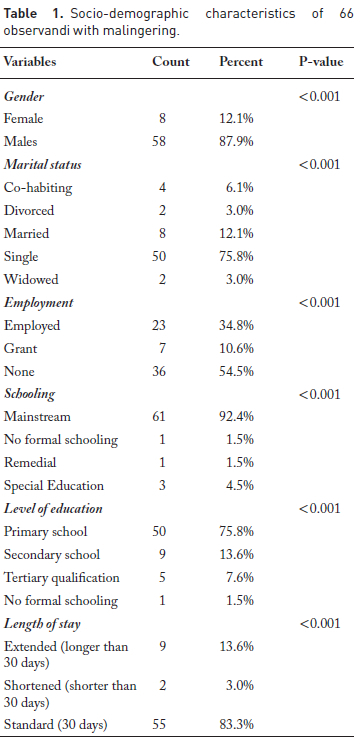
From 1 January 2018 to 31 December 2019, 478 individuals were referred for forensic observation under sections 77, 78, and 79 of the Criminal Procedure Act at Sterkfontein Hospital, and their clinical records were screened for malingering. Evidence of malingering was recorded for 66 observandi, indicating a prevalence of 13.8% (Lower CI: 1.1, Upper CI: 1.7). This study describes further findings about these 66 observandi with malingering. The mean age of this group was 34.4 (SD = 10.7) years. Table 1 illustrates the other socio-demographic variables.
Forensic considerations
Most of the observandi with malingering had a forensic history (n = 43, 65.2%). Most of these observandi were previously charged with minor offences (31) compared to serious offences (17) (some observandi had been charged previously with both minor and serious offences). Ten observandi (n = 10, 15.2%) had previous observations, 4 for the same charge and 6 for a different charge. Significantly more observandi had serious charges (n = 46, 70%) than minor ones (N = 28, 42 %), including those with serious and minor offences (n = 8.) Most of the serious charges were for rape or rape of a minor, assault with the intent to cause grievous bodily harm, attempted murder, and murder. Most minor offences were theft, malicious injury to property, housebreaking, and contravening of a protection order. Some observandi had multiple charges against them.
Regarding findings under sections 77, 78, and 79 of the CPA, of the 66 observandi with malingering, only one was found unfit to stand trial and not criminally responsible, with an additional one found not fit to stand trial and two found not responsible. Malingering was noted in the psychiatric court reports of significantly fewer observandi (n:21, 32%) compared to those where it was not documented (n = 45, 68%).
Clinical considerations
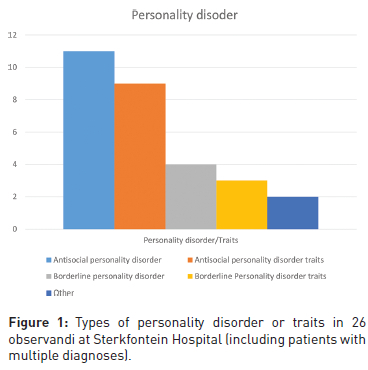
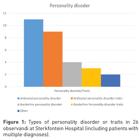
Significantly more observandi had a history of psychoactive drug use (n = 59, 89%) than those without (n = 7, 11%). Cannabis and alcohol were the most frequently used. The presence of a psychiatric history was not clinically significant, and the most common previous diagnoses included mood and psychotic disorders. Of the observandi, 32 reported a history of suicide attempts (48.5%) in comparison with 34 who did not (51.5%). Significantly fewer observandi were diagnosed with a mental illness according to their assessment diagnoses (n = 25, 37.9%) than those that did not (n = 41, 62.1%; p = 0.049). The most prominent disorders that were diagnosed were psychotic disorders (n = 17) and mood disorders (n = 10), followed by post-traumatic stress disorder (n = 2), and substance withdrawal (n = 1). A psychoactive substance use disorder was documented under the assessment diagnosis in 36 (56.1%) of the 66 observandi, and three were diagnosed with an intellectual disability or impairment. Of the 66 observations, 26 were noted to have a personality disorder or traits, as illustrated in Figure 1.
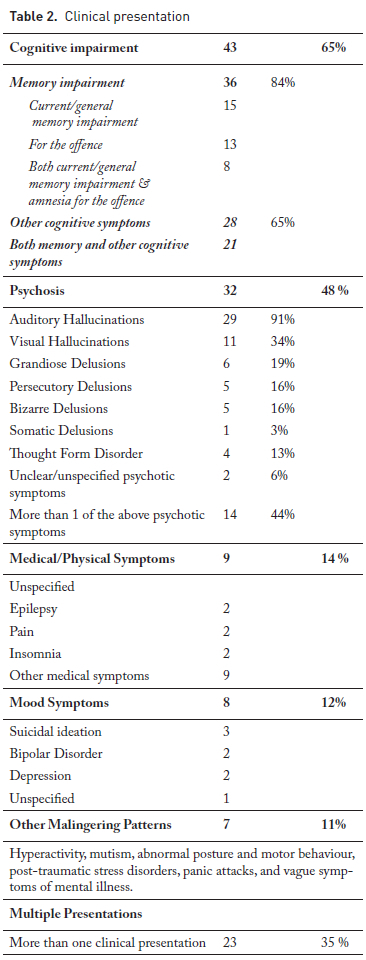
The clinical presentation in the 66 observandi, including cognitive impairment, psychosis, mood, and medical or physical symptoms of malingering, is illustrated in Table 2. Some had multiple symptoms within one presentation and symptoms from more than one group of clinical presentations.
Assessments performed
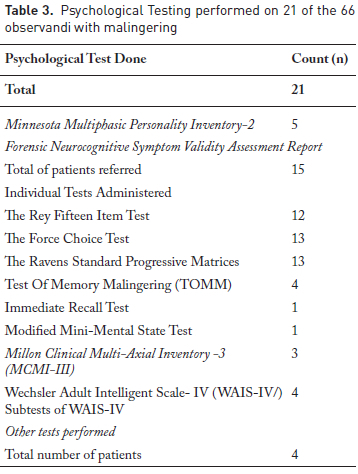
Psychological testing was done on 26 (39,4%) of the 66 observations. Adequate assessment results regarding malingering were available in 21 observandi. Table 3 summarises the types of psychological evaluations that were performed.
Regarding the assessment on malingering, evidence was found in 13 observandi during the psychological evaluation and no evidence was found in 8.
DISCUSSION
The prevalence of malingering in this study population (13,8 %) is in keeping with the literature.(5) The socio-demographic profile of the observandi is generally consistent with the findings of other studies. There was a male pre-dominance, and the mean age of subjects was 34.4 years.(9) Primary school was the highest level of education for most of the observandi, which corresponds with the lower level of education for malingerers reported in the literature.(9)
A significant number of observandi (65.2 %) had a forensic history. Although there is a paucity of research on how this is linked to malingering, it corresponds with findings reported in another study in the same setting.(22) As the severity of the charge might be perceived as linked to the prospective sentence length if found guilty, it may be a valuable measure of incentive for malingering. Most of the defendants in this study were charged with serious offences, corresponding to findings in a sample of individuals admitted to a state hospital to recover after being found not competent.(23) However, there is conflicting evidence regarding the association between the severity of the charges against individuals and malingering.(9)
A known psychiatric history seemed insignificant in this study; this contrasts with 87% of malingerers who had either a history of prior inpatient (the majority) or outpatient psychiatric treatment.(24) A significant number of the observandi had a history of substance use. Little literature is available on the association between substance use and malingering. However, the rate of cannabis use was much higher in this forensic population than was reported in the general population, which is consistent with findings of a higher rate of substance abuse in forensic psychiatric patients and that alcohol and cannabis use increases the risk of criminal and violent behaviour.(25) The high rate of substance use for this specific population was consistent with the literature.(22)
The most prominent personality disorder or trait was anti-social personality disorder. This is an expected finding, as anti-social personality disorder has been linked to an increased risk of violence.(26) There are conflicting results about the association between anti-social personality disorder and malingering in the available literature.(27,28)
As malingering does not impact fitness to stand trial and criminal responsibility, the forensic findings in this study are expected. Malingering was only noted in 21 (31.8%) on the psychiatric report in terms of the Criminal Procedure Act. This may reflect a reluctance by the psychiatrists to note malingering on the documents provided for the courts, and the reason for this could be a topic for further research. It may be that malingering holds a negative connotation, and they fear it will impact a judge's view of an individual, influencing their verdict and sentencing in the future.
The most common clinical presentation was cognitive impairment, followed by psychotic symptoms, physical symptoms, mood symptoms, and other patterns. This finding is partly consistent with the literature.(9) Symptoms of more than one type of psychiatric disorder were present in about a third of the presentations, providing perhaps a good illustration of how "crowding the canvas" could be highly suggestive of malingering and is consistent with findings from another study.(9,17) The rate of multi-symptom presentations might have been higher if all the presenting symptoms were documented under evidence of malingering in the report in terms of the Mental Health Care Act.
The high rate of cognitive symptoms as part of the clinical presentation is in keeping with the findings in the literature.(9) Cognitive presentations in this study were divided into memory impairment (the most common presentation) and other cognitive symptoms. About a third of the subjects attempted to malinger amnesia specifically for the offence.
The most common psychotic symptoms that were present were auditory hallucinations, followed by visual hallucinations and delusions, a finding that is consistent with findings in the literature.(7,9,24) There are conflicting opinions on whether disorders of thought processes can be included as clinical indicators of malingered psychosis. (9,29) One study reported that thought process disturbances could be malingered but at a lower rate, consistent with the findings of this study.(9)
The presence of mood symptoms (including suicidal ideation) as part of the clinical presentation of malingering was much lower than found in the literature.(9,24) In addition, the low rate of documented malingered suicidal ideation is inconsistent with the high rate of a history of suicidal ideation and suicidal attempts reported by the observandi.
About 40 % of the observandi were referred for psychological testing, including 53 % of the individuals who presented with cognitive symptoms. The reason for the low referral rate could be the lack of staff" and resources, and perhaps the team felt confident that malingering was evident from a clinical perspective and that no further validation was needed. The neurocognitive symptom validity assessments (which included three or more different tests) were primarily used in this setting, followed by the MMPI-2. The results of the psychological evaluation indicated that where malingering was suspected based on clinical grounds, 62 % were in keeping with the clinical suspicion of malingering. Although this result might be insignificant due to the small sample, it still raises the question of exactly how accurate the diagnosis of malingering is when based on clinical factors alone. Additionally, although psychological assessments help detect malingering with some accuracy, it is not foolproof,(18) and this may explain the results of psychological assessments that did not show evidence of malingering for 8 of the observandi. For about half of the individuals who were referred for the psychological evaluation, a malingering battery was used; this can be more accurate than using only a single test.(30)
LIMITATIONSThis was a retrospective study; thus, incomplete or unavailable data could have impacted the results. Also, multiple symptoms were documented at times during the admission period. However, where malingering was suspected or confirmed, the symptoms thought to have been malingered were not specified. This and the small sample size could have led to false negatives. The study was conducted at one forensic unit in a particular population, and conclusions drawn from this study may not apply to other settings.
CONCLUSION & RECOMMENDATIONS
The prevalence of malingering in this setting is comparable to that reported in other countries, and this reflects our ability to detect and record if malingering is suspected with some accuracy. There should be a higher index of suspicion in observandi with more than one clinical presentation. More detailed note-keeping is required to establish precise malingering patterns; perhaps a symptom presentation checklist in the forensic setting could be helpful in this regard. Considering the high rate of cognitive presentations and findings that the diagnosis of malingering on clinical factors alone might not be highly accurate, in cases where malingering of cognitive symptoms is suspected clinically, observandi should be referred to psychological services for a battery of tests. Further research on malingering in this setting and other forensic settings in South Africa is needed to build on the findings and conclusions of this study.
ACKNOWLEDGMENTS
We gratefully acknowledge the following persons for contributing to this study: Mr. R. Mohale and his team at Sterkfontein Hospital Registry, who helped effortlessly to access data; Mr. J. Fourie, who assisted in setting up the electronic data sheet; Prof N. Pillay, who was responsible for analysing the data; and Dr. Marques, who assisted with the language editing.
REFERENCES
- 1. American Psychiatric Association. Diagnostic and statistical manual of mental disorders. 5th ed. Arlington, VA: American Psychiatric Association; 2013: 727-727.
- 2. Halligan PW, Bass, C, Oakley DA. Wilful deception as illness behaviour. In: Halligan P, Bass C, Oakley D, editors. Malingering and illness deception. New York: Oxford University Press; 2003: 16.
- 3. Pollock PH, Quigley B, Worley KO, Bashford C. Feigned mental disorder in prisoners referred to forensic mental health services. J Psychiatr Ment Health Nurs. 1997; 4(1):9-17.
- 4. Chafetzl M, Underhill J. Estimated costs of malingered disability. Arch Clin Neuropsychol. 2013; 28(7):633-639.
- 5. Sadock BJ, Sadock VA, Ruiz P, editors. Kaplan & Sadock's synopsis of psychiatry: behavioral sciences/clinical psychiatry. 11th ed. Baltimore, MD: Wolters Kluwer; 2015.
- 6. Brown J, Besser J, Piccolino AL, Peric F. Malingering: a basic introduction for clinical and forensic professionals. Forensic Sch Today. 2015; 1(1):1-3.
- 7. Resnick P, Knoll J. Faking it: how to detect malingered psychosis. Curr Psychiatr. 2005; 4(11):13-25.
- 8. Rogers R, Salekin RT, Sewell KW, Goldstein A, Leonard KA. A comparison of forensic and non-forensic malingerers: a prototypical analysis of explanatory models. Law Hum Behav. 1998; 22(4):353-367.
- 9. Saberi SM, Sheikhazadi A, Ghorbani M, et al. Feigned symptoms among defendants claiming psychiatric problems: survey of 45 malingerers. Iran J Psychiatry. 2013; 8(1):14-19.
- 10. Rissmiller DJ, Wayslow A, Madison H, et al. Prevalence of malingering in inpatient suicide ideators and attempters. Crisis. 1998; 19(2):62-66.
- 11. Appelbaum PS, Jick RZ, Grisso T, et al. Use of posttraumatic stress disorder to support an insanity defence. Am J Psychiatry. 1993; 150(2):229-234.
- 12. Taylor PJ, Kopelman MD. Amnesia for criminal offences. Psychol Med. 1984; 14(3):581-588.
- 13. Nakic M, Thomas P. Dissociative identity disorder in the courtroom. J Am Acad Psychiatry Law. 2012; 40(1):146-148.
- 14. Mellers JDC. The approach to patients with 'non-epileptic seizures'. Postgrad Med J. 2005; 81(958):498-504.
- 15. Mendelson G, Mendelson D. Malingering pain in the medicolegal context. Clin J Pain. 2004; 20(6):423-432.
- 16. Kucharski LT, Duncan S, Egan SS, Falkenbach DM. Psychopathy and malingering of psychiatric disorder in criminal defendants. Behav Sci Law. 2006; 24(5):633-644.
- 17. Resnick P, Knoll J. Malingered psychosis. In: Rogers R, editor. Clinical assessment of malingering and deception. 3rd ed. New York: The Guillford Publications; 2008: 60.
- 18. Walczyk JJ, Sewell N, DiBenedetto MB. A review of approaches to detecting malingering in forensic contexts and promising cognitive load-inducing lie detection techniques. Front Psychiatry. 2018; 9:1-14.
- 19. Bunnting BG, Wessels WH, Lasich AJ, Pillay B. The distinction of malingering and mental illness in black forensic cases. Med Law. 1996; 15(2):241-247.
- 20. South African Parliament. Government Gazette Republic of South Africa. 1977. Criminal Procedure Act 51 of 1977.
- 21. South African Parliament. Mental Health Care Act No. 17 of 2002. Vol. 449, Government Gazette Republic of South Africa. Cape Town; 2002.
- 22. Valabdass SN, Subramaney U, Edge A. Characteristics of persons accused of intimate partner homicide amongst forensic psychiatric observations. S Afr J Psychiatr. 2021; 27:1675.
- 23. McDermott BE, Dualan IV, Scott CL. Malingering in the correctional system: does incentive affect prevalence? Int J Law Psychiatry. 2013; 36(3-4):287-292.
- 24. Cornell DG, Hawk GL. Clinical presentation of malingerers diagnosed by experienced forensic psychologists. Law Hum Behav. 1989; 13(4):373-383.
- 25. Marais B, Subramaney U. Forensic state patients at Sterkfontein Hospital: a 3-year follow-up study. S Afr J Psychiatry. 2015; 21(3):86-92.
- 26. Filov I. Antisocial personality traits as a risk factor of violence between individuals with mental disorders. Open Access Maced J Med Sci. 2019; 7(4):657-662.
- 27. Pierson AM, Rosenfeld B, Green D, Belfi B. Investigating the relationship between antisocial personality disorder and malingering. Crim Justice Behav. 2011; 38(2):146-156.
- 28. Kucharski LT, Toomey JP, Fila K, Duncan S. Detection of malingering of psychiatric disorder with the personality assessment inventory: an investigation of criminal defendants. J Pers Assess. 2007; 88(1):25-32.
- 29. Resnick PJ. The detection of malingered psychosis. Psychiatr Clin North Am. 1999; 22(1):159-171.
- 30. Schretlen DJ. The use of psychological tests to identify malingered symptoms of mental disorder. Clin Psychol Rev. 1988; 8(5):451-476.