Association of Anthropometric Measures with Blood Pressure in Young Urban Adolescents in South Africa
Abstract
BACKGROUND: Elevated blood pressure in adolescence is an important early marker of future cardiovascular risk. Anthropometric measures such as body mass index (BMI) and skinfold thickness may provide simple, low-cost tools to identify individuals at risk. However, data from urban South African adolescent populations remain limited. METHODS: We conducted a cross-sectional study of 878 adolescents (aged ≥13 years) from a school in Alexandra, Johannesburg. Resting blood pressure, height and weight were measured using standardised methods, and triceps skinfold thickness was assessed using calibrated callipers. RESULTS: The cohort comprised 556 females and 322 males, with a mean age of 15.6 years. Most participants had a normal BMI (61.4%), while 20.5% were underweight, 11.5% overweight, and 6.6% obese. Females had significantly higher BMI and skinfold thickness than males (p<0.0001), while males were taller. Females had a lower likelihood of elevated systolic blood pressure (SBP) compared to males (OR 0.75; 95% CI 0.56-0.99; p=0.042), with no difference in diastolic blood pressure (DBP). Participants with elevated SBP were significantly taller and heavier, and had higher BMI (all p<0.0001), but skinfold thickness was not associated with elevated SBP (p=0.39). Elevated DBP was associated with higher weight (p=0.0015) and BMI (p=0.036), but not with height or skinfold thickness. CONCLUSION: Anthropometric measures, particularly weight and BMI, are associated with elevated blood pressure in urban South African adolescents. These findings support the use of simple anthropometric assessments to support early cardiovascular risk recognition in adolescents.
INTRODUCTION
Elevated blood pressure in childhood and adolescence is increasingly recognised as an important early marker of later cardiovascular risk. Adolescents with elevated blood pressure are more likely to develop hypertension and later cardiovascular disease.(1) Longitudinal studies, including those conducted in South Africa, have demonstrated that elevated blood pressure may persist from early childhood into late adolescence.(1,2) Identification of modifiable risk factors during this period is therefore critical for early prevention strategies.
Additionally, the rising prevalence of overweight and obesity among children and adolescents represents a major global public health concern. The World Health Organization highlights that overweight and obesity in childhood are associated with adverse health consequences during youth and with a higher likelihood of obesity, diabetes, and cardiovascular disease developing in adulthood.(3) In low- and middle-income countries (LMICs), these factors occur alongside undernutrition, creating a dual burden of malnutrition.
Anthropometric measures provide practical, low-cost assessments of early cardiovascular risk in children and adolescents. Body mass index (BMI) is commonly used in epidemiological studies because it is easy to obtain and standardise, although it does not fully capture body composition. Skinfold thickness may therefore add useful information on adiposity. Previous studies have demonstrated that BMI, skinfold thickness, and other body-composition measures are associated with systolic and diastolic blood pressure in young people, suggesting that anthropometric measures can help identify individuals at risk of elevated blood pressure.(4,5) Although some South African studies have examined associations between anthropometric measures and blood pressure in children and adolescents, data from urban school-based adolescent populations remain limited.(6)
Against this background, this study aimed to assess the relationships among anthropometric measures, such as height, weight, body mass index (BMI), skinfold thickness, and blood pressure, in urban adolescents in South Africa.
METHODS
Study Design and Variables
This was a cross-sectional study of 878 adolescents conducted at a school in Alexandra, Johannesburg, in 2013. All eligible students present during the study period were invited to participate. Adolescents aged ≥13 years were included; those with an acute illness or lack of consent were excluded. Blood pressure was measured using an automated device after 5 minutes of rest in the seated position, with an appropriately sized cuff; the average of two readings was recorded. Height and weight were measured using standardised equipment, and body mass index (BMI) was calculated as weight (kg)/height (m2
-
Definitions
For the purposes of analysis, systolic blood pressure values >120 mmHg were classified as elevated systolic blood pressure, and diastolic blood pressure values >80 mmHg were classified as elevated diastolic blood pressure. These thresholds were used to identify adolescents with blood pressure values above the normal range for pragmatic comparative analysis; they were not intended to establish a clinical diagnosis of hypertension, which requires confirmation using age-, sex-, and height-specific paediatric criteria and repeat measurements over time.
BMI was classified according to the WHO 2007 growth reference for children and adolescents aged 5-19 years, using BMI-for-age z-scores. Thinness (underweight) was defined as <−2 SD, overweight as >+1 SD, and obesity as >+2 SD.
Statistics
All data were entered into an Excel spreadsheet, and statistical analyses were performed using SAS version 9.4 for Windows. A 5% significance level was used. Continuous variables are summarised as mean ± standard deviation (SD) or median (interquartile range, IQR), as appropriate, and this is indicated in the tables.
The relationships between weight, height, BMI, skinfold thickness, and sex, controlling for age, were assessed using Analysis of Covariance (ANCOVA). Continuous variables were log-transformed, where necessary, to meet the assumptions of the technique. The relationship between categorised SBP, DBP and sex, controlling for age, was analysed by logistic regression.
The relationship between SBP and DBP to BMI, skinfold thickness, height, and weight was analysed using the independent-samples t-test. When the data did not meet the assumptions of the test, the nonparametric Wilcoxon rank-sum test was used. Because height, weight, BMI and skinfold thickness are interrelated anthropometric measures, Spearman rank correlation analyses were performed to assess the correlation structure between these variables. Correlations were examined in the overall cohort and stratified by sex.
Sample Size Calculation
Sample size estimation was based on the key research question, namely, determining between-sex differences in a continuous variable while controlling for age. For the detection of small, medium and large effect sizes (f = 0.10, 0.25, and 0.40, respectively) with 80% power at the 5% significance level, sample sizes of 787, 128 and 52 are required. The actual sample size of 878 used in this study allows the detection of even small effect sizes.
Ethics
The University of the Witwatersrand Human Research Ethics Committee approved the study (M120979). Permission to conduct the study was obtained from the Gauteng Department of Education and the school governing body. Written informed consent was obtained from parents or guardians, and assent was obtained from participating adolescents.
RESULTS
Demographic and Anthropometric Characteristics
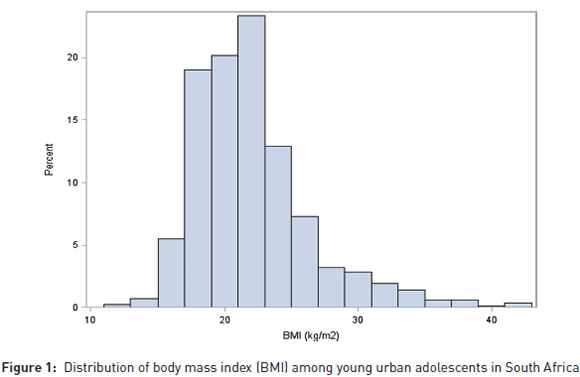
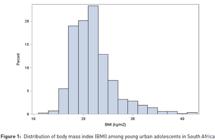
A total of 878 adolescents were included in the analysis, comprising 556 females and 322 males. The mean age of the cohort was similar between the sexes (15.6 years in both groups). Overall, 61.4% of participants had a normal BMI, while 20.5% were underweight, 11.5% were overweight, and 6.6% were obese (Figure 1). The mean skinfold thickness was 17.1 mm, and the mean weight was 56.1 kg.
Comparison of Anthropometric Variables and Blood Pressure by Sex
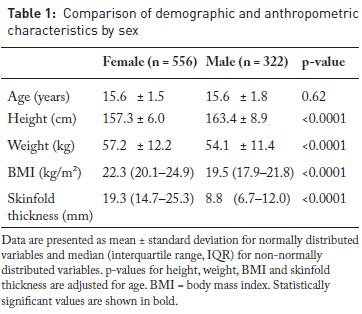
After controlling for age, males were significantly taller than females. At a given age, males were on average 6.0 cm taller than females (95% CI 5.1-7.0; p < 0.0001) (Table 1). Females, however, were significantly heavier than males, with an adjusted mean difference of 3.3 kg (95% CI 1.9-4.8; p < 0.0001).
Females also had significantly higher adiposity measures than males. Median BMI was 22.3 kg/m22
The descriptive statistics by sex showed similar patterns. Mean height was 157.3 cm in females and 163.4 cm in males. Mean weight was 57.2 kg in females and 54.1 kg in males.
Females had a significantly lower likelihood of elevated SBP than males after controlling for age (p = 0.042), with an odds ratio of 0.75 (95% CI 0.56-0.99). There was no significant sex difference in the likelihood of elevated DBP (p = 0.26; OR 1.19, 95% CI 0.88-1.61).
Association of Anthropometric Variables with Blood Pressure
Systolic Blood Pressure
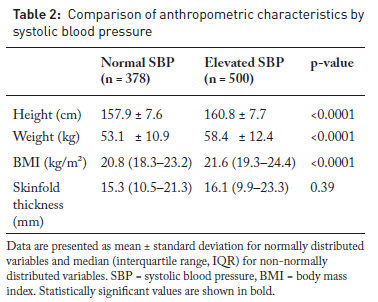
Participants with an elevated SBP were significantly taller and heavier than those with normal SBP (Table 2). The mean height of those with an elevated SBP was 160.8 cm (95% CI 160.1-161.5) compared with 157.9 cm (95% CI 157.2-158.7) in those with normal SBP (p < 0.0001). Likewise, the mean weight was 58.4 kg (95% CI 57.3-59.4) in the elevated SBP group versus 53.1 kg (95% CI 52.0-54.2) in the normal SBP group (p < 0.0001). BMI was also significantly higher among participants with an elevated SBP. The median BMI was 21.6 kg/m22
Diastolic Blood Pressure
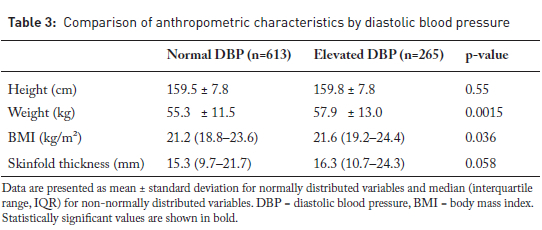
There was no significant association between height and DBP category (p = 0.55). (Table 3) However, participants with elevated DBP were significantly heavier than those with normal DBP, with mean weights of 57.9 kg (95% CI, 56.3-59.4) and 55.3 kg (95% CI, 54.4-56.2), respectively (p = 0.0015).
BMI was also significantly, though modestly, higher among participants with elevated DBP. The median BMI in the elevated DBP group was 21.6 kg/m22
Analyses of interrelated anthropometric measures
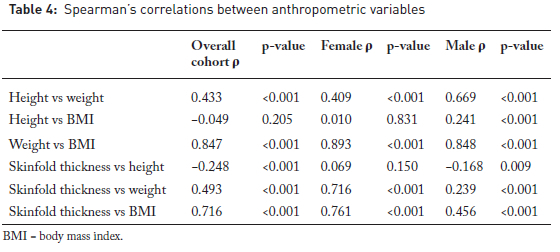
Because height, weight, and BMI are interrelated, additional exploratory analyses were conducted to assess correlations among these anthropometric variables. Weight and BMI were strongly correlated (Spearman ρ = 0.847, p < 0.001), while skinfold thickness correlated with both weight (ρ = 0.493, p < 0.001) and BMI (ρ = 0.716, p < 0.001). These correlations were stronger among females than males, suggesting that the relationship between skinfold thickness and other anthropometric measures may differ by sex. (Table 4)
DISCUSSION
This cross-sectional study of urban South African adolescents found that simple anthropometric measures, particularly weight and BMI, were associated with elevated blood pressure. Elevated SBP was associated with greater height, weight and BMI, while elevated DBP was associated with greater weight and BMI. Skinfold thickness was not significantly associated with either SBP or DBP. Females had higher BMI and skinfold thickness than males, but were less likely to have elevated SBP. Because height, weight and BMI are interrelated, the observed associations should be interpreted as descriptive associations between body-size-related measures and elevated BP values, rather than evidence that each anthropometric measure has an independent causal effect.
BMI and weight were the most consistent anthropometric correlates of elevated blood pressure in our cohort. Excess adiposity may contribute to higher blood pressure through increased sympathetic activity, insulin resistance, sodium retention, activation of the renin-angiotensin-aldosterone system, and vascular dysfunction.(7)
SBP showed stronger associations with anthropometric measures than DBP in our cohort. This suggests that systolic pressure may be more sensitive to body size-related variation during adolescence.(8) Males were more likely to have elevated SBP despite females having higher BMI and skinfold thickness, which may reflect sex-related differences in pubertal maturation, lean mass, fat distribution, and vascular physiology.(8,9)
Although skinfold thickness is considered a more direct measure of adiposity, it was not significantly associated with elevated BP in the overall unadjusted comparison. This may reflect measurement variability, the use of a single-site triceps skinfold rather than multiple sites, or differences in the relationship between skinfold thickness and BP by sex and body size. In our analyses, skinfold thickness correlated with weight and BMI, particularly among females. These findings suggest that skinfold thickness may still provide adiposity-related information in selected subgroups, although these analyses should be interpreted cautiously. Some international studies have similarly shown that skinfold-based measures do not consistently outperform BMI in identifying cardiovascular risk in children and adolescents.(4,10)
Our findings are broadly consistent with international data showing positive associations between adiposity and blood pressure in children and adolescents.(4,5,9-11) Large non-African studies have shown that higher adiposity is associated with higher blood pressure in youth and that simple anthropometric measures, such as BMI, perform well as screening markers for cardiovascular risk. In the Canadian Québec Adipose and Lifestyle Investigation in Youth study, adiposity was positively associated with blood pressure in children and adolescents,(5) while the Bogalusa Heart Study found that BMI was at least as useful as skinfold thickness for identifying cardiovascular risk factors in children.(4)
African data are more limited, but available studies support a similar overall pattern. A longitudinal South African study found that higher childhood BMI was associated with higher diastolic blood pressure, supporting a link between body size and blood pressure.(2) In another South African adolescent study from a township population in North West Province, systolic blood pressure positively correlated with anthropometric parameters, including skinfold measures. However, BMI itself was not significantly associated with blood pressure, a finding that differs from most of the existing literature.(12)
Evidence from other African settings, although sparse, also supports an association between adiposity and elevated blood pressure in children and adolescents. In Nigeria, studies among adolescents have reported that BMI remains an important screening marker for high blood pressure and that obesity and central obesity are associated with higher blood pressure levels.(13,14) Research from Cameroon also echoed these findings.(15) Broader African evidence also supports this trend; a systematic review and meta-analysis of paediatric hypertension in Africa found the pooled prevalence of hypertension was 18.5% among children and adolescents with overweight or obesity, compared with 4.8% in those with normal weight and 1.0% in those with underweight.(16) Our findings are broadly consistent with other African data, but remain important as they demonstrate that this association between adiposity and elevated blood pressure extends to an urban African adolescent population, a setting where nutritional transition, changing lifestyle patterns, and socioeconomic heterogeneity exist.
In an urban South African setting, data have shown that elevated blood pressure emerges early and tracks into late adolescence, highlighting the importance of identifying simple markers of cardiovascular risk in youth.(2,6) Against this background, our study adds useful evidence from an underrepresented urban South African adolescent setting, and suggests that in this population, weight and BMI may be a more informative correlate of elevated blood pressure than single-site triceps skinfold thickness. Although this cross-sectional study cannot determine whether these adolescents will develop hypertension or later cardiovascular disease, existing longitudinal evidence indicates that elevated BP in childhood and adolescence may track over time and is associated with later cardiovascular risk. Therefore, our findings support the value of measuring BP alongside routine anthropometric assessments in school and primary care settings, particularly among adolescents with higher weight or BMI.
STRENGTHS AND LIMITATIONSThe strengths of this study include the relatively large sample size, the standardised collection of blood pressure and anthropometric data, and the focus on an urban South African adolescent population, a group for which local data remain limited. Limitations of this study include its cross-sectional design, which precludes causal inference, and the findings from a single urban school may not be generalisable to other adolescent populations. Blood pressure was measured at the study visit rather than across multiple visits, which may have led to misclassification of elevated blood pressure. In addition, the fixed blood pressure thresholds used for our analysis may not fully reflect age-, sex-, and height-specific paediatric blood pressure classification, and elevated values on a single study visit do not establish a diagnosis of hypertension. Residual confounding by factors such as pubertal stage, physical activity, dietary intake, and family history cannot be excluded. In addition, because this was a cross-sectional study, we could not determine whether adolescents with elevated BP values developed persistent hypertension, target-organ changes, or later cardiovascular disease. Longitudinal follow-up would be required to establish whether the observed anthropometric associations have prognostic significance. Adiposity was assessed using a single triceps skinfold measure, which may not fully capture body fat distribution. Lastly, the data were collected in 2013, and secular changes in obesity prevalence, lifestyle patterns and adolescent cardiovascular risk may limit direct extrapolation to current populations.
CONCLUSION
In this cohort of urban South African adolescents, weight and BMI were the anthropometric measures most consistently associated with elevated blood pressure, whereas single-site triceps skinfold thickness showed no significant association. These findings highlight the importance of simple, low-cost anthropometric assessment as a practical tool for supporting early cardiovascular risk recognition in resource-limited school and primary care settings. Given this, and the risk for elevated adolescent blood pressure to track into later life, larger longitudinal and multicentre studies are needed to determine whether these readily measurable markers can help identify young people at greatest risk of persistent hypertension and future cardiovascular disease.
REFERENCES
-
1. Theodore RF, Broadbent J, Nagin D, et al. Childhood to early-midlife systolic blood pressure trajectories: early-life predictors, effect modifiers, and adult cardiovascular outcomes. Hypertension. 2015; 66(6):1108-1115. doi:10.1161/HYPERTENSIONAHA.115.05831.
» https://doi.org/10.1161/HYPERTENSIONAHA.115.05831 -
2. Kagura J, Adair LS, Musa MG, Pettifor JM, Norris SA. Blood pressure tracking in urban black South African children: birth to twenty cohort. BMC Pediatr. 2015; 15:78. doi:10.1186/s12887-015-0402-z.
» https://doi.org/10.1186/s12887-015-0402-z -
3. World Health Organization. Obesity and overweight. Geneva: World Health Organization; 2025 Dec 8 [cited 2026 Apr 9]. Available from: https://www.who.int/news-room/fact-sheets/detail/obesity-and-overweight.
» https://www.who.int/news-room/fact-sheets/detail/obesity-and-overweight -
4. Freedman DS, Katzmarzyk PT, Dietz WH, Srinivasan SR, Berenson GS. Relation of body mass index and skinfold thicknesses to cardiovascular disease risk factors in children: the Bogalusa Heart Study. Am J Clin Nutr. 2009; 90(1):210-216. doi:10.3945/ajcn.2009.27525.
» https://doi.org/10.3945/ajcn.2009.27525 -
5. Paradis G, Lambert M, O'Loughlin J, et al. Blood pressure and adiposity in children and adolescents. Circulation. 2004; 110(13):1832-1838. doi:10.1161/01.CIR.0000143100.31752.B7.
» https://doi.org/10.1161/01.CIR.0000143100.31752.B7 -
6. Nkeh-Chungag BN, Sekokotla AM, Sewpaul R, et al. Prevalence of hypertension and pre-hypertension in 13-17 year old adolescents living in Mthatha, South Africa: a cross-sectional study. Cent Eur J Public Health. 2015; 23(1):59-64. doi:10.21101/CEJPH.A3922.
» https://doi.org/10.21101/CEJPH.A3922 -
7. Kotchen TA. Obesity-related hypertension: epidemiology, pathophysiology, and clinical management. Am J Hypertens. 2010; 23(11):1170-1178. doi:10.1038/ajh.2010.172.
» https://doi.org/10.1038/ajh.2010.172 -
8. Syme C, Abrahamowicz M, Leonard GT, et al. Sex differences in blood pressure and its relationship to body composition and metabolism in adolescence. Arch Pediatr Adolesc Med. 2009; 163(9):818-825. doi:10.1001/archpediatrics.2009.92.
» https://doi.org/10.1001/archpediatrics.2009.92 -
9. Kwarteng EA, Shank LM, Yanovski JA. Influence of puberty on relationships between body composition and blood pressure: a cross-sectional study. Pediatr Res. 2023; 94(2):781-788. doi:10.1038/s41390-023-02503-7.
» https://doi.org/10.1038/s41390-023-02503-7 -
10. Plachta-Danielzik S, Landsberg B, Johannsen M, Lange D, Müller MJ. Association of different obesity indices with blood pressure and blood lipids in children and adolescents. Br J Nutr. 2008; 100(1):208-218. doi:10.1017/S0007114508882980.
» https://doi.org/10.1017/S0007114508882980 -
11. Ribeiro RC, Lamounier JA, Oliveira RG, Bensenor IM, Lotufo PA. Measurements of adiposity and high blood pressure among children and adolescents living in Belo Horizonte. Cardiol Young. 2009; 19(5):436-440. doi:10.1017/S1047951109990606.
» https://doi.org/10.1017/S1047951109990606 -
12. Mamabolo RL, van Rooyen JM, Schutte AE, Monyeki MA, Kruger HS. Association between blood pressure, measures of body composition and lifestyle factors in township adolescents, North-West Province, South Africa. Afr J Phys Health Educ Recreat Dance. 2011; 17(1):51-68. doi:10.4314/ajpherd.v17i1.65245.
» https://doi.org/10.4314/ajpherd.v17i1.65245 -
13. Senbanjo IO, Oshikoya KA. Obesity and blood pressure levels of adolescents in Abeokuta, Nigeria. Cardiovasc J Afr. 2012; 23(5):260-264. doi:10.5830/CVJA-2011-037.
» https://doi.org/10.5830/CVJA-2011-037 -
14. Oduwole AA, Ladapo TA, Fajolu IB, Ekure EN, Adeniyi OF. Obesity and elevated blood pressure among adolescents in Lagos, Nigeria: a cross-sectional study. BMC Public Health. 2012; 12:616. doi:10.1186/1471-2458-12-616.
» https://doi.org/10.1186/1471-2458-12-616 -
15. Nganou-Gnindjio CN, Essama DB, Nkeck JR, et al. Prevalence and factors associated with hypertension among school children and adolescents in urban and semi-urban areas in Cameroon. J Clin Hypertens (Greenwich). 2021; 23(8):1490-1497. doi:10.1111/jch.14309.
» https://doi.org/10.1111/jch.14309 -
16. Crouch SH, Soepnel L, Kolkenbeck-Ruh A, et al. Paediatric hypertension in Africa: a systematic review and meta-analysis. EClinicalMedicine. 2022; 48:101444. doi:10.1016/j.eclinm.2021.101229.
» https://doi.org/10.1016/j.eclinm.2021.101229