Burnout and Quality of work life amongst Urology medical staff in South Africa - a nationwide survey
Abstract
BACKGROUND: Worldwide, doctors face many job challenges, predisposing them to burnout. Studies have shown that urologists are also vulnerable to burnout. Burnout's effects are dire and negatively affect patient outcomes. To our knowledge, there is no published data on various aspects of the quality of life of South African doctors OBJECTIVES: To analyse the quality of work life and burnout amongst South African Urology medical staff METHODS: An anonymous online survey using the National Institute for Occupational Safety and Health (NIOSH) Worker Well-Being Questionnaire evaluated the quality of work life and burnout among South African urologists RESULTS: 122 urology medical staff completed the survey, of which 101 complete responses were received. The survey response rate was 25.8%. Only 36% of the surveyed group would choose a career in medicine again. Of the 101 complete responses, 29.7% worked more than 80 hours weekly. Rates of burnout were found to be high at 58%, with many factors lowering the quality of work life, such as lack of job satisfaction, not having a mentor, workplace bullying, excessive stress and anxiety, depression, and insufficient opportunities for restorative personal time. The prevalence of depression was 11.9% CONCLUSIONS: This study showed that burnout and poor quality of work life are prevalent among South African physicians working in urology practice. Addressing excessive workloads, improving mentorship quality, fostering a respectful and inclusive workplace culture, and expanding access to wellness initiatives are critical to enhancing physician well-being and improving healthcare delivery
INTRODUCTION
Burnout and poor quality of work life (QOWL) are increasingly recognized as critical issues affecting healthcare professionals worldwide. Urology has been identified as a high-risk discipline among medical specialties, with physicians facing intense workloads, emotional demands, and long hours, all of which compromise well-being and professional satisfaction. In South Africa, these challenges are magnified by systemic issues such as staffing shortages, under-resourced facilities, and socio-economic pressures, potentially exacerbating the risk of burnout among urology medical staff (UMS).
Quality of work life refers to a worker's overall satisfaction with their occupational environment and ability to meet personal and professional needs.(1) It encompasses multiple dimensions, including work-life balance, autonomy, workplace relationships, job security, remuneration, and growth opportunities.(2)
Studies suggest that only 59% of doctors report being satisfied with their work life, compared to 89% of professionals in other fields.(3) In urology, dissatisfaction rates can be exceptionally high, with up to 20% of staff expressing discontent and strain related to their careers.(2) This contributes to doctors leaving the profession and is detrimental to patient care.(4)
Burnout syndrome is a state of emotional, mental, and physical exhaustion caused by prolonged stress, often manifesting as emotional exhaustion, depersonalization, and a reduced sense of personal accomplishment.(3,5,6) It is associated with significant individual and organizational consequences, including depression, reduced productivity, medical errors, and staff attrition. Burnout often goes underreported due to stigma and fear of professional repercussions.(3,5,7) Variable burnout rates between 21% and 100% have been demonstrated among South African doctors.(8)
Despite the increasing recognition of burnout globally, data on QOWL and burnout specific to UMS in South Africa are scarce. No prior nationwide study has focused solely on this population. Given the unique challenges faced by SA's healthcare workforce and the low urologist-to-population ratio (0.56 per 100,000), it is imperative to understand the extent and drivers of burnout in this group.(9) This study thus aims to evaluate the QOWL and prevalence of burnout among UMS in South Africa using a nationally distributed survey based on the validated National Institute for Occupational Safety and Health (NIOSH) Worker Well-being Questionnaire.(10,11)
MATERIALS AND METHODS:
An observational cohort study was conducted on South African UMS (medical officers, registrars (trainees), and consultants) by inviting them to participate in an anonymous electronic survey. At least 6 months of urology work experience and having practiced urology within the previous 12 months were criteria for eligibility.
Data was collected via a validated NIOSH Well-being questionnaire.(12) Twenty questions focused on demographics, while 45 focused on work experiences, work environment, physical and mental health, and experiences and activities outside work. This nationwide survey was distributed via email and the South African Urological Association's WhatsApp platforms. Confirmatory factor analysis of the NIOSH Well-being questionnaire has been performed in prior studies, which led to the removal of items with low variance.(12) These items were omitted from the results and discussion in this study.
The survey was created and hosted on SurveyMonkey. On average, completing the survey took only 20 minutes. No incentive was offered to participants. Responses were collected over 2 months in 2024.
Ethical approval was granted by the University of Witwatersrand Human Research Ethics Committee.
Data was analysed using version 29 of IBM SPSS Statistics. Descriptive statistics were used to present the demographic and professional profiles of the study participants and to describe their feedback on the various "Quality of work life" and "burnout" variables assessed in the study. Descriptive statistics were presented as frequencies and percentages for categorical variables and as means with standard deviation for continuous variables. For job satisfaction and other outcomes measured on a constant scale, similar comparisons were performed using one-way analysis of variance (ANOVA). The Pearson correlation coefficient was used to examine the nature and strength of linear covariance between some quality of life-related factors and outcomes. Differences in outcomes were analysed using Fisher's exact test and Pearson's chi-square test.
RESULTS
Demographics
One hundred twenty-two participants responded to the survey, of which only 101 were complete responses (82% completion rate). Only complete responses were used for this study's analysis. The overall response rate was 25.8% (122/472). The response rate for practicing urologists was 13.5% (47/347), registrars (trainees) 46,2% (30/65), and medical officers 40% (24/60).
Work evaluation and experience
Regarding vacation, 22.8% (23/101) of UMS reported insufficient vacation. Median hours worked by UMS in a typical week were 61-80 hours by 30.7%, with 22.7% working between 81-100 hours and 6.9% working over 100 hours. Extra hours worked for more than 10 days per month were reported by 28.7% (29/101).
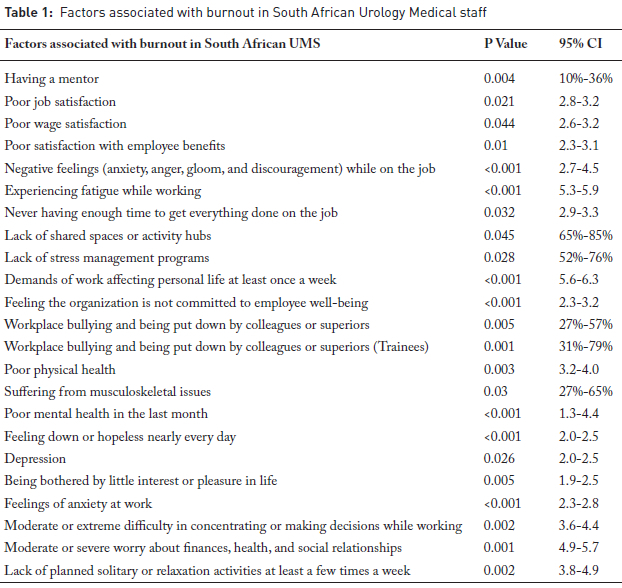
Having a mentor was reported by 59.4% (60/101) of UMS. Those with mentors showed higher job satisfaction scores of 3.27 (95% CI 2.56-3.98) compared to scores of 2.95 (95% CI 2.15 - 3.75) in those without mentors (p = 0.04).
Interestingly, 23.8% (24/101) of UMS would not choose Medicine as a career if given a choice again. Those under the age of 35 years were less likely [23.3% (10/43)] to reselect a career in medicine as compared to the older age groups (95% CI 10%-36%) (p<0.05). Of those choosing a career in medicine again, 77.9% (60/77) would reselect urology as a specialty.
Regarding job satisfaction, 83.2% (84/101) were satisfied, while only 56.5% (57/101) were satisfied with their wages. Regarding job security, 23.7% (24/101) of UMS reported poor job security.
A significant proportion of UMS reported experiencing negative feelings of anxiety, 41.6% (42/101), anger, 34.6% (35/101), gloom, 23.8% (24/101), and discouragement, 31.7% (32/101), at least a few times a week.
Sixty-seven out of 101 (66.3%) UMS reported experiencing fatigue at least once a week.
Ninety-seven percent (98/101) of UMS agreed that their work served a greater purpose and was meaningful to them.
Fifty-nine out of one hundred and one (58.4%) of UMS self-reported suffering from burnout whilst working in Urology. Having a mentor was surprisingly associated with increased burnout rates (p = 0.004) (95% CI 45%-77%).
Workplace policies and culture
Twenty-eight percent (28/100) of UMS felt they were not treated respectfully in their organization, while 29.6% (29/98) felt their contributions were not valued. Only 35.7% (35/98) of UMS felt their organization cared about their general work satisfaction. Forty-eight out of 101 respondents (47.6%) felt they received recognition for a well-done job.
Workplace physical environment and safety climate
Only 37.7% (38/101) of respondents felt unsafe in the workplace, and 63.6% (61/96) of participants felt management did not respond quickly regarding workplace safety issues.
In terms of discrimination, 26.7% (27/101) of UMS felt discrimination concerning age, 36.6% (37/101) related to race, and 23.7% (24/101) related to gender. A worrying 6.9% (7/101) of UMS experienced sexual harassment in the previous 12 months while at work, while 13.9% (14/101) were exposed to physical violence at work.
Forty-two out of 101 UMS (41.6%) reported being bullied or threatened while at work, and 48.5% (49/101) of respondents revealed being put down or addressed unprofessionally by coworkers or superiors. Workplace bullying and being put down by colleagues or superiors were both associated with burnout (p = 0.005) (95% CI 38%-72%), and trainees (21/29) were more vulnerable than urologists (12/49) (p = 0.001).
Work-related injuries were suffered by 21/100 (20.8%) in the previous 12 months, of which 38.1% (8/21) required some form of treatment, change in job activity, or lost time from work.
Health Status
Only 5.9% (6/101) of UMS described their physical health as poor. However, on average, UMS's health was not good for 6.4 days a month (95% CI 5.0-7.8 days). 34.7% (35/101) reported suffering from musculoskeletal issues.
Chronic insomnia was experienced by 20.8% (21/101), which was defined as occurring three or more nights per week for at least 3 months and not attributable to another health problem.
On average, in the past 30 days, the mental health of UMS was not good for 7.7 days (95% CI 6.1-9.3 days). When UMS were asked how often they experienced stress weekly, 42.6% (43/101) stressed about their health, 60.4% (61/101) about their finances, 65.4% (66/101) by family and social relationships, and 76.3% (77/101) stressed by their work.
Twelve among the 101 UMS (11.9%) reported being depressed at the time of the survey. Almost 10% (10/101) of respondents reported feeling down or hopeless nearly every day, while 10.9% (11/101) reported being bothered by little interest or pleasure in life.
Feeling anxious or on edge nearly every day was experienced by 12.9% (13/101) of UMS, and 10.9% (11/101) were bothered by being unable to control or stop worrying.
Many UMS, 65/101 (64.3%), slept 6 hours or less at night, with 65.4% (66/101) reporting feeling sleepy at work in the preceding 7 days.
Twenty of 101 UMS (19.8%) had moderate or extreme difficulty concentrating or making decisions while working. At least once a day: 28.8% (29/101) of UMS did not focus well enough on their work, 19.8% (20/101) did not work as carefully as they should have, 11.9% (12/101) did not work when they should have been, and 8% (8/101) got less work done compared to others.
Home, community, and society
Seventy-five percent (75/100) of UMS were moderately or severely worried about maintaining the standard of life they enjoy, and 62% (62/100) did not have enough income to cover monthly bills.
Eighteen percent (18/100) of participants rarely or did not receive social and emotional support from family or friends. 10% (10/100) of UMS planned solitary or relaxation activities at least a few times a week.
DISCUSSION
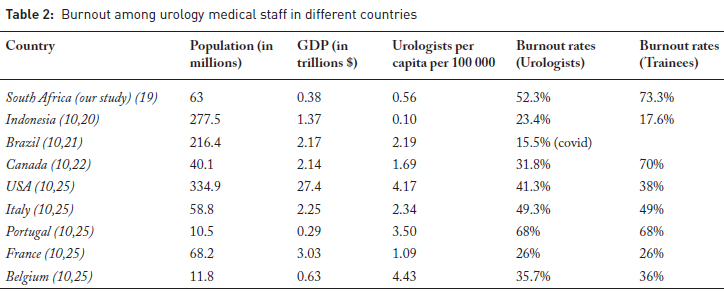
This study demonstrated that among South African UMS, the burnout rates were high at 58%, surpassing many reported rates in local studies. South African urology trainees had the highest burnout rates compared to other countries.(8) The prevalence of depressive symptoms, though lower than in International studies, is concerning.(7) South Africa has a population of 63 million and only 347 registered urologists, of which 50 are full-time employed in the public sector.(9,13) Thus, South Africa's low urologist-per-capita ratio compounds these challenges.
Our study's 58% burnout rate (73.3% in trainees) is comparable to South African general surgical subspecialties, with an overall 53% (60.9% among trainees) burnout rate. South African orthopaedic subspecialties had higher rates (72% overall and 93% among trainees).(14,15)
Several factors negatively impacted QOWL. Long working hours, often exceeding 80 hours per week amongst South African UMS, and poor vacation uptake, combined with sleep deprivation, emerged as major contributors to reduced QOWL.(15) Besides these factors, the impact of other factors such as experience, age, and employment opportunities on QOWL amongst Urologists remains to be explored further. More UMS are needed, or peripheral referral hospitals must be better equipped to help ease the burden on central hospitals where UMS are mostly found.
Urology medical staff younger than 35 were least likely to choose medicine again, aligning with previous findings that suggest unmet job and work-life expectations.(12) Despite this, 78% would choose urology again, like a United States study.(2) While mentoring can improve job satisfaction by providing guidance and alleviating burnout, our study found an unexpected increase in burnout among UMS with mentors.(16,17) This paradox may reflect the variable quality of mentorship, with inadequate mentor-mentee relationships potentially contributing to increased expectations, pressure to perform, or a lack of genuine support - all of which can exacerbate feelings of emotional fatigue and overwork.
The demands of work spill over into the personal lives of UMS, contributing to emotional exhaustion and strained support systems. In addition, 48.5% of participants reported workplace bullying. Though lower than rates documented in American studies (90%), trainees were disproportionately more affected.(18) While support from supervisors and coworkers was a common experience, distrust and disappointment with hospital management, stemming from safety concerns, feeling undervalued, and perceived lack of responsiveness were also shared sentiments. These factors negatively impact job satisfaction, potentially leading to attrition.(18)
Compared to other countries, SA trainees had the highest burnout rates, while SA urologist burnout rates were 2nd to Portugal, as shown in Table 2 below. Different methodologies between studies may account for differences. The South African urologist per capita rate of 0.56 per 100,000 was much lower than that of European and North American countries.(9)
Interventions like seminars on professionalism, confidential reporting systems, and staff" wellness initiatives were rarely known to UMS. Promoting awareness and access to these resources could improve resilience.(23) Furthermore, non-work-related wellness practices such as mindfulness, exercise, yoga, meditation, and good social support were associated with reduced burnout, suggesting potential avenues for individual and organizational interventions.(24-26) Promoting openness and support will encourage UMS to seek help without fear of stigma.(27)
LIMITATIONSOne of the potential limitations of this study is the relatively low response rate (25%) of physicians working in the urology departments of South Africa. This survey was long, on average taking 20 minutes to complete. Even though the survey was anonymous, some participants may have hesitated to complete it. However, Fosnacht et al. have shown that surveys with smaller sample sizes of less than 500 need 20-25% response rates to provide confident estimates.(28) Questionnaires are unable to extract nuanced and detailed responses from participants. Response and non-response bias may have occurred, with respondents structuring their answers according to what they think the study seeks. Self-reported burnout lacks objective validation.
CONCLUSIONS
This study is the first to document the scope and determinants of quality of work life amongst South African urology medical staff The prevalence of burnout and poor quality of work life, particularly among trainees and early-career professionals, is alarming. With over half of respondents reporting burnout and nearly 12% experiencing depressive symptoms, the current working conditions are unsustainable and potentially detrimental to both practitioner well-being and patient care. The findings underscore the urgent need for systemic reforms. Addressing excessive workloads, improving mentorship quality, fostering a respectful and inclusive workplace culture, and expanding access to wellness initiatives are critical steps forward. It is crucial to prioritize the health of medical doctors by implementing targeted, evidence-based interventions that support individual resilience and organizational change. A collaborative approach involving hospital management, senior clinicians, and wellness teams is essential.
The time to invest in the well-being of South Africa's medical workforce is now.
REFERENCES
- 1. Storman M, Storman D, Maciąg J. Quality of work-life among young medical doctors in Poland. Int J Occup Saf Ergo. 2022; 28(3):1611-1617.
- 2. Pruthi NR, Deal A, Langston J, et al. Factors related to job satisfaction in urology. Urol Pract. 2016; 3(3):169-174.
-
3. Medscape National Physician Burnout & Suicide Report 2020: The Generational Divide. https://www.medscape.com/slideshow/2020-lifestyle-burnout-6012460#1 (Accessed 2/9/2024).
» https://www.medscape.com/slideshow/2020-lifestyle-burnout-6012460#1 - 4. O'Neil A, Baldwin D, Cortese S, et al. Impact of intrawork rest breaks on doctors' performance and well-being: systematic review. BMJ Open. 2022; 12:e062469.
- 5. Rodríguez-Socarras M, Skjold Kingo P, Uvin P, et al. Lifestyle among urology trainees and young urologists in the context of burn-out syndrome. Actas Urol Esp (Engl Ed). 2020; 44(1):19-26.
- 6. Maslach C, Jackson SE. The measurement of experienced burnout. J Organ Behav. 1981; 2(2):99-113.
- 7. Mukendi A. The hidden struggle of overworked urology residents "the hour": the overlooked burnout, a narrative review. UroPrecision. 2024; 2(1):16-23.
- 8. Nazeema A, Lowton K, Tenea Z, Anic A, Jayrajh P. Study of burnout and depressive symptoms in doctors at a central level, state hospital. S Afr J Psychiatry. 2023; 29:1866.
- 9. John J. Urology pathways for the primary care physician. S Afr Med J. 2024; 114(4):e1670.
- 10. Powers JN, Farewell CV, Mauirro E, et al. The NIOSH Worker Well-being Questionnaire (WellBQ): a psychometric assessment with the early childhood education workforce. Early Child Educ J. 2024; 53(3):799-807.
- 11. Marchalik R, Marchalik D, Wang H, Pasieka H. Drivers and sequelae of burnout in U.S. dermatology trainees. Int J Womens Dermatol. 2021; 7(5):780-786.
- 12. Chari R, Sauter SL, Petrun Sayers EL, et al. Development of the National Institute for Occupational Safety and Health Worker Well-being Questionnaire. J Occup Environ Med. 2022; 64(8):707-717.
-
13. Department of Statistics South Africa: South Africa's population surpasses the 63 million mark. https://www.statssa.gov.za/?p=17430 (Accessed 4/9/2024).
» https://www.statssa.gov.za/?p=17430 - 14. Naidu P, Buccimazza I. Surgery in South Africa: challenges and barriers. S Afr J Surg. 2021; 59(3):77-81.
- 15. O'Connor M, Ferreira N, Smith M, et al. High burnout among the South African orthopaedic community: a cross-sectional study. SA Orthop J. 2022; 21(3): 132-142.
- 16. Terry T, Redfern N, French G. Mentoring for urologists. J Clin Urol. 2019; 12(2):158-162.
- 17. Chowdhury ML, Husainat MM, Suson KD. Workplace bullying of urology residents: implications for the atient and provider. Urology. 2019; 127:30-35.
-
18. Payne S, Kane A, Thomas K, et al. Factors influencing when urologists leave full-time practice. British Association of Urological Surgeons. https://www.baus.org.uk/_userfiles/pages/files/professionals/baus%20business/BAUSBU%20report-2%20(002).pdf (Accessed 20/9/2024).
» https://www.baus.org.uk/_userfiles/pages/files/professionals/baus%20business/BAUSBU%20report-2%20(002).pdf -
19. World Bank Group: Data. Country search. https://data.worldbank.org/?_gl=1*1ts25fe*_gcl_au*NjU2MzgxNzUxL-jE3MjU0MTk4NTg (Accessed 23/9/2024).
» https://data.worldbank.org/?_gl=1*1ts25fe*_gcl_au*NjU2MzgxNzUxL-jE3MjU0MTk4NTg - 20. Rustandi R, Rahman F, Manduaru R, et al. Prevalence of burnout among urologists and its risk factors in Indonesia. Afr J Urol. 2024; 30:1-8.
- 21. da Silva AGT, Diaz JO, Görgen ARH, et al. Brazilian urologist's mental health aspects during the COVID-19 pandemic. Int Braz J Urol. 2021; 47(4):882-886.
- 22. Chan EP, Stringer LS, Forster A, et al. Burnout in Canadian urology: cohort analysis from the 2018 Canadian Urological Association census. Can Urol Assoc J. 2021; 15(6 Suppl 1): S5-S15.
- 23. Pang KH, Webb TE, Esperto F, Osman NI. Is urologist burnout different on the other side of the pond? A European perspective. Can Urol Assoc J. 2021; 15(6 Suppl 1): S25-S30.
- 24. Johnstone J, Gabara A, Hopman WWM, Touma NJ. Impact of the COVID-19 pandemic on the burnout rates of graduating Canadian Urology residents. BJU Int. 2022; 130(3):389-393.
- 25. Marchalik D, Goldman C, Carvalho FL, et al. Resident burnout in USA and European urology residents: an international concern. BJU Int. 2019; 124(2):349-356.
- 26. Aryankhesal A, Mohammadibakhsh R, Hamidi Y, et al. Interventions on reducing burnout in physicians and nurses: a systematic review. Med J Islam Repub Iran. 2019; 33:77.
- 27. Razai MS, Kooner P, Majeed A. Strategies and interventions to improve healthcare professionals' well-being and reduce burnout. J Prim Care Community Health. 2023; 14:21501319231178641.
- 28. Fosnacht K, Sarraf S, Howe E, Peck LK. How important are high response rates for college surveys? Rev High Educ. 2017; 40(2):245-265.