Newer Modalities for Hypertension Management: A Review of siRNA Therapies and Aldosterone Synthase Inhibitors
Abstract
Hypertension is the leading cause of cardiovascular morbidity and mortality worldwide, with a significant number of all treated patients failing to achieve their target blood pressure goals. This therapeutic gap is driven by a number of factors, including, but not limited to, non-compliance with medications and the physiological phenomenon of renin-angiotensin-aldosterone system (RAAS) escape. In addition, the prevalence of resistant hypertension is increasing, posing a particular therapeutic challenge. In recent years, new classes of drugs have emerged that offer novel mechanisms to target the RAAS and address these challenges. This review article provides an in-depth overview of two such novel therapeutic modalities: small-interfering RNA therapies, exemplified by zilebesiran, and aldosterone synthase inhibitors, including lorundrostat and baxdrostat. We examine the mechanism of action of these new molecules, summarise the evidence on their safety and efficacy, and discuss their potential for future hypertension management. These therapies offer the promise of sustained blood pressure reduction with infrequent dosing, potentially overcoming the issues of non-compliance, the RAAS escape phenomenon and assisting in the management of resistant hypertension.
INTRODUCTION
An estimated 33% of adults worldwide have hypertension, representing approximately 1.4 billion adults. A majority of these adults live in the low- and middle-income countries. Approximately 600 million adults living with hypertension are unaware that they have this condition, with only 23% of adults on treatment achieving their target blood pressure goals.(1) This therapeutic gap is driven by a combination of factors, including poor medication adherence and physiological limitations of existing drugs, such as the 'RAAS escape' phenomenon, in which compensatory mechanisms blunt the long-term efficacy of RAAS inhibitors.(2,3)
A significant proportion of the hypertension population suffers from resistant hypertension. This phenotype is characterized by uncontrolled blood pressure despite maximally tolerated therapy with three antihypertensive agents, including a diuretic. The true prevalence of resistant hypertension is estimated to be between 10% to 15%, with the prevalence increasing in patients with chronic kidney disease and heart failure.(4)
The RAAS is key to regulating blood pressure, and its over-activation is an important driver in most forms of hypertension. Consequently, it has been the primary target for anti-hypertensive drug development for decades.
Conventional RAAS blockade with RAAS blockers is often limited by the phenomenon of 'aldosterone escape', where aldosterone levels eventually increase despite ongoing therapy.(3) The limitations of the current agents have led to the search for newer molecules that can provide more robust, sustained and targeted inhibition of the RAAS.
This review focuses on two of the most pioneering classes of newer antihypertensive drugs: small interfering RNA (siRNA) therapies and aldosterone synthase inhibitors (ASIs).
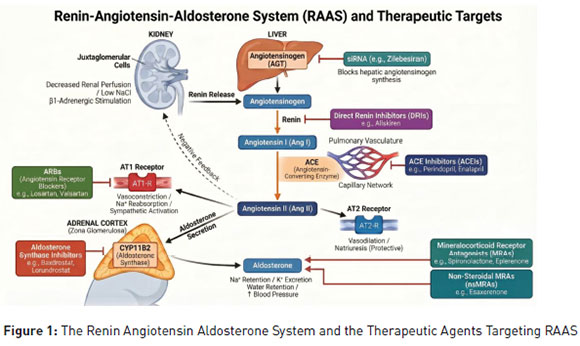
RAAS AND ITS LIMITATIONSThe RAAS plays a pivotal role in the pathogenesis of hypertension. (Figure 1) The RAAS cascade begins with cleavage of angiotensinogen produced in the liver to angiotensin I by renin. Angiotensin I is converted by angiotensin converting enzyme (ACE) to angiotensin II, which is the primary effector of RAAS. It induces potent peripheral vasoconstriction and stimulates the zona glomerulosa to produce aldosterone. Aldosterone promotes sodium and water retention by the kidneys, further increasing blood pressure. Regulation of aldosterone synthesis is multifactorial, with the primary modulators being Angiotensin II, extracellular potassium levels and adrenocorticotropic hormone.(5)
RAAS inhibitors and mineralocorticoid receptor antagonists (MRAs) have proven highly effective but, over time, can lead to paradoxical and chronic elevation of aldosterone, known as 'aldosterone escape', resulting in sodium and water retention and elevated blood pressure.(6)
This phenomenon occurs via ACE-independent pathways, including compensatory activation of alternative pathways involving Chymase and Cathepsin G.(7,8) The former is found mainly in cardiovascular tissue and directly converts Angiotensin I to Angiotensin II, bypassing ACE inhibitors.(7) Hyperkalemia can also stimulate aldosterone synthesis through calcium-dependent pathways.(9). These mechanisms can limit the long-term blood pressure-lowering effects of the RAAS blockers. The chronic elevation of aldosterone also leads to myocardial and vascular fibrosis, leading to progressive heart failure. It also increases progression of chronic kidney disease through inducing glomerulosclerosis, interstitial fibrosis and proteinuria.(10)
Mineralocorticoid receptor antagonists such as spironolactone and eplerenone reduce cardiovascular events and mortality in heart failure and decrease albuminuria when added to ACE inhibitors or angiotensin receptor blockers (ARBs). However, their use carries a risk of hyperkalemia. Steroidal MRAs, particularly spironolactone, also lack receptor selectivity. In addition to blocking mineralocorticoid receptors, spironolactone interacts with androgen and progesterone receptors, leading to endocrine adverse effects such as gynecomastia, decreased libido, erectile dysfunction, and menstrual irregularities.(11)
ALDOSTERONE SYNTHASE INHIBITORS: A TARGETED APPROACH TO ALDOSTERONE EXCESS
Aldosterone synthase inhibitors target the final step in the Renin-Angiotensin-Aldosterone system, i.e., Aldosterone synthesis. Excess aldosterone causes not only hypertension but also increased cardiovascular and renal damage through hypertension-independent mechanisms, including inflammation, fibrosis, and oxidative stress.(12)
Mechanism of Action
Aldosterone Synthase Inhibitors act at the final rate-limiting step of aldosterone synthesis by inhibiting CYP11B2 (aldosterone synthase). CYP11B2 catalyzes the hydroxylation and oxidation of 11-deoxycorticosterone to corticosterone, 18-hydroxycorticosterone and ultimately aldosterone.(13)
Aldosterone Synthase Inhibitors limit the synthesis of both circulating and tissue aldosterone, curbing the genomic (profibrotic and pro-inflammatory gene transcription) and non-genomic (oxidative stress, inflammation and endothelial dysfunction) effects of aldosterone.(14)
However, ASIs do not inhibit cortisol production or block the mineralocorticoid receptor, which is an advantage over older non-selective inhibitors and MRAs. By not blocking the mineralocorticoid receptor, ASIs allow endogenous glucocorticoids to bind to the receptor, thereby preventing the hyperkalemia that is a common side effect of MRAs.(14)
The main limitation in developing ASIs has been achieving high selectivity for CYP11B2 over CYP11B1, an enzyme that shares 93% sequence homology and is responsible for cortisol synthesis.(15) The first-generation ASIs, like osilodrostat, were not highly selective, leading to blunted cortisol responses and the subsequent risk of adrenal insufficiency.(16)
Clinical Evidence
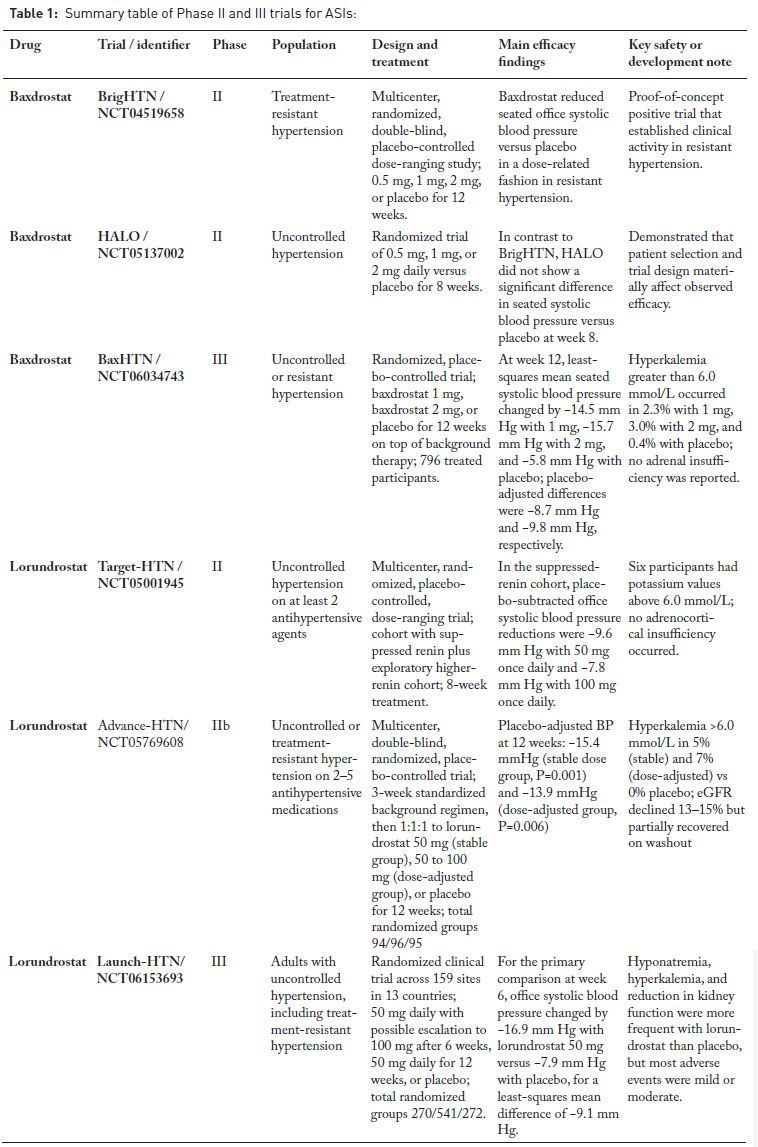
Several ASIs are undergoing phase 2 and 3 clinical trials, indicating favourable safety and efficacy profiles. Baxdrostat and lorundrostat are the second-generation ASIs that have shown promising results in resistant hypertension and hyperaldosteronism. (See Table 1)
A meta-analysis by Marzano et al. (17) which included seven randomized clinical trials (RCTs) involving 1440 patients showed that ASIs reduced office systolic blood pressure (SBP) significantly by 6.3 mmHg ([95% confidence interval (CI), -8.8 to -3.8]; p < 0.0001) and diastolic blood pressure by 2.2 mmHg ([95% CI, -4.2 to -0.2]; p = 0.03)
Another recent meta-analysis by Goh et al.,(18) which included eight RCTs and 2653 patients, showed a significant reduction in SBP with ASIs compared to placebo (MD: -6.01 mmHg; 95% CI: -9.3 to -2.71; I222
Baxdrostat is notable for its high selectivity (>100 fold) for CYP11B2 over CYP11B1. It has a favourable pharmacokinetic profile with a long half-life of 30 hours, allowing once-daily dosing.
The BrigHTN trial was a phase II, multi-center, placebo-controlled trial evaluating baxdrostat for treatment-resistant hypertension.(19) Patients with resistant hypertension were randomized to baxdrostat (0.5 mg, 1 mg or 2 mg) once daily for 12 weeks or placebo. The primary endpoint was a change in the systolic blood pressure (SBP) from baseline to week 12 in each baxdrostat group versus placebo. Baxdrostat produced significant, dose-dependent reductions in SBP, with placebo-corrected changes of -11 mmHg and -8.1 mmHg at the 2 mg and 1 mg doses, respectively. There were no serious adverse events attributed to baxdrostat, and no cases of adrenal insufficiency were reported. Cases of hyperkalemia were infrequent, occurring in only 2 patients, and did not recur after withdrawing and re-initiating the drug.
The phase II HALO trial, a double-blind, placebo-controlled, multicenter study, evaluated the efficacy of baxdrostat (0.5 mg, 1 mg, or 2 mg) versus placebo in patients with uncontrolled hypertension.(20) However, it failed to meet its primary endpoint of achieving a significant reduction in seated SBP after eight weeks. Non-adherence to the drug and a large placebo effect may have contributed to the trial's failure to reach its primary endpoint.
The BaxHTN trial was designed to study the safety and efficacy of baxdrostat in patients with uncontrolled and resistant HTN.(21) It was a phase III multinational, double-blind, randomized, placebo-controlled trial. A total of 796 patients with uncontrolled and resistant hypertension were randomized to 1 mg baxdrostat, 2 mg baxdrostat, or placebo in addition to background antihypertensive therapy for 12 weeks. At the end of the study period, the change from baseline in the least-squares mean seated SBP was −14.5 mmHg (95% CI, −17.6 to −13.3) with 1 mg Baxdrostat, and −5.8 mmHg (95% CI, −7.9 to −3.8) with placebo. An elevated K⁺ of > 6.0 mmol/L was seen in 2.3% of patients with 1 mg Baxdrostat, in 3% with 2 mg Baxdrostat, and 0.4% with placebo.
The BaxHTN trial demonstrated significantly lower seated SBP when Baxdrostat was added to background therapy in patients with uncontrolled or resistant HTN. The percentage of patients with serious adverse events was low and similar across treatment groups. The incidence of hyperkalaemia was higher in the baxdrostat groups, but the number of patients who discontinued baxdrostat was low.
Bax24 confirmed the sustained reduction in blood pressure with Baxdrostat over the nycthemeral period. It significantly reduced 24h ambulatory placebo-corrected difference SBP by −14·0 mm Hg (−17·2 to −10·8; p < 0·0001).(22)
Lorundrostat
Lorundrostat is another second-generation ASI with more than 300-fold selectivity for aldosterone synthase over cortisol synthase.
The Target-HTN was a phase II, multicenter, placebo-controlled trial that included patients with uncontrolled HTN who were on at least 2 antihypertensive agents.(23) The patients were randomized to receive lorundrostat at various doses (12.5mg, 50mg or 100mg once daily) versus placebo. In the lorandrostat arm, placebo-subtracted blood pressure reductions were -9.6 mmHg at 50 mg once daily and -7.8 mmHg at 100 mg once daily. Hyperkalemia occurred in 3.6% of patients, and no cases of adrenal insufficiency were reported.
The Advance-HTN was a phase IIb, multicenter, double-blind, randomized, placebo-controlled trial.(24) It evaluated lorundrostat 50mg daily, lorundrostat 50mg with the potential to escalate to 100mg daily or placebo in patients with uncontrolled or resistant hypertension. After 12 weeks, lorundrostat reduced the 24-hr average systolic BP by 15.4 mmHg in the stable-dose group, 13.9 mmHg in the dose-adjustment group, and 7.4 mmHg in the placebo group. Hyperkalemia occurred in 5% of patients in the stable-dose group and 7% in the dose-adjustment group.
The Launch-HTN trial was a phase III randomized clinical trial which included patients with uncontrolled hypertension who were randomized to lorundrostat 50mg once daily for 6 weeks followed by 100mg daily for 6 weeks, 50mg daily for 12 weeks, or a daily placebo for 12 weeks.(25) The pooled lorundrostat 50mg group lowered the automated SBP by a least-squares mean of 16.9 mmHg at 6 weeks vs 7.9 mmHg with placebo, an effect that was sustained through 12 weeks. Treatment discontinuation due to hyperkalemia, hyponatremia and renal dysfunction occurred in 2 participants in the dose-adjusted lorundrostat group and 7 participants in the stable-dose group.
siRNA THERAPY
Small interfering RNAs (siRNAs), represented by the prototypical Zilebesiran, are a novel class of RNA interference therapeutics with growing relevance in cardiovascular medicine. Their target is angiotensinogen - the most upstream precursor involved in RAAS signaling.
MECHANISM OF ACTIONZilebesiran achieves hepatic specificity through covalent conjugation to an N-acetylgalactosamine (GalNAc) ligand, which facilitates selective binding to the asialoglycoprotein receptor on hepatocytes, enabling receptor-mediated endocytosis of the molecule into the cell.(26) Once intracellular, the siRNA is loaded onto the RNA-Induced Silencing Complex (RISC) after which the protein directs sequence-specific cleavage of Angiotensinogen mRNA, thereby suppressing downstream production of angiotensin I and II. Importantly, RISC is recycled following each cleavage event, prolonging the duration of action. By reducing angiotensinogen production at the most proximal point in the RAAS cascade, siRNA therapy may circumvent RAAS escape.
CLINICAL EVIDENCEPhase I and II trials for Zilebesiran show promising results. KARDIA-1 enrolled 394 patients with hypertension, randomized across four escalating dose groups of Zilebesiran and one placebo group. At 8 weeks, treatment produced a clinically significant reduction in 24-hour ambulatory systolic blood pressure of up to 15 mmHg.(27) Notably, serum angiotensinogen was reduced by 88-98% across dose groups. The data suggest that 300 mg may represent the optimal dose, as no further BP reduction was observed at 600 mg. The drug's safety profile was broadly favourable. Adverse events were predominantly mild and transient, with injection site reactions and hyperkalemia representing the most frequently observed findings. Less common adverse events included transient elevation of hepatic enzymes, hypotension, and acute kidney injury, all of which were self-limiting and resolved without sequelae. Four patients required discontinuation of the drug due to adverse events, namely hypotension, hypertension, and injection site reactions.
The subsequent phase 2 KARDIA-2 trial extended this work by evaluating Zilebesiran as an add-on therapy in 672 patients with uncontrolled hypertension on background treatment with indapamide, amlodipine, or Olmesartan.(28) The most pronounced reductions in blood pressure occurred in the indapamide and amlodipine combination groups, at 12.1 mmHg and 9.7 mmHg, respectively. The attenuated effect in the olmesartan group is expected as both agents act on the RAAS, thereby limiting the additive benefit. Rates of hypotension, hyperkalemia, and acute kidney injury were higher in the Zilebesiran arm, though the majority of events were mild and self-limiting.
KARDIA-3, which was recently concluded, extended the investigation to patients with established cardiovascular disease or high cardiovascular risk who were on two or more background antihypertensives.(29) A single dose of Zilebesiran 300 mg produced a placebo-adjusted reduction in office systolic BP of 5.0 mmHg at 3 months (p=0.0431), with sustained benefit to 6 months.
A phase III trial, ZENITH (ZilebEsiraN cardIovascular ouTcome Study in Hypertension), is on the horizon to evaluate the impact of Zilebesiran on major adverse cardiovascular events in patients with uncontrolled hypertension.(30)
The therapeutic advantages of siRNA-based therapy are considerable. The sustained biochemical effect of a single dose allows a twice-yearly dosing regimen. Additionally, Zilebesiran achieves consistent 24-hour BP control, which improves cardiovascular outcomes as nocturnal hypertension is known to be associated with an increased risk of cardiovascular events.(31)
A legitimate concern surrounding long-acting molecules such as Zilebesiran is the absence of a rapid reversal strategy. In clinical scenarios where restoration of RAAS is desirable to maintain tissue perfusion, for example, emergent surgery, haemorrhage or acute kidney injury, prolonged duration of action becomes a liability. Uijil et al. reported on the use of vasopressors or strategies such as fludrocortisone or high-salt diets to gradually reverse the blood pressure-reducing effects of Zilebesiran.(32) The most elegant reversal strategy is REVERSIR (RVR) technology, which consists of synthetic short, single-stranded oligonucleotides complementary to the antisense siRNA strand connected to the RISC. In effect, they block the recognition and silencing of angiotensinogen mRNA, thereby allowing its production to resume.(33) In preclinical studies, REVERSIR restored mean arterial pressure to baseline values within 4 to 7 days.
DISCUSSION
Despite the availability of multiple potent antihypertensive agents, HTN remains the leading cause of CV morbidity and mortality globally. Both siRNA therapies and aldosterone synthase inhibitors represent significant advancements in the management of HTN. Their mechanisms of action and Zilebesiran's long half-life address the key shortcomings of currently available therapeutic agents.
Aldosterone Synthase Inhibitors offer a highly targeted approach for a large subset of patients where aldosterone excess is the primary driver of uncontrolled and resistant hypertension. In addition to controlling BP, ASIs also provide better cardiac and renal protective effects than traditional MRAs. They also do not have the conventional hormonal side effects of the pre-existing MRAs due to their high selectivity for CYP11B2. The phase 2 and phase 3 trials showed a slight increase in hyperkalaemia that was not severe enough to warrant discontinuation of the ASI. The clinical rationale for adding an ASI to a RAAS blocker is strong. While RAAS blockers decrease aldosterone secretion, the effect is transient due to aldosterone escape. By adding an ASI, clinicians can achieve complete RAAS blockade, preventing the downstream non-genomic effects of aldosterone.
The addition of Zilebesiran to an existing therapeutic regimen is mechanistically sound. While Zilebesiran strongly suppresses angiotensinogen production and circulating angiotensinogen, the addition of an ARB ensures that any residual angiotensin II generated at the tissue level is blocked at the AT receptor. Zilebesiran also overcomes the shortcomings of non-compliance due to its long half-life and parenteral route of administration.
Both ASIs and Zilebesiran are being positioned as add-on therapies to previously existing regimens, including RAAS blockers, CCBs and thiazide diuretics.
CONCLUSION
The landscape of hypertension is witnessing a major paradigm shift defined by targeted, mechanism-specific pharmacotherapy. Aldosterone synthase inhibitors and the siRNA therapeutic agent, Zilebesiran, represent two of the most promising advancements in decades. Aldosterone Synthase Inhibitors provide a potent, well-tolerated means of inhibiting aldosterone synthesis, overcoming the limitations of traditional MRAs. Conversely, Zilebesiran leverages RNA interference to provide sustained suppression of angiotensinogen with a single bi-annual injection, thereby overcoming the pervasive issue of medication non-compliance. ASIs have demonstrated robust efficacy and safety in Phase II and III clinical trials and demonstrate immense potential as add-on therapies to current standards of care for uncontrolled and resistant hypertension. Zilebesiran has also shown good clinical efficacy and safety in early clinical trials. Both agents hold promise for significantly improving blood pressure control rates and mitigating the global burden of hypertension-related cardiovascular disease.
AUTHOR CONTRIBUTIONSDr Hussein Bagha was responsible for the conception of the review article, the overall structure of the manuscript, the literature review and the drafting of the work.
Professor Jarraya Faical defined the scope of the manuscript and critically revised the manuscript
Both authors contributed to the interpretation of the literature, reviewed the final manuscript and approved the version to be published
REFERENCES
-
1. World Health Organization. Hypertension [Internet]. Geneva: World Health Organization; 2025 Sep 25 [cited 2026 Apr 19]. Available from: https://www.who.int/news-room/fact-sheets/detail/hypertension
» https://www.who.int/news-room/fact-sheets/detail/hypertension -
2. Chobanian AV. The hypertension paradox: more uncontrolled disease despite improved therapy. N Engl J Med. 2009; 361(9):878-887. doi:10.1056/NEJMsa0903829.
» https://doi.org/10.1056/NEJMsa0903829 - 3. Lakkis J, Lu WX, Weir MR. RAAS escape: a real clinical entity that may be important in the progression of cardiovascular and renal disease. Curr Hypertens Rep. 2003;5(5):408-417.
-
4. Natale F, Franzese R, Luisi E, et al. The increasing problem of resistant hypertension: we'll manage till help comes! Med Sci (Basel). 2024; 12(4):53. doi:10.3390/medsci12040053.
» https://doi.org/10.3390/medsci12040053 -
5. Bassett MH, White PC, Rainey WE. The regulation of aldosterone synthase expression. Mol Cell Endocrinol. 2004; 217(1-2):67-74. doi:10.1016/j.mce.2003.10.011.
» https://doi.org/10.1016/j.mce.2003.10.011 -
6. Staessen J, Lijnen P, Fagard R, et al. Rise in plasma concentration of aldosterone during long-term angiotensin II suppression. J Endocrinol. 1981; 91(3):457-465. doi:10.1677/joe.0.0910457.
» https://doi.org/10.1677/joe.0.0910457 -
7. Urata H, Boehm KD, Philip A, et al. Cellular localization and regional distribution of an angiotensin II-forming chymase in the heart. J Clin Invest. 1993; 91(4):1269-1281. doi:10.1172/JCI116325.
» https://doi.org/10.1172/JCI116325 -
8. Paul M, Poyan Mehr A, Kreutz R. Physiology of local renin-angiotensin systems. Physiol Rev. 2006; 86(3):747-803. doi:10.1152/physrev.00036.2005.
» https://doi.org/10.1152/physrev.00036.2005 -
9. Lotshaw DP. Role of membrane depolarization and T-type Ca2+ channels in angiotensin II and K+ stimulated aldosterone secretion. Mol Cell Endocrinol. 2001; 175(1-2):157-171. doi:10.1016/S0303-7207(01)00384-7.
» https://doi.org/10.1016/S0303-7207(01)00384-7 -
10. Briet M, Schiffrin EL. Aldosterone: effects on the kidney and cardiovascular system. Nat Rev Nephrol. 2010; 6(5):261-273. doi:10.1038/nrneph.2010.30.
» https://doi.org/10.1038/nrneph.2010.30 -
11. Funder JW. RALES, EPHESUS and redox. J Steroid Biochem Mol Biol. 2005; 93(2-5):121-125. doi:10.1016/j.jsbmb.2004.12.010.
» https://doi.org/10.1016/j.jsbmb.2004.12.010 -
12. Brown NJ. Contribution of aldosterone to cardiovascular and renal inflammation and fibrosis. Nat Rev Nephrol. 2013; 9(8):459-469. doi:10.1038/nrneph.2013.110.
» https://doi.org/10.1038/nrneph.2013.110 -
13. Veldhuis JD, Melby JC. Isolated aldosterone deficiency in man: acquired and inborn errors in the biosynthesis or action of aldosterone. Endocr Rev. 1981; 2(4):495-517. doi:10.1210/edrv-2-4-495.
» https://doi.org/10.1210/edrv-2-4-495 -
14. Verma S, Pandey A, Pandey AK, et al. Aldosterone and aldosterone synthase inhibitors in cardiorenal disease. Am J Physiol Heart Circ Physiol. 2024; 326(3):H670-H688. doi:10.1152/ajpheart.00419.2023.
» https://doi.org/10.1152/ajpheart.00419.2023 -
15. Cerny MA. Progress towards clinically useful aldosterone synthase inhibitors. Curr Top Med Chem. 2013; 13(11):1385-1401. doi:10.2174/1568026611313120003.
» https://doi.org/10.2174/1568026611313120003 -
16. Calhoun DA, White WB, Krum H, et al. Effects of a novel aldosterone synthase inhibitor for treatment of primary hypertension: results of a randomized, double-blind, placebo- and active-controlled phase 2 trial. Circulation. 2011; 124(18):1945-1955. doi:10.1161/CIRCULATIONAHA.111.029892.
» https://doi.org/10.1161/CIRCULATIONAHA.111.029892 -
17. Marzano L, Merlo M, Martinelli N, Pizzolo F, Friso S. Efficacy and safety of aldosterone synthase inhibitors for hypertension: a meta-analysis of randomized controlled trials and systematic review. Hypertension. 2025; 82(4):e47-e56. doi:10.1161/HYPERTENSIONAHA.124.23962.
» https://doi.org/10.1161/HYPERTENSIONAHA.124.23962 -
18. Goh JS, Sohail S, Ayub H, et al. Efficacy and safety of aldosterone synthase inhibitors in hypertension: a systematic review and meta-analysis. Endocrinol Diabetes Metab. 2025; 8(5):e70094. doi:10.1002/edm2.70094.
» https://doi.org/10.1002/edm2.70094 -
19. Freeman MW, Halvorsen YD, Marshall W, et al. Phase 2 trial of baxdrostat for treatment-resistant hypertension. N Engl J Med. 2023; 388(5):395-405. doi:10.1056/NEJMoa2213169.
» https://doi.org/10.1056/NEJMoa2213169 -
20. Kumbhani DJ. Efficacy and safety of baxdrostat in patients with uncontrolled hypertension - HALO [Internet]. American College of Cardiology; 2023 [cited 2026 Apr 20]. Available from: https://www.acc.org/latest-in-cardiology/clinical-trials/2023/03/01/23/34/halo
» https://www.acc.org/latest-in-cardiology/clinical-trials/2023/03/01/23/34/halo -
21. Flack JM, Azizi M, Brown JM, et al. Efficacy and safety of baxdrostat in uncontrolled and resistant hypertension. N Engl J Med. 2025; 393(14):1363-1374. doi:10.1056/NEJMoa2507109.
» https://doi.org/10.1056/NEJMoa2507109 -
22. Azizi M, Brown J, Dwyer J, et al. Effect of baxdrostat on ambulatory blood pressure in patients with resistant hypertension (Bax24): a phase 3 randomized controlled trial. Lancet. 2025; 407:988-999. doi:10.1016/S0140-6736(25)XXXX-X.
» https://doi.org/10.1016/S0140-6736(25)XXXX-X -
23. Laffin LJ, Rodman D, Luther JM, et al. Aldosterone synthase inhibition with lorundrostat for uncontrolled hypertension: the target-HTN randomized clinical trial. JAMA. 2023; 330(12):1140-1150. doi:10.1001/jama.2023.16029.
» https://doi.org/10.1001/jama.2023.16029 -
24. Laffin LJ, Kopjar B, Melgaard C, et al. Lorundrostat efficacy and safety in patients with uncontrolled hypertension. N Engl J Med. 2025; 392(19):1813-1823. doi:10.1056/NEJMoa2501440.
» https://doi.org/10.1056/NEJMoa2501440 -
25. Saxena M, Laffin L, Borghi C, et al. Lorundrostat in participants with uncontrolled hypertension and treatment-resistant hypertension: the launch-HTN randomized clinical trial. JAMA. 2025; 334(5):409-418. doi:10.1001/jama.2025.9413.
» https://doi.org/10.1001/jama.2025.9413 -
26. Morosan PA, Bobu AM, Carauleanu A, et al. Zilebesiran as an innovative siRNA-based therapeutic approach for hypertension: emerging perspectives in cardiovascular medicine. Int J Mol Sci. 2025; 26(21):10717. doi:10.3390/ijms262110717.
» https://doi.org/10.3390/ijms262110717 -
27. Bakris GL, Saxena M, Gupta A, et al. RNA interference with zilebesiran for mild to moderate hypertension: the KARDIA-1 randomized clinical trial. JAMA. 2024; 331(9):740-749. doi:10.1001/jama.2024.0728.
» https://doi.org/10.1001/jama.2024.0728 -
28. Desai AS, Karns AD, Badariene J, et al. Add-on treatment with zilebesiran for inadequately controlled hypertension: the KARDIA-2 randomized clinical trial. JAMA. 2025; 334(1):46-55. doi:10.1001/jama.2025.6681.
» https://doi.org/10.1001/jama.2025.6681 -
29. European Society of Cardiology. KARDIA-3 trial examines blood-pressure lowering effects of zilebesiran in hypertensive patients at high cardiovascular risk [Internet]. 2025 Aug 30 [cited 2026 Apr 19]. Available from: https://www.escardio.org/news/press/press-releases/KARDIA-3-trial-examines-blood-pressure-lowering-effects-of-zilebesiran
» https://www.escardio.org/news/press/press-releases/KARDIA-3-trial-examines-blood-pressure-lowering-effects-of-zilebesiran -
30. Alnylam Pharmaceuticals, Inc. Alnylam announces first patient dosed in ZENITH global phase 3 cardiovascular outcomes trial of zilebesiran [Internet]. 2025 Oct 1 [cited 2026 Apr 19]. Available from: https://investors.alnylam.com/press-release?id=29321
» https://investors.alnylam.com/press-release?id=29321 -
31. Parati G, Pengo MF, Avolio A, et al. Nocturnal blood pressure: pathophysiology, measurement and clinical implications. J Hypertens. 2025; 43(8):1296-1310. doi:10.1097/HJH.0000000000004053.
» https://doi.org/10.1097/HJH.0000000000004053 -
32. Uijl E, Ye D, Ren L, et al. Conventional vasopressor and vasopressor-sparing strategies to counteract the blood pressure-lowering effect of small interfering RNA targeting angiotensinogen. J Am Heart Assoc. 2022; 11(15):e026426. doi:10.1161/JAHA.122.026426.
» https://doi.org/10.1161/JAHA.122.026426 -
33. Ye D, Cruz-López EO, van Veghel R, et al. Counteracting angiotensinogen small-interfering RNA mediated antihypertensive effects with REVERSIR. Hypertension. 2024; 81(7):1491-1499. doi:10.1161/HYPERTENSIONAHA.124.22878.
» https://doi.org/10.1161/HYPERTENSIONAHA.124.22878