Inflammation - The pressure is on! A mini review of recent evidence of inflammation and hypertension in South Africa
Abstract
BACKGROUND: The relationship between inflammation and hypertension remains poorly understood in the South African population AIM: This mini review aimed to provide an updated overview of recent research in South Africa, assess the current state of evidence, and identify key gaps and limitations METHODS: The literature search of four databases, PubMed, Scopus, Web of Science and EBSCOhost, for studies published over the past 10 years (1 January 2016 - 12 May 2026) was performed by an independent individual, with article screening (N = 668) and data extraction conducted independently by two reviewers, with 27 studies finally included in the analysis RESULTS: Evidence was heterogeneous. Most studies were cross-sectional and drew from a limited number of cohorts. Findings for CRP, IL-6, TNF-α and other inflammatory markers were inconsistent, with associations appearing more evident in specific phenotypes such as masked, white-coat or sustained hypertension, overweight/obesity, and hypertensive disorders of pregnancy CONCLUSION: Based on current evidence, there is an inconsistent relationship between inflammation and hypertension. The review highlights the need for more prospective, mechanistic studies to develop effective therapeutic strategies for individuals with low-grade inflammation and hypertension, as well as preventive interventions to reduce inflammatory burden before disease onset
hypertension; blood pressure; inflammation; South Africa
INTRODUCTION
Despite significant efforts to improve the identification and treatment of hypertension, its prevalence in South Africa continues to rise (1,2). It is currently estimated that a substantial proportion of individuals are either unaware of their hypertension status or, if aware, remain untreated or inadequately treated (3,4). Whether current treatment strategies address the underlying drivers of the condition remains unclear, particularly given the multifactorial mechanisms underlying hypertension. A key limitation that has been suggested is the paucity of context-specific mechanistic research aimed at elucidating the underlying pathways among individuals with hypertension in sub-Saharan African populations (5). Over time, the role of inflammation in the development and progression of hypertension has attracted increasing scientific attention, particularly as several established cardiovascular risk factors, including unhealthy lifestyle behaviours (unhealthy diets, a sedentary lifestyle, smoking, and excessive alcohol consumption), sleep alterations and psychosocial stress, are known to promote inflammatory processes as previously reviewed (6,7). Furthermore, several interconnected pathophysiological mechanisms, such as high oxidative stress, endothelial dysfunction, and altered sympathetic nervous system activation and renin-angiotensin-aldosterone system (RAAS) activity, have been implicated in the inflammatory cascade, creating a cycle that further exacerbates inflammation and accelerates hypertension development (8,9). In addition, it has been postulated that individuals in low- and middle-income countries, such as South Africa, may be more susceptible to low-grade chronic inflammation (10), which could further contribute to the already high burden of hypertension. Therefore, it is important to improve our understanding of the relationship between inflammation and hypertension in the South African context by critically evaluating the existing evidence to inform and build upon in future research. Therefore, this review aimed to provide a concise, updated overview of recent research conducted in South Africa to assess the current state of evidence and to identify key gaps and limitations. It also seeks to highlight priority areas and provide recommendations for future research.
METHODS
We adopted a narrative review approach to synthesise and evaluate the current literature available on the relationship between hypertension and inflammation in South Africa. The literature search across four databases, PubMed, Scopus, Web of Science, and EBSCOhost, was performed by an independent individual on 12 May 2026. The search string used (Supplement 1) was designed to identify original publications on the relationship between inflammation and hypertension in South Africa.
The search output from the databases, PubMed (N = 119), Scopus (N = 430), Web of Science (N = 291) and EBSCOhost (N = 198), was uploaded to Covidence (11) which was used to scan for duplicates (N = 370) and conduct preliminary abstract screenings based on the following criteria: Original articles, published between 1 January 2016 and 12 May 2026 with study settings in South Africa; articles published in English language. We excluded other review articles, including narrative, literature, scoping, and systematic reviews, meta-analyses, as well as editorials, conference papers and articles for which full texts were not available. The most recent 10-year period was selected to provide an up-to-date review of the literature while minimising potential overlap with previously published reviews on the topic.
Title and abstract screening (N = 668) was performed by two reviewers (EJvV and AJ), with discrepancies resolved by discussion and consensus. The final selection was made after full-text reviews (N = 60), resulting in 27 articles included for this review. Data for specific study characteristics, aims, main results and conclusions were extracted and included the study design and setting (geographical region of participant recruitment), sample size, participant sociodemographic information (age, sex, ethnicity and socio-economic status), blood pressure (BP) apparatus used, hypertension guidelines used for hypertension classification, how inflammation was defined (i.e., biomarkers or measures used to assess inflammation) and the main findings of the study.
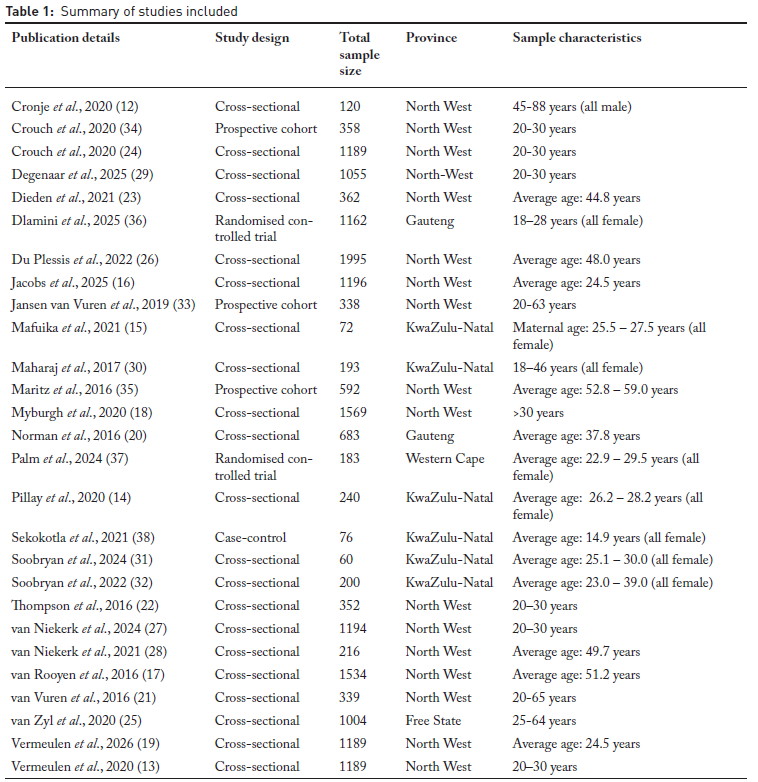
DESCRIPTION OF STUDIESThe 27 studies included covered a range of designs (the majority being cross-sectional studies (12-32), three prospective cohort studies (33-35), two randomised controlled trials (36,37) and one case-control study (38), as well as different settings. Seventeen studies recruited individuals from local communities, six studies recruited from hospitals or clinics (14,25,30-32,37), and four studies recruited from schools (21,28,33,38), as shown in Table 1. A more detailed summary is available in Supplement 2.
The studies are not fully representative of the broader South African population, as the majority (10 studies) were conducted in the North West Province. Only six studies were conducted in KwaZulu-Natal (14,15,30-32,38), two in Gauteng (20,36), one in the Free State (25) and one in the Western Cape (37). Although the 27 studies had distinct aims and objectives, most utilised data derived from three major cohorts, namely the African PRospective study on the Early Detection and Identification of Cardiovascular disease and HyperTension (African-PREDICT) (39) (eight studies), the Sympathetic activity and Ambulatory Blood Pressure in Africans (SABPA) study (40) (four studies), and the South African leg of the international Prospective Urban and Rural Epidemiology (PURE) study (41) (five studies). In addition, two studies recruited participants from maternity wards at a large regional hospital in Durban (14,30). However, it was unclear whether the remaining Durban-based studies were drawn from the same participant cohort, as they only specified recruitment from a large regional hospital (15,31,32,37). Consequently, only four studies could be confidently considered to have been conducted independently (20,25,36,38).
Sample sizes ranged from relatively small (N = 60) (31) to larger cohorts (N = 1995) at baseline(26). The average participant ages ranged from 16 to 64 years. The samples were diverse in terms of sex, with 18 studies including both sexes, 8 studies including only females (14,15,30-32,36-38), and 1 study including only males (12). Not all studies explicitly reported the racial ancestry of participants. Among those that did, the racial distribution generally reflected the local population demographics of the regions in which the studies were conducted. While most of the studies recruited participants from general local populations, several focused on specific subgroups or hypertensive conditions, particularly preeclampsia (N=6) (14,15,30-32,37).
Seven of the studies included ambulatory blood pressure monitoring (ABPM) data alongside office BP measures (13,19,20,22,24,27,34), with four studies solely using ABPM (21,28,29,33), ten only office BP (12,16-18,23,25,26,35,36,38) and six studies not specifically mentioning the type of BP assessment (14,15,30-32,37). Not all the studies specified the guidelines that were used to define hypertension, although some studies referenced or referred to the guidelines of the European Society of Cardiology/European Society of Hypertension (ESC/ESH), the International Society of Hypertension (ISH), and the International Society for the Study of Hypertension in Pregnancy (ISSHP) guidelines to classify individuals with preeclampsia. The ongoing updating of hypertension guidelines in light of emerging global evidence may explain the variation in diagnostic criteria used across the studies included in this review. Nevertheless, the guidelines used by the included studies generally relied on the traditional definition of hypertension at a systolic BP (SBP)/diastolic BP (DBP) ≥ 140/90 mmHg, ensuring consistency across the studies (42-45). The most frequently analysed inflammatory markers were C-reactive protein (CRP), tumour necrosis factor-alpha (TNF-α) and interleukin (IL)-6. Most of the inflammatory markers were measured using high-sensitivity analytical methods. Two studies did not specify the specific assay kits used and thus the sensitivity of these measurements is not clear.
SYNTHESIS OF RESULTSThe primary aims of most studies were not specifically focused on investigating the relationship between inflammation and hypertension, and the studies demonstrated considerable diversity in their objectives. This led to various studies stratifying their study populations by different variables/outcomes when comparing BP and inflammatory markers. For the purposes of this review, we considered only differences observed when groups were defined by hypertension or inflammatory status.
C-reactive protein and high blood pressure phenotypes
While some studies reported positive correlations between SBP and CRP in unadjusted analyses (16,17), most cross-sectional studies showed no evidence of a relationship between BP and CRP after adjustment for various covariates (12,16,17,25,28,38). Similarly, CRP has been shown to be higher in hypertensive than in normotensive groups (16,26,29,35), with significance lost in some cases after multivariate adjustment (35). In contrast, CRP was retained in all models and was associated with increased odds of both white coat and sustained hypertension when included alongside traditional demographic variables (age, sex, and ethnicity), a measure of body composition, total cholesterol, and a macrovascular parameter (19). The opposite was also shown, with SBP and DBP being higher above the clinical cut point for CRP (>3mg/L) compared to CRP ≤3mg/L (18). Furthermore, individuals with masked hypertension had a higher odds for CRP levels above 1.10 pg/ml (despite similar CRP levels in normotensive and masked hypertensive groups in multivariate-adjusted comparisons) (22). Positive correlations between DBP and CRP were only revealed in specific contexts, namely in White men (21) and in overweight/obesity (27). Here, both 24-hour (24h) SBP and DBP were positively correlated with CRP when individuals were stratified by body mass index (BMI). The findings emphasise that hypertensive phenotypes should be considered when elucidating the mechanisms by which inflammation contributes to elevated BP, as certain associations appear to be phenotype specific. In particular, relationships may be evident only under conditions such as white-coat, masked, and sustained hypertension (19), but not necessarily in hypertension overall. In addition, alterations in circulating inflammatory markers are often modest and transient, as in younger populations without overt pathological conditions. These effects, along with stronger influences from other cardiometabolic risk factors (as indicated below), may weaken evident associations when overall hypertension is analysed, disregarding its phenotypic subgroups.
Other circulating inflammatory markers and blood pressure
Similar results were evident in the studies that investigated the relationship of BP with IL-6 and TNF-α, with most of the studies showing no significant relationships between SBP and IL-6 (12,17,28,36) nor between SBP and TNF-α (12,36). Stratified by BP status, results ranged from no differences in IL-6 or TNF-α levels between hypertensive and normotensive groups in unadjusted (22,30) and multivariate-adjusted (16,35) comparisons to higher IL-6 levels in hypertensives compared to normotensives in minimally adjusted comparisons (29). In the context of overweight/obesity, 24h SBP positively correlated with IL-6, while both 24h SBP and DBP correlated positively with TNF-α (27). Here, a positive correlation between 24h SBP and TNF-α was only seen in normal-weight individuals.
These findings highlight the importance of body composition when assessing the role of inflammation in the development of hypertension. The studies that reported no associations had adjusted for body composition measures such as BMI or waist circumference, which may partially explain the null findings. This is supported by the study by van Niekerk et al. (2024), which demonstrated that the association became apparent only after stratifying individuals by BMI status (27). In addition, whether BP was measured in the office or across a 24h period adds another dimension, as no associations between inflammatory markers and office BP, daytime or nighttime ABPM were observed, irrespective of BMI status. Associations were found only with BP measured over the full 24h period (27).
Other inflammatory cytokines have been investigated in fewer studies, with largely inconsistent findings. In young adults (aged 20-30 years), IL-10 levels were lower in pre-hypertensives/hypertensives than in normotensives in multivariate analyses, whereas no differences were found for fibrinogen or growth differentiation factor 15 (GDF-15) levels. However, in multiple regression analyses, IL-10 had a positive association with office SBP only in the pre-hypertensive/hypertensive subgroup (16). In the same cohort, Vermeulen et al. (2020) found that central SBP (cSBP) and 24h DBP increased with higher GDF-15 quartiles, whereas 24h SBP, office BP, and hypertension status did not differ significantly (13). Also, in young African women (median age of 21 years), targeted proteomics analyses revealed no differences in inflammatory protein levels between normal and elevated BP groups, and none of the proteins associated with office BP after adjusting for confounders (36). In studies conducted in older adults (mean age ranges 25-64 years) (25) and 45-88 years (12), Van Zyl et al. (2020) found office DBP to be inversely associated with IL-10 in normal-weight individuals, whereas 24h DBP showed an inverse correlation with IL-8 in overweight/obese individuals only (25). On the other hand, Cronje et al. (2020) reported no evidence of a linear association between BP and either IL-10 or IFN-γ (12). Different inflammatory markers have been investigated in the context of hypertensive disorders in pregnancy (HDPs). Compared with gestationally matched normotensive controls, women with gestational hypertension and early-onset preeclampsia (EOPE) had higher transforming growth factor beta-1 (TGFβ-1) levels, and EOPE had higher TGFβ-1 levels than late-onset preeclampsia (LOPE) (32). When investigating pre-eclamptic women in combination with human immunodeficiency virus (HIV) infection, Mafuika et al. (2021) found tenascin-C (TN-C) levels to be higher in women with preeclampsia than in pregnant normotensives, regardless of HIV status, and preeclamptic HIV-positive women had higher TN-C levels compared to preeclamptic HIV-negative and normotensive pregnant women (15). Maharaj et al. (2017) found no differences in IL-2 or interferon-gamma (IFN-γ) levels between pregnant women stratified according to BP and HIV status (30).
Studies that investigated associations with white blood cell counts, including leucocytes, neutrophils, lymphocytes, monocytes, and the neutrophil-to-lymphocyte ratio, revealed no associations with BP or hypertension (25,28). Similarly, no associations were revealed between GDF-15 and C-X-C motif chemokine 16 (CXCL16) with hypertension after adjustment for ethnicity (23).
Composite inflammatory markers and prospective findings
Due to the null and contradictory findings described above, several studies have adopted alternative approaches, such as using a composite inflammatory score or applying principal component analysis or factor analysis to group specific inflammatory mediators into distinct factors. Cross-sectional analyses using these factor scores did not reveal any associations with BP measures (24). In contrast, associations with an overall inflammatory score were observed only in the context of overweight and obesity. Specifically, in the overweight/obese group, 24h SBP and DBP were positively correlated with the inflammatory score (27).
The findings of the prospective cohort studies were more complex, emphasising the role of inflammation in changes in BP over time. In this regard, baseline CRP and TNF-α, as well as changes in CRP and TNF-α levels over a three-year period, did not associate with three-year changes in SBP, nor did they associate with a higher odds of hypertension in a cohort of adult teachers (33). Similarly, no statistically significant associations were found in young Black adults over a 4.5-year follow-up period (34). In contrast, numerous associations were present between baseline pro- and anti-inflammatory mediators (IFN-γ, granulocyte-macrophage colony-stimulating factor (GM-CSF), IL-4, IL-6, IL-7, IL-8, IL-10, IL-12, IL-13, IL-17A, IL-21, IL-23, macrophage inflammatory protein-1 (MIP-1)-α and MIP-1-β) and changes in BP after adjusting for multiple covariates in White young adults of this cohort (34).
When inflammatory mediators were grouped into factors for the total cohort, percentage change in 24h SBP was positively associated with Factor 1 (Fractalkine, IFN-γ, IL-4, IL-7, IL-10, IL-12, IL-17A, IL-23, interferon-inducible T-cell alpha chemoattractant (ITAC), (MIP)-1α, MIP-1β, TNF-α, GM-CSF) and Factor 2 (IL-6, IL-8, IL-3) (34). In addition to these associations, the percentage change in daytime SBP was also positively associated with Factor 3 (IL-1β, IL-2, IL-5, IL-21, MIP-3α), and Factor 3 predicted a reduced risk of hypertension (34). In ethnicity-stratified analyses, distinct inflammatory factor structures emerged across ethnic groups. In White participants, 24h and daytime SBP were positively associated with Factor 1. In this subgroup, Factor 2 was also positively associated with 24h SBP, 24h DBP, daytime SBP, and daytime DBP (34). These findings were unexpected: higher inflammatory profiles and BP have previously been reported in Black participants (21,23,24,33), but associations between inflammatory markers and BP changes in young adults were observed only in White participants (34). The authors suggested that this may reflect the predominance of other mechanisms in young Black adults, such as increases in adiposity, socio-economic transitions, and vascular or renal factors, which may more strongly influence BP progression. In contrast, in White young adults, more subtle variations in inflammatory markers may be more closely linked to early changes in BP (34).
Exosome-associated cytokines, epigenetic markers and blood pressure
Beyond circulating inflammatory mediators and conventional cytokine profiling, Pillay et al. (2020) investigated exosome-associated cytokines as potential biomarkers of preeclampsia (14). This reflects a broader shift toward more sophisticated biomarker approaches, including extracellular vesicle-derived signals, which may provide deeper insight into inflammatory signalling beyond the systemic circulation. Maternal circulating exosomal IL-10 levels were lower, while exosomal TNF-α, IL-2, and the TNF-α/IL-10 ratio was higher in pre-eclampsia (both EOPE and LOPE) compared to normotensives, regardless of HIV status. In HIV-positive women, the exosomal IL-2/IL-10 ratio was higher in pre-eclamptic than in normotensive pregnant women, while exosomal TNF-α was higher and exosomal IL-2 and the IL-2/IL-10 ratio were lower in EOPE than in LOPE. Exosomal IL-2, on the other hand, was higher in EOPE than LOPE in HIV-negative women. In receiver operating characteristic analysis, exosomal IL-10, cytokine ratios, and exosomal cytokine-to-placental-derived exosome ratios were not strong predictors of preeclampsia compared with controls. However, the individual exosomal cytokines IL-2 and TNF-α demonstrated promising diagnostic potential for pre-eclampsia. Exosomal IL-2 predicted preeclampsia in HIV-positive women with EOPE and LOPE, as well as in HIV-negative women with EOPE, when compared to their respective control groups. Similarly, exosomal TNF-α predicted both EOPE and LOPE in HIV-positive and HIV-negative women relative to controls (14). These results emphasize the importance of considering comorbidities such as HIV infection in the context of HDPs.
While exosome-associated cytokines provide insight into intercellular inflammatory signalling, they do not fully capture upstream regulatory mechanisms. The study by Cronjé et al. (2020) aimed to address this gap by investigating epigenetic regulation, particularly methylation-derived inflammatory markers (methylation-derived neutrophil-to-lymphocyte ratio (mdNLR), methylation-derived lymphocyte-to-monocyte ratio (mdLMR), and individual genomic cytosine-phosphate-guanine (CpG)) sites as potential upstream mechanisms influencing inflammatory pathways in hypertension (12). Although no overall association was observed between BP and methylation-derived inflammatory markers, specific CpG sites, including the myeloid CpGs cg03621504 and cg2593880, explained variance in SBP. In particular, cg03621504 and mdNLR explained an additional 7% of the variance in SBP, and a ~2% increase in methylation at cg03621504 was associated with an approximately 10 mmHg change in the geometric mean of SBP (12). The authors concluded that methylation-derived inflammatory markers were more strongly associated with cardiovascular function than conventional protein-based inflammatory markers, and that they do not merely serve as proxies for circulating proteins but instead provide complementary information about the relationship between inflammation and cardiovascular regulation.
Inflammatory gene expression signatures in hypertension disorders of pregnancy
Using a multiplex inflammation panel, Soobryan et al. (2023) investigated the expression of 255 inflammatory and housekeeping genes in women with gestational hypertension and EOPE (31). In both of the latter conditions, major histocompatibility complex, class II, DR alpha (HLA-DRA) expression was upregulated, and v-maf avian musculoaponeurotic fibrosarcoma oncogene homolog F (MAFF) and myocyte enhancer factor 2A (MEF2A) expression downregulated, compared to their respective normotensive groups. Additionally, mitogen-activated protein kinase 1 (MAPK1) expression was significantly upregulated in the EOPE compared to the normotensive and gestational hypertensive groups. Ras homolog family member A (RHOA) expression did not differ between the groups. In addition to providing information on potential underlying mechanisms, the authors concluded that the expression levels of selected genes could also have diagnostic potential to distinguish early-onset pre-eclampsia from gestational hypertension, two conditions that share similar clinical manifestations.
LIMITATIONS OF THE STUDIES AND RECOMMENDATIONS FOR FUTURE RESEARCHOf the studies included in this review, there was one case-control study, two randomised controlled trials, whilst the remainder were observational studies (including three prospective studies). This highlights the need for more prospective and intervention studies aimed at reducing inflammation and the associated risk of hypertension. Despite increasing attention to hypertension in children and adolescents (46), only two studies in this review included participants younger than 18 years (20,38), highlighting a significant gap in understanding of inflammatory mechanisms related to BP and the potential development of hypertension in paediatric populations.
The majority of studies did not account for key sociodemographic factors in their statistical analyses. Although some reported data on urbanisation were available, these environmental and socio-economic influences were generally not integrated into the analytical framework, limiting the interpretation of their potential confounding or mediating effects. Similarly, psychosocial stressors, including childhood adversity and exposure to violence, which are highly prevalent in settings such as South Africa, were not considered in the studies examining the direct relationship between inflammation and hypertension. Furthermore, poor or vague descriptions of methods (e.g., the type of BP assessments or BP guidelines used) and poor characterisation of some of the study participants, i.e., not reporting key information such as ethnicity, age range, or geographic region where study participants reside or were recruited from, limit the comparison of findings between different studies. In this regard, a systematic review that assesses the quality of available studies according to set criteria, as well as a meta-analysis that statistically integrates findings from different studies, is recommended.
Lastly, South Africa is known to carry a high burden of disease (47). Strikingly, of the studies included in this review, only a few investigated HIV as a comorbidity in conjunction with HDPs, whereas several other communicable and non-communicable diseases, including mental health conditions, as comorbidities, warrant further investigation.
REVIEW LIMITATIONSWhile the search strategy for this review was deliberately designed to capture studies focusing on biomarkers primarily involved in inflammation, it may have inadvertently excluded studies investigating markers with secondary or indirect inflammatory roles, such as those related to endothelial and immune function, as well as oxidative stress. In addition, the restriction to the most recent 10-year period was applied to ensure an up-to-date synthesis of the literature and to minimise overlap with previously published reviews on the topic. However, this approach may also have resulted in the omission of relevant studies published prior to 2016.
CONCLUSION
This mini review briefly summarises the most recent scientific evidence on the relationship between inflammation and hypertension in South Africa. The link between inflammation and hypertension is well established, but the available evidence from South Africa is mixed, with some contradictory findings. Inflammatory markers such as CRP, IL-6 and TNF-α are not consistently associated with hypertension across all populations. Associations appear stronger in specific subgroups, such as people with masked, white-coat or sustained hypertension, overweight/obesity, and HDPs. The evidence base is limited, as most studies were cross-sectional, with few prospective studies and no intervention studies aimed at reducing inflammation and the associated risk of hypertension. Thus, several important gaps remain. This highlights the need for further research to inform the development of effective therapeutic strategies for individuals with low-grade inflammation and hypertension, as well as preventive interventions to reduce the inflammatory burden before disease onset.
DISCLOSURESThe authors have no conflicts of interest regarding this manuscript, and the authors received no financial support from any institution.
AUTHOR CONTRIBUTIONSEJvV: Conceptualisation, article screening and data extraction, interpretation, writing of original draft, review and editing.
AJ: Conceptualisation, article screening and data extraction, interpretation, writing of original draft, review and editing. Both authors read and approved the final manuscript.
ACKNOWLEDGEMENTS
The authors would like to thank Gerda Beukman for assisting with the initial database literature searches.
REFERENCES
-
1. Peer N, Uthman OA, Kengne AP. Rising prevalence, and improved but suboptimal management, of hypertension in South Africa: a comparison of two national surveys. Glob Epidemiol. 2021; 3:100063. doi:10.1016/j.gloepi.2021.100063.
» https://doi.org/10.1016/j.gloepi.2021.100063 -
2. Kandala NB, Nnanatu CC, Dukhi N, et al. Mapping the burden of hypertension in South Africa: a comparative analysis of the national 2012 SANHANES and the 2016 Demographic and Health Survey. Int J Environ Res Public Health. 2021; 18(10):5445. doi:10.3390/ijerph18105445.
» https://doi.org/10.3390/ijerph18105445 -
3. Woodiwiss AJ, Orchard A, Mels CMC, et al. High prevalence but lack of awareness of hypertension in South Africa, particularly among men and young adults. J Hum Hypertens. 2025; 39(2):111-119. doi:10.1038/s41371-023-00873-3.
» https://doi.org/10.1038/s41371-023-00873-3 -
4. Mtintsilana A, Mapanga W, Craig A, Dlamini SN, Norris SA. Self-reported hypertension prevalence, risk factors, and knowledge among South Africans aged 24 to 40 years old. J Hum Hypertens. 2025; 39(2):177-187. doi:10.1038/s41371-024-00957-8.
» https://doi.org/10.1038/s41371-024-00957-8 -
5. Jobe M, Beye SM, Gaye ND, et al. Hypertension in sub-Saharan Africa: burden, barriers and priorities for improving treatment outcomes. Circ Res. 2025; 137(1):106-118. doi:10.1161/CIRCRESAHA.124.323889.
» https://doi.org/10.1161/CIRCRESAHA.124.323889 -
6. Furman D, Campisi J, Verdin E, et al. Chronic inflammation in the etiology of disease across the life span. Nat Med. 2019; 25(12):1822-1832. doi:10.1038/s41591-019-0675-0.
» https://doi.org/10.1038/s41591-019-0675-0 -
7. Schloss MJ, Swirski FK, Nahrendorf M. Modifiable cardiovascular risk, hematopoiesis, and innate immunity. Circ Res. 2020; 126(9):1242-1259. doi:10.1161/CIRCRESAHA.120.315936.
» https://doi.org/10.1161/CIRCRESAHA.120.315936 -
8. Dinh QN, Drummond GR, Sobey CG, Chrissobolis S. Roles of inflammation, oxidative stress, and vascular dysfunction in hypertension. Biomed Res Int. 2014; 2014:406960. doi:10.1155/2014/406960.
» https://doi.org/10.1155/2014/406960 -
9. Satou R, Penrose H, Navar LG. Inflammation as a regulator of the renin-angiotensin system and blood pressure. Curr Hypertens Rep. 2018; 20(12):100. doi:10.1007/s11906-018-0900-0.
» https://doi.org/10.1007/s11906-018-0900-0 -
10. López-Jaramillo P, Velandia-Carrillo C, Álvarez-Camacho J, et al. Inflammation and hypertension: are there regional differences? Int J Hypertens. 2013; 2013:492094. doi:10.1155/2013/492094.
» https://doi.org/10.1155/2013/492094 -
11. Covidence systematic review software, Veritas Health Innovation, Melbourne, Australia. Available at www.covidence.org.
» www.covidence.org -
12. Cronjé HT, Elliott HR, Nienaber-Rousseau C, et al. Methylation vs. protein inflammatory biomarkers and their associations with cardiovascular function. Front Immunol. 2020; 11:1577. doi:10.3389/fimmu.2020.01577.
» https://doi.org/10.3389/fimmu.2020.01577 -
13. Vermeulen B, Schutte AE, Gafane-Matemane LF, Kruger R. Growth differentiating factor-15 and its association with traditional cardiovascular risk factors: the African-PREDICT study. Nutr Metab Cardiovasc Dis. 2020; 30(6):925-931. doi:10.1016/j.numecd.2020.03.001.
» https://doi.org/10.1016/j.numecd.2020.03.001 -
14. Pillay P, Moodley K, Vatish M, et al. Exosomal Th1/Th2 cytokines in preeclampsia and HIV-positive preeclamptic women on highly active anti-retroviral therapy. Cytokine. 2020; 125:154795. doi:10.1016/j.cyto.2019.154795.
» https://doi.org/10.1016/j.cyto.2019.154795 -
15. Mafuika SN, Naicker T. The role of Tenascin-C in HIV associated pre-eclampsia. Pregnancy Hypertens. 2021; 25:156-160. doi:10.1016/j.preghy.2021.06.001.
» https://doi.org/10.1016/j.preghy.2021.06.001 -
16. Jacobs A, Kruger R, Smith W, Mokhaneli MC, Mels CMC. Profiling endothelial function, oxidative stress and inflammatory biomarkers in individuals with various cardiovascular risk factors: the African-PREDICT study. Hypertens Res. 2025; 48(12):3209-3220. doi:10.1038/s41440-025-02392-9.
» https://doi.org/10.1038/s41440-025-02392-9 -
17. van Rooyen Y, Schutte AE, Huisman HW, et al. Inflammation as possible mediator for the relationship between lung and arterial function. Lung. 2016; 194(1):107-115. doi:10.1007/s00408-015-9804-9.
» https://doi.org/10.1007/s00408-015-9804-9 - 18. Vermeulen M, Smith W, Breet Y, Wentzel A. When the sum isn't the whole - The vascular status score and its components in hypertension identification: The African PREDICT study. J Hum Hypertens. 2026 May 9. doi: 10.1038/s41371-026-01156-3. Epub ahead of print. PMID: 42104041.
- 19. Vermeulen M, Smith W, Breet Y, Wentzel A. When the sum isn't the whole-the vascular status score and its components in hypertension identification: the African-PREDICT study. J Hum Hypertens. 2026. doi:10.1038/s41371-026-01156-3.
-
20. Norman G, Norton GR, Gomes M, et al. Circulating resistin concentrations are independently associated with aortic pulse wave velocity in a community sample. J Hypertens. 2016; 34(2):274-281. doi:10.1097/HJH.0000000000000792.
» https://doi.org/10.1097/HJH.0000000000000792 -
21. van Vuren EJ, Malan L, von Känel R, Cockeran M, Malan NT. Hyperpulsatile pressure, systemic inflammation and cardiac stress are associated with cardiac wall remodeling in an African male cohort: the SABPA study. Hypertens Res. 2016; 39(9):648-653. doi:10.1038/hr.2016.45.
» https://doi.org/10.1038/hr.2016.45 -
22. Thompson JES, Smith W, Ware LJ, et al. Masked hypertension and its associated cardiovascular risk in young individuals: the African-PREDICT study. Hypertens Res. 2016; 39(3):158-165. doi:10.1038/hr.2015.123.
» https://doi.org/10.1038/hr.2015.123 -
23. Dieden A, Malan L, Mels CMC, et al. Exploring biomarkers associated with deteriorating vascular health using a targeted proteomics chip: the SABPA study. Medicine (Baltimore). 2021; 100(20):e25936. doi:10.1097/MD.0000000000025936.
» https://doi.org/10.1097/MD.0000000000025936 -
24. Crouch SH, Botha-Le Roux S, Delles C, Graham LA, Schutte AE. Distinct inflammatory mediator patterns in young Black and White adults: the African-PREDICT study. Cytokine. 2020; 126:154894. doi:10.1016/j.cyto.2019.154894.
» https://doi.org/10.1016/j.cyto.2019.154894 -
25. van Zyl S, van Rooyen FC, Joubert G, Kruger WH, Walsh CM. A comparison of the socio-behavioral-metabolic risk profiles and associated factors for chronic diseases of lifestyle in urban and rural communities in central South Africa. Front Public Health. 2020; 8:570676. doi:10.3389/fpubh.2020.570676.
» https://doi.org/10.3389/fpubh.2020.570676 -
26. du Plessis JP, Lammertyn L, Schutte AE, Nienaber-Rousseau C. H-type hypertension among Black South Africans and the relationship between homocysteine, its genetic determinants and estimates of vascular function. J Cardiovasc Dev Dis. 2022; 9(12):447. doi:10.3390/jcdd9120447.
» https://doi.org/10.3390/jcdd9120447 -
27. van Niekerk E, Botha-Le Roux S, Mels CMC, et al. Twenty-four-hour ambulatory, but not clinic blood pressure associates with leptin in young adults with overweight or obesity: the African-PREDICT study. Hypertens Res. 2024; 47(2):478-486. doi:10.1038/s41440-023-01477-7.
» https://doi.org/10.1038/s41440-023-01477-7 -
28. van Niekerk E, Botha Le Roux S, Atzler D, et al. Blood pressure and nitric oxide synthesis capacity in physically active and inactive groups: the SABPA study. J Hum Hypertens. 2021; 35(4):325-333. doi:10.1038/s41371-020-0344-2.
» https://doi.org/10.1038/s41371-020-0344-2 -
29. Degenaar A, Kruger R, Jacobs A, Pieters M, Mels CMC. Differential associations between kidney and vascular health biomarkers in young adults stratified by blood pressure status: the African Prospective study on the Early Detection and Identification of Cardiovascular disease and Hypertension study. J Hypertens. 2025; 43(8):1339-1347. doi:10.1097/HJH.0000000000004051.
» https://doi.org/10.1097/HJH.0000000000004051 -
30. Maharaj NR, Phulukdaree A, Nagiah S, et al. Pro-inflammatory cytokine levels in HIV infected and uninfected pregnant women with and without preeclampsia. PLoS One. 2017; 12(1):e0170063. doi:10.1371/journal.pone.0170063.
» https://doi.org/10.1371/journal.pone.0170063 -
31. Soobryan N, Reddy K, Ibrahim UH, et al. Identification of gene signature markers in gestational hypertension and early-onset pre-eclampsia. Placenta. 2024; 145:1-8. doi:10.1016/j.placenta.2023.11.011.
» https://doi.org/10.1016/j.placenta.2023.11.011 -
32. Soobryan N, Kumar A, Moodley J, Mackraj I. An observational study of pro- and anti-angiogenic factors in hypertensive disorders of pregnancy in women of African ancestry. J Obstet Gynaecol. 2022; 42(7):2698-2703. doi:10.1080/01443615.2022.2099253.
» https://doi.org/10.1080/01443615.2022.2099253 -
33. Jansen van Vuren E, Malan L, von Känel R, et al. Longitudinal changes of cardiac troponin and inflammation reflect progressive myocyte stretch and likelihood for hypertension in a Black male cohort: the SABPA study. Hypertens Res. 2019; 42(5):708-716. doi:10.1038/s41440-018-0183-5.
» https://doi.org/10.1038/s41440-018-0183-5 -
34. Crouch SH, Botha-Le Roux S, Delles C, Graham LA, Schutte AE. Inflammation and hypertension development: a longitudinal analysis of the African-PREDICT study. Int J Cardiol Hypertens. 2020; 7:100067. doi:10.1016/j.ijchy.2020.100067.
» https://doi.org/10.1016/j.ijchy.2020.100067 -
35. Maritz M, Fourie CM, van Rooyen JM, Huisman HW, Schutte AE. Carotid characteristics of Black South Africans with five-year sustained hypertension. Cardiovasc J Afr. 2016; 27(4):262-269. doi:10.5830/CVJA-2016-059.
» https://doi.org/10.5830/CVJA-2016-059 -
36. Dlamini SN, Norris SA, Micklesfield LK. Associations between skeletal muscle mass and elevated blood pressure are independent of body fat: a cross-sectional study in young adult women of African ancestry. Br J Nutr. 2025; 133(3):316-330. doi:10.1017/S0007114525000029.
» https://doi.org/10.1017/S0007114525000029 -
37. Palm K, Cluver C, Langenegger E, et al. Circulating concentrations of pro-inflammatory cytokines in preeclampsia with varying disease severity. Pregnancy Hypertens. 2024; 38:101168. doi:10.1016/j.preghy.2024.101168.
» https://doi.org/10.1016/j.preghy.2024.101168 -
38. Sekokotla AM, Iputo JE, Sewani-Rusike CR, et al. Serum magnesium and high-sensitive C-reactive proteins in hypertensive, obese female school learners. West Indian Med J. 2021; 69(1):32-37. doi:10.7727/wimj.2015.292.
» https://doi.org/10.7727/wimj.2015.292 -
39. Schutte AE, Gona PN, Delles C, et al. The African Prospective study on the Early Detection and Identification of Cardiovascular disease and Hypertension (African-PREDICT): design, recruitment and initial examination. Eur J Prev Cardiol. 2019; 26(5):458-470. doi:10.1177/2047487318822354.
» https://doi.org/10.1177/2047487318822354 -
40. Malan L, Hamer M, Frasure-Smith N, Steyn HS, Malan NT. Cohort profile: sympathetic activity and ambulatory blood pressure in Africans (SABPA) prospective cohort study. Int J Epidemiol. 2015; 44(6):1814-1822. doi:10.1093/ije/dyu199.
» https://doi.org/10.1093/ije/dyu199 -
41. Teo K, Chow CK, Vaz M, Rangarajan S, Yusuf S; PURE Investigators-Writing Group. The Prospective Urban Rural Epidemiology (PURE) study: examining the impact of societal influences on chronic noncommunicable diseases in low-, middle-, and high-income countries. Am Heart J. 2009; 158(1):1-7.e1. doi:10.1016/j.ahj.2009.04.019.
» https://doi.org/10.1016/j.ahj.2009.04.019 -
42. Mancia G, Fagard R, Narkiewicz K, et al. 2013 ESH/ESC practice guidelines for the management of arterial hypertension. Blood Press. 2014; 23(1):3-16. doi:10.3109/08037051.2014.868629.
» https://doi.org/10.3109/08037051.2014.868629 -
43. Williams B, Mancia G, Spiering W, et al. 2018 ESC/ESH guidelines for the management of arterial hypertension. Eur Heart J. 2018; 39(33):3021-3104. doi:10.1093/eurheartj/ehy339.
» https://doi.org/10.1093/eurheartj/ehy339 -
44. Unger T, Borghi C, Charchar F, et al. 2020 International Society of Hypertension global hypertension practice guidelines. Hypertension. 2020; 75(6):1334-1357. doi:10.1161/HYPERTENSIONAHA.120.15026.
» https://doi.org/10.1161/HYPERTENSIONAHA.120.15026 -
45. Jones ESW, Damasceno A, Ogola EN, et al. PASCAR commentary on the International Society of Hypertension global guidelines 2020: relevance to sub-Saharan Africa. Cardiovasc J Afr. 2020; 31(6):325-330. doi:10.5830/CVJA-2020-055.
» https://doi.org/10.5830/CVJA-2020-055 -
46. Ruan X, Zhu A, Wang T, et al. Global prevalence of hypertension in children and adolescents younger than 19 years: a systematic review and meta-analysis. JAMA Pediatr. 2025; 179(9):987-999. doi:10.1001/jamapediatrics.2025.2206.
» https://doi.org/10.1001/jamapediatrics.2025.2206 -
47. Achoki T, Sartorius B, Watkins D, et al. Health trends, inequalities and opportunities in South Africa's provinces, 1990-2019: findings from the Global Burden of Disease 2019 Study. J Epidemiol Community Health. 2022; 76(5):471-481. doi:10.1136/jech-2021-217480.
» https://doi.org/10.1136/jech-2021-217480