Θεός, Father and the 'Holy Trinity' in the New Testament
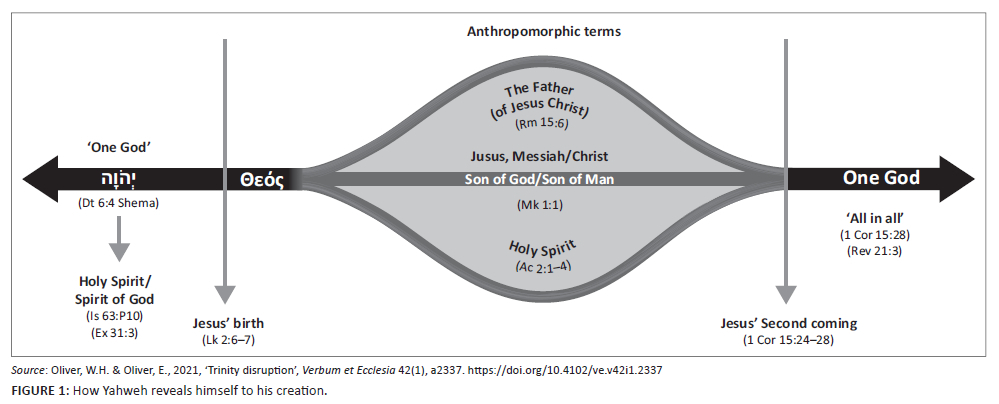
The term 'Holy Trinity', not known to the writers of the Bible, is still an elusive term to use nowadays, especially when one first reads the New Testament in light of the Old Testament and not immediately in light of the Creeds and Statements of Faith. This article discusses the roles of Θεός (God) and 'Father' in the New Testament with reference to the Holy Trinity. The conclusion is that the New Testament does not depict a Holy Trinity, but rather portrays Θεός as a coordinator, bringing a harmony between his anthropomorphic assignments 'Father', 'Son' and 'Holy Spirit', as well as all the followers of Θεός on Earth. INTRADISCIPLINARY AND/OR INTERDISCIPLINARY IMPLICATIONS: On the first level, this article covers the disciplines of Old Testament, New Testament (NT) and Practical Theology. On the second level, it makes use of philosophy and logics to help determine the 'truths' in the Bible. Who is Θεός? We propose that the NT depicts him as coordinator of his three revelations, 'Father', 'Son' and 'Holy Spirit'. Using anthropomorphic terms, Θεός reveals himself to his followers on Earth. The Bible is used as the main source, with references to the three Creeds and four Statements of Faith.
God; Yahweh; Father; Holy Trinity; Jesus; Holy Spirit; Bible
 Thumbnail